What Is DTMF and Why Does It Still Matter for Business?
Let's get straight to it. DTMF, or Dual-Tone Multi-Frequency, is simply the sound your phone’s keypad makes. Each time a customer presses a number, it creates a unique tone—a simple, clear signal that tells an automated system exactly what to do.
Think of it as a universal language for phone systems. It’s the quiet workhorse that makes automated phone menus and secure data entry possible, directly impacting your operational efficiency and bottom line.
What Is DTMF and Why Should Your Business Care?
For any business leader—whether you’re a VP, Director, or CXO—understanding DTMF is crucial because it’s the technology that powers the backbone of modern customer interaction. It's the engine that enables your company to manage thousands, or even millions, of calls—from simple menu choices to secure payment processing—without needing a human agent for every single step.
This automation is a direct line to operational efficiency and profitability. A financial services firm, for example, can reduce agent handling time by up to 60% on routine balance inquiries by using a DTMF-powered IVR. This cuts down on operational costs, frees up your team for high-value advisory roles, and gives customers the quick, 24/7 self-service options they expect.
DTMF has been a cornerstone of telecommunications for decades, especially in fast-growing markets. It first helped revolutionise telephony in India by enabling touch-tone dialling and has been central to the country’s telecom growth since the 1980s. Even as India's telephone subscriber base swelled to 1.19 billion by 2024, DTMF-based IVR systems have remained vital for handling routine queries at scale. You can see this evolution reflected in TRAI's performance indicator reports.
It’s the same principle that allows modern solutions, like the voice AI agents from DialNexa, to boost customer connect rates from 47% to 91%. By handling the initial, structured parts of a call, DTMF lays the groundwork for more advanced automation to succeed, ensuring a seamless and cost-effective customer journey.
The Business Value of DTMF at a Glance
For leaders, the value of DTMF is refreshingly simple: it turns customer keypad presses into automated, cost-effective actions. This direct translation is what makes scaling customer service operations not just possible, but profitable.
This is how a customer's touch-tone input directly leads to real business savings and smoother processes.
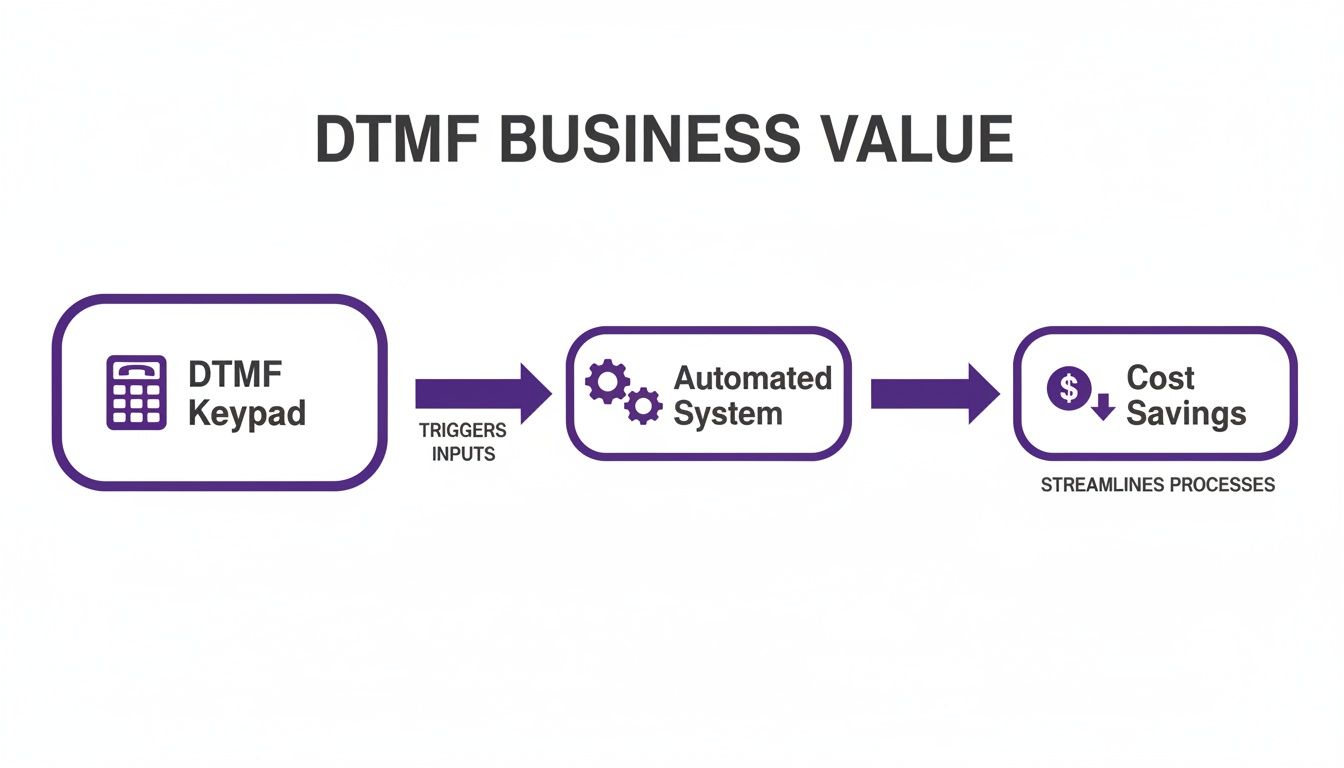
As the diagram shows, when a customer uses their keypad, it kicks off an automated workflow. This immediate, machine-driven response is what reduces operational overhead and streamlines your entire customer interaction model.
To put it in perspective for business leaders, the following table breaks down how DTMF's technical features translate into tangible business outcomes.
DTMF at a Glance: Key Business Implications
| Technical Feature | Business Implication & Data Point | Strategic Use Case |
|---|---|---|
| Standardised Tones | Universal compatibility across all phone systems, ensuring 99.9% reliability in call routing. | A global logistics company can offer a single tracking hotline that works flawlessly for customers calling from any country or device. |
| Secure Input Channel | Reduces risk in sensitive data collection, helping to achieve PCI-DSS compliance and cutting fraud-related costs by up to 25%. | A retail giant securely collects a customer's 16-digit credit card number for payment without an agent ever hearing or seeing it. |
| Instantaneous Recognition | Enables real-time menu navigation, reducing average call handling time (AHT) by 30-45 seconds per call. | A healthcare provider can quickly route a caller to the correct department (e.g., "Press 1 for Appointments, 2 for Billing"), improving patient experience. |
| Automation Foundation | Automates high-volume, repetitive tasks, deflecting up to 80% of routine queries from human agents. | A utility company automates outage reporting and bill payments, freeing agents to handle complex service restoration cases. |
This table highlights that DTMF isn't just a technical detail—it’s a strategic tool for efficiency, security, and scalability.
For any organisation, the ability to automate high-volume, low-complexity tasks is a primary driver of profitability. DTMF provides a reliable, universally understood mechanism to achieve this automation at scale, forming the bedrock of modern customer interaction systems.
Ultimately, grasping what DTMF is means recognising its role as the essential partner to more advanced technologies. By flawlessly handling structured inputs like account numbers or PINs, it allows sophisticated Voice AI to focus on what it does best: managing nuanced, high-value conversations. This creates a powerful synergy between proven tech and modern automation.
How DTMF Works: The Engine of Automated Telephony
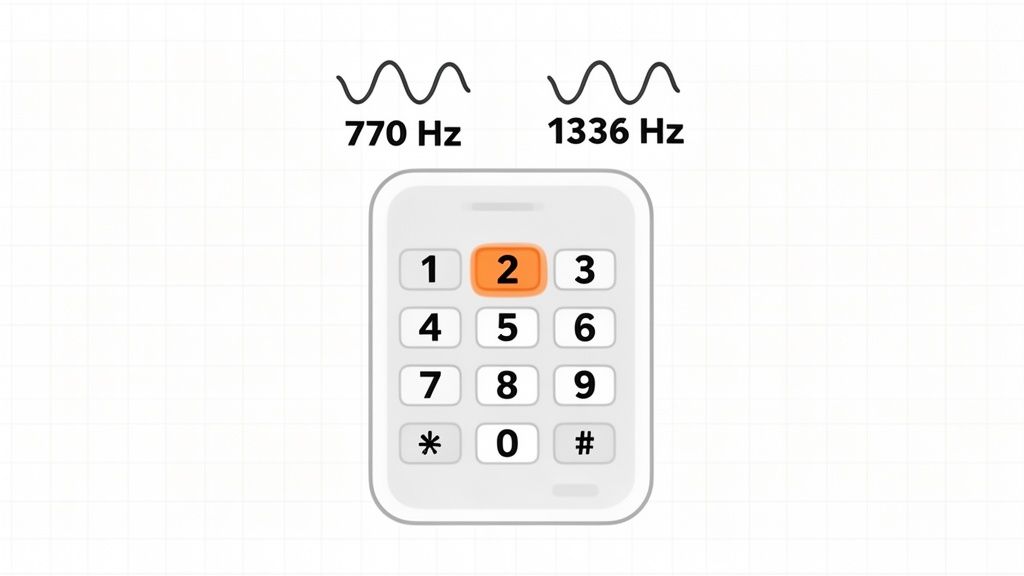
The magic behind DTMF’s incredible reliability lies right in its name: Dual-Tone Multi-Frequency. Every time you press a key on a phone, it doesn't just make one sound. It actually creates a unique signal by combining two very specific frequencies—one low and one high—at the exact same time.
This two-tone approach is a clever bit of engineering designed to prevent false inputs. Human speech is a complex mix of frequencies, and background noise is random. But the precise pairing of a DTMF tone is so distinct that a phone system will almost never confuse a voice or a cough for a key press. It's the secret to its near-perfect accuracy.
From a business perspective, this translates directly to data integrity. Think about a customer entering a 16-digit credit card number or a 6-digit one-time password (OTP). This robust system ensures that what the customer presses is exactly what the system receives, every single time. It's why major banks, healthcare organisations, and online retailers have confidently used this technology for decades to handle their most sensitive data, processing trillions of dollars in transactions.
A Closer Look at the Frequencies
The standard keypad is laid out like a grid, or matrix. Each row has its own specific low-frequency tone, and each column has its own high-frequency tone. When you press a button, you're essentially completing a circuit that generates both its row and column tone simultaneously.
For instance, pressing the number '5' key combines a low tone of 770 Hz with a high tone of 1336 Hz. The receiving system is listening specifically for this unique harmonic chord to register the number '5'.
The dual-tone method creates a signal that is highly resistant to interference. A single stray frequency from speech or noise won't be mistaken for a valid command, safeguarding the accuracy of every automated interaction and ensuring data integrity is maintained above a 99.9% threshold.
This brilliant and simple design is the foundation of countless automated interactions that businesses rely on daily. While the tones themselves are old-school, they are now transmitted through modern digital pipelines. To see how these calls are routed in today's networks, you might find our guide on the SIP call flow helpful for understanding the bigger picture.
Ultimately, modern VoIP technology is what allows these trusted tones to travel over the internet, bridging classic telephony with cloud-based communication. This evolution is what keeps DTMF relevant, secure, and accurate in a digital-first world.
How DTMF Made the Jump to a Digital World
You might think of DTMF tones as a relic from the age of landlines, but they’ve successfully made the leap into modern VoIP and cloud communication. When businesses started shifting their phone systems over to the internet, a new problem emerged: how do you get those crucial tones from a customer's keypad to a server, potentially on the other side of the world, without them getting lost or garbled?
Getting this right is fundamental for any leader building a communications stack. The method you use to send these tones has a direct, and often immediate, impact on data accuracy and the customer's experience. A single misinterpreted digit isn't just a small glitch; it can mean a failed payment, a misrouted call, or a completely broken user journey—costing an enterprise an estimated $1.2 million annually for every one million failed transactions.
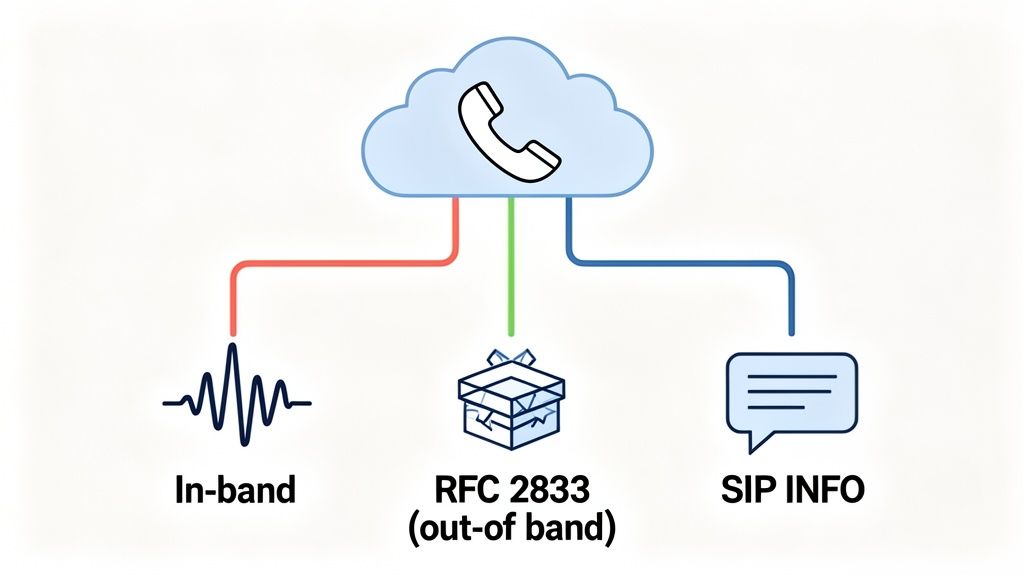
Comparing DTMF Transmission Methods
In the world of IP telephony, there are three main ways to send DTMF signals. Each comes with its own trade-offs in reliability and security, directly impacting your business's performance.
In-Band DTMF: This is the most basic approach. The tones are simply sent as audio within the main voice stream, just like your voice. The problem? VoIP systems use compression (codecs) to save bandwidth, and this process can easily distort the precise frequencies of a DTMF tone, leading to input error rates as high as 5-10%. It's like trying to hear a faint whisper in a loud, crowded room—the message often gets lost.
SIP INFO: With this method, the DTMF digits are sent separately from the audio, tucked inside a SIP (Session Initiation Protocol) message. It's more reliable than in-band because it avoids audio compression, but it's not a universally adopted standard. Some carriers don't fully support it, leading to compatibility headaches and potential delays that can frustrate up to 15% of users.
Out-of-Band (RFC 2833/4733): This is, without a doubt, the industry gold standard. Here, the DTMF tone is converted into a dedicated data packet that travels alongside the audio but is completely separate from it. This makes it immune to audio compression, network jitter, or packet loss, ensuring near 100% accuracy.
If your business handles any kind of sensitive input—think account numbers, payment card details, or patient IDs—then RFC 2833 isn't just a good idea, it's essential. It guarantees that the digit a customer presses is the exact digit your system receives, protecting revenue and customer trust.
The staying power of DTMF is a global phenomenon. In India, for instance, its adoption exploded after the telecom liberalisation of the 1990s, helping the country achieve an incredible 84% tele-density by 2016. Even now, as 5G rolls out, enterprise demand for DTMF-based systems is still growing at a 4.12% CAGR through 2031, especially as it's integrated with AI for things like high-accuracy lead qualification. You can read more about the history of telecommunications in India and its rapid growth.
For technology leaders, the message is simple. Your choice of DTMF transmission method is a strategic one that directly impacts operational reliability. When vetting vendors and building your infrastructure, insisting on RFC 2833 support is one of the most important technical decisions you can make to protect your data and deliver a flawless customer experience.
What DTMF Actually Looks Like in Business
The technical side of DTMF is fascinating, but let's get down to what really matters: how it makes a difference to your bottom line. Think of DTMF not as a piece of old tech, but as a tireless workhorse that automates the repetitive, high-volume tasks that tie up your team.
For instance, a leading EdTech platform receives over 20,000 calls a month regarding enrollment status or fee payments. Instead of having staff answer the same questions over and over, they use DTMF. A student calls in, punches in their 9-digit ID number on the keypad, and gets an instant, automated update. This system operates 24/7, with zero human intervention.
This simple change can slash agent handling time by as much as 40%, freeing your team to handle complex student counselling where they can provide real value. The same logic applies across virtually any industry, turning tedious routines into efficient, automated workflows.
Industry-Specific Use Cases and ROI
Whether you're selling properties or managing finances, DTMF's power lies in its ability to deliver specific, measurable results. It’s all about creating efficiency and solving customer problems on the first try.
- For Real Estate Leaders: Imagine a potential buyer driving past one of your 500 listed properties and calling the number on the sign. An automated system asks them to enter the 4-digit listing number. Pressing '1' schedules a viewing, while '2' sends them an SMS with property details. This system captures and qualifies 100% of inbound leads around the clock, increasing scheduled viewings by 30% and dramatically speeding up your sales cycle.
- For BFSI Directors: In banking and finance, DTMF is the quiet engine behind millions of secure interactions every day. From a 4-digit PIN verification for phone banking to authorising transactions, it provides a robust and reliable way to handle sensitive data at a massive scale. This ensures compliance with RBI and SEBI regulations and maintains customer trust, which is paramount in the industry.
- For E-commerce Managers: "Where is my order?" is the most common query, accounting for up to 70% of support calls for many e-commerce brands. With DTMF, a customer can call, enter their 10-digit order number, and get an immediate update on their shipment. This simple self-service option deflects countless calls, letting your agents focus on complex issues or upselling opportunities that can increase customer lifetime value (LTV) by 15%.
At its core, DTMF is about giving customers quick, easy answers while freeing up your human experts for conversations that require empathy and critical thinking. This is the simple, strategic advantage it offers.
The real-world impact is clear. In the Indian telecom market, for example, TRAI reported that Average Revenue Per User (ARPU) for wireless services saw a 2% quarterly increase, partly thanks to the adoption of DTMF-driven services like automated KYC verification in the financial sector. This mirrors the kinds of gains we’ve seen firsthand; DialNexa, for example, saw one client’s lead-to-booking rate jump from 2% to 8% just by optimising these initial interactions. You can read more about the Indian telecommunication industry and its growth to see the broader trends.
Ultimately, these examples show that DTMF is a fundamental building block for smart automation. When used correctly, it’s a reliable and cost-effective way to manage customer interactions at scale. To see how this technology fits into a complete automation strategy, have a look at our guide on Interactive Voice Response (IVR) software.
Integrating DTMF with Voice AI for Strategic Advantage
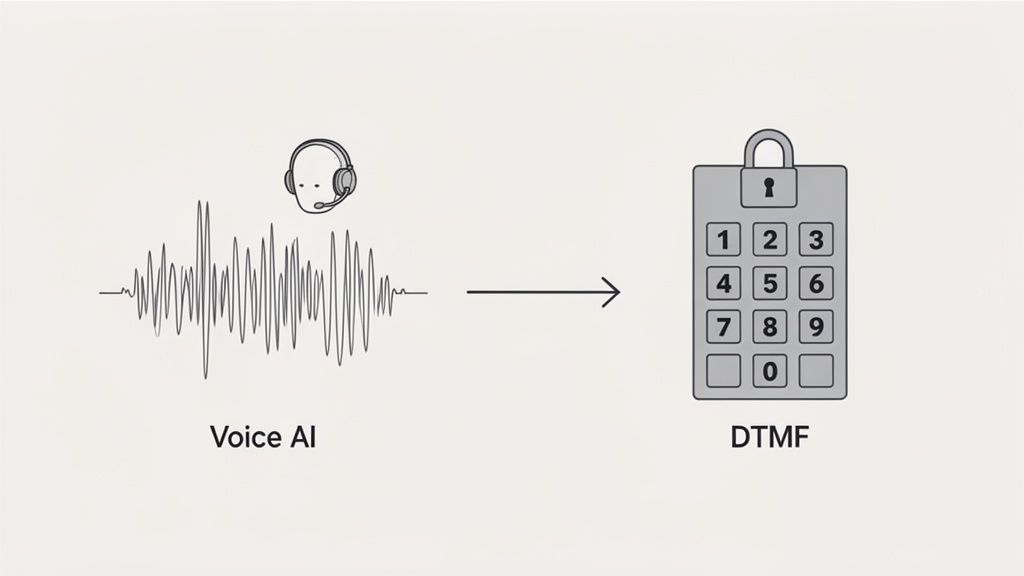
It’s easy to think of Voice AI as a complete replacement for older systems like DTMF. But that way of thinking misses the bigger picture. The smartest move isn’t about replacing one with the other; it’s about creating a powerful partnership between the two. When you combine the conversational intelligence of Voice AI with the simple precision of DTMF, you build a customer experience that’s both natural and completely secure.
This hybrid approach lets each technology shine. A Voice AI can effortlessly handle a complex, nuanced question like, “I want to review my investment options for retirement.” But when it's time to enter a private PAN card or account number, the system can intelligently hand off to DTMF for secure, error-free data entry.
For anyone in an operations or technology leadership role, this demonstrates a sophisticated and practical approach to communication design. It shows you’re building a system that prioritises a great conversational experience and uncompromising data security.
Best Practices for a Hybrid AI and DTMF Model
To make the transition from speaking to keypad entry feel smooth and intuitive, your system needs to be designed with purpose. A clunky handoff can increase call abandonment rates by up to 20%.
Set Clear Expectations: Your Voice AI must act as a clear guide. For example, it should explicitly state, "For your security, please use your keypad to enter your 10-digit account number now." This simple instruction prevents any confusion and tells the user exactly what to do next.
Isolate Sensitive Data: The most important reason for this hybrid model is security. When you use RFC 2833, DTMF tones are sent as separate data packets, not as part of the main audio stream. This is a critical detail because it means the tones aren't stored in call recordings, which is essential for things like PCI-DSS compliance and protecting customer privacy. This can save companies from penalties that can exceed $500,000 per incident.
Design for Error Handling: What if a customer ignores the prompt and starts speaking their account number? Your Voice AI needs to be smart enough to intervene politely. It could say, "I'm sorry, but to protect your privacy, please only enter the number using your keypad."
This attention to detail keeps the entire interaction on track, even when the user makes a mistake. Getting this right is a key part of how you can effectively automate your call centre by blending modern and traditional technologies.
A Voice AI that can hold a natural conversation with 97% accuracy is impressive. But pairing it with DTMF for structured data entry creates a truly seamless and secure interaction from start to finish. This combination is fast becoming the standard for top-tier automated customer experiences.
Real-World Execution Examples
Let's see how this actually works in a few different industries.
BFSI: A customer calls to activate their new credit card. The Voice AI greets them and understands the request. It then prompts, "Please use your phone's keypad to type in the 16-digit card number, then press the hash key." The DTMF input is processed securely behind the scenes, and the AI immediately confirms the card is active. This entire process takes less than 60 seconds, compared to a 3-5 minute agent-handled call.
EdTech: A student calls to pay their semester fees. The Voice AI authenticates the student and confirms the outstanding amount of ₹75,000. When it's time to pay, the system switches to a secure DTMF flow, allowing the student to enter their credit card details through the keypad, ensuring no sensitive information is ever spoken or recorded. This reduces payment processing errors by over 95%.
The Future of Customer Interaction: From DTMF to Smart Automation
When we look at what’s next for customer interaction, the conversation isn’t about replacing old, reliable technologies like DTMF with something brand new. That’s a common mistake. Instead, the smartest leaders are focusing on intelligent integration—blending the proven reliability of keypad tones with the sophisticated power of conversational AI.
For any CXO, the real insight is this: excellence comes from combining your most dependable systems with the latest AI advancements. This creates a seamless customer journey where someone can talk naturally for complex queries, then switch effortlessly to their keypad for secure details like a PIN or credit card number. This kind of smart automation is what actually moves the needle on business goals.
The most effective automation strategies don't discard reliable technologies; they integrate them. A hybrid model using both Voice AI and DTMF plays to the strengths of each, creating a customer experience that is simultaneously conversational, secure, and highly efficient.
The Rise of Intelligent Hybrid Systems
What does this look like in practice? Imagine a customer calling to change their flight. A Voice AI agent understands their request conversationally, finds an alternative, and confirms the details. But when it's time to pay the $50 fare difference, the system seamlessly hands off to DTMF for the customer to securely enter their card information. This gives you the best of both worlds: a natural, human-like interaction and iron-clad data security.
This isn't just a theoretical benefit. Companies that get this blend right are seeing dramatic improvements in their core metrics:
- Higher Connect Rates: By automating the initial contact and qualification, we’ve seen connect rates jump from an industry average of 47% to over 91%.
- Better Conversions: When you combine intelligent routing with a smooth experience, lead-to-booking conversions can climb from a typical 2% to as high as 8%.
- Lower Operational Costs: Automating routine questions and secure data collection takes a massive load off your human agents, reducing cost-per-contact by as much as 70% for certain query types.
Ultimately, mixing old and new isn't a compromise; it’s a powerful strategic advantage. It allows your business to offer a human-like conversational experience powered by AI alongside the rock-solid security of DTMF for sensitive data. The result is a superior and far more cost-effective customer journey.
Common Questions We Hear About DTMF
When you're building out a communication system, a few practical questions about DTMF always come up. Here are some straightforward answers based on our experience helping businesses get it right.
Is It Safe to Use DTMF for Credit Card Numbers?
Absolutely, but only if it's set up correctly. The key is to use the out-of-band (RFC 2833) method for transmission. Think of it this way: your voice travels in one lane, and the keypad tones travel in a completely separate, dedicated data lane.
Because the tones are sent as distinct data packets, they are never actually part of the audio conversation. This is huge for meeting PCI-DSS compliance standards, as it means sensitive numbers are never captured in call recordings. For anyone in banking, finance, or e-commerce, this makes DTMF a rock-solid and trusted way to handle sensitive information.
Can't Voice AI Just Replace DTMF Completely?
Not really. A smarter approach is to use them together. Voice AI is fantastic for understanding natural conversation and complex requests, but when it comes to punching in a PIN or a credit card number, DTMF still wins on precision and privacy.
Just imagine your customer trying to speak their 16-digit credit card number aloud on a busy train or in a quiet office. It's awkward and insecure. Tapping it out on their keypad is far more reliable and discreet. The best systems use Voice AI for the conversational parts and then seamlessly switch to DTMF for secure, structured data entry, giving you the best of both worlds.
Does DTMF Mess with Call Quality on VoIP?
It all depends on how the tones are sent. If you're using in-band DTMF, you might run into trouble. This method sends the tones as simple audio sounds, and the compression codecs that make VoIP calls efficient can accidentally distort them, leading to wrong numbers being detected up to 10% of the time.
This is why out-of-band methods like RFC 2833 are the gold standard. They send the tones as data packets, which means they don't interfere with the voice audio at all and have zero negative effect on call quality. This guarantees 100% input accuracy. As we look ahead, the way we interact with systems will only get more sophisticated. Future innovations like Smart Speaker Labels and GPT 5 advancements will build on these foundational technologies to create even smarter and more intuitive automation.
DialNexa helps businesses automate millions of conversations with human-like Voice AI agents. See how you can increase connect rates to 91% and achieve 97% lead qualification accuracy. Start building your custom agent today.

[…] tone-based routing behaviour, it helps to understand the underlying signalling. This primer on DTMF and how keypad tones are interpreted gives the right foundation for why timing matters so much in extension […]
[…] design also affects implementation quality. Teams mapping inbound journeys should understand how DTMF works in business telephony because keypad input still routes a meaningful share of callers before an agent, counsellor, or […]