
A Leader’s Guide to Strategic Contact Center Outsourcing
When a company outsources its contact centre, it’s handing over the reins of its customer service and support to a dedicated third-party expert. But let’s be clear: this is much more than a simple cost-cutting trick. For senior leaders, it’s a strategic lever for growth, giving businesses the power to scale up, tap into specialised talent, and pour their energy into core innovation while the experts handle customer interactions.
Why Leaders Are Turning to Contact Centre Outsourcing
For today’s senior executives, outsourcing a contact centre isn’t about offloading a problem; it’s about seizing a competitive advantage. It's a calculated move that directly fuels market expansion, builds operational agility, and ultimately, boosts the bottom line. This mindset transforms customer support from a necessary cost centre into a powerful engine for strategic growth.
Imagine a fast-growing SaaS company with its sights set on global expansion. The thought of building an in-house team to deliver 24/7 technical support is a strategic nightmare. It means a massive investment in hiring, training, and infrastructure, diverting capital and focus from product development. By outsourcing, the CEO can partner with a specialist practically overnight, providing round-the-clock support and freeing up their best engineers to do what they do best: build an exceptional product that dominates the market.
Unlocking Strategic Value Beyond Cost Savings
While the financial argument is often the starting point, the real strategic value emerges when outsourcing aligns with core business objectives. Smart leaders see it as a way to hit ambitious goals that would be a logistical and financial nightmare to manage internally.
-
Rapid Scalability: Consider an e-commerce brand gearing up for a major holiday sale. Instead of scrambling to hire and train temporary staff—a process that drains HR and operational resources—they can instantly scale their support team through a partner to handle the flood of customer queries, ensuring a seamless customer experience and maximising revenue.
-
Access to Specialised Skills: A financial services firm entering a new market can partner with a provider steeped in local regulatory compliance and complex financial products. This guarantees customers receive accurate, high-quality support every single time, mitigating significant compliance risks from day one.
-
Focus on Core Competencies: When a COO offloads the complex management of customer service, internal leadership teams are free to concentrate on innovation, product development, and market strategy—the very activities that drive long-term growth and shareholder value.
The old idea of outsourcing as just a cost-saving tactic is completely outdated. Today, it’s an executive-level decision aimed at building resilience, elevating the customer experience, and hitting fast-forward on a company's strategic roadmap.
This shift in thinking is mirrored in the market's explosive growth. The Indian BPO services market, for example, pulled in $44 billion in revenue during FY22, growing by more than 14%. It's projected to hit a valuation of around $139.35 billion by 2033, a testament to the immense strategic and financial power businesses are tapping into. You can discover more insights about India's evolving call centre industry and how it’s shaking up CX.
Consider this playbook your C-suite guide to making a smart, high-impact decision.
Choosing the Right Outsourcing Model for Your Business
Picking an outsourcing partner for your contact centre is a major strategic decision, and it goes much deeper than just looking at a map. The right model isn't just about where your agents sit; it’s about finding a perfect match for your brand’s personality, your customers’ expectations, and your long-term financial goals. Get this right, and you're well on your way to achieving the kind of growth and operational flexibility you’re aiming for.
Often, the decision to outsource is the first real step on the path to strategic expansion. This flowchart neatly captures that pivotal moment leaders face when they take a hard look at their customer service operations.
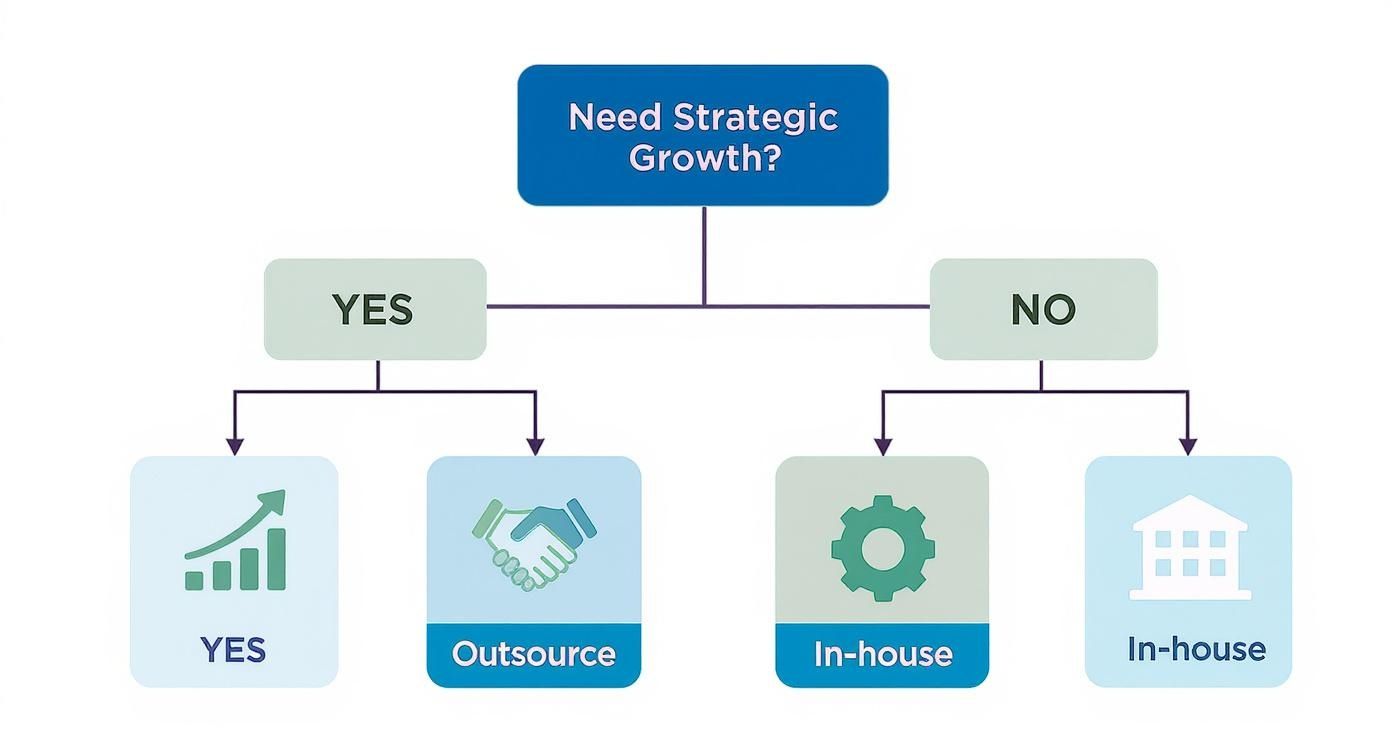
As you can see, when growth is the main driver, outsourcing opens up a powerful path forward. It’s a different conversation than just managing day-to-day internal tasks. Each outsourcing model brings its own unique mix of benefits and trade-offs, designed for different business priorities.
The Onshore Model: Proximity and Cultural Alignment
Onshore outsourcing is simple: you partner with a provider located in your own country. Yes, it's typically the most expensive route, but for certain business cases, the benefits in cultural and linguistic alignment are second to none. You’re not wrestling with time zones or tripping over language barriers, which is absolutely critical if your team handles sensitive or complex customer problems.
A practical example? Think of a premier Indian wealth management firm. They're dealing with high-net-worth clients and intricate financial regulations. For them, an onshore partner is a non-negotiable strategic choice. The nuanced, culturally-savvy conversations needed to maintain client trust and navigate complex compliance simply demand local expertise.
The Nearshore Model: A Balance of Cost and Quality
Nearshoring means outsourcing to a neighbouring country or one in a very similar time zone. This model really hits the sweet spot for many executives, balancing significant cost savings with strong cultural familiarity. You often tap into a highly skilled, multilingual talent pool at a much better price than you’d find at home, and without the headaches of major travel or communication gaps.
For instance, a European luxury e-commerce brand might choose a nearshore partner in a country like Poland. This move gives them instant access to agents who can support multiple European languages, understand the high expectations of their affluent customers, and deliver a seamless, premium experience across the continent—all at a more favourable price point.
The Offshore Model: Maximising Cost Efficiency and Scale
When you hear offshore, think of partnering with a provider in a more distant country, often in a region like Southeast Asia. This is the model that delivers the biggest bang for your buck in terms of cost savings. It also unlocks access to a massive talent pool, making it perfect for companies that need 24/7 support and the ability to scale up quickly for global operations.
Picture this: A US-based software company with users all over the world could leverage an offshore partner in the Philippines for round-the-clock technical support. This means a customer in Australia gets the same fast, expert help at 2 PM their time as a user in New York does, all while keeping operational costs firmly in check and ensuring global service continuity.
To help you weigh these options from a leadership perspective, here's a quick comparison of the three primary models. Each has its place, and the "best" one really depends on your strategic business objectives.
A Strategic Comparison of Outsourcing Models
| Model | Cost Structure | Key Advantage | Ideal Use Case Example |
|---|---|---|---|
| Onshore | Highest | Cultural/Linguistic Alignment | High-value, complex interactions (e.g., premier financial services in India) |
| Nearshore | Moderate | Balanced Cost & Quality | Multilingual regional support (e.g., European e-commerce) |
| Offshore | Lowest | Scalability & 24/7 Coverage | High-volume, global support (e.g., worldwide SaaS tech support) |
Ultimately, choosing an outsourcing model is a direct reflection of your company's priorities. It’s a strategic calculation where you weigh cost efficiency against the value of cultural proximity and specialised expertise to find the perfect fit for your customer base and growth strategy.
The Hybrid Model: The Best of Both Worlds
Why stick to just one model? A hybrid approach lets you mix and match to build a custom solution. This is a more sophisticated strategy where a COO can optimise for both cost and quality by routing different tasks to the most suitable location.
Routine, high-volume questions? Let an offshore team handle those cost-effectively. Complex, high-value conversations requiring deep domain knowledge? Keep them with a specialised onshore or nearshore team. This flexibility allows you to capture major cost savings on standard support without ever compromising the quality of service for your most important customers. It's a framework for building a global customer service operation that's perfectly tailored to your business.
Weighing the Strategic Benefits and Risks
Every significant business decision is a trade-off, and outsourcing your contact centre is a classic example. For any senior leader, this isn't just about handing off tasks. It's a strategic move that requires a careful balancing act between significant rewards and very real risks. You need to go in with your eyes wide open, assessing both sides of the coin to make a decision that strengthens your operations and protects the brand you’ve built.
Most conversations about outsourcing start with cost savings, but the true strategic value is found far beyond the budget sheet. When you partner with a specialist provider, you're not just hiring agents; you're gaining instant access to a deep pool of talent and technology that would otherwise take years and a massive capital investment to build in-house. This immediately gives you a new level of agility, letting your business pivot and respond to market shifts on a dime.
The Upside: Strategic Advantages of Outsourcing
Look past the obvious cost-cutting, and you'll see that a smart outsourcing strategy can fundamentally change how your company grows and connects with customers.
- Access to Specialised Talent: Instead of trying to become an expert in everything, you tap into a team that already lives and breathes your industry. For a healthcare tech firm, this means partnering with a provider whose agents are already versed in HIPAA compliance and can handle sensitive patient queries with the required empathy and professionalism from day one.
- Rapid Scalability for Market Demands: Think about an EdTech company swamped during admissions season. An outsourcing partner lets them instantly scale up their support team to handle thousands of enquiries, all without the immense headache and cost of hiring and training a temporary army of staff. This kind of elasticity ensures a smooth customer experience and prevents lost revenue during peak periods.
- Enhanced Operational Agility: By outsourcing support, you free up your internal teams to focus on what they do best—building great products and defining market strategy. This sharpens your competitive edge because your brightest, most expensive talent is locked on innovation, not support logistics.
For many leaders, the ability to scale on demand is the real game-changer. It turns customer support from a rigid, fixed cost into a flexible, variable resource that breathes with the rhythm of your business.
A great outsourcing partnership isn't about offloading a department; it’s about plugging into a high-performance engine. It gives you the specialised skills and scalable power you need to deliver fantastic customer experiences, without pulling focus from your core mission.
Navigating the Potential Risks and Pitfalls
Of course, letting another company handle a critical, customer-facing function brings its own set of challenges that you need to manage from the get-go. As a leader, your biggest concerns are rightly centred on maintaining control of your brand's voice and ensuring customer data stays secure. Getting this wrong can cause serious, long-term damage to your reputation and your bottom line.
A major worry is losing your distinct brand voice. Your brand is built on a specific tone, culture, and a set of values that your customers know and trust. Ensuring an external team can live and breathe that identity day-in and day-out takes a serious, ongoing commitment to training and quality control. Without it, you risk creating a disconnected, generic experience that can alienate even your most loyal customers.
Then there's the critical issue of data security. In a world full of strict privacy laws like GDPR and CCPA, the buck still stops with you when it comes to protecting customer information, even if a third party is handling it.
- Maintaining Brand Integrity: Your partner can't just be a vendor; they have to become a genuine extension of your team, fully immersed in your company culture. This goes way beyond a simple script—it requires constant alignment, shared KPIs, and truly shared goals.
- Ensuring Data Security and Compliance: Take a healthcare provider, for example. They need a partner who is not only HIPAA compliant but also deeply skilled in empathetic communication. You can't compromise on security protocols or the human side of care when the stakes are this high.
- Avoiding a Dip in Customer Satisfaction: A bumpy transition or a partner who simply isn't up to snuff can cause your CSAT and NPS scores to take a nosedive. This is where proactive monitoring, transparent reporting, and crystal-clear Service Level Agreements (SLAs) become non-negotiable.
Ultimately, successful outsourcing is all about proactive risk management. If you can anticipate these challenges and build a solid framework to tackle them from the very beginning, you can tap into the massive benefits while keeping your brand and your customers safe. It turns a leap of faith into a calculated, strategic win.
How AI Is Reshaping Outsourcing Quality
Let's be honest, the old view of outsourcing often brought to mind low-cost solutions that came with a trade-off in quality. That picture is completely out of date. Today’s best outsourcing partners are genuine innovation hubs, investing heavily in top-tier agent training, rigorous quality assurance, and insightful analytics to provide a truly exceptional service.
Now, that evolution is hitting lightspeed thanks to Artificial Intelligence. AI is much more than a buzzword; it's a practical tool that’s completely rewriting the rulebook for customer support quality and efficiency. When you blend AI with a skilled human team, you get a hybrid model that makes every single customer interaction smarter, faster, and more effective.

The Human-AI Hybrid Model in Action
Picture a financial services firm working with an outsourced contact centre. An AI voice agent, like one from DialNexa, fields the call first. It can instantly run through KYC verification, check for fraud alerts, or answer simple questions about an account balance—all with flawless accuracy and complete compliance, 24/7.
This simple step frees up the highly trained human agents to do what people do best: tackle complex investment questions, offer empathetic financial advice, and build real relationships with high-value customers. The AI hands off the call to the human agent with all the context, so the customer never has to repeat themselves. It’s this smart division of labour that proves modern outsourcing is about adding strategic value, not just trimming budgets.
This powerful partnership between people and AI delivers real, measurable improvements across the board, boosting both operational efficiency and customer satisfaction.
AI-Powered Quality and Performance
One of the biggest game-changers AI brings is to quality assurance (QA). The old way involved managers randomly listening to a tiny fraction of calls—maybe 1-2% of all interactions. It was slow, costly, and every executive knew that critical customer insights were slipping through the cracks.
AI flips this entire process on its head. Modern AI tools can analyse 100% of customer interactions, from phone calls to chats and emails. This gives leadership a complete, unvarnished view of agent performance and what your customers are really feeling.
- Sentiment Analysis: AI can detect frustration, delight, or confusion in a customer's tone, giving supervisors real-time alerts to intervene and save a potentially negative experience.
- Compliance Monitoring: In tightly regulated industries like finance or healthcare, AI automatically flags any conversation that might breach compliance rules, dramatically reducing risk. You can learn more about how data and AI will transform contact centres for financial services in our detailed guide.
- Personalised Coaching: Instead of generic feedback, AI pinpoints exactly where an agent is struggling—for example, with upselling or handling objections—and helps create targeted coaching plans for real, data-driven improvement.
This leap from random spot-checks to total analysis means quality is no longer a guessing game. It becomes a predictable, measurable, and constantly improving part of your operation, giving you unprecedented insight into the experience your outsourced team delivers.
Giving Agents Superpowers and Boosting CX
AI doesn't just watch over agents; it actively helps them. By augmenting their skills in real-time, AI essentially creates "super agents" who are far more effective and efficient, directly impacting your bottom line.
Think about an e-commerce agent handling a complex product return. As they speak to the customer, an AI assistant is already working in the background. It pulls up the customer’s entire order history, summarises past conversations, and suggests the perfect resolution based on company policy and that customer’s lifetime value. All this information appears on a single screen, helping the agent solve the problem faster and more accurately.
The results are staggering. Top-performing Indian outsourced call centres, for instance, are now hitting customer satisfaction (CSAT) scores of 85-90%, right up there with the best in-house teams. The introduction of AI has pushed these numbers even higher, with studies showing AI-assisted agents achieve a 12% higher first-contact resolution rate than their unassisted colleagues.
Ultimately, AI is making contact centre outsourcing a much smarter, more strategic choice. It turns the traditional cost-cutting model on its head and transforms it into a powerful engine for delivering superior customer experiences that build loyalty and drive real business growth.
Selecting the Right Outsourcing Partner
Choosing a partner for your contact centre is the most critical decision you'll make in this entire journey. Get it right, and they become a seamless extension of your brand, driving customer loyalty and growth. Get it wrong, and you're in for a world of operational headaches, brand damage, and a tarnished reputation. This isn't a choice you can make by simply comparing price sheets.
What you're really looking for is a strategic partner who gets your business, inside and out. That means digging for deep industry specialisation. A generic, one-size-fits-all provider just won’t do the job. For example, a real estate firm doesn't just need people to answer phones; it needs a team that understands lead qualification, can speak knowledgably about different property types, and knows how to nurture a potential buyer through their decision-making journey.
Beyond the Pitch Deck: What Truly Matters
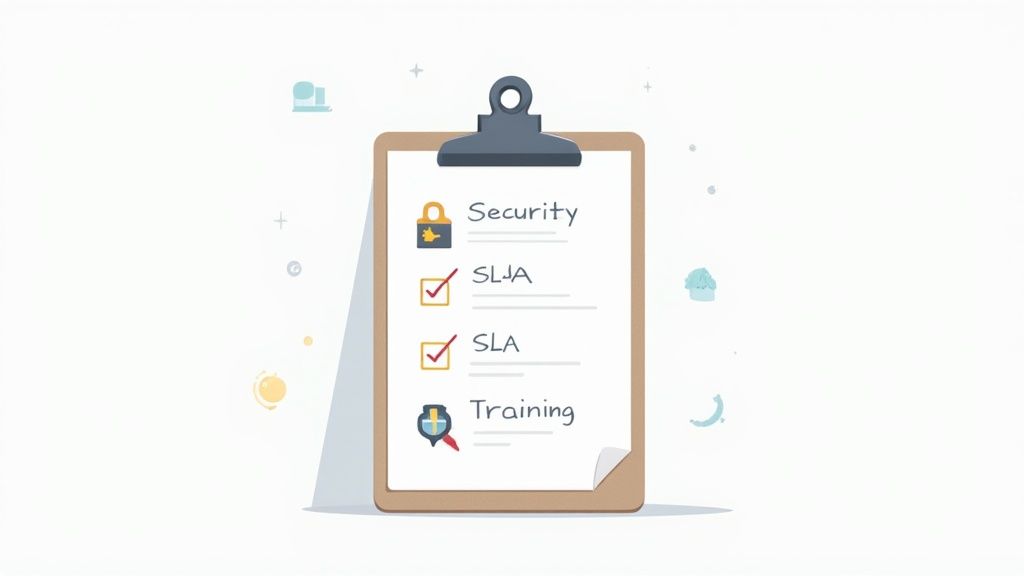
When you start vetting potential partners, you need a solid checklist to cut through the marketing fluff and get to what really counts. These are the non-negotiables for any executive.
-
Robust Security and Compliance Certifications: Your customer data is your responsibility, full stop. A potential partner must prove an unshakable commitment to security. Look for key certifications like ISO 27001 for information security and confirm they are fully compliant with regulations vital to your industry, like GDPR in Europe or HIPAA for healthcare data.
-
Proven Industry Expertise: Don't just take their word for it. Demand case studies and speak with references from companies in your field. If you’re a SaaS company, your partner needs to be fluent in technical support, tiered escalations, and customer onboarding. Their experience should be a direct mirror of your day-to-day operational needs.
-
Technological Alignment: Their tech stack has to integrate seamlessly with yours. This includes their CRM, communication platforms, and reporting tools. A disconnected technology ecosystem is a guaranteed recipe for inefficiency and a fragmented customer experience. You should also assess if their technology is forward-thinking. To get a sense of what's possible, you can read more about how PolyAI optimises conversational AI for contact centres and understand the kind of tech shaping the industry's future.
Deconstructing the Service Level Agreement
The Service Level Agreement (SLA) isn't just a contract; it's the very blueprint for your partnership. A vague or weak SLA leaves you completely exposed to risk. Your legal and operational teams must scrutinise this document, focusing on the specific clauses that define what success, failure, and accountability actually look like.
Of course, a strong SLA will clearly outline key performance indicators (KPIs) like First Contact Resolution (FCR) and Customer Satisfaction (CSAT). But it must go deeper, including commitments on the operational factors that directly impact quality.
Your SLA should be a shield, not just a document. It needs to contain explicit clauses on agent training programs, targets for agent attrition rates, and a detailed disaster recovery plan. These elements are your assurance of operational continuity and consistent service quality.
Another massive factor is the talent pool a partner can tap into. India's call centre and BPO industry, for example, has seen staggering growth, adding around 700,000 new jobs in the last year alone. This huge, skilled workforce is a major strategic advantage for partners based there, ensuring a steady supply of well-trained agents.
Critical Questions to Ask Potential Vendors
To truly evaluate a vendor, you need to ask pointed questions that reveal their real capabilities and whether they will be a strong cultural fit.
- How will you immerse your agents in our brand culture and voice? Look for a detailed plan for onboarding and continuous training, not just a one-off session. A great partner will propose regular calibration sessions with your team.
- Can you walk me through your quality assurance process and reporting dashboard? Ask them how they monitor performance, deliver feedback, and use data to coach agents for tangible improvement. Insist on seeing a demo of the analytics platform you will have access to.
- What is your strategy for managing seasonal peaks or unexpected surges in volume? Their answer here will reveal everything about their scalability and workforce management expertise. A vague response is a major red flag.
- Describe your agent retention strategy and current attrition rate. High turnover is a huge red flag for a COO. It often points to underlying problems with management or training that will inevitably impact your customers and your brand's reputation.
Asking these tough, business-focused questions upfront is how you find a true partner who's invested in your long-term success, not just a vendor looking to close a deal.
Ensuring a Seamless Transition to Outsourced Operations
Deciding to go with contact centre outsourcing is a major strategic step. But the real work begins after the contract is signed. The success or failure of the entire venture hinges on how you manage the transition. A well-planned, smooth handover is absolutely critical to avoid disrupting business operations, maintaining customer satisfaction, and actually realising the benefits you were promised.
This isn’t just an IT project or a simple handover of tasks. Think of it as a carefully managed business integration. It requires a clear roadmap, strong executive sponsorship, and a joint steering committee that gets your internal teams and your new partner on the same page from day one. Without that shared understanding of goals, timelines, and responsibilities, even the best-laid plans can quickly fall apart.
Laying the Groundwork with Knowledge Transfer
The first crucial phase is a deep dive into knowledge transfer. Your new partner needs more than just your process manuals and scripts. To truly represent your brand, they need to internalise your company’s personality, your brand voice, and all the unwritten rules of how you connect with your customers.
This means going beyond the basics:
- Immersive Training: Don't just send documents. Arrange for the partner’s initial wave of agents to shadow your most experienced in-house team members, creating a "train the trainer" model.
- Comprehensive Documentation: Open up your entire knowledge base. Give them access to real-world examples of past customer conversations (both good and bad) and detailed guides on your products or services.
- Cultural Onboarding: It's vital they understand the "why" behind the "what." Share your company's mission and values so they can become genuine brand ambassadors, not just script-readers.
The Pilot Program: A Strategic Test Run
Before you flip the switch and move your entire volume over, you absolutely must run a controlled pilot program. This is your safety net—a proof-of-concept that lets you test everything in a low-risk, live environment. You can validate technology integrations, agent skills, and workflows to iron out any kinks before they affect your entire customer base.
For instance, a SaaS company might start by outsourcing support for a single, straightforward task, like handling password resets for a specific user segment. This gives them a chance to test the partner’s ability to use their CRM, their communication protocols, and their quality checks on a very manageable scale. Once those benchmarks are consistently met and exceeded, they can gradually hand over more complex issues.
A well-designed pilot program isn't about testing if the partner can do the job. It's about working together to perfect the process so that when you're ready to scale, you can do it with complete confidence and minimal business disruption.
Establishing Governance and Communication
Finally, a solid governance framework is the foundation of any lasting partnership. This is the rulebook that defines how you’ll work together, track performance, and solve problems. You need clear lines of communication, from daily operational huddles to formal quarterly business reviews (QBRs) with senior leaders from both companies to discuss strategic alignment and long-term goals.
This structure also needs to define what success looks like—for both of you. Using modern tools to gain insight into performance is a key part of this. In fact, it's worth exploring how speech analytics helps improve coaching and training to see how data-driven insights can continuously lift the quality of service. This commitment to ongoing dialogue and shared goals is what turns a simple vendor arrangement into a powerful strategic alliance that helps your business grow.
Answering Key Executive Questions
Even with the best strategy laid out, leaders always have a few tough questions that need solid answers before they'll sign off on outsourcing. And they should. We're talking about the big-ticket items: protecting the brand's reputation, guaranteeing performance, and keeping customer data locked down tight.
Let's be clear, these aren't just details—they're the very foundation of customer trust. Getting these right is what separates a successful partnership from a costly cautionary tale.
How Do We Keep Our Brand Voice?
This is arguably the most common concern from the C-suite. How can you be sure an outside team will represent your brand with the same care and personality as your own people? It's a valid concern. You've spent years and millions building your brand's voice, and you can't risk it sounding generic or, worse, completely off-key.
The answer is that it doesn't happen by accident; it's achieved through intentional, deep immersion. It starts with training that goes way beyond scripts and product manuals. The partner's agents need to live and breathe your company’s mission, its values, and the specific personas of your customers.
The real magic, however, happens in the day-to-day management. You need dedicated quality assurance teams and, crucially, regular calibration sessions where your managers and the partner’s managers sit down together. They listen to calls, review chats, and align on what "excellent" actually sounds like for your brand. For a high-end e-commerce brand, for example, this might mean focusing on a warm, personal tone that makes every customer feel like a VIP, a standard that must be measured and enforced.
What Are the Most Important KPIs to Watch?
It’s easy to get lost in a sea of operational metrics. Things like Average Handle Time (AHT) are important for efficiency, but they don't tell you if your customers are actually happy or if their issues are resolved. A fast call isn't a good call if the customer has to phone back an hour later.
To truly understand the health of your customer relationships and the ROI of the partnership, you need to focus on the KPIs that measure quality and loyalty.
- First Contact Resolution (FCR): This is a critical one. It measures how often an issue gets solved on the very first try. A high FCR is a powerful indicator that your outsourced team is well-trained, knowledgeable, and empowered to solve customer problems effectively.
- Customer Satisfaction (CSAT): The most direct way to get a pulse check on service quality. A simple post-interaction survey asking, "How satisfied were you with this interaction?" gives you immediate, actionable feedback on individual agent performance.
- Net Promoter Score (NPS): This is the big-picture, strategic metric. By asking how likely a customer is to recommend your company, NPS gives you a clear view of their overall loyalty to your brand, moving beyond a single interaction to measure the health of the entire customer relationship.
Can We Really Trust an Outsourcer with Sensitive Data?
Yes, you can—but only with extreme diligence. Handing over customer data is a massive responsibility and a significant source of risk. You absolutely cannot afford to partner with anyone who doesn't take security as seriously as your own CISO. This part is non-negotiable.
Security can't be an afterthought; it has to be a deal-breaker. Vetting a partner’s security credentials is just as critical as checking their operational skills. Your reputation, regulatory standing, and your customers’ trust are on the line.
Look for irrefutable proof. Don't just take their word for it. You need to see internationally recognised certifications like ISO 27001 for information security and SOC 2 for data privacy controls. If you handle payments, PCI DSS compliance is mandatory. These aren't just logos; they represent a commitment to rigorous, independently audited processes. Crucially, ensure your contract grants you the right to conduct your own security audits.
Ready to see how intelligent automation can complement your outsourcing strategy? DialNexa provides human-like Voice AI agents that handle routine calls at scale, freeing your expert teams for high-value interactions. Explore what's possible at https://dialnexa.com.

Excellent insights on how contact center outsourcing has evolved from a cost-saving tactic into a true growth strategy. The emphasis on AI, scalability, and preserving brand experience offers a valuable roadmap for modern business leaders.
This well-researched article provides practical guidance on choosing the right outsourcing model while highlighting the growing role of AI in customer support. Great read for business leaders and decision-makers.