
Improving Customer Engagement: A CXO’s Playbook for 2026
The weakest engagement strategies often look the busiest. A brand can push more emails, add more chat prompts, and report more interactions, yet still erode loyalty if those moments lack relevance, timing, and context. That's why the most important shift in improving customer engagement isn't increasing activity. It's increasing decision quality across every touchpoint.
The evidence for that shift is already visible. Companies using AI to enhance customer engagement report a 20% increase in customer satisfaction scores, and AI-driven predictive analysis leads to a 20% improvement in anticipating individual customer needs according to Insider One's customer engagement statistics. For boards and CXOs, that changes the conversation. Engagement is no longer a soft metric owned by marketing. It's a measurable operating lever that affects retention, conversion, support efficiency, and customer lifetime value.
Table of Contents
- Moving Beyond Metrics to Meaningful Engagement
- Diagnosing Your Current Engagement Deficit
- Architecting Your Omnichannel Engagement Blueprint
- Executing with the Modern Engagement Toolkit
- Unlocking Revenue with Proactive Voice AI Engagement
- How to Measure Iterate and Scale for ROI
Moving Beyond Metrics to Meaningful Engagement
Customer engagement is not a communications problem. It is a revenue design problem.
Boards often see engagement through fragmented reports. Marketing tracks opens and clicks. Service tracks response times. Product tracks usage. Customers do not separate those functions. They judge the company on whether each interaction arrives with the right context, at the right moment, and helps them complete a meaningful task.
That is why engagement should be governed as an operating system for growth. A qualification call, a renewal reminder, a KYC clarification, an onboarding prompt, or a course completion follow-up each influences conversion, retention, or cost to serve. If those moments are managed independently, the business creates friction at precisely the points where customers decide whether to continue, expand, or disengage.
Earlier in this article, we noted the rapid shift toward AI-mediated customer interactions. The strategic implication is larger than channel automation. As more touchpoints are handled by machines, value shifts to firms that can make automated outreach context-aware, timely, and commercially useful.
Board-level view: Engagement should be managed like a revenue system, not a campaign calendar.
That changes the investment case. The question is no longer whether to automate. It is where automation creates measurable commercial advantage. Human-like voice interaction stands out here because it does more than deflect service volume. Used proactively, it can qualify intent, recover stalled journeys, confirm eligibility, and move customers toward higher-value actions before a support ticket or churn signal appears.
Three outcomes make engagement a board issue rather than a departmental one:
- Retention improves when contact is relevant. Customers who only hear from a company during failures or collections infer low ongoing value.
- Efficiency improves when intent is identified early. Better-timed outreach reduces avoidable support demand and limits wasted sales follow-up.
- Growth improves when engagement advances a decision. The highest-return interactions help customers adopt faster, renew with less friction, and complete revenue-linked actions.
The firms that outperform do not merely increase message volume across channels. They build a decision model for engagement. That means choosing when a digital prompt is enough, when a human agent is required, and when proactive Voice AI can handle outreach at scale while still capturing nuance. For a CX leader, CRO, or Managing Director, that is the core management challenge: building an engagement model that produces consistent commercial outcomes, not isolated channel activity.
Diagnosing Your Current Engagement Deficit
Most engagement audits fail because they begin with campaign outputs instead of customer behaviour. Clicks and impressions may be useful, but they don't tell you whether customers find recurring value in the product or relationship.
Start with stickiness, not sentiment alone
For Indian SaaS and EdTech businesses, the ratio between Daily Active Users and Monthly Active Users is one of the clearest signals of product stickiness. A ratio below 0.2 signals weak engagement, while maintaining a ratio above 0.3 correlates with a 42% lower customer churn rate and 19% higher Customer Lifetime Value, according to Insider One's customer engagement metrics benchmark.
That metric matters because it cuts through vanity reporting. A product can attract sign-ups and still fail to become habitual. If your DAU/MAU ratio is weak, customers are telling you that the value proposition isn't showing up often enough in their daily or weekly workflow.
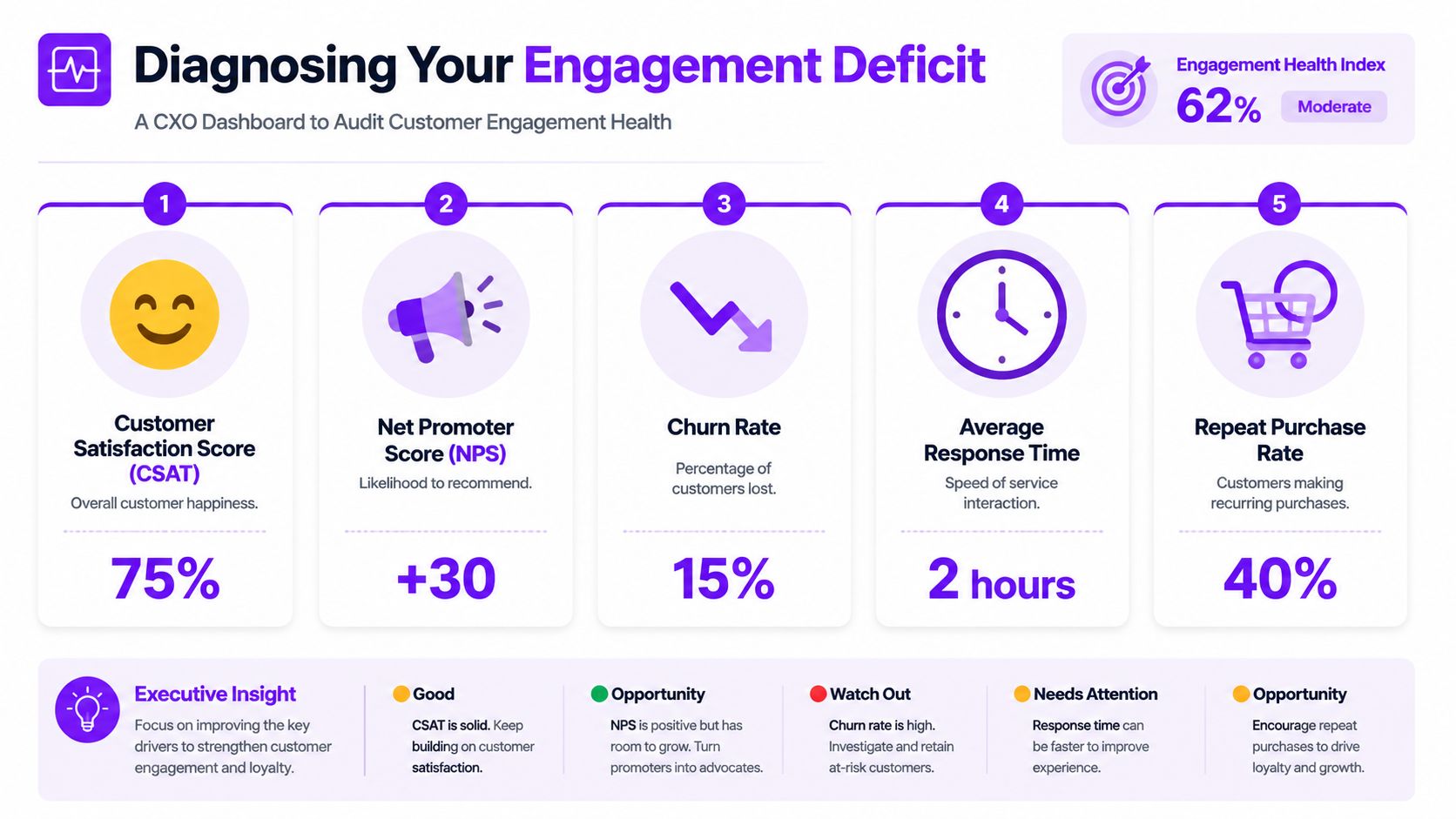
Use that stickiness signal alongside operational measures, not instead of them. A practical executive dashboard should review:
- Usage depth: Look at feature adoption and repeat behaviour, not just log-ins.
- Journey friction: Check where sessions stop, where forms are abandoned, and where users request help.
- Commercial progression: Track whether engaged users move towards enrolment, renewal, booking, or purchase.
- Service burden: If engagement quality is poor, support volume often rises because customers need more clarification.
Build a baseline that can guide investment
A baseline audit should answer one question. Where does engagement break down in ways that affect revenue or cost?
One useful example comes from content navigation. Indian retail and EdTech brands tracking conversion rate and pages per session found that campaigns increasing pages per session from 2.5 to 4.2 resulted in a 37% higher conversion rate, according to Extend's engagement metrics analysis. That tells an executive team something important. Better engagement isn't always about adding new channels. Sometimes it's about making the existing journey more coherent so customers discover enough relevant information to act.
If your teams can't identify where users disengage by stage, channel, and intent, they can't allocate budget intelligently.
For an EdTech platform, that might mean separating visitors who consume free lesson previews from prospects who attend counselling calls but never enrol. For a BFSI platform, it might mean isolating the KYC stage where users pause and need reassurance. For a real estate developer, it might mean finding the drop-off point between an enquiry form and a site-visit booking call.
An airline follows a similar logic on its own timeline: customer service in the aviation industry lives or dies on how quickly disruption, rebooking, and baggage moments are acknowledged across booking, airport, and in-flight touchpoints.
A concise diagnostic process works well:
- Audit behaviour by lifecycle stage. Acquisition, activation, support, renewal, and advocacy shouldn't sit in one blended dashboard.
- Identify the highest-friction moments. The right question isn't “Where are we busiest?” It's “Where are customers hesitating?”
- Quantify business effect. Tie disengagement to churn risk, support cost, conversion delay, or missed bookings.
- Prioritise fixes by strategic value. A small improvement in a high-intent moment often matters more than broad uplift in low-intent traffic.
When executives diagnose engagement this way, they stop funding activity and start funding outcomes.
Architecting Your Omnichannel Engagement Blueprint
An omnichannel strategy fails when every department optimises its own channel. Marketing wants reach. Support wants deflection. Sales wants response. Customers want continuity.
Map channels to customer intent
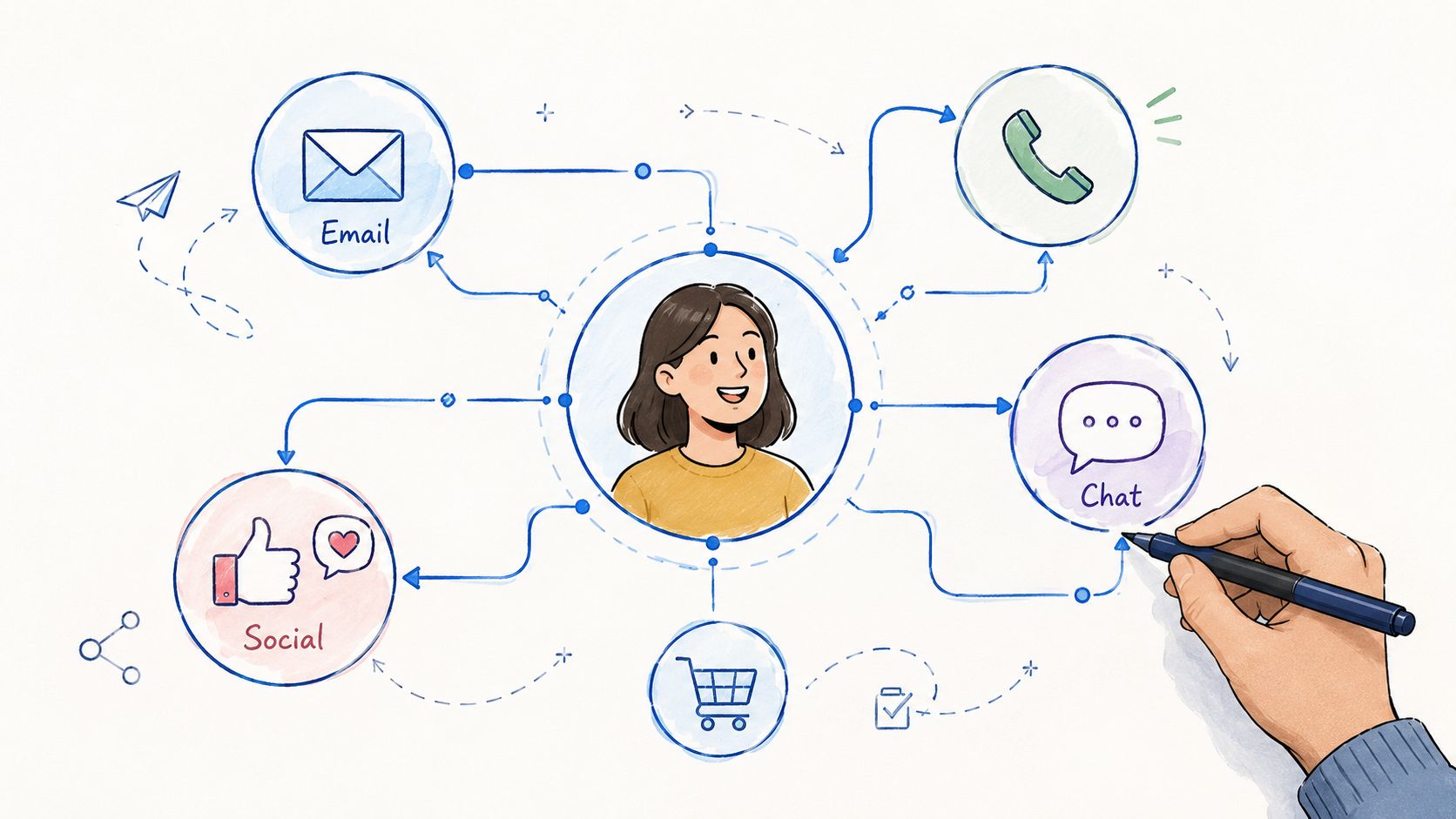
The better approach is to map customer intent to channel choice. That sounds simple, but it changes operating design.
An EdTech company attracting first-time learners should use discovery-led channels differently from conversion-led channels. Research-oriented audiences may respond well to short-form social content that lowers cognitive effort and creates familiarity. That's why the Indian EdTech firms using Instagram features such as Stories, Reels, and Live sessions reported a 35% increase in follower engagement and a 28% boost in course enrolment enquiries within three months, according to the SciencePubCo study on Indian EdTech engagement.
For that same EdTech company, Instagram shouldn't carry the full conversion burden. It should move prospects to a structured journey. Course comparisons, counselling conversations, WhatsApp reminders, and guided onboarding each belong to a later stage.
A BFSI business has a different pattern. Discovery may start with digital content, but moments such as document clarification, risk explanation, or KYC resolution often need secure, proactive communication. A real estate firm follows another path. Initial awareness may come from ads or social channels, but qualification and visit scheduling demand faster, richer engagement.
A practical planning exercise starts with a detailed journey map. Teams that need a shared method for that work can use this guide to customer journey mapping to align touchpoints, friction points, and ownership.
Design for orchestration, not channel ownership
Once persona and intent are mapped, the operating question becomes orchestration. Who triggers the next step, using which signal, through which channel?
That's where many organisations waste money. They run disconnected email, paid media, social, call-centre, and CRM workflows that compete instead of reinforce. Leaders who want a tighter operating model should understand how to master multi channel management so channel selection follows customer context rather than team structure.
A useful design rule is to assign channels specific jobs:
| Channel | Best role in the journey | Practical example |
|---|---|---|
| Instagram Reels or Stories | Discovery and early interest | EdTech previews, student success snippets, faculty Q&A |
| Structured follow-up and content depth | Application reminders, plan comparisons, onboarding sequences | |
| WhatsApp or messaging | Timely nudges and action prompts | Missed session reminders, document prompts, appointment confirmation |
| Voice | Complex qualification and reassurance | KYC clarification, property booking, programme counselling |
This short explainer is a helpful complement when reviewing orchestration choices with cross-functional teams.
A good omnichannel blueprint doesn't ask which channel is most modern. It asks which channel gives the customer the least friction at that moment.
That principle prevents overspending on fashionable channels and underinvesting in the ones that close real intent.
Executing with the Modern Engagement Toolkit
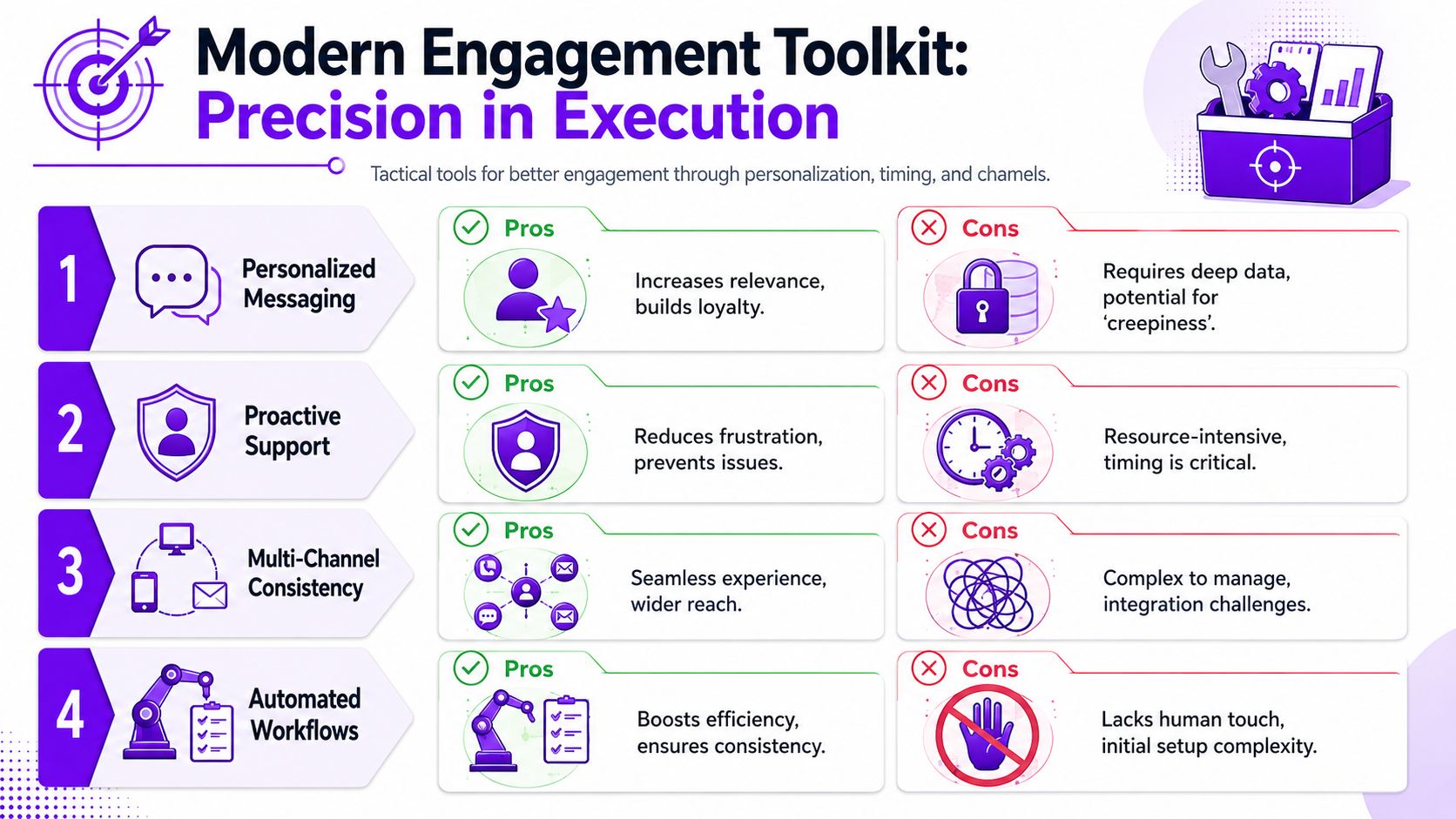
Execution determines whether an engagement strategy produces measurable revenue or just more activity. The strongest teams focus less on volume and more on intervention design. They identify the moments that change customer behaviour, then build systems that respond with precision.
Use personalisation where it changes behaviour
Personalisation has clear commercial value when it is tied to intent, timing, and decision friction. According to VWO's customer engagement statistics, personalised marketing communications can increase purchase likelihood by 76%. Separately, Epsilon's research on personalisation found that 80% of consumers are more likely to buy when brands offer personalised experiences.
For a board or revenue leader, the implication is straightforward. Personalisation should be treated as a conversion system, not a messaging tactic.
That changes execution priorities. A learner who attended a webinar should not receive the same sequence as someone who viewed tuition details twice and abandoned the application form. A SaaS buyer who returns to integration documentation signals a different level of intent than one reading a top-of-funnel blog post. In e-commerce, category-specific follow-up generally outperforms generic product pushes because it reflects actual consideration patterns rather than catalogue exposure.
Consistency matters as much as relevance. If marketing automation, CRM workflows, support prompts, and outbound scripts rely on conflicting customer assumptions, response rates fall and qualification quality deteriorates. Teams assessing the orchestration layer behind those journeys may find this overview of conversational AI solutions useful when comparing automation approaches.
Make interaction part of the offer
Interactive formats do more than improve engagement metrics. They reduce qualification cost.
Outgrow's summary of interactive content benchmarks notes that interactive content can generate conversion rates up to 2 times higher than passive content. The operational advantage is often larger than the marketing advantage because quizzes, calculators, assessments, and guided selectors generate declared preference data that static content cannot.
That has direct application across sectors. An EdTech provider can replace a generic programme brochure with a short career-fit assessment that routes prospects into the right counselling path. A D2C brand can use a product finder to narrow choice and reduce return risk. A financial services firm can use guided eligibility checks to improve lead quality before a human advisor spends time on the account.
Interaction also prepares the ground for voice. When a customer has already supplied context through an assessment or guided workflow, a follow-up conversation can begin with interpretation and recommendation rather than basic data capture. That is a better use of agent time and a stronger foundation for Voice AI-led qualification.
Practical rule: If the customer must do too much interpretation alone, conversion slows and service demand rises.
Automate with judgement, not just speed
Automation creates value when it improves decision quality at scale. ProductGrowth.in's analysis of EdTech engagement strategies found that cohort-based learning models outperform self-paced structures on completion, and that behaviour-based WhatsApp re-engagement outperforms generic progress messaging when learners show early signs of drop-off, according to ProductGrowth.in's EdTech engagement strategies. The broader lesson extends beyond EdTech. Trigger logic should reflect customer behaviour, not campaign calendars.
That principle is especially important in voice. Many firms still treat calls as overflow from digital channels, then wonder why conversion and follow-up efficiency remain weak. A better model uses human-like voice interaction earlier, as an active qualification and engagement layer. Voice can confirm intent, clarify objections, recover abandoned journeys, and route the next best action in real time. In higher-consideration categories, that often produces better economics than adding more email volume or paid retargeting.
The toolkit should therefore be built around interventions with measurable commercial purpose:
- Behaviour-triggered messaging: respond to inactivity, repeat visits, high-value page views, and partial form completion
- Outcome-based prompts: frame communications around the next decision or milestone, not generic progress updates
- Interactive qualification flows: use assessments, calculators, and guided choices to collect intent signals before sales or support intervention
- Voice-led escalation: shift complex or high-intent cases into conversation quickly, including systems designed to prevent missed calls with AI
- Shared orchestration rules: ensure CRM, messaging, support, and voice systems act on the same customer state
Used together, these tools do more than improve engagement rates. They lower qualification waste, increase conversion efficiency, and create the operating conditions for proactive Voice AI to function as a primary growth engine rather than a support fallback.
Unlocking Revenue with Proactive Voice AI Engagement
Revenue teams lose value when voice sits at the end of the journey instead of at the point of decision. In categories where customers need clarification before they commit, proactive voice interaction can qualify demand, recover hesitation, and move buyers to the next step faster than text-only sequences.
Why voice belongs earlier in the funnel
Many organisations still treat voice as a support channel. The customer browses, receives messages, stalls, and only reaches conversation after confusion or delay. That operating model fits low-consideration transactions. It performs poorly when the purchase requires explanation, reassurance, or guided qualification.
Analysts at Cyient's analysis of data-driven customer engagement found that 73% of customers prefer voice for complex queries, while 68% of businesses still rely on automated voice menus that fail to capture intent. For boards, that gap matters because it affects conversion economics, not just service quality. If customer preference and channel design are misaligned at the point of uncertainty, more prospects drop, more sales time is wasted, and more acquisition spend goes unrecovered.
The strategic implication is straightforward. Voice should be deployed where ambiguity is highest and commercial intent can still be shaped. In practice, that means programme counselling in EdTech, KYC guidance in BFSI, site-visit qualification in real estate, and high-intent product conversations in software sales.
Cyient also reports that AI voice agents can increase connect rates from 47% to 91%, improve lead-to-booking conversion from 2% to 8%, and match human judgement with 97% accuracy. Those outcomes matter because they shift voice from a cost-control tool to a revenue engine.
Where Voice AI produces measurable commercial value
The strongest business case for Voice AI is not lower call handling cost alone. It is the ability to qualify earlier, route faster, and reserve human attention for opportunities that justify it.
| Industry | Use Case | Metric | Result |
|---|---|---|---|
| Real estate | Site-visit booking and lead qualification | Connect rate | 47% to 91% |
| Real estate | Site-visit booking and lead qualification | Lead-to-booking conversion | 2% to 8% |
| BFSI and trading platforms | KYC guidance and complex support | Customer preference for voice in complex queries | 73% |
| Cross-industry qualification workflows | AI judgement quality | Accuracy matching human judgement | 97% |
Used well, a voice agent does more than answer questions. It can collect buying signals, test urgency, resolve basic objections, schedule the next action, and write structured outcomes back into CRM. That shortens response time and improves sales productivity because advisers start with context rather than restarting discovery from zero.
The ROI profile becomes clearer at the operating level. A real estate developer can screen for project fit, budget range, and visit readiness before assigning a sales adviser. A trading platform can reduce KYC abandonment by guiding users through blockers in natural language. An EdTech provider can qualify learners by goals, timing, and programme fit before counsellor time is allocated.
There is also a preventable leakage problem. Missed inbound calls, delayed callbacks, and inconsistent follow-up reduce conversion in every high-intent category. Teams reviewing that exposure can assess practical options to prevent missed calls with AI, especially when call demand is volatile or staffing coverage is uneven.
For leadership teams, the operational question is not whether voice should exist. It is how voice should be governed, measured, and integrated. A useful reference point is a set of call centre dashboard reporting practices that connect response quality, volume, and outcome tracking to commercial decisions.
DialNexa Labs Private Limited is one example in this category, with human-like Voice AI agents used for qualification, customer support, recruitment, and presales across sectors including EdTech, BFSI, real estate, hospitality, e-commerce, and software. The strategic value comes from using voice as an active engagement layer early in the customer journey, where better qualification and faster intervention can produce measurable revenue impact.
Voice becomes strategic when it captures intent before delay reduces conversion.
Human-like voice interaction now belongs in the growth system itself. Used proactively, it can generate pipeline, improve qualification efficiency, and increase conversion without expanding headcount at the same rate.
How to Measure Iterate and Scale for ROI
A customer engagement strategy earns board support when it produces a repeatable learning system. Without that, teams accumulate tools, channels, and campaigns without knowing what compounds value.
Close the loop between feedback and action
Measurement should begin with structured customer feedback because it reveals whether operational assumptions match customer reality. In India, collecting structured feedback through automated surveys yields a 31% higher Net Promoter Score improvement compared to sporadic reviews, and companies that automate the process see a 27% increase in customer satisfaction scores, according to Bettermode's customer engagement metrics analysis.
That matters because ad hoc feedback is biased towards extremes. Automated collection gives leadership a more reliable signal across the full journey. It also creates a cleaner base for prioritising product fixes, message changes, script revisions, and support improvements.
A practical dashboard should combine sentiment, behaviour, and economics. For teams building that visibility layer, call centre dashboards provide a useful reference for structuring operational reporting around response quality, volume, and outcomes.
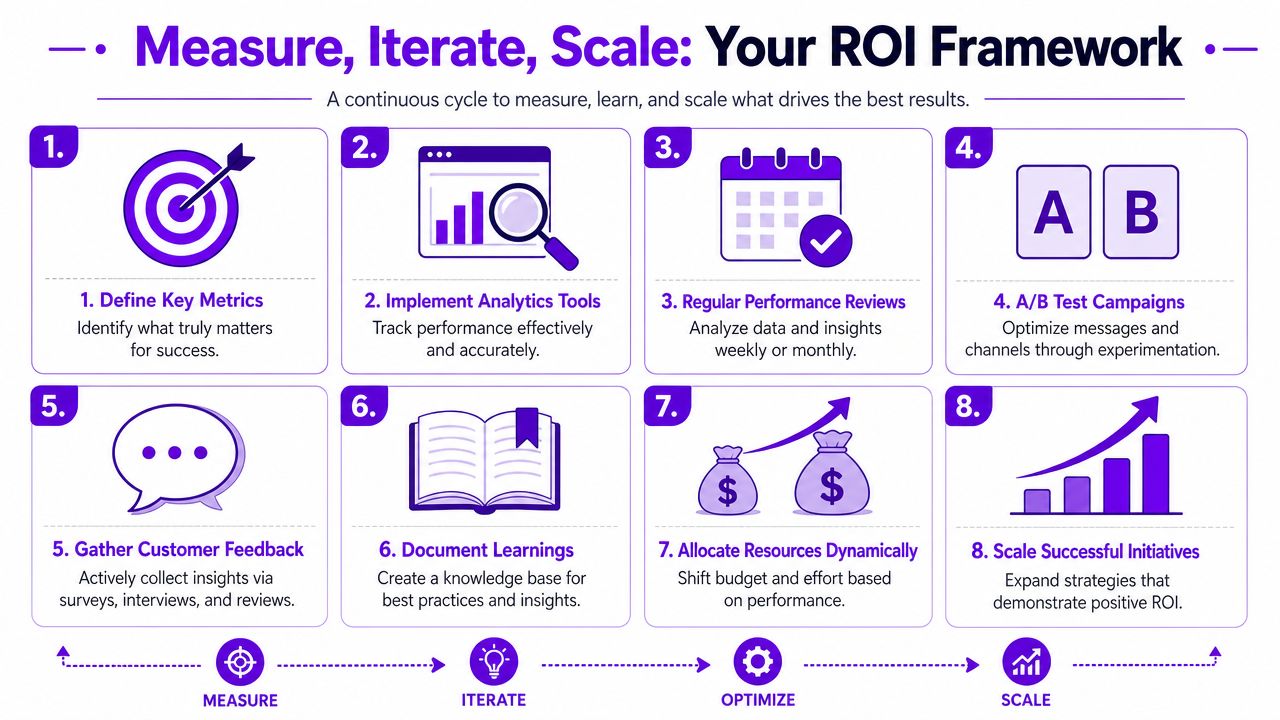
The right executive review should ask:
- What changed in customer behaviour? Look at completion, booking, repeat use, and support demand.
- What changed in customer sentiment? Review CSAT and NPS trends from structured feedback.
- What changed in commercial output? Tie engagement improvements to conversion, renewal, or reduced churn risk.
Social channels also need disciplined measurement because engagement there can look healthy while producing little business value. Leaders reviewing that area may benefit from frameworks that boost social media ROI and cut risk when deciding what to scale and what to stop.
An executive checklist for scaling what works
The strongest engagement teams run a closed-loop operating model. They test messages, channels, scripts, and triggers. Then they move resources towards what performs.
A concise implementation checklist helps:
- Define one commercial outcome per journey. Enrolment, booking, activation, renewal, or repeat purchase.
- Set one behavioural leading indicator. Stickiness, re-engagement, session depth, or completion.
- Automate feedback capture. Don't depend on anecdotal comments from frontline teams alone.
- Test one variable at a time. Script, timing, channel, or offer.
- Document learning centrally. Local optimisation inside one team doesn't scale.
- Reallocate budget quickly. Stop protecting underperforming channels for political reasons.
The purpose of measurement isn't reporting. It's capital allocation.
Boards should insist on that distinction. If an engagement initiative improves customer behaviour but doesn't receive follow-on investment, the company is measuring correctly and managing poorly. If it receives investment without evidence, the reverse is true.
DialNexa Labs Private Limited helps organisations deploy human-like Voice AI agents for qualification, customer support, recruitment, and presales workflows where conversation quality directly affects conversion and service efficiency. If your team is rethinking improving customer engagement through proactive, voice-first journeys in EdTech, BFSI, real estate, e-commerce, healthcare, or software, explore DialNexa Labs Private Limited to assess where voice automation fits your operating model.

This is a strong perspective on how customer engagement directly connects to revenue, retention, and operational efficiency. The focus on intent-driven personalization, omnichannel orchestration, and measurable outcomes makes the strategy highly practical for modern businesses.
This content gives a clear and practical view of why customer engagement should be treated as a growth strategy rather than just a marketing activity. The focus on customer intent, consistent experiences, and measurable business outcomes makes the approach especially valuable.
A strong perspective on treating customer engagement as a business growth system rather than isolated marketing or service activities. The focus on behaviour, journey friction, measurable outcomes, and omnichannel continuity makes the strategy highly practical.
A strong and practical perspective on improving customer engagement by connecting behavioural insights, omnichannel journeys, and proactive Voice AI. The focus on measurable outcomes and continuous optimisation makes the overall strategy especially valuable for modern businesses.