
Exotel Pricing: Complete Guide for Indian Businesses 2026
Exotel's published India tiers are INR 9,999 for Dabbler, INR 19,999 for Believer and INR 49,499 for Influencer. Those figures are only the entry point, because per-minute voice, SMS, number rental and DLT pass-through charges sit on top of the bundle, making actual Exotel pricing usage-driven.
That's the counterintuitive part of buying Exotel for an Indian BFSI, EdTech or D2C operation. A plan that looks inexpensive on a pricing card can produce a very different monthly cost once agents start calling, customers answer across circles, SMS campaigns run, and compliance-related charges reach the invoice.
For a CXO, the right question isn't “Which Exotel plan is cheapest?” It's “What will one connected conversation, qualified lead or booked appointment cost at our volume?”
Table of Contents
- What Exotel Actually Costs Indian Buyers in 2026
- How the Dabbler, Believer and Influencer Plans Compare
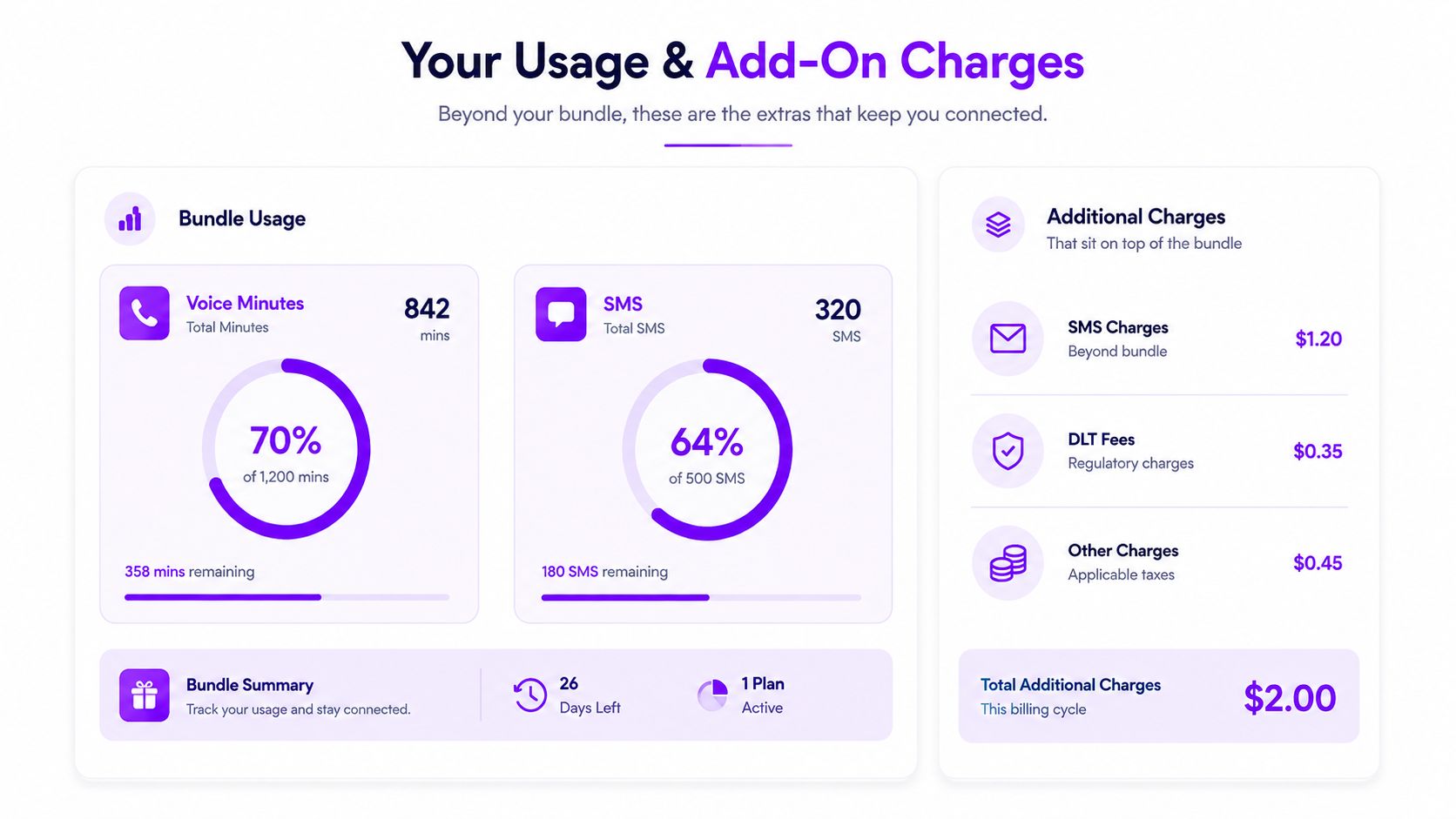
- Voice Minutes, SMS and DLT Fees That Sit on Top of the Bundle
- Sample Invoice Breakdown for a Mid-Size CXO Team
- Real Use-Case Cost Models for BFSI, EdTech and Real Estate
- IVR, API, Recording and Analytics Add-Ons That Drive Recurring Cost
- Procurement and Negotiation Tactics for Indian Buyers
- How Exotel Stacks Up Against Voice AI Alternatives Like DialNexa
What Exotel Actually Costs Indian Buyers in 2026
Exotel's published India business phone system tiers are Dabbler at INR 9,999, Believer at INR 19,999 and Influencer at INR 49,499, with custom enterprise pricing for larger deployments, according to the published Exotel business phone system pricing. Treat those amounts as prepaid commercial bundles, not as complete monthly invoices.
The distinction matters because Exotel's Indian pricing combines software access with usage. A public proposal for the Influencer package shows INR 49,499 plus 18% GST, divided into INR 10,499 for software rental over 12 months and INR 39,000 as available usage balance. That structure tells procurement teams exactly where to focus: the bundle buys the platform and a pool of communications capacity, while actual consumption determines how quickly the balance disappears.
The invoice has more than one layer
A realistic Exotel budget should separate four layers:
- Bundle commitment: The plan selected at the start of the commercial term.
- Voice consumption: Incoming and outgoing minutes, often affected by call direction and circle.
- Messaging usage: SMS and WhatsApp charges, with category-specific tariffs.
- Telecom pass-throughs: Number rental, DLT and operator-related charges that may not be obvious from the headline plan.
Independent pricing coverage also notes that invoices can include per-number rental, per-minute voice, SMS or WhatsApp usage, DLT charges and operator fees above the bundle amount, as discussed in this Exotel pricing and review analysis.
Procurement rule: Approve Exotel only after the vendor maps your call volume, message volume, number count and compliance charges into a written commercial model.
For a small support team with predictable inbound traffic, the bundle may work well. For BFSI collections, admissions follow-up or real estate lead qualification, under-forecasting is more likely because the team's cost follows connected activity rather than the number of agents. DialNexa's broader cloud telephony provider comparison is useful when you're benchmarking Exotel against alternative operating models.
How the Dabbler, Believer and Influencer Plans Compare
The public plan ladder is easy to read, but it's easy to misinterpret. A Capterra India listing shows Micro at INR 5,555 for 3 months, Dabbler at INR 9,999 for 6 months, Believer at INR 19,999 for 12 months and Influencer at INR 49,499 for 12 months. The Capterra India Exotel listing provides the clearest public view of those plan names, prices and validity periods.
Exotel India plan tiers at a glance
| Plan | Published Price (INR) | Validity | Best Fit |
|---|---|---|---|
| Micro | 5,555 | 3 months | Very small teams validating a telephony workflow |
| Dabbler | 9,999 | 6 months | Startups and small support or sales teams |
| Believer | 19,999 | 12 months | Growing teams with recurring calling requirements |
| Influencer | 49,499 | 12 months | Larger operations requiring more capacity and flexibility |
The Micro tier is the lowest public entry point in the marketplace listing, but its short validity makes it a test purchase rather than a dependable operating base. It can suit a small team validating IVR, call routing or lead callbacks before committing to a longer commercial cycle.
Dabbler is the sensible starting point for a limited pilot. A startup can use it to validate call quality, routing logic and agent adoption without committing to the larger Influencer bundle. It shouldn't be selected merely because it has the lowest visible price. If the team exhausts its included usage quickly, the apparent saving disappears.
Believer is the more practical middle tier for an established EdTech admissions desk, D2C support pod or small sales operation. Its 12-month validity gives finance teams a longer planning window, but the plan still needs to be tested against expected voice and messaging consumption.
Influencer is the published scale tier. It's the logical candidate for higher concurrency, multiple workflows and larger agent groups, but it isn't automatically the most economical option. The value depends on whether your team uses the available rental and usage allocation fully.
Pick by utilisation, not label
A plan comparison should answer three questions:
- How many people need to handle interactions at the same time?
- How many minutes and messages will the operation consume?
- Will the team use the bundle within its validity window?
A technically larger plan can create poor economics when usage is light. Conversely, a cheaper plan can become expensive if the team repeatedly tops up or adds numbers. Buyers comparing communication platforms should also review how alternative models package seats and usage, including the framework in this Vapi pricing guide.
Voice Minutes, SMS and DLT Fees That Sit on Top of the Bundle
The headline plan price hides the operational variable that matters most: the tariff applied to each interaction. Historical Exotel India pricing lists local incoming voice at INR 0.40 per minute, inter-circle incoming at INR 0.75 per minute, local outgoing at INR 0.80 per minute and national outgoing at INR 1.15 per minute. The same reference lists SMS pricing from INR 0.18, as shown in Exotel's historical India pricing reference.
Why call direction changes the economics
A collections workflow may make national outbound calls, while a customer support queue may receive local inbound traffic. Those are not interchangeable cost lines. A real estate team may also receive calls from prospects in different circles, creating a different mix from a city-focused admissions desk.
For a simple illustration, 10,000 minutes billed at INR 0.40 per minute would produce INR 4,000 in voice usage, while the same volume at INR 1.15 per minute would produce INR 11,500. Those are tariff illustrations based on the published rates, not a forecast of your invoice. GST, number rental and other charges would need separate treatment.
Messaging adds another dimension. Historical references describe conversational messaging at INR 0.80 for marketing conversations, INR 0.38 for utility conversations and INR 0.36 for service conversations, while the older SMS reference lists pricing starting at INR 0.18 for 100,000 SMS. Teams must verify the applicable commercial category before approving a campaign.
The compliance lines deserve written treatment
DLT registration, operator charges and other India-specific pass-throughs can sit outside the visible bundle. That matters for BFSI and EdTech teams sending reminders, updates or campaign messages, because a message may carry both a communications tariff and a compliance or operator-related cost.
Ask Exotel to provide:
- Voice rates by direction and circle: Don't accept one blended rate for mixed traffic.
- Message categories: Separate marketing, utility and service treatment.
- Number rental terms: List every number, activation charge and recurring rental.
- DLT responsibility: State which fees are passed through and which services are included.
- Usage reporting: Require an export that reconciles minutes, messages and balances.
The tariff table is more useful than the plan name. A finance leader should model the expected interaction mix before choosing the bundle, because small per-minute differences become material when collections or follow-up teams operate at high volume.
Sample Invoice Breakdown for a Mid-Size CXO Team
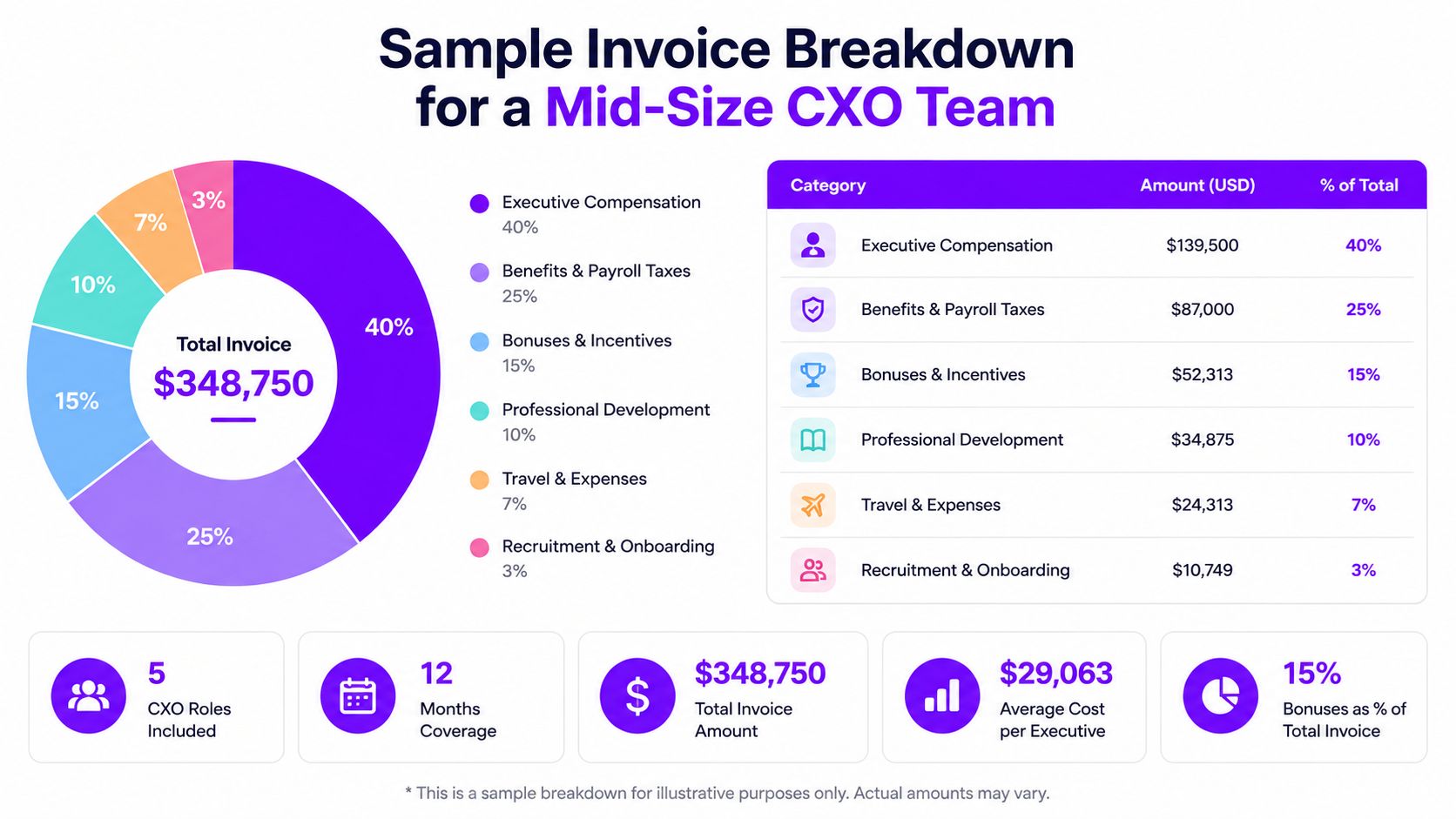
The INR 19,999 Believer plan is a bundle price, not a realistic mid-size operating budget. For a 25-seat EdTech admissions team handling outbound counselling, inbound callbacks, SMS reminders and several numbers, usage charges quickly become the larger line item.
Use a defined operating scenario rather than the headline plan. This model assumes 60,000 outbound minutes, 25,000 inbound minutes and 40,000 SMS. These volumes are a planning case, not a published Exotel case study. The calculation uses the historical voice and SMS tariffs supplied for this analysis. Number rentals, DLT, operator charges and GST remain separate because their exact values are not exposed in the available data.
EdTech admissions model
| Cost item | Calculation | Indicative amount |
|---|---|---|
| Believer bundle | Published plan price | INR 19,999 |
| Outbound voice | 60,000 × INR 1.15 | INR 69,000 |
| Inbound voice | 25,000 × INR 0.40 | INR 10,000 |
| SMS | 40,000 × INR 0.18 | INR 7,200 |
| Number rentals | Depends on numbers provisioned | Quote required |
| DLT and operator charges | India-specific pass-throughs | Quote required |
| GST | Applied according to the commercial invoice | Confirm in writing |
The calculable subtotal before rentals, pass-through charges and GST is INR 106,199. That is already far above the INR 19,999 bundle price. The final invoice can increase once Exotel adds numbers, compliance charges and applicable taxes. Procurement should reject any fixed monthly estimate until those items appear in writing.
BFSI collections needs a separate model
A 60-seat BFSI collections operation on Influencer will generate a different invoice. High outbound volume, multiple numbers or queues, recordings, reporting and compliance controls all need separate review. Model connected minutes apart from attempted dials. Short, unsuccessful calls can consume budget without producing comparable recovery value.
Independent reviews identify number rental, voice, SMS or WhatsApp usage, DLT fees and operator charges as costs above the bundle. Finance should match every line against Exotel's usage report before classifying the plan as the operating expense.
Finance test: If the spreadsheet contains only the bundle price and agent count, it is not an Exotel cost model yet.
Real Use-Case Cost Models for BFSI, EdTech and Real Estate
The same Exotel bundle can produce very different economics across industries. A collections manager cares about the cost of a connected minute and a successful repayment conversation. An EdTech director cares about the cost of a qualified counselling lead. A real estate head cares about the cost of a booked site visit.
BFSI collections
Start with the voice mix. Local incoming traffic is listed at INR 0.40 per minute, while national outgoing traffic is listed at INR 1.15 per minute in the historical India tariff reference. A collections team that routes most activity through national outbound calling will consume budget faster than a local inbound support queue.
The source also notes that per-minute differences of INR 0.10 to INR 0.35 can swing cost per connected call by 15% to 25% at collections volumes. That's why procurement should request reporting by call direction, circle and outcome instead of reviewing only aggregate usage. A low average rate can conceal an expensive outbound segment.
Track these measures together:
- Cost per connected minute: Voice usage divided by connected minutes.
- Cost per promise-to-pay conversation: Voice and messaging spend divided by verified conversations.
- Cost per recovered account: Total communications spend divided by accounts producing the target outcome.
EdTech admissions
Admissions teams combine outbound calls with reminders and follow-ups. The relevant unit isn't the message price. It's the cost of moving a lead from attempted contact to a qualified counselling conversation, then to an application or enrolment event.
Use separate tags for first call, counsellor callback, appointment reminder and no-response SMS. If one queue uses national outbound and another receives local inbound, blending them will distort the economics and make the Believer or Influencer decision unreliable.
Real estate site visits
Real estate teams should measure cost per booked site visit, not cost per dial. A campaign may produce many short conversations, but the commercial value comes from qualified prospects who accept a date and location.
For a clean model, assign each number and workflow to a project, record the voice tariff applied, classify follow-up SMS by message purpose, and divide the fully loaded spend by booked visits. DialNexa's cloud contact centre solutions overview can help teams compare a human-agent model with an automation-led workflow.
The executive takeaway is simple: Exotel pricing should be evaluated against business outcomes, not against the plan card. A lower tariff doesn't guarantee lower acquisition cost if the workflow still depends on manual attempts and repeated follow-ups.
IVR, API, Recording and Analytics Add-Ons That Drive Recurring Cost
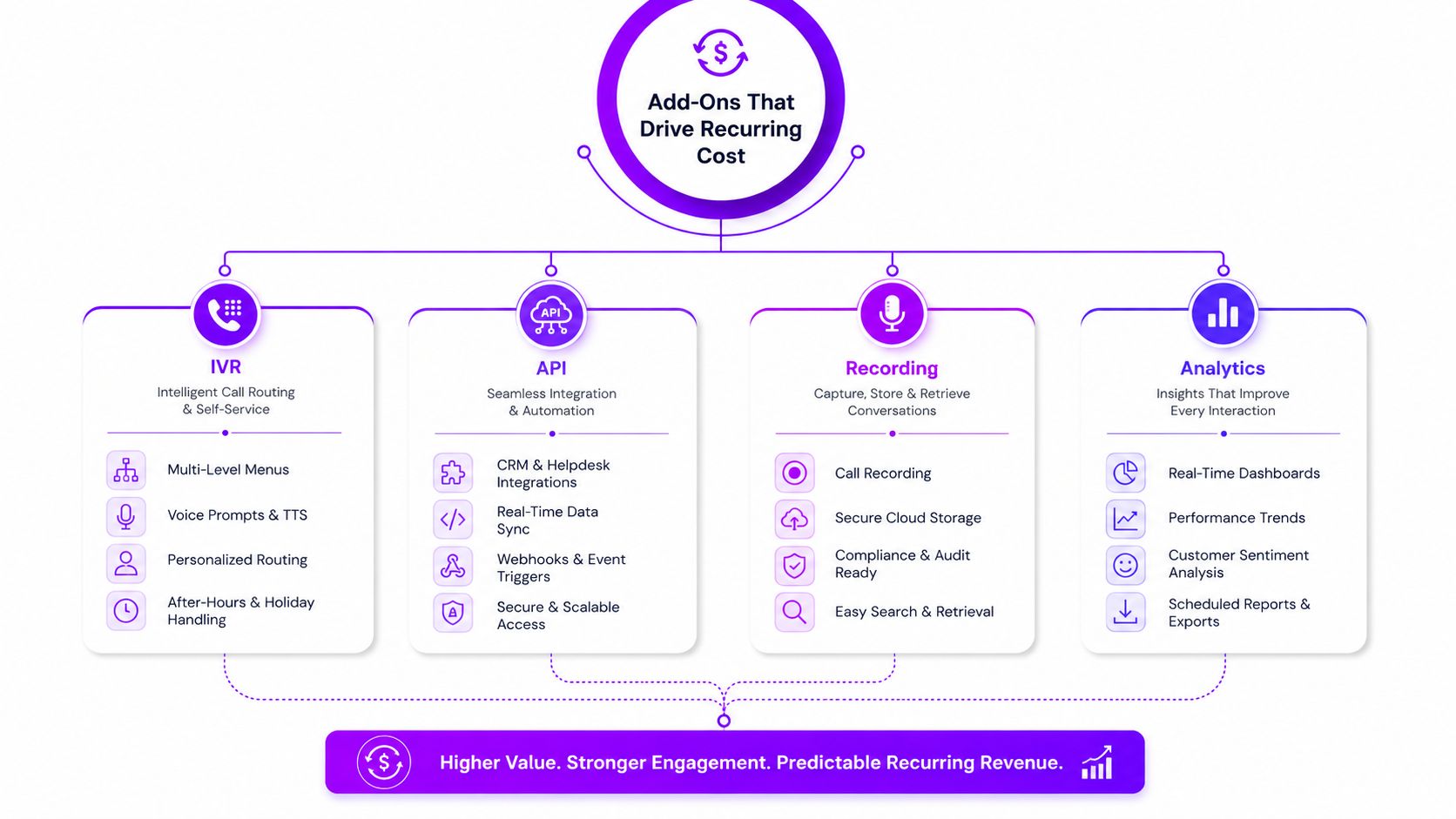
A telephony bundle gets a team connected. Enterprise operations usually need more than connectivity. Multi-level IVR, intelligent routing, recording, storage, dashboards, CRM connectors and WhatsApp enablement can become recurring cost drivers even when voice usage remains stable.
Separate feature scope from usage scope
A collections operation may require call recording and retention for quality review. An EdTech business may need CRM events pushed into its admissions system. A real estate team may require lead routing by project, city or broker. Each requirement affects the commercial design differently.
Use this classification during vendor review:
- IVR and routing: Usually shaped by flow complexity, departments and routing rules.
- API and CRM integration: Driven by implementation scope, connectors and transaction volume.
- Recording and storage: Influenced by recording coverage, retention requirements and retrieval needs.
- Analytics: Depends on dashboard depth, user access and reporting requirements.
- WhatsApp enablement: Tied to message categories, conversation usage and platform terms.
Exotel's public pricing language describes the product as transparent, scalable and flexible, but the public snippet doesn't expose granular add-on prices. Procurement teams should therefore expect commercial negotiation and demand a line-item proposal, as indicated on the Exotel public pricing page.
Questions to ask before signing
Ask whether each module is included in the selected bundle, priced separately, or available only through an enterprise proposal. Confirm whether storage is pooled, whether API support includes implementation assistance, and whether analytics users incur additional charges.
For IVR design, document the number of levels, language prompts, working hours, fallback routing and overflow behaviour. Teams evaluating the operational role of IVR can also review this guide to IVR interactive voice response software.
A vendor's demo may show every feature. Your contract should show which features are enabled, what limits apply, how usage is measured and what triggers a price change.
Procurement and Negotiation Tactics for Indian Buyers
Don't negotiate Exotel pricing from the headline bundle alone. Negotiate the invoice architecture.
The Influencer proposal offers a useful precedent. Public coverage describes the INR 49,499 bundle as INR 10,499 in software rental plus INR 39,000 in usage credits, as reflected in the Exotel business phone system proposal information. Ask for the same clarity in your own proposal, even if your enterprise package uses different terms.
Put these items in the commercial schedule
- Volume commitments: Request a rate review tied to committed minutes or messages, with a clear treatment for unused volume.
- GST treatment: State whether prices are before or after GST, and show the tax treatment for every line item.
- DLT and operator charges: Require pass-through costs to be listed separately, with no unexplained “telecom” bucket.
- Concurrency and SLA: Define expected simultaneous calls, service availability commitments and escalation paths.
- Number terms: Confirm activation, rental, replacement and porting charges for every number.
- Pilot exit: Set a test period, success criteria, data-export rights and a no-surprise termination process.
Commercial discipline: Never accept “usage varies” as the final answer. Ask the vendor to model low, expected and peak consumption using your own traffic profile.
The buyer should also request a sample invoice, a usage dashboard export and a reconciliation exercise before signature. Make finance, operations, compliance and IT review the same document. Sales may describe a feature as included, while the order form attaches a volume, storage or seat condition.
For BFSI, pin down recording access, audit support and escalation ownership. For EdTech, define campaign messaging categories and opt-out handling. For real estate, separate project-level numbers and attribution so finance can calculate cost per booked visit.
How Exotel Stacks Up Against Voice AI Alternatives Like DialNexa
Exotel is a telephony infrastructure choice. A Voice AI platform is an operating model choice. That distinction matters when a business is paying human agents to repeat qualification questions, confirm appointments, chase documents or send routine follow-ups.
Exotel can remain appropriate where agents need direct control, complex conversations require human judgement, or the team already has a mature contact-centre process. Its prepaid bundles and usage tariffs make sense when volumes are controlled and the organisation can monitor consumption closely.
Voice AI becomes more compelling when the workflow is structured and repetitive. BFSI teams can automate selected reminder and support conversations. EdTech teams can handle initial qualification and counselling triage. Real estate teams can automate lead discovery, follow-up and site-visit booking before handing high-intent prospects to sales.
Compare the buying decision, not only the vendor
| Decision factor | Exotel | Voice AI alternative |
|---|---|---|
| Primary unit of cost | Telephony bundle plus usage | Commercial model depends on vendor and deployment |
| Human involvement | Agents handle the conversation | AI handles defined workflows, with human escalation |
| Control | Direct routing and telephony controls | Workflow, persona and automation controls |
| Best operating fit | Teams with established agent operations | Teams seeking automated qualification and follow-up |
| Procurement focus | Minutes, messages, numbers, DLT and add-ons | Automation scope, escalation, integrations and governance |
Revenue teams comparing communication tools may also find Salesmsg for revenue teams useful as a separate reference point for messaging-led workflows.
The right alternative depends on the outcome you're buying. If the goal is to provision Indian numbers and route calls, Exotel may be enough. If the goal is to reduce repetitive agent work and move more leads toward appointments or qualified handoffs, compare the full workflow cost in an Exotel alternatives decision framework.
Before the next vendor review, ask:
- What's our fully loaded cost per connected conversation?
- Which activities require a human?
- What portion of qualification, booking or follow-up can be automated?
- How will compliance, escalation and recording be governed?
- Can the vendor show the total cost under normal and peak usage?
DialNexa Labs Private Limited provides human-like Voice AI agents for qualification, customer support, recruitment and presales across BFSI, EdTech, real estate, healthcare, e-commerce and software workflows. Visit DialNexa Labs Private Limited to evaluate an automation-led calling model, review deployment options and compare the cost of AI-handled conversations with your current Exotel operation.

This is a clear and practical breakdown of Exotel’s pricing structure and hidden costs. I especially liked how it explains why businesses should compare usage, validity, and additional charges instead of looking only at the headline price.
A clear and informative guide that breaks down Exotel pricing for Indian businesses in 2026.
The detailed insights make it easier to understand the plans, costs, and factors to consider before choosing a solution.
This is a detailed and practical breakdown of Exotel pricing that clearly explains bundles, voice usage, messaging, DLT, and other potential costs.
The real-world examples for BFSI, EdTech, and real estate make the guide especially useful for businesses planning an accurate communication budget.
This is a clear and practical guide for Indian businesses evaluating Exotel pricing in 2026. The detailed breakdown makes it easier to understand the available options, compare costs, and choose a plan that aligns with business communication needs.