

What Is Conversational AI and How Does It Drive Business Growth
At its heart, conversational AI is technology built to understand, process, and respond to human language—both spoken and written. For a business leader, it’s best understood as a highly scalable digital workforce, one that can manage thousands of customer conversations simultaneously, around the clock, without performance degradation.
Your New Digital Workforce Has Arrived
Picture your very best customer service or sales development representative—the one who’s patient, incredibly knowledgeable, and always delivers the right message. Now, imagine scaling that rep’s skills to handle thousands of concurrent conversations, with no dip in quality. That’s the strategic power of conversational AI. We're not just discussing algorithms; we're talking about building a reliable, hyper-efficient digital team that operates 24/7.
This technology allows your business to connect with customers on a personal level, but at a scale that was previously unimaginable. For any executive, the critical question isn’t “what is this tech?” but “what tangible business outcomes can it deliver?” The answer is direct: it slashes operational costs, ensures a consistently excellent customer experience, and unlocks new channels for revenue growth.
A Strategic Asset for Growth
Let's be clear: this is far more than just another chatbot. Conversational AI is a sophisticated system designed to grasp the subtleties of human language—the intent behind a question, the context of a problem, and the most natural way to respond. That ability turns routine interactions into strategic business opportunities.
By automating routine conversations, conversational AI frees up your human teams to focus on high-value, strategic work. This isn't about replacing people; it's about empowering them. For instance, a major telecom company could deploy AI to handle 70% of its inbound billing inquiries, allowing its skilled agents to focus solely on complex technical support and high-value customer retention efforts. Your AI handles the volume, so your team can drive the value.
This kind of strategic automation has a direct, measurable impact on the bottom line. We see companies making huge strides in areas like lead qualification and customer support.
- Slash Operational Costs: Automate thousands of routine calls and chats, dramatically reducing manual intervention and lowering the cost-per-interaction. A financial services firm, for example, could use AI to automate KYC verification calls, cutting the cost of this mandatory process by over 50%.
- Deliver Consistent Excellence: Guarantee every customer receives the same high standard of service, any time of day, without the variability of human agents. This is crucial for brands where consistent messaging and compliance are non-negotiable.
- Unlock New Growth: By qualifying leads faster and more accurately, you can accelerate your sales cycle and convert more prospects into paying customers. An EdTech company using AI to instantly engage with new inquiries can increase its qualified application rate by 3x.
Ultimately, the business case for this technology is clear from day one. To get a deeper look at the fundamentals, check out a comprehensive guide to what conversational AI is and see how it’s reshaping customer interactions. It's time to stop seeing conversational AI as a tech tool and start seeing it as a core part of your growth strategy.
How Does Conversational AI Actually Work?
So, how does this technology manage to interact with a person so naturally? From a leadership perspective, you don't need to be a programmer to grasp its function. At its core, conversational AI acts like a highly efficient digital team member, translating unstructured human language into structured data it can act upon to achieve a business goal.
This isn’t a single piece of technology; it's a coordinated process where different components work in harmony. Think of it as a digital assembly line for conversations, where each station has a specific job to make the final interaction seamless and intelligent.
The entire process boils down to three key functions: understand the user, respond intelligently, and ultimately, drive business growth.
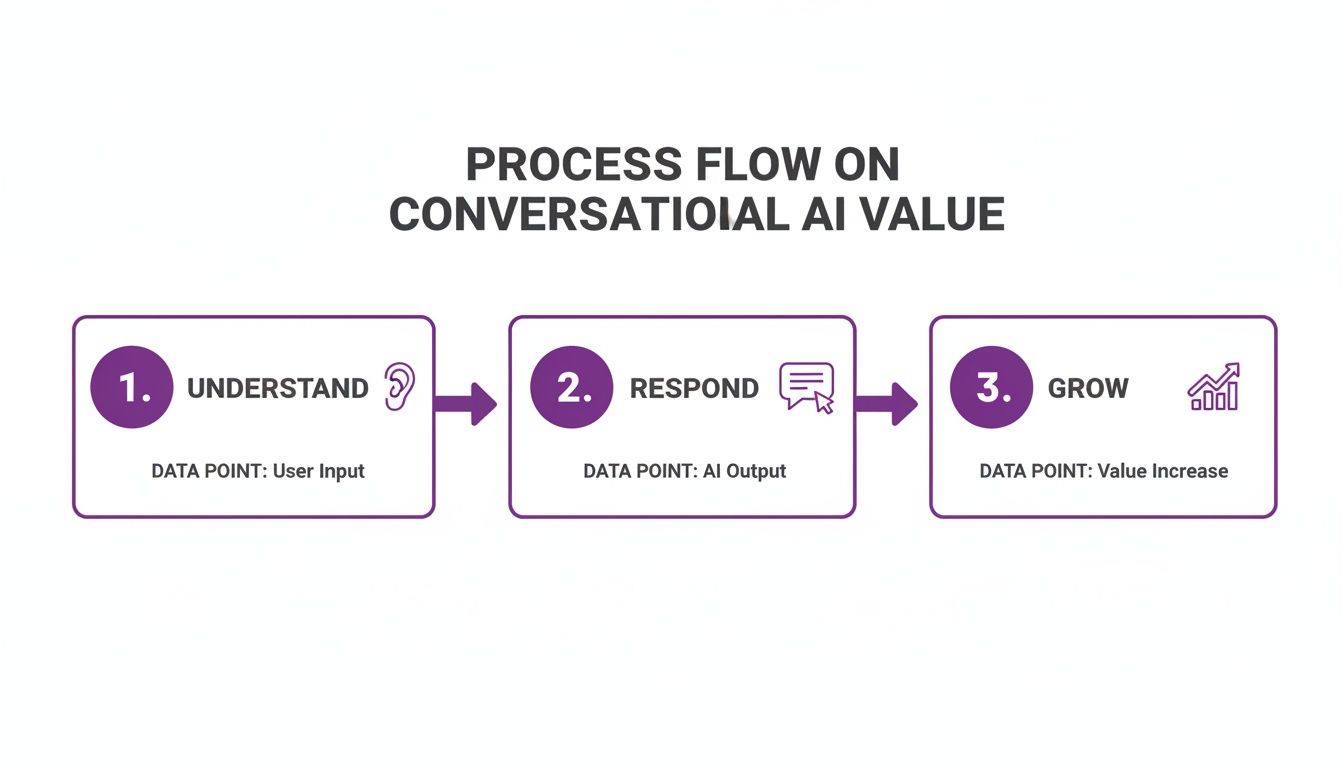
This simple flow illustrates that the objective isn't just to have a conversation. It's about leveraging those conversations to produce measurable business outcomes.
The Core Components: NLP, NLU, and NLG
Let's pull back the curtain on the "brains" of the operation. You’ll often hear the terms Natural Language Processing (NLP), Natural Language Understanding (NLU), and Natural Language Generation (NLG). They might sound similar, but each has a distinct and crucial role in delivering business value.
-
NLP: The Ears of the System. First, the AI must process the input. NLP is the technology that takes raw human language—text from a chat window or spoken words from a phone call—and structures it for a computer. For voice systems, this starts with Automatic Speech Recognition (ASR), which converts speech into text. Think of NLP as the transcriber that captures every word accurately.
-
NLU: The Brain that Grasps Meaning. Simply processing words isn't enough; the AI must understand the business intent behind them. This is NLU's job. It deciphers what a user actually wants to achieve. When a customer says, "My package hasn't arrived, where is it?" NLU identifies the intent as 'check_order_status' and extracts the entity 'package'. This ability to understand context, not just keywords, is what separates a strategic AI from a frustrating, old-school bot.
-
NLG: The Voice that Responds. Once the AI knows the user's intent, it needs to reply in a clear, brand-aligned, and human-like manner. Natural Language Generation (NLG) crafts the response. It takes structured data (like a tracking number or appointment time) and assembles it into a natural sentence. For a director of customer experience, good NLG is the difference between a robotic "Order 789 confirmed" and a brand-enhancing "Great! Your order #789 is confirmed and should be with you by Tuesday."
The Director: Dialogue Management
With the core language components in place, another piece is needed to guide the conversation strategically from start to finish. This is the job of the Dialogue Manager.
Think of it as the conversation's director or a project manager. It keeps the interaction on track and ensures it moves logically toward a predefined business goal. For example, if a prospective client wants to book a demo, the Dialogue Manager knows to ask for their name, then their company, and finally their preferred time. It remembers what’s been said and knows what information is still required to complete the task.
This is what guarantees a reliable, goal-driven conversation. It prevents the interaction from going in circles and ensures every engagement is structured to achieve a specific business outcome, whether that’s resolving a support ticket or qualifying a sales lead.
Once conversations are automated at this scale, the next challenge is turning transcripts into structured insight – a discipline covered in depth in our conversation intelligence guide.
Putting Conversational AI to Work in Your Industry
The theory behind conversational AI is interesting, but its real value is demonstrated through tangible ROI in specific industries. This isn't a futuristic concept; it's a practical tool already solving major operational bottlenecks and driving revenue for businesses today.
For any business leader, the question is simple: "How can this solve my specific problems and help us grow?" The answer lies in applying conversational AI to handle high-volume, repetitive tasks, turning mundane interactions into opportunities for efficiency and sales. This is where AI transforms from a line item expense into a core driver of performance.
The image below gives a glimpse into a few of the industries where AI is already making a significant impact.
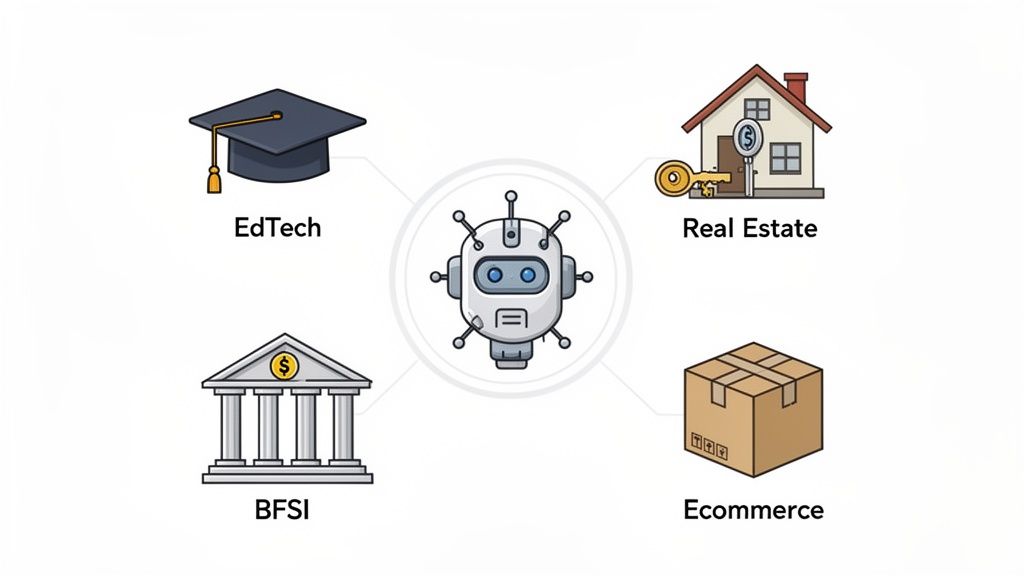
Each of these sectors has unique challenges, and conversational AI offers tailored solutions, whether it's qualifying high-value leads or providing compliant, 24/7 customer support.
Transforming EdTech and Student Recruitment
Educational institutions are inundated with inquiries from prospective students, especially during peak admission seasons. Admissions teams are often stretched thin, leading to slow response times and, ultimately, lost enrollment opportunities.
Practical Example: An AI agent can engage thousands of potential students simultaneously via voice or chat. It answers questions about course fees, curriculum, and entry requirements while gauging the prospect's level of interest and qualification. The outcome? A clean, pre-qualified list of high-intent leads is delivered directly to admissions counselors, freeing them to focus on building relationships and finalizing enrollments with the most promising candidates.
Boosting Conversions in Real Estate
In the fast-paced real estate market, speed-to-lead is everything. The first five minutes after an online inquiry are critical; a delayed response almost guarantees the lead is lost to a competitor.
Practical Example: A Voice AI agent can instantly call every new lead that fills out a form on your website, day or night. It confirms their interest, answers basic property questions ("Does it have a balcony?"), and books a site visit directly into a sales agent's calendar. This not only guarantees immediate engagement but also significantly boosts the number of qualified site visits. Human agents can then focus their time on showing properties and closing deals.
For a real estate developer, this eliminates manual dialing and inconsistent follow-ups. By automating the top of the sales funnel, some firms have seen their lead-to-booking rates jump from a typical 2% to an impressive 8%—a fourfold increase in qualified site visits, directly impacting the sales pipeline.
Modernising BFSI and E-commerce Operations
In Banking, Financial Services, and Insurance (BFSI), operations are governed by strict compliance and high customer expectations. Conversational AI helps businesses meet these demands by automating routine but critical tasks.
Practical Example: In banking, an AI agent can conduct initial KYC (Know Your Customer) verification calls, asking a standard set of questions and logging responses for compliance, all without human intervention. In e-commerce, the most common query is "Where is my order?" An AI agent can handle thousands of these inquiries simultaneously by integrating with logistics systems, providing real-time tracking updates via call or text. This drastically reduces the load on human support teams, allowing them to handle complex issues like product returns or complaints. This ability to both improve CSAT and cut operational costs is why so many companies are exploring how AI voice agents are transforming customer service and sales.
The conversational AI market in India is expanding rapidly, with these sectors leading the charge. Valued historically at around USD 288 million, the market is a mix of homegrown innovators and global players adapting their solutions for Indian businesses. This growth is being fuelled by the clear ROI seen in industries like BFSI and real estate, where AI agents are handling everything from compliant support calls to initial property enquiries.
Choosing Your Channel: Voice AI vs. Text AI
Once you've decided to implement conversational AI, the next strategic question is: should it talk or type? The choice between voice and text is not a technical detail; it's a crucial decision that shapes customer experience and operational efficiency.
Think of it as assigning the right task to the right team member. You wouldn't ask your top salesperson to handle routine data entry. Similarly, using a voice agent for a simple data lookup or a chatbot for a nuanced sales negotiation is a misallocation of resources. The key is to align the channel with the business objective of the interaction.
Are you aiming for lightning-fast, transactional efficiency, or do you need to build rapport and guide a customer through a complex journey? Your answer will point directly to the right technology.
When to Deploy Text AI for Maximum Efficiency
Text-based AI, or chatbots, excels at speed and precision. Its core strength is processing high volumes of straightforward, data-driven queries where a quick, accurate answer is the top priority. It's your digital workhorse for transactional tasks.
Practical Examples:
- Order Status Updates: A customer asks, "Where's my package?" A chatbot instantly fetches tracking data from your logistics system and provides a link. The query is resolved in seconds, no human required.
- Basic FAQ Handling: For repetitive questions like "What are your business hours?" or "What is your return policy?", a chatbot delivers instant, consistent answers 24/7, freeing up your team for more complex issues.
- Simple Data Collection: When you need to capture an email for a newsletter or a policy number to initiate a support ticket, a chatbot makes the process quick and frictionless for the customer.
A well-placed chatbot acts as the ultimate front-line filter. It handles the bulk of routine inquiries, ensuring your human experts are engaged only when their empathy and problem-solving skills are truly necessary.
For a deeper dive into how these channels compare for different business goals, check out our guide on voice assistants vs. chatbots for your business.
When Voice AI Is Essential for Building Rapport
Voice AI becomes indispensable when the conversation requires nuance, persuasion, and a human touch. The subtleties of tone and natural back-and-forth make voice agents ideal for high-value interactions where building trust and driving a specific outcome are paramount.
Practical Examples:
- High-Value Lead Qualification: A voice agent engages a potential real estate buyer in a genuine conversation. It can understand their budget, preferences ("I need at least three bedrooms"), answer specific questions about a property, and gauge their seriousness before seamlessly booking a viewing with a human agent.
- Sensitive Customer Service Issues: When a customer is frustrated with a service outage, the calm, patient tone of a human-like voice AI can de-escalate the situation far more effectively than a cold text interface, gathering details before routing to a specialized human agent.
- Complex Appointment Scheduling: Booking a detailed financial consultation isn't a simple, one-step process. A voice agent can navigate the back-and-forth ("Is Thursday afternoon good for you?"), find the perfect time, and gather all necessary context, making the experience feel personal and professional.
Choosing between text and voice isn't an either/or decision. The most effective strategies often use both, creating a seamless customer journey that leverages the strengths of each channel at different touchpoints.
Strategic Comparison: Voice AI vs. Text AI
To make the decision clearer for your business, here is a breakdown of the core strengths and ideal use cases for each channel.
| Attribute | Voice AI | Text AI (Chatbots) |
|---|---|---|
| Best For | Complex, nuanced, and relationship-driven conversations. | High-volume, transactional, and data-driven queries. |
| Primary Goal | Building rapport, persuading, de-escalating, and guiding decisions. | Providing instant answers, collecting simple data, and resolving issues fast. |
| User Experience | Personal and empathetic. Mimics a human-to-human interaction. | Quick and efficient. No-frills access to information. |
| Key Use Cases | Lead qualification, complex support, outbound sales, appointment setting. | Order tracking, FAQs, password resets, basic lead capture. |
| Complexity Handled | High. Can manage multi-turn conversations and emotional nuance. | Low to medium. Best for straightforward, predictable conversational flows. |
| Cost & Effort | Higher initial investment due to sophisticated voice technology. | Generally lower cost and faster to implement for basic tasks. |
Ultimately, the choice depends entirely on the specific business process you're trying to optimize. By mapping the customer's need to the channel's strength, you ensure your investment in conversational AI delivers maximum ROI.
Your Conversational AI Implementation Checklist
Integrating conversational AI is a strategic initiative, not just a tech upgrade. A successful deployment requires a business-first plan. This checklist serves as a roadmap to guide your project from concept to a value-delivering asset.
The journey starts with a simple question: why? Without a clear business purpose, even the most advanced AI can become an expensive experiment. The best implementations are always grounded in solving a specific business problem or seizing a clear opportunity for growth.
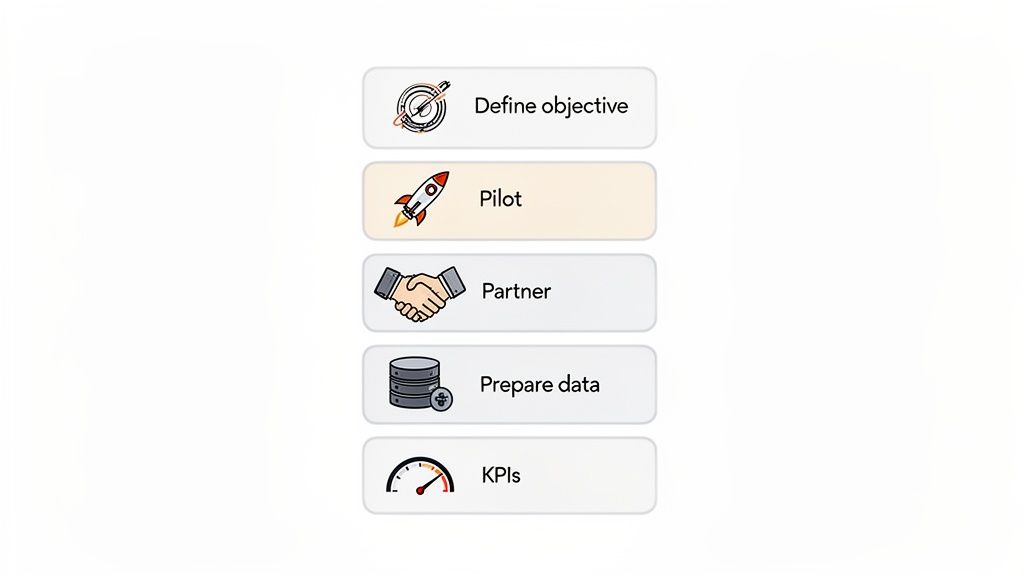
This structured approach ensures your AI project is a core part of your company's growth and efficiency strategy, not just an IT task.
Step 1: Define a Sharp Business Objective
Before evaluating vendors or technology, define precisely what you want the AI to achieve. A vague goal like "improve customer service" is insufficient. Your objective must be specific, measurable, and directly tied to a business outcome. This focus will guide every subsequent decision.
Examples of strong business objectives:
- "Reduce average support ticket resolution time by 30% in the next six months by automating initial data collection."
- "Increase the lead-to-booking rate for property viewings from 2% to 6% this quarter by ensuring 100% of leads are contacted within 5 minutes."
- "Automate 80% of routine KYC verification calls to free up compliance officers for high-risk case analysis."
Step 2: Identify a High-Impact Pilot Project
Avoid a "big bang" rollout. A massive, company-wide deployment from day one is a recipe for failure. Instead, select one high-impact area for a pilot project. This allows you to test the technology, collect real-world data, and demonstrate quick wins with minimal risk.
Look for a process that is a known bottleneck but is straightforward enough to automate. Excellent candidates include initial lead qualification calls, handling "where's my order?" queries in e-commerce, or scheduling first-round recruitment interviews. A win here builds the internal support and momentum needed for a wider rollout.
A well-chosen pilot project becomes your internal case study. It provides hard data and a success story to justify further investment and secure buy-in from other departments.
Step 3: Select the Right Technology Partner
Your choice of technology partner is critical. Look beyond flashy demos and seek a partner with proven experience in your industry. A vendor that understands the nuances of EdTech lead nurturing or the compliance hurdles in BFSI will provide a far more effective solution than a generic, one-size-fits-all platform.
Key questions for potential partners:
- Scalability: Can their system handle your peak call or chat volume as you grow?
- Integration: How seamlessly does it connect with your existing CRM, helpdesk, and other core business systems?
- Support & Expertise: What level of strategic support and industry expertise do they provide during and after implementation?
Step 4: Prepare Your Data Effectively
Conversational AI learns from data. To perform effectively from the start, it needs high-quality, relevant information. This could be historical customer chat logs, call transcripts, or your internal knowledge base. The better the data you provide, the smarter and more natural its conversations will be.
Step 5: Establish Clear KPIs to Measure Success
If you can't measure it, you can't manage it. Return to your business objective from Step 1 and define the Key Performance Indicators (KPIs) that will prove success. These are not vanity metrics; they are objective proof of the AI's business impact.
Essential KPIs to track:
- Conversion Rate: The percentage of AI interactions that achieve the desired business outcome (e.g., a booked demo, a completed sale).
- Customer Satisfaction (CSAT) Score: Direct feedback from customers after interacting with the AI.
- Containment Rate: The percentage of queries the AI resolved autonomously, without needing escalation to a human agent.
This kind of strategic thinking is driving a huge market shift. In 2024, India's conversational AI market hit USD 455.4 million and is expected to soar to USD 1,846.0 million by 2030, with industries like real estate and EdTech leading the charge. You can learn more about India's booming conversational AI market to understand how this growth is part of a much larger trend of smart AI investment.
The Future of Customer Engagement
The current capabilities of conversational AI are powerful, but the next evolution will be transformative. We are moving beyond simple, reactive chatbots that merely answer questions. The future is proactive, hyper-personalized AI assistants that anticipate customer needs.
Imagine an AI that not only processes a product return but also analyzes the customer’s purchase history to proactively suggest a better-fitting alternative. Consider a system that not only answers a query about an investment product but also identifies a relevant upsell opportunity based on the customer's profile and real-time market data—all within a single, seamless conversation. This is the strategic direction of the technology.
From Reactive Scripts to Proactive Strategy
We are shifting from a rigid, question-and-answer model towards a predictive and strategic one. The AI of tomorrow will function less like a digital receptionist and more like an intelligent business development partner, capable of guiding the customer journey to drive revenue.
This evolution is fueled by AI's growing ability to analyze vast amounts of data in real-time. Every interaction becomes a source of strategic insight, a capability that is driving a massive market shift.
The conversational AI market in India is exploding. Valued at USD 516.8 million in 2024, it's forecast to jump to a staggering USD 4,936.9 million by 2033. This isn't just hype; businesses are deploying solutions that achieve 97% accuracy in lead qualification while cutting operational costs by up to 30%. You can dig deeper into the numbers on India's conversational AI market growth on imarcgroup.com.
The Rise of the AI-Human Hybrid Team
Perhaps the most significant change on the horizon is the collaboration between AI and human teams. The future isn't AI replacing your best people; it's about creating a hybrid team where technology and talent play to their respective strengths. AI handles high-volume tasks, data analysis, and initial touchpoints, freeing your human experts for high-value, emotionally complex interactions.
This synergy creates a customer journey that is both highly efficient and effective:
- Initial Engagement: A human-like Voice AI makes the first contact, qualifying a lead or diagnosing a support issue through a natural, multi-minute conversation.
- Intelligent Handoff: When a human touch is required, the AI seamlessly transfers the call—along with a complete conversation summary and key insights—to the appropriate human agent.
- Empowered Agents: Your team member enters the conversation fully briefed, ready to close the deal or resolve a complex problem without ever asking the customer to repeat themselves.
This model perfectly blends the efficiency of automation with the irreplaceable value of human empathy and strategic thinking. By understanding these trends now, you can position your organization to harness the next wave of AI innovation. For a broader perspective on market forecasts, explore our analysis of the global conversational AI market size. This forward-thinking approach is what builds a true, sustainable competitive advantage.
A Few Common Questions About Conversational AI
As a leader, you're not just buying tech; you're making a strategic investment. When it comes to conversational AI, you need straight answers about how it fits into your business, how customers will react, and what the real financial impact will be. Let's cut through the noise and address the questions that really matter.
Just How Difficult Is It to Integrate Conversational AI Into Our Current Systems?
This is probably the biggest misconception out there. Modern conversational AI platforms aren't built to rip and replace your existing tools; they're designed to plug right into them.
Think of it this way: the AI uses APIs (Application Programming Interfaces) to talk to your CRM, helpdesk, or other business software. This connection allows the AI to pull up customer history for a truly personal conversation and then push important updates back into your systems.
Here’s a real-world example: One of our real estate clients has a Voice AI agent that pulls new lead details from their CRM, has a natural chat with the prospect, and then automatically logs the "Site Visit Booked" status and appointment time right back into the CRM's calendar. It’s all about enhancing your current tech stack, not starting from scratch. This means you can get up and running and see value much faster.
Will My Customers Actually Want to Talk to an AI?
It's a fair question, but the data is clear: customers are surprisingly happy to interact with an AI when it handles the right kind of task efficiently. For straightforward things like checking an order status or booking an appointment, many people actually prefer the instant, 24/7 help an AI offers. No waiting, no hold music.
Today’s advanced voice AI can hold conversations that are incredibly human-like, making the whole experience feel less like a robot and more like a helpful assistant. The best strategy is to let the AI handle the routine, high-volume queries. This frees up your human team to step in for the complex, sensitive situations where empathy is key. It's the best of both worlds: customers get quick answers for simple needs and expert human support when it really counts.
What’s the Real ROI on This? Is It Just About Cutting Costs?
The return on investment shows up in two major areas: saving money and making money.
On the one hand, yes, you'll see significant operational cost savings by automating thousands of repetitive calls and chats. But the strategic ROI is where it gets exciting—it's about driving growth through better lead conversion, shorter sales cycles, and keeping your customers happier.
To put some numbers on it, we've seen real estate clients boost their lead-to-booking rates from a typical 2% all the way up to 8% after bringing in a Voice AI agent. The true value isn't just in what you save; it's in the powerful combination of cutting operational overhead while actively growing your revenue and freeing your team to focus on strategic goals.
Ready to see how a digital workforce can transform your customer engagement? DialNexa delivers human-like Voice AI agents that turn more conversations into conversion-ready outcomes. Book a demo today.

[…] teams still aligning stakeholders on the category itself, DialNexa's primer on what conversational AI is in practice is a helpful starting point. But at board level, the conclusion should already be clear. This is […]
[…] Voice and visual features help teams assess whether text alone is enough, or whether broader conversational AI capabilities will drive better retention, conversion, or service […]
[…] primer before evaluating investment options, what is conversational AI from MakeAutomation and this guide to conversational AI systems and use cases provide useful background. The board-level question is different. Which conversations sit close […]
Excellent breakdown of conversational AI as a strategic growth engine rather than just a support tool. The focus on measurable outcomes, industry-specific applications, and a structured implementation roadmap makes this incredibly valuable for business leaders planning AI adoption.
[…] can connect telephony, CRM data, workflow tools, and escalation logic in one system. A broader overview of conversational AI systems and how they fit business operations helps frame that shift, but the board-level implication is more specific. Companies are no longer […]