

Scaling Your Real Estate Firm with a Strategic Virtual Assistant
A virtual assistant for real estate is a remote professional who manages the administrative, marketing, and operational tasks that are critical for your agency's success. By delegating these functions, you empower your top agents to dedicate their time to high-value activities: nurturing client relationships and closing deals. For a VP of Sales or a CEO, this isn't just about outsourcing; it's a strategic move to unlock operational leverage.
The Strategic Shift to a Virtual Assistant Model
For today's real estate executives, the critical question is not if you should delegate, but how to delegate to engineer sustainable growth. Integrating a virtual assistant is a calculated business decision that provides operational leverage and a distinct competitive advantage. You are strategically reallocating your most valuable asset—your agents' time—from low-yield administrative tasks directly to revenue-generating activities.

Consider two real estate firms, both experiencing rapid growth. At Firm A, top-performing agents are mired in operational details. They lose critical hours each day to paperwork, scheduling property viewings, and updating MLS listings. Their growth is capped not by their sales acumen, but by the sheer volume of administrative workload.
Firm B, in contrast, has agents focused exclusively on client engagement and contract execution. This is possible because a skilled virtual assistant for real estate is managing the entire back-end workflow, from qualifying inbound leads to coordinating with mortgage brokers and inspectors. This is not mere support; it's a force multiplier for the entire sales organization.
Achieving True Operational Leverage
By offloading these time-intensive responsibilities, your leadership team can transition from reactive problem-solving to proactive, strategic initiatives. This is the inflection point where genuine scaling begins.
- Market Expansion: With agents unburdened from administrative tasks, you can execute on a strategy to penetrate a new geographic market or property segment you've been targeting.
- Strategic Partnerships: Directors and VPs gain the bandwidth to cultivate high-value relationships with developers, lenders, and institutional investors.
- Enhanced Client Service: Your agents can provide the undivided attention that high-net-worth clients expect, leading to increased customer lifetime value and referral business.
Practical Example: A mid-sized brokerage in a competitive urban market was struggling to expand into the luxury condo segment. Their top agents were spending nearly 40% of their week on transaction coordination and scheduling. By hiring two VAs to manage these tasks, the firm freed up over 30 agent-hours per week. This time was reinvested into networking and prospecting, resulting in a 25% increase in luxury listings within six months.
This strategic shift is far more than an efficiency gain; it's a blueprint for scalable growth. As your transaction volume increases, you can seamlessly add more virtual assistants without the significant overheads of full-time employees. The clear business impact of VAs is a primary driver why the AI virtual assistants market is projected to grow significantly, signaling a market-wide trend towards intelligent delegation. Adopting this model now builds a real estate enterprise that is more profitable, agile, and prepared for future market dynamics.
How a VA Can Transform Your Daily Operations
Moving from high-level strategy to tactical execution, the true value of a virtual assistant for real estate is realized in daily operations. For agency leaders, this is about systematically re-engineering workflows to ensure your most skilled personnel—your agents—are exclusively focused on revenue generation. By delegating core operational functions, you create a system where agents can operate at peak performance.

This strategic delegation transforms an unpredictable influx of inquiries into a structured, qualified pipeline. It introduces precision into administrative processes and enables your firm to deliver a consistently superior client experience—a key differentiator in a competitive marketplace.
Mastering Lead Management and Qualification
Every day, your brokerage is inundated with leads from multiple channels: website forms, Zillow, social media campaigns, and inbound calls. Without a robust system, this volume can overwhelm even your most capable agents, resulting in delayed responses and, consequently, lost revenue. A virtual assistant provides an immediate, quantifiable solution.
A VA serves as your dedicated front line, systematically processing and qualifying every new contact. They can engage with new inquiries in real-time, gathering the critical data needed to assess a prospect's intent and readiness.
- First Contact: A VA can execute a multi-channel outreach (email and SMS) within five minutes of a new lead submission, asking pre-defined qualifying questions about budget, desired location, and timeline.
- CRM and Nurturing: They ensure every interaction is logged in your CRM, correctly tag the lead's status, and enroll them in the appropriate automated nurture campaigns.
- Booking Appointments: For high-intent leads, the VA can directly schedule an introductory call or property viewing in the assigned agent’s calendar, eliminating friction.
Practical Example: A leading brokerage implemented a VA to manage their inbound web leads. Previously, their average response time was over two hours. The VA, using a scripted outreach process, reduced this to under three minutes. Within the first quarter, their lead-to-appointment conversion rate increased by 22%, directly attributable to the speed and consistency of the follow-up.
Executing Flawless Scheduling and Coordination
The logistical complexity of coordinating schedules is a significant operational drag in real estate. Managing multiple agent calendars, client availability, and property access can easily lead to double bookings and missed appointments, damaging client perception. A virtual assistant centralizes this function, bringing order to the chaos.
Consider the simple task of arranging a property tour. It requires aligning the schedules of the buyer, seller, both agents, and potentially a property manager. A VA manages these moving parts with precision, confirming every appointment and ensuring all stakeholders are notified of any changes.
Their coordination role extends across the entire operational calendar:
- Coordinating with Vendors: Scheduling photographers, home inspectors, and staging companies.
- Managing Team Meetings: Organizing weekly sales pipeline reviews and training sessions.
- Client Follow-ups: Triggering reminders for agents to follow up post-viewing or after an offer submission.
Delivering Precision Administrative Support
Administrative tasks are the engine of a real estate firm, but they are also a major productivity drain for agents. Delegating these responsibilities to a virtual assistant for real estate not only reclaims valuable agent time but also introduces a higher level of consistency and accuracy to your back-office operations. You can explore the many benefits of an AI virtual agent in our detailed guide to see how automation can supercharge these functions even further.
Let's look at a prime example: managing property listings. The demand for VAs in India's real estate sector has grown significantly, driven by this very need. Recent data indicates that approximately 22% of agents in India now delegate property listing management to VAs, fundamentally changing their portfolio management efficiency.
Key administrative tasks a VA can own include:
- CRM Management: Ensuring all client interactions, notes, and documents are logged with 100% accuracy and timeliness.
- Document Preparation: Drafting sales agreements, listing contracts, and addendums from approved templates.
- Listing Updates: Maintaining current property statuses across the MLS and all third-party listing portals.
By entrusting these essential functions to a skilled virtual assistant, you empower your sales team to perform at their highest capacity, focusing their efforts on closing deals and driving business growth. This strategic shift is fundamental to building a more efficient, scalable, and profitable real estate organization.
Human Touch vs. AI Speed: Finding the Perfect Balance
In today's real estate landscape, the discussion is no longer a binary choice between human resources and technology. For forward-thinking leaders, the challenge is to architect an intelligent system where the nuanced intuition of a human expert is amplified by the sheer processing power of AI. It is not an "either/or" scenario; it's about creating a synergistic team that outperforms the sum of its parts.
A human virtual assistant for real estate is indispensable for scenarios requiring empathy and complex problem-solving. Consider a delicate negotiation between an anxious first-time homebuyer and a recalcitrant seller. No algorithm can interpret subtle emotional cues or build the rapport necessary to prevent a high-value deal from collapsing. This is where human intelligence excels.
Conversely, AI is the undisputed champion of volume, speed, and consistency. It can process a massive influx of new inquiries 24/7 without fatigue, ensuring every lead receives an immediate, standardized response. In a market where speed-to-lead is a critical success factor, this level of responsiveness is a non-negotiable competitive advantage.
The Hybrid Model: Your Competitive Edge
The optimal strategy is not to choose between these assets but to blend them into a seamless, hybrid workflow. This approach leverages each for its core strengths, optimizing every stage of the customer journey for maximum efficiency and an enhanced client experience.
- AI Kicks Things Off: An AI-powered chatbot or voice agent can engage a new lead from your website or a property portal the instant they inquire. It asks initial qualifying questions, captures essential data, and answers common queries immediately, day or night.
- The Seamless Handoff: Once the AI has qualified the lead's intent, it can automatically schedule a call or transfer the conversation—along with the complete interaction history—directly to a human VA.
- Human VA Takes Over: The human assistant then adds the critical layer of personalization. They can build rapport, address complex questions, and strategically guide the prospect toward booking a viewing or speaking with an agent.
Practical Example: A national brokerage deployed an AI voice agent to handle after-hours calls. The AI successfully qualified 60% of these inbound leads and scheduled them for a call-back with a human VA the next morning. This hybrid approach ensured 100% lead capture and allowed the VAs to start their day with a pre-vetted list of warm leads, increasing their productivity by 30%.
Why This Combination Just Works
Integrating AI and human VAs creates a system that is both scalable and deeply personalized. The rapidly evolving real estate market in India serves as a compelling case study. A recent industry report revealed that slow follow-up times cost agents thousands in lost commissions annually, underscoring the criticality of immediate engagement. In response, many Indian firms are now deploying AI voice bots and virtual assistants for initial lead qualification and appointment scheduling (it starts with the right prospect list – see our guide to sourcing quality data for real estate calling)—a strategic move that is yielding significant returns.
This strategy directly addresses the most significant bottlenecks in a real estate agency's pipeline. Missed calls represent a major source of lost revenue, but a well-designed system combining AI and human VAs can virtually eliminate this problem. You can learn more about how realtors lose business by not answering calls and the AI solution in our deep-dive article on the topic.
By automating the repetitive, high-volume initial stages of communication, you enable your skilled human assistants to concentrate on high-impact activities: building relationships and solving complex client problems. These are the functions that directly drive revenue and enhance your firm's reputation. This strategic balance is the key to a more resilient, efficient, and profitable real estate business.
Your CXO Blueprint for VA Integration
Integrating a virtual assistant is not a simple hiring decision; it is a strategic operational change. Deploying a VA without a structured plan is akin to acquiring powerful new software without an implementation strategy—it's destined to underdeliver. This blueprint provides a leadership-focused roadmap to effectively embed a VA into your operations, ensuring they function as a high-impact asset from day one.
It begins with absolute clarity. Vague directives like "manage leads" are a recipe for failure. You must define a precise role with measurable outcomes. This involves architecting a detailed playbook for every core function being delegated.
This same clarity must extend to your technology stack. Your systems must be configured to empower your VA, not create operational friction. The objective is to create a seamless flow of information that eliminates manual work and accelerates your entire sales cycle.
Defining Roles with Precision
To maximize ROI, you must move beyond generic job descriptions to laser-focused role definitions. This involves mapping out specific tasks and, more importantly, the key business outcomes you expect. A well-defined role is the foundation of a successful VA partnership.
For example, a Lead Qualification Specialist VA should not just be "handling inquiries." Their role should be defined by specific actions and metrics:
- Task: Respond to all new web-form submissions within five minutes.
- Process: Utilize pre-approved email and SMS templates to ask three core qualifying questions (e.g., budget, timeline, desired location).
- System Action: Log every response and update lead status in the CRM under the "New Inquiry" tag.
- Success Metric: Increase the lead-to-appointment booking rate by 15% within the first quarter.
This level of detail eliminates ambiguity and directly links the VA's daily activities to your firm's strategic objectives.
Engineering Scalable SOPs
Your Standard Operating Procedures (SOPs) are the operational playbook for your business. For a virtual assistant, these documents are the definitive source of truth for executing tasks correctly and consistently. Well-documented, scalable SOPs ensure that whether you have one VA or a team of ten, the quality of execution remains uniformly high.
A robust SOP is a dynamic document. It should be detailed enough for a new team member to execute a process without direct supervision but flexible enough to be updated as you refine your workflows.
Consider a routine process like coordinating a property viewing. A comprehensive SOP would include:
- A checklist for gathering availability from the buyer, seller, and both agents.
- Template communications for confirming the appointment via email and SMS.
- A clear protocol for handling last-minute cancellations or rescheduling requests.
- Instructions for triggering automated reminders 24 hours and 2 hours before the viewing.
By systemizing these workflows, you deliver a consistently professional experience for every client and make your VA’s role more efficient and less susceptible to human error.
This diagram illustrates a common hybrid workflow, where AI handles the initial high-volume intake and basic qualification before a human VA intervenes for high-touch, personalized engagement.
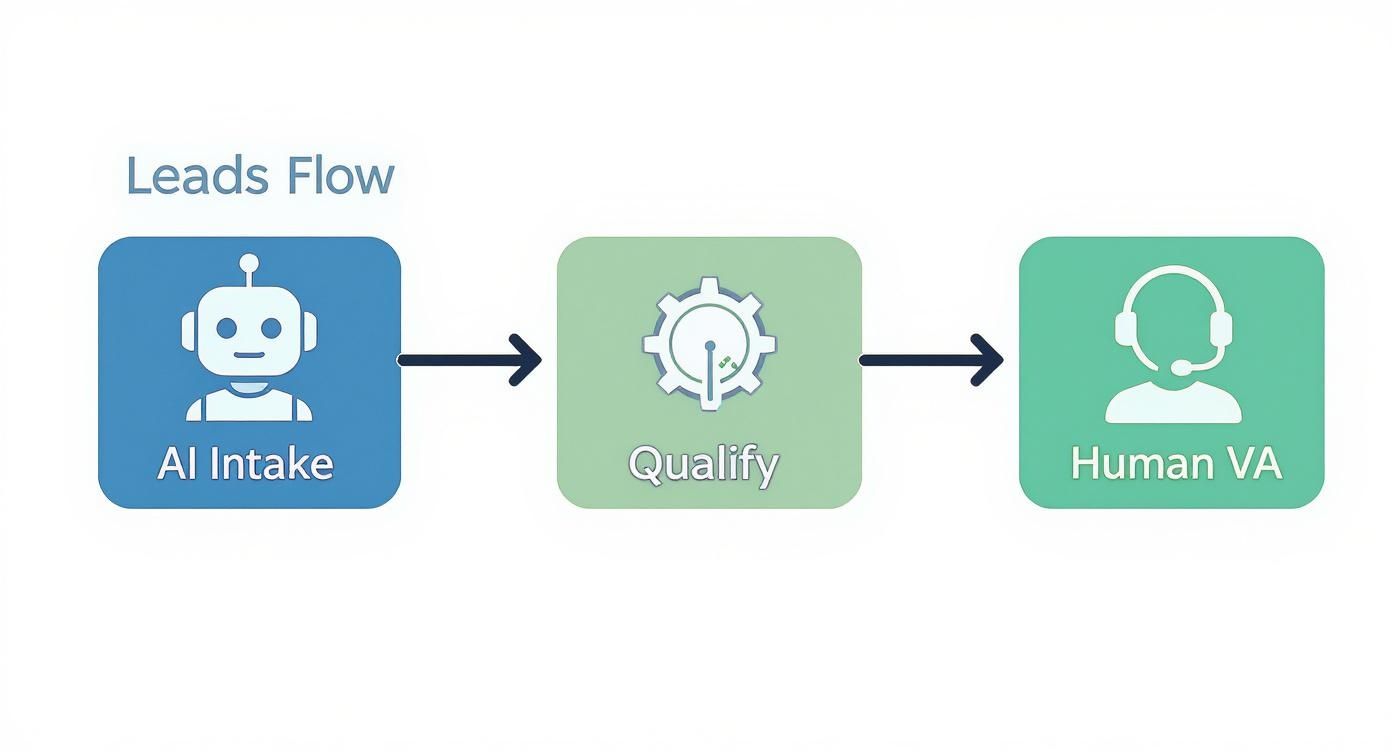
This process flow demonstrates how you can effectively blend technology and human skill to manage leads, ensuring no opportunity is missed while maximizing the productivity of your agents.
Integrating the Right Technology Stack
Finally, your technology stack must serve as the integrated backbone of your operations. The key concept here is integration. You need data to flow seamlessly between the platforms your team uses daily. Application Programming Interfaces (APIs) are essential for achieving this.
Imagine this scenario: your virtual assistant for real estate logs a call outcome as "Site Visit Booked" in your telephony software. An API call can instantly and automatically update that lead's status in your CRM. This update could then trigger another automated action, such as enrolling the client in a "Pre-Viewing Nurture" email sequence via your marketing automation platform.
This level of integration creates a powerful, automated ecosystem. It dramatically reduces manual data entry, minimizes the risk of errors, and provides leadership with a real-time, accurate view of the sales pipeline. Following this blueprint transforms your VA from a task-doer into a fully integrated, indispensable component of your growth engine.
Calculating the True ROI of Your Virtual Assistant
https://www.youtube.com/embed/CUB3R5a8c2U
For any business investment, the ultimate question is always the same: what is the return? While a virtual assistant for real estate offers immediate cost savings on salaries, the true value lies in their role as a revenue accelerant. To capture the full picture, executives must look beyond simple hourly rates and focus on the metrics that directly impact growth and profitability.
Measuring success is not merely about cost reduction; it's about tracking gains in productivity and revenue. The right KPIs will demonstrate precisely how a VA is making your most valuable asset—your team of agents—more effective and profitable.
Moving Beyond Simple Cost Savings
The most effective way to quantify financial impact is through a straightforward formula that balances efficiency gains against new revenue generation. This data-driven approach provides the justification for the investment and informs decisions on scaling the VA team.
ROI Formula: (Value of new deals from VA-supported agents + Savings from administrative efficiencies) – (Total VA investment)
This calculation reframes the VA from a cost center to a profit center. For instance, if a VA service costs ₹50,000 per month but enables your agents to close just one additional deal with a ₹2,00,000 commission, the return is not merely positive—it is substantial, representing a 300% ROI for that month.
Key Performance Indicators for VA Success
To populate that formula with real data, you must track the right KPIs. These are the metrics that connect your VA's daily activities directly to your bottom line.
- Decreased Lead Response Time: How quickly are new inquiries being engaged? A VA can reduce this from hours to mere minutes. A target of responding to all web leads within 5 minutes is an achievable goal that significantly increases conversion probability.
- Increased Lead-to-Appointment Rate: What percentage of qualified leads result in a scheduled site visit? With a VA managing qualification and follow-up, it is common to see this metric improve by 15-20% within a single quarter.
- Higher Number of Viewings Per Agent: With administrative burdens removed, how many more properties can each agent show per week? An increase from 5 to 8 viewings per agent per week is a realistic outcome, directly creating more sales opportunities.
This data-driven approach provides a clear, objective assessment of the investment's performance. The global talent pool to support this growth is robust, with India emerging as a major hub. An estimated 1 to 1.5 million virtual assistants are based in India, representing a significant portion of the global market. This has made the country a premier destination for high-quality real estate administrative support. You can read more about the rising demand for virtual assistants from India on Vocal.media.
By focusing on these specific, measurable outcomes, you can accurately calculate the immense value a real estate VA brings to your business. The conversation shifts from managing an expense to making a strategic investment in scalable growth.
Selecting the Right VA Partner for Your Firm
Choosing a provider for your real estate virtual assistant is not a standard vendor selection; it is analogous to hiring a senior manager. You are not simply sourcing a resource; you are establishing a long-term strategic partnership that must align with your corporate culture, security protocols, and growth ambitions.
A poor choice can lead to operational disruptions, potential security vulnerabilities, and a misallocated budget. As a leader, your role is to mitigate these risks by conducting rigorous due diligence from the outset. A structured vetting process is the only way to ensure your selected partner can deliver tangible business outcomes, not just a service.
Your Due Diligence Checklist
Before entering into any agreement, your leadership team must subject potential partners to a thorough evaluation. This process allows you to penetrate beyond the sales presentation to assess their core capabilities and cultural fit.
Here are the critical questions that demand answers:
- Real Estate Specialisation: Can they provide specific case studies or testimonials from real estate firms of a similar scale? Ask for concrete examples of how they helped a brokerage increase its appointment setting rate or reduce its administrative overhead.
- Data Security and Confidentiality: What are their specific protocols for protecting your sensitive client and financial data? Inquire about their NDAs, secure data transfer methods, and compliance with relevant data protection regulations. This is a non-negotiable point.
- Scalability and Flexibility: Can their service model adapt to your business cycles? Discuss the process for scaling from one VA to a team of five during a peak season, and, just as importantly, the process for scaling back down. A true partner understands that business needs are dynamic.
If a provider cannot furnish specific success metrics from the real estate sector, it constitutes a significant red flag. Generic testimonials are insufficient. You require evidence that they possess a deep understanding of the unique pressures and workflows of your industry.
Assessing Communication and Reporting
Transparent and consistent communication is the bedrock of a successful remote partnership. You require a clear, ongoing view of your VA's performance without engaging in micromanagement.
- Communication Channels: What tools do they utilize for daily check-ins and urgent communications? Confirm their proficiency with your firm's preferred platforms, such as Slack or Microsoft Teams.
- Reporting Structure: What is the frequency and format of performance reports? What key metrics are tracked? A quality partner will provide detailed reports covering tasks completed, hours logged, and progress against your pre-defined KPIs.
Executing this structured evaluation removes subjectivity from the decision-making process. It provides the confidence to select a partner who will not only supply skilled personnel but will also function as a trusted advisor, helping you build a more streamlined and profitable real estate organization.
Answering the Questions from the Top
As a senior leader in a real estate firm, every new investment is subject to intense scrutiny. You are evaluating not just features, but bottom-line impact, potential risks, and the timeline for realizing a return. Let's address the critical questions that accompany the decision to onboard a virtual assistant for real estate.
What’s the Real Cost Compared to an In-House Hire?
It is a common mistake to compare a VA’s hourly rate directly to an employee's salary. This is a flawed, apples-to-oranges comparison. The total cost of an employee extends far beyond their gross pay; it includes benefits, payroll taxes, office space, equipment, and significant recruitment and training costs.
The virtual assistant model eliminates these ancillary expenses. For example, an in-house administrative employee with a ₹4,00,000 annual salary could represent a total cost to the business exceeding ₹6,00,000 when all overheads are included. A skilled VA service can provide an equivalent level of support for a single, predictable fee, often resulting in total cost savings of up to 70%.
How Do You Keep My Confidential Data Secure?
In the real estate business, your data—client lists, transaction details, financial records—is your most valuable asset. Protecting it is not merely a priority; it is a fundamental operational requirement. Any reputable VA provider has built its business on a foundation of airtight security and client trust.
- Ironclad NDAs: Before any access is granted, the VA signs a legally binding non-disclosure agreement. This is a standard, non-negotiable practice.
- Secure Systems: VAs operate within encrypted environments and are trained to handle all sensitive data using secure protocols for communication and file transfer.
- Access Control: Your firm retains complete control. You determine the precise systems and level of information your VA can access, granting permissions on a need-to-know basis only.
Delegating tasks should never mean compromising on security. With a properly vetted partner, it won’t.
How Soon Can I Expect to See a Real Return on Investment?
This is not a long-term strategic play with a payoff horizon of years. The operational impact of a virtual assistant is realized almost immediately. The timeline for a positive return is measured in weeks and months, not years.
Initial efficiency gains—such as accelerated lead response times and more organized agent calendars—are typically observable within the first 30 days. A clear, positive financial ROI, driven by an increase in agent-closed deals, generally becomes evident within the first business quarter.
This rapid feedback loop validates the investment and provides the confidence to scale the model and compound the benefits across your organization.
Ready to see how a voice AI agent can deliver these results at scale for your real estate firm? DialNexa provides intelligent agents that handle lead qualification and site-visit booking with human-like precision, freeing your team to focus exclusively on closing deals. Discover the DialNexa difference.

Leave a Reply