
Scaling Bulk Voice Calls With an AI-Driven Strategy
Bulk voice calls are essentially automated phone calls that send a pre-recorded message to thousands of people simultaneously. But let's be clear: this isn't about the robotic, one-way messages of the past. With today's Voice AI, these calls are interactive, personalized, and can sound so human you’d be hard-pressed to tell the difference. From a leadership perspective, they are a powerful tool to drive measurable business outcomes, from qualifying high-value leads to handling proactive customer support.
Why Bulk Voice Calls Are a Strategic Imperative
Let's face it. The market is saturated. Executive inboxes are buried, and social media ads are swiped away in a heartbeat. For any senior leader, securing a direct line to your audience has become a massive challenge. In this crowded space, AI-powered bulk voice calls are re-emerging, not as an old-school tactic, but as a vital channel for creating genuine connections at scale. The ability to speak directly into your customer's ear with a clear, tailored message is a game-changer for driving growth and operational efficiency.
For a Director of Sales, this means contact rates can skyrocket. Imagine a scenario where an AI handles the initial outreach, sifting through thousands of leads from a recent trade show, and hands your elite sales team only the prospects who have confirmed their interest and budget. Your top performers stop wasting time on dead ends. For a VP of Customer Experience, it's about shifting from reactive to proactive support. For example, an AI can proactively call all customers in an area affected by a service outage, providing updates and reducing inbound call volumes by over 60%, boosting satisfaction and freeing up human agents for complex issues.
Unlocking Tangible Business Value
Modern voice campaigns aren't a niche tool; their applications stretch across the entire business and tie directly into core executive goals like efficiency, ROI, and competitive advantage.
Here are a few practical examples of how senior leaders are leveraging this:
- Streamlining Collections: A major financial services firm automates its payment reminders, including personalized details like the customer's name and outstanding balance. The result? A 22% increase in on-time payments within the first quarter, allowing their collections team to focus exclusively on high-value, sensitive cases.
- Boosting Voter Turnout: A political campaign blankets key constituencies with get-out-the-vote messages in the voice of the candidate. This personal touch creates an emotional connection that a simple text message can't match, contributing to a measurable lift in voter participation in targeted districts.
- Enhancing E-commerce Logistics: A national online retailer implements automated calls to update customers on their delivery status. This simple, proactive communication slashes "Where is my order?" calls to their support center by 40%, smoothing out the post-purchase experience and improving customer loyalty scores.
The strategic shift here is from broadcasting a message to orchestrating intelligent, automated conversations. The technology, often called Voice Broadcast solutions, has evolved far beyond what many leaders might remember.
A Proven Channel in a Mobile-First World
This strategy is especially potent in mobile-first markets like India, a country with over 1.08 billion active mobile subscribers. Voice calls don't require an internet connection or even a smartphone, giving you a direct line to a much broader audience than digital-only methods can provide.
This direct access is incredibly effective in Tier-2 and Tier-3 cities. In fact, we've seen voice marketing campaigns generate up to 38% more conversions than email or SMS in these areas, largely because they can communicate in local languages and dialects. When you layer in AI that creates natural, trustworthy voices, engagement goes through the roof.
Ultimately, weaving bulk voice calls into your corporate strategy is about running a smarter, more efficient operation and building stronger customer relationships. By automating routine outreach, you don't just cut costs—you make your messaging consistent, perfectly timed, and far more impactful. To go a bit deeper, check out our insights on why implementing AI voice agents in 2025 will elevate customer experience and boost business growth.
Building Your High-Performance Voice Campaign
A great campaign isn’t just about having a compelling message. From my experience, what truly separates a forgettable voice blast from an intelligent customer interaction engine is the underlying architecture—both technical and strategic. For any leader, getting this blueprint right is the difference between just making calls and actually driving measurable growth.
Let's get straight into the core components, starting with the engine that powers it all: your dialer technology.
Selecting the Right Dialer Technology
The type of dialer you choose has a direct, and often underestimated, impact on your campaign's efficiency and the customer's experience. This isn't just a technical choice; it's a strategic one. You need to match the tool to the job.
Are you aiming for high-volume, low-touch notifications, or are your teams managing high-value, complex relationships? The answer dictates your choice.
-
Preview Dialers: Think of this as the tool for your top-tier, consultative teams. It serves up all the customer's information before the call is placed, giving your agent a moment to prep. A Director of Enterprise Sales would insist on this, ensuring their team is armed with context before speaking to a key account. It's all about maximising the value of each conversation.
-
Power Dialers: When you need to blend efficiency with a human touch, the power dialer is your workhorse. It automatically dials the next number on a list the second an agent is free, cutting out the dead time between calls. This is perfect for a Head of Inside Sales whose team needs to make hundreds of follow-ups without the drag of manual dialling.
-
Predictive Dialers: This is your solution for massive scale. A predictive dialer is smart; it uses an algorithm to dial multiple numbers at once, predicting when an agent will be free and connecting them to a live person instantly. A VP of Operations running a huge payment reminder campaign would use this to contact thousands of customers per hour with almost zero agent downtime.
To make this decision clearer at a strategic level, think about how each technology serves a specific business objective.
Strategic Dialer Selection Framework
Matching dialer technology to specific executive-level business goals.
| Dialer Type | Primary Business Use Case | Ideal for Which Department Head? | Key Performance Benefit |
|---|---|---|---|
| Preview | High-value, complex sales & relationship management | Director of Enterprise Sales | Maximised conversion rates on key accounts |
| Power | High-volume follow-ups & lead qualification | Head of Inside Sales | Increased agent talk time and productivity |
| Predictive | Mass notifications, surveys, & payment reminders | VP of Operations / Collections | Unmatched contact rate and operational scale |
Ultimately, choosing the right dialer ensures that your technology is actively supporting your team's primary function, not getting in their way.
The goal is to cut through the digital noise and create a genuine connection, which is what a well-planned voice strategy is all about.
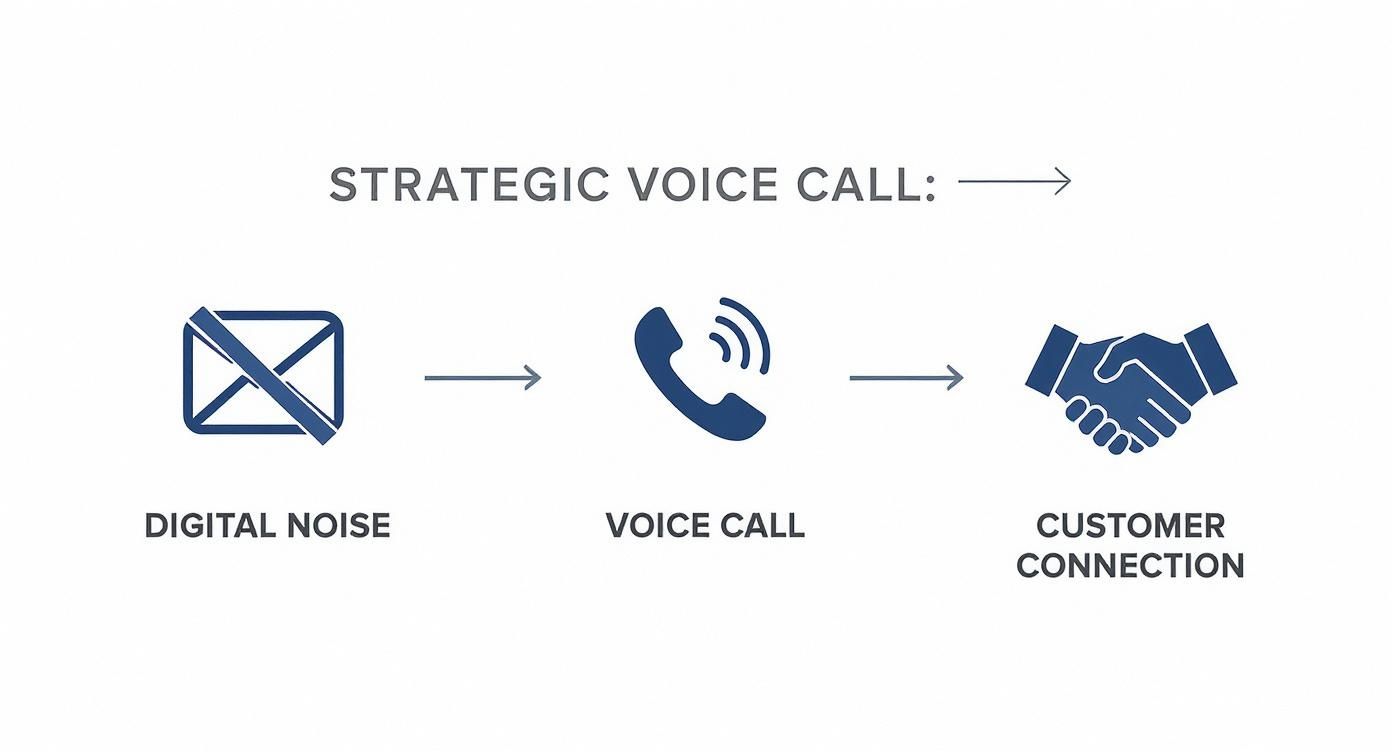
This journey from noise to connection is the entire point of a modern bulk voice calls initiative.
The Power of Voice AI and Natural Language
Once your dialer is sorted, the next layer is the voice itself. This is where modern conversational AI, driven by Natural Language Processing (NLP), really changes the game. Forget those old, static, pre-recorded messages. Today's tech allows for interactive, human-like conversations that can actually understand what the customer wants.
Imagine a customer receives an automated delivery notification call. They might interrupt and ask, "Can you just leave it with the security guard at the main gate?" An advanced Voice AI understands this contextual request, confirms the action ("Sure, I'll update the delivery notes to leave the package with the main gate security guard"), and updates the delivery notes in your logistics system. No human intervention needed.
That's how you turn a simple notification into a valuable, service-focused interaction that builds brand loyalty.
As a leader, your focus should be on how Voice AI can automate routine conversations. This frees up your best people to handle the high-value, complex issues where they truly make a difference. It’s a direct win for both operational efficiency and team morale.
Integrating with Your Core Business Systems
The final, crucial piece of this architecture is integration. A voice platform running in a silo is a huge missed opportunity. The real power is unlocked when you connect it to your CRM and other business systems through APIs (Application Programming Interfaces).
Think about it: your voice platform talking directly to your Salesforce or HubSpot CRM. This creates an intelligent, automated feedback loop.
Here’s a practical executive-level example:
- Triggered Calls: In your CRM, a high-value prospect's status changes to "Demo Requested." This action automatically triggers a voice call from a sophisticated AI agent to schedule the appointment, checking the prospect's calendar availability via an integrated scheduling tool. The entire process happens within 60 seconds of the request.
- Data Enrichment: The call outcome—whether it was "Demo Scheduled," "Needs Follow-up," or "Voicemail"—is written back to the customer's contact record in the CRM in real-time, along with a full transcript and summary of the call.
This seamless flow of data gives your sales and support teams a complete, up-to-the-minute picture of every interaction. Your bulk voice calls are no longer just an outreach tool; they become a vital, data-rich part of your entire customer lifecycle strategy, fuelling smarter decisions across the whole organisation.
Mastering Compliance and Building Customer Trust
For anyone in a leadership position, compliance is far more than just a legal checkbox. It’s the bedrock of your company's integrity and a critical component of your brand's reputation. When you're dealing with bulk voice calls, navigating the regulatory landscape isn't just an operational chore—it's a strategic imperative. In India, this means getting to grips with the guidelines laid out by the Telecom Regulatory Authority of India (TRAI).
This isn't about memorising dry legal text. It's about fundamentally understanding the business impact of frameworks like DLT (Distributed Ledger Technology) for sender ID registration, having airtight consent management processes, and adhering to strict Know Your Customer (KYC) norms. Getting this right not only helps you sidestep hefty penalties but, more importantly, it builds the kind of trust that cements long-term customer relationships.
Navigating DND and DLT in Practice
The Do Not Disturb (DND) registry often feels like a major roadblock for businesses. How do you respect a customer's choice to opt-out while still getting essential information to them? The entire solution lies in how you classify your calls within the DLT framework.
Let’s take a financial services firm as an example. A promotional call about a new investment fund is a clear no-go for anyone on the DND list. But what about a call alerting that same customer to a suspicious transaction on their account? That's transactional, and it has to get through.
Here’s how to think about it strategically:
- Transactional Route: This is your express lane for critical alerts—think OTPs, delivery confirmations, or fraud warnings. These are designed to bypass DND filters because they contain information the customer needs immediately.
- Promotional Route: Any marketing-related bulk voice calls fall squarely in this category. These calls must respect the DND list. Trying to sneak promotional content through the transactional route is a surefire way to land in hot water.
- Service Implicit/Explicit: This is the middle ground. It covers communications based on a customer's existing relationship with you or explicit consent they've given, like sending renewal reminders or service updates.
The real aim here is to architect a communication strategy where every single call has a clear, justifiable purpose. That kind of transparency transforms a regulatory headache into a customer-centric practice, proving that you respect their time and preferences.
The Dynamics of a Mobile India
Understanding subscriber behaviour is just as crucial for compliance as it is for campaign performance. The Indian telecom market is incredibly fast-moving, marked by high mobile number portability (MNP) and an enormous subscriber base. As of July 2025, India had roughly 1,220 million telephone subscribers. In that month alone, an eye-watering 15.41 million MNP requests were submitted, highlighting just how quickly customers switch providers.
This constant churn means your contact lists need to be validated relentlessly to stay compliant and effective. A phone number’s network and DND status can literally change overnight. You can find detailed subscriber reports on TRAI's website to keep up with these trends.
With over 1,170 million wireless subscriptions, this mobile-first reality makes bulk voice calls an incredibly potent tool, especially for reaching people in areas where text literacy or reliable data connectivity might be a challenge.
An Actionable Compliance Checklist
To make sure your campaigns are built on solid ground, your team needs to be auditing your processes regularly. Think of it as preventative maintenance that protects your brand and reinforces the trust you've built.
- Validate DLT Registration: Is your business properly registered on a DLT platform? Are all your sender IDs (Headers) and voice templates approved and, critically, are they in the right categories?
- Audit Your Consent Protocols: How are you actually capturing and storing customer consent? You need clear, time-stamped records to back up any promotional outreach you do.
- Segment Your Contact Lists: Make it a routine to scrub your lists against the national DND registry. Better yet, build a system that automatically flags and separates DND numbers from your marketing campaigns from the get-go.
- Review Call Scripts for Transparency: Does every call script start by clearly identifying your company and the reason for the call? Ambiguous or deceptive openings are a huge compliance red flag.
Simply knowing the rules isn’t enough; you have to put them into practice across your entire operation. This approach flips compliance from a defensive chore into a proactive strategy for building stronger, more transparent relationships with your customers. And for those exploring the use of AI, it’s also wise to dig into the legal and ethical considerations of AI phone calls to ensure your strategy is sound from every angle.
Crafting Voice Campaigns That Actually Work
Anyone can blast out a generic voice message. That's just noise. A truly effective campaign, however, treats each call as a strategic asset. The goal isn't just to reach your customers; it's to get them to listen and, more importantly, to act. This is where you move beyond simple announcements and start creating genuinely compelling interactions, which comes down to a smart mix of persona, scripting, and targeting.
Before you write a single word, you need to decide who—or what—is making the call. Your AI's voice persona is a direct extension of your brand, and it needs to be chosen deliberately. Is it a calm, helpful assistant for appointment reminders? A formal, authoritative tone for financial alerts? Or an upbeat, enthusiastic voice for a special event? This decision sets the stage for the entire conversation.
Designing a Voice Persona That Resonates
An AI voice persona is so much more than just picking a voice that sounds nice. It’s about matching the vocal characteristics to the call’s purpose and your brand's personality.
For instance, a luxury real estate firm inviting high-net-worth clients to an exclusive property viewing would need a polished, sophisticated voice. On the other hand, an EdTech platform following up with students about their course applications should probably use an encouraging, friendly, and youthful tone.
The key here is consistency. This voice becomes a recognisable part of your customer experience, so it has to feel authentic every single time.
Smart Scripting and Hyper-Personalisation
Let's be honest: static, one-size-fits-all scripts are dead. The real magic of modern bulk voice calls is in dynamic, data-driven scripting that speaks to each person as an individual. This is where your CRM integration stops being a database and starts being a strategic powerhouse, enabling personalisation at a massive scale.
Think about the difference between a generic message and a call that says:
"Hello Priya, this is a reminder from Acme Electronics. Your recent order, number 85421, containing the new Spectra smartphone, is scheduled for delivery today between 2 PM and 4 PM."
That level of detail instantly shifts the call from an annoying interruption to a genuinely helpful service. It shows you know your customer and what matters to them right now. This simple change can dramatically boost engagement and build a much stronger connection to your brand.
Good scripts also need to be interactive. By integrating an IVR (Interactive Voice Response) menu—like a simple "Press 1 to confirm your appointment, or press 2 to reschedule"—you empower the customer and automate a task that would otherwise eat up your team's time.
The Power of Smart Segmentation and Scheduling
Even the world's best message will fall flat if it reaches the wrong person at the wrong time. This is why segmentation and scheduling are arguably the most important parts of your entire campaign. Blasting your whole list is not just inefficient; it's a great way to get people to opt out. A targeted approach, using the data you already have, is what makes your message relevant.
As a leader, you should be pushing your teams to think beyond basic demographics and dive into more sophisticated, behaviour-based segments.
Practical Ways to Segment Your Audience
- By Purchase History: An e-commerce brand could target customers who bought winter jackets last year with a first-alert call about a new seasonal collection. It feels less like a cold ad and more like an exclusive heads-up.
- By Engagement Level: A SaaS company could send a special offer to users who finished a free trial but didn't subscribe, hitting them with a relevant pitch at the perfect moment.
- By Geographic Location: A retail chain can announce a new store opening or a local-only sale just to customers within a specific PIN code, making the message immediately useful.
Once you know who you're calling, you have to figure out when. Calling a working professional at 11 AM on a Tuesday about a flash sale is a wasted effort. But schedule that same call for 7:30 PM, when they're on their commute home or relaxing, and your connection rates can skyrocket.
Here’s how to think about timing for different scenarios:
| Business Scenario | Target Audience | Optimal Call Window | Why It Works |
|---|---|---|---|
| Clinic Appointment Reminders | All Patients | 9 AM – 11 AM | Catches people at the start of the day as they plan their schedule. |
| E-commerce Flash Sale | Working Professionals | 7 PM – 9 PM | Aligns with post-work hours when they have time for personal tasks. |
| Real Estate Open House Invite | High-Income Prospects | 12 PM – 2 PM, Saturday | Targets weekend downtime when people are more open to personal plans. |
By carefully aligning your persona, script, segments, and timing, you turn bulk voice calls from a blunt instrument into a precision tool. Every call becomes a calculated, data-informed interaction designed to hit a specific goal, driving better engagement and a much stronger return on your investment.
Measuring Success and Optimising Performance
If you can't measure it, you can't manage it. In the world of bulk voice calls, flying blind on gut feelings just won't cut it. You have to move beyond vanity metrics like 'total calls made' and dig into the numbers that actually tell you what's working—and more importantly, what isn't.
Getting a handle on the right key performance indicators (KPIs) is what separates a campaign that fizzles out from one that scales profitably. It's about diagnosing the health of your campaigns with surgical precision, not just guessing.
Decoding Your Core Campaign Metrics
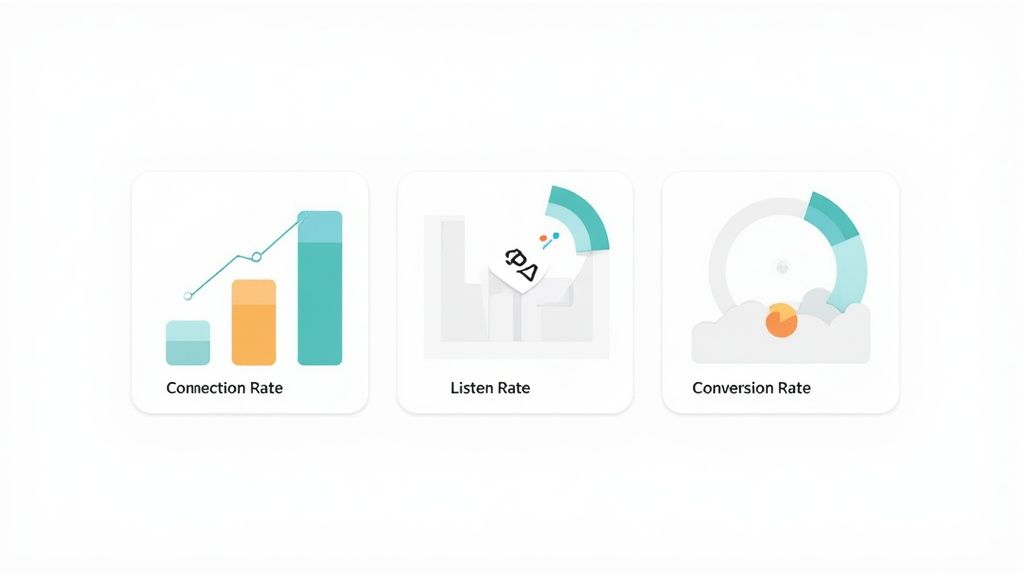
When I look at a voice campaign, I immediately zero in on three core metrics. Each tells a different part of the story, and together they paint a full picture of performance.
- Connection Rate: This is your foundation. What percentage of your calls actually connect to a person or voicemail? If this number is consistently low—say, under 40%—it's a massive red flag. Nine times out of ten, the culprit is a poor-quality or stale contact list.
- Listen Rate (or Call Duration): So, you got through. But are they listening? If people are hanging up within the first few seconds, your opening hook is failing. A low listen rate almost always points to an unengaging script or a voice persona that just doesn't click with your audience.
- Conversion Rate: This is the bottom line. Of the calls that connected, what percentage led to the action you wanted? This could be a scheduled appointment, a payment confirmation, or even just a request for a follow-up. This is your ultimate measure of success.
As a leader, your job is to connect these dots. A low connection rate requires a data hygiene initiative. A low listen rate demands a script and persona overhaul. A low conversion rate means your call-to-action is weak or poorly targeted.
These metrics are your diagnostic tools. We break this down even further in our guide on how to measure the success of your outbound campaigns with our AI voice agent.
Driving Continuous Improvement with A/B Testing
Once you have a solid baseline for your KPIs, the real work begins: optimisation. This is where A/B testing becomes your best friend. Instead of guessing what works, you can prove it with data by testing one variable at a time.
For bulk voice calls, you can test almost anything:
- Different Scripts: Pit a formal, professional script against a more relaxed, conversational one. See which one keeps people on the line longer.
- Varied Call Times: Does your audience respond better in the morning or late afternoon? Split your list and find out. The results might surprise you.
- AI Voice Personas: Would a male voice outperform a female voice for your specific offer? Or vice-versa? Don't assume—test it.
For instance, a real estate company could test two opening lines. The first might be direct: "Hello, I'm calling about our new project launch." The second could be benefit-driven: "Hello, are you interested in exclusive pre-launch pricing on luxury apartments in your area?" A simple A/B test will quickly tell you which hook gets more prospects to stay on the line and listen.
Analysing Cost and Demonstrating ROI
At the end of the day, it all comes down to the return on your investment. You need to prove that your voice campaigns are not just working, but are also cost-effective compared to other channels. The metric that matters here is Cost Per Acquisition (CPA).
The calculation is simple: Total Campaign Cost / Number of Conversions.
If a campaign cost you ₹20,000 and brought in 50 qualified leads, your CPA is ₹400 per lead. This number is your power tool. It allows you to have intelligent conversations and benchmark voice against your digital ads, email marketing, or anything else in your mix. This is how you prove the channel's value to the board.
In India, bulk voice calls are particularly powerful when paired with other mobile strategies. SMS, for example, boasts open rates that can hit 98%, completely blowing email out of the water. We've seen Diwali campaigns combining voice calls and SMS boost sales by over 30%, all while achieving a lower CPA than digital ads alone. This integrated approach ensures your message is heard, offering a trusted and scalable way to connect with a huge range of audiences.
Answering the Executive Questions on AI Voice Campaigns
As a leader, you're always looking for new ways to grow the business, make operations more efficient, and connect better with your customers. When considering a strategic move into AI-powered voice campaigns, some important questions always come up about performance, brand image, and how it all fits together technically. Let's tackle the big ones we hear all the time from executives.
How Do We Make Sure AI Voice Calls Actually Sound Human?
This is, without a doubt, the number one concern for any brand-conscious leader. And for good reason. No one wants their brand represented by a clunky, robotic voice.
The good news is, today’s technology is light years ahead of the monotone voices you might be imagining. Modern Text-to-Speech (TTS) and conversational AI platforms use what's called neural TTS, which produces speech that's remarkably human, complete with natural pacing and intonation.
To really nail the human touch, you need to focus on three things:
- Crafting the Right Persona: Think carefully about the voice that represents your brand. Is it warm and friendly for a healthcare reminder? Or is it crisp and professional for a financial update? Choosing the right voice persona is half the battle.
- Writing for the Ear, Not the Eye: Your scripts should sound like a real conversation, not a legal document. Use contractions (like "you're" instead of "you are"), natural-sounding phrases, and keep the flow conversational.
- Building in Smart Interactivity: The real magic happens when the AI can understand what the person is saying and respond dynamically. An AI that can handle an interruption or an unexpected question without getting flustered feels incredibly human.
My best advice? Start with a pilot programme. Test it out on a small group of trusted customers to get real feedback and fine-tune the experience before you roll out your bulk voice calls on a larger scale.
What's a Realistic ROI for a Bulk Voice Campaign?
While the exact return on investment for bulk voice calls will naturally differ based on your industry and what you're trying to achieve, it's a highly trackable channel. The trick is to look beyond simple metrics like call duration and focus on what really matters to the business.
For a lead generation campaign, the key metric is your Cost per Qualified Lead. If you're sending payment reminders, you should be measuring the uplift in on-time collections against the cost of the campaign.
You have to be disciplined about tracking conversions.
For instance, let's say a campaign costs you ₹50,000. If it brings in 100 new sales and you make an average profit of ₹1,500 on each, your total return is ₹1,50,000. That’s a 200% ROI—a powerful number to take to any board meeting.
Voice calls often come in at a lower cost-per-contact than many digital ad formats, and they're particularly potent for driving immediate action, like getting people to register for an event or provide feedback. The most important thing is to define your conversion goals upfront and make sure your tracking is locked in before you press go.
How Do These Voice Campaigns Plug Into Our CRM and Other Tools?
This is where bulk voice calls go from being a standalone tactic to a genuinely strategic tool. A modern voice platform isn't an island; it's built to connect.
Most platforms have APIs ready to integrate directly with major CRMs like Salesforce, Zoho, or HubSpot. This creates a powerful two-way data flow.
First, you can pull customer lists directly from your CRM to trigger calls based on real-time events. Imagine automatically calling a customer who just abandoned their shopping cart or whose subscription is about to expire. That kind of timely, relevant outreach is incredibly effective.
Second, the results of every call—whether it was 'answered', 'voicemail left', or 'callback requested'—get pushed right back into the CRM, automatically updating that customer's record. This closes the loop, giving your sales and support teams a complete picture of every interaction. For a deeper dive into the strategic side, exploring how to Optimize Customer Experience with AI in SaaS can offer some valuable perspective.
This level of integration transforms your voice platform from a simple dialler into an intelligent part of your entire customer management strategy.
Ready to see how human-like Voice AI can transform your outreach? DialNexa helps teams build, train, and deploy custom agents that handle everything from lead qualification to customer support at scale. Turn more conversations into conversions. Learn more at https://dialnexa.com.

This is an excellent breakdown of how AI-powered voice campaigns are evolving from mass outreach tools into strategic assets for customer engagement and operational efficiency. The focus on personalization, compliance, and measurable ROI clearly shows how voice AI can create real business value at scale.