

8 Strategic Telephone Conversation Examples to Elevate Your Team in 2025
In a world of digital noise, a well-executed phone call is more than just a conversation; it's a critical touchpoint that defines brand perception and drives revenue. For VPs, Directors, and CXOs, optimising these interactions is not an operational detail but a strategic imperative. The challenge lies in scaling high-quality, on-brand conversations across thousands of daily calls while maintaining efficiency and compliance.
This guide moves beyond generic templates to provide a strategic playbook. We offer a deep dive into industry-specific telephone conversation examples tailored for senior leaders focused on measurable outcomes. You will find actionable scripts for key sectors, including EdTech, real estate, banking, e-commerce, and healthcare.
We will dissect each script, providing tactical analysis on how to qualify leads faster, handle complex objections with confidence, and secure appointments or sales more efficiently. You will see replicable methods to not only improve your team's performance but also to integrate intelligent automation. The goal is to transform your contact centre from a cost centre into a powerful engine for sustainable growth and customer loyalty. This collection is your resource for building conversations that convert, ensuring every call becomes a strategic asset for your organisation.
1. Educational Enrollment Inquiry Call
The Educational Enrollment Inquiry Call is the critical first point of contact between a prospective student and an EdTech institution. This foundational dialogue serves a dual purpose: it provides the prospect with essential information while simultaneously allowing the admissions counsellor to qualify the lead. The goal is to move beyond a simple Q&A and strategically guide the conversation towards enrollment.
For senior leaders in EdTech, optimising this first touchpoint directly impacts lead conversion rates, enrollment numbers, and ultimately, revenue. It's where a generic inquiry is transformed into a personalised learning pathway, building trust and demonstrating institutional value from the very first interaction.
Strategic Breakdown and Example
The conversation must be structured to uncover the prospect's motivations, current skill set, and learning preferences. A high-performing counsellor doesn't just answer questions; they ask insightful ones to build a comprehensive student profile.
Example Script Snippet:
Counsellor: "Thanks for your interest in our Data Science programme! Before we dive into the curriculum, could you tell me what you're hoping to achieve with this certification? Are you looking to switch careers, or upskill in your current role?"
Prospect: "I'm a marketing analyst, and I want to move into a more data-driven role. But I'm worried about the time commitment."
Counsellor: "That's a very common goal, and our flexible weekend batch is designed specifically for working professionals like you. Based on your analyst background, you'd likely excel in our modules on predictive analytics. We can also schedule a demo with a course instructor to address any specific curriculum questions you have."
Actionable Takeaways for Leaders
To scale this process effectively, CXOs should focus on systemisation and empowerment.
- Implement Dynamic Scripting: Use a guided question flow to identify learning goals, technical proficiency, and career aspirations. This isn't about a rigid script but a framework that ensures key qualification data is captured consistently on every call.
- Leverage CRM Integration: Ensure your telephony system automatically populates prospect profiles in your CRM. This arms counsellors with lead context before the call connects and creates a rich data source for personalised follow-ups and marketing automation.
- Establish Clear Escalation Paths: Not every counsellor can handle complex queries about corporate financing or advanced curriculum. Define clear triggers for when a call should be escalated to a senior counsellor or a subject matter expert to maintain a high-quality interaction.
- Prepare for Objections: Equip your team with well-researched responses to common objections related to cost, time commitment, and prerequisite knowledge. This turns potential roadblocks into opportunities to highlight programme flexibility and student support systems.
2. Real Estate Property Discovery Call
The Real Estate Property Discovery Call is the foundational interaction between a potential buyer or tenant and a real estate agency. This conversation is designed to efficiently capture a prospect's requirements while simultaneously qualifying their intent and capacity to transact. The primary objective is to move from a general inquiry about a listing to scheduling a tangible next step, like a site visit.
For senior executives in real estate, optimising this first call is paramount to pipeline velocity and sales efficiency. A well-executed discovery call transforms a passive online lead into an active, qualified prospect, directly influencing viewing-to-deal conversion rates. It is the critical juncture where an agent builds rapport and establishes the agency's value proposition through expertise and personalised service.

Strategic Breakdown and Example
A successful discovery call goes beyond just reciting property features. It must be a structured dialogue aimed at uncovering the prospect's lifestyle needs, financial readiness, and decision-making timeline. A top-performing agent uses this call to build a comprehensive buyer profile, enabling them to suggest the most suitable properties.
Example Script Snippet:
Agent: "Thank you for inquiring about our 3BHK flat in Koramangala. To help me find the best options for you, could you tell me a bit about what's prompting your move and what your ideal move-in date is?"
Prospect: "My family is growing, so we need more space. We're hoping to move within the next three months, but our main concern is finding a place near a good school."
Agent: "That's a top priority for many of our clients, and we have a few properties in excellent school districts. Based on your need for more space and a quick timeline, I have two other listings that just came on the market that might be an even better fit. Would you be available for a site visit this Saturday to see all three?"
Actionable Takeaways for Leaders
To scale lead management and increase conversion, real estate directors should focus on technology and process refinement.
- Integrate with a Live Property Database: Connect your telephony system to a real-time property inventory. This ensures agents provide accurate availability and pricing, preventing prospect disappointment and protecting the firm's reputation for reliability.
- Implement Persona-Based Qualification: Use guided questions to quickly categorise leads (e.g., first-time homebuyer, investor, tenant). This allows for tailored pitches and helps prioritise high-intent prospects for senior agents, maximising their impact.
- Automate Site-Visit Scheduling: Equip agents with tools that sync with their calendars to offer and confirm viewing slots directly during the call. This reduces administrative friction and captures commitment while the prospect's interest is at its peak.
- Develop Property-Specific Talking Points: Create concise, compelling talking points for each key listing that highlight unique selling propositions (USPs) beyond what's in the online description, such as community amenities or upcoming infrastructure developments that impact property value.
3. Banking and Financial Services Compliance Call
The Banking and Financial Services Compliance Call is a high-stakes interaction where agents handle sensitive financial data, verify customer identity, and explain complex regulatory requirements. This dialogue is foundational for maintaining trust and security, covering everything from Know Your Customer (KYC) verification to transaction inquiries and fraud prevention. The primary goal is to resolve the customer's issue while adhering to strict legal and security protocols.
For leaders in the BFSI sector, optimising these telephone conversation examples is not just about customer service—it's a matter of regulatory adherence and risk management. A single compliance failure can lead to severe financial penalties and reputational damage. Therefore, structuring these calls for accuracy, security, and efficiency is a strategic imperative that directly protects the organisation's bottom line and market standing.
Strategic Breakdown and Example
The conversation must be methodically structured to first authenticate the user's identity securely before addressing their financial query. The agent must balance a helpful tone with the non-negotiable need for procedural rigour, ensuring no sensitive information is disclosed without proper verification.
Example Script Snippet:
Agent: "Thank you for calling ABC Bank. For your security, before we discuss your account, I need to verify your identity. Could you please provide your full name and the last four digits of your PAN card?"
Customer: "It's Rohan Sharma, and the last four digits are 5678. I'm calling because I see a transaction I don't recognise."
Agent: "Thank you, Mr. Sharma. I see you've passed the initial verification. As a final security step, I've sent a one-time passcode to your registered mobile number. Could you please read that back to me? Once verified, we can immediately investigate the transaction you mentioned."
Actionable Takeaways for Leaders
To manage compliance at scale, CXOs must invest in technology and rigorous training that leaves no room for error.
- Implement Multi-Factor Authentication (MFA): Do not rely on a single data point for identity verification. Use a combination of static information (date of birth) and dynamic codes (OTPs) sent to a registered device to fortify security and mitigate fraud risk.
- Automate and Log Everything: Use a telephony system that automatically logs every call, creates a searchable transcript, and flags keywords related to fraud or compliance issues. This creates an auditable trail essential for regulatory reviews and internal audits.
- Develop Tiered Escalation Protocols: Create clear, documented triggers for escalating calls. For example, if a customer fails verification twice or reports a high-value fraudulent transaction, the call should be immediately routed to a specialised fraud or security team.
- Conduct Continuous Compliance Training: The regulatory landscape is constantly evolving. Equip your team with ongoing training on the latest AML, KYC, and data privacy regulations. Modern speech technology can be instrumental in monitoring calls for compliance and providing real-time agent feedback. Learn more about how speech technology is transforming financial services on DialNexa.com.
4. E-Commerce Customer Support and Billing Inquiry Call
The E-commerce Customer Support and Billing Inquiry Call represents a pivotal moment in the customer journey. For D2C brands and marketplaces, these interactions are frequent, high-stakes touchpoints where customer loyalty is either strengthened or broken. The primary objective is to resolve a customer's issue regarding orders, billing, or returns efficiently and accurately, transforming a moment of potential friction into a positive brand experience.
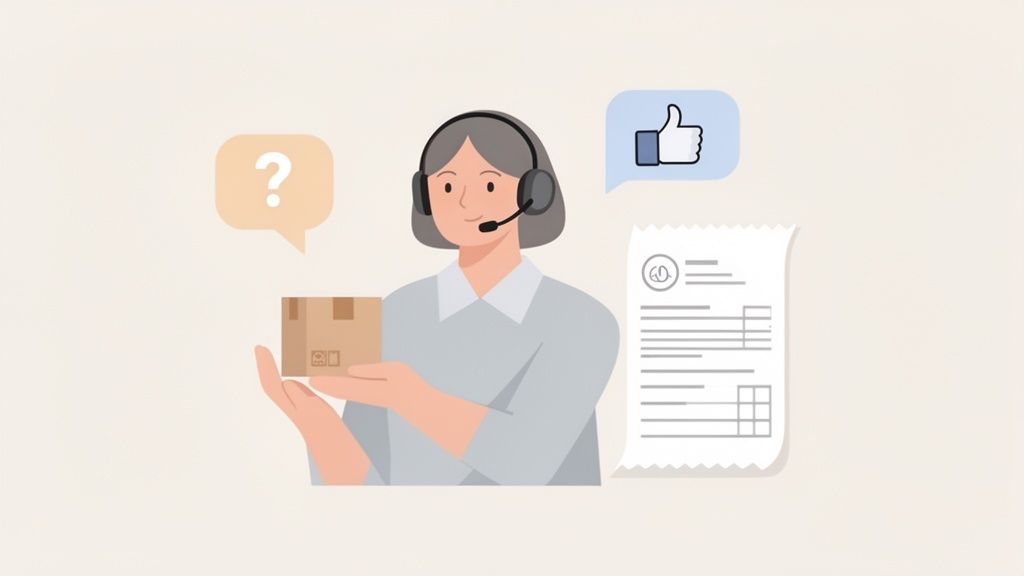
For e-commerce leaders, optimising these telephone conversation examples is not just about managing costs; it's a strategic imperative for improving customer lifetime value (CLV) and reducing churn. An effective support call can de-escalate frustration, prevent a negative review, and reinforce the customer’s decision to purchase. It is a direct reflection of the brand's commitment to post-purchase satisfaction.
Strategic Breakdown and Example
A successful support call hinges on immediate context and swift resolution. The agent, whether human or AI, must instantly access the customer's order history and billing data to provide informed, accurate support without forcing the customer to repeat information. The conversation should be empathetic and solution-oriented.
Example Script Snippet:
Agent: "Thank you for calling [Brand Name]. I see you're calling about order #582-19B. How can I help you with it today?"
Customer: "Yes, my bill shows I was charged twice for the same pair of shoes. I need one of those charges reversed immediately."
Agent: "I understand your concern and I'm looking at your statement now. I see the duplicate charge from our payment processor. I've just processed a refund for the extra ₹1,499. You'll see it back in your account within 3-5 business days. I've also sent a confirmation email for your records."
Actionable Takeaways for Leaders
To scale support operations without sacrificing quality, leaders must invest in integration and intelligent automation.
- Integrate with Order Management Systems (OMS): Your telephony platform must have real-time access to your OMS and CRM. This allows agents to immediately retrieve order status, tracking details, and payment history, dramatically reducing call handling time and improving first-call resolution rates.
- Create Quick-Resolution Pathways: Identify the top 3-5 reasons for customer calls (e.g., "Where is my order?", "How do I make a return?") and build automated IVR or voicebot flows to resolve them without human intervention, freeing up agents for more complex issues.
- Implement Proactive Notifications: Reduce inbound call volume by sending automated SMS or voice alerts for order confirmations, shipping updates, and delivery completions. This manages customer expectations and preemptively answers their most common questions.
- Utilise Sentiment Analysis: Modern platforms can detect frustration in a customer's tone of voice. This can trigger an automatic escalation to a senior human agent, preventing a poor experience from spiralling into a major issue and protecting brand reputation.
5. Software SaaS Demo Scheduling and Presales Call
The Software SaaS Demo Scheduling and Presales Call is a pivotal interaction in the B2B technology sales cycle. It acts as the bridge between a prospect's initial curiosity and their deeper engagement with a product. The primary objective is to qualify the lead's suitability and then seamlessly book a product demonstration with a specialised sales representative.
For SaaS company leaders, optimising this first human touchpoint is crucial for managing the sales pipeline and maximising resource allocation. A well-executed presales call prevents wasting valuable sales executive time on unqualified leads. It ensures that every demo is delivered to a prospect with a genuine need, budget, and authority, significantly improving demo-to-close conversion rates.
Strategic Breakdown and Example
A successful presales conversation is a delicate balance of information gathering and value propositioning. The agent must quickly diagnose the prospect's pain points, align them with the software's solutions, and confirm they meet the ideal customer profile (ICP) before proceeding to schedule a demo.
Example Script Snippet:
Presales Rep: "Thanks for your interest in our project management platform. To make sure we set you up with the right expert, could you tell me a bit about your current workflow? What are the biggest challenges your team is facing with project tracking?"
Prospect: "We're a marketing agency with about 50 users. We're struggling to manage client deliverables across different teams and our current system is just a mess of spreadsheets."
Presales Rep: "That's a classic bottleneck we help solve. Our agency-specific module with client-facing dashboards would be a perfect fit. Based on your team size and use case, our senior account executive, Priya, would be the best person to walk you through a tailored demo. Does Thursday at 3:00 PM work for you?"
Actionable Takeaways for Leaders
To scale an effective presales function, VPs of Sales and CXOs must focus on process standardisation and smart automation.
- Develop Persona-Based Qualification: Create detailed buyer persona profiles with specific qualification questions. This ensures reps consistently identify a prospect's industry, team size, use case, and decision-making authority, leading to a higher quality pipeline.
- Arm Reps with Competitive Intelligence: Maintain an up-to-date battle card comparing your features against key competitors. This allows reps to handle comparative questions confidently and pivot the conversation back to your unique value proposition.
- Integrate Calendars and CRM: Use a telephony system that integrates directly with sales reps' calendars and your CRM. This automates the scheduling process, respecting rep availability and specialisation, and logs all call data for a complete prospect history.
- Automate Post-Call Follow-ups: Implement automated email or SMS sequences to confirm the demo booking, send reminders, and follow up with no-shows to easily reschedule. This reduces administrative burden and measurably improves attendance rates.
6. Healthcare Patient Appointment Booking Call
The Healthcare Patient Appointment Booking Call is a foundational interaction in the patient journey, serving as the primary channel for scheduling, rescheduling, or confirming medical consultations. This conversation is not merely administrative; it is a critical touchpoint that balances operational efficiency with patient care, empathy, and strict regulatory compliance like HIPAA. The objective is to efficiently manage provider schedules while ensuring the patient feels supported and their privacy is protected.
For healthcare executives, optimising this interaction is paramount for improving patient experience, reducing administrative overhead, and minimising costly no-shows. An efficient and empathetic booking process directly influences patient retention and the overall reputation of the healthcare provider or platform. It is the first step in delivering a seamless, patient-centric care experience.

Strategic Breakdown and Example
A successful patient booking call must be structured for both empathy and precision. The agent must quickly verify patient identity, understand their needs, navigate complex provider schedules, and communicate information clearly, all while maintaining a reassuring tone. The conversation is a blend of data collection and patient service.
Example Script Snippet:
Agent: "Thank you for calling City Central Hospital. This is Priya. How may I help you today? For security, could you please confirm your full name and date of birth?"
Patient: "Hi, it's Rohan Sharma, 15th of March, 1985. I need to book a follow-up with Dr. Gupta, the cardiologist."
Agent: "Thank you for verifying, Mr. Sharma. I see your file. Dr. Gupta is available next Tuesday at 11:00 AM or Thursday at 2:30 PM. Which works better for you? We will also send you an SMS and email reminder 24 hours before your appointment to confirm."
Actionable Takeaways for Leaders
To scale patient support while maintaining high standards of care and compliance, healthcare leaders should focus on technology-driven workflows and rigorous training.
- Integrate with EMR/EHR Systems: Connect your telephony system directly with your Electronic Medical Record or Electronic Health Record platform. This gives agents instant, secure access to patient history and provider availability, drastically reducing booking time and errors.
- Establish Clear Triage Protocols: Not all calls are simple bookings. Train agents to recognise keywords indicating urgent medical needs (e.g., "chest pain," "difficulty breathing") and define a clear, immediate escalation path to a registered nurse or on-call clinician.
- Automate Reminders and Confirmations: Implement an automated, multi-channel reminder system (SMS, email, automated voice call) to reduce no-show rates. Allow patients to confirm or reschedule via a simple response, which frees up agent time for more complex interactions. Learn more about how modern speech technology in healthcare is transforming these processes on DialNexa.com.
- Prioritise Compliance Training: Conduct regular and mandatory training on data privacy regulations like HIPAA. All conversations involving Patient Health Information (PHI) must be handled with the utmost security, using encrypted lines and secure data storage to prevent breaches.
7. Hotel and Hospitality Reservation and Concierge Call
The Hotel and Hospitality Reservation and Concierge Call is far more than a transactional booking; it is the first impression of the guest experience. This conversation handles everything from securing a room to arranging special requests and providing local insights. The objective is to efficiently convert an inquiry into a confirmed booking while simultaneously showcasing the brand's commitment to personalised service.
For senior leaders in the hospitality sector, optimising this interaction is crucial for maximising occupancy rates, increasing average booking value through upsells, and fostering guest loyalty. This type of telephone conversation example transforms a simple booking into a curated experience, setting the stage for positive reviews and repeat business. It is where operational efficiency meets exceptional service.
Strategic Breakdown and Example
A successful reservation call is structured to quickly confirm availability, present options attractively, and anticipate guest needs. A skilled agent moves beyond logistics to act as a local guide, building rapport and demonstrating value that booking websites often cannot replicate.
Example Script Snippet:
Agent: "Thank you for calling The Grand Luxe Hotel. My name is Priya. How may I assist you today?"
Guest: "Hi, I'd like to book a room for two adults from the 15th to the 17th of next month."
Agent: "Certainly. For those dates, we have our popular Deluxe King rooms available, which offer stunning city views. I also see we have a special offer on our Executive Suites, which include complimentary breakfast and evening lounge access. Since you're staying for the weekend, would either of those options interest you?"
Guest: "The suite sounds nice, but what about local dining?"
Agent: "An excellent question! We're just a short walk from some of the city's finest restaurants. I can certainly make a dinner reservation for you. Would you prefer modern European or traditional Indian cuisine?"
Actionable Takeaways for Leaders
To elevate this critical touchpoint from a cost centre to a revenue driver, hospitality leaders should focus on integration and empowerment.
- Integrate with Your PMS: Ensure your telephony system has real-time integration with your Property Management System (PMS). This allows agents to see live availability, pricing, and guest history, enabling them to make instant, personalised offers without placing the guest on hold.
- Develop Dynamic Upselling Scripts: Equip your team with scripts that prompt them to offer relevant upgrades. This shouldn't be a hard sell but a value-added suggestion based on the guest's length of stay, party size, or booking history.
- Build a Centralised Knowledge Base: Create a digital, easily searchable knowledge base with details on room amenities, local attractions, dining recommendations, and transportation options. This empowers agents to answer questions confidently and act as effective concierges.
- Track and Fulfil Special Requests: Implement a system where special requests (e.g., extra pillows, dietary needs, anniversary decorations) are logged directly into the PMS during the call. This ensures seamless communication between the reservations team, housekeeping, and food and beverage departments, guaranteeing a flawless guest experience upon arrival.
8. Recruitment and Candidate Screening Call
The Recruitment and Candidate Screening Call is an organisation's first direct interaction with potential talent. This conversation is designed to efficiently qualify candidates against job requirements, assessing their skills, experience, and cultural alignment. The primary goal is to filter a large applicant pool down to a high-quality shortlist for hiring managers, saving significant time and resources.
For HR leaders and Chief Talent Officers, optimising this initial screening process is crucial for competitive advantage. A well-executed screening call improves the quality of hire, reduces time-to-fill, and enhances the employer brand by ensuring a positive candidate experience from the start. It is a strategic function that directly impacts operational efficiency and the calibre of an organisation's workforce.
Strategic Breakdown and Example
A successful screening call balances structured qualification with conversational engagement. The recruiter must probe beyond the resume, uncovering motivations, salary expectations, and potential red flags while keeping the candidate engaged. This isn't just a checklist; it's a diagnostic conversation.
Example Script Snippet:
Recruiter: "Thanks for applying for the Senior Product Manager role. Your resume shows strong experience in SaaS. Could you walk me through a product you launched from ideation to market, and what your specific contribution was?"
Candidate: "Certainly. At my last company, I led the launch of a new analytics dashboard. I was responsible for the entire product roadmap, user research, and coordinating with the engineering and marketing teams."
Recruiter: "That's exactly the kind of hands-on experience we're looking for. This role is budgeted for a salary range of ₹18-22 LPA. Does that align with your expectations? This helps us ensure we're on the same page before moving forward."
Actionable Takeaways for Leaders
To scale recruitment efforts and maintain quality, CXOs should focus on process standardisation and data-driven improvements.
- Develop Role-Specific Scorecards: Work with hiring managers to create a standardised scorecard for each role. This should define key qualifications, "must-have" skills, and cultural fit indicators to ensure consistent and fair evaluations across all recruiters.
- Integrate with an Applicant Tracking System (ATS): Ensure your telephony system automatically logs call notes, dispositions, and scorecard results into your ATS. This creates a single source of truth for each candidate, enabling better pipeline management and data analysis.
- Establish a Clear Communication Cadence: Define protocols for candidate follow-up. A simple, automated email confirming the next steps (or kindly declining) immediately after a screening call significantly improves the candidate experience and protects your employer brand.
- Train for Conversational Probing: Equip your team to go beyond surface-level questions. Role-playing exercises focused on uncovering a candidate’s problem-solving skills, collaborative style, and career ambitions will yield much deeper insights than simply verifying their resume.
8 Telephone Call Scenario Comparison
| Use Case | Implementation Complexity 🔄 | Resources & Integrations 💡 | Expected Outcomes ⭐📊 | Ideal Use Cases | Key Advantages ⚡ |
|---|---|---|---|---|---|
| Educational Enrollment Inquiry Call | 🔄🔄🔄 — Moderate; needs program DB, dialog flows | 💡 CRM, course catalogue, scheduling, knowledge base | ⭐⭐⭐⭐ — Higher lead→enrollment; structured prospect data; 24/7 qualification | EdTech platforms, universities, online course providers | ⚡ Scales qualification; reduces manual inquiries; consistent positioning |
| Real Estate Property Discovery Call | 🔄🔄🔄 — Moderate; real‑time inventory critical | 💡 PMS/listings feed, calendar, lead scoring, mapping | ⭐⭐⭐⭐ — Increased site‑visit bookings; faster lead routing | Brokerages, portals, developers during launches | ⚡ Faster booking; standardizes recommendations; handles peak volume |
| Banking & Financial Services Compliance Call | 🔄🔄🔄🔄🔄 — High; strict security & regulatory controls | 💡 Bank‑grade encryption, KYC docs, audit logging, MFA | ⭐⭐⭐⭐⭐ — Improved KYC completion; audit readiness; consistent compliance | Banks, FinTech, trading platforms, insurers | ⚡ Reduces compliance backlog; maintains audit trails; 24/7 verifications |
| E‑Commerce Customer Support & Billing Call | 🔄🔄 — Low–Moderate; requires OMS/inventory integration | 💡 Order management, payment gateway, returns system, CRM | ⭐⭐⭐⭐ — Fewer tickets; faster resolution; improved CSAT | D2C, marketplaces, subscription services, retailers | ⚡ Handles routine support at scale; reduces resolution time and costs |
| Software SaaS Demo Scheduling & Presales Call | 🔄🔄🔄 — Moderate; needs product KB and routing logic | 💡 CRM, calendar/sales routing, pricing engine, feature KB | ⭐⭐⭐⭐ — Higher demo attendance; faster sales cycles; better lead quality | SaaS vendors, B2B sales teams, product demos | ⚡ Pre‑qualifies leads; boosts demo conversion; saves sales time |
| Healthcare Patient Appointment Booking Call | 🔄🔄🔄🔄 — High; HIPAA compliance and triage required | 💡 EHR/scheduling integration, secure messaging, triage rules | ⭐⭐⭐⭐ — Reduced no‑shows; lower front‑desk load; 24/7 booking | Clinics, telemedicine, dental, mental health platforms | ⚡ Cuts administrative work; improves booking availability and reminders |
| Hotel & Hospitality Reservation & Concierge Call | 🔄🔄🔄 — Moderate; needs PMS and inventory sync | 💡 PMS, payment gateway, upsell engine, local KB | ⭐⭐⭐⭐ — Higher booking conversion; better request capture; upsell lift | Hotels, resorts, vacation rentals, travel desks | ⚡ 24/7 reservations; captures special requests; drives upsells |
| Recruitment & Candidate Screening Call | 🔄🔄 — Low–Moderate; requires role criteria and ATS link | 💡 ATS/CRM, role profiles, bias‑checks, scheduling | ⭐⭐⭐⭐ — Faster screening; reduced time‑to‑hire; structured candidate data | Recruitment firms, enterprise HR, staffing platforms | ⚡ Screens high volumes; improves recruiter efficiency; better candidate routing |
From Theory to Action: Implementing Your High-Impact Conversation Strategy
We have journeyed through a comprehensive collection of telephone conversation examples, spanning critical industries from EdTech and real estate to healthcare and recruitment. Each script and strategic breakdown was designed not just as a template, but as a blueprint for engineering high-value, repeatable interactions. The core lesson is clear: excellence in communication is no longer an art left to chance; it is a science that can be systematised, measured, and scaled.
The examples provided demonstrate that a well-structured conversation is built on foundational pillars. These include a compelling opening that captures attention, precise qualification questions that uncover needs, empathetic objection handling that builds trust, and a clear closing that drives action. Moving beyond mere words, we analysed the strategic intent behind each phrase, highlighting how tonality, pacing, and active listening transform a monologue into a powerful dialogue.
Unifying the Threads: Core Takeaways for Organisational Leaders
For the VPs, Directors, and CXOs steering their organisations, these telephone conversation examples reveal a powerful strategic lever. The primary insight is that consistency is the bedrock of a scalable customer engagement model. When every agent, whether human or AI, follows a proven conversational framework, you eliminate variability and ensure a standard of quality that defines your brand experience.
Here are the most critical takeaways to implement immediately:
- Standardise Your Core Interactions: Identify the top 3-5 most frequent call types in your organisation. Use the frameworks provided to build standardised scripts that are not just rigid, but adaptable, with clear decision trees for common scenarios.
- Embrace Data-Driven Refinement: A script is not a static document; it's a dynamic tool. Continuously analyse call outcomes, listen to recordings, and gather feedback to refine your approaches. Which opening lines have the highest engagement? Which objection-handling tactics lead to the most conversions?
- Empower, Don't Restrict: The goal of a script is to provide a safety net and a guide, not a cage. Train your teams on the why behind the script. When they understand the strategic purpose of each stage, they can improvise effectively and handle unexpected turns with confidence, adding a crucial human touch.
The Strategic Leap: From Human-Led to AI-Powered
The true competitive advantage in today's market lies in intelligent automation. While your top-performing team members are invaluable for complex, high-stakes negotiations, a significant portion of your daily calls are repetitive and process-driven. Think of appointment scheduling, lead qualification, or initial customer support inquiries. These are prime candidates for automation.
The telephone conversation examples in this article are not just training material for human agents; they are the direct source code for creating sophisticated Voice AI agents. By codifying these proven dialogues, you can deploy an automated workforce that operates 24/7, handles thousands of calls simultaneously, and executes your best practices with 100% compliance and consistency.
This shift allows you to reallocate your most valuable resource, your people, to where they can create the most impact. Imagine your best sales representatives spending their entire day on closing conversations with pre-qualified, high-intent leads, rather than on cold calling and scheduling. That is the transformative power of integrating these proven conversational models with AI. Your role as a leader is to identify these opportunities and champion the technological shift that turns your communication strategy into a powerful, automated growth engine.
Ready to transform these telephone conversation examples from static text into dynamic, automated assets? The team at DialNexa specialises in building intelligent Voice AI agents that execute these proven scripts at scale, handling everything from lead qualification to appointment scheduling with human-like precision. Visit DialNexa to discover how you can automate your routine calls and empower your team to focus on what matters most.

Excellent breakdown of real-world call scenarios with practical strategies that leaders can implement immediately to improve customer experience and conversion rates. The industry-specific examples and actionable takeaways make this a highly valuable guide for scaling communication excellence across sectors.