

Real Estate Lead Generation: Boost Growth with AI & ROI
Online channels now generate a large share of residential property inquiries, but inquiry volume and revenue rarely rise at the same rate. For a real estate VP, that gap is the operating problem: demand is reaching the business, yet too little of it becomes qualified pipeline because routing, response speed, and follow-up discipline break before the sales team ever gets a real shot.
The practical implication is straightforward. Real estate lead generation should be managed as a conversion system, not a campaign calendar. High-performing teams define channel-level KPIs, score intent early, automate first response, and track the effect on cost per qualified lead, booking rates, and sales cycle velocity. Teams that do not build those controls usually end up paying twice, once to acquire the inquiry and again to recover from slow or inconsistent handling.
That is the lens used in Algomizer's AI lead plan. The useful question is not which tactic produces the most raw leads. It is which mix of inbound, outbound, nurturing, and automation produces qualified demand at a cost structure the business can scale.
Table of Contents
- The New Economics of Real Estate Leads
- Building Your Inbound Lead Engine
- Mastering Outbound Channels and Offline Synergy
- Designing the Crucial Lead Nurturing Flow
- Scaling with Automation and Voice AI
- Measuring Success with KPIs That Drive Growth
- Conclusion Building Your Lead Generation Moat
The New Economics of Real Estate Leads
Online inquiry volume has risen faster than most sales teams' ability to qualify and convert it. The result is a unit-economics problem, not a traffic problem.
For a real estate VP, that changes the core question. Lead generation is no longer about buying more names into the funnel. It is about building a system that turns fragmented inquiry into qualified conversations at a predictable cost and speed.
A portal lead, website form, missed call, or WhatsApp message is only an early intent signal. Revenue appears later, after contact is made, qualification is completed, and the lead is routed into the right follow-up path. Teams that treat every inquiry as equal usually inflate reported lead volume while depressing contact rates, site visits, and booking efficiency.
Why lead volume is a weak management metric
Lead count is easy to report and easy to misread.
A campaign can produce lower cost leads while worsening sales productivity. Sales teams then spend more time on unreachable or low-intent prospects, response queues lengthen, and high-intent buyers wait alongside casual browsers. Pipeline quality falls even when dashboards suggest growth.
Three operating failures usually sit behind that pattern:
- Response lag: prospects often submit inquiries across multiple projects and brokers within minutes. The first organised team to respond often gets the first meaningful conversation.
- Poor qualification design: if forms, call scripts, and CRM fields fail to capture budget, location preference, purchase timeline, and financing status, sales receives noise instead of prioritised demand.
- Broken handoffs: leads stall when ownership changes across marketing, inside sales, site teams, or channel partners without a defined SLA.
These are management issues. They should be fixed with process design, routing logic, and accountability.
Operating rule: judge each lead source by cost per qualified lead, contactability rate, appointment rate, and time-to-first-conversation.
The question leadership teams should ask instead
A stronger executive question is simple: how many inquiries become contacted, qualified, appointment-ready opportunities within a defined time window, and what does that cost by channel?
That framing changes budget decisions. It also changes how technology should be evaluated. Portals, landing pages, call teams, CRM workflows, and AI assistants belong in one operating model because each one affects conversion velocity. Teams comparing channels without looking at follow-up capacity are only measuring acquisition cost, not revenue efficiency.
For firms redesigning that system, Algomizer's AI lead plan is a useful reference because it focuses on how online demand is structured and processed after capture, which is where a large share of value is either created or lost.
The same principle applies to calling operations. Teams reviewing data for real estate calling performance and follow-up design can see why contact strategy belongs inside lead economics, not outside it.
What a strong lead system does
High-performing teams treat lead generation as a conversion supply chain. The system needs four capabilities:
- Capture demand across search, portals, paid social, referrals, direct traffic, and phone inquiries.
- Classify intent using fields and conversation data such as budget band, micro-market, unit preference, buying timeline, financing readiness, and source reliability.
- Route by value and urgency so high-intent leads get immediate outreach, mid-intent leads enter nurture tracks, and cold or incomplete records are recycled without clogging active queues.
- Learn from outcomes so spend shifts toward channels that improve qualified pipeline creation, shorten sales cycle length, and reduce wasted agent time.
The strategic implication is straightforward. More inquiries do not create growth on their own. Better qualification logic, faster response, and tighter operational control improve conversion economics. That is the shift in real estate lead generation.
Building Your Inbound Lead Engine
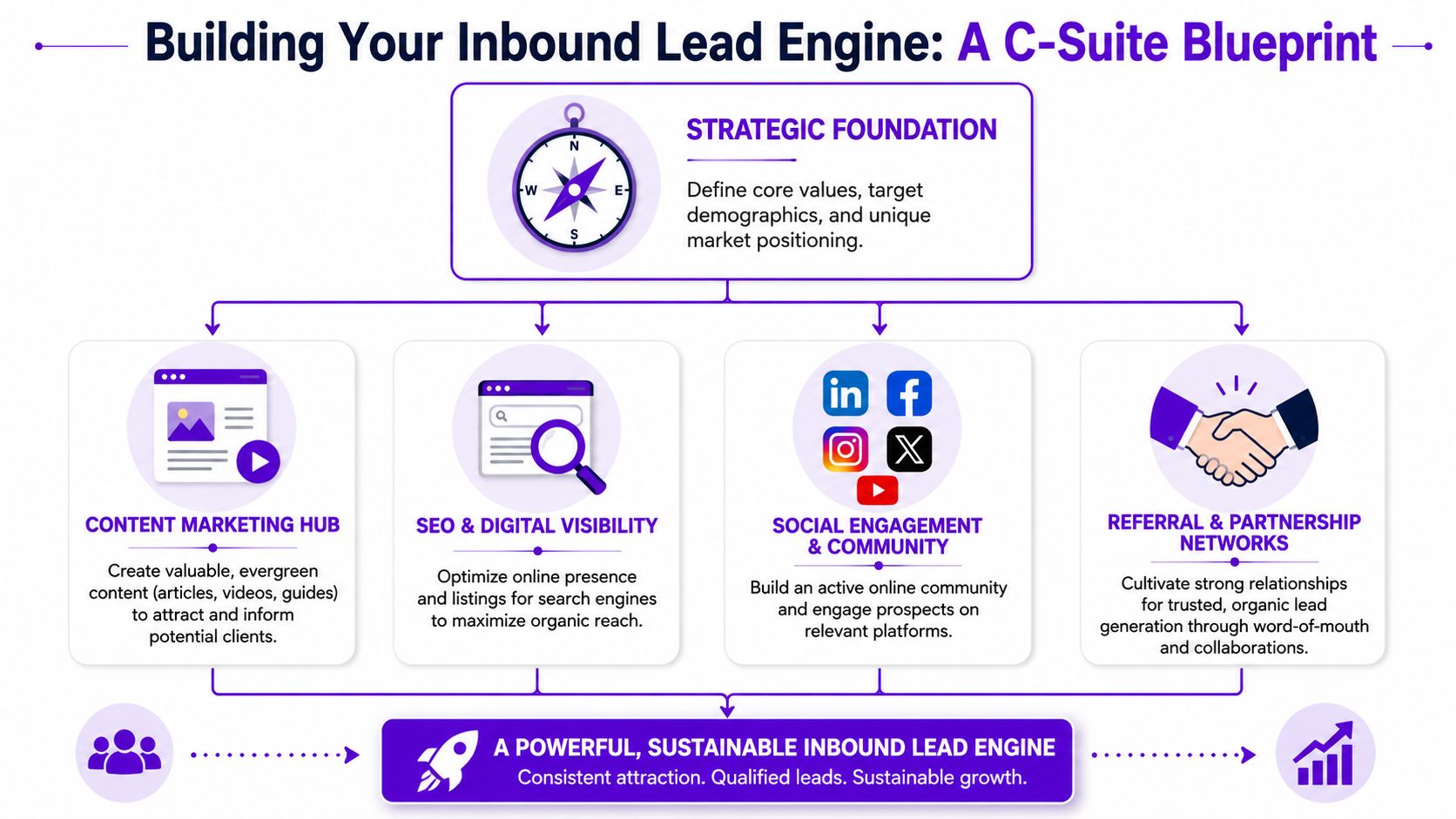
Inbound is where real estate brands create compounding advantage. Paid media can fill the funnel quickly, but owned visibility lowers dependency on rented channels over time and gives executives more control over lead quality.
The strongest inbound engines aren't broad. They're local, specific, and built around decision-stage information.
Own the local search layer
National portals are strong at inventory discovery. They're weaker at neighbourhood judgement. That's the opening.
Guidance reviewed in this local SEO and lead generation resource notes that optimising a Google Business Profile with professional photos and asking past clients for reviews, combined with writing hyper-local content like school-district comparisons, materially increases visibility and trust in local search, systematically raising the share of leads sourced organically versus paid.
For a VP, the implication is operational. Your brand should show up where buyer intent becomes local:
- Google Business Profile: complete every field, use professional photography, keep contact information accurate, and maintain review velocity through a structured post-close process.
- Neighbourhood landing pages: build pages around specific micro-markets, not just city-wide terms.
- Local proof assets: publish market recaps, school catchment explainers, commute analyses, project comparison pages, and buyer guides.
A practical example: if your firm sells heavily in Pune, a generic “homes in Pune” page is less strategic than separate pages and content clusters around budget-sensitive micro-markets, commute corridors, and buyer profiles.
Turn content into a qualification asset
Content is commonly treated as awareness by teams. More advanced teams use it for pre-qualification.
A school-district comparison attracts family buyers. An EMI explainer attracts payment-focused buyers. A locality map attracts site-visit candidates. A quarterly market recap attracts investors and fence-sitters.
That means content should be tied to CRM fields and downstream action. If a prospect downloads a first-time buyer checklist, watches a project walkthrough, and returns to a locality page, your team should know that before any call happens.
For teams tightening this connection between calling operations and data, real estate calling data workflows can help frame how source, behaviour, and response timing should connect inside one lead model.
A strong inbound engine doesn't just attract traffic. It gives sales context before the first conversation.
Build an inbound workflow leaders can govern
An executive-grade inbound system has governance built in. That means:
- Editorial priorities: approve a quarterly content slate tied to business goals such as mid-market launches, inventory ageing, or luxury absorption.
- Review generation process: assign responsibility for review asks at possession, rental renewal, and post-registration stages.
- Lead routing rules: direct leads from high-intent pages to faster follow-up paths than general blog subscribers.
- Channel accounting: separate branded organic, non-branded organic, GBP calls, direct website forms, and portal referrals in reporting.
Here's the hidden strategic benefit. Inbound gives you margin protection. As organic and local search contribute a larger share of demand, your blended acquisition cost becomes less exposed to auction volatility in paid media.
That doesn't mean inbound replaces outbound. It means it gives outbound a stronger base. When paid campaigns and referral traffic send prospects to a credible, localised brand presence, conversion friction falls.
Mastering Outbound Channels and Offline Synergy
A channel that generates inexpensive inquiries but few qualified conversations does not improve growth. In real estate, outbound only creates value when leadership can trace each source to contact rate, appointment rate, and sales cycle speed.
That is why high-performing teams treat outbound and offline relationship-building as one operating system. Paid channels create controllable demand. Referral loops, local partnerships, and on-ground events raise trust and improve conversion quality. The combined effect is lower cost per qualified lead, not just higher lead volume.
Paid social for controllable top-of-funnel volume
Facebook and Instagram are useful because they allow tight audience design, fast creative testing, and clear budget control. Their real advantage is operational. Leadership can decide which buyer segments deserve spend, what message each segment sees, and how quickly the sales team responds.
An analysis by Ylopo found that segmented Facebook and Instagram campaigns in real estate perform better than broad targeting. That finding matters less as a media insight than as an organisational one. If your campaigns mix first-time buyers, investors, and upgraders into one form flow, sales inherits ambiguity, follow-up gets slower, and qualification costs rise.
A workable paid social system usually includes four components:
- Segment-specific campaigns: separate campaigns by buyer type, price band, geography, and urgency.
- Message-market fit: use creative built around decision drivers such as financing clarity, locality access, project trust signals, or rental yield.
- Response design: match the lead path to your operating capacity. Instant forms can work when callback speed is high. Click-to-WhatsApp can work when conversational qualification is strong.
- Post-capture routing: push high-intent leads to the fastest queue, and send lower-intent leads into automated education before an agent spends time.
This is also where offline credibility improves digital performance. Teams publishing local proof points, neighbourhood pages, and geo content strategies for real estate usually give paid traffic a stronger reason to convert because the buyer sees relevance beyond the ad itself.
Referrals as a margin-efficient demand channel
Referral business is often classified as relationship marketing. For a VP, it should be treated as pipeline strategy.
Referral leads usually enter the funnel with more trust, fewer objections, and shorter evaluation cycles than cold paid leads. That changes the economics. Even if referral volume is smaller, the channel can produce lower acquisition cost per closed deal because qualification effort is lighter and appointment-to-close rates are often better.
The operational mistake is leaving referrals to agent memory and informal client goodwill. A referral channel needs process:
Defined trigger points
Registration, possession, lease renewal, resale appreciation, and service milestones create natural windows for outreach.A scripted referral ask
Agents and relationship managers should know when to ask, how to ask, and what value framing works best.Useful follow-up content
Send market movement summaries, project-area updates, financing guidance, or tenant demand signals instead of generic festive messages.Source-level attribution
Record the referring client, agent, branch, and downstream outcome so leadership can compare referral conversion against paid and portal traffic.
For adjacent partnership models, mortgage lead generation workflows are worth studying because financing education often starts before a site visit and can materially affect who becomes sales-ready.
The strongest real estate demand engines treat the customer base as an active acquisition asset, not a closed transaction archive.
Offline channels should feed the CRM, not sit outside it
Events, broker meets, local sponsorships, channel partner networks, and resident-community relationships can produce high-intent opportunities. They also create reporting blind spots when teams capture them informally.
The fix is simple in concept and difficult in execution. Every offline interaction needs the same source discipline as a digital lead. Tag the event or partner, log the first meaningful conversation, measure time to follow-up, and track whether that source produces meetings, site visits, and bookings at a better rate than paid traffic.
Offline channels matter most in two cases. First, in micro-markets where trust and local familiarity heavily influence shortlisting. Second, in higher-consideration purchases where buyers want validation from people, not just ads and landing pages.
Real Estate Lead Channel Performance Matrix
| Channel | Avg. Cost per Lead | Avg. Conversion Potential | Lead Intent | Scalability |
|---|---|---|---|---|
| Organic search and Google Business Profile | Lower over time as owned visibility compounds | Strong when pages match local buying intent | Usually high intent | Moderate, then strong as content library expands |
| Portals and search marketplaces | Varies by package and geography | Often weaker without fast follow-up | Mixed intent | High |
| Facebook and Instagram lead campaigns | Depends on targeting quality and creative discipline | Stronger when campaigns use intent filters and structured response flows | Medium to high when segmented well | High |
| Referrals and past-client reactivation | Typically efficient because trust already exists | Often strongest in downstream conversion | High trust intent | Moderate, depends on customer base and follow-up process |
| Offline events and local partnerships | Variable and operationally intensive | Can be high when backed by strong relationships | Medium to high | Moderate |
The executive question is not which single channel wins. It is whether the portfolio improves qualified lead flow without extending the path to revenue.
A strong mix usually follows a clear pattern. Paid social supplies controllable volume. Referrals improve conversion quality. Offline presence strengthens trust in markets where brand familiarity affects shortlist decisions. Managed together, those channels give leadership better control over CPL, cost per qualified meeting, and deal velocity.
Designing the Crucial Lead Nurturing Flow
Most revenue leakage happens after the lead is captured and before a meaningful conversation begins. That interval is short, but it's where pipeline quality is won or lost.
The first hour decides the funnel
Real estate teams often debate creative, channel mix, and landing page design. Those matter. But speed still shapes the first serious advantage.
Research cited in this real estate lead response benchmark shows that responding to a lead within the first five minutes makes agents 21 times more likely to convert that lead compared with slower responders, and responding within one hour still makes them seven times more likely to convert than those taking longer.
For leadership, this isn't just a sales coaching point. It's an organisational design principle.
If your enquiry volume peaks outside working hours, or if forms route into a queue that waits for manual assignment, your funnel is structurally slow. The consequence shows up later as lower appointment rates, lower contact rates, and longer sales cycles.
A practical multi channel sequence
A useful nurturing flow combines speed with progressive qualification. Not every lead deserves the same cadence, but every lead deserves a fast acknowledgement and a path to human conversation.
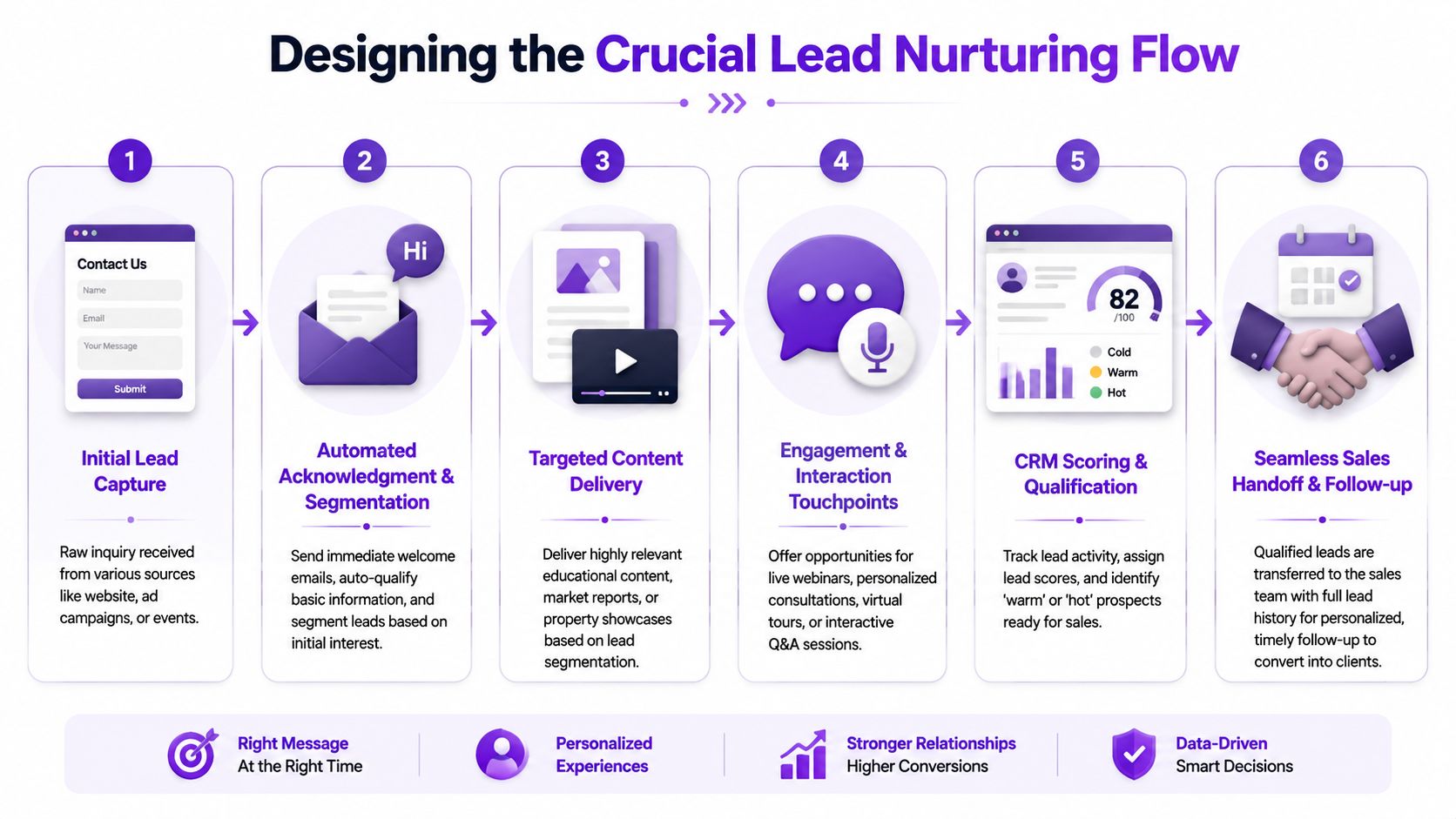
A practical sequence looks like this:
Instant acknowledgement
Confirm receipt immediately through SMS, WhatsApp, or email. State the property or area of interest and promise next contact clearly.Auto-segmentation
Tag by source, project, budget band, and intent clues such as EMI tool use, brochure download, or page depth.First call attempt
Trigger a callback as soon as possible. If no answer, continue with a message path rather than waiting a full day.Context delivery
Send one useful asset matched to intent, such as a project video, locality map, or payment explainer.Re-contact window
Retry within a defined short window, ideally with context from prior engagement.Sales handoff or nurture track
Sales gets leads with clear notes. Low-readiness leads move into a longer cadence instead of going dark.
For teams building localised nurture content into this process, geo content strategies for real estate are useful because geography-specific information often keeps early-stage buyers engaged without forcing a premature sales pitch.
Respond fast, then earn the next interaction with relevance.
Sample scripts your team can deploy
The best scripts don't sound scripted. They reduce uncertainty, gather signal, and move the prospect to the next commitment.
Instant SMS after a website form fill
- Message: “Hi [Name], thanks for your interest in [Project/Area]. We've received your enquiry and will contact you shortly. If you'd like, reply with your budget range or preferred visit time so we can prepare relevant options.”
WhatsApp message after a Facebook lead form
- Message: “Hello [Name], this is [Brand/Consultant]. You requested details for homes in [Location]. I can share a project video, locality map, or EMI estimate first. Reply with the option that would help most.”
Email for a mid-funnel nurture lead
- Subject line: “Shortlist for [Location] based on your enquiry”
- Body: “We've selected a few options aligned to your interest in [area/property type]. If commute, budget, or possession timeline matters most, reply with that priority and we'll narrow the shortlist.”
Call opener for qualification
- Script: “Thanks for enquiring about [project]. I want to make this useful. Are you exploring for self-use or investment, and are you comparing options in the same locality or across a few areas?”
The executive point is that a nurturing flow should be audited like any revenue process. Listen to calls. Review reply rates by message type. Compare appointment rates by sequence, source, and contact time. Real estate lead generation becomes more predictable when the first hour is designed, not improvised.
Scaling with Automation and Voice AI
At low volume, teams can manage follow-up through individual effort. At scale, that approach breaks. Enquiries arrive at uneven hours, across multiple channels, and in bursts that overwhelm manual calling queues.
The commercial impact is simple. Every delayed response lowers the odds that your team will be the first serious conversation.
Where manual follow-up breaks
Human-only teams struggle in three places:
- Concurrency: several hundred enquiries can arrive within short campaign windows.
- Consistency: different agents qualify differently, ask different questions, and log incomplete notes.
- Coverage: evenings, weekends, launch days, and missed-call recovery create operational gaps.
That's where automation matters. Not because it replaces relationship-led selling, but because it protects the earliest and most repetitive part of the funnel.
The dialling layer behind that automation matters just as much as the workflow logic; this outbound dialer software guide covers pacing modes and TRAI compliance controls relevant to high-volume real estate outreach.
The case for Voice AI becomes stronger when the workload is standardisable. First response, basic qualification, appointment booking, reminder calls, and reactivation are structured conversations. They still need nuance, but they don't always need a human to initiate them.
What Voice AI should own
A Voice AI layer works best when it handles high-frequency, rules-based conversation steps and hands richer conversations to human teams.
That usually includes:
- Immediate callback after inbound enquiry
- Basic qualification, such as budget, location preference, buying timeline, and purpose
- Appointment setting for site visit, consultation, or call-back
- Reminder and no-show recovery
- Lead reactivation for dormant enquiries and past prospects
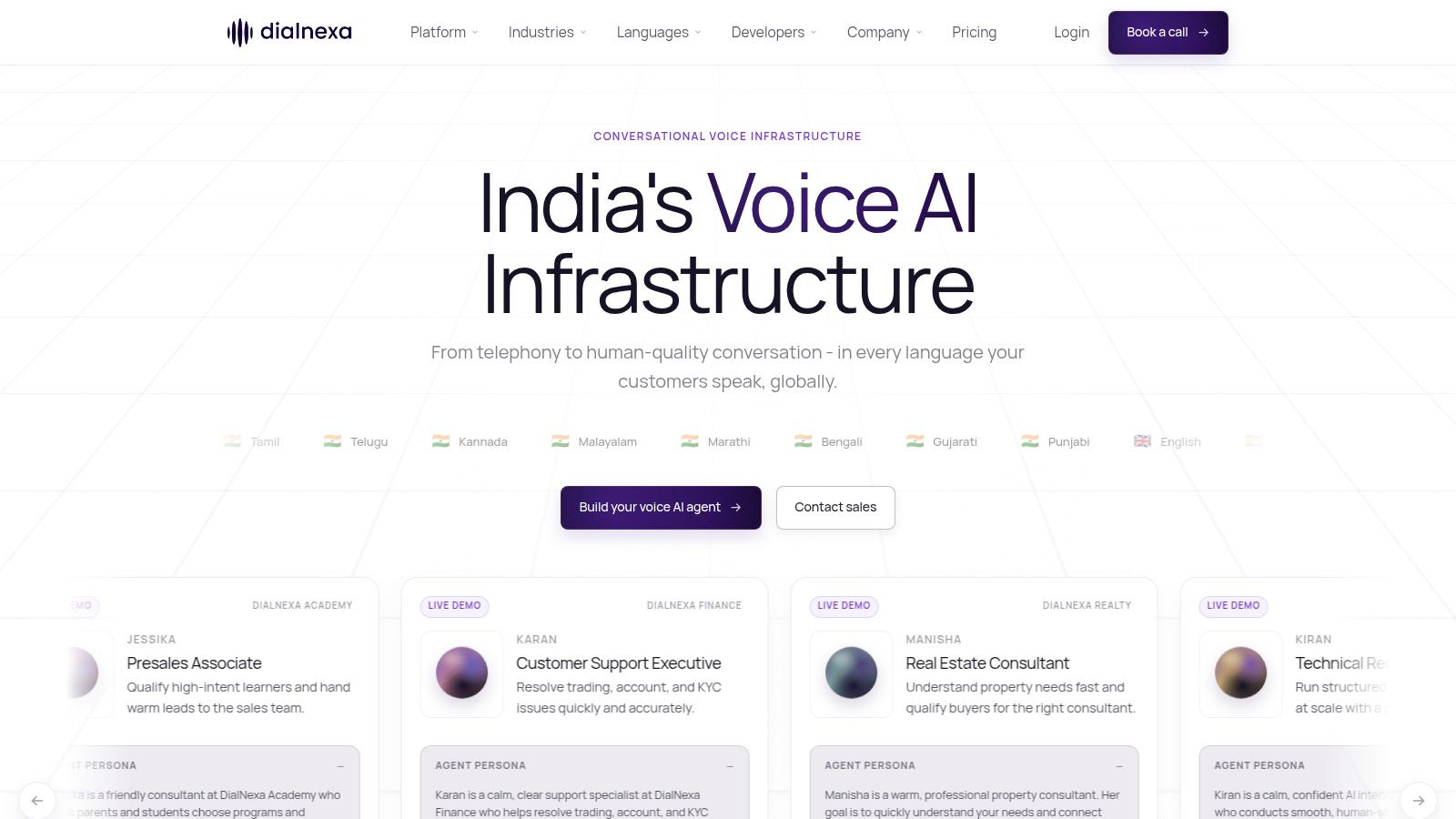
One factual benchmark matters here. DialNexa Labs Private Limited states that customers report connect rates rising from 47% to 91%, lead-to-booking improving from 2% to 8%, and AI-qualified leads matching human judgement with 97% accuracy. Those numbers should be read as product performance claims from the publisher, not market-wide averages, but they illustrate the business case for structured automation in a volume-heavy funnel. Teams evaluating this model can review a concrete example in this overview of an AI voice agent for real estate.
A short product walkthrough helps make the workflow tangible:
What executives should evaluate before rollout
Voice AI should be judged like any revenue system. Start with process fit.
Ask these questions:
- Which calls are repetitive enough to standardise?
- What data fields must be captured before handoff?
- How will the CRM receive call outcomes, transcripts, and booking status?
- When does the workflow escalate to a human agent?
- Which KPIs will define success?
A practical rollout often starts with one narrow use case, such as inbound portal callback for one city or one project cluster. That keeps testing clean. Leaders can compare contact rate, appointment rate, and speed-to-first-conversation against the manual baseline.
Automation should remove delay and inconsistency. Your best closers should spend less time chasing first contact and more time handling committed buyers.
Used properly, Voice AI doesn't flatten the customer experience. It protects the moments where speed and repetition matter most, then routes context-rich opportunities to the people who close.
Measuring Success with KPIs That Drive Growth
Executives don't need more marketing dashboards. They need a smaller set of numbers that explain whether the lead engine is producing revenue efficiently.
That means filtering out vanity metrics. Impressions and clicks matter only if they help explain movement in qualified pipeline.
The dashboard that matters
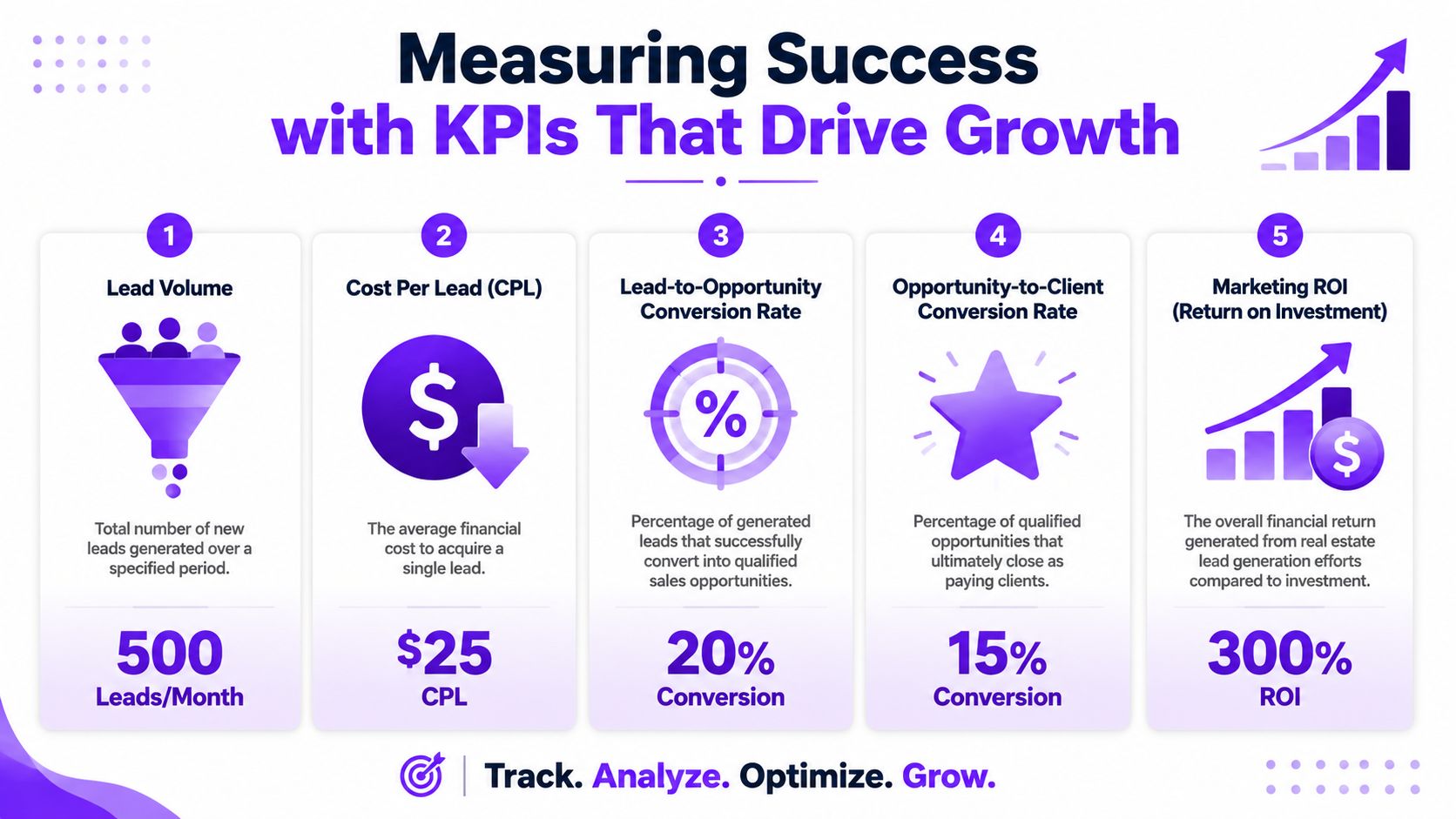
For most real estate firms, five KPIs create enough operating visibility:
Lead-to-contact rate
This shows whether your follow-up machinery is working. If contactability is poor, the issue may be data hygiene, channel quality, or response delay.Lead-to-appointment rate
This is the cleanest bridge between marketing and sales. It tells you whether targeting, messaging, and first-touch qualification are aligned.Cost per qualified lead
This is more useful than cost per lead because it reflects real sales potential, not just top-of-funnel volume.Appointment-to-site-visit progression
In property sales, this reveals whether the qualification conversation is attracting genuine intent or just generating soft bookings.Sales cycle velocity
Track how quickly different channels move from enquiry to meaningful sales milestone.
How to read channel performance like an operator
A VP should read KPI movement diagnostically.
If cost per lead looks efficient but cost per qualified lead rises, the channel is probably buying noise. If lead-to-appointment improves while sales cycle length worsens, qualification may be too loose. If referrals convert well but volume plateaus, post-sale engagement may need stronger process ownership.
Tooling is critical. A useful review of essential real estate marketing tools can help leadership teams think through how CRM, attribution, call workflows, and reporting should fit together instead of sitting in disconnected stacks.
One more point matters. KPI governance should happen at the channel-to-outcome level, not at the campaign screenshot level. The board doesn't need to know which ad got the most comments. It needs to know which system produced qualified opportunities faster and more efficiently.
Conclusion Building Your Lead Generation Moat
A list of leads is easy to buy. A lead generation system is harder to replicate.
That distinction matters more now because the market rewards operators, not just advertisers. One team buys the same portal inventory and social traffic as everyone else. Another team builds local search authority, segments demand cleanly, responds quickly, nurtures systematically, and routes serious buyers to the right people. The second team creates an asset. The first team rents attention.
That's the deeper lesson in real estate lead generation. Sustainable growth doesn't come from stacking tactics. It comes from linking channels, response speed, qualification logic, and measurement into one operating model.
For VPs, directors, and CXOs, the strategic move is to stop asking, “How do we get more leads?” and start asking, “How do we convert demand into qualified pipeline with less friction?” That shift improves cost discipline, shortens time to appointment, and makes revenue less dependent on any single channel.
The moat is operational. Inbound builds trust and lowers acquisition dependency. Outbound creates controlled reach. Nurturing protects intent. Automation removes delay. KPIs keep every channel accountable to pipeline and revenue.
That's how real estate lead generation becomes more than marketing. It becomes infrastructure.
If your team wants to turn enquiries into faster qualified conversations, DialNexa Labs Private Limited provides Voice AI agents for real estate workflows such as inbound qualification, follow-up calls, and site-visit booking, helping sales teams reduce response lag and focus human effort on higher-intent buyers.

An excellent breakdown of modern real estate lead generation that focuses on conversion quality rather than vanity metrics. The emphasis on response speed, nurturing workflows, and AI-powered automation offers valuable insights for building a scalable and sustainable growth engine.
[…] in how serious property firms think about responsiveness and qualified demand, this piece on improving property inquiry conversion is worth a skim. It reinforces a useful truth. In premium property, process quality shapes outcomes […]
This is a practical and insightful approach to real estate lead generation, especially the focus on response speed, qualification, and nurturing. The channel-wise strategies and automation insights make it useful for building a more consistent sales pipeline.