

Boost Quality Assurance Teams: Structure, Scale, and Lead for Growth
As a leader, you see your Quality Assurance (QA) team not as a bug-hunting squad, but as a strategic asset—a core function that actively protects your revenue and hard-won brand reputation. They are not a final checkpoint; they are the pit crew for your product's race to the market, ensuring you move with both speed and stability to avoid a catastrophic crash.
Why a Modern Quality Assurance Team is a Strategic Asset
In today's market, the real cost of poor quality is staggering—it can chew up 15–20% of a company’s annual revenue. But the damage isn't just financial. It's the slow erosion of customer trust and your competitive position. A single critical bug slipping into a live environment—like a checkout failure during a Black Friday sale—can cause service outages, trigger a storm of negative press, and send customers to your competitors, wiping out months of marketing investment in an instant.
This is where a modern QA team changes the game. They shift the focus from reactively finding bugs to proactively championing quality. In short, they become the guardians of the customer experience, making sure every feature and update delivers on the promise you've made to your users.
The Shift from Gatekeeper to Business Partner
Traditionally, QA was seen as the final gate before a product launch—a necessary, but often frustrating, bottleneck. Today's most effective quality assurance teams are anything but. They are strategic partners, embedded within the entire development lifecycle from the earliest stages. They don't just find problems; they help prevent them from ever happening.
For a C-level executive, this proactive approach pays dividends directly to the bottom line:
- Reduced Development Costs: It is exponentially cheaper to catch a design flaw in a wireframe than to recode a live application. For example, identifying a flawed payment workflow during the design phase might cost a few hours of discussion, whereas fixing it post-launch could cost tens of thousands in development, customer support, and lost sales.
- Faster Time-to-Market: When quality is built into the process from the start, you eliminate those last-minute, fire-drill scrambles that delay launches. This leads to predictable and accelerated release cycles, allowing you to outpace competitors.
- Enhanced Brand Reputation: Nothing builds a reputation for reliability like consistently delivering high-quality products. On the flip side, relying on outdated or poorly tested systems puts your business at significant risk.
A proactive QA function doesn’t just fix mistakes; it prevents them, protecting both margins and brand credibility. This mindset transforms the team from a cost centre into a value-creation engine.
Building a Global Standard of Excellence
As businesses scale, tapping into a global talent pool is a massive strategic advantage. India, for instance, has become a global hub for QA talent, with over 1.5 million engineering graduates entering the workforce each year. This incredible talent pool allows companies to build highly skilled and cost-effective quality assurance teams.
With competitive salaries—like ₹12-18 lakhs annually for an automation analyst with 3-5 years of experience—you can attract top professionals who can handle complex testing demands and integrate seamlessly into fast-paced, agile workflows.
Ultimately, elevating QA to a strategic asset requires strong leadership. Understanding how leaders can effectively support Quality Assurance teams is what truly transforms the function, ensuring it has the resources, authority, and alignment to drive quality across the entire organisation.
Choosing the Right Structure for Your QA Team
How you structure your quality assurance team isn't just an org chart detail—it's the blueprint that dictates its success and impact. For any business leader, getting this model right means aligning your quality function with your company’s speed, risk appetite, and strategic goals. The wrong structure creates friction and bottlenecks. The right one accelerates growth and innovation.
Think of it this way: a company making bespoke luxury cars wouldn't use the same supply chain as one mass-producing family vehicles. In the same vein, your QA structure needs to fit your product and your development methodology. There's no single perfect solution, but understanding the dominant models is the first step to building a team that gives you a genuine competitive edge.
The Centralised QA Model: Command and Control
Imagine a central command centre that oversees operations for an entire organisation. The Centralised QA model works like that, with a single, independent QA department serving all product and development teams. This group is responsible for creating and enforcing uniform quality standards, processes, and tools across the board.
This model is the gold standard for industries where consistency and compliance are absolutely non-negotiable.
- Best For: Fintech, healthcare, or any sector with strict regulatory requirements where standardised validation and clear audit trails are critical.
- Executive Benefit: You get a single, clear view of quality across the entire business. It simplifies resource management and ensures best practices are applied uniformly, significantly reducing compliance risks.
A practical example is a multinational bank launching a new mobile payments app. A Centralised QA team would be essential to ensure every feature, from fund transfers to user authentication, meets the same stringent security protocols and regulatory standards (like GDPR or PCI-DSS) before going live, regardless of which development team built it.
The Embedded QA Model: Speed and Agility
Now, picture a specialist embedded within a small, fast-moving squad. That’s the Embedded QA model. Here, QA professionals are integrated directly into individual product or agile development teams. They’re in the trenches with developers, designers, and product managers—attending daily stand-ups, participating in sprint planning, and contributing to retrospectives.
This structure is built for speed and context-specific quality.
By placing quality experts directly within the creative process, you shift their role from gatekeeper to collaborator. This not only accelerates development but also fosters a shared sense of ownership over the final product quality.
A fast-growing SaaS startup releasing weekly feature updates thrives with an Embedded model. A QA analyst sitting with the "user onboarding" team can provide instant feedback on new tutorial flows, catching usability issues as they happen. This rapid feedback loop allows the team to iterate quickly and improve the user experience without the delay of a formal handoff to a separate QA department.
The Hybrid QA Model: Scalability and Balance
The Hybrid model is a smart blend of the other two approaches. It combines a small, centralised QA authority—often called a QA Centre of Excellence (CoE)—with embedded QA testers who remain part of their development squads. The CoE sets the high-level strategy, selects the tools, and defines best practices, while the embedded members handle the day-to-day testing.
This balance is perfect for larger companies that need both strong governance and agile execution. It allows individual teams to move fast while ensuring the whole organisation adheres to core quality principles.
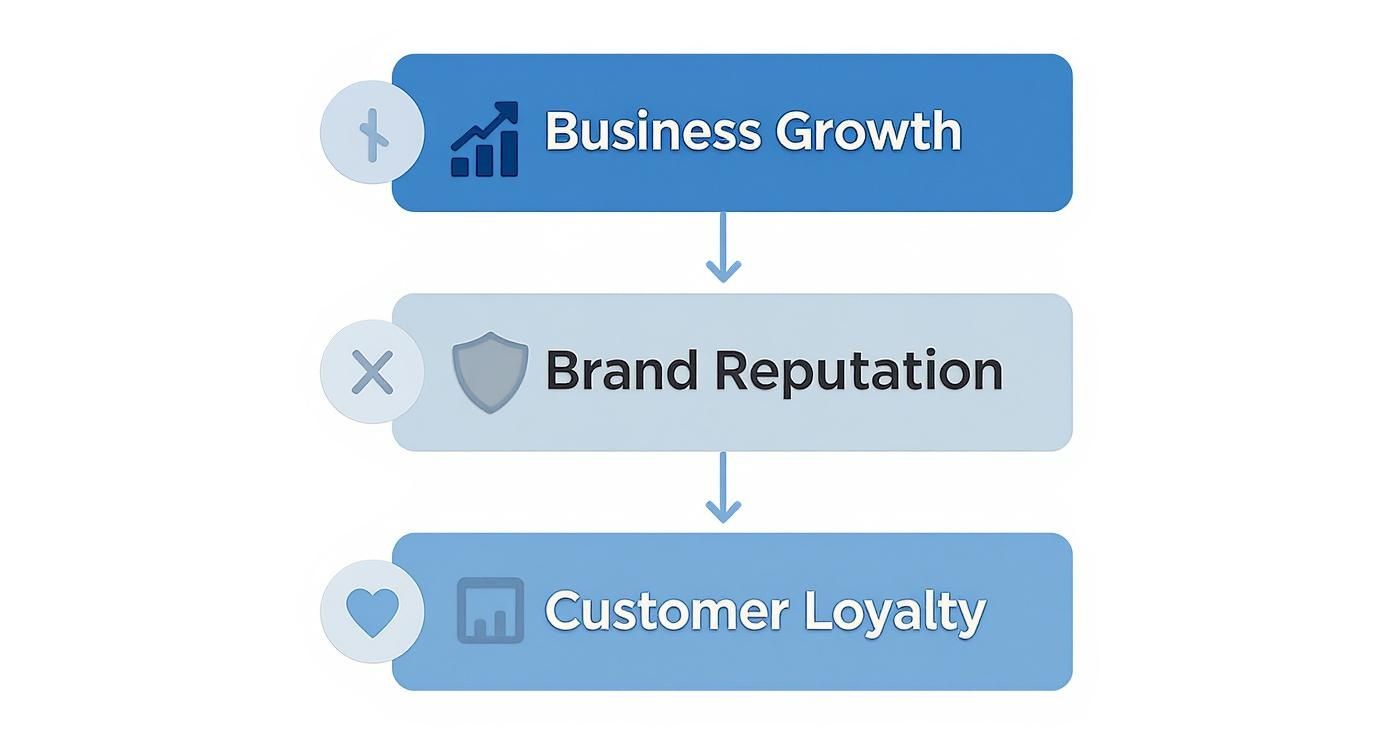
As the chart shows, a strong QA function, regardless of its structure, directly fuels the business outcomes that matter: customer loyalty is protected by a solid brand reputation, which in turn drives sustainable business growth. For any leader looking to scale operations without sacrificing quality, the Hybrid model offers a robust and adaptable framework.
Key Role Responsibilities in Different QA Models
The specific duties of a QA professional can change quite a bit depending on the structure they work within. The table below breaks down how key roles and their responsibilities differ between the Centralised and Embedded models.
| Role | Centralised Model Responsibilities | Embedded Model Responsibilities |
|---|---|---|
| QA Manager | Oversees all QA projects, allocates resources from a central pool, and reports on organisation-wide quality metrics. | Acts as a chapter lead or mentor, focusing on professional development and best practices, not direct project management. |
| Test Lead/Architect | Designs enterprise-wide test strategies, selects and standardises tools, and enforces testing processes. | Advises the team on testing approaches, helps with complex test scenarios, and champions quality within the sprint. |
| QA Analyst/Engineer | Executes test plans received from a test lead, reports defects to a central system, and performs regression testing for multiple projects. | Works within the agile team, writes and automates tests for new features, provides immediate feedback, and participates in all ceremonies. |
| Automation Engineer | Builds and maintains a centralised automation framework used by all teams. Focuses on broad, end-to-end regression suites. | Develops and maintains automation scripts specific to the team's product or feature area. Integrates tests directly into the CI/CD pipeline. |
Understanding these distinctions is key to hiring the right people and setting clear expectations. An engineer who thrives on deep product ownership might feel stifled in a Centralised model, while someone who excels at process standardisation would be a perfect fit.
Using Automation and AI to Maximise QA Impact
For any forward-thinking leader, technology is the ultimate force multiplier. Applied to quality assurance, it can completely overhaul the function, transforming it from a manual, labour-intensive process into a high-speed, high-impact strategic asset. Investing in automation and AI isn't just about keeping up; it’s about fundamentally changing what your quality assurance teams can achieve.
Think of the difference between a team of artisans hand-crafting a product and a fully automated assembly line. The artisans bring skill and creativity, but the assembly line delivers speed, consistency, and scale that are simply unmatched. This is the exact shift that automation brings to QA. It frees your human experts from repetitive, mundane tasks, allowing them to focus on complex, creative challenges that require a human brain.

Driving Efficiency and Coverage at Scale
Automation truly shines when it comes to tasks that are impossible to perform manually at scale. Take regression testing, for example, where hundreds or even thousands of existing functions have to be re-tested every time a new piece of code is added. Doing this by hand is a slow, error-prone ordeal that can bring your entire release pipeline to a grinding halt.
With automation, however, these tests can run overnight, covering thousands of user pathways across different devices and browsers. A practical example is a major e-commerce platform that runs 5,000 automated tests every night. This gives their development teams immediate feedback, ensuring a new feature doesn't inadvertently break the checkout process and giving them the confidence to innovate faster.
The Strategic Business Case for Investment
Viewing technology as a cost centre is a common mistake. For QA, it’s a direct investment in your company’s growth and stability. The strategic benefits are clear and quantifiable, making it easier to secure boardroom buy-in.
- Slash Time-to-Market: When automated testing is part of your CI/CD pipeline, you get faster feedback, quicker bug fixes, and more frequent releases. Getting features to your customers faster is a massive competitive advantage.
- Drastically Reduce Defect Costs: The cost of fixing a bug skyrockets the later it’s found. Automation catches defects early when they are cheap and easy to fix. For instance, a bug found by a developer costs roughly $80 to fix, but that same bug found by a customer can cost over $10,000 in support time, developer effort, and potential churn.
- Elevate Customer Experience: AI-driven tools can simulate thousands of different user journeys. This uncovers edge cases and usability issues that manual testers might miss, helping you deliver a flawless experience right from launch.
The QA landscape in India highlights this trend, where about 68% of quality assurance teams now use AI for key testing activities. This adoption is expected to speed up release cycles by 30-40% and cut post-release defects by a staggering 40%. While finding staff skilled in AI tools remains a challenge, the business case is incredibly compelling, with AI projected to halve regression test maintenance costs alone.
From Repetitive Tasks to Strategic Insights
The true power of integrating AI isn't just about doing old tasks faster; it’s about unlocking entirely new capabilities. AI can analyse test results to predict high-risk areas of an application, allowing your team to focus their valuable time where it's needed most. This predictive ability turns QA from a reactive function into a proactive one.
By automating the predictable, you empower your team to explore the unpredictable. This is where your best people find the critical, nuanced bugs that automation can’t—and deliver immense value.
For instance, AI can help manage the enormous amount of data needed for effective testing. Tools designed to automate data labelling at scale with a human-in-the-loop approach can prepare large, accurate datasets for training and testing AI models—a task that would be prohibitively expensive and time-consuming to do manually.
Ultimately, automation and AI are not about replacing your team. They're about amplifying their impact, turning your QA function from a necessary checkpoint into a powerful driver of business growth.
Measuring QA Performance with Business-Focused KPIs
"What gets measured gets managed." It's an old adage for a reason, especially for senior leaders. But when it comes to quality assurance, performance discussions can quickly dissolve into technical jargon that doesn't resonate in the boardroom.
To have a data-driven conversation about the value of your quality assurance teams, you must speak the language of the business. This means focusing on metrics that demonstrate how quality directly impacts the company's financial health. These Key Performance Indicators (KPIs) translate your team's day-to-day efforts into tangible business results like protected revenue, customer retention, and sustainable growth.
Let's break them down into three key areas: operational efficiency, team effectiveness, and direct business impact.
Gauging Operational Efficiency
Efficiency metrics answer a simple question: are we using our resources effectively? They provide a clear view of the speed and scalability of your quality processes, showing where automation is delivering real value and how quickly the team can support development.
- Test Automation Coverage: This is the percentage of your test cases that are automated versus executed manually. A high percentage is a major strategic win. It means your team can test more code, more frequently, without increasing headcount. This directly accelerates your time-to-market.
- Test Execution Time: How long does it take to run all the tests for a new release? As you optimise and automate, this number should decrease. A shorter execution time makes your entire development pipeline faster and more reliable, allowing you to deploy updates with greater confidence.
Consider an e-commerce platform that increased its automation coverage from 40% to 80%. This slashed their full regression testing time from two days to just four hours. As a result, they can now deploy critical price changes or new promotions daily instead of weekly, enabling them to react to market trends far faster than their competitors.
Evaluating Team Effectiveness
Effectiveness KPIs measure how well the QA team is achieving its core mission: finding and resolving bugs before they impact a customer. These metrics reveal how effectively you're protecting the user experience and your brand's reputation.
A truly effective quality assurance team doesn’t just find bugs; it prevents them from ever reaching the customer. Their success is measured not by the problems they report, but by the problems your users never experience.
Here are the critical metrics for effectiveness:
- Defect Detection Percentage (DDP): This compares the number of bugs your QA team finds before a release against the number of bugs your users find after. A high DDP, say around 95%, demonstrates your quality process is robust and catching almost everything before it goes live.
- Escaped Defect Rate: This tracks the number of serious bugs that slip through and make it into the live product. Keeping this number consistently low is a direct indicator of product stability and a positive customer experience.
Imagine a banking app where an "escaped" defect causes incorrect account balances to be displayed. The resulting panic and loss of trust would be immediate and severe. An effective QA team works to keep this rate as close to zero as possible, acting as the last line of defence for your company's credibility.
Connecting QA to Business Impact
This is where you demonstrate the undeniable financial value of quality assurance to senior leadership. Business impact KPIs create a direct line between QA activities and the company's bottom line.
- Cost of Quality (CoQ): This is a powerful financial metric. It weighs the cost of preventing bugs (e.g., training, better processes) against the much higher cost of fixing them (rework, customer support calls, lost sales). A downward trending CoQ is proof that your QA team is successfully shifting from expensive, reactive fixes to smart, cost-effective prevention.
- Reduction in Customer Support Tickets: A simple but powerful KPI. Track the number of support tickets related to software bugs. When this number drops following a release, it’s clear evidence that your QA team’s work has produced a better, more intuitive product. This translates to higher customer satisfaction and lower operational costs for your support department.
How to Hire and Retain an Elite QA Team
Building a world-class team is your ultimate competitive advantage. While the right technology and processes are crucial, they are only as effective as the people implementing them. For any executive, attracting, developing, and retaining top QA talent isn't just an HR function—it’s a core business strategy that fuels innovation and protects your bottom line.
Every dollar you invest in an elite QA team pays dividends through superior product quality, higher customer retention, and a stronger brand. But achieving this means looking beyond a candidate's technical skills on a resume.
Hiring for More Than Technical Prowess
Technical know-how is the price of entry, not the whole game. The truly exceptional QA professionals possess a unique blend of soft skills that enables them to champion the customer and drive quality across the entire organisation. They become the voice of your user, ensuring the final product is not just functional, but genuinely intuitive and reliable.
When hiring, look for candidates who exhibit these crucial traits:
- Relentless Curiosity: They don’t just follow a test script; they constantly ask "what if?" and push the system to its limits. This is how they uncover the subtle, high-impact bugs that others miss.
- Strong Communication: They must be able to explain a complex technical bug to a developer one minute and then articulate its business impact to a non-technical manager the next. Clear communication ensures problems get resolved quickly.
- Customer Empathy: The best QA professionals put themselves in the user’s shoes. They aren’t just testing if a button works; they’re testing from the perspective of a customer trying to accomplish a goal under pressure.
To identify these individuals, you must go beyond standard technical questions in an interview.
Ask questions that reveal how they think and act, like: "Describe a time you had to advocate for the user's experience against a tight deadline. What was the situation, and what was the outcome?"
This type of question reveals far more about their ability to prioritise quality under pressure—a true sign of a valuable addition to your quality assurance teams.
Creating Clear Pathways for Growth
Talented people will not stay if they feel they are in a dead-end job. A common leadership mistake is treating QA as a stepping stone to another career. To retain your best people, you must build clear, compelling career paths that show them they have a future within your organisation.

A well-defined career ladder shows your team you are invested in their long-term growth. It might look something like this:
1. Junior Tester: Executes test cases and learns the product inside and out.
2. QA Analyst/Engineer: Develops test plans, writes automation scripts, and takes ownership of quality for specific features.
3. Senior QA Engineer: Mentors junior team members, leads complex testing projects, and helps shape the overall test strategy.
4. QA Architect: Designs the enterprise-level testing framework, evaluates and selects tools, and sets the high-level technical vision for quality.
A structured training plan is essential to support this progression. Using an effective employee training plan template can provide a great starting point for programmes that genuinely foster growth. This approach not only keeps your team engaged but also ensures their skills evolve with your company's needs. Nurturing this kind of high-performance culture is a massive strategic advantage; you can learn more about how to build a high-performance creative team in 2025 in our detailed guide.
When you focus on both hiring for the right mindset and creating a culture of growth, you build an organisation that is set up to innovate for years to come.
Integrating Your QA Team with a Quality Management System
A skilled QA team is essential, but they cannot reach their full potential operating in a vacuum. To maximise their impact, you need to integrate them into a robust Quality Management System (QMS). This step is what separates a group of talented testers from a truly unified, high-performing quality operation.
Think of your QA team as a crew of expert mechanics. The QMS is their state-of-the-art diagnostic suite. It provides the data, historical records, and real-time feedback they need to pinpoint issues, prevent future breakdowns, and keep the entire product engine running smoothly. Without it, they're operating with blinders on.
The QMS: Your Quality Control Hub
A modern QMS is not just a digital filing cabinet for compliance documents. It serves as the central nervous system for quality, connecting every part of the product lifecycle—from initial requirements and design through to customer feedback post-launch. This creates a single source of truth that aligns every stakeholder.
For a director or VP, this means gaining a clear, consolidated view of quality across the entire portfolio. Instead of chasing down disparate reports and spreadsheets, you get a live dashboard of your quality health. A good QMS empowers your QA team with crucial functions, including:
- Automated Reporting: Generate up-to-the-minute reports on bug trends, test coverage, and other key metrics without hours of manual data compilation.
- Compliance Tracking: Effortlessly manage and document adherence to standards like ISO 9001 or HIPAA, ensuring you are always audit-ready.
- Continuous Improvement: Establish a formal feedback loop where learnings from testing and customer support tickets are channelled back into the development process, preventing recurring issues.
Tracing Bugs Back to Their Roots
One of the most powerful advantages a QMS provides is traceability. When a customer reports a critical bug, the system allows your team to trace its origin all the way back through the development cycle. For example, a bug causing data loss in a new feature could be traced from the live incident, to the specific code commit, and even to the original user story that had an ambiguous requirement.
By connecting all the dots, a QMS turns bug fixing from a panicked, reactive chore into a powerful learning experience. Your team can stop just patching symptoms and start fixing the root cause for good.
This transformative capability is why companies are investing heavily in QMS software. In India alone, the market for QMS is expected to jump from USD 240.9 million in 2024 to a massive USD 522.8 million by 2030. This isn't just a trend; it’s a fundamental shift towards integrated systems that help quality assurance teams systematically reduce errors, with some businesses reporting a 30% reduction in defects. You can find more global trends in quality management on startus-insights.com to see the bigger picture.
Ultimately, combining a talented team with a powerful QMS is not an expense—it's a strategic investment. It helps build a resilient, data-driven quality culture that doesn't just find mistakes but actively prevents them, safeguarding your revenue and your customers' trust.
Frequently Asked Questions About Building QA Teams
When building a QA team from scratch or scaling an existing one, numerous questions arise, especially from leadership. Answering these correctly from the outset is crucial for ensuring your investment in quality aligns with business objectives and delivers a tangible return. Let's tackle some of the most common questions from an executive perspective.
Who Is the First Key Hire for a New Quality Assurance Team?
Your first hire sets the tone for everything that follows, so make it count. You need a QA Lead or Manager with a strong strategic mindset. This person isn't just another tester; they are the architect of your quality practice. They will be responsible for crafting the vision, selecting the right tools, defining processes, and, most importantly, hiring the rest of your team.
For example, if a fintech startup is building a new product, their first QA hire must be thinking about compliance and risk from day one. They will build a testing strategy that prioritises security and data integrity, saving the company from potentially millions in fines and reputational damage down the line. That foundational leadership is priceless.
How Do I Justify the ROI of Investing in QA Automation?
This question is a boardroom staple. The key is to stop talking about automation in purely technical terms and start framing the return on investment (ROI) in the language of business value. When you do that, the justification becomes clear.
- Direct Cost Savings: Calculate the hours your team spends on manual regression testing. Show how automating this work saves thousands of man-hours per year, even after accounting for tool and training costs.
- Revenue Impact: Speed to market is a revenue driver. Demonstrate how automation reduces the release cycle from months to weeks, allowing you to launch new features and capture market share ahead of competitors.
- Risk Mitigation: Quantify the cost of failure. Calculate the potential financial impact of a critical bug reaching your customers, factoring in lost sales, brand damage, and customer churn.
Automation isn't a cost centre; it's a revenue protector. A retail company could justify the investment by showing that automating their checkout process testing prevents an estimated ₹50 lakhs in lost sales per hour during a potential outage on a peak shopping day.
How Can We Shift Quality to a Company-Wide Responsibility?
Transforming quality from a departmental silo into a company-wide mindset is a cultural shift that must be championed from the top. It requires deliberate and consistent action, not just a memo.
A great first step is to embed QA professionals directly into development teams. When they collaborate daily, quality becomes a shared goal. Next, introduce shared quality metrics, like "escaped defect rate," that both developers and QA are accountable for.
Empower developers with tools that provide instant, automated feedback on their code quality. Above all, leadership must constantly reinforce the message that quality is everyone's job. When a product manager gets as excited about a low bug count as they do about launching a flashy new feature, you'll know the culture is truly changing. Quality becomes a collective win.
Ready to enhance your team's efficiency and scale your customer interactions? DialNexa delivers human-like Voice AI agents that automate routine calls, allowing your teams to focus on high-value conversations. Discover how to turn more conversations into conversions by visiting https://dialnexa.com.

Excellent insights on how modern QA teams have evolved from bug finders into strategic business partners driving customer trust and revenue growth. Investing in automation, AI, and skilled QA talent is clearly a competitive advantage in today’s fast-moving digital landscape.