
Operational Cost Reduction Strategies for VPs & CXOs in 2026
Most boards still treat cost reduction as a budgeting exercise. That framing is no longer adequate in high-volume Indian operations. When digital payments volumes reached 18.67 billion transactions in May 2025, with UPI accounting for 16.99 billion, the operating question changed from “Where can we cut?” to “How do we lower cost per interaction without increasing exceptions, complaints, or compliance exposure?” (tractian.com on cost reduction)
In that environment, false economies become expensive very quickly. A staffing cut that lengthens queues, a vendor switch that increases rework, or a badly designed automation layer that pushes complex cases into repeated callbacks can all reduce visible spend while increasing total operating cost. Boards need a broader lens: service quality, rework, exception handling, supervision load, and trust all sit on the same P&L logic as wages and software licences.
Leaders looking to manage operational expenses effectively should start with one principle: the cheapest process on paper is often the most expensive process in production if it creates downstream failure costs.
Table of Contents
- The CXO Dilemma Cutting Costs Without Breaking the Business
- Adopting a Strategic Cost Reduction Framework
- Identifying Primary Cost Drivers and Key KPIs
- High-Impact Levers for Tactical Cost Reduction
- Industry Case Studies Measurable Outcomes in India
- Your Implementation Roadmap and ROI Calculation
The CXO Dilemma Cutting Costs Without Breaking the Business
The classic cost programme assumes that spend categories are independent. They aren't. Labour decisions affect quality. Quality affects rework. Rework affects service levels. Service levels affect customer trust and regulator attention. In regulated sectors such as BFSI, healthcare, and edtech, one weak link usually shows up later as a bigger invoice somewhere else.
That's why operational cost reduction has to be treated as a systems problem, not a procurement event. The board's real objective isn't the lowest nominal cost. It's the lowest sustainable cost of delivering a compliant, consistent outcome at scale.
Why cost cuts fail in practice
Most failed cost programmes have one trait in common. They optimise for a visible line item and ignore adjacent costs.
A few examples illustrate the pattern:
- Headcount cuts without workflow redesign: teams save salary expense but inherit longer handling times, more escalations, and more supervisory intervention.
- Low-cost outsourcing without control discipline: the contract looks cheaper, but variability rises and customers call back more often.
- Automation without exception design: straightforward queries are handled, yet complex cases bounce between channels and create duplicate work.
- Compliance shortcuts: turnaround may improve briefly, but remediation and audit clean-up can erase the gain.
False economy isn't “spending less and getting less”. It's “spending less in one place and more everywhere else”.
What boards should optimise instead
A stronger board conversation starts with a narrower operating unit: the interaction, the case, the verification flow, the booking journey, or the complaint cycle. Then management asks four questions:
| Decision lens | What to test |
|---|---|
| Cost per unit | What does one resolved interaction or completed workflow actually cost? |
| Quality stability | Does the change reduce variance, or does it create more exceptions? |
| Compliance resilience | Can the process remain controlled under higher volumes? |
| Scalability | Does marginal cost improve as volume rises, or does complexity rise with it? |
This shifts the debate away from crude cost suppression. It also creates competitive advantage. In high-volume service businesses, the winner usually isn't the company with the smallest team. It's the company that can absorb volume spikes without service degradation.
Adopting a Strategic Cost Reduction Framework
Boards need a method that separates durable efficiency from cosmetic savings. One useful starting point comes from India's Productivity Linked Bonus (PLB) model, formalised for industrial establishments in the 1970s. Its enduring lesson is simple: costs are controlled more reliably when compensation and staffing are tied to measurable output rather than manual effort alone. In large operations, even a 1% productivity improvement can affect payroll efficiency across thousands of employees (cloudvara.com on cost reduction strategies).
That principle remains highly relevant for service operations. The modern version isn't only about wages. It applies to vendor pricing, contact centre staffing, technology utilisation, and process ownership. If spend isn't linked to throughput and quality outcomes, cost inflation creeps in through idle capacity, duplicated work, and avoidable exception handling.
Why output-linked economics matter
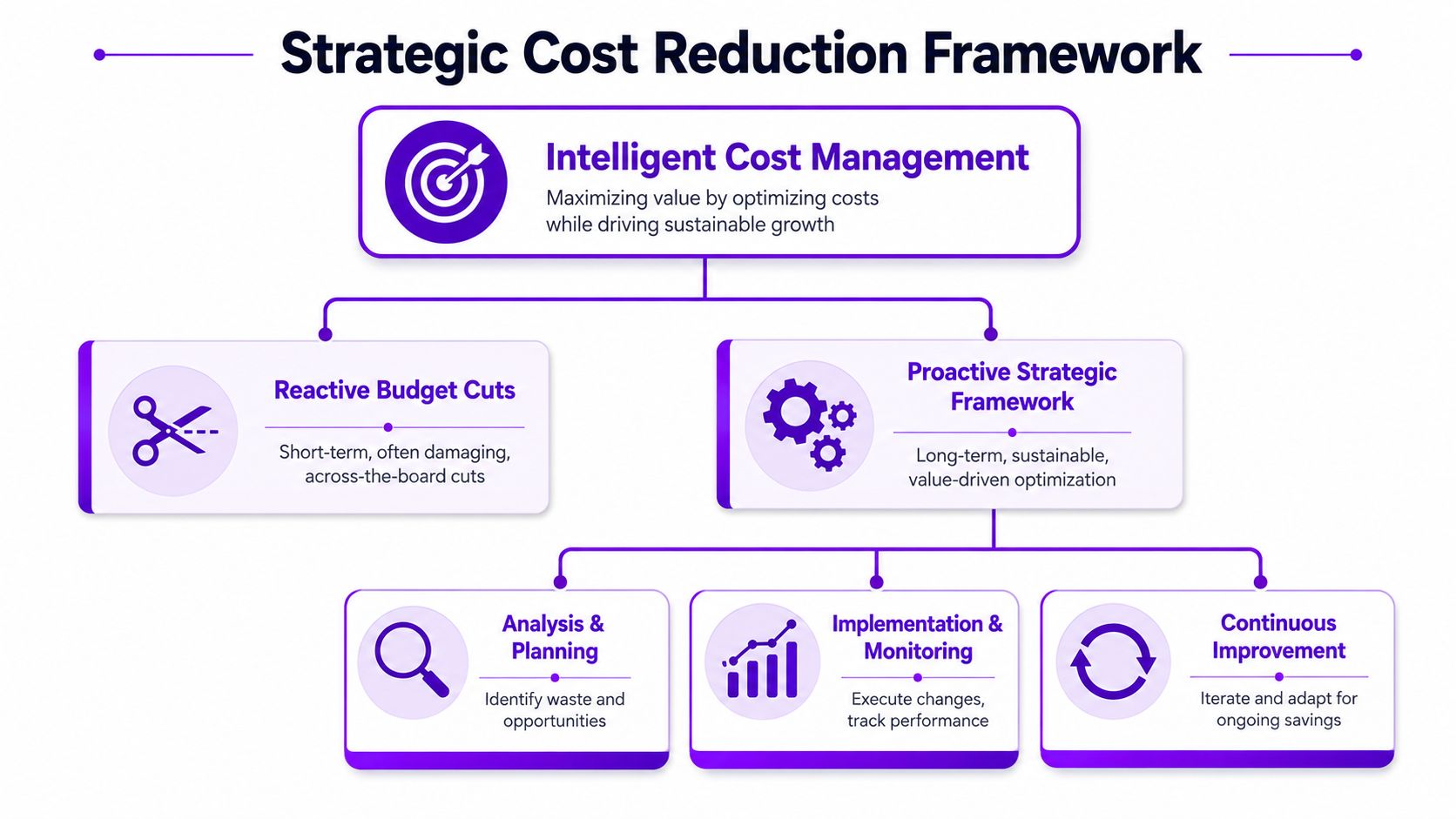
Reactive budget cuts usually treat all costs as equal. A strategic framework doesn't. It distinguishes between:
- Value-creating cost: spending that improves throughput, quality, or conversion.
- Control cost: spending required to keep risk, compliance, and service standards stable.
- Failure cost: rework, callbacks, duplicated verification, and escalation overhead.
- Idle or redundant cost: licences, vendors, handoffs, and labour capacity that don't improve outcomes.
Many CXO teams underperform in a specific way: They negotiate hard on visible spend, yet allow failure cost to remain structurally embedded.
Practical rule: If a cost initiative doesn't specify its impact on throughput, quality, and exception volume, it isn't a strategy. It's a cut.
A board-level lens for total operating cost
A more useful framework looks like this:
Map the full workflow
Track demand from first contact to resolution, fulfilment, or booking. Include handoffs and approval points.Separate fixed cost from volume-sensitive cost
Some costs scale with demand. Others should remain stable if the operating model is sound.Attach output metrics to every spend pool
This is the service-era equivalent of the PLB logic.Prioritise non-value-added activity
Repeated verification, manual transcription, duplicate customer contact, and fragmented tools usually sit here.Review automation readiness
Teams evaluating service workflows often use contact center automation frameworks to determine which interactions are standardised enough for technology-led cost improvement.
A board that adopts this structure gets better capital allocation decisions. It can fund improvements that lower unit cost over time, rather than rewarding short-term reductions that degrade operating capacity.
Identifying Primary Cost Drivers and Key KPIs
Most companies know their salary bill. Fewer know their cost of poor quality in day-to-day operations. That's a problem, because hidden cost often sits in the workflow, not in the org chart.
For service-heavy organisations, the baseline should start at the process level. Measure the journey that creates the expense. In many cases, the largest drivers aren't only wages. They include delays, repeated callbacks, fragmented tools, manual checks, low-quality routing, and exception queues that consume senior staff time.
Where hidden cost usually sits
In practical terms, boards should ask management to break operational cost into the categories below.
- Direct labour cost: frontline handling time, team leader oversight, QA effort, and back-office support.
- Technology cost: platform subscriptions, integrations, maintenance overhead, and duplicate tools serving similar use cases.
- Vendor and contract cost: BPO arrangements, implementation partners, telephony providers, compliance vendors, and outsourced processing.
- Failure cost: rework, callbacks, abandoned cases, repeated document collection, and manual correction.
- Service-quality cost: customer effort, complaints, churn risk, and reputational damage where trust matters.
For labour analysis, some finance teams use external benchmarks on how to reduce employee costs without defaulting to simplistic headcount logic. That's useful only if labour is evaluated alongside throughput and rework, not in isolation.
The KPI stack that prevents guesswork
A good KPI stack contains a mix of financial, operational, and customer-quality metrics. Not every business needs the same dashboard, but most need the same categories.
| KPI category | What it tells leadership |
|---|---|
| Cost per service interaction | The average operating cost to complete or resolve a customer contact |
| First contact resolution | Whether demand is being solved once or recycled into the queue |
| Process cycle time | How long the workflow takes from initiation to completion |
| Handoff rate | How often a case moves between teams, agents, or systems |
| Rework volume | How much avoidable work the system is generating |
| Customer effort or friction signals | Whether “efficiency” is being purchased at the expense of experience |
A practical diagnostic sequence works well:
- Establish the current-state baseline for one high-volume journey.
- Identify the top failure points where cost repeats.
- Measure exception causes rather than only total volume.
- Track post-change movement in both cost and quality metrics.
Teams refining these dashboards often adapt proven contact centre KPI structures so finance, operations, and service leaders are using the same definitions.
If a process looks cheap but produces repeat demand, it isn't efficient. It's deferred cost.
High-Impact Levers for Tactical Cost Reduction
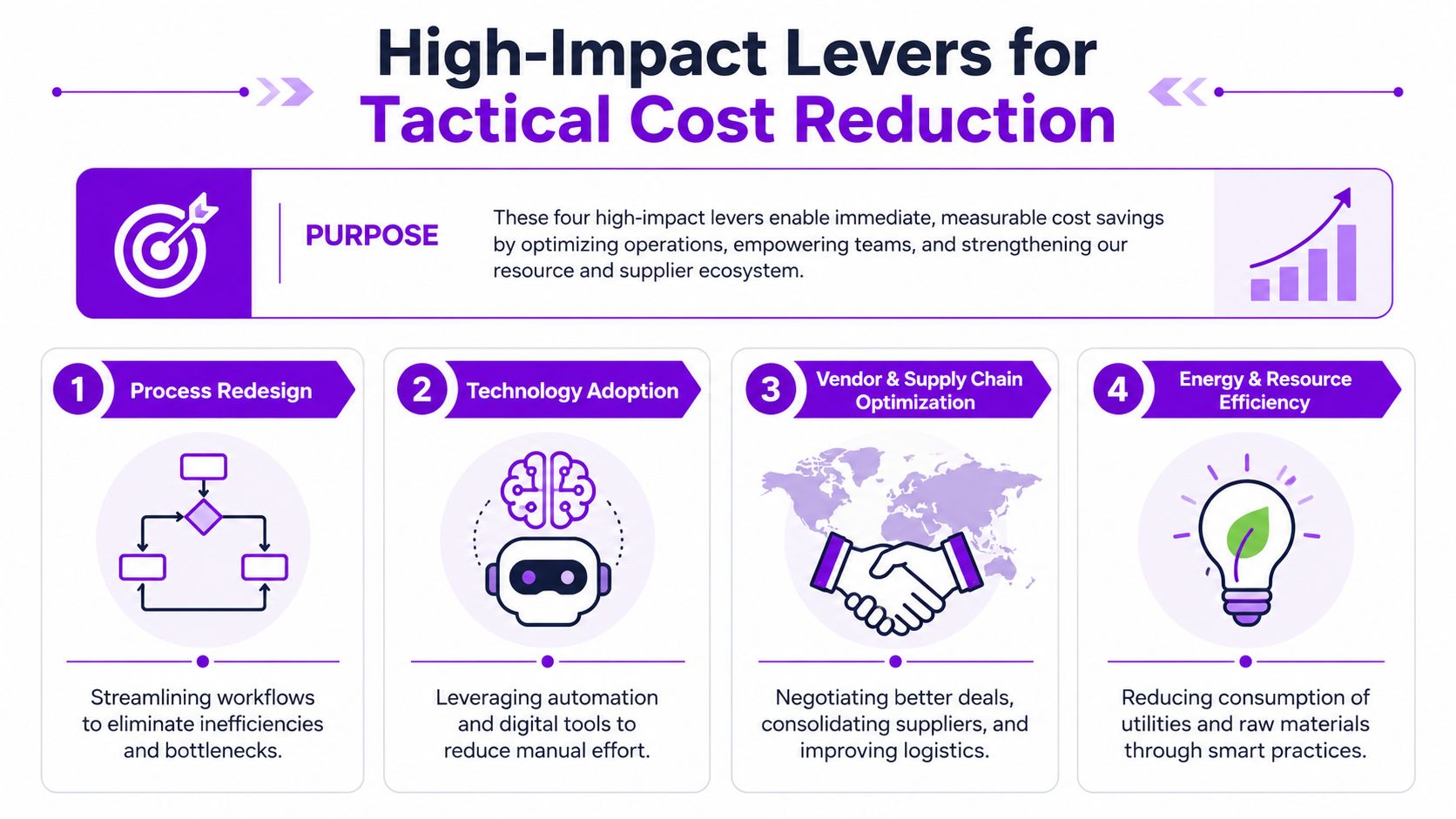
Tactical cost reduction works when leaders choose levers that remove structural waste. It fails when they compress capacity as the sole measure. Four levers matter most in service operations: process redesign, automation, commercial optimisation, and technology consolidation.
Process redesign before cost cutting
Lean Six Sigma provides one of the clearest ways to attack hidden cost. The DMAIC method, defined as Define, Measure, Analyze, Improve, Control, requires teams to quantify the Cost of Poor Quality (COPQ), establish a process baseline, map the current workflow, isolate the dominant defect driver, and lock in gains with SOPs and KPI monitoring (6sigma.us on operational cost reduction).
That matters because many operating losses don't appear as “waste” in financial reports. They sit in duplicate verification, repeated customer contact, delayed approvals, and preventable escalations.
A practical board question is this: What defect generates the most repeat work? Fixing that defect often produces cleaner savings than broad-based cuts.
Automation where intent is repetitive
In customer-facing environments, automation is most effective where requests are standardised. Industry guidance notes that AI-driven agents can reduce manual intervention by up to 40% and cut customer service costs by up to 30% when they handle high-volume queries such as order-status or account questions without human escalation (MemberSplash guide to operational efficiency).
The mechanism isn't generic labour replacement. It's queue compression. Each deflected interaction removes handling time, lowers average cost per resolution, and reduces rework caused by manual transcription or follow-up errors. The highest-yield use cases are usually lead qualification, booking, support triage, and reminder workflows with clear intent patterns.
For leaders evaluating automating business processes, the discipline matters as much as the tool. Start with baseline cost mapping. Define the top intents. Create deterministic routing for exceptions. Then measure deflection rate, first-contact resolution, and handoff rate.
One option in this category is AI in customer service workflows, including platforms such as DialNexa that automate repetitive voice interactions for qualification, support, booking, and follow-up processes.
Commercial and technology clean-up
Some savings don't require transformation. They require management discipline.
- Vendor optimisation: renegotiate contracts against measured service outcomes, not only volume commitments.
- Role redesign: cross-train teams so routine demand doesn't always flow to the highest-cost employee tier.
- Tool rationalisation: remove overlapping software and fragmented systems that increase maintenance and reporting complexity.
- Exception governance: define which tasks must remain human-managed because downstream risk is too expensive to automate badly.
The common thread is selectivity. The board should expect management to automate the repeatable, standardise the variable, and protect the judgement-heavy work.
Industry Case Studies Measurable Outcomes in India
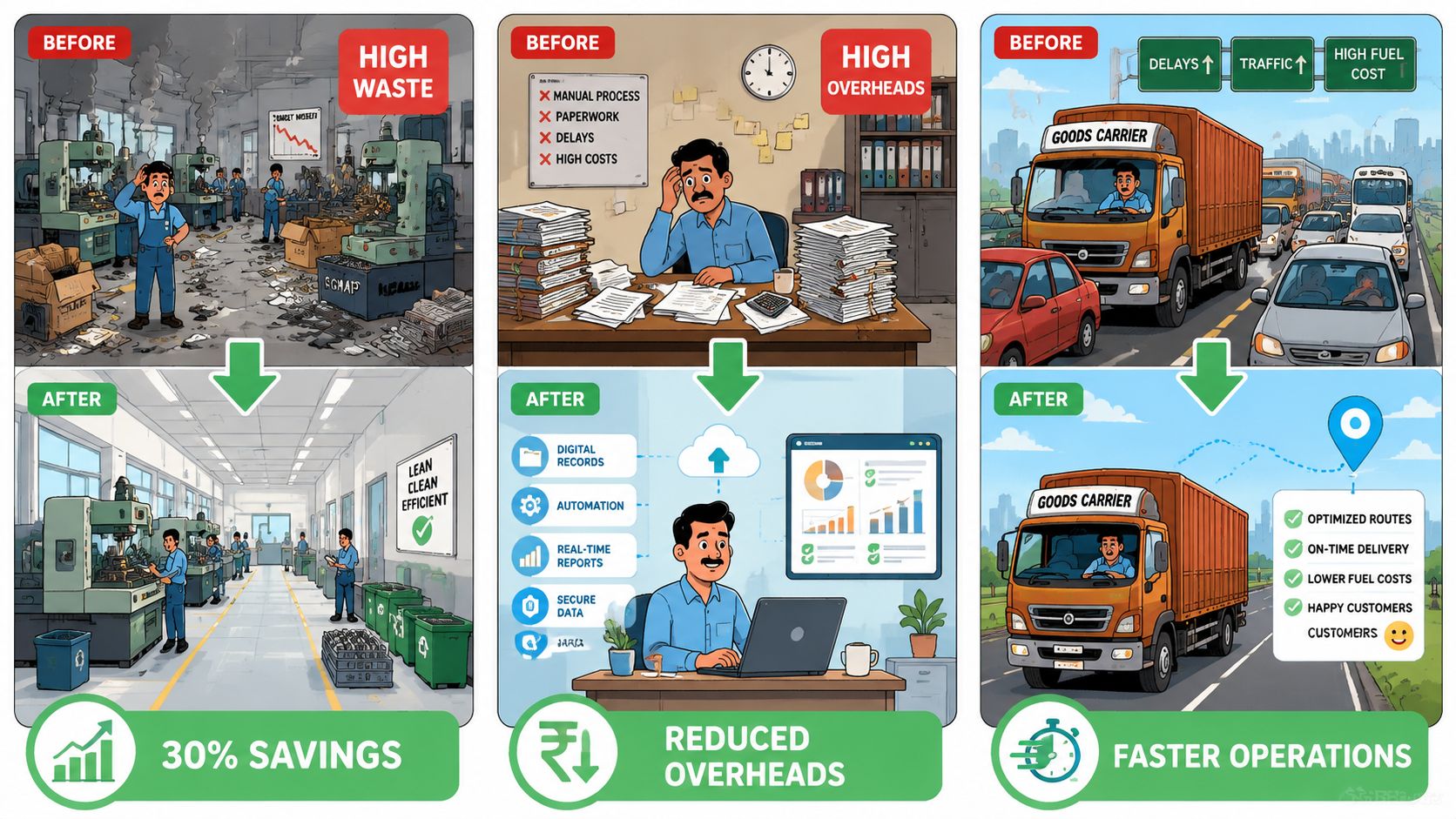
Operational cost reduction becomes credible when it's tied to specific workflows, not abstract principles. The examples below show how leaders can apply the same logic differently across sectors.
EdTech counselling operations
An online learning platform often struggles with follow-up consistency. Counsellors spend large portions of the day retrying unreachable leads, repeating programme explanations, and scheduling calls that don't progress.
A better operating model standardises first-touch qualification, reminder calls, and booking flows. The human team then focuses on nuanced counselling, objection handling, and conversion-ready conversations.
The financial gain doesn't come only from lower frontline effort. It also comes from cleaner utilisation. Senior counsellors spend less time on low-yield outreach, and management gets a more predictable funnel.
BFSI verification and support workflows
In BFSI, the wrong cost decision usually shows up as rework or compliance stress. KYC support, document follow-up, and status queries create heavy demand, but they don't all require the same level of human judgement.
A DMAIC-led redesign is useful here because it treats cost reduction as an engineering exercise. Teams map the verification flow, identify where repeated checks or missing information cause defects, then tighten SOPs and routing. As noted earlier, this method helps organisations reduce cycle time, variance, and rework by isolating defect drivers rather than merely cutting visible spend.
In regulated operations, the cheapest step is the one that prevents the next corrective step.
Real estate lead qualification and booking
Property consultancies often allow expensive sales capacity to be consumed by early-stage screening. Agents spend time discovering budget, preferred location, buying intent, and availability before any serious site visit is booked.
A stronger design splits the workflow. Routine discovery, first qualification, and visit scheduling are standardised. Senior agents engage later, when the buyer has been filtered and the next conversation can move toward closure.
That shift lowers the effective cost of each serious opportunity. It also reduces a common hidden expense: uneven agent attention across the lead pool. When the front end is standardised, response quality becomes more consistent and commercial productivity usually improves without a proportional increase in headcount.
Your Implementation Roadmap and ROI Calculation
Most cost programmes fail during execution, not diagnosis. The board approves a target, functions interpret it differently, and teams start cutting before they've defined the operating baseline. A stronger roadmap uses staged deployment, control metrics, and explicit ownership.
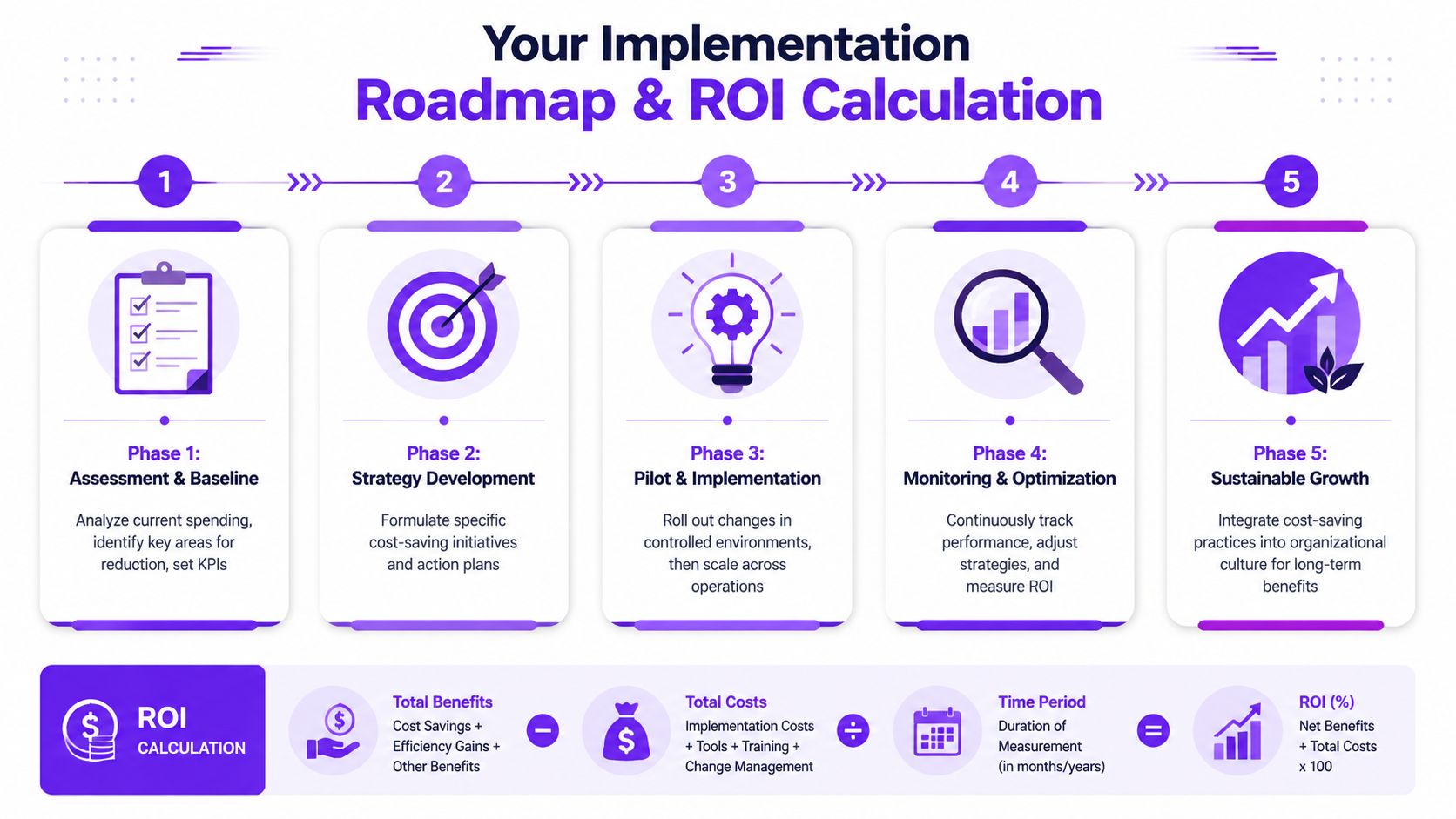
A phased operating model
A practical roadmap usually follows five phases.
Assessment and baseline
Select one high-volume workflow. Measure current cost per interaction, cycle time, handoff rate, and rework volume.Strategy design
Choose the intervention type. Process redesign, automation, staffing redesign, vendor reset, or tool consolidation.Pilot deployment
Start in a controlled environment. Keep the scope narrow enough to observe causes, not just outcomes.Monitoring and optimisation
Review both hard savings and hidden-cost indicators. If quality worsens, the initiative isn't ready to scale.Scaled rollout with governance
Formalise ownership, SOPs, exception handling, and executive reporting.
How boards should calculate ROI
The cleanest ROI model combines direct savings with avoided cost, while keeping quality risk visible.
| ROI component | What to include |
|---|---|
| Direct cost reduction | Lower labour requirement, reduced vendor spend, fewer licences, lower manual handling |
| Avoided failure cost | Reduced rework, fewer callbacks, lower supervisor load, less duplicate verification |
| Capacity release | Time redeployed to sales, advisory, or complex cases |
| Implementation cost | Technology, process redesign effort, change management, training |
| Risk adjustment | Any increase in compliance exposure, complaint volume, or service instability |
A simple board formula works well in practice:
ROI = (Annualised financial benefit – implementation cost) / implementation cost
The discipline lies in what counts as “financial benefit”. Boards should insist that management include more than payroll savings. If a redesigned workflow cuts repeat demand, reduces exception handling, and releases senior capacity for higher-value work, those effects belong in the business case.
Board test: approve only the initiatives that lower total operating cost while preserving control, quality, and scalability.
A final implementation point matters. Don't launch a broad transformation first. Launch a proof point. One process, one baseline, one governance owner, one scorecard. Once the pilot demonstrates lower unit cost without increased failure cost, scaling becomes a capital allocation decision rather than a leap of faith.
If your team is evaluating how voice automation fits into a broader operational cost reduction programme, DialNexa Labs Private Limited provides Voice AI agents for qualification, customer support, booking, recruitment, and presales workflows. For boards and operators, the useful question isn't whether to automate everything. It's which repetitive conversations can be standardised to lower cost per interaction without creating hidden downstream expense.

Excellent breakdown of operational cost reduction as a systems strategy rather than a simple budget-cutting exercise. The focus on quality, compliance, automation, and sustainable ROI offers practical insights that every business leader can apply for long-term efficiency and growth.
A strong and practical perspective on treating operational cost reduction as a systems problem rather than simply cutting budgets or headcount. The focus on workflow redesign, measurable KPIs, automation, quality, and hidden failure costs makes the framework especially valuable for sustainable efficiency.