
Benefits of AI in Customer Service: Boost CX & Cut Costs
43% of contact centres had already adopted AI technologies, and those adopters reported a 30% reduction in operational costs, according to an industry snapshot cited by ISG in a Statista-reported view of the market. That single number changes the conversation.
For a CXO, the benefits of AI in customer service aren't mainly about adding a chatbot to the website. They're about changing the economics of service delivery. The key question is whether your service model can absorb growth, support more channels, and maintain response quality without adding cost at the same pace.
In India, that question is sharper. Teams often serve multilingual customers, experience bursty demand, and operate in sectors where customer support affects revenue, retention, trust, and compliance. In that environment, AI becomes a lever for operational control. It can reduce repetitive workload, standardise responses, improve routing, and keep service levels steadier outside normal staffing patterns.
Table of Contents
- Why AI in Customer Service is a Boardroom Conversation
- The Core Benefits Reshaping Customer Experience
- How AI Moves Key Business Metrics
- AI in Action Industry-Specific Use Cases
- Strategic Implementation Planning Your AI Deployment
- Navigating Challenges and Ensuring ROI
- Your Next Steps Towards an AI-Powered Future
Why AI in Customer Service is a Boardroom Conversation
Customer service used to be reviewed as a support function. Today, it influences revenue conversion, customer retention, brand trust, and operating margin. That's why AI in customer service now belongs in board meetings, not just in IT or operations reviews.
The executive lens is simple. If service quality drops when volume rises, growth becomes expensive. If response times depend too heavily on staffing, shifts, or language availability, your customer experience becomes variable. And if customer interactions aren't routed well, your highest-cost people spend time on the lowest-value work.
That's where AI changes the shape of the problem. Used well, it absorbs repetitive interactions, routes requests with better precision, and keeps service available outside standard staffing windows. For leaders evaluating contact centre automation strategies, the value isn't cosmetic. It's structural.
The competitive issue is operating leverage
A company that resolves routine issues instantly can protect margins while scaling support. A company that still handles every simple query manually often adds cost faster than it adds customer value.
This matters even more in India-facing operations. Service demand often spans regional languages, post-work browsing hours, admission cycles, payment reminders, policy servicing, and seasonal spikes. AI creates a more stable service layer across those fluctuations.
Board-level takeaway: AI is most valuable when it changes unit economics and service reliability at the same time.
Service quality is now a growth variable
In sectors like BFSI, EdTech, telecom, SaaS, and e-commerce, support isn't only post-sale. It shapes whether prospects complete onboarding, whether customers trust digital workflows, and whether high-intent users convert before interest drops.
That's why the benefits of AI in customer service should be framed as a business model decision:
- Margin protection: Automate repetitive queries so cost-to-serve doesn't rise in lockstep with volume.
- Revenue support: Respond faster when customers are deciding, comparing, or trying to complete a transaction.
- Experience consistency: Reduce dependency on which agent is available, which shift is active, or which queue is overloaded.
- Managerial visibility: Build workflows that can be measured, audited, and improved over time.
A service operation that learns, routes, and resolves faster becomes an advantage. A service operation that waits for more headcount every time volume rises becomes a constraint.
The Core Benefits Reshaping Customer Experience
The most important benefits of AI in customer service aren't isolated features. They work together to compress response time, improve consistency, and free human teams to focus where judgement matters.
Here is the high-level picture executives should care about.
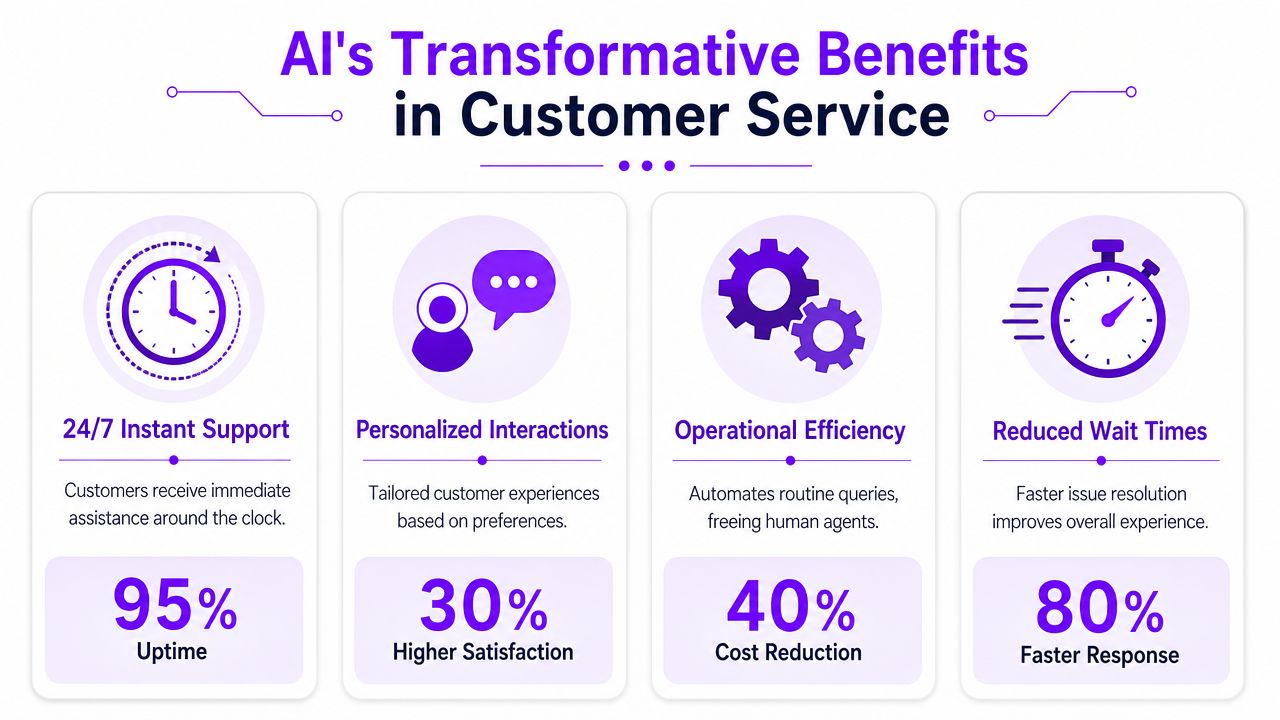
Instant resolution changes customer expectations
Customers don't compare your support only with direct competitors. They compare it with the fastest experience they've had anywhere. That's why speed now shapes perceived quality.
Zendesk's 2026 customer-service statistics note that AI can identify customer intent automatically so agents resolve issues faster and more accurately. The same Zendesk dataset on AI customer service productivity shows that 68% of customers say quick responses are the most positive aspect of chatbots, 75% of customer inquiries can now be resolved without human intervention, conversational AI has boosted productivity for 94% of customer-service specialists, and reduced agent effort for 87%.
For a CXO, those numbers point to a simple operational truth. Fast, always-available service isn't only a convenience feature. It reduces friction at the exact points where customers abandon journeys, escalate unnecessarily, or form a negative impression of the brand.
Much of that speed depends on how reliably the underlying speech models perform under real call conditions, which is why it's worth reviewing ASR accuracy benchmarks across noisy, multilingual audio before scaling voice automation.
A short explainer is useful here:
Personalisation becomes operational, not artisanal
IBM also reports, in the same evidence summary provided, that 62% of executives globally believe generative AI can disrupt how organisations design experiences, with personalisation at the core of that change. The strategic implication is that personalisation no longer has to be limited to premium segments or highly trained human agents.
AI can classify intent, pull context, recommend the next best response, and maintain continuity across channels. In practical terms, that means a student asking about a course, a banking customer asking about an account action, and an e-commerce buyer checking an order don't all need the same queue or the same script.
Fast support improves satisfaction. Context-aware support improves trust.
Availability creates continuity, not just coverage
In Indian operations, 24/7 support matters because customer demand doesn't arrive in neat windows. Prospects browse after work, customers message during payment issues, and service peaks don't align perfectly with staffing plans.
The foundational benefits are easiest to understand in operational terms:
- Routine automation: AI can handle FAQs, account lookups, simple support flows, and basic routing.
- Human capacity release: Agents spend less time on repetitive work and more time on edge cases, escalations, and revenue-sensitive conversations.
- Cross-channel consistency: The same logic can guide interactions across voice, chat, and digital support paths.
- Elastic service delivery: Teams can absorb volume spikes without degrading response quality as sharply as manual-only models do.
The result isn't just “better support”. It's a service model that becomes more responsive, more consistent, and easier to scale.
How AI Moves Key Business Metrics
Customer service AI earns budget approval when it changes operating economics. For a CXO, the relevant question is not whether automation sounds novel. It is whether it improves service ratios, protects revenue, and delays the need for linear headcount growth.
Industry analysis has linked AI adoption in contact centres with lower operating costs, and the mechanism is straightforward. Cost pressure in service functions rarely comes from wages alone. It comes from avoidable repeat contacts, slow triage, poor queue allocation, inconsistent agent productivity, and demand spikes that force expensive staffing decisions.
Which KPIs shift
The first measurable gains usually appear in a small group of management metrics. These are the numbers that shape hiring plans, service-level commitments, and margin discipline.
| Metric | Typical Benchmark (Without AI) | Projected Performance (With AI) | Business Impact |
|---|---|---|---|
| First Contact Resolution | Lower when intent is misclassified or queues are broad | Higher when routine issues are resolved instantly and complex cases reach the right team sooner | Fewer repeat contacts and lower service load |
| Average Handling Time | Higher because agents spend time on repetitive explanations and triage | Lower when AI handles FAQs, gathers context, and routes correctly | More throughput per team and better queue control |
| Customer Satisfaction | More volatile when wait times rise and support quality varies by shift | More stable when response speed and answer consistency improve | Better retention and stronger brand trust |
| Cost-to-Serve | Rises with volume because support scales through headcount | Improves when automation absorbs repetitive interactions | Better operating leverage as demand grows |
This directly impacts planning assumptions.
A service leader who reduces repetitive handling volume can protect SLAs through demand peaks without matching every surge with new hiring. In India, that matters during admissions cycles in EdTech, repayment reminders and service requests in BFSI, and festival-led ticket spikes in commerce. The operational benefit is larger than faster response time alone. It gives finance and operations teams more predictability in capacity planning.
Projected KPI improvements with customer service AI
The strongest KPI case rests on workflow design.
- FCR improves when AI identifies intent early, captures customer context, and sends edge cases to the right specialist instead of a generic queue.
- AHT falls when basic questions are resolved before agent involvement, or when the agent receives a structured summary instead of starting from zero.
- CSAT becomes more stable when response quality depends less on shift timing, queue congestion, or agent-by-agent variation.
- Cost-to-serve declines when growth in contact volume no longer requires proportional growth in frontline staffing.
For CXOs, these metrics should not be tracked in isolation. In BFSI, a lower AHT is only valuable if compliance quality holds. In EdTech, better FCR matters more when it reduces drop-off during counselling, enrolment, or fee-payment journeys. AI performs best as a routing and decision-support layer tied to business outcomes, not as a standalone automation project.
For leaders managing public and digital service channels, the external perspective on boosting efficiency in social customer care adds a useful dimension to KPI planning beyond voice and email.
Internal governance matters as much as model accuracy. Teams should tie AI performance to queue health, repeat-contact rates, escalation quality, containment logic, and channel mix. A practical benchmark structure for that appears in DialNexa's guide to contact centre KPI tracking.
The most durable AI business case starts with service efficiency, then expands into retention, capacity, and margin improvement.
AI in Action Industry-Specific Use Cases
The benefits of AI in customer service become clearer when you look at workflows, not features. In India, enterprise AI use cases are built around NLP-based intent detection and automated routing, enabling systems to reply instantly and guide users through transactions. This reduces average handling time and repeat contacts while improving first-contact resolution in high-volume sectors like BFSI, EdTech, and e-commerce, as described in NICE's overview of AI customer service automation benefits.
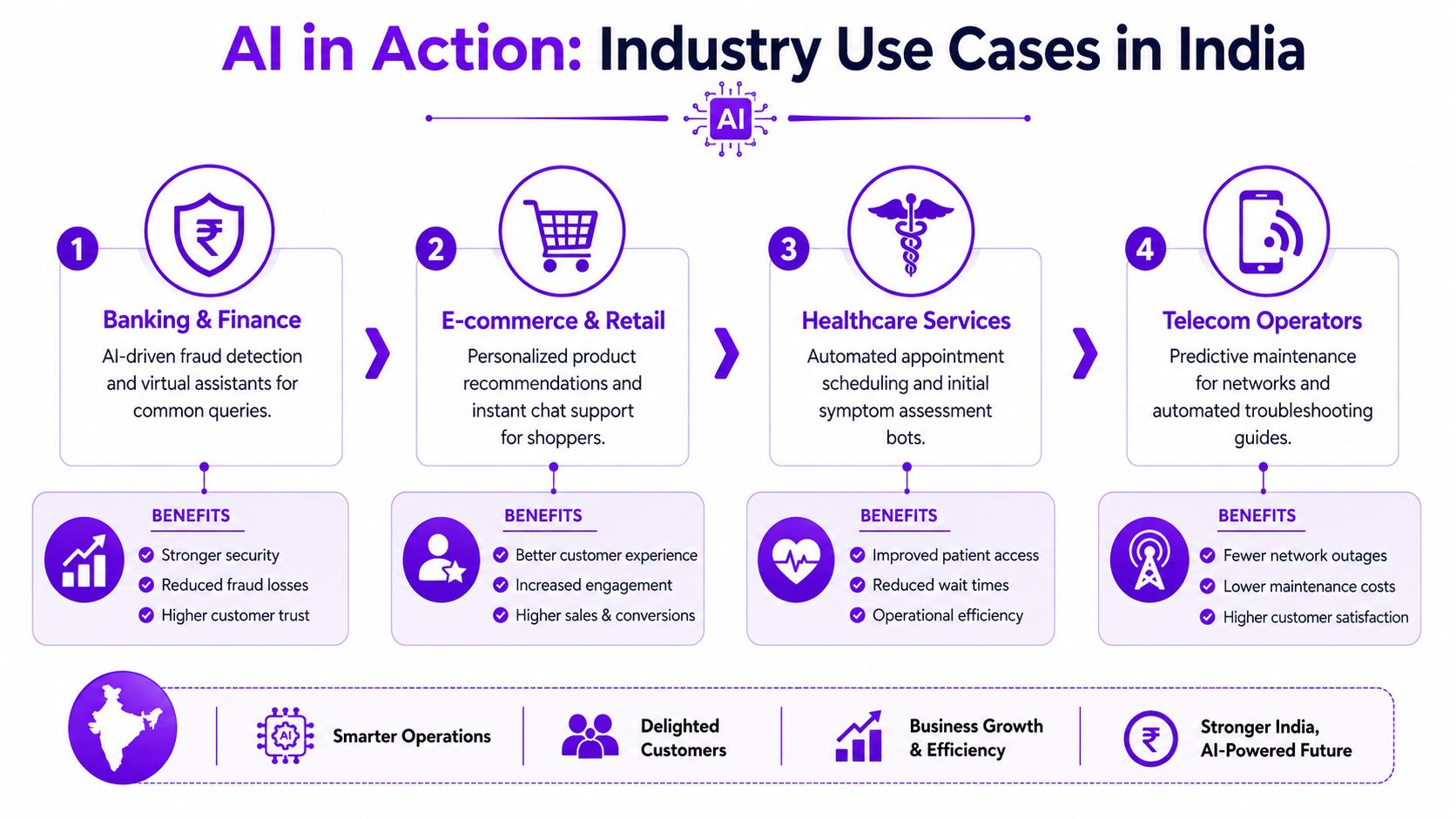
BFSI where speed must stay auditable
A customer starts a support chat about updating KYC details, document status, or a blocked transaction. An AI layer identifies the intent, asks the right first questions, routes the case to the correct flow, and captures the context before a human ever joins.
That changes two things. First, the customer gets an immediate response instead of waiting in a generic queue. Second, the operations team has a cleaner handoff for sensitive cases that require human review.
In BFSI, the value isn't only lower handling burden. It's cleaner segmentation between routine servicing and sensitive decision points.
EdTech where response timing affects enrolment
An interested student often asks the same cluster of questions. Programme format, fees, eligibility, language, placement support, class timing, and admission steps. If those questions sit in a queue for too long, the lead cools.
An AI assistant can answer common programme questions, qualify student interest, and route high-intent conversations to counsellors with context attached. That lets the admissions team spend more time on fit, objections, and closing.
This is one reason support and sales operations increasingly overlap in education businesses. Service responsiveness influences conversion quality.
In EdTech, “support” often starts before enrolment. That makes response latency a revenue issue.
Real estate where after-hours demand is real demand
A buyer sees a listing at night and calls for details. They want location context, budget fit, configuration options, possession timelines, or to book a site visit. A manual team may miss that call or delay the callback. AI doesn't.
A voice workflow can qualify discovery calls, capture preferences, answer common property questions, and book a next step. Teams exploring that model can review an example of an AI solution for agency lead capture to understand how structured call handling works in enquiry-heavy environments.
This is also the one place where a voice-first tool can matter materially. DialNexa Labs Private Limited provides voice AI agents that handle qualification, support, recruitment, and presales workflows across sectors such as EdTech, BFSI, and real estate. The operational fit is strongest where teams need high-volume call handling with consistent scripts and clean escalation logic.
The pattern across sectors
Different industries use different scripts, but the same operational logic appears repeatedly:
- Intent first: Classify why the customer is contacting you before deciding who or what should respond.
- Routine resolution next: Let AI resolve standard questions immediately when policy permits.
- Escalation by exception: Move emotional, high-risk, high-value, or regulated interactions to people.
- Context preservation: Pass the interaction history forward so customers don't repeat themselves.
That's the difference between adding automation and redesigning service.
Strategic Implementation Planning Your AI Deployment
Most AI programmes don't fail because the technology can't answer questions. They fail because leaders automate the wrong workflow, measure the wrong outcome, or deploy without enough operational control.
The first principle is simple. Start with work that is high-volume, repetitive, and visible enough to improve quickly.
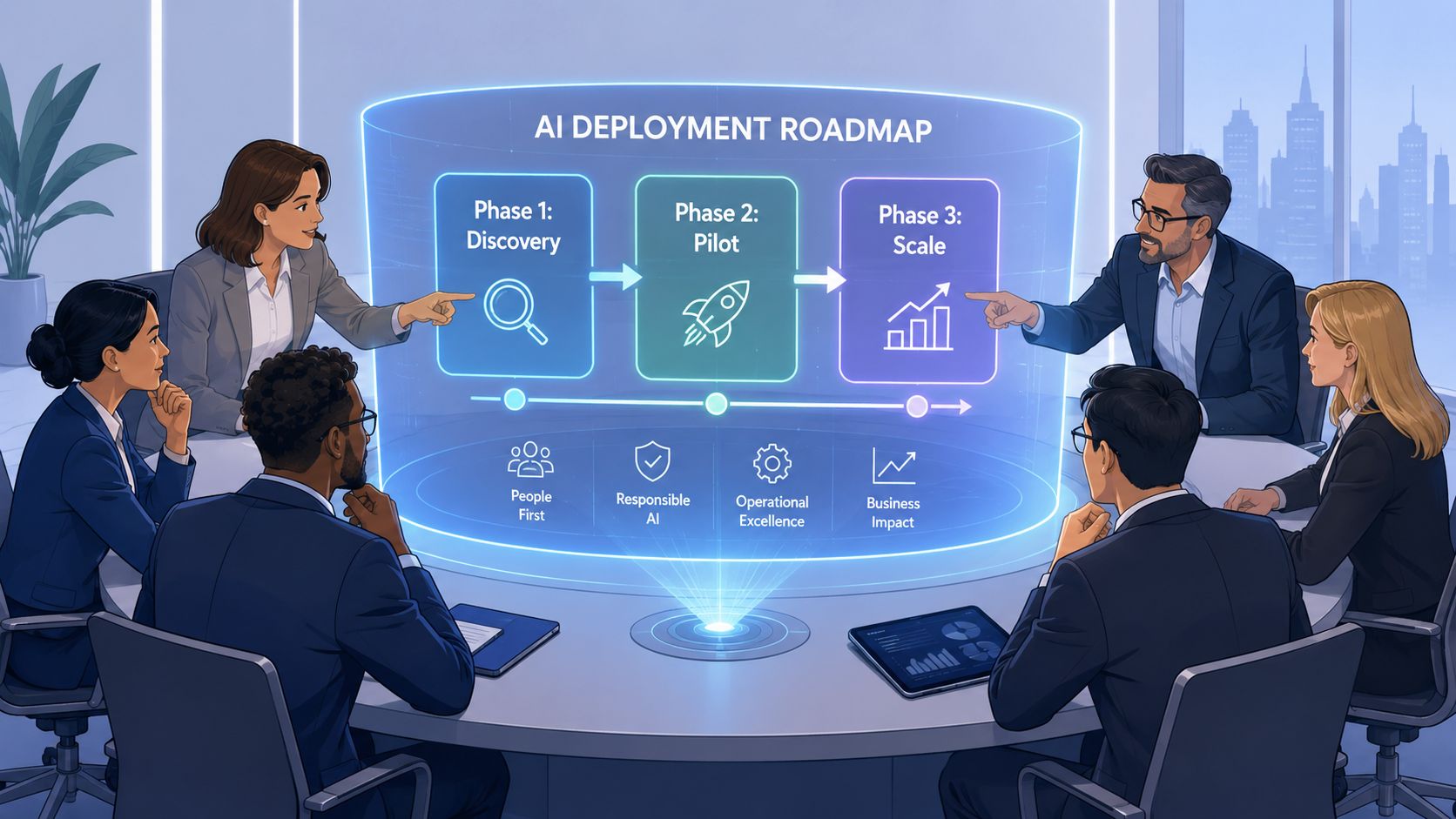
Start where the workflow is repetitive and visible
AI handles routine tasks like FAQs and ticket routing 24/7, which directly lowers wait times. The deeper leadership benefit, as explained in Horatio's guide to AI for customer service operations, is variance reduction. Service levels become less dependent on agent availability, shift timing, or language coverage.
That suggests a practical sequence:
- Pick a narrow problem first. FAQ handling, status checks, appointment booking, enquiry qualification, and first-line triage are usually easier starting points than complex complaint handling.
- Check system readiness. If your CRM, knowledge base, and routing logic are disorganised, AI will mirror that confusion.
- Decide handoff rules early. Teams need clarity on when AI resolves, when AI assists, and when humans take over.
- Measure operational stability. Don't just track volume deflection. Watch consistency across shifts, channels, and peak periods.
Choose a deployment model leaders can govern
Executives should ask three questions before approving rollout:
- Build: Do we have the technical and operational depth to own training, orchestration, and governance internally?
- Buy: Does an existing platform already fit our use case with less implementation drag?
- Partner: Do we need workflow expertise as much as we need software?
For many teams, the right answer is a mix. A platform may provide the core AI capability, while internal teams define policy, escalation rules, and knowledge governance. Leaders comparing options can review examples of what an AI agent for customer service should support before they evaluate vendors or internal build plans.
Practical rule: If the first deployment cannot be governed by operations leaders, it probably shouldn't be the first deployment.
Navigating Challenges and Ensuring ROI
AI in customer service creates value, but only when leaders control the risks that matter. For regulated Indian sectors like BFSI, the key question isn't whether AI sounds efficient. It's whether service can improve without increasing regulatory risk.
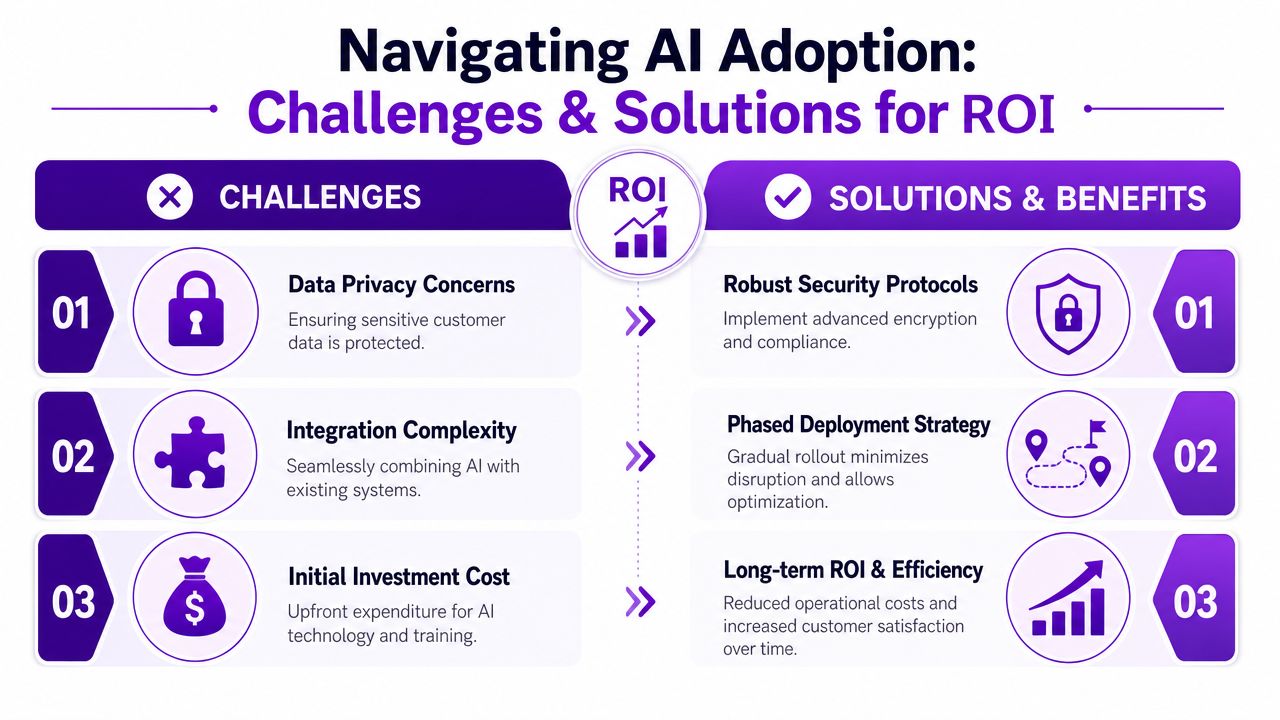
That concern is justified. With India's Digital Personal Data Protection Act enacted in 2023, organisations must ensure AI systems are compliant, auditable, and escalation-ready for sensitive issues, as highlighted in DevRev's analysis of AI benefits in customer service.
The main risks are manageable
The most common executive concerns are predictable. That's useful because predictable risks can be designed around.
| Challenge | What it looks like in practice | Strategic mitigation |
|---|---|---|
| Data privacy | Sensitive customer information passes through AI workflows | Limit AI access by use case, keep audit trails, and apply strict data handling controls |
| Integration complexity | AI sits outside core systems and creates fragmented service | Connect AI to CRM, knowledge sources, and routing logic before scaling customer-facing use |
| Loss of human touch | Customers get trapped in rigid flows during nuanced issues | Build explicit escalation paths for complaints, distress, exceptions, and high-value moments |
| Change resistance | Teams see AI as disruption instead of support | Position AI as workload redesign, not labour replacement, and train managers on hybrid operations |
ROI comes from discipline, not enthusiasm
Many teams overfocus on the model and underfocus on governance. A stronger approach is to separate contacts into categories:
- Safe to automate: FAQs, status checks, simple booking flows, basic triage.
- Safe to assist: Cases where AI gathers context, but a human decides the next action.
- Human-first by policy: Sensitive financial queries, complaints with risk implications, exceptions requiring judgement.
This is especially important in BFSI. A compliant AI deployment should be auditable, should preserve customer context, and should make escalation easy when a workflow crosses into a regulated or sensitive state.
The broader ROI lesson is straightforward. The benefits of AI in customer service don't come from automating everything. They come from automating the right things, documenting the controls, and preserving trust while efficiency rises.
Your Next Steps Towards an AI-Powered Future
The strongest argument for AI in customer service is no longer technological. It's economic and competitive. Companies that use AI well can resolve routine demand faster, protect service quality during volume spikes, and deploy human teams where judgement produces the most value.
That makes AI a present operating decision, not a future innovation theme.
A sensible next move doesn't need to be large. It needs to be precise.
- Audit current performance. Identify the top three friction points in your customer journey. Look for repetitive contacts, long wait points, weak routing, and support moments that delay revenue or create avoidable dissatisfaction.
- Assemble a pilot team. Include operations, CX, compliance or risk where relevant, and the business owner whose workflow will be tested. AI projects work better when service design and governance sit together.
- Define a 90-day pilot. Choose one narrow use case with clear success criteria. Good candidates include first-line triage, FAQ handling, enquiry qualification, or after-hours voice support.
A well-scoped pilot does more than test a tool. It tells you whether your organisation can redesign service around speed, consistency, and operational control.
If the answer is yes, AI stops being an experiment. It becomes part of how your company scales.
If your team is evaluating customer support or voice automation in sectors like BFSI, EdTech, real estate, e-commerce, or SaaS, DialNexa Labs Private Limited is one option to review. The company provides voice AI agents for qualification, support, recruitment, and presales workflows, with tooling designed for custom call flows, escalation logic, and deployment across industry-specific service journeys.

“Excellent insights on building high-performance cold calling systems with a strong focus on strategy, compliance, and data-driven optimisation. A practical and valuable guide for businesses looking to scale outreach effectively and sustainably.”
[…] useful reference point is the broader pattern of AI in customer service benefits for support operations. The strongest deployments reduce avoidable call volume, improve consistency, and protect human […]
[…] teams evaluating automation, the relevant lens is unit economics rather than novelty. This analysis of AI's impact on customer service unit economics is a useful reference for assessing where automation reduces cost without undermining service […]