
Multilingual Call Centers: Your 2026 CXO Roadmap
You're probably already seeing the pattern. Growth is coming from outside your original customer base, inbound demand is getting more geographically distributed, and your support operation still behaves as if one or two languages are enough. The result isn't just service friction. It's slower conversion, weaker trust in regulated conversations, and a higher cost to serve because too many calls bounce between IVR branches, queues, and agents before anyone solves the issue.
That's why multilingual call centers have moved out of the operations silo. For a CXO, this is now a market-access decision, a workforce-design decision, and increasingly an AI decision. The question isn't whether customers prefer native-language support. They do. The strategic question is which interactions need human fluency, which can be standardised through Voice AI, and how to build a model that scales without adding complexity faster than revenue.
Table of Contents
- Why Multilingual Support Is Now a Boardroom Conversation
- Deconstructing the Modern Multilingual Call Centre
- The Strategic Choice Human Agents vs Voice AI
- A Phased Roadmap for Implementing Multilingual Support
- Measuring What Matters KPIs and ROI for Multilingual Operations
- Industry Blueprints Real-World Multilingual Use Cases
- Your Next Steps Toward a Global Voice
Why Multilingual Support Is Now a Boardroom Conversation
A company can look operationally healthy and still be structurally underprepared for nationwide growth. This often happens when acquisition expands faster than service design. Marketing opens up new regions, sales enters new states, and the contact centre still assumes English plus Hindi will absorb the demand.
That assumption breaks quickly in India. The 2011 Census recorded 121 languages spoken by 10,000 or more people, and the Constitution's Eighth Schedule includes 22 scheduled languages, a reality that makes language coverage an operational requirement rather than a localisation exercise, as noted in VoiceSpin's discussion of multilingual contact centres. The same source notes that 79% of contact centres have customers who are not native speakers of the primary language used by the centre, which helps explain why multilingual capability has become foundational.
Growth stalls before leaders notice it
The boardroom implication is straightforward. If your service model doesn't match the language profile of your growth markets, your business starts leaking value in places standard dashboards rarely isolate. Support queues get noisier. Conversion falls in some regions but not others. Complaint resolution takes longer because callers repeat themselves or abandon the interaction.
Practical rule: Treat language support as a revenue-enablement layer, not a courtesy layer.
For sectors such as BFSI, e-commerce, telecom, and education, callers often expect service in Hindi, English, and at least one regional language. That changes staffing, IVR logic, escalation design, and QA. It also changes competitive position. A rival that can explain a product, resolve a billing issue, or complete onboarding in the caller's preferred language usually earns trust faster.
The strategic issue isn't language availability alone
Many leadership teams still frame multilingual support as “adding more languages”. That's too narrow. The larger issue is whether your operating model can convert, serve, and retain customers across heterogeneous language segments without creating cost sprawl.
A useful way to think about it is that multilingual capability widens your serviceable market while reducing avoidable friction in high-intent interactions. That's why the business case increasingly sits with revenue, CX, operations, and compliance leaders together, not with the contact-centre manager alone. If you want a broader strategic framing, this perspective on why multilingual customer support is essential for global business growth aligns with the same direction of travel.
Deconstructing the Modern Multilingual Call Centre
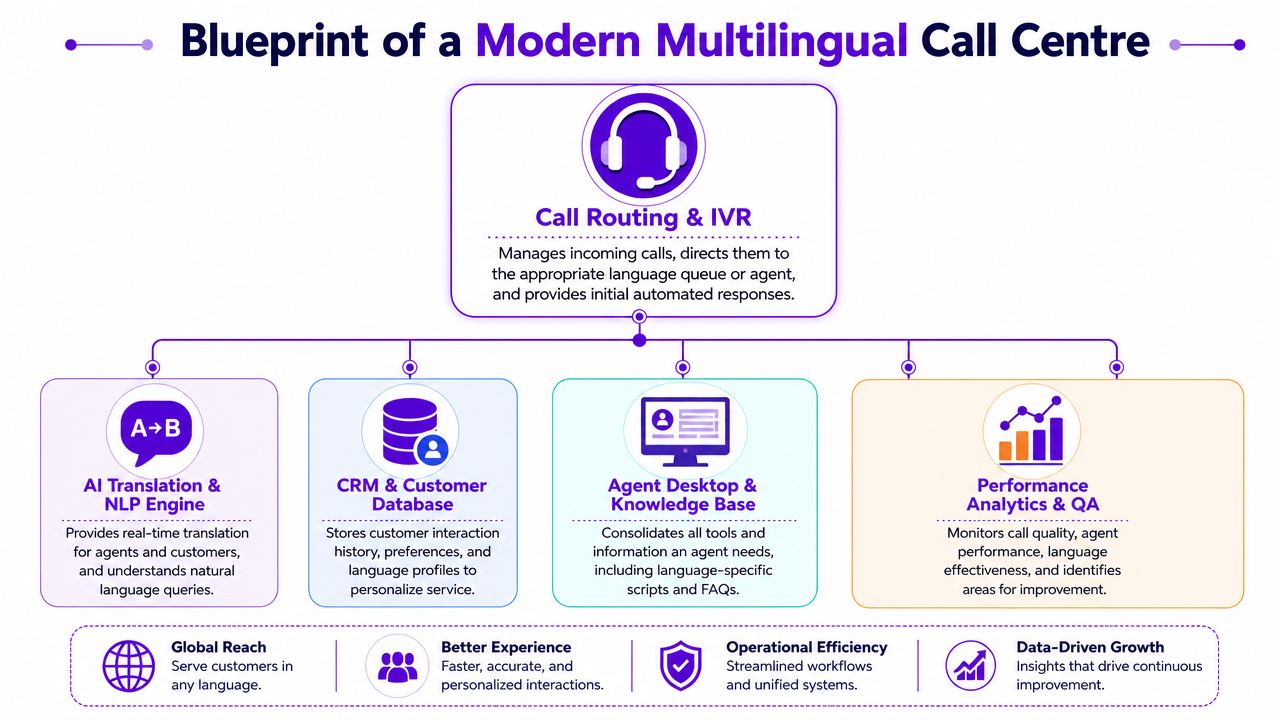
A modern multilingual call centre isn't just a phone team with a translated IVR. It's a routing and decision system that identifies language early, preserves context, and directs the interaction to the right human or AI layer before friction compounds.
The operating model has changed
In India-facing operations, effective multilingual support is built on intelligent language-routing, not just a menu tree. The design pattern is to detect the caller's language, segment the queue, and route to an appropriate agent or AI layer. According to Open Access BPO's guidance on multilingual call-centre management, this approach reduces misroutes, shortens average handle time, and prevents the quality loss that comes from repeated transfers.
That matters because the customer experience damage usually happens before the “real” conversation starts. A caller who presses the wrong option, reaches the wrong queue, repeats the issue, and gets transferred again arrives at the final agent already frustrated. By then, even a skilled agent is working uphill.
The core stack a CXO should expect
A credible multilingual architecture usually includes these components:
- Language-aware call routing: The ACD should treat language as a formal skill, not an informal note in workforce planning.
- Multilingual IVR: Menus should reduce confusion quickly, especially for first-time callers and mixed-language users.
- AI translation and NLP: Teams evaluating automation should understand how NLP for business applications supports intent detection, language recognition, and structured response flows.
- CRM and language profile integration: Customer history, prior language choice, and interaction context should travel with the call.
- Agent desktop and localised knowledge base: Agents need scripts, prompts, and compliance language matched to the queue they serve.
- Language-specific analytics: Reporting has to show where transfer rates, abandonment, QA variance, and containment differ by language.
A multilingual centre performs well when routing, knowledge, QA, and compliance all recognise language as an operational variable.
The strategic design choice sits on top of this stack. Some organisations staff native or advanced-language agents for major queues and use automation selectively. Others build an AI-first front layer and reserve people for escalation, exceptions, and high-value conversations. Both can work. The quality of the decision depends on interaction design, risk level, and unit economics.
The Strategic Choice Human Agents vs Voice AI
Every executive conversation about multilingual call centers eventually reaches the same decision point. Do you build language capacity through people, through AI, or through a hybrid model that uses each where it performs best?
The wrong answer is usually the extreme one. A fully human model struggles to scale economically across many language queues. A fully automated model breaks down when nuance, trust, or compliance matter more than speed.
Where human-led teams still win
Human agents remain stronger in interactions that require judgement, reassurance, or flexible interpretation. That includes emotionally charged complaints, complex negotiations, sensitive collections, detailed counselling, and exceptions where policy and empathy have to work together.
This is even more relevant in regulated sectors. Guidance focused on multilingual AI in India warns that AI translation must be benchmarked carefully for consent, KYC, and complaint resolution, and that CXOs should ask for language-specific error rates and containment outcomes, especially in BFSI and healthcare, as discussed in TDS Global Services' article on multilingual call centres.
A human-led model also gives leaders more confidence when the conversation involves mixed-language speech, code-switching, or domain-specific terminology. In those settings, “good enough” automation may not be good enough at all.
Where Voice AI changes the economics
Voice AI is strongest when interactions are structured, high-volume, repetitive, or time-sensitive. Think appointment booking, lead qualification, basic support, payment reminders, order status, return initiation, site-visit scheduling, and first-line triage. Here, the strategic value isn't novelty. It's standardisation at scale.
The economics become compelling when the operation faces rising volume and diverse demand. The global call and contact centre outsourcing market was estimated at USD 97.31 billion in 2024 and is projected to reach USD 163.86 billion by 2030, growing at a 9.8% CAGR from 2025 to 2030, according to Language I/O's overview of multilingual call centres. The same source notes an average call centre handles roughly 4,400 calls per month, and 61% of call-centre leaders reported higher call volume after 2020. Under those conditions, automation becomes less a feature and more an operating necessity.
A product category worth evaluating in that context is SnapDial's AI voice agent solutions, which illustrates how vendors are positioning Voice AI for scalable business calling across routine workflows. Another useful reference point is this overview of the best voice AI platform in India, especially if your team is comparing deployment models rather than just feature lists.
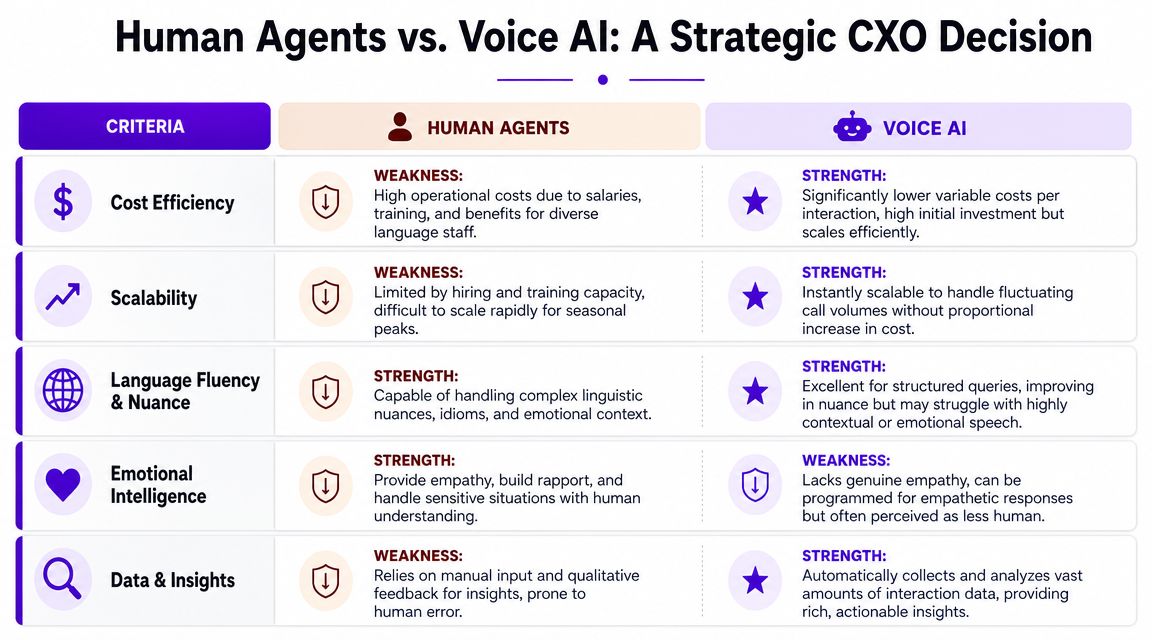
Here's a practical comparison.
| Criterion | Human-Led Model | Voice AI Model |
|---|---|---|
| Cost efficiency | Higher ongoing cost because language coverage depends on hiring, training, scheduling, and retention across queues | Lower variable cost per interaction once deployed, especially for recurring and standardised call types |
| Scalability | Expansion is constrained by recruiting and training capacity | Capacity scales faster, which is valuable during campaign spikes and after-hours demand |
| Language fluency and nuance | Better at idioms, emotional tone, ambiguity, and contextual interpretation | Strong for structured conversations, but performance must be validated by language and use case |
| Emotional intelligence | Better for empathy, de-escalation, and trust-building in sensitive cases | Can simulate supportive language, but still needs escalation pathways |
| Consistency and compliance | Depends on coaching, monitoring, and agent discipline | Delivers highly consistent scripts, provided legal and compliance logic are correctly designed |
| Data capture | Insights depend on tags, notes, and QA review quality | Captures conversational data systematically, which improves analysis and optimisation |
| Speed of deployment | New language queues can take time to recruit and stabilise | New flows can often be configured faster, then refined through monitored pilots |
Later in the evaluation, this video is useful for leadership teams aligning on what Voice AI can and cannot own in production environments.
Don't choose between humans and AI at the category level. Choose by interaction type, compliance exposure, and language-specific failure cost.
For most organisations, the strongest model is hybrid. Put Voice AI in front of routine, repeatable, high-volume workflows. Keep human agents for escalations, high-stakes verification, and exceptions where nuance affects risk or conversion.
A Phased Roadmap for Implementing Multilingual Support
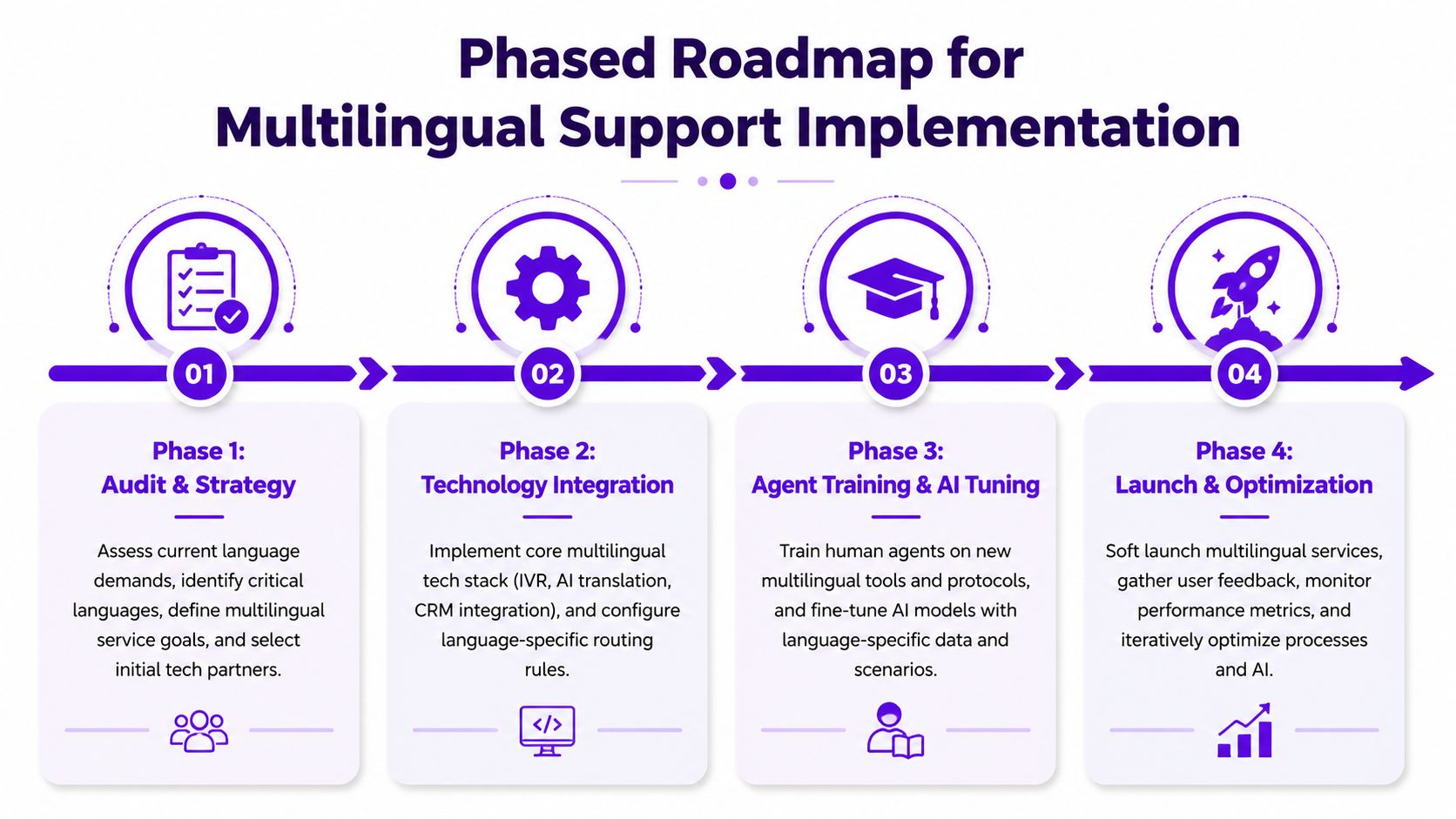
Most multilingual programmes fail because leaders try to launch “coverage” instead of building operating discipline. A phased model works better because it lets you validate language demand, de-risk technology choices, and align staffing with actual usage rather than assumptions.
Phase 1 and Phase 2
Phase 1 starts with an audit. Pull call logs, CRM records, missed-call data, sales outcomes, and complaint categories. Then identify where language mismatch creates leakage. In many organisations, the first useful finding isn't that “we need more languages”. It's that two or three language clusters drive most of the avoidable transfers or conversion loss.
Phase 2 is architecture and vendor selection. At this stage, many teams overbuy. They compare platforms based on feature breadth, but the better question is narrower: can the system route by language, preserve context, support localised scripts, and measure outcomes by queue and use case?
A best-practice approach treats multilingual operations as a workforce-planning problem. That means using customer data to hire native or advanced-language agents for dominant language clusters, while using AI-driven translation and self-service for long-tail languages to control cost and complexity, as outlined by Call Centre Studio's guidance on building multilingual operations.
A practical vendor checklist should include:
- Routing logic: Can the platform detect, infer, or persist language preference accurately enough for production use?
- Operational fit: Does it integrate with your CRM, QA workflow, and existing telephony environment?
- Escalation design: Can it transfer smoothly from AI to human without forcing the customer to restart?
- Compliance support: Can scripts, prompts, and audit trails be localised for regulated workflows?
Phase 3 and Phase 4
Phase 3 is pilot and validation. Start with one high-volume, lower-risk workflow in one or two priority languages. Good pilot candidates include appointment requests, lead qualification, order status, admissions enquiry triage, or payment reminder calls. Avoid launching first in complaint resolution or KYC-heavy flows unless your validation model is mature.
Phase 4 is controlled scale. Once the pilot shows stable routing, acceptable containment, and clear escalation patterns, expand by interaction type before expanding by language count. That sequencing keeps complexity manageable.
One tool category that fits this stage is configurable Voice AI. For example, DialNexa Labs Private Limited offers Voice AI agents for workflows such as qualification, customer support, recruitment, and presales, which is the kind of operational scope many teams need when moving from pilot to production.
Operator's lens: Scale the workflows you can standardise first. Scale the emotionally complex and compliance-sensitive flows last.
Leaders should also assign clear ownership across functions:
- Operations owns queue design and staffing logic
- CX owns journey design and escalation policy
- Compliance reviews scripts and verification paths
- Data teams validate language-level reporting
- Technology teams manage integration and telemetry
This cross-functional ownership matters because multilingual support fails when one team treats it as a translation project and another treats it as a telephony project. It's neither. It's a service operating model.
Measuring What Matters KPIs and ROI for Multilingual Operations
The biggest reporting mistake in multilingual call centers is blending everything into one score and calling it insight. A single CSAT trend can hide severe underperformance in specific language queues. An overall FCR number can look acceptable while one region absorbs repeated transfers and avoidable callbacks.
The KPI mistake most teams make
A better measurement model starts by tagging every interaction by language and then reviewing quality, efficiency, and commercial outcomes at that level. The key recommendation from Physicians Angels' discussion of multilingual support measurement is to track language-wise FCR, CSAT, and lead conversion, because performance gaps often reflect cultural or linguistic mismatch rather than agent capability alone.
That changes what executives can improve.
- Language-wise FCR: Useful for spotting where routing or script design fails.
- Language-wise CSAT: Useful for identifying friction that doesn't show up in productivity metrics.
- Queue abandonment by language: Useful for finding menu confusion, long waits, or weak staffing alignment.
- Containment by language: Critical if AI is part of the operating model.
- Lead-to-conversion by language: Often the clearest bridge between CX investment and revenue.
- QA by language: Necessary when one queue follows the script but still underperforms commercially.
If you're operationalising this in an AI context, a metrics framework like the one outlined in voice AI analytics deployments for contact centres can help teams structure reporting beyond generic automation dashboards.
A practical ROI lens
ROI should be calculated in business terms, not technology terms. The question isn't “did the bot answer calls?” It's whether multilingual design improved access, reduced avoidable cost, and lifted revenue quality in the queues that matter.
A simple board-level ROI lens usually includes three buckets:
| ROI driver | What to examine | Typical implication |
|---|---|---|
| Efficiency | Repeated transfers, avoidable human handling, after-hours coverage, self-service adoption | Better use of agent capacity and lower cost-to-serve on routine interactions |
| Revenue protection | Conversion by language, drop-off in enquiry flows, missed follow-up windows | Fewer high-intent leads lost because the language experience was weak |
| Risk control | Error patterns in sensitive flows, escalation quality, script adherence | Safer use of AI and clearer boundaries for human intervention |
A useful internal discipline is to compare language segments, not just aggregate totals. If one language queue shows weak conversion and high abandonment, the fix may be script localisation, different staffing, or AI support. Without segmented measurement, leaders often spend more on headcount when the actual issue is design.
Industry Blueprints Real-World Multilingual Use Cases
Multilingual strategy becomes more concrete when you map it to the interaction economics of a specific industry. The right model for a BFSI service desk won't be identical to the right model for an edtech admissions team or an e-commerce support operation.
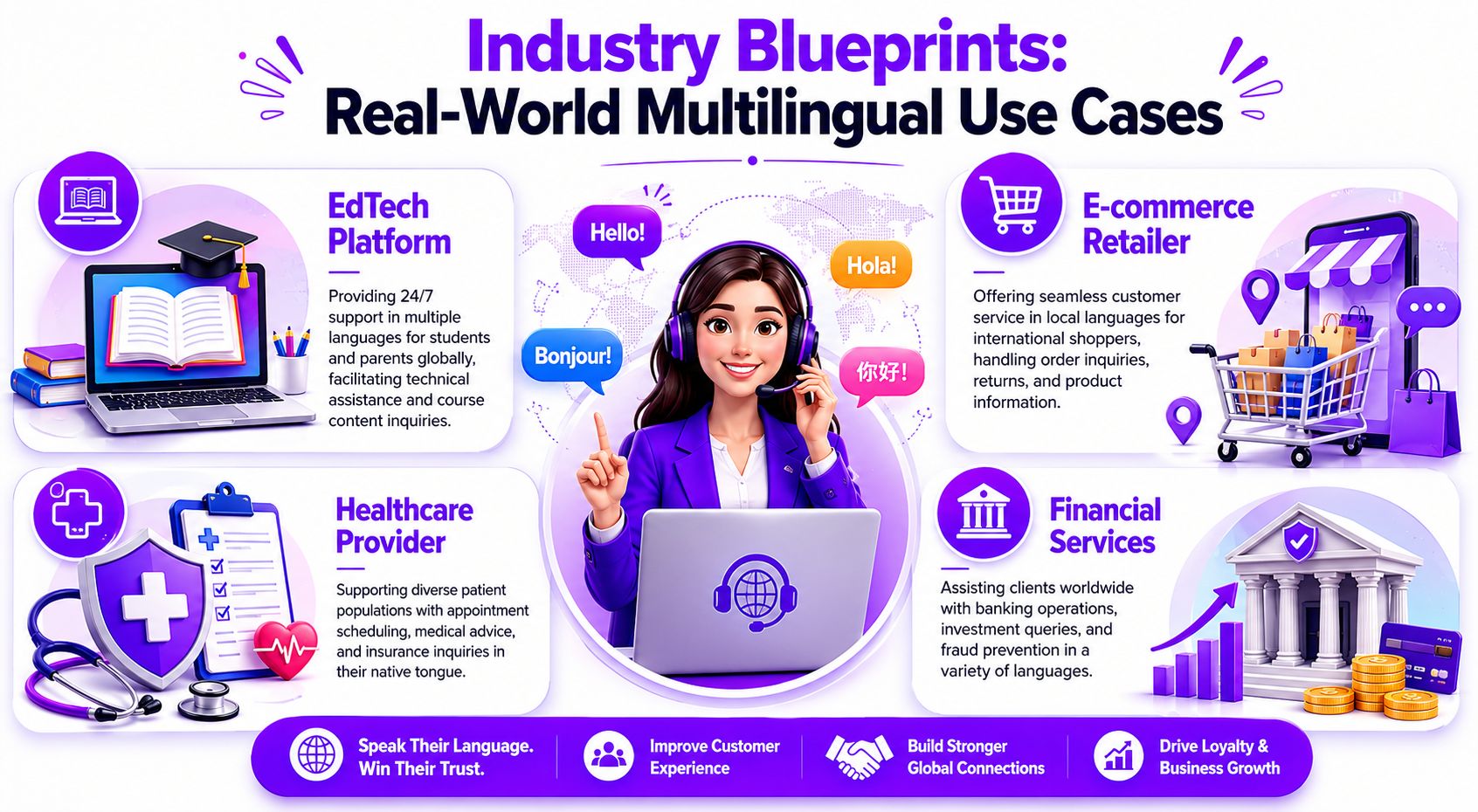
The pressure behind these deployments is broad, not niche. The global outsourcing market numbers and rising post-2020 volume trends cited earlier show why organisations can't keep solving diverse demand with linear headcount growth alone. In practice, that's pushing more firms toward multilingual automation for routine workflows while preserving human oversight where trust and judgement matter.
What this looks like by sector
EdTech
Admissions and counselling teams often need to answer similar questions repeatedly, but trust still matters. A strong model uses multilingual Voice AI for first-contact triage, programme discovery, reminder calls, and document follow-up, while handing serious counselling conversations to human advisors who can adapt to student and parent concerns.
BFSI
Banks, lenders, insurers, and trading platforms need a stricter boundary. Multilingual automation can manage reminder calls, status updates, FAQ-level service, and guided next steps. Sensitive verification, dispute handling, or anything that creates consent risk should escalate quickly to trained agents with language and compliance support.
In BFSI, the decision isn't whether AI speaks the customer's language. It's whether the operating model knows when not to let AI continue.
Real estate
This category is ideal for hybrid design. Many buyer conversations start with repetitive questions about location, pricing bands, unit availability, and site-visit logistics. Voice AI can handle discovery, qualification, and booking flow discipline. Human teams then step in when negotiation, financing, or family decision dynamics become part of the call.
E-commerce and D2C
These businesses benefit most when multilingual support is connected to order systems and return workflows. Routine calls such as order status, return initiation, refund guidance, and delivery rescheduling are often suitable for automation. Human agents can focus on damaged-order disputes, retention saves, and exceptions that need judgement.
Healthcare and appointment-driven services
Here, multilingual support improves access quickly, but caution matters. Appointment scheduling, reminders, and basic navigation fit structured automation. Symptom interpretation, complaint handling, and insurance complexity usually need tighter human control.
The common pattern across sectors is simple. Standardise the predictable. Escalate the consequential.
Your Next Steps Toward a Global Voice
A multilingual strategy only becomes valuable when leadership narrows it to operational choices. Which languages drive demand density. Which workflows are repetitive enough for automation. Which interactions carry enough emotional or compliance weight to keep humans in control. Those are the decisions that determine ROI.
Three moves will usually create momentum fastest:
- Commission a language-demand audit across inbound calls, sales conversations, support tickets, and missed interactions.
- Choose one high-impact pilot in a workflow where standardisation is possible and failure cost is manageable.
- Set language-specific success criteria before launch, especially for routing quality, containment, escalation, and commercial outcomes.
Multilingual call centers aren't just about sounding local. They're about building a service architecture that can grow with your market, protect quality under volume pressure, and allocate human expertise where it creates the most value.
If your team is evaluating how a multilingual Voice AI pilot could fit into support, qualification, recruitment, or presales workflows, DialNexa Labs Private Limited is one option to review. The company builds human-like Voice AI agents for business calling, with configurable workflows that can support high-volume, structured conversations while preserving handoff paths for cases that need human judgement.

A highly insightful article that positions multilingual support as a strategic growth and revenue enabler rather than a simple customer service feature. The practical roadmap, industry examples, and balanced view of human agents and Voice AI make it extremely valuable for modern business leaders.