
MyOperator Pricing Breakdown for Indian CXOs in 2026
MyOperator's published cloud telephony pricing starts at ₹2,500/month for Compact and reaches ₹2,00,000/month for Enterprise, but those figures are annual commitments billed in one lump sum, not month-to-month subscriptions. For Indian CXOs, the question isn't the headline tier, it's how quickly add-ons, annual cash outlay, and regulated-workflow costs turn a “simple” telephony buy into a material TCO decision.
| Plan Name | Headline Monthly Cost | Annual Billing Commitment | Target Audience |
|---|---|---|---|
| Compact | ₹2,500/month | Billed yearly with GST applicable | Small teams |
| Sedan | ₹5,000/month | Billed yearly with GST applicable | 10 users |
| SUV | ₹15,000/month | Billed yearly with GST applicable | 10 users |
| Enterprise | ₹2,00,000/month starting price | Billed yearly with GST applicable | Larger organisations |
Table of Contents
- Decoding the Published MyOperator Pricing Tiers
- The Hidden Costs of Scaling in Regulated Industries
- MyOperator vs Voice AI Economics for Lead Qualification
- Calculating Your Real Cost-Per-Lead
- Procurement Strategy and Negotiation Tactics
- When to Choose DialNexa Over Traditional Telephony
- Frequently Asked Questions About MyOperator Costs
Decoding the Published MyOperator Pricing Tiers
MyOperator's India pricing page is unusually explicit. It lists Compact at ₹2,500/month, Sedan at ₹5,000/month, SUV at ₹15,000/month, and Enterprise at ₹2,00,000/month starting price, while also stating that all plans are billed yearly and GST is applicable (MyOperator pricing page). That structure matters because the published monthly numbers look like light SaaS spending, but the actual commitment is an annual procurement decision.
What the annual billing really means
For finance teams, the distinction is not cosmetic. A startup comparing Compact with a conventional monthly utility subscription has to budget for a lump-sum annual payment, plus GST, instead of spreading exposure across twelve billing cycles. MyOperator support documentation says the pricing visible in the dashboard is shown at the plan and per-unit level, and that the company does not offer in-house instalments, though buyers may convert the charge to EMI through their bank (MyOperator support article).
The brand also publishes a separate India product-pricing page with much smaller annual entry points, including Basic at ₹499/year, Standard at ₹1,199/year, Premium at ₹2,499/year, and Service A at ₹99 per transaction (MyOperator product pricing). The split matters. MyOperator is not selling one clean plan family. It is presenting different pricing frames for different product lines and buying motions.
The published tiering can still mislead procurement teams if they stop at the headline. A contact centre that expects heavy call volumes, frequent routing changes, or regulated workflow controls will usually spend more on usage, configuration, and internal administration than a small team doing basic call handling. For that reason, the practical question is not which tier is cheapest, but which tier matches the operational load without forcing repeated upgrades.
| Plan Name | Headline Monthly Cost | Annual Billing Commitment | Target Audience |
|---|---|---|---|
| Compact | ₹2,500/month | Yearly lump sum, GST applicable | Small teams |
| Sedan | ₹5,000/month | Yearly lump sum, GST applicable | 10 users |
| SUV | ₹15,000/month | Yearly lump sum, GST applicable | 10 users |
| Enterprise | ₹2,00,000/month starting price | Yearly lump sum, GST applicable | Large organisations |
Practical rule: if you're comparing MyOperator against any vendor with monthly billing, compare the cash you must commit today, not the nominal per-month headline.
The branding gap matters as much as the price gap. Buyers evaluating telephony should also compare how vendors frame commercial terms across products, and a useful benchmark is compare attribution software costs, because attribution tools often present the same kind of annualised commitment behind a clean-looking monthly label.
For teams migrating from another telephony stack, the product-level view is worth a direct cross-check. MyOperator's own positioning becomes easier to evaluate when you compare it with a structured breakdown such as Exotel pricing analysis, especially if your shortlist includes annual billing commitments and seat-based tiers side by side.
Why this matters to procurement
The published tiers are not expensive or cheap. They are cash-flow sensitive. A CFO looking at Compact or Sedan should ask whether the platform will be used as a routing layer, a reporting layer, or a revenue capture system, because the answer determines whether the annual commitment is efficient or just convenient. The lowest published entry point is attractive for small teams, but the higher-value cloud telephony tiers only make sense if call handling, analytics, and workflow control are being used at scale.
The Hidden Costs of Scaling in Regulated Industries
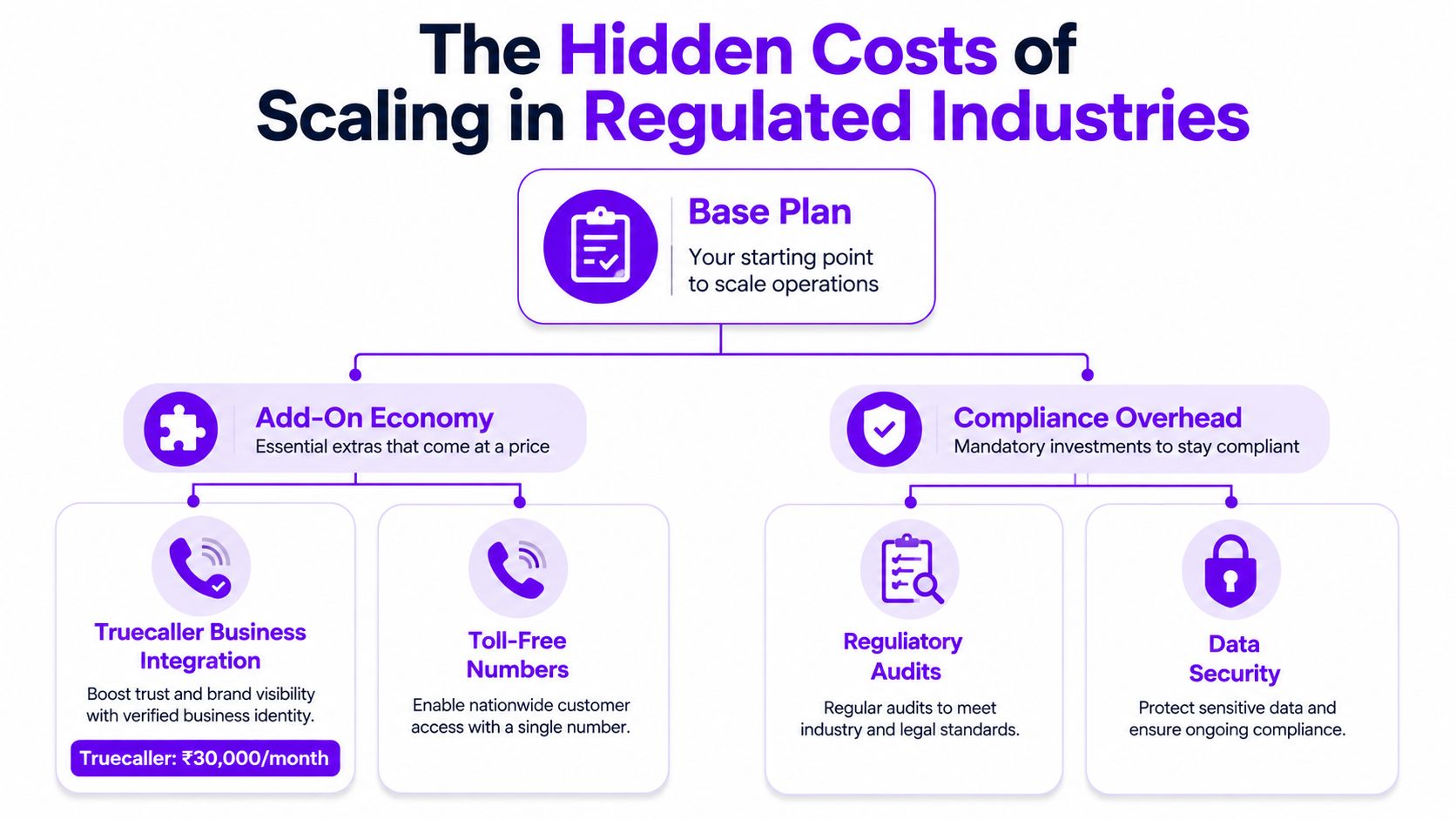
A low headline price does not stay low for long in BFSI and Healthcare. Once regulated workflows enter the buying decision, the cost base shifts from a single plan fee to a stack of usage, compliance, and operational charges, and that is where total cost of ownership starts to diverge from the published tier.
Add-ons change the economic shape
MyOperator's pricing page lists India-specific communication add-ons, including Truecaller Business starting at ₹30,000/month, 1800 Toll-Free starting at ₹500/month, and Auto-Dialer starting at ₹700/user/month (MyOperator pricing page). These line items do not look large on their own, but they change the commercial model. A collections team that needs caller identification, toll-free inbound access, and automated dialling is not buying one seat plan. It is assembling a communications stack.
For regulated buyers, that distinction matters. A bank running collections may need trusted caller identity, controlled number strategy, and call orchestration. A hospital may care more about patient callbacks, appointment reminders, and service responsiveness. In both cases, the bill can rise through channel features before seat count becomes the main driver.
A pricing table does not add much at this point. The useful question is which features are mandatory for the workflow, and which ones are optional conveniences that become hard to remove after deployment. In BFSI and Healthcare, that answer often includes identity trust, routing controls, and audit-friendly communication paths, which turns a basic telephony purchase into a more layered operating expense.
Where per-minute economics become the decisive factor
Independent 2026 buyer guides show voice AI economics often involve per-minute costs ranging from ₹2.5–₹8, with high-volume contracts above 5 lakh minutes potentially falling to ₹1.5–₹3 per minute (Voice AI India 2026 guide). That is the more useful comparison set for large Indian operations than a static seat plan. It shows that voice economics do not move in a straight line, and published tier pages rarely explain where the curve changes.
For CFOs, the procurement test is straightforward. If call volume is low and routing is the main need, a telephony tier may be rational. If the operation depends on large-scale, compliance-heavy conversations, the question becomes whether the platform still looks efficient once add-ons, hosting expectations, and workflow complexity are included.
CFO checkpoint: ask vendors to separate mandatory costs from optional costs before you compare any quoted plan.
MyOperator's published schedule gives a starting point, but it leaves the hard TCO question open. That gap matters most in BFSI and Healthcare, where compliance overhead often stays hidden until implementation begins.
MyOperator vs Voice AI Economics for Lead Qualification
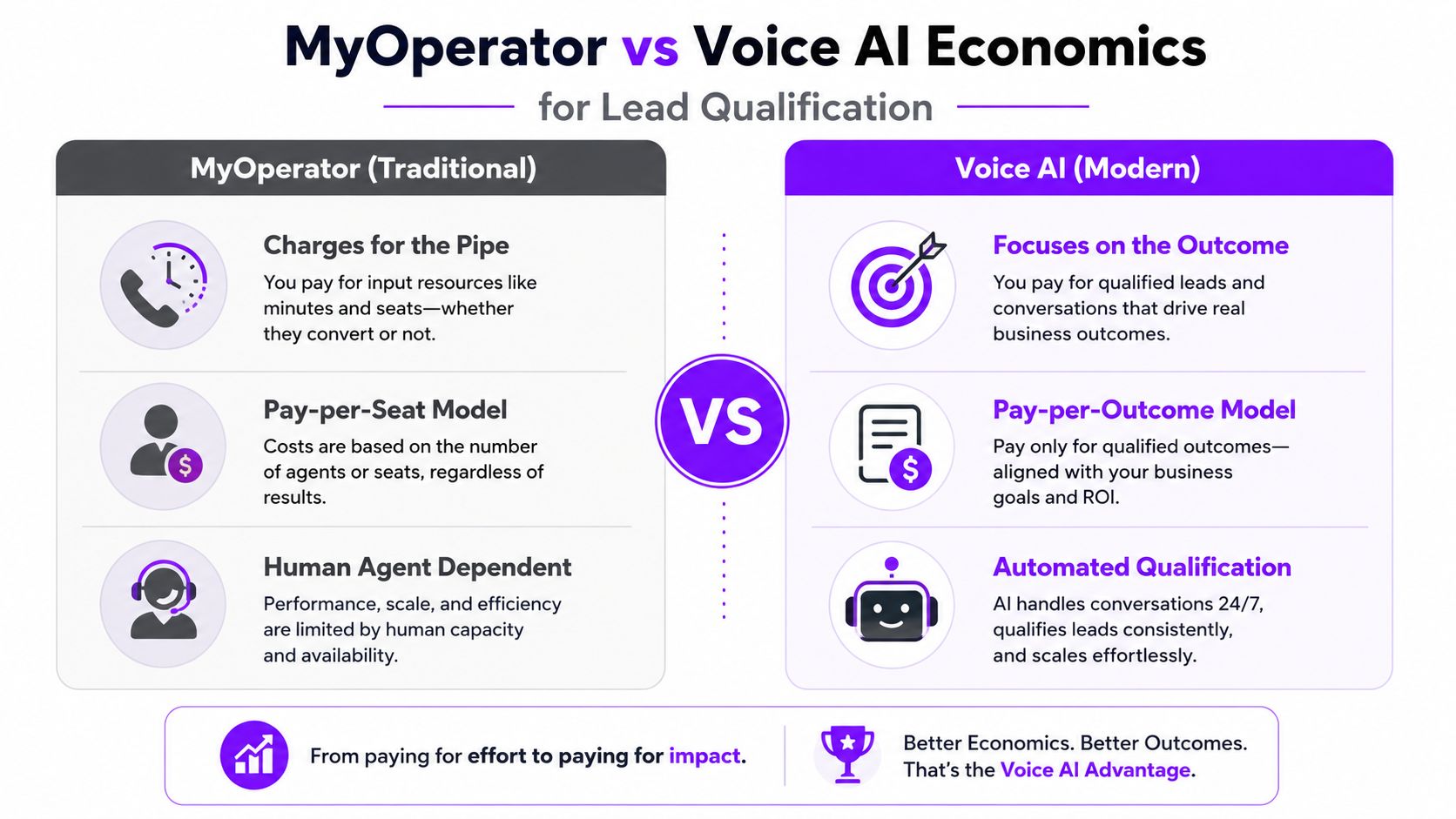
MyOperator is priced like infrastructure. Voice AI platforms are priced like conversion systems. That difference matters most in revenue-facing use cases where the objective is not merely to connect the call, but to qualify the lead, hold the conversation, and push the buyer closer to a booked outcome.
Pipe economics versus outcome economics
MyOperator's model, as published, focuses on the pipe, meaning seats, call handling, and usage-based channel costs. A Voice AI model focuses on the outcome, meaning qualified conversations and next-step actions. That distinction is especially important for lead qualification in EdTech, Real Estate, and similar sales-intensive businesses.
DialNexa is one example of the outcome-oriented category. DialNexa publishes voice AI positioning around qualification, support, recruitment, and presales, and its public materials state that teams report connect rates rising from 47% to 91%, lead-to-booking improving from 2% to 8%, and AI-qualified leads matching human judgment with 97% accuracy. Those numbers are part of DialNexa's own published product context, and they matter because they shift the ROI discussion from call cost to booking efficiency.
A practical comparison for sales leaders
A sales VP should compare vendors on what happens after the call connects, not just whether the call got routed. A traditional telephony stack can be efficient if humans are doing the work and the workflow is straightforward. But when the business needs natural, multi-minute conversations at scale, outcome-based Voice AI can produce a lower effective acquisition cost even if the per-interaction price looks higher.
MyOperator's public pricing pages do not show that conversion layer. That is not a flaw, it's a product boundary. But procurement teams need to recognise the boundary before they assume a cheaper telephony tier is also the cheaper sales system.
For teams comparing vendor categories, DialNexa's Voice AI company breakdown is a useful companion because it frames the market by capability rather than by line-item telecom pricing.
The core insight is simple. If your team is paying for conversations but only measuring connections, you're underpricing the value of automation. If your revenue model depends on qualified conversations, the better benchmark is the cost per qualified lead, not the cost per seat.
Calculating Your Real Cost-Per-Lead
The cleanest way to assess myoperator pricing is to stop thinking about plan names and start modelling your own funnel. If your current process relies on humans to answer, qualify, and transfer leads, your real cost per lead includes more than platform fees. It includes the wage cost of missed calls, slow callbacks, and repeated handoffs.

Build the calculator in layers
Start with three buckets.
- Human handling cost: include salaries and any overtime attached to inbound or outbound response work.
- Telephony cost: include the annualised plan commitment, any usage-based communication costs, and channel extras.
- Opportunity cost: include the value lost when a lead is missed, delayed, or routed badly.
That structure is more useful than vendor marketing because it mirrors how your pipeline leaks. A missed healthcare appointment reminder has a different cost profile from an unanswered real estate enquiry, but both inflate CPL when response times slip.
Use outcome quality as a multiplier
DialNexa's published product material says AI-qualified leads can match human judgment with 97% accuracy, which is useful as a benchmark when comparing AI-assisted outreach to manual qualification. If your current process routes low-intent leads to senior staff, then the hidden cost is not just labour, it's senior selling time spent on poor-fit conversations. A high-accuracy AI layer can free those people to work the deals that need a human.
The framework below helps procurement teams normalise the comparison.
| Input | What to Capture | Why It Matters |
|---|---|---|
| Labour | Salary cost tied to lead handling | Shows manual qualification expense |
| Platform | Annualised telephony or AI subscription | Reveals committed spend |
| Usage | Minutes, messages, add-ons | Captures variable cost |
| Missed response | Lost leads or delayed callbacks | Measures opportunity loss |
Analyst note: when a vendor quote looks cheap, ask what portion of your team's time it will still consume after deployment.
If you're building the CRM side of that calculation, a practical reference is CRM and lead management for revenue teams, because the cost per lead only makes sense when leads are tracked through to conversion.
The point is not to force every buyer into automation. It's to make the economics visible. Once you price in human follow-up, missed call recovery, and transfer friction, a seemingly affordable telephony plan can end up sitting beside a much more expensive operating model.
Procurement Strategy and Negotiation Tactics
MyOperator's annual billing model changes the negotiating game. If a vendor charges in one lump sum and does not offer in-house instalments, procurement teams need to treat the contract like a capital allocation decision, not a lightweight software subscription. The levers are still there, but they're different levers.
What to press on before signing
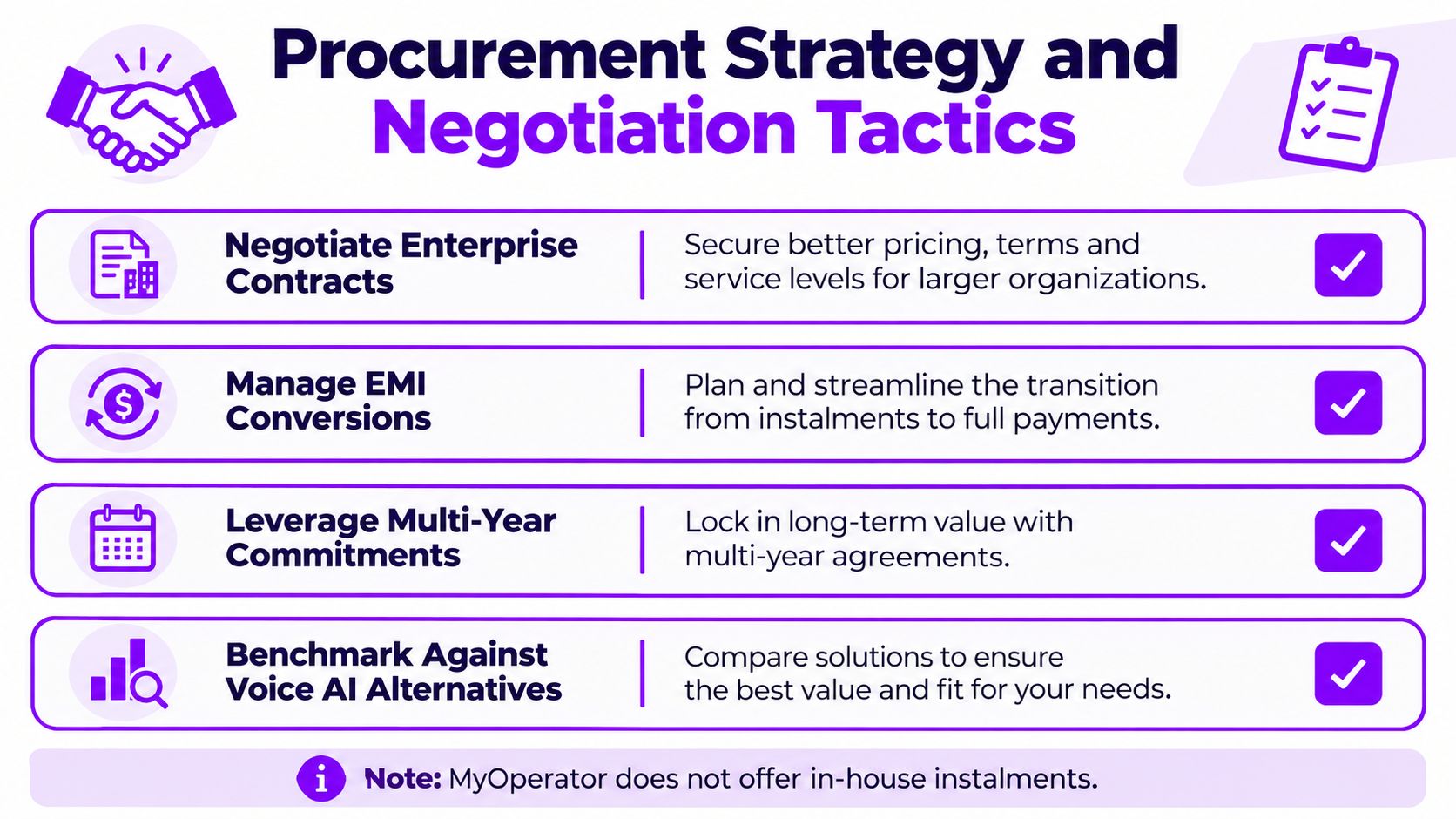
MyOperator support documentation states that all plans are billed annually in one lump sum and the company does not offer in-house instalments, though customers may convert charges to EMI via their bank (MyOperator support article). That detail should shape the negotiation. If the vendor expects annual cash upfront, then the buyer should ask for clarity on implementation scope, support boundaries, and usage assumptions before finance approves the payment.
The second pressure point is the usage layer. MyOperator publishes WhatsApp destination rates for Indian numbers, including Marketing at ₹0.95, Authentication at ₹0.13, Utility at ₹0.13, and Service at free (MyOperator pricing page). Those rates matter because messaging economics can accumulate quickly when a workflow shifts from calls to notifications, reminders, and follow-up campaigns.
A simple procurement checklist
- Negotiate Enterprise Contracts: ask for scope clarity, service boundaries, and what is included in the annual payment.
- Manage EMI Conversions: if cash flow is tight, confirm bank-side EMI conversion before approval.
- Use Multi-Year Commitments: only if the roadmap is stable and the usage model is locked.
- Benchmark Against Voice AI Alternatives: compare what the platform does per conversation, not just per seat.
For teams already thinking about migration paths, a relevant internal reference is communication in negotiation, because the buying team often loses value when technical, finance, and ops stakeholders don't share the same cost model.
Procurement rule: do not compare a lump-sum annual contract against a monthly quote without normalising both to the same cash-flow horizon.
One more strategic point matters for long-term lock-in. As AI capabilities become standard in conversational workflows, legacy telephony vendors can look cheap at entry but expensive at the point where you need intelligence, automation, and data portability. Procurement should price for the next operating model, not only the current one.
When to Choose DialNexa Over Traditional Telephony
Traditional telephony still makes sense when your goal is simple routing, internal handling, or lightweight call management. If the business just needs calls answered, transferred, and recorded, a utility platform can be enough. The economics change when the operation depends on long conversations, lead qualification, or support resolution at scale.
DialNexa fits the second case because it is built around human-like Voice AI agents for qualification, support, recruitment, and presales, with ready-made personas and API-first deployment. That model is more relevant when CXOs need fewer dead-end calls and more completed outcomes. MyOperator remains a credible option where telephony is the product. DialNexa becomes more relevant where conversation is the product.
Use-case fit matters more than vendor loyalty
If your team only needs call distribution and basic communication plumbing, shifting to AI is unnecessary complexity. But if your support or sales team spends most of its time on repetitive, multi-step calls, the old seat-plus-minute model starts to look like overhead rather than an advantage.
That's where buyers should evaluate the operating difference, not just the commercial difference. Legacy telephony asks, “How many users and minutes do you need?” Voice AI asks, “How many qualified conversations do you need, and what is one worth to your business?” Those are not equivalent questions.
DialNexa's Exotel alternatives analysis is a useful way to frame that choice because it compares utility-style telephony against AI-first conversation handling without pretending they solve the same problem.
If your team measures success in booked meetings, resolved queries, or verified follow-ups, the platform should optimise for those outcomes directly.
For Indian CXOs in BFSI, Healthcare, D2C, EdTech, and Real Estate, that distinction is decisive. Traditional telephony is still useful, but it's rarely the endpoint once conversation quality becomes a revenue metric.
Frequently Asked Questions About MyOperator Costs
Is GST included in the published price? MyOperator's pricing page says GST is applicable, so the published figures should be treated as pre-GST commitments (MyOperator pricing page). Can I port my existing number to MyOperator for free? The public pricing pages don't state that, so buyers should confirm migration terms during procurement. What happens if I exceed my bundle? The dashboard reportedly shows live plan pricing and per-unit call and message rates, so ask for the exact overage schedule before signing (MyOperator support article).
DialNexa Labs Private Limited helps Indian teams deploy Voice AI agents for qualification, support, recruitment, and presales, which makes it relevant when telephony costs stop being just a communications line item and start affecting revenue efficiency. If you're comparing MyOperator pricing against outcome-based automation for regulated or high-volume workflows, visit DialNexa Labs Private Limited to review how a Voice AI operating model changes the economics of each conversation.

This is a detailed and practical breakdown of MyOperator pricing, hidden costs, and real-world telephony economics. I especially liked how it connects pricing with ROI, lead qualification, and procurement decisions.
This is a well-researched and practical breakdown of MyOperator pricing, especially the focus on annual commitments, add-ons, and hidden scaling costs. The CFO-focused TCO and cost-per-lead approach makes the comparison especially valuable for businesses evaluating telephony and Voice AI solutions.
A useful pricing breakdown that makes it easier for Indian CXOs to understand the costs and plans involved.
The clear insights can help businesses evaluate communication solutions based on their needs and budget.
This is a helpful pricing guide for Indian CXOs evaluating MyOperator in 2026. The clear breakdown makes it easier to understand the available options, compare costs, and make a more informed decision based on business needs.