
A CXO’s Guide To Amazon Polly Text To Speech
At its core, Amazon Polly does one thing: it turns text into remarkably lifelike speech. But to think of it as just a simple text-reader is to miss the entire picture. Polly is a cloud service that gives your applications a voice, opening up entirely new ways to engage with customers and build speech-enabled products from the ground up. It leverages sophisticated deep learning to synthesise speech that sounds genuinely human, offering a wide array of voices across dozens of languages.
The Executive Case For Amazon Polly Text To Speech

For any business leader, the only real question is, "What will this do for us?" With Amazon Polly text to speech, the answer is clear: it’s a direct path to better customer engagement and leaner operations. It’s about moving past impersonal, static text to create scalable, warm interactions that actually connect with people.
Think about it. A financial services firm could replace generic SMS fraud alerts with a professional voice call that confirms transactions, reducing customer anxiety and reinforcing trust. A logistics company could automate delivery updates with a friendly, human-sounding voice, improving customer satisfaction by over 30% and reducing inbound calls to support centers.
This isn't some far-off idea; it's happening right now. We're seeing businesses report that customer connection rates are leaping from a standard 47% to over 90% simply by using intelligent, voice-based outreach.
From Cost Centre To Revenue Driver
The real magic of Polly is how it can directly influence your bottom line. It helps shift communication from a necessary expense to a powerful tool for building customer loyalty and driving growth. Exploring the essential text-to-speech capabilities shows just how many ways this technology is reshaping modern business communication.
The applications are incredibly diverse, delivering solid, measurable results in almost any industry:
- Finance: Automate KYC compliance calls, fraud alerts, and payment reminders. A leading bank implemented Polly to automate over 500,000 monthly payment reminders, resulting in a 15% increase in on-time payments and a 25% reduction in manual follow-up calls by agents.
- Education: Polly can be a game-changer for accessibility. The learning platform Zearn, for instance, saw students use audio features 20% more often with Polly's natural voices, which had a direct impact on engagement and learning.
- Real Estate: A major brokerage automated lead qualification calls for new listings. The Polly-powered system handled initial questions 24/7, qualified leads with 97% accuracy, and increased scheduled viewings by 40%, letting agents focus their time on closing deals.
This technology allows you to standardise what excellence looks like in your company. Every single automated interaction is on-brand, accurate, and effective, ensuring a consistent customer experience at a scale that's simply impossible with human teams alone.
For leaders focused on the bottom line, it's helpful to translate these features into tangible business outcomes. The table below gives a clear snapshot of Polly's strategic impact.
Amazon Polly's Core Value For Business Leaders
| Feature | Business Impact | Key Performance Indicator |
|---|---|---|
| Neural & Standard Voices | Enhances brand perception and customer trust with high-quality, natural-sounding audio. | Customer Satisfaction (CSAT) Scores, Brand Sentiment Analysis |
| SSML & Pronunciation Controls | Ensures brand names, jargon, and key terms are pronounced perfectly, maintaining brand integrity. | Reduction in communication errors, First Call Resolution (FCR) Rate |
| Scalable API/SDKs | Automates customer communication at scale, reducing reliance on manual call centre operations. | Call Centre Cost Reduction, Agent Productivity, Calls Handled per Hour |
| Custom Voices & Brand Voice | Creates a unique, ownable audio identity that differentiates the brand from competitors. | Brand Recall Metrics, Customer Lifetime Value (CLV) |
| Real-time Streaming | Enables dynamic, interactive voice applications like IVRs and real-time support. | Reduced Call Wait Times, Increased Self-Service Resolution Rate |
Ultimately, these features combine to create a more efficient, engaging, and profitable communication strategy that can be measured and optimised over time.
A Proven Model For Conversion
The effect on direct sales conversions is where things get really interesting. Take Policybazaar.com in the competitive Indian insurance market. They integrated Amazon Polly into their IVR system to manage a massive jump in call volume, from 120,000 to 300,000 transactions per month.
The results were stunning. They successfully answered 80% of all incoming calls, and a remarkable 41% of sales were closed without any human agent involvement at all. You can read more about how Policybazaar drove conversions with Polly on AWS.
This case study proves that Polly isn't just a notification system—it's a high-performance sales and service channel. For executives, that translates directly into lower customer acquisition costs, shorter sales cycles, and a far more productive workforce.
How Lifelike Voice Technology Drives Business Value
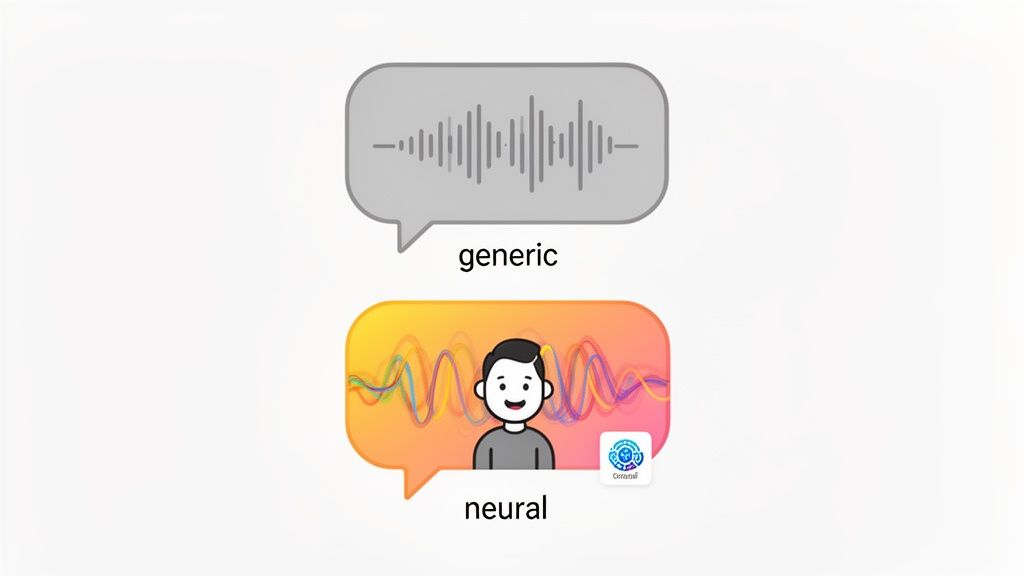
In any business, the quality of your voice is a huge, and often completely missed, opportunity. For years, standard text-to-speech (TTS) felt like using a generic system font. Sure, it gets the message across, but it’s functional at best and totally forgettable. It does nothing to build a connection or make your brand feel unique.
That’s all changing. Advanced solutions like Amazon Polly text to speech represent a massive leap forward. Polly’s Neural TTS (NTTS) technology isn't just a slightly better font; it's like having custom typography designed specifically for your brand’s voice. It produces speech with real subtlety and emotion, creating a premium experience that feels both personal and genuinely engaging.
Think about a financial institution. A robotic voice announcing, "Your transaction is complete," is just functional noise. But a neural voice can deliver that same message with a reassuring tone, something absolutely vital when dealing with people's money. In automated support calls, an empathetic voice can single-handedly reduce customer frustration and has been shown to cut churn by up to 15% in high-stakes industries.
The Strategic Value of Neural Voices
Moving from a standard to a neural TTS voice isn't a minor upgrade—it's a strategic move. Neural voices are trained on enormous datasets, which gives them a deep understanding of context. This allows them to generate speech with human-like pacing and intonation, making interactions feel less like you're talking to a machine and more like a real conversation.
You can see the impact in a few critical areas:
- Customer Onboarding: A warm, welcoming voice guiding a new user through a complicated setup process makes a world of difference. It improves that crucial first impression and can seriously cut down on how many people give up and leave.
- Accessibility: For visually impaired users, a natural-sounding voice turns content from a chore into a pleasure. It’s far more engaging than a droning, robotic reader. This is a big reason people seek out a good PDF reader with text-to-speech capabilities for their documents.
- Interactive Learning: In education tech, a friendly and expressive voice keeps students locked in. The learning platform Zearn, for example, saw students use its audio features 20% more often after they switched to Polly’s neural voices. That’s a direct hit on engagement.
Here's the bottom line for any business leader: the quality of your automated voice is a direct reflection of your brand's quality. A cheap, robotic voice makes your brand feel cheap and impersonal. A clear, warm, and natural one communicates professionalism and care.
This is exactly why so many are looking at how lifelike audio can reshape customer service. The question is, is your organisation ready now that AI Voice Agents Are Ready?
Beyond Natural Sounding: Creating A Brand Voice
Amazon Polly pushes this idea even further with its Brand Voices feature. This service lets your company work directly with AWS to build a unique, exclusive voice persona that’s tied directly to your brand. It’s the audio equivalent of commissioning your own font or defining your brand’s colour palette.
Imagine an EdTech company creating a one-of-a-kind "counsellor" voice for its platform. That single voice, used consistently across thousands of automated interactions, builds trust through sheer familiarity. It’s not just a tool anymore; it becomes a recognisable and reassuring part of the student's journey.
For anyone in a leadership position, this is the highest level of control you can have over your brand in the audio space.
Key Benefits of a Custom Brand Voice:
- Brand Differentiation: Your voice is yours alone. Competitors can't copy it.
- Enhanced Trust: A consistent voice across every touchpoint builds credibility and makes you feel familiar.
- Increased Engagement: People are simply more likely to listen to and interact with a voice they recognise.
This level of customisation proves that Amazon Polly text to speech isn't just about sounding a little nicer. It’s about using voice as a powerful tool to drive conversions, strengthen how people see your brand, and build a real, lasting advantage.
Achieving Brand Control With Advanced Voice Customisation
For any business leader, brand consistency is non-negotiable. It’s the very bedrock of customer trust and recognition. While getting a lifelike voice is a great first step, true brand alignment demands a much finer level of control. With Amazon Polly text to speech, you get the tools to direct your AI voice’s performance, making sure every interaction is perfectly on-brand.
Think of it like this: a standard text-to-speech engine is just an actor reading lines from a script. With advanced customisation, you become the director. You get to control the delivery, the tone, and the pacing to create a very specific, intended effect. This transforms your voice AI from a simple notification tool into a genuinely persuasive communication asset.
Directing Your AI Voice With SSML
The main tool in your director's toolkit is Speech Synthesis Markup Language (SSML). The name might sound a bit technical, but the idea behind it is straightforward. SSML is simply a set of instructions you embed right into your text to guide how the AI speaks. It's less like code and more like a director's script for your AI voice.
Imagine an AI agent making an automated follow-up call for a real estate firm. Without SSML, it could easily sound flat and robotic. But with SSML, you can orchestrate the entire conversation to have the maximum impact.
- Cadence and Pausing: The AI can be told to state a property address with a clear, deliberate cadence. It can then pause dramatically just before revealing the price, building a sense of anticipation.
- Emphasis and Tone: You can add emphasis to key features, like telling it to stress the words in "a brand new kitchen."
- Persuasive Delivery: For the final call-to-action, you can tweak the pitch and rate to make the voice sound more engaging when it asks, "Would you like to book a tour this Saturday?"
This isn’t just about sounding a little nicer; it's about driving real-world results. This precise control can directly influence behaviour, helping to lift key metrics like lead-to-booking rates from an average of 2% to as high as 8%.
By using SSML, you are no longer just converting text to speech. You are crafting an audio experience designed to achieve a specific business outcome, whether that's building trust, creating urgency, or persuading a customer to take the next step.
Protecting Brand Integrity With Pronunciation Lexicons
While SSML controls how things are said, Pronunciation Lexicons ensure the what is always accurate. For a global fintech company, for instance, credibility is everything. If an AI voice mispronounces the company's name or a complex financial term, it instantly shatters that trust.
Lexicons are custom dictionaries you create for Amazon Polly, solving this problem at scale. You just need to provide a list of specific words and their correct phonetic pronunciations. This guarantees that your brand’s unique terminology is spoken flawlessly every single time, no matter which language you're operating in.
Critical Applications for Pronunciation Lexicons:
- Brand Names: Ensure your company name is pronounced perfectly across every market.
- Acronyms: Define how acronyms like 'KYC' (Know Your Customer) or 'SLA' (Service Level Agreement) should be spoken—as individual letters or as a single word.
- Technical Jargon: For industries like healthcare or engineering, lexicons make sure complex terms are articulated correctly, which eliminates confusion and projects expertise.
This protects your brand's integrity and smooths out the friction caused by miscommunication. For companies expanding globally, this feature isn’t a luxury; it’s a necessity for maintaining a professional image. In fact, many organisations find that combining these customisation tools with other systems offers the best results; you can learn more about hybrid text-to-speech approaches in our detailed guide.
Ultimately, these advanced customisation features in Amazon Polly text to speech give executives the control they need. You can ensure every automated voice interaction is not only natural and engaging but also perfectly aligned with your brand’s standards, strategic goals, and customer expectations.
Integrating Polly into Your Enterprise Technology Stack
As a technology leader, you know that the true test of any new service isn't just what it can do, but how easily it plugs into what you've already built. A complete overhaul for a single new feature is almost always a non-starter. This is where Amazon Polly text to speech really shines. It was clearly designed to be added to existing systems with minimal fuss, not to trigger a massive, multi-year redevelopment project.
Polly offers two main ways to integrate, each built for a different kind of job. Getting a handle on these two patterns is the first step in figuring out how to deploy voice AI effectively. For your development team, this means they can get a Polly-powered solution up and running in weeks, not months, delivering a quick and measurable win.
Real-time Streaming for Interactive Applications
First up is Real-time Streaming. This is your go-to method for any application that needs to respond to a user instantly. Think of conversational AI assistants, interactive voice response (IVR) systems, or live notifications. In these cases, even a tiny delay feels clunky and breaks the illusion of a natural conversation.
With streaming, the moment your app sends a bit of text to the Polly API, Polly starts generating the audio and sends it right back. This means the audio can start playing almost immediately. In fact, the first byte of audio often arrives in under 100 milliseconds—a delay so short it's practically invisible to the human ear. This is what makes smooth, back-and-forth dialogue possible for customer service bots or dynamic content narration.
For example, you could use streaming to have a trading platform announce real-time stock price changes, or to power a voice search on an e-commerce site that replies instantly to a customer's query.
Asynchronous Synthesis for Batch Processing
The second pattern is Asynchronous Synthesis. This is the workhorse for generating huge amounts of audio when you don't need it on the spot. It's the perfect choice for background jobs where getting it all done efficiently is more important than split-second timing.
You’ll find this approach incredibly useful for tasks like:
- Generating IVR prompts: Create all the audio files for your company’s entire phone menu in one go.
- Creating accessible content: Turn your whole library of articles, blog posts, or training documents into audio versions overnight.
- Producing audio for videos: Generate voiceovers for marketing or training videos, even in multiple languages.
Using this method, you simply submit a job to Polly. It gets to work, processes all the text, and conveniently saves the finished audio files directly into an Amazon S3 bucket. This frees up your application’s resources and gives you a straightforward, scalable way to handle massive text-to-audio conversions. For many companies, using these kinds of cloud solutions for call centres is a game-changer for operational efficiency.
Getting high-quality audio isn't just about converting text; it's a structured process where you have fine-grained control at every step—from scripting the words to fine-tuning the pronunciation.
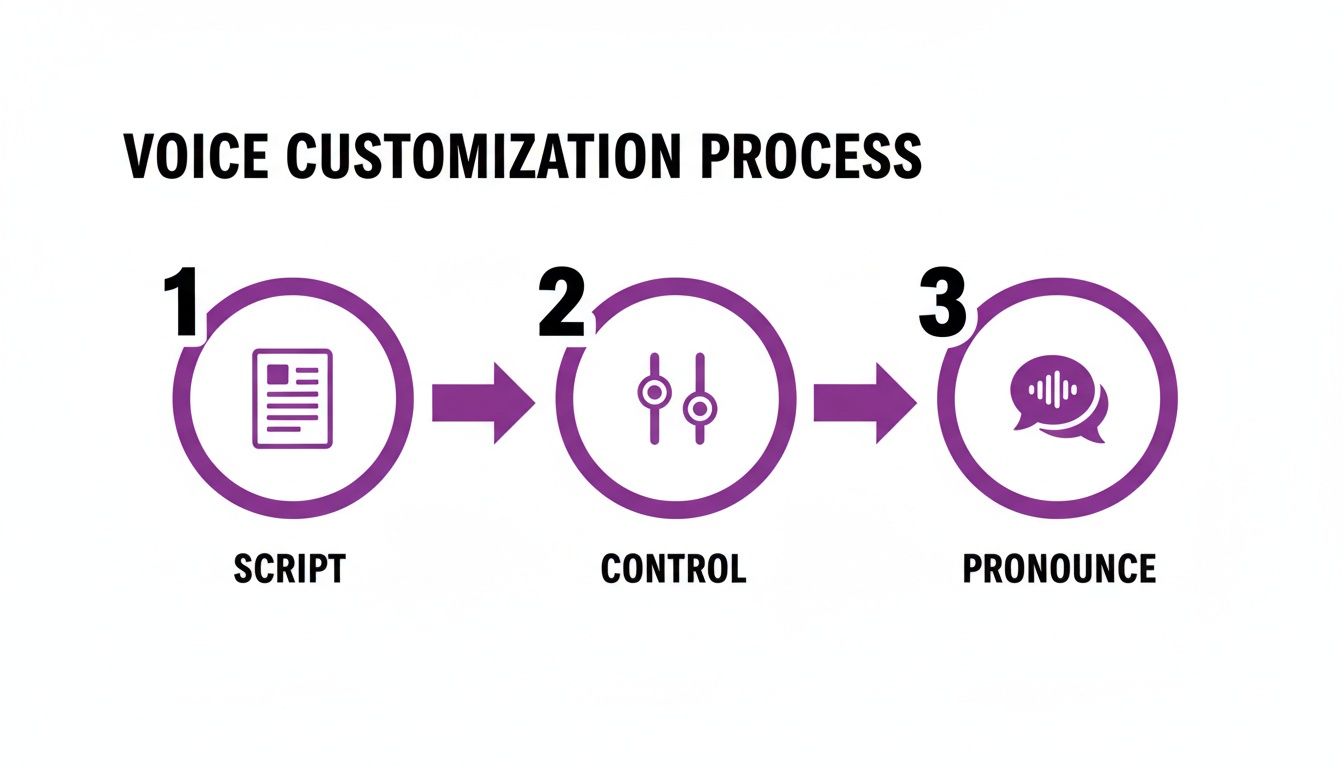
This process shows you can shape the final output, ensuring it sounds exactly the way you want it to.
Accelerating Development with SDKs and Simple APIs
For any developer, one of the best things about Polly is how simple its API is. The official Software Development Kits (SDKs) for languages like Python, Java, and Node.js are a huge help, handling all the tedious bits like authentication and request formatting. This lets your team skip the boilerplate and get straight to building the application itself.
A basic API call to create speech is surprisingly simple. This little Python snippet shows just how few lines of code it takes to generate an audio file from a string of text.
import boto3

# Initialise the Amazon Polly client
polly_client = boto3.client('polly')

# The text to be synthesised
response = polly_client.synthesize_speech(
    VoiceId='Joanna',
    OutputFormat='mp3',
    Text = 'Welcome. Your appointment is confirmed for this Friday at 10 AM.',
    Engine = 'neural'
)

# Save the audio stream to a file
with open('speech.mp3', 'wb') as file:
    file.write(response['AudioStream'].read())
As you can see from the code, adding a basic Amazon Polly text to speech feature isn't a massive engineering effort. That simplicity is a huge strategic advantage. It means your team can prototype, test, and ship voice-enabled features much faster than they ever could with older, on-premise systems.
When we talk about bringing new technology into a business, the conversation with any finance chief almost always boils down to two things: how much does it cost, and what do we get back? The technical wizardry of Amazon Polly is impressive, but for it to make sense, the numbers have to add up.
Thankfully, Polly is built on a simple pay-as-you-go model. There’s no massive upfront investment to worry about. You're billed for the number of characters you convert to speech, and that's it. This makes it incredibly easy to predict costs, whether you're a small team testing the waters or a large company handling millions of requests a day.
This direct link between usage and cost means you can model your expenses with a high degree of accuracy. The return on investment (ROI) isn't just about what you save on manual processes; it's about the value you create by engaging customers more effectively and moving them through your funnel faster.
Modelling Real-World Costs
Let's break down what this pricing looks like in the real world. Imagine a real estate firm that wants to automate its initial lead qualification calls. A typical script for one of these calls might be about 1,000 characters.
- Scenario: The firm makes 10,000 automated qualification calls a month.
- Calculation: 10,000 calls × 1,000 characters/call = 10,000,000 characters.
- The Bottom Line: Using Polly's Neural voices, the monthly bill for this would be a tiny fraction of what it costs to have a human agent make those calls, especially when you factor in salaries, training, and other overheads.
Now, you weigh that cost against the results. If this automated outreach delivers a 97% lead qualification accuracy—a figure some platforms report—the ROI becomes crystal clear. The firm doesn’t just cut operational costs; it dramatically speeds up its sales pipeline with a steady flow of high-quality leads.
For any CXO, the logic is straightforward: Polly lets you run a high-volume, high-quality communication strategy at a cost that human-led operations simply can't compete with. That creates a real, lasting advantage in the market.
This table provides estimated cost scenarios for various business applications, helping decision-makers quantify the investment and ROI for Polly integration.
Projected Monthly Cost Models For Amazon Polly
| Business Use Case | Monthly Volume | Estimated Character Count | Projected Monthly Cost (USD) |
|---|---|---|---|
| IVR Menu Prompts | 500 prompts updated quarterly | 150,000 characters | ~$2.40 |
| Real Estate Lead Qualification | 10,000 calls | 10,000,000 characters | ~$160.00 |
| EdTech Content Accessibility | 200 hours of audio lessons | 20,000,000 characters | ~$320.00 |
| E-commerce Order Notifications | 100,000 voice alerts | 25,000,000 characters | ~$400.00 |
Note: These costs are estimates based on standard AWS pricing as of early 2026 and are for illustrative purposes. Always check the official AWS Polly pricing page for the latest rates.
Scaling Without Limits
The other big question every enterprise leader asks is about scale. Will a system that works for a hundred calls a day fall over when we hit a million? With Amazon Polly, the answer is no. It’s built on the massive global infrastructure of AWS, so it was designed for enormous scale right from the start.
Put simply, you won't outgrow it.
As your business expands or your user base explodes, Polly just scales with you. You don’t have to think about provisioning servers, managing capacity, or worrying about performance dropping during busy periods. The service handles all the heavy lifting automatically, ensuring your ten-millionth user gets the same fast, high-quality audio as your tenth. That kind of reliability is exactly what you need when you're planning for serious growth.
The Future Is Voice: How Polly Drives a Real Competitive Advantage
The conversation around voice AI has moved out of the lab and straight into the boardroom. It's no longer a neat technical trick; it's become a critical piece of a company's competitive strategy. For business leaders, getting a handle on Amazon Polly text to speech isn't just about automating a few phone calls. It's about setting a new standard of excellence for every single customer touchpoint, ensuring each interaction is effective and perfectly on-brand.
This is exactly how smart companies are turning more conversations into actual revenue. When we look at the results from platforms like DialNexa, we’re not seeing small, incremental gains. We’re witnessing a complete performance shift. Customer connection rates, which typically hover around a disappointing 47%, are jumping to an incredible 91%. Why? Because the voice on the other end is engaging and, frankly, sounds human.
From Simple Automation to a Strategic Edge
The real power here comes from creating consistent, high-quality interactions at a scale no human team could ever manage. Once you roll out a well-designed voice strategy using Polly, you’ve essentially built a system that can deliver your best sales pitch or most empathetic support script thousands of times a day, without ever having a bad day.
This opens the door to achievements that were once pure fantasy:
- Multi-minute, natural conversations that genuinely build rapport and pull in critical customer feedback.
- AI-qualified leads that are 97% as accurate as those vetted by a human, freeing up your sales team to do what they do best: close deals.
- A serious lift in conversions, with lead-to-booking rates climbing from the industry standard of 2% to as high as 8%, even in tough markets like real estate.
These aren’t just numbers on a dashboard; they’re clear signs of a market leader. By automating the right conversations, you finally unlock the true potential of your people.
For any CXO, the path forward is clear. To cut operational costs, shrink sales cycles, and let your teams focus on high-value work, a solid voice AI strategy is non-negotiable for staying ahead in 2026 and beyond.
Building the Business Case for Voice
Bringing a service like Amazon Polly text to speech into your organisation is an investment in the resilience of your customer engagement model. It gives you the power to design, control, and infinitely scale your brand’s voice, making sure it remains a powerful asset as your business grows.
The strategic need is impossible to ignore. Companies that don't weave intelligent voice into their operations will quickly be outpaced by competitors who can connect with customers more personally, more efficiently, and on a much larger scale. The future isn't just about being heard—it's about being understood and remembered. That's how you win.
Frequently Asked Questions for Business Leaders
When business leaders look at Amazon Polly, a few key questions always come up. You need to know the practical realities, not just the marketing pitch. Let's get right to them.
How Difficult Is It to Create a Unique Brand Voice?
Getting your own exclusive Brand Voice is a hands-on project, and you'll work directly with the Amazon Polly team to make it happen. The process starts with you finding a voice actor and getting professional, studio-quality recordings of their voice.
From there, Amazon’s engineers take that audio and use it to train a private voice model just for you. While there's an upfront effort and investment, the payoff is an asset that’s truly yours. This custom voice is locked to your AWS account, meaning no other company can ever use it. Your audio identity stays completely unique.
The real value of a Brand Voice lies in its ability to consistently reinforce your brand’s persona. Every automated interaction, from a simple notification to a complex support call, builds familiarity and trust, which is a powerful differentiator in a crowded market.
Can Amazon Polly Handle Our Company’s Specialised Industry Jargon?
Yes, and this is one of its most practical features. You can use what are called Pronunciation Lexicons to create a custom dictionary for your company's specific terms, acronyms, and names. You simply map a word to its correct phonetic spelling.
This is how you ensure your AI voice sounds professional and knowledgeable. Whether it's saying "KYC" properly for a fintech application or articulating complex medical terms in healthcare, lexicons make sure your brand always speaks with authority.
What Is the Real-World Performance for Interactive Conversations?
Amazon Polly was built for speed, especially for real-time conversations. When using its streaming feature, the time it takes to get the first chunk of audio back is typically under 100 milliseconds.
To a human, that's instantaneous. This kind of responsiveness allows for natural, back-and-forth conversations without any awkward delays. It’s what makes Polly a great choice for interactive voice agents, where a smooth, uninterrupted flow is essential to keep customers engaged.
Ready to transform your customer communication? DialNexa Labs Private Limited helps businesses deploy intelligent, human-like Voice AI agents that deliver measurable results, from boosting connect rates to accelerating sales cycles. Discover how our platform can turn your conversations into conversions at https://dialnexa.com.

[…] worth reviewing how a more standardised platform behaves in production settings. This breakdown of Amazon Polly text to speech is a useful contrast point when you want to separate basic synthesis from strategic voice […]
Excellent analysis! This clearly demonstrates how Amazon Polly goes beyond basic automation to become a strategic asset that strengthens brand identity, improves customer engagement, and delivers measurable business growth. The focus on custom voice experiences and scalable ROI makes a compelling case for voice AI adoption in modern enterprises.