
Optimizing Modern E Commerce Processes From Click to Customer
At its heart, an e-commerce process is the entire journey a customer takes with your brand, from the moment they decide to buy something to the moment it arrives at their door—and even after. This isn't just one action, but a chain of connected events: capturing the order, processing the payment, managing your stock, fulfilling the order, shipping it out, and handling any returns or questions that come up.
The New E-Commerce Blueprint for Executive Leaders
For any modern business leader, e-commerce has moved from being just another sales channel to the very centre of the organisation's growth strategy. A common but costly mistake is to see these processes as a simple, straight line. The reality is far more dynamic. The most successful executives treat their e-commerce operation as a living ecosystem where every part has a direct impact on revenue, efficiency, and how long a customer stays loyal.
A great way to think about it is like a high-performance vehicle. Each process, from order capture to final delivery, is a vital component of the engine. If one part is out of sync or running poorly, it doesn’t just slow down that one function. It compromises the performance of the entire machine, hurting your speed, your margins (fuel efficiency), and the customer's overall experience.
The Exploding Market Opportunity
The pressure to get these processes right is only growing, especially when you look at the market. India's e-commerce sector, for example, is set for explosive growth, projected to climb from US$84 billion in 2022 to an incredible US$211.6 billion by 2025. This boom is powered by over 900 million internet users and the near-universal use of smartphones.
With quick commerce alone growing at a 70-80% CAGR, fine-tuning every step in the customer journey isn't just a good idea—it's a matter of survival and market leadership. You can get a deeper look into this expansion in this detailed retail industry analysis.
As a leader, your job isn't to get lost in the weeds of every single step. It's to understand how these moving parts connect to the big-picture business goals. A snag in payment processing isn't an IT problem; it's a direct hit to your conversion rate and top-line revenue.
To win in this fiercely competitive space, every process needs to be perfectly tuned. This means linking each operational stage to a clear business objective and a Key Performance Indicator (KPI) that you can actually measure.
Core E-Commerce Processes and Their Strategic Value
The table below provides a high-level map that connects each core stage of the e-commerce journey to its strategic value. Think of this as a blueprint for executive oversight, helping you see how day-to-day operations feed into your most important business outcomes.
| Process Stage | Primary Function | Strategic Goal | Core KPI |
|---|---|---|---|
| Order Capture | Receiving customer orders from various channels (website, app, marketplace). | Maximise revenue opportunities and create a frictionless entry point. | Conversion Rate |
| Payment Processing | Securely collecting payment and authorising transactions. | Reduce friction and cart abandonment while ensuring security. | Payment Success Rate |
| Inventory Management | Tracking stock levels across all sales channels in real-time. | Minimise holding costs and prevent stockouts to avoid lost sales. | Inventory Turnover Rate |
| Order Fulfilment | Picking, packing, and preparing orders for shipment. | Increase operational speed and accuracy to reduce errors. | Order Accuracy Rate |
| Shipping & Logistics | Transporting the package from the warehouse to the customer. | Ensure timely, cost-effective delivery to drive customer satisfaction. | On-Time Delivery Rate |
| Returns & Logistics | Managing the process of customers returning products. | Retain customer loyalty and recover value from returned goods. | Return Rate |
| Customer Support | Assisting customers with queries before, during, and after purchase. | Enhance customer experience and drive long-term loyalty. | First Contact Resolution |
By breaking it down this way, you can clearly see where your attention needs to be. A low conversion rate points to issues in Order Capture, while a high return rate suggests a deeper look into your Fulfilment or product descriptions is needed.
Mapping the Seven Stages of the E-commerce Value Chain
For any executive overseeing an online business, a clear map of the e-commerce value chain is essential. It’s not just a checklist of tasks; it’s a living system where one stage’s performance directly feeds into the next. From the moment a customer lands on your site to the day they might send a product back, optimising these seven core processes is the key to profitability and lasting growth.
Think of it this way: your e-commerce engine needs three things to run smoothly—customer acquisition, solid operations, and customer retention. They all have to work together.
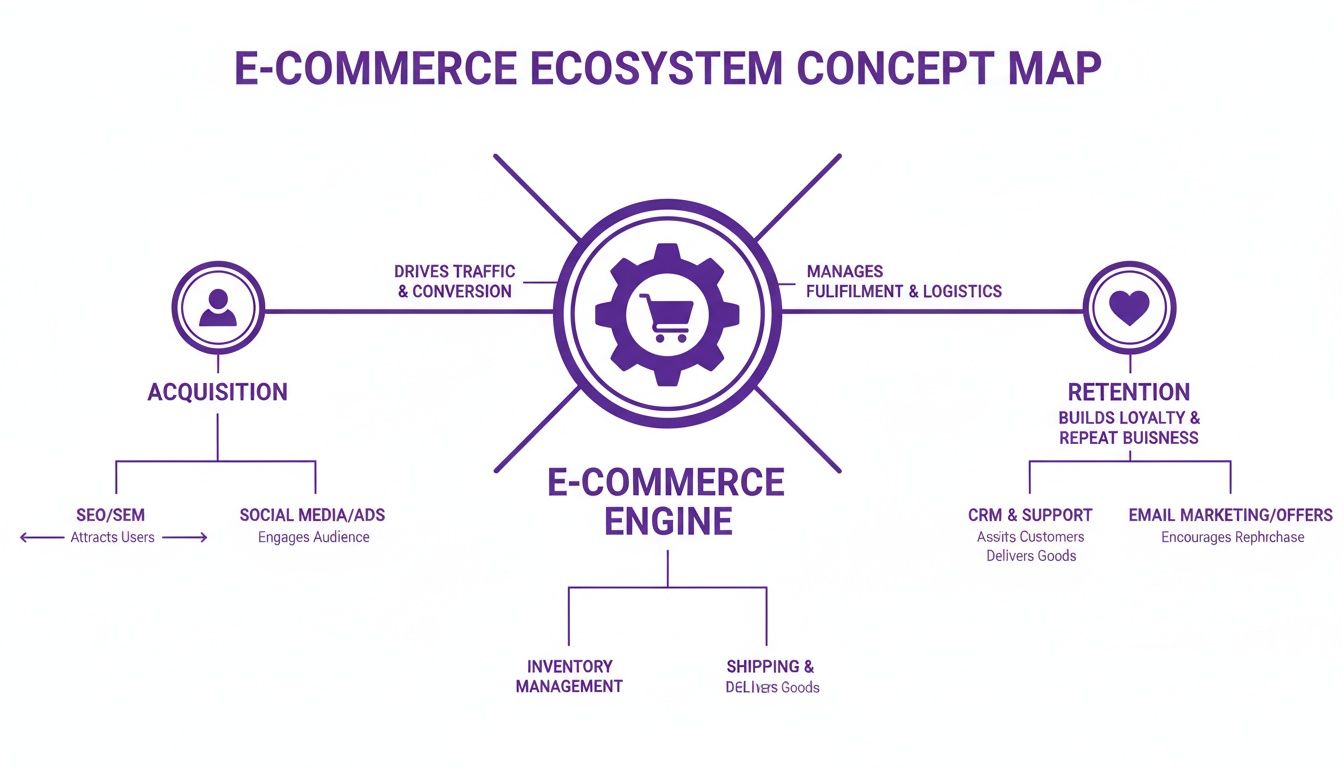
This visual really brings it home. A successful business isn't just about getting new customers in the door; it's about executing flawlessly behind the scenes and building relationships that keep people coming back.
1. Order Capture
This is your digital storefront, the very first point of contact. Order capture is all about successfully receiving a customer’s intent to buy, wherever that may happen—your direct-to-consumer (D2C) website, a marketplace like Amazon or Flipkart, or even a social media shop on Instagram.
A disjointed strategy here is a recipe for lost sales. A leading electronics brand, for instance, saw a 25% uplift in sales within three months of synchronizing their D2C site's promotions with their Amazon storefront. It creates a consistent brand experience and captures customers wherever they prefer to shop.
2. Payment Processing
The moment a customer decides to buy, your payment process needs to be invisible, fast, and completely secure. Any hesitation or roadblock at this stage is a primary driver of abandoned carts. A study by Baymard Institute found that 18% of US online shoppers have abandoned a cart in the past quarter solely due to a "too long/complicated checkout process."
In a market like India, offering a wide range of payment options isn't just a nice-to-have, it's a must. By integrating popular methods like UPI and Buy Now, Pay Later (BNPL), you're not just adding convenience; you're actively lowering the barrier to purchase. For example, a fashion retailer reported a 40% increase in average order value (AOV) for purchases made via BNPL, demonstrating that flexible payments encourage larger buys.
3. Inventory Management
Good inventory management is the absolute backbone of any e-commerce operation. It’s about knowing exactly what you have in stock, where it is, and how much is available across all your channels—in real time. Without this single source of truth, you’re flying blind, risking overselling items you don't have or tying up precious capital in products that just won't move.
Imagine a popular clothing brand during the Diwali shopping rush. If their website and physical stores aren't perfectly synced, they can easily sell the last S-sized kurta to two different people at once. The result? One cancelled order, one very unhappy customer, and a direct hit to the bottom line. This isn't a hypothetical; it's a daily reality that erodes both revenue and brand trust.
4. Order Fulfilment
This is where the magic happens inside the warehouse. Order fulfilment covers picking the right items off the shelf, packing them securely, and getting the parcel ready for its journey. The two measures of success here are simple: speed and accuracy.
A high error rate during the picking process is a direct line to incorrect orders, which inevitably inflates your return rates and chips away at the trust you've worked so hard to build. A leading 3PL provider estimates that every mis-pick costs a business between $22 and $100 when you factor in labor, shipping, and replacement costs.
5. Shipping and Logistics
Once a package is sealed and labelled, it enters the world of shipping and logistics. This is the complex dance of moving a product from your warehouse to a customer's home as quickly and cheaply as possible. Getting this right often requires dedicated ecommerce supply chain management know-how.
One of the most powerful tools at your disposal here is proactive communication. For example, a home goods D2C brand implemented automated WhatsApp updates for shipping milestones. This simple change led to a 15% reduction in Return to Origin (RTO) rates because customers were better prepared for delivery, and it cut "Where is my order?" support queries by nearly 40%.
6. Returns and Reverse Logistics
Let's be realistic: returns are a part of doing business online. How you handle them—a process called reverse logistics—is a make-or-break moment for your customer relationship. A clunky, expensive, or confusing returns process can turn a customer off for good. In fact, 92% of consumers surveyed said they would buy again if the product return process was easy.
On the flip side, making returns easy and transparent can build incredible loyalty. When customers know they can buy with confidence, they’re far more likely to come back again and again.
7. Customer Support
Finally, customer support is the thread that runs through this entire journey. From a pre-sale question about a product’s dimensions to the classic post-purchase "Where is my order?" query, providing quick, helpful answers is non-negotiable.
For many businesses, this is where costs can quickly get out of hand. Having your team manually answer the same questions over and over is not just expensive; it’s a poor use of their time and skills. For a company with a support team of 10 agents, if 60% of their time is spent on repetitive WISMO queries, you're losing over 10,000 hours of strategic work per year.
Pinpointing Your Most Costly Operational Bottlenecks
When you're scaling an e-commerce business, the small operational snags that were once just minor annoyances can quickly spiral into major financial drains. These bottlenecks often hide in plain sight within your daily e-commerce processes, quietly eating away at your margins and chipping away at customer trust. For leaders, the real job isn’t just finding these problems—it’s about understanding their true cost and prioritising them accordingly.
Think of your entire operation as a high-pressure water pipe. A tiny, seemingly insignificant leak can waste a staggering amount of water over time. Your task is to find those leaks and patch them before the whole system's integrity is at risk.
Friction at the Front End: The Conversion Killers
Often, the most glaring bottlenecks are the ones that stop a sale before it even happens. These are the issues that directly hit your top line, turning keen shoppers into missed opportunities.
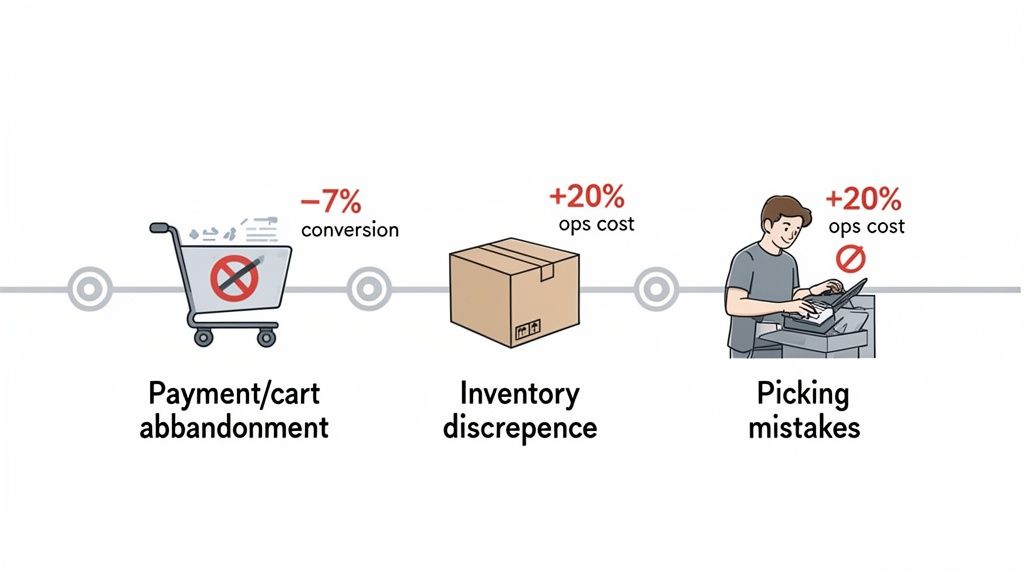
A classic offender is a slow website. We've all been there. The data is undeniable: a Google/Deloitte study found that even a 0.1-second improvement in site speed can boost conversion rates by 8%. For a business doing ₹1 Crore in monthly revenue, that fractional improvement translates into ₹8 Lakh in additional sales each month.
Then there's the clunky checkout process, a notorious driver of cart abandonment. When a customer is ready to buy but gets hit with unexpected shipping fees or is forced to create an account, they're gone. In fact, studies show that nearly 70% of online shopping carts are abandoned, and a huge chunk of that is simply down to friction. To get a better handle on this, it helps to know the difference between bounce and exit rates. For a deeper look, check out our guide on how to assess and audit bounce and exit rate analytics to increase conversions.
Hidden Costs in Your Warehouse Operations
Once an order is successfully placed, a whole new set of potential headaches crops up in your warehouse. These problems are less visible to customers at first, but they have a massive effect on your operational costs and, eventually, your brand's reputation.
Take inaccurate inventory, for instance. Your website says an item is in stock, a customer buys it, but you can't actually find it on the shelf. Now you have to cancel the order. You haven't just lost that one sale; you've created a frustrated customer who probably won't be coming back.
An even more expensive problem is a high rate of picking errors. When your team sends the wrong size, colour, or product, it can inflate your operational costs by up to 20%. That number isn't just a guess—it accounts for processing the return, shipping the correct item, and the potential loss on the returned product.
For a mid-sized D2C brand shipping 5,000 orders a month, a seemingly small 2% mis-pick rate translates to 100 incorrect orders. This can quickly add up to tens of thousands of rupees in direct costs, not to mention the priceless damage to your brand’s credibility.
Post-Purchase Challenges That Erode Loyalty
The final battleground for bottlenecks is after the package has already left your facility. This is where you either solidify customer loyalty or create a vocal critic.
Here are the most common post-purchase issues and the damage they cause:
- Delayed Shipping: When you don't meet your promised delivery times, you're not just late—you're breaking a promise. Research by Oracle shows that 13% of customers will never shop with a retailer again after just one late delivery.
- Poor Communication: Nothing creates customer anxiety like a lack of updates. Radio silence on an order's status triggers a flood of "Where is my order?" (WISMO) tickets, which can easily overwhelm your support staff.
- Complicated Returns: A difficult or expensive returns process is a huge red flag for shoppers. With over 67% of customers checking the returns policy before they even think about buying, you can't afford to get this wrong.
By systematically walking through each stage of your e-commerce journey, you can start to spot these expensive bottlenecks. When you quantify their impact in real terms—lost revenue, bloated operational costs, and fading customer loyalty—you build a clear and compelling case for investing in a fix.
Driving Hyper Efficiency with AI and Automation
Once you’ve pinpointed your most expensive bottlenecks, the natural next move is to turn those operational drains from cost centres into genuine strategic advantages. This is where you embed artificial intelligence and automation right into the heart of your core e-commerce processes. It’s about finally moving past the limitations of manual work to adopt technology that doesn’t just trim costs, but builds a more resilient and scalable business.
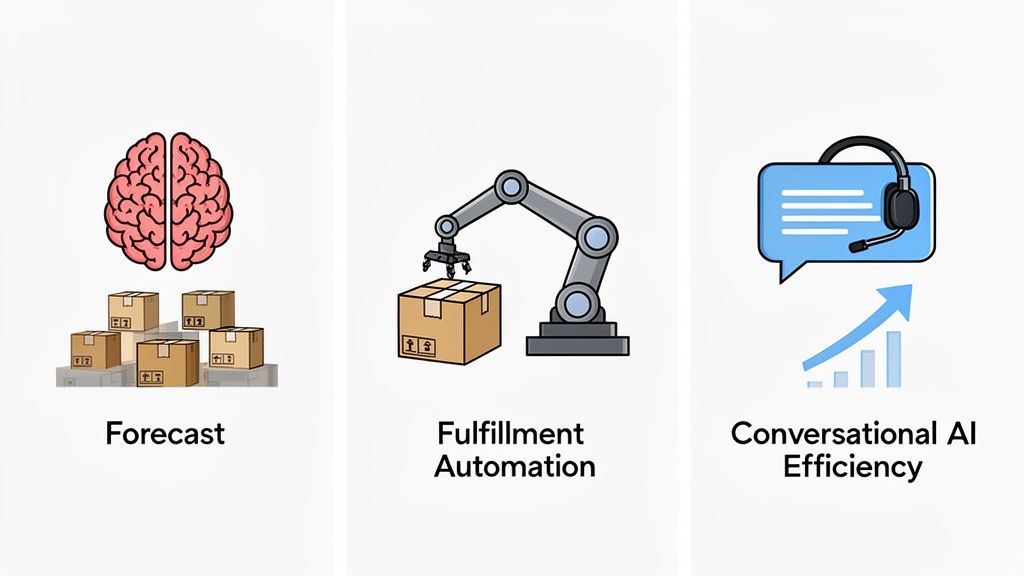
The real objective isn't just to get things done faster; it's to get them done smarter. Think of automation as a force multiplier, giving your team the space to concentrate on high-value, strategic work instead of getting bogged down by repetitive, low-impact tasks.
Smarter Inventory and Fulfilment
Let's begin with the back-end operations, an area where even small improvements can produce huge returns. Inventory management, a classic source of tied-up capital, can be radically improved with a dose of AI.
Instead of just looking at last year’s sales figures, AI-driven demand forecasting digs deeper. It analyses market trends, competitor moves, and even things like weather patterns to get a much clearer picture of what your customers will actually buy. A large European retailer used AI forecasting to reduce stockouts by up to 50%, which directly translates to recaptured revenue. This kind of precision can reduce the capital you have locked in slow-moving stock by up to 30%, freeing up cash for initiatives that actually grow the business.
Over in the warehouse, Robotic Process Automation (RPA) is perfect for taking over the monotonous jobs that are so often subject to human error. This includes tasks like:
- Automated Order Entry: RPA bots can instantly grab order information from all your channels and feed it into your main system, completely wiping out manual data entry mistakes.
- Streamlined Picking and Packing: While not full-blown warehouse robotics, RPA can optimise picking routes for your staff and generate shipping labels automatically, speeding up the entire fulfilment cycle.
- Inventory Reconciliation: These bots can constantly cross-check stock levels between your sales platforms and your warehouse management system, flagging any mismatches in real time.
The Power of Conversational AI in Customer Interactions
While back-end automation is all about efficiency, customer-facing automation is where you can create a brand experience that truly stands out. Traditional call centres often struggle under pressure, with operational costs eating up a staggering 15-20% of total revenues. This is where scalable Voice AI becomes a complete game-changer. These solutions can handle complex, multi-minute conversations naturally and scale up to thousands of calls a day without you needing to hire more people. For any leader looking to explore this, understanding the core benefits of AI in ecommerce is a fantastic place to start.
This technology is especially relevant in a market like India, where an estimated 270 million people shopped online in 2024. The tech-savvy consumer base there is perfectly primed for this kind of interaction.
For VPs and Directors, the strategic play here is clear: use automation to handle the predictable, high-volume queries so your expert human agents can focus on complex, revenue-generating conversations. This is how you scale support without scaling your headcount.
AI-powered voice and chat agents, like those from DialNexa, can automate 70-80% of all routine customer interactions. Just think about the most common questions your team fields every day: "Where is my order?" or "How do I start a return?" An AI agent can answer these questions instantly, 24/7, with 97% accuracy. A cosmetics brand using this technology reduced its average cost-per-contact from $5 to under $1.
But this isn’t just about deflecting support tickets; it’s about giving customers immediate answers while you gather valuable data. The applications go far beyond basic support, too. For example, AI agents can make automated outbound calls to confirm Cash on Delivery (COD) orders—a simple step that dramatically cuts down costly Return to Origin (RTO) rates. They can also follow up on marketing campaigns, helping to lift lead qualification rates from a typical 2% to an impressive 8%.
For a deeper dive into how this technology can be a catalyst for expansion, you might be interested in our guide on how to unlock ecommerce growth in 2024. By integrating these smart systems, you're not just fixing problems; you are building a more intelligent, efficient, and customer-focused e-commerce machine.
Your Strategic Implementation Roadmap for 2026
Turning your e-commerce operations from a collection of manual tasks into a smart, automated system is a big project. But you don't have to do it all at once. A phased approach makes the whole thing manageable and delivers value at every step. Think of this 2026 roadmap as a way to break the journey down into three clear, actionable stages, letting you build momentum and show real results along the way.
Phase 1: Audit and Quick Wins
The goal here is simple: score some immediate wins by grabbing the low-hanging fruit. This phase is all about building confidence inside your team by showing clear, measurable improvements without a massive upfront investment. It's about proving the concept works before you go all-in.
First things first, you need to conduct a proper audit of your current e-commerce processes. Dive into your analytics and find the single biggest point of friction. For most online stores, that’s cart abandonment.
From there, you can roll out simple automations that pack a punch. For instance, setting up an automated abandoned cart email sequence is a classic for a reason—it can help you recover up to 15% of otherwise lost sales. Another quick win is adding an address validation API at checkout. This tiny change can slash Return to Origin (RTO) problems caused by typos by more than 20%.
- Key Actions: Pinpoint your top 3 process bottlenecks using data. Set up basic automation for cart recovery and address verification.
- Recommended Technologies: Your existing email platform (like Mailchimp or Klaviyo) and a solid address verification API.
- Expected ROI: You should see a 5-10% bump in recovered revenue and a definite drop in shipping mistakes within the first quarter.
Phase 2: Core Process Automation
With some early successes under your belt, it’s time to get serious. Phase 2 is all about automating the operational engine of your business. The aim is to build a solid, scalable foundation that gets rid of the big inefficiencies in your day-to-day work. You’ve stopped just patching leaks; now you’re rebuilding the plumbing.
A great place to start is with a centralised inventory management system. This will synchronise your stock levels in real time across every place you sell—your website, marketplaces, and even physical shops. This one change can practically eliminate overselling and cut the carrying costs of unsold stock by 10-15%.
This is also the perfect moment to introduce AI into your customer support. Getting a conversational AI agent to handle the top 70-80% of repetitive questions like "Where is my order?" instantly frees up your human team for more complex issues. Not only does this reduce your support costs, but customers love getting instant, 24/7 answers. A global electronics company saw a 60% reduction in support agent workload within six months of implementing this.
- Key Actions: Integrate a centralised inventory platform. Deploy a Voice AI agent to automate Tier-1 customer support.
- Recommended Technologies: An inventory management system (like Unicommerce or Cin7) and a conversational AI platform like DialNexa.
- Expected ROI: Expect to cut order fulfilment errors by up to 50% and see first-response times for customer queries drop from hours to mere seconds.
Phase 3: Advanced Optimisation and AI Integration
The final phase is where you truly future-proof your operation. Here, we deploy advanced AI to create predictive and proactive strategies. The objective is to stop reacting to problems and start anticipating them, which gives you a serious competitive edge.
This is where you bring in sophisticated tools like AI-powered demand forecasting. By analysing your sales history, market trends, and even wider economic signals, these models can predict future demand with over 95% accuracy. This lets you fine-tune your purchasing, reduce excess stock, and avoid running out of popular items during peak season.
You can also automate much more complex interactions. For example, using a Voice AI agent for outbound campaigns can completely change the game. An AI agent can make thousands of calls a day to re-engage customers who haven't bought in a while or to qualify new leads, pushing lead qualification rates from a typical 2% to over 8%. At this stage, you’re not just making processes better; you’re actively creating new avenues for growth.
- Key Actions: Implement AI for demand forecasting. Use autonomous Voice AI for outbound sales and proactive customer check-ins.
- Recommended Technologies: Specialised AI forecasting software and advanced Voice AI platforms.
- Expected ROI: Increase your gross margins through smarter inventory management and open up a new stream of qualified leads, directly boosting your top-line revenue.
Your Phased Implementation Plan
To make this roadmap even clearer, we've broken it down into a table. This gives you a bird's-eye view of how to introduce automation and AI into your e-commerce operations stage by stage.
| Phase | Objective | Key Actions | Example Technologies | Expected ROI |
|---|---|---|---|---|
| One | Secure quick wins & build internal momentum | Analyse process bottlenecks, automate cart recovery, and verify addresses. | Email Marketing Platforms (Mailchimp, Klaviyo), Address Verification APIs | 5-10% increase in recovered revenue, 20% reduction in shipping errors. |
| Two | Automate core operational workflows | Integrate centralised inventory, deploy AI for Tier-1 support queries. | Inventory Management Systems (Unicommerce, Cin7), Conversational AI (DialNexa) | Up to 50% fewer fulfilment errors, instant customer support response times. |
| Three | Achieve predictive and proactive operations | Deploy AI for demand forecasting, use Voice AI for outbound campaigns. | AI Forecasting Software, Advanced Voice AI Platforms | 95% forecast accuracy, 8%+ lead qualification rates, increased gross margins. |
Following a structured plan like this removes the guesswork. You start with high-impact, low-effort tasks, prove the value, and then build on that success to create a truly intelligent and efficient e-commerce machine.
Questions We Hear from E-commerce Leaders
If you're running an e-commerce company, you're constantly asking yourself how to make things run smoother, faster, and more profitably. Getting the right answers starts with asking the right questions. Here are our direct, no-fluff answers to the most common challenges we see e-commerce executives grappling with.
Where Should I Start Automating for the Biggest, Fastest ROI?
For the most immediate impact on your bottom line, start with your post-purchase customer support. This is almost always where you’ll find the highest concentration of simple, repetitive questions that are perfect for automation.
Think about it: queries like "Where is my order?" (WISMO) or "How do I return this?" can easily make up over 70% of your support team's entire ticket volume. When you deploy a conversational AI agent to handle these 24/7, customers get instant answers, which is a massive win for their experience.
The financial logic is just as compelling. A mid-sized D2C brand handling 10,000 support tickets a month can see its operational costs drop by thousands of rupees almost overnight. At the same time, we've seen first-contact resolution rates jump by over 50%. Your human agents are then freed up to tackle the complex sales or retention issues that actually grow your business.
How Can I Get My Cart Abandonment Rate Down?
A high cart abandonment rate is a direct punch to your revenue, and it's almost always a symptom of a process problem. Fixing it isn't about one magic bullet; it's about systematically removing friction from your checkout journey.
Here's your action plan:
- Simplify Your Checkout Flow: Cut down the number of steps and fields. If you can get it all onto a single, clean page, do it. The less work it feels like, the better.
- Be Transparent with Pricing: Unexpected shipping costs or taxes are the number one killer of conversions. Show the final, all-in price as early as you possibly can. No surprises.
- Offer the Right Payment Options: In the Indian market, this is critical. Integrating UPI and popular digital wallets isn't a nice-to-have; it's a must. We’ve seen this simple change lower cart abandonment by as much as 40-50%.
- Automate Your Recovery Efforts: Don't let those abandoned carts just sit there. Set up an automated sequence of emails, SMS messages, or even a follow-up call from a Voice AI agent to bring shoppers back. This one process alone can recover up to 15% of what would have been lost sales.
My Return to Origin Rate Is Killing My Margins. Which Processes Are Broken?
A high Return to Origin (RTO) rate is a silent profit drain. It bleeds money through wasted shipping costs and locked-up inventory. When we see this problem, it almost always points to a breakdown in one of three areas.
First, look at your Order and Address Verification process. You’d be surprised how often a simple typo in an address is the culprit. Integrating an automated address validation API at checkout is a simple fix that catches these mistakes before a package ever leaves your warehouse.
Second, audit your Shipping and Communication strategy. Are you keeping customers in the loop? Proactive, automated SMS and WhatsApp notifications confirming delivery windows are essential. An automated call to confirm a customer's availability right before dispatch can be incredibly effective, especially for high-value orders.
Finally, review your Payment Options. A heavy reliance on Cash on Delivery (COD) almost always goes hand-in-hand with higher RTO rates, simply because of impulse cancellations. You can nudge customers toward paying upfront by offering small discounts for prepaid orders. It's a simple tactic that can cut your RTO rate by as much as 30%.
How Does a Platform Like DialNexa Fit into Our Existing E-commerce Processes?
The best way to think about a platform like DialNexa is not as a replacement for your current tools, but as a powerful extension of your team. It’s designed to plug directly into your existing communication workflows and supercharge them at key moments in the customer journey.
For example, in the pre-sales stage, our Voice AI can handle outbound calls to qualify thousands of leads from your marketing campaigns, helping take your lead-to-booking rate from a typical 2% all the way up to 8%. This means your sales team is only spending their valuable time on prospects who are actually interested and ready to buy.
In the post-sales stage, it connects directly to your helpdesk to automate all those high-volume support questions. For something like order verification, our Voice AI can make automated calls to confirm COD orders, which is a huge factor in reducing your RTO rate. It handles these high-volume voice tasks with 97% accuracy, letting you scale your customer communication without having to scale your headcount.
By automating the right conversations, DialNexa helps your team focus on what really matters—growth. See how our human-like Voice AI can transform your e-commerce operations by visiting https://dialnexa.com.

[…] this two-way flow of goods smoothly. To get a handle on it, you need to understand the modern e-commerce processes from click to customer and where the physical handoffs […]