
AI Virtual Assistant for Business: The 2026 CXO Playbook
In India, the question is no longer whether an AI virtual assistant for business can work. The market is already on a steep growth curve, with Fact.MR projecting 24.6% CAGR from 2025 to 2035 for India, while the broader virtual assistant services market is set to rise from USD 5.3 billion in 2025 to USD 43.4 billion by 2035 (Wishup report). That's not a novelty curve. It's a board-level signal that voice and chat automation are becoming operating infrastructure.
For Indian CXOs, the decision is sharper. Which workflow should go first, what should stay human, and what governance has to exist before the first call is automated? That framing matters because the biggest early segment is still administrative virtual assistants at 31.5% share, and SMBs account for 44.4% of the client base in the same forecast set, which shows the technology is moving into everyday operations, not just innovation labs (Wishup report). If your team is still treating this as a software purchase, you're already behind.
Table of Contents
- Why Indian CXOs Are Betting on AI Virtual Assistants in 2026
- What an AI Virtual Assistant for Business Actually Does
- The ROI Math Every Director Should Run Before Signing
- Industry-Specific Use Cases Across the Indian Economy
- Compliance and Data Privacy Considerations You Cannot Skip
- A Practical 90-Day Implementation Roadmap
- Vendor Evaluation Criteria and What to Ask on the Demo
- Common Pitfalls and the Metrics That Predict Failure
Why Indian CXOs Are Betting on AI Virtual Assistants in 2026
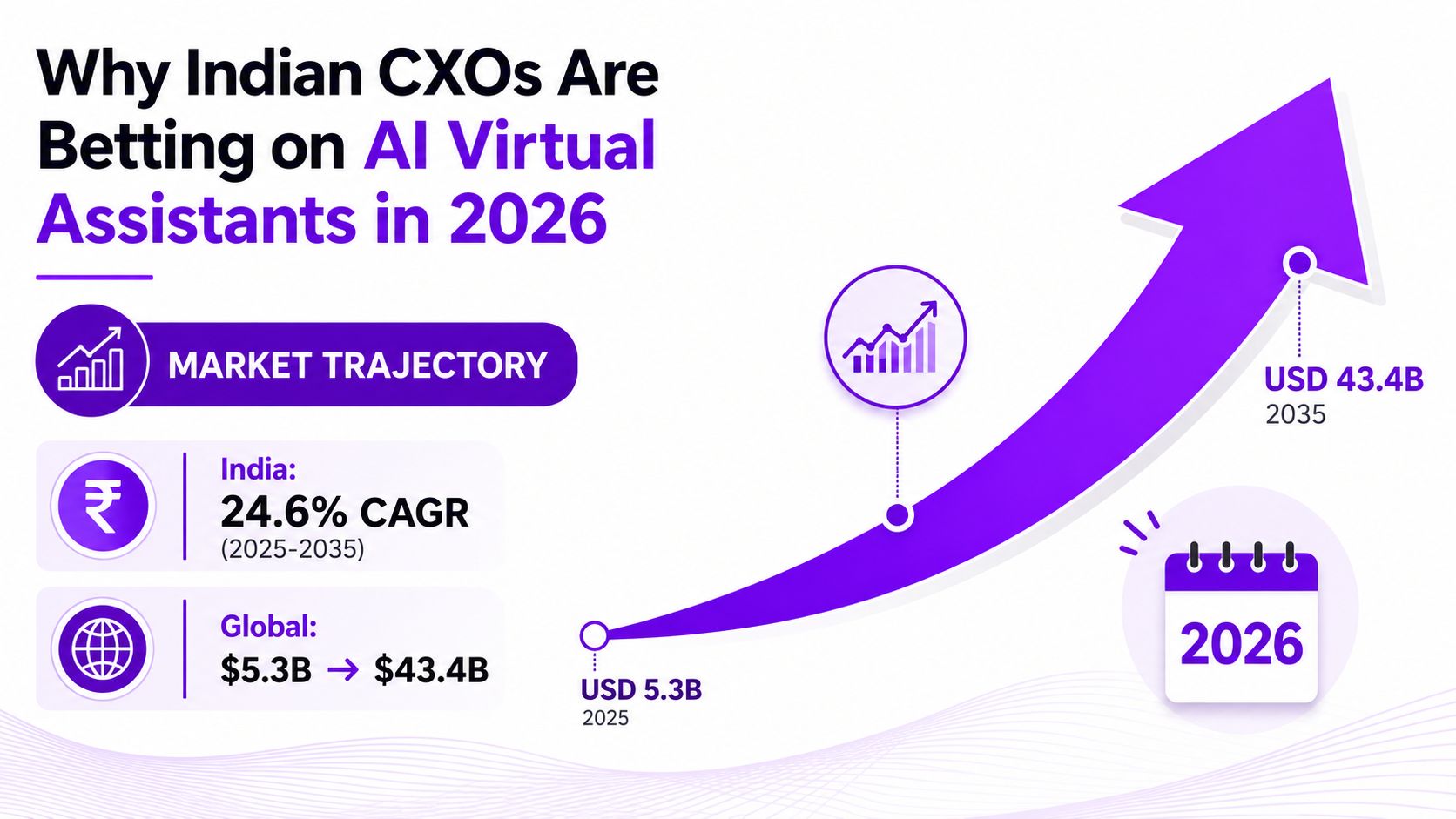
Indian CXOs are betting on AI virtual assistants because call volume, service expectations, and labour cost are colliding at the same time. The operational pressure is real in banking complaints, job-seeker queries, healthcare access, and routine service requests across large customer bases. Analysts at Wishup report note that the category is moving from support tooling into mainstream operations, and A growth chart showing the market trajectory for AI virtual assistants in India from 2025 to 2035. makes the direction obvious, sustained adoption is now the default case, not the exception.
That matters because the first deployment is usually the least glamorous and the most valuable. Use AI virtual assistants to absorb repetitive work, answer routine questions, route callers correctly, capture intent, and reduce the load on front-line teams. The right starting point is not a broad transformation pitch. It is a queue with high volume, low complexity, and clear escalation rules.
What this means for leadership
The smartest buyers in India are not purchasing a product, they are redesigning a process. They start with the work that burns agent time every day, then decide which parts should be automated, which parts should stay human, and which parts need audit controls before any automation goes live. For teams that need a practical view of voice-led deployment in India, this India-focused voice AI overview is useful context.
That sequencing matters because generic assistants fail fast in Indian operations. Code-switching, regional language variation, noisy calls, and mixed intent are normal, not edge cases. If a vendor cannot handle those conditions, the deployment will look cheap in the demo and expensive in production.
Practical rule: deploy first where the workflow is repetitive, high-volume, and measurable. Defer emotionally charged cases, exception-heavy workflows, and anything that needs strict human judgment until the controls are proven.
Large enterprises should read the market signal carefully. Adoption is starting in the parts of the business where the payoff is easiest to measure, then spreading into adjacent workflows once the team trusts the assistant. That is why the key question is not whether to buy an AI virtual assistant for business. The main question is which process should be automated first, which service levels should be protected by escalation, and which metrics will prove the investment is paying back.
What an AI Virtual Assistant for Business Actually Does
A serious assistant is not a FAQ page with a voice. It behaves more like a trained front-office employee who can listen, interpret, remember, act, and respond. If one of those layers is missing, you don't have an operational tool. You have a scripted bot.
The five-layer model that CXOs should use
The first layer is the ear, which means speech recognition and text capture. The assistant has to hear spoken language accurately, including noisy calls and mixed phrasing, or the rest of the stack fails. The second layer is the brain, which identifies intent and extracts what matters from the conversation.
The third layer is memory, which preserves context across turns. That matters in real business calls because customers don't speak in neat one-question sessions. They interrupt themselves, change topics, and refer back to earlier details.
The fourth layer is the hands, meaning workflow execution. A useful assistant doesn't just answer, it updates CRM records, books appointments, creates tickets, or triggers follow-up tasks. The fifth layer is the voice, which sends the response back naturally, ideally in the language or language mix the caller is already using.
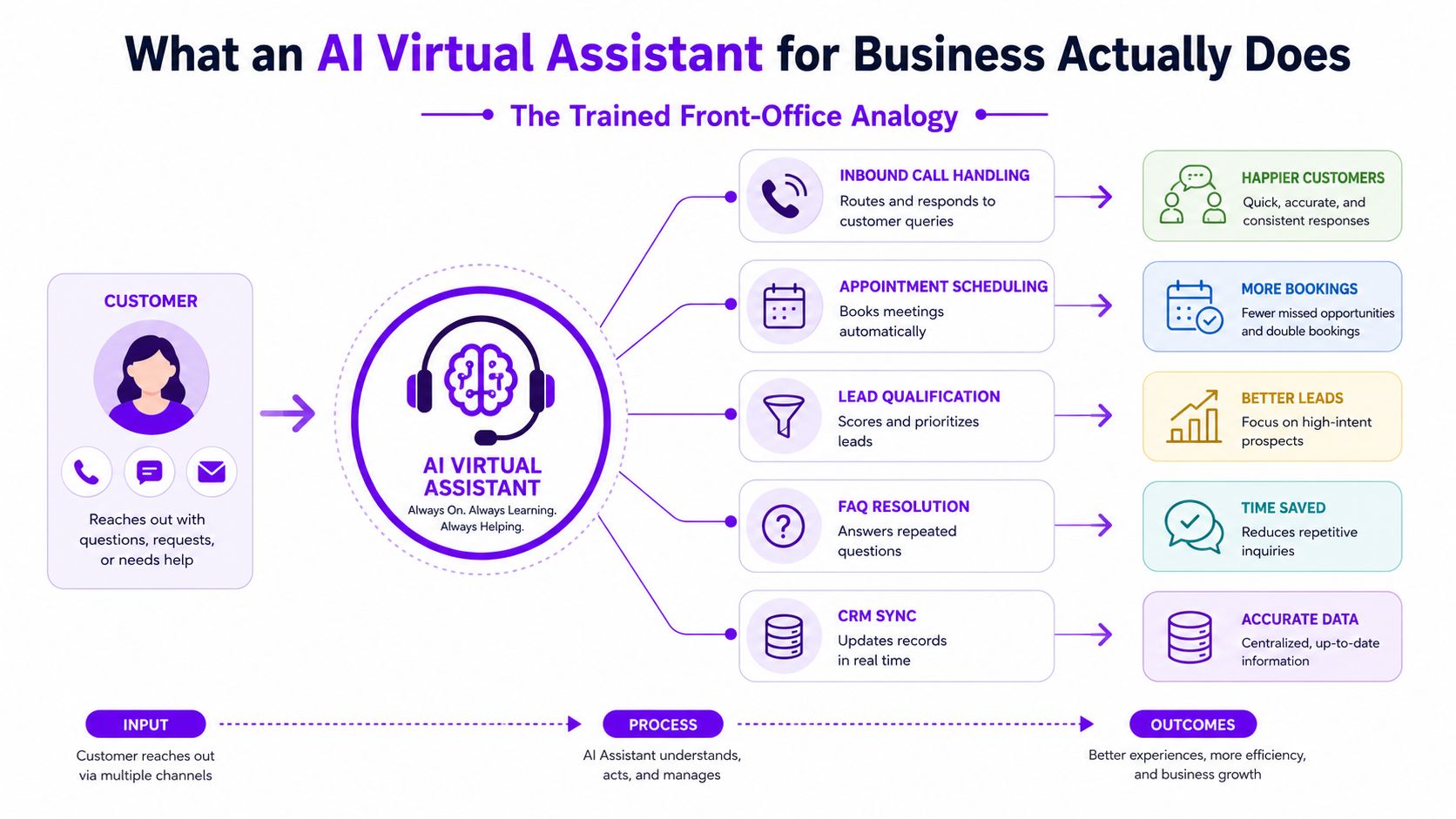
The distinction that matters is simple. A FAQ bot answers a static question. A real assistant handles a multi-turn flow, keeps context, escalates cleanly, and logs the outcome so the business can act on it later. That's why vendor demos that only show polite answers are useless.
Don't buy a conversation engine that can't complete an action. A response without a workflow is just a nicer script.
For Indian enterprises, the architecture has to include NLP, ASR, CRM integration, calendar integration, ticketing, knowledge-base access, workflow orchestration, context management, and analytics (NICE platform overview). That combination is what moves the assistant from a support layer to an operational system.
If you want a simple test, ask whether the assistant can finish the job without a human handoff. If it can only route calls, it's helpful. If it can qualify, book, update, and escalate in one flow, it's strategic. For a more technical primer, this conversational AI explainer is a useful reference.
Teams that want to measure whether an assistant is actually understanding intent, sentiment, and outcome across thousands of calls should also review this guide to conversation intelligence, which explains how that analysis layer turns raw transcripts into operational insight.
The ROI Math Every Director Should Run Before Signing
Most AI purchase decks are too vague to trust. “Efficiency gains” is not a business case. The only question that matters is how much each interaction costs today, how much volume the assistant can absorb, and where payback begins.
According to an analysis by ArticSledge business analysis, AI virtual assistants can handle 60–80% of routine business queries automatically, cut support costs by 30–70%, and reduce cost per interaction from USD 8.01 per human-only interaction to USD 0.70 with AI. The same source also points to about 2.4x productivity gains for teams using AI virtual assistants.
The boardroom math
Run that math against your own volumes, not a vendor slide. If your operation sits on repeated reminders, qualification calls, complaint intake, or status checks, the economics move fast because every one of those interactions consumes the same agent time as a higher-value conversation.
| Metric | Human Baseline | AI-Assisted | Improvement |
|---|---|---|---|
| Cost per interaction | USD 8.01 | USD 0.70 | Lower operating cost |
| Routine query handling | Human-led | 60–80% automated | Higher containment |
| Support cost | Baseline | 30–70% reduction | Material cost compression |
| Team output | Human-only | 2.4x productivity gains | More work per agent |
Juniper Research also estimated in September 2024 that chatbots and AI assistants would save businesses USD 11 billion annually by 2028, up from USD 6 billion in 2024, by reducing customer-service time by 2.5 billion hours globally. That is not a niche productivity story. It is a labour-absorption story, and for Indian enterprises that means one thing, deploy the assistant where call volume is high, language is messy, and repeat intent is predictable.
The India-specific test is harsher than most vendor demos admit. RBI complaint queues, NCS-style job-seeker volume, and healthcare access bottlenecks all create the same operational pattern, too many inbound queries, too few trained handlers, and too much variation in language and code-switching for a manual model to stay efficient. A generic bot that handles scripted English but fails on mixed Hindi, Tamil, Marathi, or Hinglish is a cost centre, not an efficiency play.
Where to deploy first
Start with work that is repetitive, measurable, and already expensive. Qualification, reminders, support triage, and follow-up calls belong first. If the process depends on emotional judgement, policy discretion, or regulatory nuance, keep the human in the loop and automate the preparation, collection, and routing layers.
That order matters. Directors should deploy first where the assistant can complete a clean workflow with low risk of harm and high call repetition. They should defer high-stakes conversations until the model proves it can handle context, escalation, and multilingual variation without creating rework.
For a vendor-side view of call-centre automation economics, this AI call centre agent guide is a sensible companion. The core decision for a director is simple. Buy the deployment that clears payback on live volume and operational clarity. Reject the one that only sounds intelligent in a demo.
Industry-Specific Use Cases Across the Indian Economy
India does not need more generic AI chatter. It needs assistants placed on the right queues, with the right language coverage, and a clear handoff when the conversation stops being routine. The strongest use cases share the same economics, high call volume, repetitive intent, and a next action that can be defined in advance.
Six workflows that belong on the shortlist
EdTech admissions is often the cleanest first deployment. A voice agent can open with a direct qualifier, ask which programme the caller wants, check start timing, and then collect eligibility, fee sensitivity, and preferred callback time before routing hot leads to counsellors.
BFSI collections and KYC guidance demand tighter controls. The assistant should verify identity, explain the next step, and push sensitive cases to a human fast. Support and complaint triage in this sector should be structured because the volume of inbound issues is high and the cost of a wrong response is real.
Real estate works well when the assistant handles first-level discovery. “Are you looking to buy, rent, or invest?” is the right opening. If the caller shares budget, location, and move-in window, the assistant can book a site visit and update the CRM immediately.
E-commerce needs transactional precision. For COD verification and order status, the assistant should ask for the order ID, confirm the phone number, and answer directly. If the customer raises a dispute, escalation should happen at once.
SaaS onboarding and ticket triage fit hybrid workflows. The assistant can confirm account type, route integration questions, and create a ticket with the right priority. That keeps support engineers out of basic onboarding loops and frees them for work that needs judgment.
Healthcare appointment booking is the most operationally sensitive use case here. Routine reminders, confirmations, and pre-visit questions belong with the assistant, while clinical judgment stays with the human. India's access constraints make that split practical, because staff time should go to patients who need attention, not to repetitive scheduling calls.
Recruitment is another area where volume forces automation. The Ministry of Labour and Employment's National Career Service portal shows the scale of screening, follow-up, and status communication that has to happen for job seekers and employers every day (Vibe guidance on AI virtual assistants). The point is not to replace recruiters. It is to stop them wasting time on repetitive coordination and keep the pipeline moving.
One more point matters for India and too many vendors ignore it. If the assistant cannot handle mixed-language speech, code-switching, and local phrasing, it will fail on the first real queue it touches. That is why enterprise teams should deploy first where intent is repetitive and language variation is already understood, then expand only after the assistant proves it can route cleanly across Hindi, Tamil, Marathi, Hinglish, and other common combinations.
Compliance and Data Privacy Considerations You Cannot Skip
A voice assistant is not just a workflow tool. It is a data-handling system, and in India that changes the shortlist immediately. If legal, security, and operations are not aligned before launch, the project will create risk faster than value.
Where the pressure sits
The RBI Ombudsman's complaint volume is the clearest reminder that BFSI voice automation cannot be sloppy. The system received 8,92,828 complaints in 2023-24, and the largest pressure areas included mobile and electronic banking at 36.38% and loan and advances at 15.37% (Microsoft business insights). Those are exactly the areas where customers expect speed, but regulators expect precision.
Compliance maturity matters because India's conversational AI market was valued at about USD 575 million in 2025 with 17,700 active enterprise deployments, which means the market is already past the novelty stage (Ken Research summary). The differentiator is governance, not the pitch deck.
A proper review should cover consent, retention, auditability, PII redaction, escalation policy, and what happens when the assistant encounters a sensitive intent. If the vendor cannot explain where recordings live, who can access transcripts, and how a human override works, the solution is not ready.
For a practical privacy baseline, Charter Oak Strategic Partners privacy is a useful reminder that policy pages matter when vendors claim to handle sensitive customer data. For the regulatory shift in the voice-AI environment, this India compliance overview should sit on the same reading list as your internal legal memo.
Five checks to hand to legal and security
- Consent capture: confirm how opt-in is recorded and where it is stored.
- Retention rules: define how long audio, transcripts, and metadata stay accessible.
- PII controls: require redaction for account numbers, IDs, and sensitive personal details.
- Human escalation: map the exact trigger for transfer on regulated or emotional issues.
- Audit trail: verify every action the assistant takes is logged for review.
A compliant assistant is not one that avoids risk entirely. It is one that makes every risk visible, reviewable, and stoppable.
If the vendor talks only about better customer experience, they are missing the point. In regulated Indian operations, compliance is part of product design, not a legal afterthought.
A Practical 90-Day Implementation Roadmap
A 90-day deployment only works if the internal owner treats it like an operations rollout, not a tech experiment. The fastest route is narrow scope, tight measurement, and a hard go or no-go gate.
The rollout sequence
Weeks 1 to 2 should lock the workflow, baseline metrics, and owners. Pick one queue, then define containment rate, average handle time, and lead-to-booking or resolution rate before any build starts.
Weeks 3 to 4 should cover persona design, CRM integration, knowledge-base setup, and escalation logic. If the assistant cannot update systems cleanly, the pilot will produce vanity conversations instead of usable outcomes.
Weeks 5 to 6 is the decision point. Run a controlled pilot on 5 to 10% of call traffic, compare it against human baselines, and make a hard go or no-go call. If containment is weak or escalations are messy, stop and fix the design.
Weeks 7 to 12 should focus on ramp-up, tuning, and review discipline. Expand traffic carefully, refine handoff rules, and review the queue weekly with operations, not just the vendor.
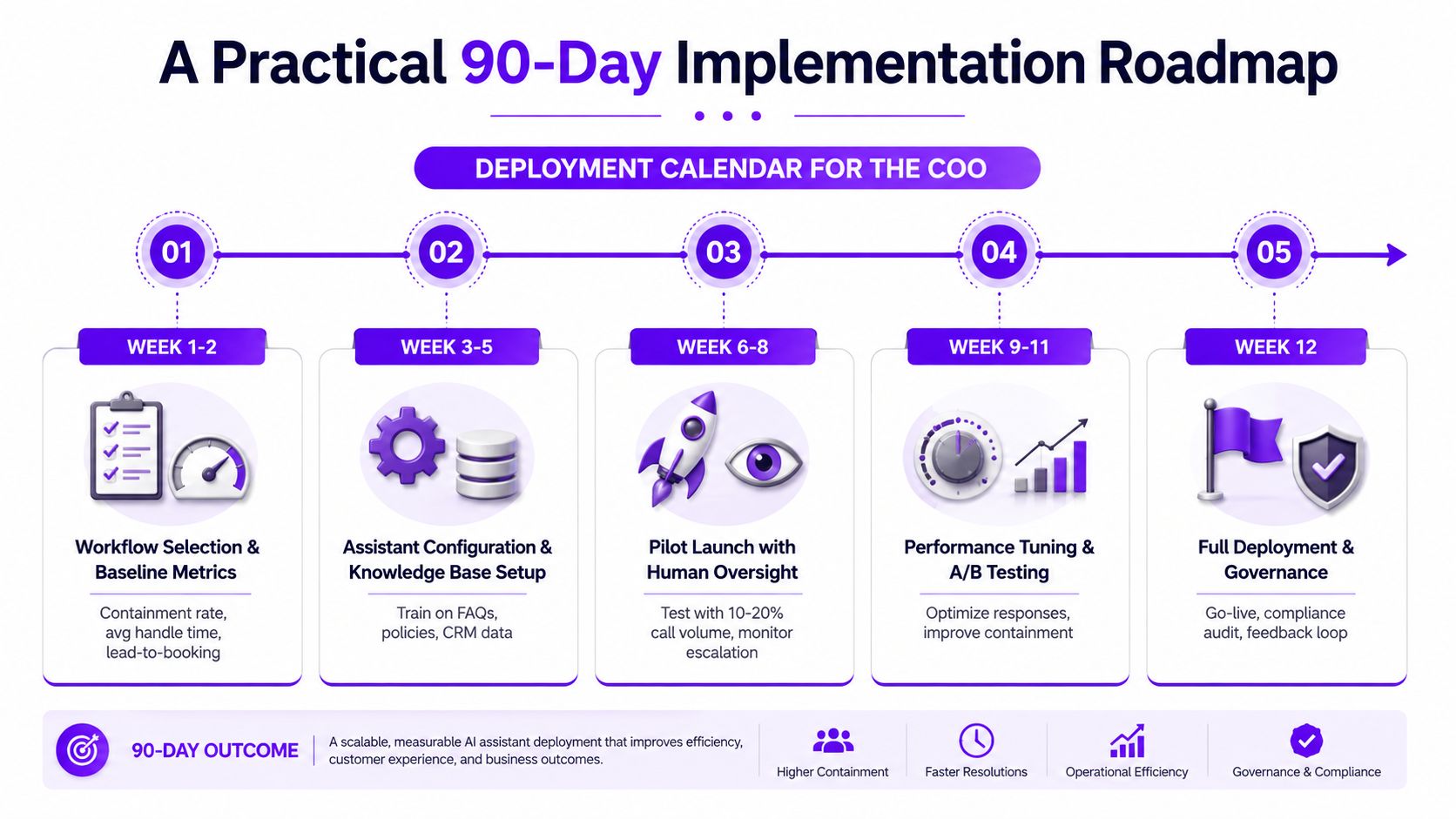
For teams that want a broader framework, this practical AI implementation roadmap is a useful companion. The common failure mode is simple. Teams launch without designing human handoff first, then spend the next month cleaning up bad escalations.
For a technical checklist on rollout dependencies, this hardware and software requirements reference can help internal teams align earlier. The COO's job is to force the project to prove itself quickly, not to let it drift into endless tuning.
Vendor Evaluation Criteria and What to Ask on the Demo
A vendor demo should feel like a stress test, not a presentation. If the supplier can't survive your real scripts, your real languages, and your real escalation scenarios, they're not ready for production.
Scorecard for the shortlist
Weight the evaluation around what affects outcome. ASR accuracy on Hindi-English code-switching and 10+ Indian languages matters because Indian callers rarely stay in one language. CRM and calendar integration depth matters because action without system updates creates rework. Escalation design matters because a bad handoff breaks trust.
Also test latency, pricing transparency, support responsiveness, security posture, SOC 2 or ISO 27001 evidence where relevant, DPDP readiness, and whether the platform can scale to thousands of daily calls without falling apart. The final criterion is simple, whether the vendor can show proven operational scale rather than a lab demo.
Ask these questions in the demo:
- Language handling: “Show me the assistant handling a mixed Hindi-English real estate enquiry.”
- Action execution: “Book a site visit and update the CRM without manual re-entry.”
- Escalation: “Transfer the caller when budget, urgency, or ambiguity crosses a threshold.”
- Compliance: “Show me transcript retention, access controls, and audit logs.”
- Throughput: “What happens when call volume spikes?”
Use a live script, not a canned one. For example, ask the assistant, “I'm looking for a 2BHK in Noida next month, but I may also consider rent first. Can you share options and book a callback?” Then watch whether it qualifies, records, and routes.
What to score
| Criterion | What good looks like |
|---|---|
| Indian language handling | Comfortable with code-switching and regional variety |
| Workflow depth | Creates, updates, and closes tasks in connected systems |
| Escalation design | Handoffs are clean and context-rich |
| Latency | Responses feel natural, not delayed |
| Compliance posture | Clear data, retention, and consent controls |
| Pricing | Transparent usage and implementation terms |
| Support | Fast, practical vendor response |
| Security | Clear certifications and access controls |
| Scalability | Proven ability to handle high daily call volume |
If you want one operational platform to evaluate alongside others, DialNexa Labs Private Limited provides voice AI agents for qualification, support, recruitment, and presales workflows, with CRM-connected call handling and configurable personas for business conversations. Keep it in the shortlist only if it survives your language, escalation, and compliance tests on the demo call.
Common Pitfalls and the Metrics That Predict Failure
Three mistakes kill these projects early. The first is over-automating emotionally loaded calls, especially loan defaults, bereavement, or grievances. When that happens, repeat calls rise and trust drops fast, so watch for a repeat-call rate above 18% as a warning signal.
The second is ignoring code-switching and forcing single-language flows. That failure usually shows up early as a containment rate below 55% in week 4. If the assistant can't handle the way your customers speak, the pilot is already broken.
The third is treating human handoff as an afterthought. That creates rising average handle time even while automation appears to increase, because agents spend time repairing broken conversations. The fix is straightforward, design the transfer path first, then build the assistant around it.
If a metric gets worse as automation rises, the workflow design is wrong. Don't defend the pilot, change it.
DialNexa Labs Private Limited builds voice AI agents for business conversations across qualification, support, recruitment, and presales. If you're evaluating an ai virtual assistant for business in India, visit DialNexa Labs Private Limited to review how a deployment-oriented approach can fit your workflows, escalation rules, and compliance requirements.

This is a very insightful breakdown of how AI virtual assistants are transforming customer service and business operations.
I especially like the focus on practical use cases, ROI, multilingual support, and compliance for Indian enterprises.
ward-thinking perspective on how AI virtual assistants are evolving from simple support bots into intelligent business infrastructure. The focus on multilingual conversations, workflow automation, and human-AI collaboration makes this approach truly innovative.
A very insightful breakdown of how AI virtual assistants can improve efficiency, ROI, and customer experience across Indian industries. The practical use cases, compliance considerations, and 90-day implementation roadmap make this especially valuable for CXOs.
A timely and insightful guide on how AI virtual assistants can support modern business operations and CXO decision-making.
The practical strategies provide useful ideas for improving productivity, customer engagement, and workflow efficiency.
This is a clear and practical guide that explains how AI virtual assistants can reduce repetitive workloads while improving customer service across Indian industries.
The focus on ROI, multilingual needs, workflow automation, and human escalation makes the article especially useful for CXOs evaluating AI adoption.