
Compliance in bank: A Strategic Guide for Modern Leadership
At its heart, bank compliance is the web of laws, regulations, and internal policies that dictate how a financial institution does business. It's the framework that ensures banks operate ethically and safely, protecting not just customer assets but the stability of the entire financial system. For any senior leader, the first step is to stop seeing compliance as a cost centre and start treating it as the strategic asset it truly is.
Why Bank Compliance Is a Strategic Advantage, Not Just a Cost
Let’s be honest. For many executives, the word "compliance" brings to mind restrictive red tape and ever-increasing operational costs. It can feel like a necessary evil—a checklist to get through just to keep the regulators happy.
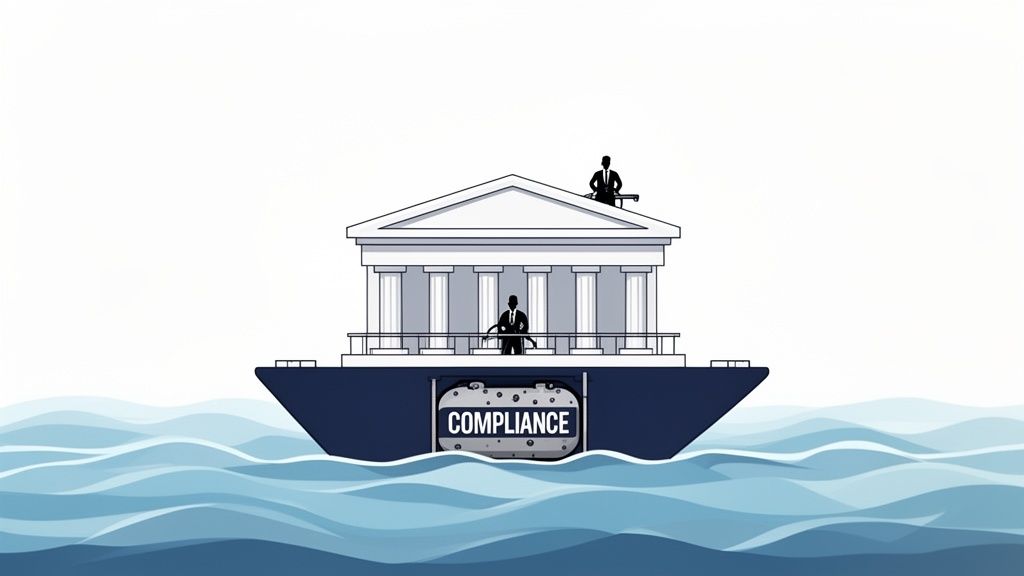
But that perspective misses the bigger picture. It overlooks the immense strategic value that a solid compliance framework brings to the table. It’s time to reframe compliance in bank operations not as an anchor holding the business back, but as the ballast that keeps the ship steady in turbulent waters.
Just like a ship's ballast provides the stability needed to navigate rough seas and protect its cargo, a strong compliance programme creates the foundation for sustainable growth. It gives your institution the confidence to chase ambitious goals, launch new products, and expand into new markets, knowing you're shielded from devastating risks.
The True Purpose of a Compliance Framework
When you boil it down, compliance performs three critical functions that directly influence your bottom line and market standing. A well-designed compliance strategy isn't about blindly following rules; it's about actively protecting and building the value of your institution. A forward-thinking approach is built to:
- Protect the Institution: Effective compliance is your first line of defence against crippling fines, drawn-out legal battles, and operational chaos that can follow a regulatory misstep. A well-publicised multi-million dollar fine for an AML breach doesn't just hurt the balance sheet; it damages shareholder confidence for years.
- Safeguard Customers: By strictly adhering to KYC (Know Your Customer) and data privacy rules, you build something priceless: trust. You show clients their money and personal information are secure with you. In an era of constant data breaches, demonstrating robust security is a powerful differentiator that attracts and retains high-value clients.
- Preserve Financial System Integrity: Your bank doesn't operate in a vacuum; it's a crucial part of the broader economic ecosystem. Robust anti-money laundering (AML) and counter-terrorist financing (CTF) controls are essential for preventing illicit funds from poisoning the system, which reinforces the stability of the entire financial sector.
From Cost Centre to Competitive Edge
When you start looking at compliance through a strategic lens, it stops being a reactive headache and becomes a proactive business driver. A properly integrated compliance function is a genuine source of competitive advantage.
Consider the practical example of a large European bank expanding its trade finance operations into Asia. Their robust, tech-driven sanctions screening system, initially built for compliance, became a key selling point. It allowed them to offer clients faster, more secure cross-border transaction processing than competitors who were still reliant on manual checks. The compliance function directly enabled market share growth.
As an executive, your role is to champion a culture where compliance is understood not as a department, but as a shared responsibility integral to every business decision. This mindset is what separates industry leaders from the rest.
Ultimately, prioritising compliance in bank operations is a direct investment in your institution's future. It builds the trust needed to attract and keep high-value clients, provides the resilience to weather economic storms, and creates the secure foundation required for long-term, profitable growth.
Understanding the Indian Regulatory Maze
For senior leaders, getting a grip on the regulatory landscape isn't about memorising legal jargon. It's about seeing around corners, anticipating market shifts, and making strategic calls that keep the business safe and profitable. In India, a handful of powerful bodies dictate the rules of the game for bank compliance, and their decisions directly shape everything from product launches to your core risk management strategy.
Think of these regulators as the architects of the financial system. They lay down the blueprints every bank must follow to keep the structure stable, fair, and secure. Getting it wrong doesn't just mean a slap on the wrist with penalties; it can derail your strategic goals and seriously damage shareholder confidence.
The Key Players Shaping Indian Banking
At the top of India's financial food chain sit three crucial institutions. As a leader, your job isn't to get lost in the weeds of their circulars, but to understand their overarching purpose and how it impacts your business.
-
Reserve Bank of India (RBI): The big one. As the central bank, the RBI is the primary regulator for the entire banking sector. Its directives have a massive ripple effect, influencing everything from lending rates and liquidity to whether your new digital banking app gets the green light. For a CXO, RBI's word is law on capital adequacy and risk frameworks, directly hitting your financial planning and growth ambitions.
-
Securities and Exchange Board of India (SEBI): If your bank touches the capital markets—through investment banking, managing assets, or acting as a depository—SEBI is watching. Their rules are all about maintaining market integrity, protecting investors, and ensuring good corporate governance. This affects how you raise capital and, crucially, how you handle client investments.
-
Financial Intelligence Unit – India (FIU-IND): This is the nerve centre for flagging suspicious financial activity. The FIU-IND is on the front line in the fight against money laundering and terrorist financing. For your bank, this means their reporting requirements are a non-negotiable part of your Anti-Money Laundering (AML) programme.
What's really critical is seeing how these pieces fit together. An RBI directive on digital KYC, for instance, has a direct knock-on effect on how your teams meet FIU-IND's AML reporting standards. It's all interconnected.
From Rules to Revenue: Turning Mandates into Strategy
The real test for any executive team is moving beyond just ticking compliance boxes and turning these regulations into a genuine business advantage. Let's look at the impact of two of the biggest mandates: the Prevention of Money Laundering Act (PMLA) and the RBI's Master Directions on Know Your Customer (KYC).
For any leader looking at the big picture, it's crucial to grasp not just what these regulations demand, but how they directly influence top-line growth and bottom-line risk. The table below breaks down the key mandates and what they actually mean for strategic decision-making at the executive level.
| Regulation/Act | Governing Body | Core Objective | Key Business Implication for VPs/CXOs |
|---|---|---|---|
| Prevention of Money Laundering Act, 2002 (PMLA) | FIU-IND | To prevent money laundering and combat the financing of terrorism. | Shapes the entire risk appetite for high-value transactions and international business. A weak PMLA framework can block entry into lucrative markets like trade finance. |
| RBI Master Directions on KYC, 2016 | RBI | To establish a clear identity verification process for all customers. | Directly impacts customer acquisition costs and conversion rates. A seamless, digital KYC process is a major competitive advantage in the retail and corporate banking space. |
| Foreign Exchange Management Act, 1999 (FEMA) | RBI | To regulate foreign exchange transactions and promote orderly market development. | Governs the feasibility and profitability of all cross-border business. Missteps can lead to significant financial penalties and halt international expansion plans. |
| SEBI (Listing Obligations and Disclosure Requirements) Regulations, 2015 | SEBI | To ensure timely and accurate disclosure of information to investors. | Critical for maintaining investor confidence and a stable stock price. A breach can trigger shareholder lawsuits and intense market scrutiny. |
Simply put, these mandates are not just red tape; they are strategic guardrails. A decision to finance a major cross-border deal, for example, lives or dies on your ability to demonstrate rock-solid due diligence under PMLA. Suddenly, compliance becomes the very engine enabling global business.
Likewise, KYC is no longer about photocopying documents. It dictates the entire digital customer experience. A smooth, compliant digital onboarding process can be a powerful magnet for new customers. A clunky one? It's a one-way ticket to high drop-off rates and lost revenue.
From a leadership perspective, the question isn't "Are we compliant?" It should be, "How is our compliance framework giving us a strategic edge?" Smart, proactive investment in robust systems can speed up time-to-market for new products and build the kind of trust that keeps customers for life.
This forward-thinking approach is fast becoming essential. Indian regulators have laid out clear expectations for modernisation, with deadlines that are already impacting bank compliance programmes. Both the RBI and SEBI are pushing for a more continuous, tech-driven supervisory model. They expect banks to have risk-based internal audits, modern Compliance Monitoring Systems (CMS), and automated reporting in place. You can learn more about what RBI and SEBI expect from your compliance programme in 2025 to get ahead of the curve.
By seeing where the regulatory winds are blowing, executives can put resources in the right place, shifting the compliance function from a reactive cost centre to a strategic partner that actively drives sustainable growth.
The Pillars of a World-Class Compliance Program
Building a compliance framework isn't just about ticking boxes for regulators; it's about creating a strategic asset that protects the bank and builds trust. From the C-suite, it's crucial to see compliance in bank operations not as a cost centre, but as a core part of the business architecture. A truly effective program is built on five interconnected pillars, each one essential for a resilient defence against financial crime and regulatory blowback.
Forget a simple checklist approach. Think of these pillars as the foundational supports of a building. If one weakens, the entire structure is at risk. They have to work together as a single, cohesive system.
Governance and Oversight: The View from the Top
It all starts at the top. The first pillar, governance, sets the tone for the entire organisation. This is about establishing crystal-clear accountability, from the board of directors all the way down. This isn't micromanagement; it's about ensuring the most senior leaders understand and own compliance risk.
Your job as a leader is to champion a culture where compliance isn't seen as a roadblock, but as a vital part of every strategic move. That means appointing a strong Chief Compliance Officer (CCO) who reports directly to the board and giving them the resources and authority they need to be effective.
Practical Example: A leading global bank recently empowered its CCO by giving them veto power over new product launches. If the compliance team determined that a new investment product carried unmanageable AML risk, the CCO could halt the launch, pending further controls. This move sent a powerful message: compliance is not a suggestion box; it is a core business control function.
Know Your Customer and Anti-Money Laundering Frameworks
Next up is your KYC and AML framework—your frontline defence against illicit money poisoning the financial system. For executives, the real question is how to make these processes both iron-clad and efficient. Clinging to outdated, paper-based KYC is no longer just a compliance problem; it's a huge drag on customer acquisition and a massive operational headache.
Modern digital onboarding, for instance, can verify a customer's identity in minutes, not days. This massively improves the customer experience while creating a much stronger, more easily verifiable audit trail for regulators. It’s a win-win.
The diagram below shows the key regulators shaping Indian banking compliance. You have to keep all of them happy.
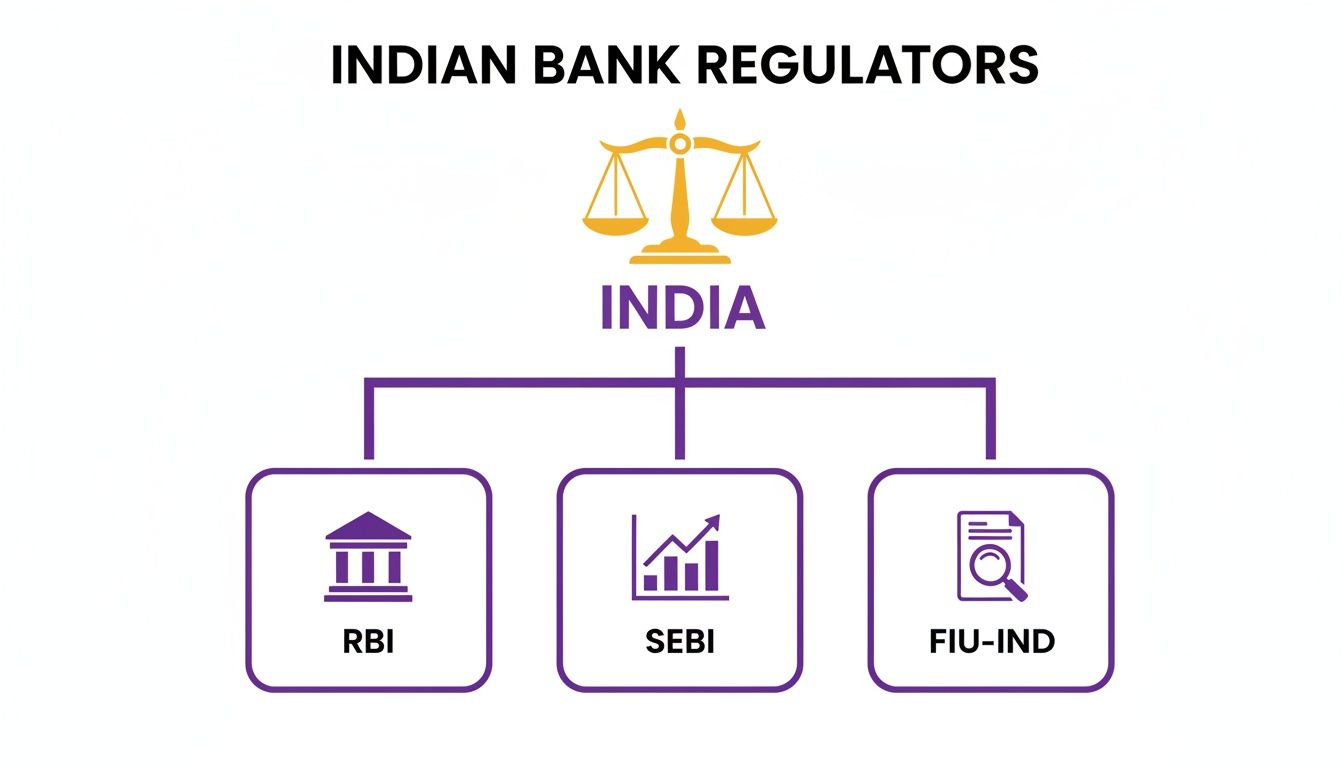
This multi-layered oversight means your strategic decisions must align with mandates from the RBI, SEBI, and FIU-IND all at once.
Transaction Monitoring and Reporting: The Digital Watchtower
The third and fourth pillars—transaction monitoring and reporting—are two sides of the same coin. Let’s be realistic: no human team can manually sift through millions of daily transactions to spot suspicious patterns. At this scale, technology isn't a luxury; it's a necessity.
Automated systems can analyse patterns, flag anomalies, and escalate high-risk activities with a speed and accuracy that's simply impossible for people. The trick is to fine-tune the system to your bank's unique risk profile. This cuts down on the "false positives" that can completely swamp your compliance teams.
Once you spot something, timely and accurate reporting to bodies like the FIU-IND is non-negotiable. This isn’t just about following the rules; it’s about being a good corporate citizen and helping maintain the stability of the entire financial ecosystem. Solid reporting builds incredible trust with regulators.
Strong monitoring and reporting depend entirely on good data. Every single action—from a flagged transaction to a submitted Suspicious Activity Report—must be meticulously documented in a tamper-proof log. To understand this better, check out our complete guide to audit logging, which explains how to maintain an immutable record for compliance.
Continuous Employee Training: The Human Element
The final pillar is the human one: continuous training. Your sophisticated tech and perfectly written policies are useless if your people don't know how to use them. A one-and-done induction session just won't cut it. Compliance training has to be an ongoing program that keeps pace with the latest regulatory changes and criminal tactics.
For leadership, the objective is to build a proactive, risk-aware culture. Training needs to be practical and tailored to specific roles, showing employees exactly how compliance impacts their day-to-day work.
- For Tellers: Training should focus on spotting red flags in face-to-face transactions, like a customer trying to break up a large deposit into smaller chunks to fly under the reporting radar.
- For Relationship Managers: Education must cover deep-dive due diligence for high-net-worth clients and understanding the money laundering risks hidden within complex corporate structures.
By investing properly in these five pillars, you shift your compliance in bank strategy from a reactive chore into a powerful business enabler. It's how you protect the institution, keep customers happy, and build a solid foundation for growth.
The Cracks in an Old System: Why Traditional Compliance is Failing
For a long time, the bank compliance playbook was simple: as the workload grew, you just hired more people. More transactions? More analysts. More regulations? More staff. But that equation doesn't add up anymore. With digital transactions exploding and regulators watching more closely than ever, that old model is officially broken.
Relying on manual checks and clunky, ageing systems has become a massive drag on financial institutions. It's not just inefficient; it's dangerous. Costs are spiralling, and the processes themselves are struggling to keep up with the sheer speed and complexity of modern financial crime.
As a leader, you're probably feeling the squeeze from all sides. The compliance budget keeps ballooning to pay for larger and larger teams who are stuck manually sifting through alerts. Meanwhile, your IT teams are spending their days patching together legacy software that was never designed for this kind of data volume.
Frankly, this way of working is completely unsustainable. The financial fallout and reputational damage from a single, major compliance slip-up can wipe out years of profit and hard-earned customer trust. The risk of missing a well-disguised money laundering ring or a sanctions breach is simply too high to leave to overworked teams and outdated tech.
The Problem with Throwing People at the Problem
The most obvious side effect of an old-school compliance approach is what I call the "headcount trap." When the only answer to new regulatory pressure is to hire another analyst, you've locked yourself into a linear growth model that eats away at your bottom line. Every new hire means more salary, more benefits, more training—turning compliance into a constantly growing cost centre.
This isn't just a theory. After several high-profile fraud cases and a clampdown on AML rules, Indian banks have been forced to dramatically increase both their compliance staff and their budgets. In fact, industry analysis shows that for mid-to-large Indian banks, compliance technology spending now accounts for a double-digit percentage of their entire IT and security budget. They're pouring money into essentials like better transaction monitoring and digital KYC just to stay afloat. You can discover more insights about these compliance spending trends from EY.
This constant, reactive spending just to keep your head above water leaves very little room for smart, forward-thinking investments.
Investing in modern RegTech is no longer an optional expense; it is a critical strategic pivot. It shifts your compliance function from a reactive, manual cost burden to a scalable, efficient, and intelligent asset that protects the institution's future.
The Hidden Dangers of Legacy Technology
Beyond the obvious strain on your budget, outdated systems create deeper, more subtle risks that can put the entire organisation in jeopardy. These old platforms are often slow, operate in silos, and simply can't provide the unified view you need to spot sophisticated financial crime patterns.
These technical shortcomings lead to serious business consequences:
- Failure to Scale: Your systems need to handle massive transaction volumes, especially during market peaks, without crashing. A legacy platform that goes down during a trading surge isn't just an IT headache; it's a huge operational and reputational failure.
- A Flood of False Positives: Old, rule-based systems are notorious for generating a mountain of false alerts. This wastes thousands of analyst hours on dead ends and, worse, creates so much noise that it's easy for a real threat to get lost in the shuffle.
- Glaring Security Gaps: Sticking with outdated software is like leaving the back door unlocked. It exposes your bank to a whole host of security vulnerabilities. For a closer look at this, learn more about how outdated software puts your business at risk.
At the end of the day, the real cost of an outdated compliance model isn't just measured in budgets or headcount. It's measured in missed opportunities and an unacceptable level of risk. Shifting to a modern, technology-first approach isn't just about becoming more efficient—it's about survival.
Using Technology for Strategic Compliance Automation
It’s clear that sticking with manual compliance processes just isn't sustainable. The real solution requires a fundamental shift in thinking—away from a reactive, people-heavy model and towards a proactive strategy driven by technology. For executives, this isn't just an IT upgrade. It's about rebuilding the core of your compliance in bank operations to be smarter, more scalable, and frankly, more affordable.
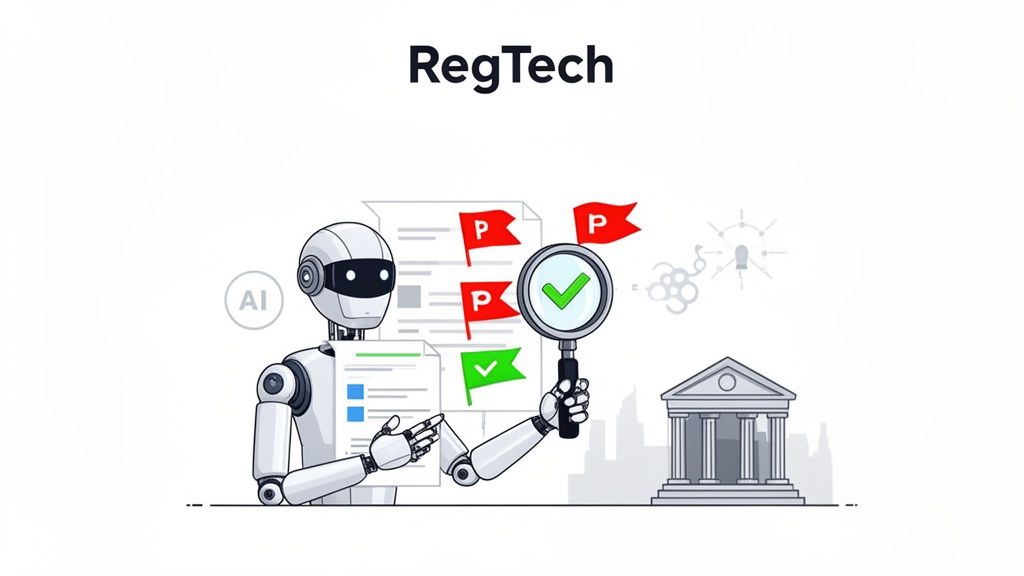
This is where Regulatory Technology, or RegTech, comes into play. By using tools like Artificial Intelligence (AI) and Machine Learning (ML), banks can turn compliance from a mountain of manual work into a highly efficient, automated function. This isn't just about working faster; it's about working smarter by catching risks that human teams might otherwise miss.
Unlocking Efficiency with Intelligent Automation
The real power of RegTech is its ability to chew through immense amounts of data with incredible speed and accuracy. Old-school, rule-based systems were notorious for creating a flood of false alarms. In contrast, AI-powered platforms can actually learn and adapt over time. They dig into transaction patterns, customer habits, and network links to find the subtle red flags that signal sophisticated financial crime.
Practical Example: A mid-sized wealth management firm implemented an ML-based transaction monitoring system. The system learned the typical investment behaviour of their high-net-worth clients. It soon flagged a series of small, unusual wire transfers from a long-standing client to a new, high-risk jurisdiction. A manual review would have missed this, but the AI saw a deviation from the established pattern, uncovering a sophisticated attempt at capital flight.
This means your highly skilled compliance officers are no longer sifting through mountains of low-value alerts. Instead, they can apply their expertise to the complex investigations that truly require human insight, adding far more value to the bank.
This focused approach pays off quickly and directly. Some financial institutions have seen false positive alerts drop by as much as 60% after bringing in AI-driven monitoring. That translates into lower operational costs and a compliance team that can actually focus on what matters.
From Cost Reduction to Customer Experience
The benefits of automating compliance go far beyond the back office. It has a real, positive impact on the customer experience, which is a major battleground in today’s competitive market. After all, one of the quickest ways to lose a high-value client is to put them through a slow, clunky onboarding process.
Technology smooths out these critical interactions:
- Faster Onboarding: Automated ID verification and digital KYC can slash onboarding times from days down to minutes. This makes a great first impression and gets new customers transacting sooner.
- Fewer Disruptions: Smart transaction monitoring means fewer legitimate customer payments get blocked by mistake, reducing friction and frustration.
- Personalised Communication: Even routine compliance touchpoints can be improved. For example, AI-powered voice agents can handle KYC update calls, providing clear instructions and gathering information efficiently, freeing up human agents for more complex issues.
Understanding how advanced tech can meet strict regulatory demands is crucial. For a closer look at how voice AI, in particular, navigates these standards, you can find some great insights in our article on regulatory compliance for Voice AI. These tools aren’t just for managing risk; they’re for delivering a better customer journey.
Demonstrating Tangible Business Value
For any CXO, the decision to invest in new tech always comes down to the return. The business case for compliance automation is strong, impacting both revenue and expenses.
The ROI is built on several key pillars:
- Reduced Operational Costs: Automation cuts down on the need for large manual review teams, directly lowering headcount-related expenses.
- Improved Reporting Accuracy: Automated systems pull information straight from the source, getting rid of the human errors that creep into manual reports and ensuring submissions to regulators are more accurate.
- Enhanced Scalability: A tech-driven compliance setup can handle a spike in transaction volume without a proportional spike in costs. This lets the bank grow without being held back by its compliance function.
- Mitigated Risk of Fines: Most importantly, a better system for spotting and stopping financial crime dramatically lowers the risk of facing massive regulatory penalties and the reputational fallout that comes with them.
By embracing smart automation, you can transform compliance in bank operations from a necessary cost centre into a driver of efficiency, a better customer experience, and a strong foundation for secure growth.
An Executive Checklist for Compliance Excellence
Effective bank compliance isn’t just about oversight; it’s about strategic engagement from the very top. For directors and the C-suite, the conversation needs to move beyond the nitty-gritty operational details. The real focus should be on the big-picture questions that test the resilience, scalability, and strategic value of the entire compliance function.
This checklist is designed to help you, as a leader, probe the right areas. It’s about ensuring your compliance programme isn't just a defensive measure, but a genuine asset that's ready for what's next. It’s time to shift from passive review to active strategic management. These questions aren’t about daily tasks—they're about the long-term health of your compliance framework.
Assessing Your Strategic Foundation
The strength of any compliance programme is directly tied to how well it’s woven into the core business strategy. If your compliance department operates in a silo, you're running a reactive—and therefore vulnerable—institution.
- Culture and Governance: How are we actively building a company-wide culture of compliance? More importantly, can we see clear evidence of this culture influencing business decisions at every level?
- Board-Level Accountability: Does our board have a direct, unfiltered line to the Chief Compliance Officer? How are we actually measuring the effectiveness of our governance and oversight?
- Risk Appetite Alignment: Is our official compliance risk appetite statement just a document on a shelf? Or is it a living guide that genuinely shapes our strategic moves, from launching new products to entering new markets?
Evaluating Technological and Operational Readiness
In a world of ever-increasing transaction volumes and regulatory pressure, technology is the backbone of a modern compliance function. An outdated tech stack isn’t just inefficient; it's a major institutional risk.
A truly effective compliance function must be built to handle tomorrow's transaction volumes, not just today's. Scalability isn't a feature; it's a prerequisite for survival and growth in the current financial landscape.
Answering the following questions will reveal whether your technology is helping or hindering your efforts.
Future-Proofing Your Compliance Tech Stack
- Scalability for Growth: Can our current compliance tech genuinely support our five-year growth plan without needing a complete, disruptive overhaul?
- Automation ROI: How are we measuring the return on investment from our automation tools? Are we tracking concrete metrics like fewer false positives, reduced manual review hours, and faster customer onboarding?
- Data Integrity: Do we have a single source of truth for compliance data? Or are critical insights still fragmented across different, siloed legacy systems?
- AI and ML Integration: Are we actively exploring or already using AI and machine learning? The goal should be to move beyond simple rule-based alerts to more predictive, behaviour-based risk detection.
By consistently asking these strategic questions, leaders can steer their bank's compliance function away from being a mere cost centre. It can and should evolve into a dynamic, intelligent operation that not only manages risk but also actively supports the institution's long-term success and leadership in the market.
Frequently Asked Questions
When you're navigating the intricate world of bank compliance, a few key questions always bubble up to the surface, especially at the leadership level. Here are some straightforward answers to the questions we hear most often from VPs, Directors, and CXOs who are trying to align compliance with real business growth.
How Can We Measure the ROI of Our Compliance Technology Investments?
Thinking about the return on your compliance tech? It's much more than just the fines you've dodged. For the C-suite, the real proof is in the numbers. Look at the reduction in manual work, measured in the actual hours your team gets back.
Another huge win is seeing a drop in false positives from your transaction monitoring. That's a direct boost to efficiency. Quicker customer onboarding also means you're generating revenue faster, and being audit-ready on demand slashes preparation costs. When you track these metrics, you're not just justifying a cost; you're building a solid financial case for smart investment.
What Is the Biggest Mistake Banks Make in Their Compliance Strategy?
Hands down, the most common pitfall is treating compliance like a separate, reactive department that just ticks boxes. When it's siloed away from the rest of the business, it becomes a source of friction and can't keep up with new threats.
The best strategies weave compliance right into the fabric of the business—from product development and market expansion to the technology roadmap. This isn't about putting the brakes on; it's about building a proactive culture of integrity that supports growth.
A proactive compliance culture isn't just about playing defence. It's about giving your business the confidence to chase ambitious opportunities, knowing a strong risk framework is already in place.
How Does AI Improve Compliance Without Introducing New Risks?
The real power of AI in compliance is its ability to bring consistency and scale to your operations. Think about it: an AI system can screen thousands of transactions against a complex web of rules in seconds. A human team could never match that level of scrutiny.
Of course, you have to manage the risks that come with the technology itself. The key is a solid governance framework. This means regularly validating your models, testing for bias, and always keeping a human in the loop for those critical, nuanced decisions. It’s the perfect blend of AI’s power and essential human judgment.
At DialNexa, we know that balancing efficiency and compliance is a high-stakes game. Our human-like Voice AI agents can handle routine compliance communications, like KYC follow-ups, freeing up your experts to focus on the high-value strategic work that truly matters. Discover how DialNexa can support your BFSI operations.

Excellent insight on reframing compliance as a strategic enabler rather than a regulatory burden. The focus on RegTech, automation, and customer trust clearly shows how strong compliance frameworks create resilience, efficiency, and long-term competitive advantage for banks.