
A CXO Guide to Automated Customer service in India
For business leaders across India, inefficient customer service has become more than a minor annoyance. It's a multi-trillion rupee problem that's actively draining profitability. By bringing in technology like AI to manage common customer queries, automated customer service frees up your human agents to tackle the truly complex issues. This turns your support team from a cost centre into a genuine strategic asset.
The High Cost of Outdated Customer Service in India
In a market as competitive as India's, the price of sluggish customer support isn't just a few unhappy callers. It's a direct and massive drain on national productivity and your company's bottom line. When customers are left waiting, the whole economy takes a hit.
The scale of this problem is genuinely staggering. A recent report found that in 2023, Indians collectively spent over 15 billion hours on hold, just waiting for a customer service agent. This lost time translates into an economic hole of roughly ₹4.5 trillion, impacting major sectors from banking and e-commerce to education technology.
This isn't just an operational snag. It’s a strategic crisis.
From Nuisance to Boardroom Emergency
For anyone in the C-suite, these numbers should set off alarm bells. Every hour a potential customer or an existing client spends stuck in a confusing phone menu is an hour they aren’t spending with your products or services. That lost time directly chips away at your profits and tarnishes your brand's reputation in a market where loyalty is incredibly thin.
Think about what this really means:
- Direct Financial Drain: That ₹4.5 trillion figure isn't abstract. It represents real economic activity, wages, and potential business that simply evaporated while people were waiting.
- Eroding Customer Loyalty: In India, two-thirds of consumers say they’ll walk away from a brand after just one bad service experience. Your outdated systems are practically gift-wrapping your customers for your competitors.
- Operational Inefficiency: Your support team is likely bogged down with manual, repetitive tasks. This keeps them from focusing on the high-value work that actually builds relationships and solves complex problems.
This operational drag points to a much deeper problem. As we've covered before, the risks of outdated software go far beyond customer frustration, creating security vulnerabilities and hindering your company's ability to adapt.
The conversation has well and truly shifted. Automated customer service is no longer some futuristic idea; it's a fundamental business strategy. It's your best defence against lost productivity and the sharpest tool for gaining a real competitive advantage.
The challenge for today's leaders is straightforward: evolve past legacy support models or prepare to be left behind. AI-powered solutions are essential for clawing back that lost productivity, rebuilding customer loyalty, and turning your service department into an engine for growth. This is no longer just a tech upgrade—it's a strategic imperative for any organisation with its eyes on the future.
The Tools of the Trade: A Look Inside the Automated Service Tech Stack
To get automated customer service right, we need to look under the bonnet and understand the tools at our disposal. This isn't about chasing the latest shiny object; it’s about strategically picking the right technology for the right job. The journey from clunky, old-school systems to genuinely smart AI is a massive leap, and knowing the difference is key to a solid investment.
Think of it as a ladder of intelligence. Each rung offers different capabilities. You start with simple, rule-based systems and climb towards sophisticated AI that can hold a real conversation. Let's break down the main players.
The Foundation: Interactive Voice Response (IVR)
We've all been there. You call a company and hear, "Press 1 for sales, Press 2 for support." That’s an Interactive Voice Response (IVR) system. It’s the original automation tool, acting like a telephone flowchart. It guides callers down a pre-set path.
While IVR is a low-cost way to sort incoming calls, its inflexibility is its biggest flaw. If a customer has a question that isn't on the menu, they hit a dead end, get frustrated, and frantically start pressing zero to find a human. While modern IVRs are better, they're still stuck in that rigid, rule-based world.
The Next Level: Intelligent Chatbots
Chatbots are the next step up. The first ones were basically text-based IVRs, following simple scripts. But with the advent of AI and Natural Language Processing (NLP), they’ve become much smarter. Now, they can actually understand what a customer is asking, pull up answers to common questions, and even handle basic tasks like checking an order status.
The real game-changer with AI-powered chatbots is their 24/7 availability and massive scale. They can handle thousands of chats at once without breaking a sweat, something no human team could ever do. For customers, that means no more waiting in line for simple queries.
This is critical because sticking with outdated, human-only models comes with a hefty price tag.
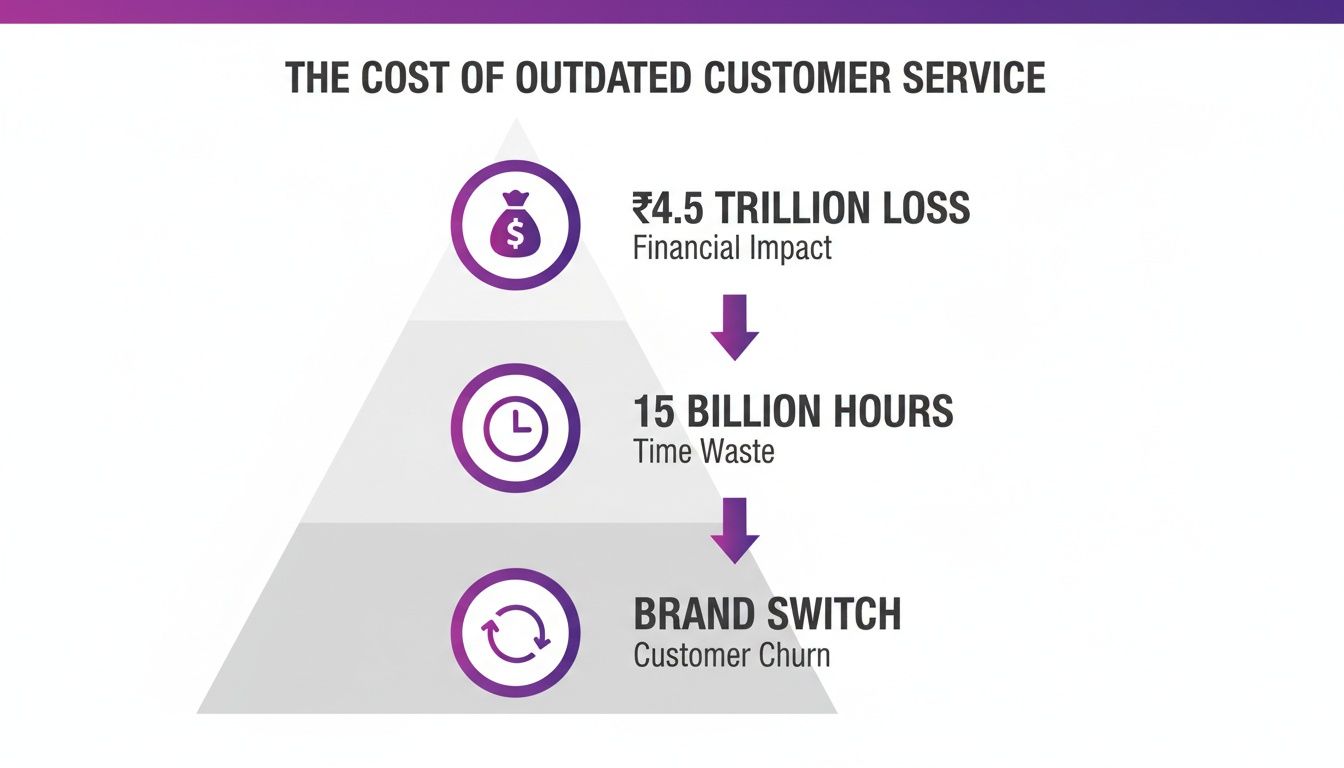
The data speaks for itself. The trillions of rupees and billions of hours lost aren't just line items; they represent real customer frustration that leads directly to churn.
The Apex: Conversational and Voice AI
At the very top of the ladder, you'll find Conversational AI. This is the powerhouse behind the most advanced automation tools, especially Voice AI. Before diving deeper, it's worth understanding how Conversational AI works, as it's the brain behind the operation. Unlike an IVR or a basic chatbot, Voice AI doesn't just listen for keywords. It gets the context, picks up on nuance, and figures out the intent behind what someone is saying.
This allows for a natural, flowing, human-like conversation. Your automated agent goes from being a script-reader to an intelligent problem-solver. It can qualify new leads, book appointments, and walk customers through complex issues, all while adapting on the fly. You can see how Contact Centre AI is completely changing the game in our detailed guide.
Choosing the Right Automated Service Technology
So, which tool is right for you? It all comes down to your specific business goals. Are you trying to cut costs, improve response times, or drive revenue? This table breaks down the strategic value of each technology to help you decide.
| Technology | Primary Function | Customer Experience | Ideal Business Use Case | Strategic Value for CXOs |
|---|---|---|---|---|
| IVR | Call routing and basic information retrieval | Rigid and structured; can be frustrating for complex issues. | Directing high call volumes to the correct department quickly. | Basic operational efficiency and cost control. |
| Chatbots | Answering FAQs and handling simple transactional queries. | Instant and responsive, but limited to its knowledge base. | Providing 24/7 self-service support for common questions on a website. | Improving response times and deflecting simple support tickets. |
| Voice AI | Handling complex, goal-oriented conversations. | Natural, adaptive, and highly conversational. | Lead qualification, appointment setting, proactive customer outreach. | High-value task automation, scalability, and enhanced data collection. |
Ultimately, making the right choice means taking a clear-eyed look at what you really need. An IVR might be enough if you just need to sort calls, but if you want to automate entire workflows and unlock serious growth, Voice AI is where the real strategic power lies.
Building a Bulletproof Business Case for Automation
Switching from a traditional support team to an automated one isn’t just a tech upgrade; it’s a serious strategic investment. And like any investment, it needs a solid business case. For any leader, the big question is always the same: what’s the return? The answer is all about turning smart technology into real, measurable results for your business.
The case for automated customer service really stands on four powerful pillars: aggressive cost reduction, radical scalability, stronger customer loyalty, and actionable data. To make a convincing argument, it helps to see the big picture, which is covered well in a complete guide to automating customer service.
Let's break down why this move makes so much financial and strategic sense.
Pillar 1: Aggressive Cost Reduction
The most immediate win you’ll see is a sharp drop in your operational costs. Think about all the repetitive, high-volume tasks your agents handle daily. By automating those, you free up your team to focus on complex issues, build relationships, and even drive revenue.
Practical Example: A leading telecom company automated its SIM card activation and recharge status queries. This single move deflected 60% of inbound calls from human agents, leading to a direct operational cost saving of ₹1.2 crore in the first year alone. This isn't about replacing your people; it's about optimizing their time and letting them do what humans do best.
Pillar 2: Radical Scalability
Picture your biggest festival sale. Website traffic goes through the roof, and so do the customer calls. A traditional contact centre would simply buckle under that kind of pressure, leading to frustrated customers and lost sales. This is where automation really shines.
An AI-powered agent can handle 10,000 concurrent calls without missing a beat. That level of scalability is just not possible with a human-only team. It means your business can handle any peak in demand, ensuring every customer gets an answer and every sales opportunity is captured.
For a growing business, this isn't just a nice-to-have—it's a competitive necessity. Being able to scale your support up or down on a dime, without massive hiring costs, gives you the agility to thrive.
This flexibility changes how you approach growth. You can launch new products or enter new markets knowing your support infrastructure can easily keep up.
Pillar 3: Enhanced Customer Loyalty
In today's fast-paced market, convenience is king. Modern Indian consumers would much rather solve an issue themselves than wait in a queue for an agent. If you don't give them that option, you're practically pushing them to your competitors.
The numbers don't lie. In 2023, a staggering 62% of Indian consumers used self-service tools like chatbots more than they did the year before. This shows a clear preference for instant, automated solutions over sitting on hold.
Practical Example: A popular e-commerce marketplace implemented a WhatsApp chatbot for order tracking. Their customer satisfaction (CSAT) score for post-purchase support jumped by 15 points within three months, and repeat purchase rates from those customers increased by 8%. Why? Instant gratification.
Pillar 4: Actionable Data Insights
Every single interaction your AI agent has is a valuable data point. This creates a goldmine of structured, actionable information on customer behaviour, common problems, and what's trending. This data is far more reliable and easier to sift through than anecdotal notes from human agents.
These insights can directly shape your business strategy, from product development to marketing. You can see exactly how AI voice agents are transforming customer service and sales by turning simple conversations into real conversions.
For instance, we've seen AI agents in the real world take lead connect rates from 47% all the way up to 91%. They've also boosted lead-to-booking conversions from 2% to an impressive 8%. This is the hard data that proves automation isn’t just a cost centre—it’s a powerful engine for growth.
A Practical Roadmap for Implementation
Jumping into automated customer service isn't just a matter of switching on a new piece of software. It's a strategic shift that needs a solid plan. To get it right, you need a clear, phased approach that connects the technology to your business goals and gets your whole team on board. This roadmap breaks the process down into four manageable stages, designed to give you a smooth transition and a fast return on your investment.
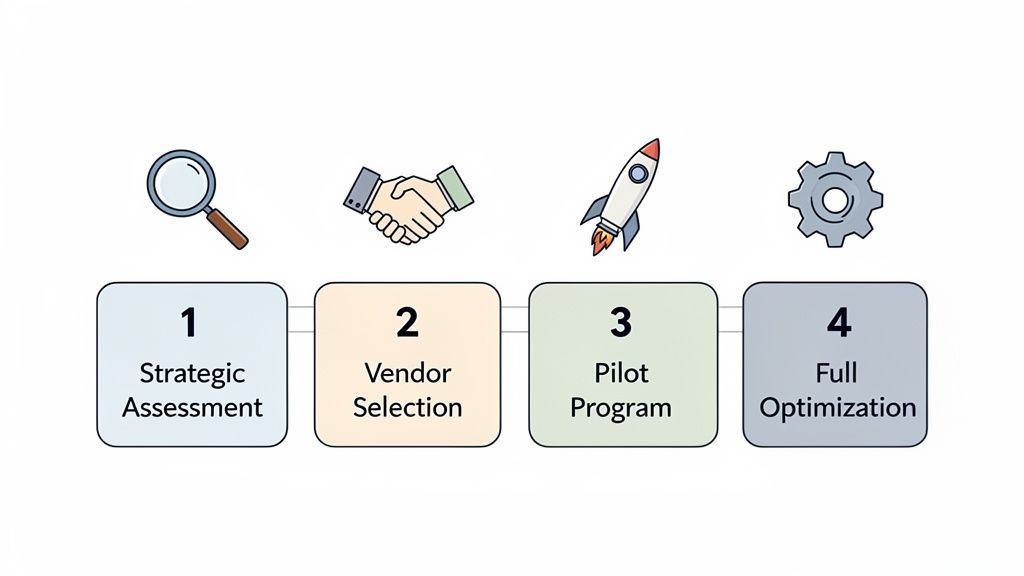
Think of this as a blueprint for success. We’ll move from big-picture strategy to the nitty-gritty of execution, making sure each step builds momentum and delivers predictable, powerful results.
Phase 1: Strategic Assessment and Planning
Before you even think about looking at technology, you need to look in the mirror. This first phase is all about figuring out where automation will make the biggest impact in your current customer service setup. The best place to start is by identifying the simple, high-volume tasks that tie up your agents' time.
These are your quick wins—the low-hanging fruit where automation can immediately prove its worth. You'll likely find them in areas like:
- Status Updates: Fielding endless queries like "Where is my order?" or "What's my application status?"
- Basic Information Requests: Answering the same FAQs over and over about business hours, locations, or product details.
- Appointment Scheduling: Managing the back-and-forth of booking, rescheduling, or cancelling appointments.
Practical Example: A leading hospital chain analyzed its call logs and discovered that 40% of inbound calls were for booking or rescheduling doctor appointments, with each call averaging 4 minutes. Automating this single process could free up over 2,000 agent hours per month, allowing staff to focus on more critical patient care coordination. This single piece of data is the cornerstone of your business case.
Phase 2: Vendor Selection and Partnership
Choosing the right technology provider is probably the most important decision you'll make in this entire process. The market is noisy, but you're not just looking for a supplier; you're looking for a strategic partner who understands your vision. Your evaluation needs to go beyond a simple feature checklist.
Here’s what to look for in a great partner:
- Vertical-Specific Expertise: Do they get your industry? A vendor with deep experience in EdTech, BFSI, or real estate will bring pre-built models and valuable insights that can dramatically speed things up.
- Seamless API Integration: The platform has to play nicely with your existing tech stack—your CRM, helpdesk, and other core systems. A smooth integration creates a single source of truth for all customer data.
- Transparent and Scalable Pricing: You need a pricing model that grows with you, not one that penalises you for success. Steer clear of vendors with confusing fee structures that lead to nasty surprises down the road.
A true partner will stick with you, offering robust support long after the initial setup to help you navigate technical challenges and fine-tune performance.
Phase 3: Pilot Programme Deployment
Once you've found your partner, it's time to test the waters with a controlled pilot programme. Resist the temptation to go for a "big bang" launch. Instead, start small. Pick one of the well-defined use cases you identified in the first phase and focus on getting that right. This approach keeps the risk low and lets you gather real-world data before you commit to a full-scale rollout.
Practical Example: An e-commerce company pilots an AI agent to handle all post-purchase order tracking questions for a specific product category. For three months, they route 50% of these queries to the AI and 50% to human agents.
Crucially, establish a control group. This is non-negotiable. By comparing the AI's performance against a team of human agents handling the exact same queries, you can measure the impact with certainty. Keep a close eye on metrics like first-contact resolution (AI: 92%, Human: 85%), customer satisfaction (AI: 4.6/5, Human: 4.2/5), and cost per interaction (AI: ₹15, Human: ₹75).
This pilot phase is also your first real change management test. It forces your sales, support, and tech teams to work together, ensuring everyone is aligned and ready for the new way of working.
Phase 4: Full-Scale Rollout and Optimisation
With solid data and key learnings from a successful pilot, you’re now ready for the main event. This is where you methodically expand the solution to other use cases and departments you've already identified.
But remember, "go-live" is the starting line, not the finish line. The final phase is a continuous loop of monitoring, analysing, and optimising. Use the data your AI agents are generating to spot new opportunities for automation and to refine the conversations they're having. This constant improvement cycle ensures your system evolves with your business and keeps delivering more and more value over time.
Seeing Automation Succeed Across Key Industries
The real value of automated customer service comes to life when you see it in action. Across some of India’s most dynamic sectors, automation isn’t just a cost-cutter; it’s a powerful tool for building a serious competitive advantage. By letting AI agents handle high-volume, repetitive tasks, businesses are finding new levels of efficiency and driving real growth.
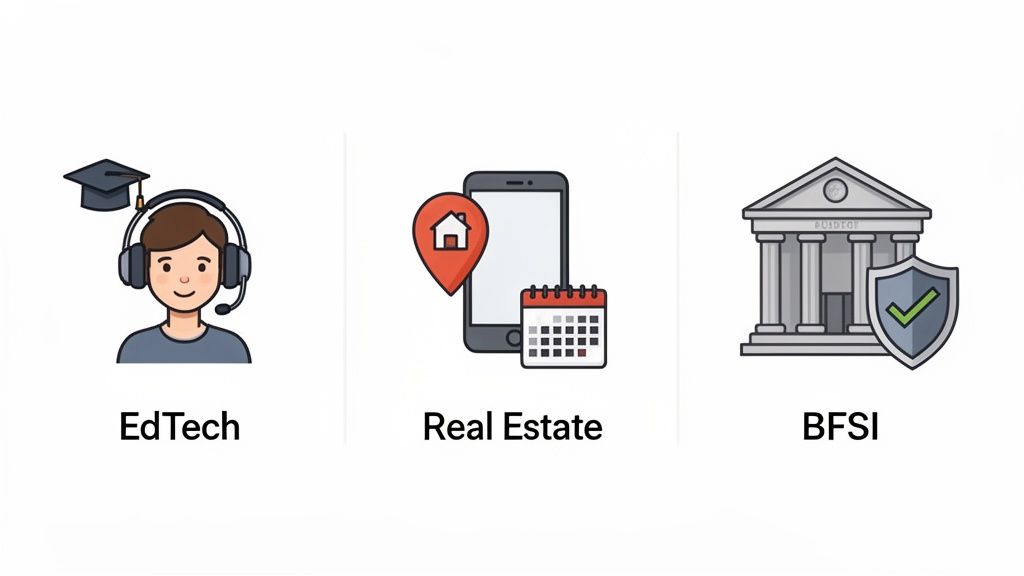
The timing couldn't be better. Trust in AI for customer support has grown significantly in India, with a surprising 66% of consumers now confident that Generative AI can deliver a better experience than traditional in-person support. This shift gives business leaders the green light to implement automation not just as a back-end tool, but as a customer-facing strategy that people are ready for. You can get a deeper sense of these evolving expectations and the rising trust in AI within the Indian market.
Let's look at how this plays out with some concrete examples from three key industries.
EdTech: Revolutionising Student Counselling
The EdTech sector has a unique problem: how to counsel thousands of potential students, each with different questions and needs, all at once during peak admission season. Human teams get overwhelmed fast, which means missed opportunities and a frustrating experience for applicants. This is where a Voice AI agent is a perfect fit.
Think about an AI agent that can handle 10,000 simultaneous calls. It can have a natural conversation with every single prospective student, answering their specific questions about course details, eligibility, or fee payments. No more waiting on hold.
- Proactive Outreach: The AI can follow up on enquiries automatically, sending reminders about application deadlines and guiding students through what to do next.
- Intelligent Qualification: It can figure out how serious a student is, and for those who are highly interested, it can seamlessly book a call with a specialist human counsellor.
- The Result: One major EdTech platform saw its application rates jump by over 35% after bringing in a Voice AI agent. Why? Because no student enquiry ever fell through the cracks again.
This approach transforms the entire admissions pipeline from a reactive bottleneck into a proactive, scalable engine for bringing in new students.
Real Estate: From Lead to Site Visit in Seconds
In the fast-paced real estate market, speed is everything. A lead that comes in from a property portal can go cold in a matter of minutes. Human agents, often tied up with existing clients, simply can't respond instantly. This delay causes a massive drop in the number of leads they actually connect with.
A real estate AI agent changes the game. It can integrate directly with platforms like MagicBricks and 99acres. The moment a new lead appears, the agent calls them—we're talking within seconds. It asks the right questions to qualify their interest: budget, preferred location, and property type.
But for promising leads, the AI’s job doesn't end there. It connects to the sales team's live calendar via an API and books a site visit in real-time, sending confirmation details to both the agent and the potential buyer instantly.
The impact of this immediate engagement is huge. One developer who adopted this strategy tripled their number of qualified, site-visit-ready leads. Even more impressive, their average lead response time plummeted from two hours to just 20 seconds. This frees up human agents to do what they do best: show properties and close deals, not chase down cold leads.
BFSI: Ensuring Compliance and Clarity
The Banking, Financial Services, and Insurance (BFSI) sector is all about strict compliance and absolute accuracy. Any AI agent working here has to be both smart and incredibly secure.
Take a trading platform, for example, where users have complex questions about market orders or need help with their KYC (Know Your Customer) verification. A compliant Voice AI can manage these conversations securely and efficiently.
- KYC Verification: The AI can guide users through submitting their documents, validating the information, and flagging any issues for a human to review. This drastically speeds up the account activation process.
- Complex Query Handling: It can field sophisticated questions about trading fees or margin requirements by pulling answers directly from a secure, internal knowledge base.
- The Outcome: A major brokerage firm cut its KYC processing time by 70% and improved its first-contact resolution for technical queries by over 50%. This not only makes operations smoother but also builds significant trust with customers.
Measuring ROI and Preparing for the Future
Bringing automation into your customer service is a big strategic decision. But how do you know if it's actually working? The real value only comes to light when you start measuring it the right way.
For any leader looking ahead, this means throwing out the old contact centre playbook. Metrics like ‘average handle time’ just don’t cut it anymore. They’re relics from a different era and simply can't show you how automation is truly affecting your bottom line and the overall health of your business.
To get a real sense of your return on investment, you need to zero in on modern Key Performance Indicators (KPIs). These are the numbers that actually tell the story of efficiency, customer loyalty, and even revenue growth.
The Metrics That Really Matter
When you track the right data, you get a crystal-clear picture of how automation is delivering real, tangible results. It's time to reconfigure your dashboards to focus on these strategic indicators:
- First Contact Resolution (FCR): This is a big one. It tells you the percentage of customer problems that get solved in the very first interaction. A high FCR, often pushing past 80-85% with a well-configured AI, is a fantastic sign that your system is working efficiently and customers aren't getting passed around.
- Customer Satisfaction (CSAT): Don't skip the post-interaction surveys. They're your direct line to customer sentiment. The best automated systems consistently pull in CSAT scores of 4.5 out of 5 or even higher, which proves that people really do value the speed and ease of use.
- Lead Qualification Rate: If you're using automation for sales, this metric is your North Star. Keep an eye on the percentage of conversations that turn into a sales-qualified lead. A top-tier Voice AI can take this rate from a standard 47% to over 90% just by making sure every single inbound lead is engaged instantly.
- Cost Per Qualified Interaction: This is where the financial benefit really shines. Calculate exactly what it costs to solve a problem or qualify a lead with automation versus a human agent. You'll often find automation can slash this cost by a massive 60-70%.
For Indian CXOs, the message couldn't be clearer. Automation isn’t some far-off trend—it’s a necessity for right now. It's the key to building a resilient, efficient, and customer-focused organisation that's ready for whatever the market throws at it tomorrow.
Getting Ready for What's Next
The world of automated customer service is moving fast, and it's not slowing down. The next major leap is happening right now with the deeper integration of Generative AI, which is paving the way for conversations that are far more empathetic and context-aware. Picture an AI that doesn't just give a scripted answer, but actually picks up on customer sentiment and adjusts its tone in real-time.
On top of that, predictive analytics is set to turn support on its head. Soon, your systems won't just react to problems; they'll anticipate them. By analysing usage patterns, they can spot potential issues before the customer even notices and proactively reach out with a solution. Think of an e-commerce site noticing a customer is stuck at checkout and having an AI agent pop up to offer help.
This shift towards proactive engagement is what will transform customer service from a reactive cost centre into a powerful engine for building loyalty. For leaders in India, this isn't the time to wait and see. By embracing this change now, you're setting your organisation up not just to keep up, but to lead the pack by delivering an unmatched customer experience at scale.
A Leader's Guide to Common Questions
Switching to an automated customer service model is a big decision, and it’s natural for leaders to have questions. This isn't just about new technology; it's about business strategy. Let's tackle the most common concerns we hear from VPs, Directors, and CXOs who are weighing this kind of investment.
Will Automation Make Our Human Agents Redundant?
Absolutely not. Think of it less as replacement and more as reinforcement. The real aim of automation is to take the pressure off your team by handling all the repetitive, high-volume tasks that clog up their day.
This frees up your best people to do what they do best: solve complex, sensitive customer problems that require a human touch. Your agents evolve into high-value specialists, which dramatically improves the quality of your customer support and their own job satisfaction.
How Much of a Headache Is Integrating This With Our CRM?
It's usually much simpler than you might think. Modern automation platforms are designed from the ground up to play nicely with other systems. Top-tier providers offer solid APIs and ready-made connectors for major CRMs like Salesforce and HubSpot.
A good partner will work hand-in-glove with your IT team to make sure data moves securely between systems. The result is a richer, unified view of every customer, updated with every single interaction.
For a mid-sized business, investing in advanced Voice AI is not just justifiable; it's a strategic move. It delivers a level of scale and efficiency that used to be reserved for massive corporations, giving you a serious competitive edge. You'll measure the ROI in how fast you grow, not just in what you save.
This kind of technology means you can manage sudden spikes in demand without scrambling to hire temps. It means you can qualify leads 24/7 and ensure your sales team spends their time on conversations that are actually going somewhere. That has a direct impact on your bottom line and market share.
Ready to see how a human-like Voice AI can change the way you operate? At DialNexa, we build custom agents that scale your outreach, qualify leads with 97% accuracy, and turn every conversation into a conversion opportunity. Discover DialNexa and book a demo today.

I especially liked the emphasis on measuring meaningful outcomes like customer satisfaction, lead conversion, and operational efficiency rather than relying on outdated metrics alone.