
The Modern Guide to Automated Calling Systems in India
At its core, an automated calling system is a technology platform that handles huge volumes of inbound and outbound calls without a human needing to dial each number. Think of it as a strategic asset that transforms high-effort, low-return calling operations into efficient, data-driven communication hubs.
For a VP of Sales, a Director of Operations, or a CXO, this isn't just a minor upgrade. It’s a fundamental shift from manual dialling to intelligent automation, enabling you to scale customer outreach and support in ways that were previously unimaginable from both a cost and efficiency standpoint.
What an Automated Calling System Truly Is
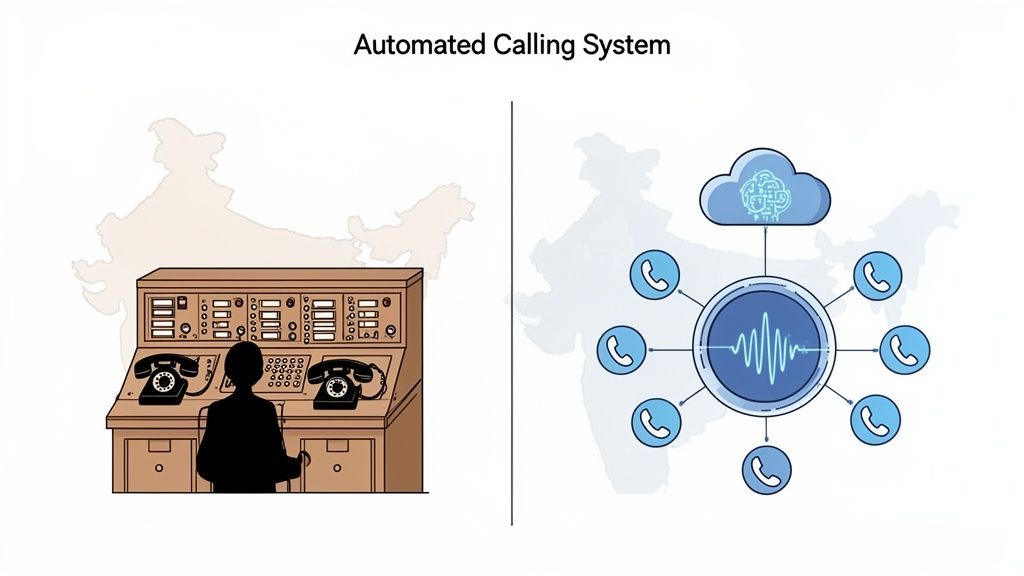
Picture your company's communication setup evolving from an old-school, manual switchboard to an intelligent digital command centre. This new hub doesn't just connect calls; it orchestrates thousands of personalised, two-way conversations all at once. That's the real power of a modern automated calling system.
Let's be clear: this is a world away from the annoying, one-way "robocalls" of the past. Today’s systems are sophisticated platforms that use a full suite of technologies to manage communications with precision. They're built not just to dial numbers but to genuinely engage, qualify, and support customers at a massive scale.
The Core Components of Modern Systems
At its heart, an automated calling system is a blend of several key technologies working together to drive business outcomes. Understanding these components reveals the system's strategic value for any senior leader.
- Intelligent Call Routing: This is the brain of your inbound operation. For example, a premium banking customer calling your support line is instantly identified by their number and routed to a senior relationship manager, bypassing the general queue. This reduces wait times by an average of 40% and boosts first-call resolution rates.
- Predictive and Power Dialers: These are the workhorses for outbound campaigns. A power dialer serves a new number to an agent the second their previous call ends. A predictive dialer takes it a step further, using algorithms to dial multiple numbers simultaneously, predicting agent availability with over 95% accuracy and connecting them only to live human answers. This can increase agent talk time from 20 minutes per hour to over 45 minutes.
- Interactive Voice Response (IVR): IVR is the self-service portal that empowers customers. A logistics company, for instance, can use an IVR to allow customers to track their package status or reschedule a delivery just by entering their tracking ID, deflecting up to 60% of routine queries from live agents.
- Voice AI Agents: This is the strategic game-changer. The most advanced systems feature AI agents that can hold natural, human-like conversations. They can qualify sales leads by asking budget and timeline questions, answer complex product queries, and even process payments securely, all operating 24/7 with 100% consistency. You can explore more about the role of AI in modern telephony in our detailed article.
Why Automation Is a Strategic Imperative in India
In India's incredibly busy telecom market, the need for smarter communication has never been greater. The sheer volume of spam calls has created a tough environment where legitimate businesses struggle to be heard.
A recent comprehensive survey revealed that over 65% of Indians receive three or more spam calls daily. This constant barrage, largely driven by inefficient manual dialling, has eroded customer trust and made it difficult for businesses to connect meaningfully.
This climate makes intelligent, compliant automated systems a necessity, not a luxury. These systems are designed to respect customer preferences while delivering clear business value. For certain campaigns, like reaching out to new prospects, dedicated cold calling solutions can dramatically improve both efficiency and reach. The trend is undeniable: as manual outreach becomes less effective, strategic automation becomes a critical competitive advantage.
For VPs and CXOs, this isn't just about small operational tweaks. It's about fundamentally transforming a costly operational centre into a powerful engine for growing revenue and keeping customers happy.
How AI-Powered Calling Actually Boosts Your Bottom Line
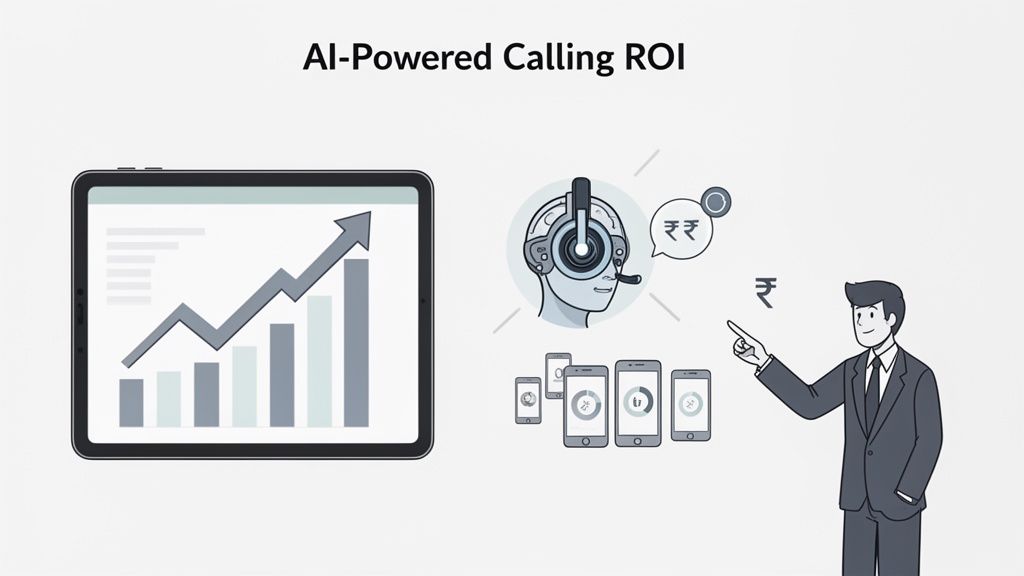
When you're a CXO watching the numbers, the return on investment from an AI-driven automated calling system isn't just a theory—it's immediate and measurable. This isn't about making small tweaks; it's a fundamental shift in how a business communicates, scales its operations, and competes in the market.
Let's talk about the direct financial impact first. A typical 50-agent call centre can easily run up operational costs of around ₹19.25 lakhs a month, including salaries, infrastructure, and overheads. By deploying an AI-powered system to handle 80% of routine calls, those costs can drop to just ₹6 lakhs. That’s an incredible ₹1.59 crores in annual savings, simply by automating repetitive tasks and allowing your human agents to focus on high-value, complex interactions.
But the real story isn't just about cutting costs. It’s about supercharging the entire revenue engine, from the very first outreach to closing the deal.
Radically Improved Efficiency and Connect Rates
One of the biggest drains on any calling operation is a poor connect rate. Think about all the time human agents spend dialling numbers that are busy, don't pick up, or are just plain wrong. It’s a massive waste of time and morale, with industry data showing agents can waste up to 70% of their day on unproductive dialing.
An AI-powered system eliminates that problem. We've seen clients go from a frustrating 47% connect rate to a remarkable 91%. This is achieved through features like answering machine detection and optimal time-to-call algorithms. When you nearly double the number of successful connections, you immediately see the impact on your sales pipeline. Every minute of the day is spent having productive conversations, not listening to a dial tone.
This strategic shift is reshaping India's contact centres amidst a boom in both data and voice usage. AI-led automation was credited with slashing call abandonment rates by 41% in 2023, transforming performance metrics for key sectors like BFSI, real estate, and EdTech. As businesses navigate this environment, the market for call centre AI is expected to grow from $103.8 million in 2024 to $452.5 million by 2030.
Unlocking Massive Scalability
For any business with ambition, scalability is non-negotiable. With a traditional human-led call centre, growth is slow and expensive. Hiring and training a new agent can take 4-6 weeks and cost thousands. An automated calling system blows those limitations away.
A single AI agent can make thousands of calls a day, day in and day out, without getting tired or going off-script. This means your organisation can handle sudden spikes in call volume—whether from a new marketing campaign generating 10,000 leads or a seasonal rush—without the chaos, overtime costs, or drop in service quality. It's this ability to scale up or down on a dime that gives you a real competitive edge.
Superior Customer Experience and Conversion
At the end of the day, growth comes from happy customers who convert. Modern Voice AI agents are surprisingly good at this, holding natural, multi-minute conversations that don't feel robotic at all.
The results speak for themselves. We've had clients see their lead-to-booking conversions jump from a standard 2% to as high as 8%—a four-fold increase. What's more, these AI agents qualify leads with a 97% accuracy rate, so your sales team gets a pipeline full of genuinely interested prospects. For example, an AI agent can ask a real estate lead about their budget, preferred location, and desired move-in date, then schedule a site visit only if they meet the criteria. To get this kind of growth, integrating AI Customer Support Agents into your strategy is a smart move.
This powerful mix of massive cost savings, limitless scalability, and a better customer journey is a true engine for business growth. You can explore our deep dive into how AI voice agents are transforming customer service and sales for more insights. The data makes it clear: AI-powered calling isn't a future trend; it's a practical tool for any leader who's serious about results today.
Where Automated Calling Makes a Real-World Difference in India
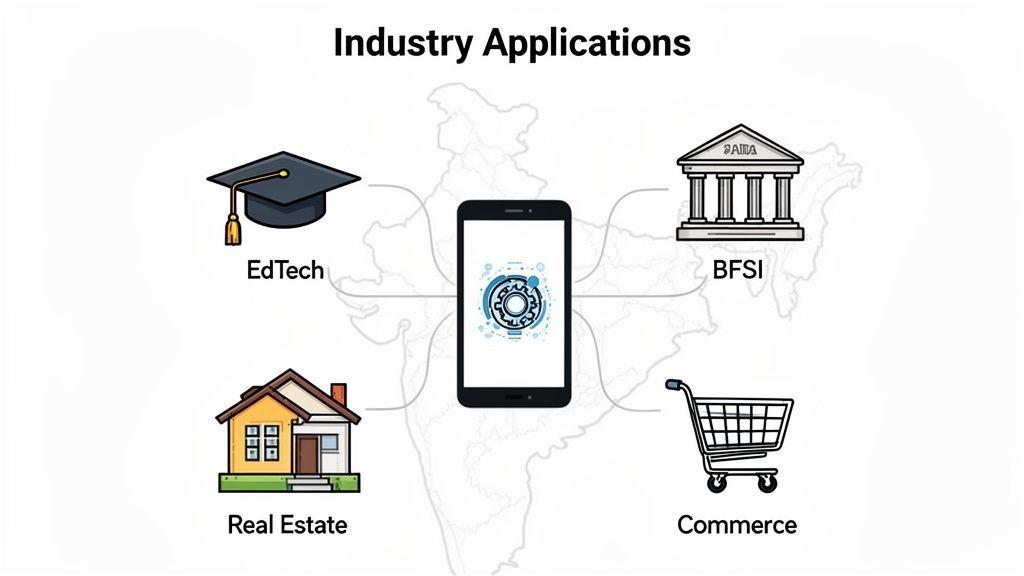
The true power of an automated calling system really comes to life when you see it tackling specific, high-stakes problems in India's most competitive markets. For any CXO or director, the conversation moves beyond abstract benefits to concrete results that directly hit the bottom line.
Let's dive into how this technology is actually being used on the ground to solve critical business headaches and drive growth in EdTech, BFSI, Real Estate, and E-commerce.
EdTech: From Mass Enquiries to Quality Admissions
India's EdTech space is a battleground. An institution might generate 20,000 new leads after a webinar, but manual teams can only contact a fraction before they go cold. It's a classic case of volume overwhelming capacity.
An automated calling system completely flips this script. It acts as the first line of engagement, managing the entire top of the admissions funnel.
- Nurturing New Leads: Imagine an AI agent instantly calling every new enquiry within 5 minutes of form submission to provide programme details, answer FAQs about course duration and fees, and qualify their interest. This frees up human counsellors to focus on high-value, high-intent applicants.
- Automated Fee Reminders: Gentle, personalised calls can be scheduled to remind students about payment deadlines, reducing payment defaults by up to 25% without tying up administrative staff.
- Instant Announcements: When exam results are out, the system can inform thousands of students simultaneously, ensuring everyone gets the news quickly and consistently.
By taking over the repetitive, high-volume tasks at the start of the admissions process, EdTech platforms have managed to boost their enrollment rates by a solid 15%. That's a direct line from operational smarts to revenue.
BFSI: Nailing Compliance and Customer Verification
In the Banking, Financial Services, and Insurance (BFSI) world, everything hinges on speed, accuracy, and watertight compliance. Yet, critical processes like KYC verification and loan eligibility checks are often slow, manual, and can take 3-5 business days.
This is where automation steps in to fix the bottlenecks. An AI-powered system can place verification calls, collect details like a date of birth or a mother's maiden name, and instantly update customer records, creating a secure and auditable trail. For instance, it can call a new credit card applicant to verify their address, check it against the application, and flag discrepancies for human review in real-time.
By automating these crucial checks and balances, financial institutions have slashed their average processing time by a massive 60%. This translates to faster loan approvals, quicker account openings, and a much happier customer base.
Real Estate: Qualifying Leads Around the Clock
Speed-to-lead is the name of the game in real estate. Harvard Business Review found that firms that contact potential customers within an hour of receiving a query are nearly 7 times as likely to have a meaningful conversation. But sales teams can't work 24/7.
As we've covered before, how realtors lose business by not answering calls and the AI solution is a major issue. An automated system solves this by acting as a 24/7 virtual agent. It can call a new lead within 60 seconds, ask qualifying questions ("Are you looking for a 2 or 3 BHK?", "What is your budget range?"), and book site visits directly into the sales team’s calendar.
This immediate engagement ensures every single enquiry gets a prompt, professional response, day or night. The result? A 30% reduction in no-show rates for site visits, simply because leads are engaged and booked while their interest is at its absolute peak.
E-commerce: Boosting Sales and Streamlining Service
For any e-commerce business, two persistent challenges are converting abandoned carts (which average nearly 70% globally) and managing the flood of post-purchase communication. An automated calling system is perfectly suited for both.
The system can be set up to trigger a personalised call 30 minutes after a customer abandons a cart, offering a time-sensitive 10% discount to nudge them over the finish line.
After the sale, it can provide proactive delivery updates ("Your order has shipped and will arrive tomorrow"), handle return requests, and conduct quick feedback surveys. This proactive communication doesn't just solve problems; it builds loyalty and turns one-time shoppers into repeat customers.
Industry Use Cases and Impact Metrics
Here's a snapshot of how automated calling systems deliver measurable results across different sectors in India.
| Industry Vertical | Primary Use Case | Key Performance Indicator (KPI) Improved | Example Metric Uplift |
|---|---|---|---|
| EdTech | Admission enquiry follow-up & qualification | Student Enrollment Rate | +15% increase |
| BFSI | KYC & customer data verification | Average Process Turnaround Time | -60% reduction |
| Real Estate | 24/7 lead qualification & appointment setting | Site Visit Show-Up Rate | +30% improvement |
| E-commerce | Abandoned cart recovery & post-purchase support | Customer Lifetime Value (CLV) | +20% increase (reported) |
This table highlights the tangible impact of moving from manual processes to intelligent, automated communication. It’s not just about efficiency; it's about driving core business metrics that define success in each of these industries.
How to Pick the Right Automated Calling System
Choosing a vendor for your automated calling system isn’t just another item on your to-do list; it's a strategic decision. For anyone in a leadership role, this evaluation has to go way beyond a simple feature-for-feature comparison. Get it wrong, and you’re looking at frustrated customers, serious compliance risks, and a big hole in your budget.
To make a smart, future-proof choice, you need to dig into five critical areas. A truly great provider will excel across the board, not just in one or two flashy features. Think of this as a framework for investing in a solution that actually drives growth, instead of just creating a new set of problems.
Conversation Quality and Intelligence
Let's start with the most important test of all: the quality of the conversation. Does the AI actually sound human? Can it handle tricky questions, or is it just a glorified robocaller reading from a script? A basic system that gets flustered by interruptions, struggles with regional accents, or can't manage a back-and-forth dialogue will only annoy your customers and damage your brand.
Don’t just take their word for it—demand a live demo using your own real-world scenarios. For example, provide a script for qualifying a real estate lead and see how the AI handles unexpected questions like "Is there a school nearby?". The AI agent should be able to hold a natural, multi-minute conversation, pull out the right information, and respond intelligently when someone goes off-script. The goal isn't to fool anyone, but to make the interaction so smooth and helpful that the customer doesn't care that they're talking to an AI.
Scalability and Rock-Solid Reliability
Your business isn't static. You have seasonal peaks, marketing campaigns, and growth spurts. The real question is, can the platform handle a massive spike in call volume without breaking a sweat? Always ask potential vendors for their uptime stats and what their Service Level Agreements (SLAs) guarantee. A 99.99% uptime guarantee is the industry standard.
Drill down with these questions:
- Peak Capacity: Can the system scale from 1,000 calls per day to 100,000 without manual intervention?
- The Tech Behind It: Is the platform built on a resilient, cloud-native architecture that promises high availability?
- Hard Numbers: What’s the average call connection time and failure rate when the system is under heavy load? A sub-3-second connection time is a good benchmark.
Reliability is simply non-negotiable. Your calling system should be a dependable workhorse, performing consistently day in and day out, ready to scale whenever you are.
Seamless Integration Capabilities
An automated calling system that can't talk to your other software is a dead end. Its real power is unlocked only when it connects smoothly with the tools you already use, like your CRM and ERP. This integration is what lets data flow freely, paving the way for truly personalised conversations and automatic record-keeping. Make sure to check out the vendor’s API documentation—it should be clear, robust, and easy for your tech team to work with.
A strong platform will also offer pre-built connectors for popular tools like Salesforce, Zoho, or HubSpot, which can make the whole integration process quick and painless. Without this deep connectivity, your team will be stuck manually exporting and importing lists, which defeats the whole point of automation.
A Watertight Compliance and Security Framework
Here in India, regulatory compliance is a massive deal. The platform you choose absolutely must have built-in adherence to all TRAI regulations, including automatically scrubbing your lists against the National Do Not Call (NDNC) Registry. A single slip-up can lead to huge fines and a PR nightmare you don’t need.
The appetite for AI-powered voice solutions is exploding in India, especially in sectors like BFSI and e-commerce. Projections show the market rocketing from $361 million in 2023 to $1.8 billion by 2030. This boom highlights just how crucial it is to pick a compliant, high-quality platform. Poorly chosen systems reportedly fail 67% of businesses. On the flip side, successful rollouts, like those at major banks, can slash costs by 30% by expertly handling diverse customer accents and queries. You can discover more insights about the Indian AI voice market's growth and what it means for businesses.
Beyond telecom rules, the vendor must prove their commitment to data security. Ask them about their data encryption protocols (AES-256 is the standard), server security, and any certifications they hold, such as ISO 27001. You need to be confident that your customers' sensitive information is locked down tight.
How Fast and Easy is the Deployment?
Finally, think about speed. In a market that moves this fast, you can't afford to get bogged down in a complex, six-month implementation project that drains your IT resources. The right partner gives you a platform that lets you design, test, and launch calling campaigns in a matter of days, not months. Look for an intuitive, no-code/low-code interface, clear guides, and a support team that actually responds within hours. The faster you can get your campaigns live, the sooner you start seeing a return on your investment—and that’s a powerful competitive edge.
Your Strategic Implementation Checklist
Rolling out an automated calling system isn't just about plugging in new software; it's a fundamental shift in your operations. For anyone leading this charge, a clear, methodical plan is the difference between a smooth transition and a chaotic one. Think of it as a roadmap to ensure the technology actually delivers on its promise of efficiency without throwing your team—or your customers—into a spin.
The first, and frankly most important, step is to get crystal clear on what you want to achieve. Vague goals like "improving outreach" just won't cut it. You need specific, measurable targets. For example, aim for something like “cutting our lead qualification time from 24 hours to 5 minutes within Q1” or “boosting appointment show-up rates by 25% by automating reminders.” When your goals are this sharp, everyone knows what success looks like and can pull in the same direction.
Identify the Best Initial Use Case
With your objectives set, it's time to pick your first project. The temptation is to automate everything at once, but that's a recipe for disaster. A successful rollout starts with a single, high-impact use case.
Look for a process that is:
- High-Volume: A task that eats up a huge chunk of your agents' time, like initial lead screening or sending out payment reminders. For instance, a process involving more than 1,000 calls a day is a prime candidate.
- Repetitive: A workflow that follows a predictable script with a limited number of possible outcomes.
- Measurable: An area where you can easily track the before-and-after performance metrics to prove it’s working.
An EdTech company, for instance, might start by automating follow-ups for admission enquiries. A real estate firm could focus on scheduling those first property viewings. Starting small builds confidence and gives you priceless insights for when you're ready to expand.
This decision tree gives you a visual guide to the key factors—Quality, Scalability, Integration, and Compliance—that should shape your choice of system.
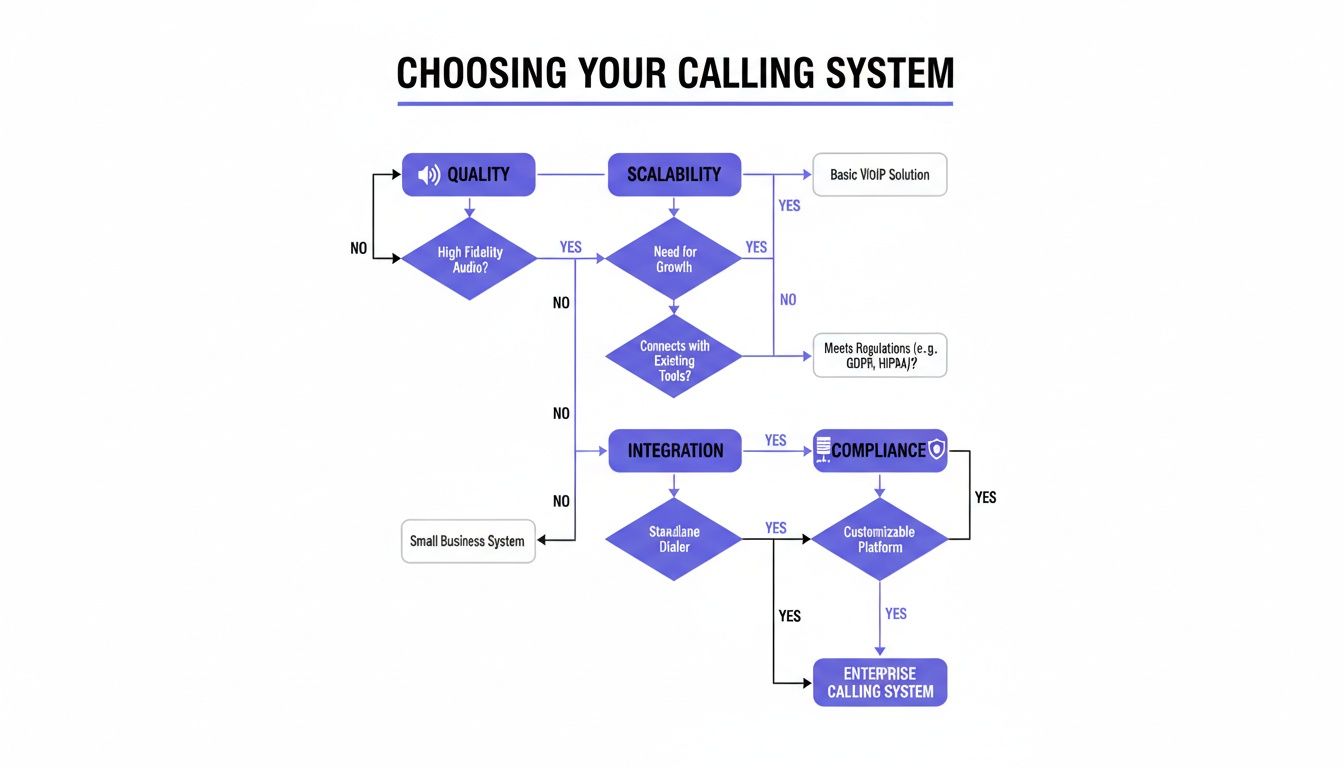
As the flowchart shows, you need a balanced solution. A system that’s brilliant in one area but weak in another will ultimately cap your ROI and introduce unnecessary business risks.
Prepare Your Data and Design the Conversation
Let's be clear: an automated system is only as smart as the data you feed it. Before you even think about launching, you need to clean up your CRM data. Make sure it's accurate, up-to-date, and properly segmented. This is non-negotiable for personalisation. A system that can greet customers by name and reference their recent purchase is infinitely more engaging than one that can't.
Next up, design a conversation flow that sounds natural. This is not about writing a stiff, robotic script. A good flow anticipates what a customer might ask, handles interruptions smoothly, and offers clear, simple paths to get things done. Get your operations team in a room and map out dialogues that actually feel helpful and human.
One mistake I see all the time is businesses launching without a trial run. A small-scale pilot, maybe with just 5% of your target list, is essential. It lets you test the call flow in the real world, catch technical bugs, and gather feedback before you go all-in. For a 10,000-contact list, a 500-contact pilot provides enough data to validate the approach.
Finally, remember that implementation is not a one-and-done task. You need to build a cycle of continuous improvement. Keep a close eye on the KPIs you defined earlier, analyse how the calls are performing, and use those insights to tweak your scripts and strategies. This iterative process is what turns a decent implementation into a truly effective one, making sure your system grows with your business and always delivers value.
Frequently Asked Questions
When you're thinking about bringing an automated calling system into your business, a lot of questions pop up. It’s a big decision. Below, we've tackled the most common ones we hear from business leaders, covering everything from customer perception and legal rules to the bottom-line financial impact.
Will an Automated Calling System Sound Robotic to My Customers?
That’s a fair question, and honestly, it’s a fear born from outdated technology. Today’s best systems use advanced Voice AI, generative language models, and text-to-speech engines that are nearly indistinguishable from a human voice for specific tasks. They can hold natural, back-and-forth conversations, understand context, and even adapt their tone. The goal isn't to trick anyone; it's about providing a surprisingly smooth and efficient experience, freeing up your human team for calls that require empathy and complex problem-solving.
A top-tier automated calling system can hit 97% accuracy when qualifying new leads through detailed conversations. That level of performance shows these systems aren't just reading a script—they're having meaningful dialogues that actually help the customer.
Ultimately, whether your customer is talking to a person or an AI, the interaction feels helpful and productive. That’s the modern standard.
How Do These Systems Ensure Compliance with TRAI Regulations?
For any serious provider in India, compliance isn't an afterthought; it's built into the very core of the platform. A professional automated calling system is designed from the ground up to follow the guidelines set by the Telecom Regulatory Authority of India (TRAI).
The most important feature here is the automatic filtering against the National Do Not Call (NDNC) Registry. Before any campaign runs, the system scrubs your list to make sure you don't call anyone who has registered for DND, protecting your business from heavy fines.
It also strictly follows TRAI’s rules on calling times and other regulations for promotional messages. Key compliance tools you should demand from any vendor include:
- Built-in DND Filtering: Automatically checking and removing numbers on the NDNC list.
- Call Recording and Auditing: Keeping secure, encrypted recordings for quality checks and to provide a clear audit trail.
- Adherence to Time Windows: Automatically stopping calls outside of legally permitted hours (e.g., 9 AM to 9 PM).
This built-in safety net doesn't just keep you out of legal trouble; it shows your customers you respect their privacy and preferences.
What Is the Typical ROI We Can Expect?
The return on investment you get from an automated calling system is massive, and it hits several parts of your business at once. The financial wins are usually the first thing you'll notice.
On the cost-saving side, the numbers are hard to ignore. For a mid-sized call centre with 50 agents, monthly operating costs can easily top ₹19 lakhs. By automating the bulk of your routine calls, that figure can drop to as low as ₹6 lakhs. That’s a saving of over ₹1.5 crores a year.
Operationally, the jump in efficiency is huge. Connect rates, which often hover around a sluggish 47% with manual dialling, can shoot up to 91%. This means your team spends its time actually talking to prospects, not listening to a phone ring.
And finally, on the revenue side, better lead qualification and relentless follow-up directly boost your sales. We've seen clients take their lead-to-booking rates from a standard 2% to as high as 8%. So, the ROI isn't just one thing; it's a powerful mix of cutting costs by over 65%, boosting agent productivity by 2X, and increasing revenue conversion by up to 4X.
How Complex Is the Integration with Our Existing CRM Software?
How tricky the integration is really comes down to the vendor you pick. Modern platforms are built with an "API-first" mindset, meaning they are designed to connect smoothly with popular CRMs like Salesforce, Zoho, and HubSpot. This makes the whole process a lot simpler than you might think.
A good vendor offers pre-built connectors that can be set up in a few clicks. The typical process involves:
- Authenticating the Connection: Securely linking the calling system to your CRM account via an API key.
- Mapping Data Fields: Using a drag-and-drop interface to tell the system which fields match up, like 'name,' 'phone number,' and 'last contact date.'
- Defining Call Triggers: Setting up "if-then" rules for when to make a call, such as "If a new lead is created in Salesforce, trigger an immediate qualification call."
A good automated calling system will have clear API documentation and a user-friendly dashboard that lets your team get campaigns running without a major IT project. When you're comparing your options, make sure you choose a vendor who makes integration easy. It’s the key to getting up and running quickly and successfully.
Ready to see how a truly intelligent automated calling system can change how your business operates? At DialNexa, we build human-like Voice AI agents that scale your outreach, support, and sales. Discover how our platform can drive your growth by visiting https://dialnexa.com.

[…] useful reference point is this guide to an automated calling system, which explains how automation shifts teams from repetitive dial tasks to structured outreach […]
This is an excellent breakdown of how AI-powered calling systems are transforming customer engagement and operational efficiency. The practical examples and ROI insights clearly show why intelligent automation is becoming a strategic necessity for modern businesses.
[…] teams comparing these models in more depth, this guide to automated calling systems is useful because it frames automation choices in practical workflow terms rather than vendor […]