

Conversation between Real Estate Agent and Customer: 2026
From Handshake to Handover: scaling high-value real estate conversations starts with one hard truth. The conversation between real estate agent and customer is not a soft skill layer sitting on top of the sales process. It is the sales process.
That matters more than many leadership teams model. Buyers typically spend 10 weeks searching for a home, including about 2 weeks before first contacting an agent, and they view an average of 7 homes. Over that span, the winning firm isn't always the one with the broadest inventory. It's often the one that communicates clearly, documents preferences early, and keeps momentum alive across every follow-up.
For CXOs, that changes the operating question. The issue isn't whether agents are having enough conversations. It's whether each conversation is structured, measurable, and repeatable across teams, cities, and lead sources. Manual calling creates variance. One agent probes well, another forgets the financing question, a third never books the next step before hanging up.
Voice AI platforms such as DialNexa introduce a different operating model. The platform description provided by the publisher states that teams use it to standardise outreach, automate routine qualification and booking, and scale to thousands of calls per day with consistent messaging. That makes conversation design a revenue architecture decision, not just a sales training topic.
Table of Contents
- 1. First Contact Discovery Call
- 2. Property Viewing Scheduling And Site-Visit Booking
- 3. Handling Objections And Negotiation Concerns
- 4. Follow-Up Calls After Property Viewing
- 5. Market Education And Investment Analysis Discussions
- 6. Lead Nurturing And Re-engagement Campaigns
- 7. Handling Inbound Inquiries And Lead Qualification At Scale
- 8. Complex Transactions Contingencies And Offer Negotiation Calls
- 8-Point Comparison of Agent–Customer Conversations
- The Executive Blueprint For AI-Powered Real Estate Communication
1. First Contact Discovery Call
The first call decides whether your team is collecting leads or building a pipeline. In a high-performing conversation between real estate agent and customer, the agent doesn't just ask what property the buyer wants. They identify urgency, constraints, and readiness to move.
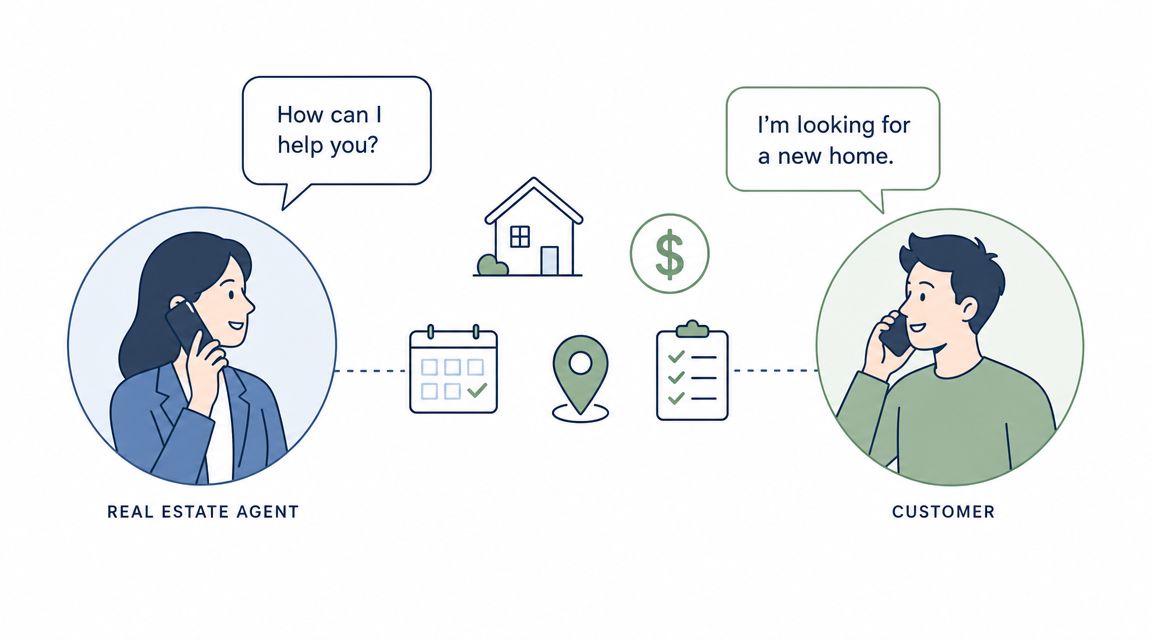
A practical example: a young professional calls about a first home in a transit-linked area. A weak agent logs "2BHK near metro". A strong agent captures preferred locality, commute pain, financing status, timeline, and whether the buyer is willing to flex on size or location. Those details determine whether the next action is a site visit, financing consult, or nurture track.
The publisher's background on DialNexa says its real-estate workflow supports discovery, qualification, and routing. That aligns well with an AI voice agent for real estate because the first call is highly repeatable if leadership defines the question order and handoff rules.
Turn vague intent into routing logic
One useful operating model is to start broad and narrow later. Ask why they're in market, then identify what blocks action. A relocating family might say school access matters more than immediate possession. An investor might care more about rental demand and management convenience than interior finish.
Practical rule: If the first call ends without a defined next step or a documented constraint, the call didn't qualify the lead. It only recorded interest.
Use a compact scoring frame inside the CRM:
- Intent clarity: Record whether the buyer can state property type, locality, and purpose.
- Decision timing: Separate immediate searchers from research-stage callers.
- Constraint visibility: Flag whether budget, location, or inventory expectations are unrealistic.
- Handoff readiness: Route serious enquiries to senior agents and lower-intent prospects to automated nurture.
External lead quality frameworks can help. Formzz's real estate lead insights are useful as a reference point for segmenting inbound demand by source and readiness. For executives, the KPI isn't call volume. It's the share of first calls that produce a reliable disposition code and a booked next action.
2. Property Viewing Scheduling And Site-Visit Booking
Scheduling sounds administrative. In practice, it's a conversion gate. If your brokerage loses booking momentum, lead generation efficiency collapses upstream.
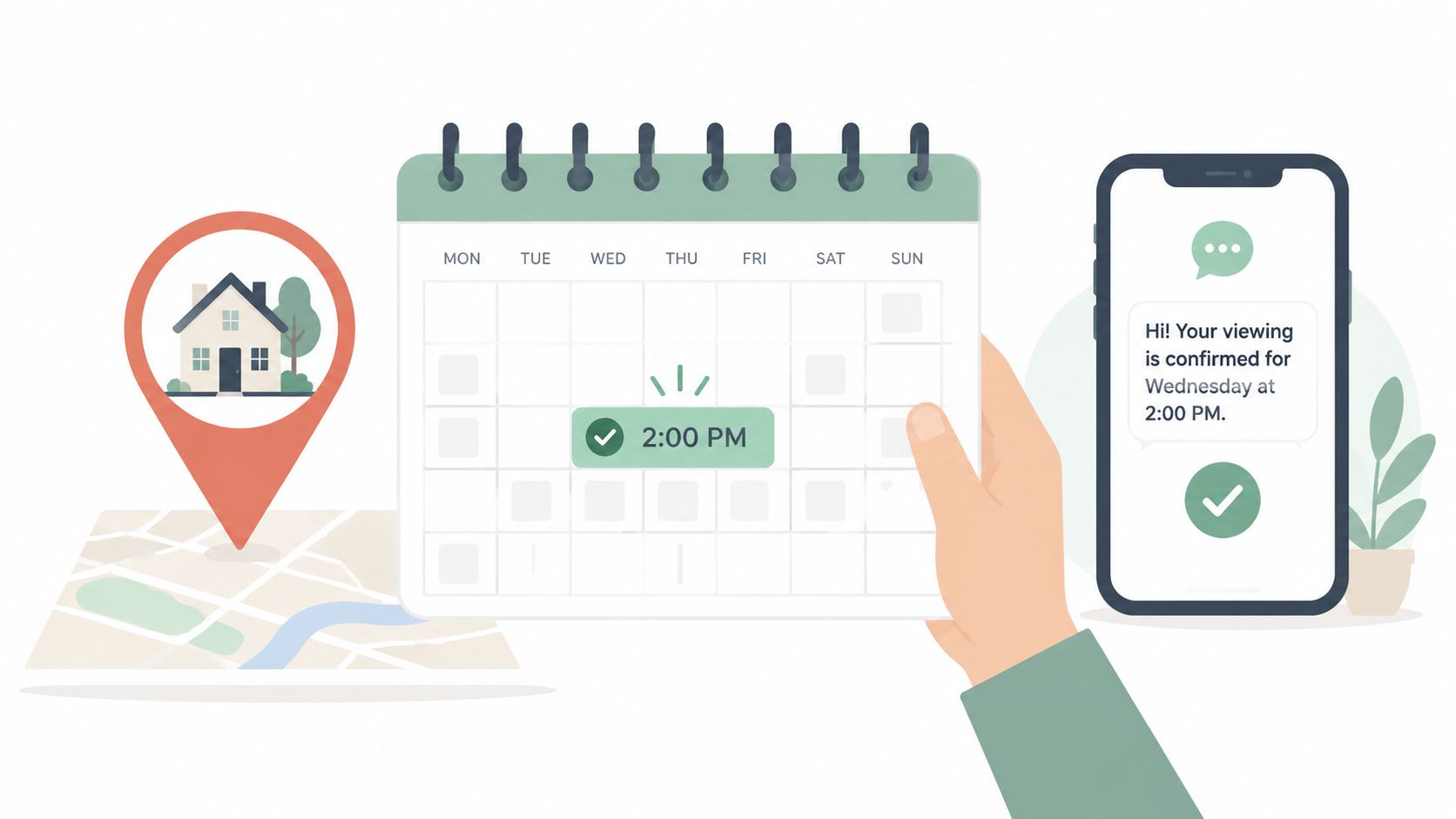
Consider a downtown buyer who asks about a specific listing on Friday evening. The team that answers with two precise slots, landmark directions, and attendance confirmation is operating a booking system. The team that says "our agent will call you" is creating delay and leakage.
For leadership, this conversation type should be treated like service operations. Calendar access, slot logic, reminder rules, and fallback workflows matter more than persuasion. If one property is unavailable, the conversation should immediately present the nearest viable alternative instead of ending in a dead line.
Booking is an operations function
Site-visit booking also creates intelligence for the field team. Ask what the prospect wants to inspect during the visit. A buyer who wants to compare kitchen layout and ventilation is different from one focused on parking access or pet policy.
A disciplined booking call should capture:
- Preferred slot windows: Morning, evening, weekday, or weekend.
- Visit context: Solo visit, spouse attending, parents joining, or broker representative.
- Visit objective: Layout validation, neighbourhood assessment, amenity check, or purchase readiness.
- Operational needs: Landmark guidance, access restrictions, or multi-property route planning.
Buyers don't experience scheduling as a clerical task. They experience it as proof that your firm can manage the purchase journey without friction.
The executive KPI here is simple. Measure booking-to-attendance consistency and the quality of information transferred from call to field staff. When AI handles confirmations and reminders consistently, agents recover time for consultative work instead of repetitive coordination.
3. Handling Objections And Negotiation Concerns
Objections are usually misclassified. Many teams hear resistance and respond with defence. Stronger teams hear resistance and diagnose a mismatch between expectation and market reality.
That distinction matters in India because the most useful consultative frame isn't "Which property do you like most?" It's the trade-off among location, property type, and budget. One buyer-conversation framework recommends agents introduce this in the first consultation and explain that buyers can usually optimise only two of the three, then reinforce the lesson after showings by asking buyers to score homes out of 10. The same guidance notes that many buyers ultimately choose an 8/10 home rather than waiting for a perfect 10/10 fit, which helps reposition compromise as progress rather than loss (buyer conversation guidance from Rev Real Estate School).
Trade-offs beat persuasion
A realistic objection conversation sounds different from a sales script. If a customer says, "The flat is too small for the price," the best response isn't "inventory is tight." It's "If size can't move, would you rather adjust location or budget?" That shifts the call from argument to decision architecture.
Here are three examples:
- Relocating buyer: Wants central location, larger unit, and a fixed budget. The agent identifies location as a fixed requirement and recommends adjusting unit size expectations.
- Family buyer: Wants a larger home in a school-centric area but is uneasy about older inventory. The agent surfaces whether age of building or commute time matters more.
- Investor buyer: Dislikes a property's current finish but values locality and tenant demand. The agent reframes cosmetic concerns against operating goals.
The highest-value objection handling doesn't remove constraints. It makes the buyer choose which constraint they can live with.
For CXOs, the KPI should track objection resolution quality, not just whether the call continued. A productive objection call narrows variables, updates CRM tags, and sharpens the shortlist. That's exactly the kind of structured input a voice AI workflow can collect before escalating a complex negotiation to a human closer.
4. Follow-Up Calls After Property Viewing
Brokerages that treat the post-viewing call as a courtesy are misallocating sales capacity. This conversation is a decision-stage diagnostic. It determines whether the lead should move to offer support, return to shortlist refinement, or exit the active pipeline.

Buyer behavior changes after the site visit. On location, many prospects respond to the agent, the seller, and the social pressure of the tour. A few hours later, they start ranking trade-offs against other properties, commute patterns, family input, and financing limits. The follow-up call captures that second layer of judgment, which is usually more predictive of conversion than the reactions recorded during the visit itself.
Consider a common scenario. A couple responds well to the neighborhood, building quality, and amenities, then hesitates once they assess kitchen layout and storage against daily use. The productive follow-up call does not rush toward an offer discussion. It isolates the blocking variable, tests whether that variable is fixable, and routes the lead to the correct next action, such as a second viewing, a revised shortlist, or a pricing conversation.
Feedback is pipeline intelligence
The business value of this call is not politeness. It is data capture.
A high-performing follow-up should document four categories:
- Purchase intent: high interest, conditional interest, or low-fit outcome
- Decision blockers: space planning, payment pressure, location compromise, renovation burden, or family resistance
- Approval path: co-decision makers, financing dependencies, and unresolved information gaps
- Committed next action: second visit, lender review, offer consultation, shortlist revision, or delayed reactivation
Those inputs improve more than agent notes. They improve forecast quality, reduce wasted callbacks, and give managers a clearer view of where deals are stalling.
This is also one of the easiest conversation types to operationalize with Voice AI. Speed matters because recall quality falls once the prospect has viewed additional inventory or discussed the property with multiple stakeholders. An automated workflow can call within minutes, capture standardized feedback, update CRM fields, and score readiness with high consistency. For CXOs, that creates measurable ROI: fewer stale opportunities, better routing to senior agents, lower manual follow-up cost, and a cleaner path to the lead-to-booking gains that structured calling systems can produce. In that model, platforms such as DialNexa are not replacing advisors. They are collecting qualification-grade feedback at scale so human agents spend time where persuasion, judgment, and negotiation still matter most.
5. Market Education And Investment Analysis Discussions
Education calls separate transactional sales teams from advisory-led firms. They also tend to expose whether your agents can translate market movement into customer-specific action.
For India-focused teams, that matters because affordability and supply pressure aren't evenly distributed. The research brief provided notes that recent market commentary points to rising residential prices in major cities and stronger demand in the ₹1 to ₹3 crore band, shifting many conversations away from aspiration and toward trade-off management (phone conversation marketing context for real estate agents). For an executive audience, that means market education isn't content marketing. It's expectation management with direct impact on site-visit quality.
A practical example: a buyer asks whether they should wait for a better deal in a premium micro-market. The agent shouldn't make return promises. They should explain what current pricing pressure means for the buyer's absolute requirements and whether the shortlist needs to move outward geographically or downward in size.
A useful explainer can support this kind of consultative discussion:
Move from aspiration to market-fit planning
Education calls work best when they simplify choices:
- For first-time buyers: Clarify what today's market means for available fit, not dream inventory.
- For upgraders: Frame whether timing pressure comes from family need, financing readiness, or locality scarcity.
- For investors: Focus on asset purpose, tenant profile, and management practicality before discussing upside.
A market education call earns trust when the customer leaves with a narrower, more realistic brief than they had at the start.
The KPI here is not whether the buyer "liked the market update". It is whether the conversation produced a cleaner shortlist, a revised budget conversation, or a decision to book a more relevant visit. That's why AI can support the front half of these calls by standardising FAQs, while human agents handle strategic interpretation and risk-sensitive advice.
6. Lead Nurturing And Re-engagement Campaigns
Nurture isn't follow-up spam. It is timed conversation design across a long buying cycle.
That timing matters because many prospects spend meaningful time in research mode before they engage fully with an agent. Leadership teams that rely only on fresh inbound will keep paying to reacquire buyers they already captured once. A better model keeps the conversation alive with context-specific prompts.
Nurture should mirror buying stage
One practical framework for conversation marketing in real estate recommends using question-led dialogue to determine who you want to reach and mapping communication to the prospect's buying cycle, then converting conversation outputs into operational assets such as lead tags, custom pipelines, and automated routing (conversation marketing for real estate websites). That is exactly how nurture becomes scalable.
Examples look like this:
- Research-stage prospect: Receives locality education and inventory-fit updates, not repeated booking pushes.
- Warm buyer: Gets alerts tied to stated preferences, such as school proximity or gated-community inventory.
- Paused lead: Receives a reactivation call when a prior objection changes, such as budget flexibility or a better-fit micro-market.
A well-run nurture system also depends on CRM hygiene. That's where CRM and lead management workflows become operationally important. If the team can't trust tags, disposition codes, and engagement history, even a strong voice AI layer will automate the wrong message.
Use nurture KPIs that executives care about:
- Re-engagement quality: Did the contact move back into active evaluation?
- Data freshness: Were intent, locality, and budget assumptions updated?
- Routing efficiency: Did the system escalate only serious prospects to agents?
The advantage isn't just better conversion. It's lower waste across call centres and field sales teams because reactivated leads arrive with cleaner context.
7. Handling Inbound Inquiries And Lead Qualification At Scale
Inbound response is where real estate operators often lose the most value in the shortest time. A prospect calls after seeing a property ad, a referral message, or a listing page. If no one answers well, acquisition spend has already leaked.
The strongest version of this conversation between real estate agent and customer is fast, brief, and structured. The caller shouldn't need to repeat basic information across three callbacks. They should get acknowledgement, qualification, and a next step in one motion.
Speed only matters if the script is structured
Immediate voice handling offers strategic value. The publisher information for DialNexa states that customers report connect rates rising from 47% to 91%, lead-to-booking movement from 2% to 8%, and AI-qualified leads matching human judgment with 97% accuracy. Those figures come from the publisher brief provided for this assignment, so they should be read as product-reported outcomes rather than independent market benchmarks.
For a C-suite team, the practical lesson is broader than one product. Inbound qualification at scale needs consistency. Ask too many questions and the caller drops. Ask too few and the field team wastes time.
That qualification discipline depends on where the calling list itself comes from. DialNexa’s breakdown of data for real estate calling looks at how segmentation and recency shape which numbers are worth dialling in the first place.
A high-functioning inbound script should capture:
- Identity and purpose: Buyer, investor, tenant, or channel partner.
- Immediate relevance: Specific property enquiry or category search.
- Core fit signals: Budget band, preferred locality, and expected timeline.
- Action path: Site visit, callback, nurture, or disqualification.
Fast answer rates don't create value by themselves. Fast, standardised qualification does.
Examples are straightforward. A weekend referral caller can be qualified and booked for a Monday consult. A specific listing enquiry can be redirected to a comparable property if the original unit is unavailable. A low-intent browser can receive educational follow-up instead of occupying a senior closer's calendar.
Executives should monitor handoff quality as closely as answer speed. If agents keep reopening the same discovery questions, the qualification layer isn't doing its job.
8. Complex Transactions Contingencies And Offer Negotiation Calls
Not every conversation should be extensively automated. Complex deals need judgment, legal awareness, and emotional control. The executive opportunity is to separate coordination from decision-making.
Offer calls, contingency discussions, and multi-party negotiations are where experienced human agents still create disproportionate value. But even here, a large share of the communication load is operational. Status updates, scheduling between lender and buyer, document reminders, and confirmation of discussion points can be standardised.
Use AI for coordination, not judgment
Take three scenarios:
- Competing offers: The customer needs a clear explanation of process and deadline, then a human negotiator should shape strategy.
- Inspection issue: AI can coordinate calls and summarise concern categories, but a human should discuss concession posture.
- Financing delay: Routine updates can be automated, while approval-sensitive advice stays with the agent or legal team.
This split protects quality. It also protects margin because high-cost human time stays focused on calls where nuance changes deal outcome.
A disciplined operating model includes:
- Clear escalation thresholds: Define what AI can explain and what must go to a licensed or authorised human.
- Written follow-through: Every verbal contingency discussion should be documented immediately.
- Customer transparency: Be explicit about whether the customer is speaking with AI or a person.
- Closure support: Use automation to keep tasks moving after verbal alignment.
For teams thinking about late-stage sales efficiency, methods of closing a sale are relevant only when the underlying communication chain is already controlled. You can't close efficiently if discovery, booking, and objection management are still inconsistent.
8-Point Comparison of Agent–Customer Conversations
Across these eight conversation types, the operating difference is clear: some calls are high-frequency process work, while others are low-volume decisions that directly affect deal margin, cycle time, or legal risk. For leadership teams, the comparison matters because each category needs a different staffing model, automation threshold, and success metric.
The table below is designed for fast executive review. It groups each conversation by operational difficulty, automation fit, expected business impact, and the point where human judgment should take over. DialNexa fits best in the categories where speed, consistency, and volume determine ROI, especially in workflows tied to qualification accuracy, booking conversion, and response-time advantage.
| Conversation Type | Operational Complexity | Automation Fit | Primary Business Impact | Best KPI Focus | Human Escalation Trigger |
|---|---|---|---|---|---|
| First Contact Discovery Call | Medium | High | Improves speed to lead, standardises intake, increases booked appointments | Contact rate, qualification accuracy, lead-to-booking rate | Budget ambiguity, unusual financing, multi-party decision dynamics |
| Property Viewing Scheduling And Site-Visit Booking | Low to Medium | Very High | Reduces scheduling friction, improves field-team utilisation, lowers no-show risk | Booking rate, show rate, time to confirmed appointment | Access exceptions, bespoke visit requirements, customer confusion |
| Handling Objections And Negotiation Concerns | High | Medium | Preserves deal momentum by answering routine concerns quickly | Objection resolution rate, drop-off rate, escalation rate | Emotion-heavy resistance, pricing disputes, concession strategy |
| Follow-Up Calls After Property Viewing | Medium | High | Captures intent while recall is fresh, increases next-step conversion | Follow-up completion rate, response rate, move-to-offer rate | Mixed signals, strong emotional hesitation, high-intent buyer questions |
| Market Education And Investment Analysis Discussions | High | Low to Medium | Builds credibility and improves lead readiness before agent involvement | Meeting conversion rate, readiness score, content engagement | Advice-sensitive questions, investment judgment, compliance-sensitive topics |
| Lead Nurturing And Re-engagement Campaigns | Low | Very High | Reactivates dormant pipeline at low cost and improves database yield | Reactivation rate, reply rate, cost per reactivated lead | Repeated non-response, change in customer profile, objection patterns |
| Handling Inbound Inquiries And Lead Qualification At Scale | Medium | Very High | Protects demand capture, shortens response time, improves routing efficiency | Speed to response, qualification accuracy, booking rate | High-value lead signals, complex product questions, request for advisor |
| Complex Transactions Contingencies And Offer Negotiation Calls | Very High | Low | Supports coordination and documentation, but final outcomes depend on human judgment | Cycle time, documentation accuracy, task completion rate | Any legal, financial, or negotiation-sensitive decision |
A pattern stands out. The strongest automation case sits in conversations that are repetitive, time-sensitive, and easy to score. That includes discovery, inbound qualification, scheduling, follow-up, and nurture. These categories create measurable operational benefits because they consume substantial agent time, occur at high volume, and benefit from consistent execution.
The weaker automation case appears where legal exposure, pricing judgment, or emotional complexity determine the outcome. In those cases, AI should support process control and documentation rather than replace the agent. That distinction protects both conversion efficiency and risk management.
For CXOs, the allocation logic is straightforward. Put Voice AI on the conversation types where missed calls, slow follow-up, and inconsistent qualification destroy pipeline economics. Keep senior agents focused on negotiation, advisory discussions, and exception handling. Firms that apply this split well can reduce cost per qualified lead, improve field-team productivity, and raise lead-to-booking performance from 2% to 8% while maintaining qualification accuracy near 97% in the right workflows.
The Executive Blueprint For AI-Powered Real Estate Communication
Brokerages that treat conversation design as an operating model, rather than agent improvisation, create measurable financial upside. The earlier sections show why. A large share of customer interactions sit in workflows that are repetitive, time-sensitive, and easy to score for quality. Those are the conditions where standardisation improves response speed, lowers labour cost, and raises conversion consistency.
For an executive team, the communication layer is not a soft skill category. It is a pipeline control system. Every delayed callback, poorly qualified inquiry, missed site visit, or inconsistent follow-up creates waste in media spend, agent capacity, and field operations. Firms that outperform in this area do not sound better on calls; they route demand more efficiently and protect high-value human time for decisions that require judgment.
That changes what should be measured.
Call volume is a weak management metric on its own. Leadership teams get a clearer view from qualification accuracy, contact-to-booking rate, booking show rate, handoff time, reactivation rate, escalation compliance, and field-team utilisation. Those KPIs show whether conversations are producing qualified movement through the funnel or just generating activity without commercial progress.
The operating principle is straightforward. Automate the conversations that are frequent, rules-based, and operationally expensive to mishandle. Keep human agents on negotiation, legal sensitivity, financing nuance, and emotionally charged decisions. This split improves unit economics because it shifts labour toward high-margin advisory work while software handles the repeatable front-end load.
Voice AI becomes valuable in that model because it can execute discovery, qualification, scheduling, reminders, and re-engagement with consistent logic across every lead source and time window. In the right workflows, that consistency supports the performance gains referenced earlier, including stronger lead-to-booking conversion and high qualification accuracy. The strategic advantage is not automation by itself. It is predictable execution at scale.
There is also a governance benefit. Once conversation flows are defined in software, leaders can audit outcomes, compare cohorts, identify leakage points, and coach against actual transcripts rather than anecdote. Best practices become transferable. Forecasting gets cleaner. Compliance improves because required questions, disclosures, and handoff triggers are built into the process instead of left to memory.
If you're evaluating tooling around that shift, choosing the right transcription tool is part of the broader stack question because analysis depends on accurate call capture and review. DialNexa Labs Private Limited is one relevant option in this category based on the publisher brief, particularly for teams that want voice AI agents to support qualification, booking, and presales workflows at scale.
The strategic conclusion is practical. A conversation between real estate agent and customer should be managed as revenue infrastructure with clear service levels, scoring rules, and escalation paths. Firms that build that system well can reduce avoidable operating cost, increase sales capacity without matching headcount growth, and create a buyer experience that is faster, more consistent, and harder for competitors to match.
If your team wants to turn discovery calls, site-visit booking, follow-ups, and inbound qualification into a more scalable operating system, explore DialNexa Labs Private Limited. The platform is built for organisations that want human-like Voice AI agents to support presales and customer communication at scale while keeping human teams focused on higher-value decisions.

[…] property negotiations, where poor questioning produces generic answers and weak qualification. This real-estate agent and customer conversation example shows how scenario-based discovery can surface timing constraints, budget sensitivity, and hidden […]
This is an excellent breakdown of how real estate conversations can be transformed into a scalable revenue engine through structured processes and AI support. The focus on balancing automation with human expertise offers valuable insights for improving conversion, productivity, and customer experience.