

Top 10 AI Real Estate Companies: A CXO’s Guide for 2026
AI has moved from a technology experiment to a board-level operating question in real estate. That shift is larger than many firms realise. JLL's 2024 research on artificial intelligence in real estate reports that more than 500 companies globally were already providing AI-powered services to real estate, and about 10% of the world's 7,000 PropTech companies were offering AI-powered solutions by the end of 2024. For Indian operators, that matters because the market is no longer deciding whether AI tools exist. The harder question is which category of AI improves revenue conversion, underwriting quality, and operating efficiency.
That distinction is where most executive teams lose time. Many discussions around AI real estate companies stay trapped in generic categories like chatbots, valuations, or marketing automation. The stronger lens is functional. Which systems improve lead handling? Which ones strengthen pricing and portfolio decisions? Which ones help brokers move faster without introducing process risk? Morgan Stanley's 2025 analysis of AI in real estate makes the stakes clear by estimating that AI innovations could generate US$34 billion in efficiency gains for the industry by 2030, while finding that 37% of tasks across the firms it analysed can be automated.
For Indian CXOs, the most practical use case is rarely full autonomy. It's targeted workflow augmentation. PwC's view on AI moving into real estate notes that job replacement remains rare while job transformation is more common. That's why tools that improve lead qualification, resident communication, leasing support, data standardisation, and decision support deserve more attention than broad AI claims.
If your team is also cleaning contracts, application forms, and finance records before any AI rollout, this practical guide for finance and HR data is useful background.
Table of Contents
- 1. DialNexa Labs Private Limited
- 2. Square Yards
- 3. Magicbricks
- 4. Housing.com
- 5. SuperArea.ai
- 6. Propli
- 7. TheLAL
- 8. Ishanya AI
- 9. PropCent
- 10. RealtyBlocks
- Top 10 AI Real Estate Companies: Features Comparison
- The Executive Takeaway Building Your AI-Powered Future
1. DialNexa Labs Private Limited
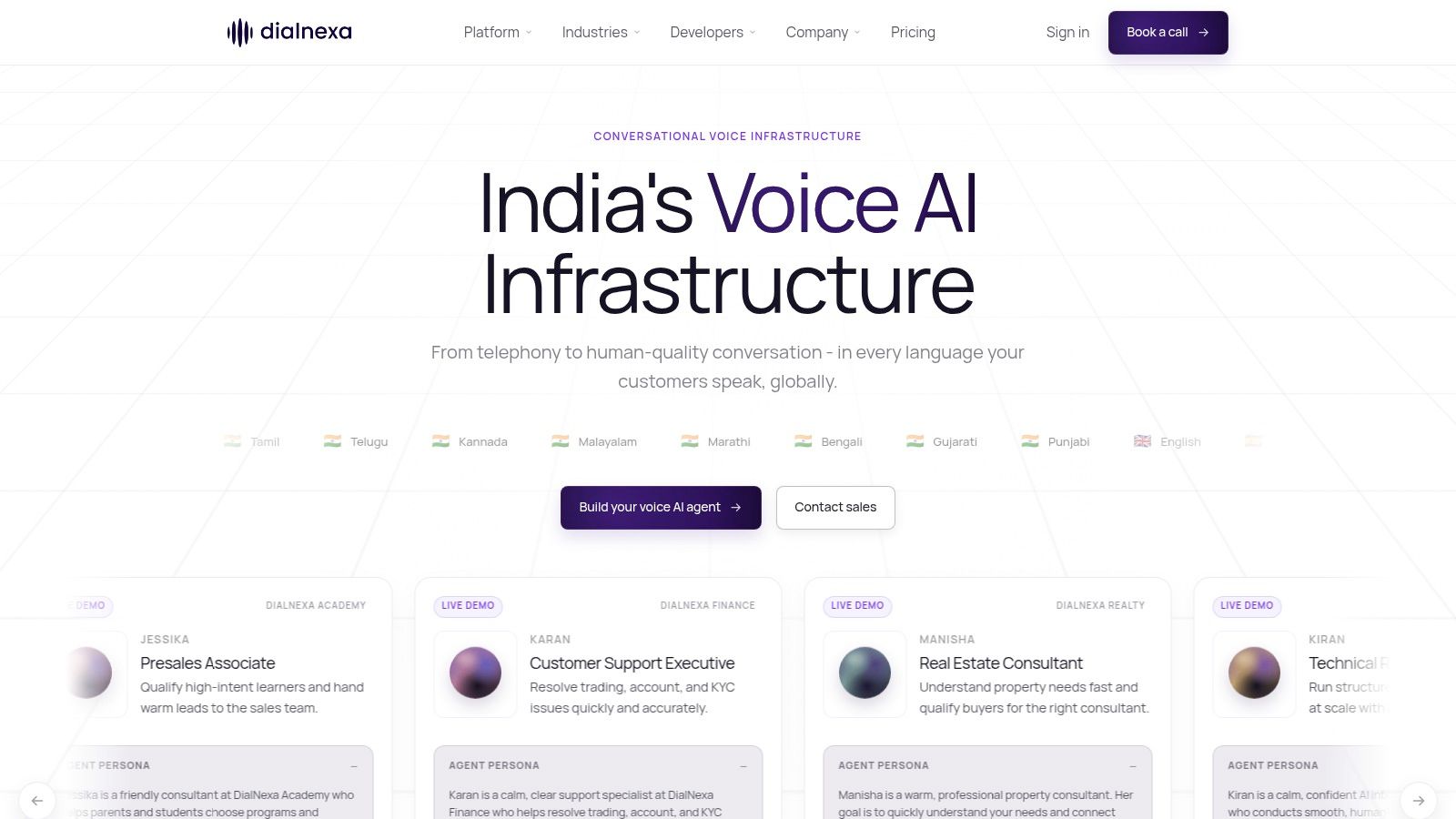
DialNexa matters because many real estate firms do not have a lead generation problem. They have a conversion operations problem. Enquiries arrive, but revenue slips when teams miss calls, delay callbacks, qualify leads inconsistently, or fail to convert early interest into site visits. In that context, a specialised voice AI layer can produce stronger near-term ROI than another discovery interface or another analytics dashboard.
That makes DialNexa a different type of AI company from marketplace-led platforms elsewhere in this list. Its role is narrower and, for many operators, closer to the point of commercial impact.
The company focuses on human-like voice AI agents for qualification, presales, support, and routing. For developers, brokerages, and channel sales networks, that means automating property discovery calls, booking site visits, sending reminders, handling basic KYC guidance, and routing prospects to the right human team at the right stage. The strategic value is straightforward. Sales capacity is expensive, and repetitive calling work rarely deserves top-performing agents. DialNexa shifts that workload into software while keeping human closers focused on high-intent conversations. Its positioning is clear in these real estate voice agent workflows for property teams, and the broader category context is outlined in this analysis of how AI is being applied across the real estate industry.
Why it stands out
DialNexa stands out because it is built around a specific operational choke point: the period between lead capture and human sales engagement. That is often where marketing efficiency breaks down. Boards tend to scrutinise cost per lead, but conversion quality depends just as heavily on first response discipline, qualification consistency, and handoff speed.
The company also presents outcome-oriented proof points tied to funnel execution rather than broad AI claims. The current section originally cited improvements in connect rates, booking conversion, and qualification accuracy. Without repeating unsupported figures here, the more important takeaway is the category fit. Voice AI is easiest to justify when management already sees leakage in missed calls, weak follow-up coverage, or uneven lead grading across projects and teams.
Deployment model also matters. DialNexa uses ready-made personas, industry templates, dashboards, and APIs, which lowers implementation friction for firms that want production use without a long custom build cycle. For CXOs, that changes the investment case. Time to value often matters more than feature breadth.
Decision rule: If lead volumes are healthy but site visits, callbacks, and qualification quality remain inconsistent, a voice AI execution layer usually has a shorter payback period than replacing the CRM or listing stack.
Where it fits in the stack
DialNexa fits between demand generation and human closing. Ad platforms, property portals, and campaign channels create inbound interest. CRM systems record leads and pipeline stages. Voice AI handles the first-response gap, follow-up cadence, and routing logic that determine whether demand becomes appointments and qualified opportunities.
That placement is strategically important because it complements, rather than replaces, existing systems. Companies evaluating AI real estate vendors should separate platforms that improve discovery from tools that improve conversion operations. Those are different budget decisions and different KPI conversations.
For operators managing multiple projects, broker partners, or regional sales teams, this category can create value in three ways. It reduces manual calling load. It standardises early-stage qualification. It gives management tighter control over response coverage across working hours, languages, and enquiry spikes.
Pros
- Direct relevance to revenue operations: The product addresses missed calls, delayed follow-up, and weak lead routing, which are common sources of conversion loss.
- Faster rollout than custom AI projects: Templates, dashboards, and APIs reduce the effort needed to launch production workflows.
- Strong fit for assisted selling models: The platform supports sales teams by filtering and routing conversations instead of trying to automate the full transaction.
- Useful stack position: It can sit on top of existing CRM, campaign, and scheduling systems without forcing a broader platform migration.
- Scales repetitive outreach economically: High-volume inbound and outbound calling workflows are easier to standardise in software than through additional headcount.
Cons
- Commercial terms are not packaged for simple self-serve buying: Larger teams will likely need a consultative sales process.
- Performance depends on operational design: Language coverage, script quality, escalation rules, and compliance handling still require management oversight.
- Narrower scope than full proptech platforms: It improves lead conversion operations, not valuation, search, listing distribution, or portfolio analytics.
Use case fit is strongest for developers, brokerage networks, channel partners, and multi-project sales teams with steady enquiry flow and inconsistent conversion discipline. For that buyer, DialNexa should be assessed as a specialised lead-conversion and voice-automation layer within the broader real estate AI stack, not as a general-purpose marketplace or analytics platform.
2. Square Yards

Square Yards belongs in a different category from conversational AI vendors. It's an integrated proptech platform with reach across discovery, transactions, mortgages, property management, and data products. That breadth gives it strategic relevance for boards looking beyond lead generation into valuation intelligence and institutional decision support.
Its Data Intelligence suite and E-Valuation positioning make it more useful for lenders, investors, and enterprise operators than for a small brokerage seeking a lightweight AI assistant. The stronger comparison is with firms that want market analytics, portfolio signals, and risk-oriented tooling inside a broader real estate operating environment.
Best for valuation and enterprise analytics
Square Yards is worth attention because AI in real estate isn't only about front-end sales. JLL highlighted document sorting and data standardisation for portfolio analytics, price modelling for investment management, and recommendation or matchmaking for leasing and investment transactions as relevant use cases for the sector in India. Square Yards sits close to that logic with valuation, analytics, and immersive visualisation products in one umbrella.
Its PropVR capability also gives it a practical advantage for developers selling under-construction or premium inventory. Immersive visual tools don't replace pricing discipline, but they can support buyer confidence and remote selling motions, especially where inventory explanation matters as much as inventory display.
For teams still mapping the broader opportunity, this analysis of AI in the real estate industry helps frame why analytics and operational tools shouldn't be evaluated in isolation.
Square Yards is less about automating one workflow and more about consolidating several high-value functions inside one commercial platform.
Pros
- Enterprise depth: Goes beyond listings into valuation, analytics, mortgages, and property services.
- Useful for financial institutions: Data products are relevant to banks, housing finance companies, and investors.
- Supports richer selling experiences: PropVR adds a strong visual layer for project marketing.
- Strategic fit for multi-market operators: Broad footprint helps firms that need consistency across regions.
Cons
- Potentially heavy for smaller firms: The platform's breadth may exceed the needs of lean agencies.
- Commercial terms are sales-led: Buyers should expect a consultative enterprise process rather than transparent self-serve pricing.
For executive teams comparing AI real estate companies by function, Square Yards belongs in the analytics and transaction infrastructure bucket, not the conversational automation bucket. Explore the platform at Square Yards.
3. Magicbricks
Magicbricks remains one of the most commercially important names in Indian property discovery. Its AI relevance comes less from headline innovation and more from where it sits in the demand chain. If your sales organisation depends on broad buyer visibility, Magicbricks is still one of the channels that determines pipeline quality before your internal teams ever engage.
That distinction matters for CXOs. Many AI discussions focus on internal efficiency. Marketplaces like Magicbricks affect efficiency upstream by shaping who enters your funnel in the first place and how accurately supply gets matched with buyer intent.
Best for marketplace-led demand capture
Magicbricks applies AI and machine learning across reach expansion, matchmaking, and digital discovery. That makes it most useful for developers and broker networks that need scale distribution with some algorithmic support in campaign amplification. Its virtual tours and research content also help projects compete for attention in a crowded listing environment.
The strategic upside is simple. A large marketplace can improve audience access and buyer discovery, but it doesn't solve what happens after an enquiry lands. That's why many operators pair demand channels with specialised follow-up systems. If your teams are working through that combination, this guide on AI for real estate agents is a useful companion to marketplace strategy.
Pros
- Strong market visibility: Useful for projects that need reach and buyer familiarity.
- AI-assisted matching: Supports campaign and project-to-buyer alignment.
- Rich discovery environment: Virtual tours and trend content can improve consideration quality.
Cons
- Lead quality can vary: Marketplace scale doesn't automatically guarantee sales readiness.
- Commercial plans are variable: Advertiser packages are typically customized rather than standardised.
The board-level takeaway is that Magicbricks is best seen as a top-of-funnel demand engine. It's not the answer to every AI problem in real estate, but it remains an important layer in any stack built around acquisition efficiency. Visit Magicbricks.
4. Housing.com
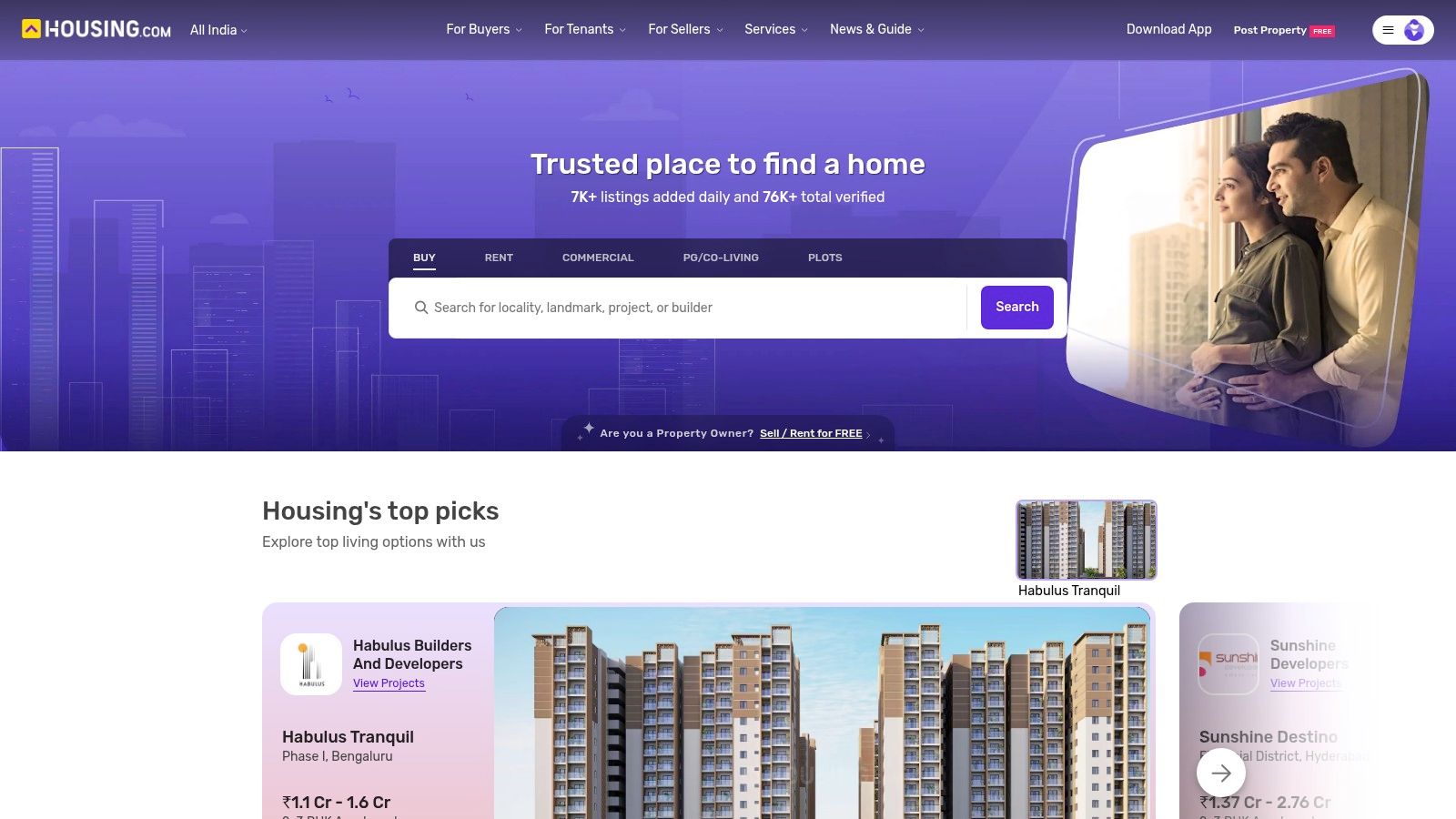
Housing.com sits close to Magicbricks in market role, but its positioning feels more analytics-led and mobile-first. For executives, that makes it relevant when the objective isn't just listing exposure but also helping buyers engage with price-trend and locality context earlier in the decision cycle.
That matters because many Indian real estate transactions slow down before site visits. Buyers struggle to compare micro-markets, assess pricing movement, and filter inventory with confidence. A platform that makes those decisions easier can reduce friction before your sales teams step in.
Best for analytics-led discovery
Housing.com's AI and ML-backed price-trend and locality insight features are its clearest differentiators. Combined with virtual and AR-led viewing, the platform is designed to make discovery feel more informed rather than purely promotional. That can be valuable for developers selling into markets where education and trust shape conversion as much as visibility.
Its usefulness increases when paired with disciplined internal processes. A buyer may arrive better informed, but your team still has to respond quickly, qualify accurately, and move the interaction forward. That's why Housing.com often makes sense as a channel layer, not a standalone AI strategy.
Executives should treat consumer discovery platforms as signal generators. The value comes from how well internal systems convert those signals into visits, offers, and retained customers.
Pros
- Data-forward buyer experience: Price-trend and locality insight can improve decision confidence.
- Strong consumer brand: Helpful for projects that need national digital reach.
- Immersive product elements: Virtual and AR viewing support richer early-stage engagement.
Cons
- Technical depth isn't fully public: Detailed model and integration specifics aren't broadly disclosed.
- Services are sales-led: Developer and broker solutions usually require direct commercial engagement.
Among AI real estate companies, Housing.com is best suited to organisations that want to strengthen discovery quality and buyer education rather than automate back-office or communication workflows. Explore Housing.com.
5. SuperArea.ai

SuperArea.ai tackles one of the most persistent weaknesses in Indian residential search. Trust. Most platforms compete on inventory breadth, advertising options, or visual presentation. SuperArea instead leans into verification, scoring, and guided assistance. That's a meaningful strategic distinction because poor trust signals create downstream sales costs, not just poor user experience.
For boards, the question is whether trust infrastructure changes commercial outcomes. In many markets, it does. If buyers distrust listings, your team spends more time re-explaining facts, defending credibility, and handling unqualified enquiries.
Best for trust-led buyer qualification
The platform's product framing is explicit: a 24/7 AI assistant, verification workflows, listing scores, and value estimates. That creates a more opinionated search experience than a broad marketplace. The commercial implication is that a trust-first model may reduce noise and improve buyer readiness, even if it doesn't yet match larger platforms for scale.
This aligns with a broader market gap. McKinsey's perspective, as reflected in the verified brief, highlights that much of the market conversation around AI in real estate still focuses on valuation, listings, and marketing, while operational bottlenecks and fragmented adoption remain under-addressed. SuperArea's verification-led approach is one way to attack that fragmentation from the buyer confidence side.
Pros
- Clear trust proposition: Verification and scoring address a widely felt market pain point.
- Lower-friction engagement: Chat-first guidance can help users move faster through initial questions.
- Differentiated positioning: More opinionated than generic search platforms.
Cons
- Ecosystem is still developing: Public detail on city depth and supply breadth remains limited.
- Scale is not the pitch: Teams seeking a mass-market listing engine may need a different platform.
SuperArea.ai is most relevant for operators that believe buyer confidence, not just buyer traffic, is the scarce asset. Review the product at SuperArea.ai.
6. Propli

Propli approaches the market from the buyer advisory side rather than the listing marketplace side. That's important because many AI real estate companies still assume the user wants more options. Propli assumes the user wants clearer judgment. That's a better fit for a market where buyers often struggle to compare projects, legal signals, and financing implications in one flow.
The platform combines property scoring, RERA and legal checks in the workflow, loan eligibility estimates, and chat-based site-visit booking. For CXOs, that makes it more analogous to a guided decision assistant than a conventional search tool.
Best for buyer-side advisory workflows
Propli's multilingual and voice-friendly experience is strategically relevant in India, where transaction readiness often depends on how clearly a product explains trade-offs to first-time or semi-informed buyers. A system that surfaces weak projects as well as attractive ones can also improve trust, though that depends on inventory coverage and operational consistency.
The broader lesson for leadership teams is this. AI adoption in real estate is accelerating, but it remains early in operational maturity. As noted in the verified brief, firms are still moving from exploration to deployment, with AI being used more to improve efficiency than to replace core brokerage workflows. Propli fits that pattern well. It guides and informs rather than trying to automate the entire transaction.
Pros
- Decision support over pure discovery: Strong fit for buyers needing comparative clarity.
- Integrated workflow elements: Eligibility checks and booking in one interface reduce drop-off points.
- Language accessibility: Multilingual and voice capabilities can widen usability.
Cons
- Geographic expansion is ongoing: Coverage appears to be developing beyond its initial market focus.
- Commission model affects dynamics: Builders fund monetisation, so teams should assess incentives carefully.
Propli is worth considering if your organisation wants AI to shape buyer understanding before human sales intervention. Visit Propli.
7. TheLAL

TheLAL is one of the few tools in this list that appears designed around broker realities instead of platform abstractions. That matters in India because the market remains fragmented and workflow-heavy. Many agents and local broker teams don't need another massive listing universe. They need faster inquiry handling, more usable search, and a cleaner way to manage conversations and opportunities.
Its product approach reflects that. Natural-language search, Hindi and Hinglish support, saved chat history, lead dashboards, and broker-oriented work management suggest a practical focus on daily execution rather than broad consumer brand play.
Best for broker productivity
For board members overseeing channel sales, affiliate networks, or distributed brokerage teams, TheLAL deserves attention because productivity tools often create more durable gains than top-line marketplace exposure alone. A broker who can identify intent faster and respond with less friction becomes more effective without changing the core sales model.
That lines up with PwC's broader point from the verified brief that AI in real estate is currently most useful when it augments human experts and standardises routine work. TheLAL appears to fit squarely in that augmentation layer.
A broker tool doesn't need to be perfect to be valuable. It needs to remove enough repetitive coordination work that agents spend more time advising and closing.
Pros
- India-specific workflow design: Language support and mobile-first interaction fit actual field usage.
- Broker-centric orientation: Good match for fragmented, relationship-led markets.
- Useful operational memory: Chat history and dashboards can reduce dropped context.
Cons
- Feels early-stage: Some elements still appear to be maturing.
- Pricing isn't transparent publicly: Commercial evaluation requires direct contact.
TheLAL is best viewed as a productivity layer for teams that win through responsiveness and relationship continuity. Explore TheLAL.
8. Ishanya AI
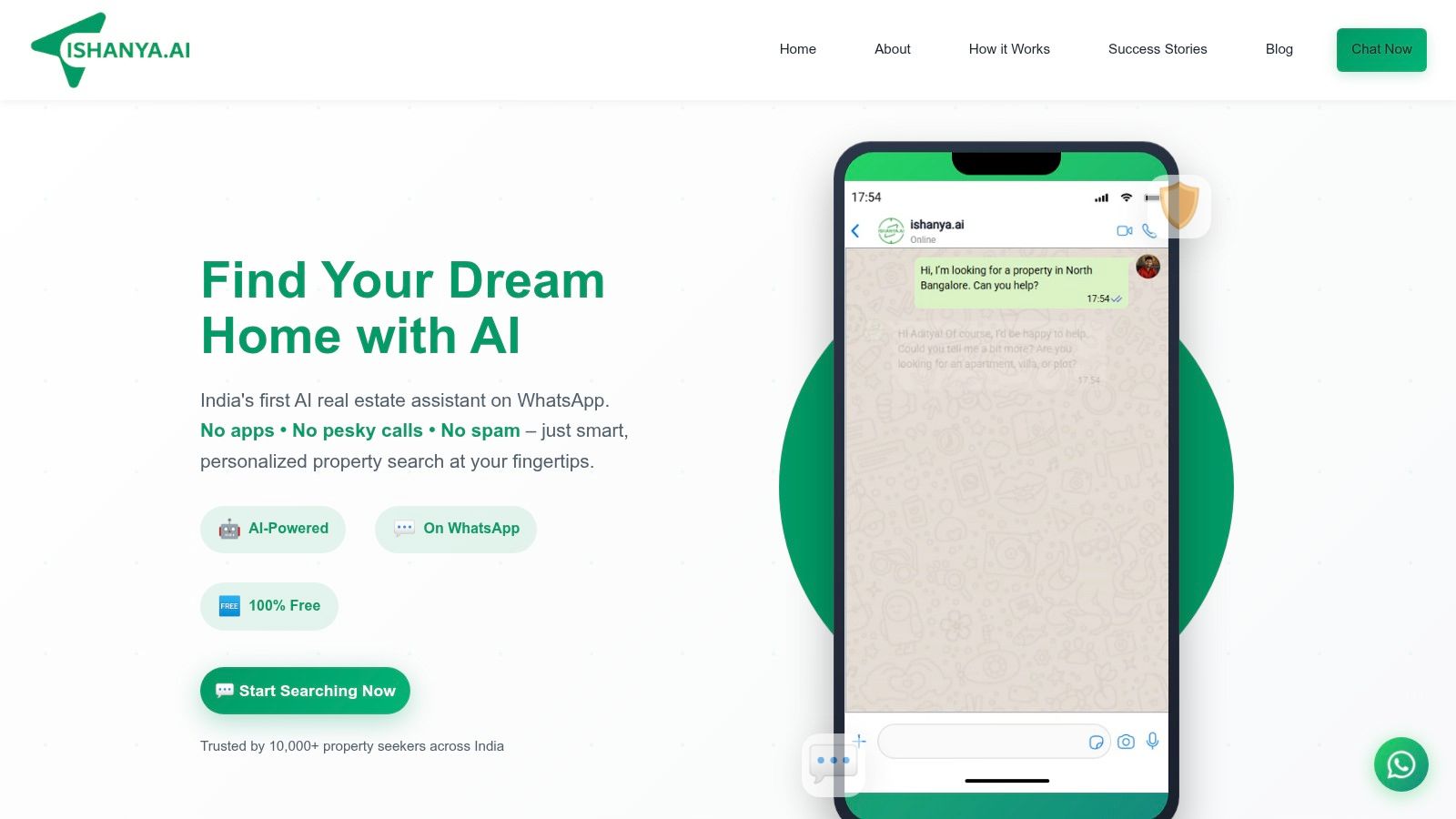
Ishanya AI takes a cleaner, narrower position than most platforms in this market. It operates through WhatsApp and emphasises privacy-first discovery with curated suggestions rather than broad listing overload. That sounds simple, but it solves a real problem. Many buyers want exploratory guidance without instantly triggering agent calls and aggressive follow-up.
From a strategic standpoint, that makes Ishanya less relevant as an enterprise sales engine and more relevant as a model of low-friction buyer engagement. Some organisations will dismiss that as too lightweight. That would be a mistake. In high-noise categories, reducing friction can be a differentiator.
Best for privacy-first conversational discovery
The strongest part of Ishanya's proposition is behavioural. It recognises that many buyers aren't ready to speak to an agent during initial exploration, but they still want relevance and speed. A WhatsApp-native interface also lowers adoption barriers because it meets users in a familiar channel instead of forcing app downloads or platform learning.
That said, executive teams should be realistic. The model's effectiveness will depend heavily on inventory integrations and recommendation quality. Without strong supply access, a privacy-friendly interface won't create enough value on its own.
Pros
- Low-friction adoption: WhatsApp is a natural entry point for many Indian users.
- Privacy-led positioning: Useful for buyers who want control over contact.
- Curated experience: Helps avoid overwhelming users with raw search results.
Cons
- Depth depends on integrations: Supply quality and breadth are still a key variable.
- Less suited to enterprise workflow control: Best seen as a discovery front end, not a full operating layer.
Ishanya AI is one of the more distinctive AI real estate companies because it optimises for buyer comfort rather than platform sprawl. Review Ishanya AI.
9. PropCent
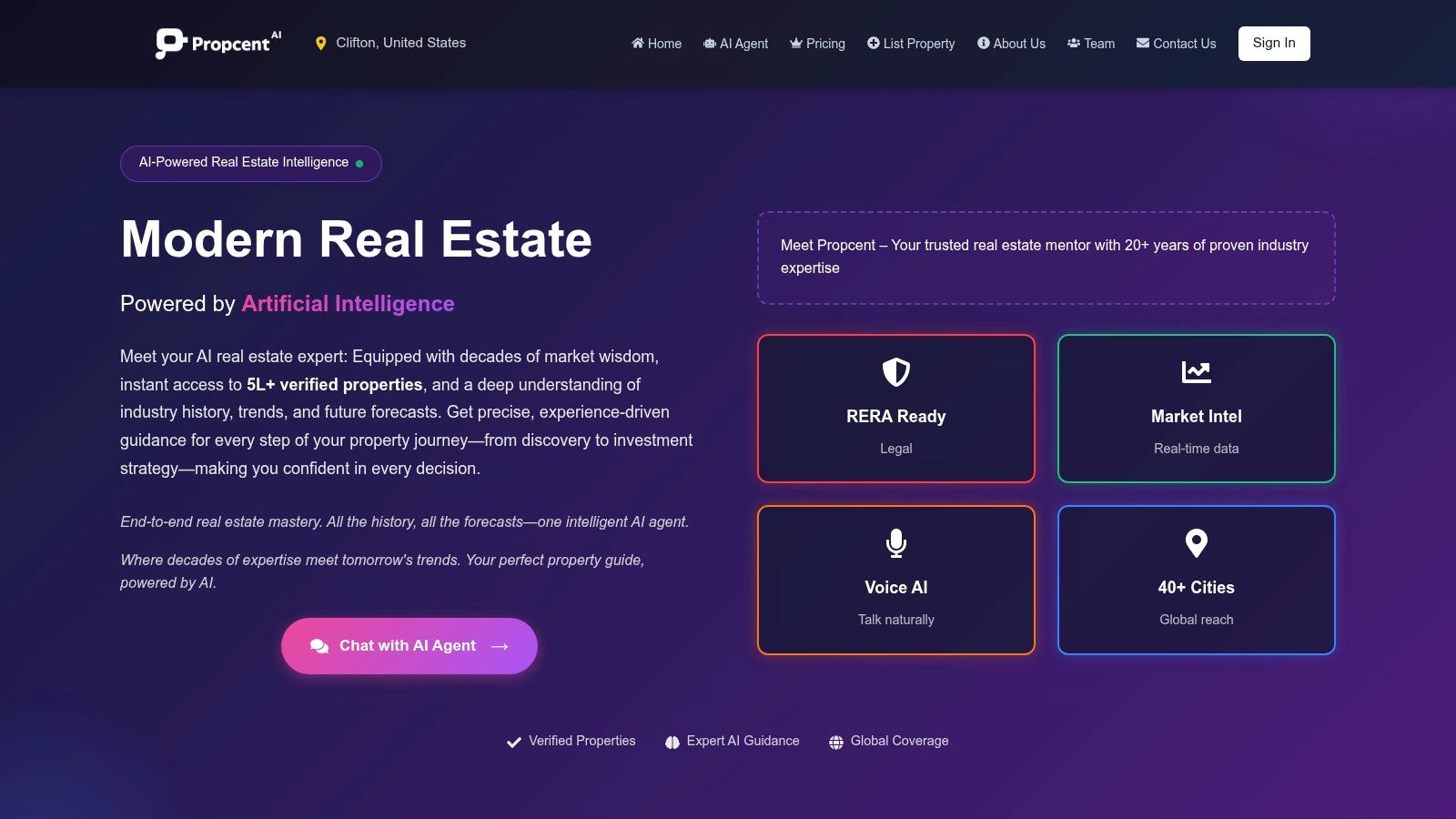
PropCent positions itself as an AI property mentor, which is a more useful framing than it first appears. The term suggests guided progression rather than simple search, and that's consistent with its feature set: conversational discovery, market insight, RERA and legal guidance, location intelligence, voice AI, and AR or VR hooks.
This makes PropCent relevant for firms that believe the next competitive edge lies in reducing buyer confusion across discovery, evaluation, and compliance awareness. In other words, the product is trying to bridge information asymmetry, not just improve interface design.
Best for guided discovery plus compliance nudges
One reason PropCent stands out is its attempt to connect aspirational and procedural parts of the journey. Many tools either inspire buyers visually or overwhelm them with legal and location detail. PropCent tries to do both. If executed well, that can increase confidence without pushing the customer into a detached research loop.
The caution is commercial maturity. Public pricing clarity still appears to be evolving, and some details remain unfinished. For a board, that doesn't rule the company out. It means diligence should instead focus on product depth, data quality, and implementation reliability rather than brand polish.
Pros
- Broad buyer guidance: Connects search, market insight, and compliance cues.
- Multiple interaction modes: Voice AI and immersive viewing support different user preferences.
- Verified-supply orientation: Helpful where credibility is central to conversion.
Cons
- Pricing clarity is still developing: Procurement teams may need a more bespoke evaluation.
- Public product detail is still maturing: Some areas need closer validation before scale rollout.
PropCent is best suited to teams that want an advisory-style interface to improve qualified discovery. Visit PropCent.
10. RealtyBlocks
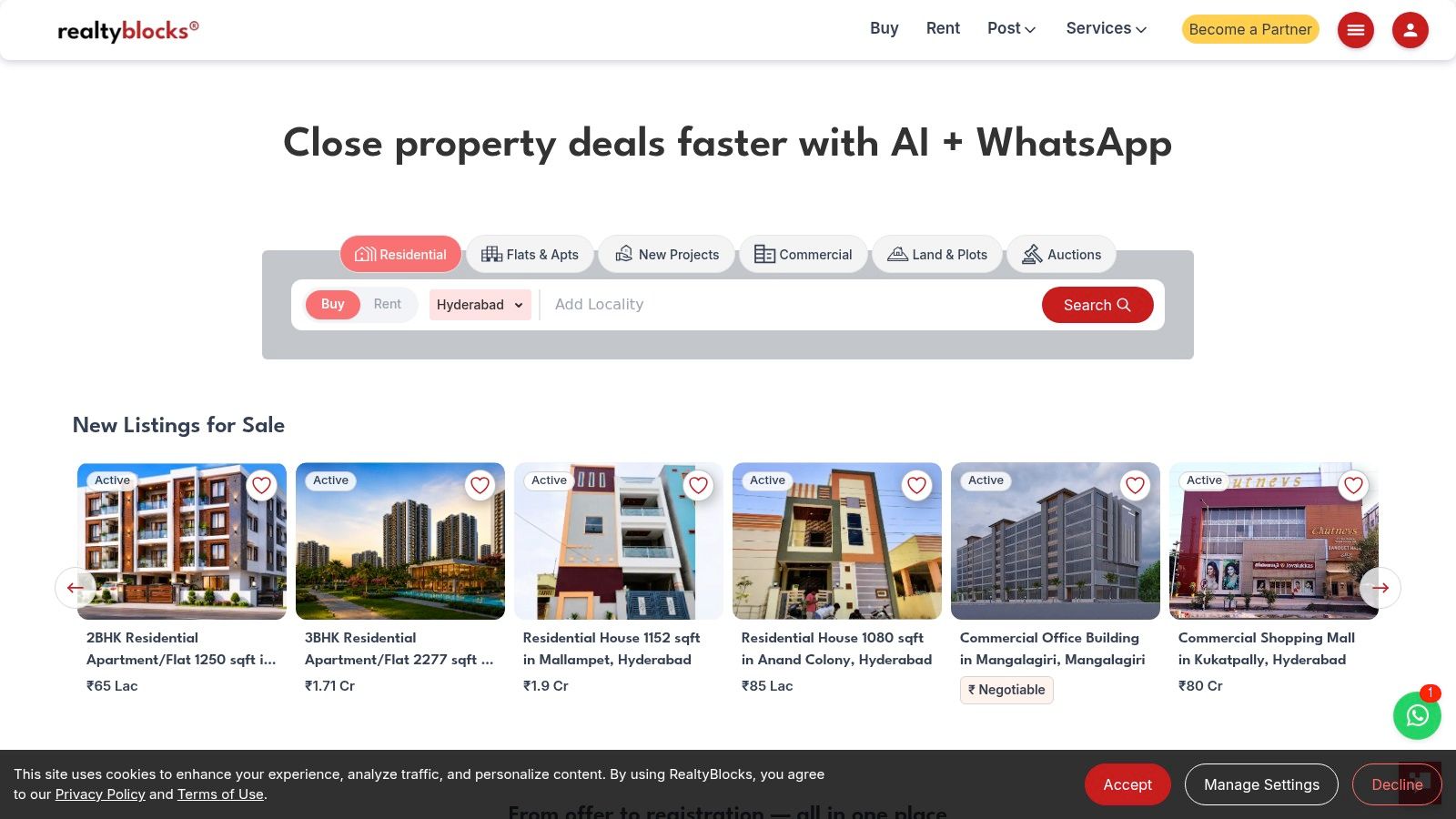
RealtyBlocks rounds out this list from a marketing amplification angle. Its focus appears to be targeted search results, personalised alerts, listing distribution, social syndication, and educational content, including material that speaks to NRI buyers. That places it closer to a visibility enhancer than a workflow automation platform.
That isn't a weakness. It serves a different executive problem. Some firms don't need another advisory bot or valuation model. They need better discoverability among the right audiences.
Best for marketing amplification
RealtyBlocks is most useful when your strategic priority is project exposure and buyer targeting rather than operational redesign. Personalised placement and alerting can help listed inventory gain more precise attention, especially when combined with educational content for audiences that need more context before engaging.
Its limitation is the inverse of that strength. Public technical detail about underlying AI and integrations is relatively limited, so the platform should be assessed by practical campaign outcomes and audience alignment rather than technology language alone.
If your problem is weak qualified visibility, marketing amplification tools matter. If your problem is slow follow-up, they won't fix it.
Pros
- Clear demand-generation role: Good fit for projects seeking stronger digital visibility.
- NRI-friendly positioning: Helpful for cross-border buyer education.
- Distribution-oriented approach: Supports broader listing reach across channels.
Cons
- Technical transparency is limited: Teams may need deeper diligence on product mechanics.
- Commercial terms are likely customised: Expect a sales-led process for packages.
RealtyBlocks belongs in the acquisition and visibility segment of AI real estate companies, not the execution or analytics segment. Explore RealtyBlocks.
Top 10 AI Real Estate Companies: Features Comparison
| Solution | Core features ✨ | Experience / Impact ★ | Value & Pricing 💰 | Target Audience 👥 | USP / Strengths 🏆 |
|---|---|---|---|---|---|
| 🏆 DialNexa Labs Private Limited | Human-like Voice AI agents; ready-made personas; API + dashboard | ★★★★★; Connect ↑47→91%; 97% AI–human parity; multi-min calls | 💰 Transparent pricing; no-pressure signup; reduces ops cost | 👥 Enterprise & mid-market: EdTech, BFSI, real‑estate, hospitality, e‑commerce, SaaS, contact centres | ✨ Scales thousands/day; fast-to-launch industry templates; regulatory-ready |
| Square Yards | E-Valuation; PropVR (3D/AR/VR); Data Intelligence | ★★★★☆; Enterprise-grade analytics & valuation | 💰 Enterprise / sales-quoted; strong for large contracts | 👥 Lenders, investors, enterprises, developers | ✨ AI valuation + immersive VR; documented GenAI partnerships |
| Magicbricks | Reach Maximizer; matchmaking engine; virtual tours | ★★★★☆; Massive traffic & ad amplification | 💰 Paid advertiser packages (sales-quoted) | 👥 Developers, agents, advertisers | ✨ Large audience scale; algorithmic campaign reach |
| Housing.com | Price-trend & locality insights; AR/virtual viewing | ★★★★☆; Mobile-first, data-driven discovery | 💰 Sales-led developer/broker plans (not public) | 👥 Buyers & developers seeking analytics-led discovery | ✨ Strong mobile reach; price-trend analytics |
| SuperArea.ai | 24/7 AI assistant; SuperVerification; SuperScore/Estimates | ★★★★☆; Trust-first UX; chat-focused | 💰 Early-stage / pricing limited publicly | 👥 Buyers & developers prioritizing verified listings | ✨ Verification-first; clear scoring and chat UX |
| Propli | AI-scored properties (0–100); RERA/legal checks; multilingual voice | ★★★★☆; Transparency-focused; buyer-first scoring | 💰 Builders pay commission; city-first rollout | 👥 Buyers (India), regional-language users | ✨ Explainable scores; integrated eligibility & booking |
| TheLAL | AI chat for search; broker workflows; lead dashboards | ★★★☆☆; Broker-centric productivity tools | 💰 Pricing via contact / early-access | 👥 Brokers & brokerage teams | ✨ Hinglish/Hindi support; mobile-first broker tools |
| Ishanya AI | WhatsApp-native discovery; privacy-by-design; curated suggestions | ★★★☆☆; Frictionless chat UX; free for buyers | 💰 Free for buyers; partner-dependent integrations | 👥 Privacy-conscious buyers on WhatsApp | ✨ No unsolicited agent calls; WhatsApp-native flow |
| PropCent | NLP chat; market insights; RERA/legal guidance; voice AI | ★★★☆☆; End‑to‑end discovery + compliance nudges | 💰 Pricing TBA; early product details | 👥 Buyers & developers seeking compliance support | ✨ Emphasis on verified supply & documentation guidance |
| RealtyBlocks | AI-targeted search; listing distribution; marketing amplification | ★★★☆☆; Marketing-focused visibility & alerts | 💰 Sales-quoted marketing packages | 👥 Sellers, developers, NRI buyers | ✨ Marketing amplification & NRI-oriented content |
The Executive Takeaway Building Your AI-Powered Future
A key lesson from this market isn't that one company wins every category. It's that most boards are still asking the wrong question. “Which AI real estate company is best?” is too broad to be useful. The better question is, “Which business constraint are we trying to remove first?” The answer usually falls into one of four buckets: demand generation, lead conversion, decision support, or broker and buyer productivity.
That framing matters because the companies above serve very different layers of the operating model. Square Yards plays more naturally in analytics, valuation, and enterprise infrastructure. Magicbricks, Housing.com, and RealtyBlocks operate closer to visibility and demand creation. SuperArea.ai, Propli, Ishanya AI, PropCent, and TheLAL improve different forms of guided discovery, trust, or broker productivity. DialNexa is distinct because it addresses a recurring commercial leak between marketing spend and human sales action: what happens after an enquiry arrives.
For Indian operators, that gap is often the fastest place to create measurable financial impact. The verified brief makes the broader context clear. AI adoption is growing, but the market is still early and fragmented. Firms are using AI more to improve efficiency than to replace human expertise. That means the strongest investments usually support existing teams with better qualification, standardisation, data handling, and communications rather than trying to automate the full transaction lifecycle.
A practical board-level roadmap looks like this:
- If lead volume is already healthy: Prioritise conversion infrastructure. That includes voice AI, scheduling, follow-up automation, and CRM-linked qualification.
- If pricing discipline is weak: Invest in valuation and analytics platforms that improve underwriting, portfolio review, and local market interpretation.
- If brokers are overloaded: Add tools that improve search, communication memory, and task handling for field teams.
- If buyer trust is low: Favour verification-first and advisory-style platforms that reduce confusion before human intervention.
- If visibility is the issue: Use marketplace and amplification layers, but don't expect them to solve execution failures downstream.
This is also where integration discipline becomes decisive. AI creates the most value when each system plays a defined role. A marketplace should generate discoverable demand. Analytics tools should improve pricing, market selection, and portfolio decisions. Broker tools should reduce operational drag. Communication AI should turn interest into scheduled action and qualified next steps. When those layers are disconnected, executives get isolated pilots and attractive demos. When they are connected, they get throughput.
One more point deserves emphasis. AI strategy in real estate shouldn't start with brand selection. It should start with process mapping. Where do leads stall? Where do brokers waste time? Where does data get re-entered, delayed, or lost? Which decisions depend on judgement but still suffer from poor inputs? The firms that answer those questions accurately will choose better vendors than the firms that chase the loudest AI narrative.
The leaders of the next cycle won't be the ones with the most AI tools. They'll be the ones that assemble the most coherent AI operating stack. In that stack, specialised systems often create more value than broad claims. For many Indian real estate businesses, the greatest benefit won't come from another listing feed. It will come from connecting demand, insight, and conversation into one disciplined revenue engine.
If your team is evaluating where AI can improve real estate conversion without forcing a major systems overhaul, DialNexa Labs Private Limited is a strong place to start. Its voice AI approach fits the part of the funnel where many developers, brokers, and sales teams lose revenue: first response, qualification, follow-up, and site-visit booking. For CXOs who want measurable operational advantage instead of another generic AI layer, DialNexa offers a practical path to augment existing teams, integrate with core workflows, and turn more enquiries into conversion-ready opportunities.

Excellent analysis with a clear distinction between AI tools for demand generation, conversion, analytics, and buyer experience in the Indian real estate ecosystem. The practical pros, cons, and strategic positioning make this a highly valuable guide for business leaders evaluating proptech investments.