

AI for Real Estate: A CXO’s Guide to Strategic Growth
AI can automate a meaningful share of real-estate work. For developers and brokers, the strategic value is not only lower cost. It is faster response times, tighter qualification, and better conversion from inquiry to site visit, an operating gap that still erodes revenue across the sector.
In Indian real estate, that gap matters more than the top of the funnel. Digital campaigns can generate attention at scale, but interest does not become inventory absorption until a buyer answers the phone, gets qualified, and commits to visiting a project. Many firms have improved ad targeting and website engagement, yet handoffs after the first inquiry remain inconsistent. Chatbots collect leads. Sales teams still spend time chasing low-intent prospects, missing callbacks, and handling repetitive screening manually.
That is why AI should be evaluated as an operating system for demand conversion, not only as a marketing tool.
The strongest use case sits in the middle of the funnel, where speed and consistency determine whether an expensive lead turns into a qualified conversation. Voice AI is increasingly relevant here because it can handle high-volume inbound and outbound conversations, verify intent, answer common questions, and schedule follow-ups without waiting for an agent to become available. For a CEO, the implication is direct. The companies that reduce response lag and improve site-visit qualification will likely gain more from AI than companies that use it only for content generation or chatbot automation.
For executives assessing the category, innovative real estate AI insights offer a useful view of how AI is shifting from isolated tools to process-level redesign. The strategic question is where AI produces measurable gains first, while keeping data handling, governance, and customer experience under control.
Table of Contents
- The New Competitive Edge in Indian Real Estate
- Core AI Applications Transforming Property Lifecycles
- Quantifying the Impact The Measurable ROI of AI
- From Chatbots to Conversations The Rise of Voice AI
- A Strategic Roadmap for AI Implementation
- Navigating Risk Data Compliance and AI Governance
- Selecting Your AI Partner A CXO Checklist
The New Competitive Edge in Indian Real Estate
India's real estate market is on track to become a US$1 trillion sector by 2030. At that scale, the competitive question is no longer who generates the most digital interest. It is who converts that interest into qualified site visits without adding cost and delay at every step.
That operating gap is where many firms underperform. Marketing systems can produce leads at volume. CRM workflows can log them. Basic chatbots can answer common questions. Yet site visit conversion often remains dependent on delayed callbacks, uneven lead qualification, and sales teams spending peak hours on repetitive first-contact tasks instead of high-value conversations.
For a CEO, that is not a minor process issue. It is a revenue and productivity issue. If two developers buy comparable traffic, the one that identifies buying intent faster, confirms budget and location fit earlier, and schedules the right visit first will usually get more value from the same marketing spend.
The strategic shift is straightforward. AI should be treated as operating infrastructure across the response layer, not only as a marketing tool. In practice, that means using AI to reduce manual work in enquiry handling, buyer profiling, project matching, and follow-up orchestration, while reserving human teams for persuasion, objection handling, and closing.
A second implication is easy to miss. Digital demand does not fail only at the top of the funnel. It leaks most heavily between first enquiry and physical visit. That is why the next wave of advantage in Indian real estate is likely to come less from prettier ad targeting and more from systems that can hold a real conversation, qualify intent, and move buyers toward a confirmed appointment. For firms examining this operational problem, data strategies for real estate calling and lead conversion offer a more relevant lens than campaign metrics alone.
Buyer expectations are also changing. As noted earlier, AI-assisted property discovery is becoming normal in mature digital markets. Indian firms should read that as an early signal. Once buyers get used to instant, context-aware responses, tolerance for slow callbacks and generic follow-ups drops sharply.
Buyers compare your response speed and relevance with the best digital experience they had this week, not only with another developer.
For leaders who want broader context on the field, these innovative real estate AI insights are useful because they show how AI use cases span discovery, operations, and decision support rather than one isolated tool category.
The strategic implication for CXOs
Three implications follow.
- The bottleneck has shifted to conversion operations: Growth depends not only on inventory and demand generation, but on how fast the organisation can turn enquiries into qualified site visits.
- Role design needs to change: Sales teams should spend less time on repetitive screening and more time on consultative conversations with buyers who meet clear criteria.
- Speed affects margins: Faster qualification and cleaner routing reduce wasted follow-up, lower acquisition cost per serious prospect, and improve sales team productivity.
Firms that build AI into the operating model will gain an execution advantage before negotiation even begins. Firms that limit AI to campaign support will automate the top of the funnel and still lose buyers in the middle.
Core AI Applications Transforming Property Lifecycles
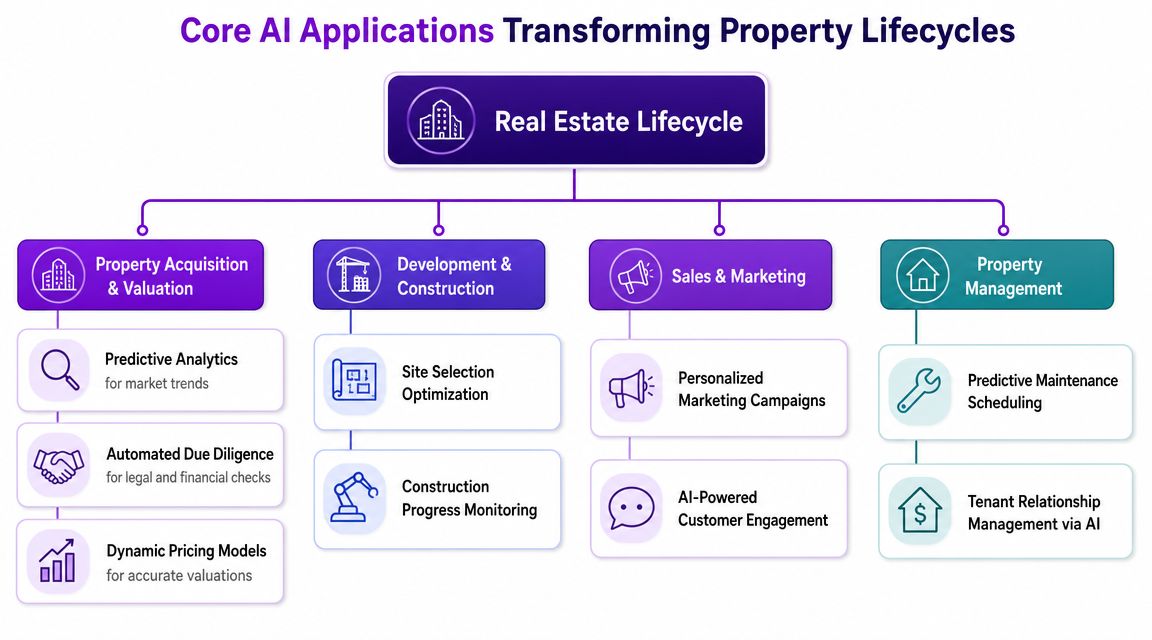
AI creates value in real estate when it is tied to a specific operating decision: which lead deserves a human call, which asset is priced off-market, and which enquiry is ready for a site visit.
Lead qualification shifts from form capture to intent scoring
The first high-value use case is not content generation. It is triage.
Real estate teams already spend heavily to generate digital enquiries across portals, paid media, and project sites. The operating problem starts after the lead arrives. Many prospects are unresponsive, under-budget, outside the project catchment, or researching far ahead of purchase. If every enquiry enters the same callback queue, sales productivity falls and serious buyers wait too long.
AI improves that middle layer. Models can read free-text requirements, classify budget fit, detect urgency from browsing patterns, and route enquiries by likely purchase intent. A buyer comparing possession-ready inventory, requesting loan support, and revisiting floor plans deserves a different workflow from a casual browser scanning premium listings across multiple cities.
That distinction matters because the revenue event is rarely the first click. It is the qualified site visit.
For teams reviewing tooling options, it helps to compare top AI lead generation platforms by workflow fit rather than by generic feature lists alone. The best system is the one that improves screening speed, routing accuracy, and salesperson utilisation.
Valuation becomes a data quality problem before it becomes a model problem
Valuation is one of the few AI applications with direct strategic consequences for acquisition, pricing, and inventory release decisions. Automated valuation models can process more variables than manual broker-led methods, but their output is only as good as the underlying data structure.
In India, that structure is often weak. Relevant inputs sit across transaction records, municipal datasets, broker feeds, project launch histories, and location-specific amenity data. If naming conventions, geo-tags, and unit specifications are inconsistent, the model does not remove market noise. It scales it.
The management implication is straightforward. Data normalisation should come before model customisation. A company that standardises project, unit, transaction, and location data will usually get more value from a basic model than a competitor running a more advanced model on fragmented inputs.
Analysts at MRI Software cite examples of modern automated valuation systems achieving very low error rates in benchmark settings in their analysis of how big data and AI are changing real-estate investment strategy. That benchmark is not India-specific, but it shows what becomes possible when input quality is tightly controlled.
Customer experience becomes conversion operations
The most misunderstood AI use case in residential real estate is customer experience. Many firms still define it as automated answers to project FAQs. That understates the business problem.
The larger gap sits between digital interest and scheduled site visits. Website chatbots and campaign automation can capture attention at the top of the funnel, but they often fail at the harder task: qualifying seriousness, handling objections in real time, and moving the buyer to a committed next step. That is why many developers report healthy enquiry volumes while sales teams still struggle to fill visit calendars with decision-ready prospects.
AI works better here when it is configured as a routing and engagement system. It should identify the next best action, assign the right channel, and preserve context across touchpoints. For one prospect, that may mean a financing callback. For another, it may mean rescheduling a missed visit or escalating to a sales manager after repeated high-intent behaviour.
Execution depends on data discipline. This guide on data for real-estate calling explains why field quality, lead tags, and routing logic shape call outcomes as much as the calling layer itself. Cleaner records produce sharper qualification and fewer wasted conversations.
Across the property lifecycle, the strongest AI deployments do three things well. They reduce time spent on low-probability leads, improve the quality of pricing and location decisions, and increase the share of enquiries that become qualified site visits.
Quantifying the Impact The Measurable ROI of AI
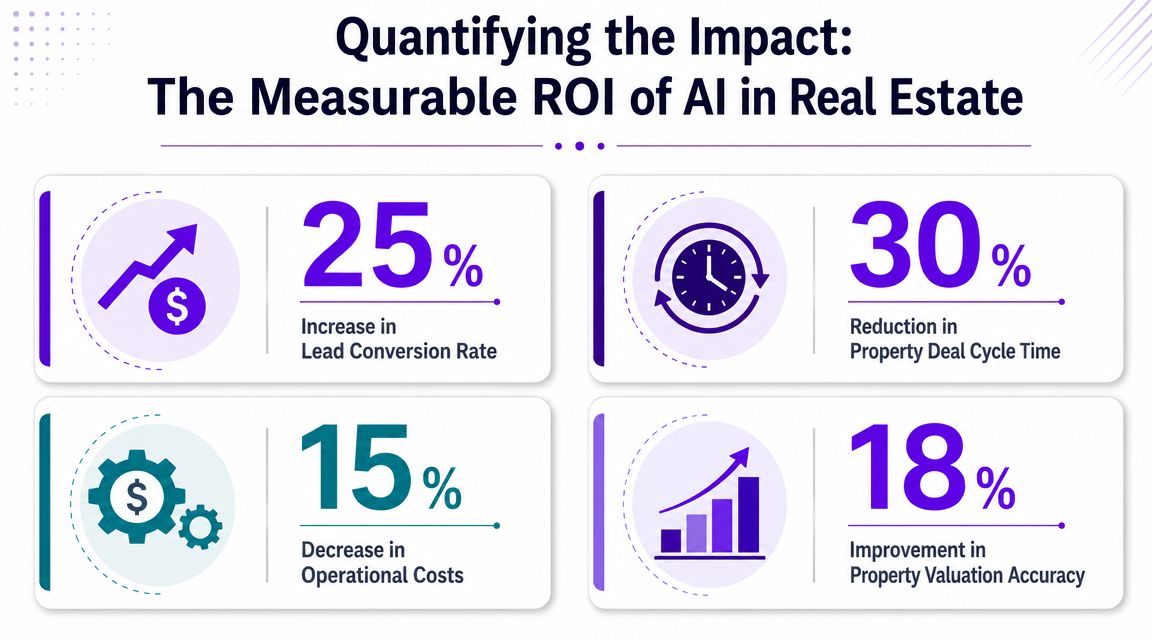
Morgan Stanley Research estimates that AI could automate 37% of tasks in real estate and generate US$34 billion in operating efficiencies by 2030. For a real-estate CEO, that headline matters less as a technology forecast and more as a margin signal. The firms that translate AI into lower servicing cost per lead, faster decision cycles, and better use of sales capacity will widen the gap on competitors still treating AI as a marketing feature.
The ROI case becomes stronger when measured at the operating-model level. Real estate companies do not lose value only through large strategic errors. They lose it through small, repeated frictions: delayed lead response, low-yield follow-ups, incomplete qualification, poor routing, and underused sales bandwidth. AI improves economics when it removes those frictions at scale.
A visual summary helps put the ROI conversation in business terms.
Where the savings originate
The largest gains usually appear in four operating areas.
- Labour reallocation: Repetitive work such as enquiry handling, follow-up scheduling, and status updates shifts from sales staff to automated systems.
- Staffing efficiency: As noted earlier, Morgan Stanley cites examples of lower on-property labour hours through AI-assisted staffing optimisation.
- Infrastructure efficiency: The same research highlights HVAC optimisation and energy-efficiency programmes as meaningful cost levers.
- Decision speed: Teams spend less time gathering inputs and more time acting on qualified information.
That mix produces a better return profile than simple headcount reduction. Real advantage comes from using expensive human capacity on negotiation, objection handling, and closing activity rather than on administrative repetition.
This is especially relevant in Indian residential sales, where the operational gap is rarely lead generation alone. Marketing platforms can produce enquiries. Revenue depends on whether the business can turn those enquiries into qualified site visits. If AI reduces response lag but fails to assess seriousness, answer context-specific questions, and secure the next step, the company improves activity volume without improving conversion economics. A well-designed AI voice agent for real estate lead qualification and site-visit booking addresses that gap more directly than a basic chatbot.
This short video gives an additional visual perspective on AI's role in real estate operations.
Why ROI compounds operationally
The first return is easy to see. Fewer manual touches per lead or asset.
The more important return comes later. Once repetitive steps are handled consistently, the firm starts generating cleaner operational data across enquiry sources, qualification outcomes, missed callbacks, visit bookings, and objection patterns. That data improves routing, staffing plans, media allocation, and project-level forecasting. Competitive advantage grows because execution becomes more predictable.
A residential developer can start with AI on inbound qualification and quickly learn which projects attract financing-dependent buyers, which catchments produce faster visit intent, and which objections block progression before a site visit. Those insights improve channel spend and sales deployment without waiting for a full platform rebuild.
For operators focused on everyday margin discipline, this perspective on how landlords save time and money with AI is useful because it frames value around routine process efficiency rather than speculative transformation.
The strongest AI ROI appears when a company removes friction from dozens of daily tasks that used to consume human follow-up, then uses the resulting data to improve conversion and resource allocation.
From Chatbots to Conversations The Rise of Voice AI
A large share of real estate demand generation now happens online, yet revenue still depends on a narrower operational outcome. A qualified conversation that ends in a site visit. That gap between digital interest and physical visit scheduling is where many AI programs underperform.
Content AI and chatbot automation help at the top of the funnel. They write listings faster, answer basic queries, and support always-on engagement. They do far less to solve the harder execution problem inside Indian real estate sales operations. How to contact an enquiry quickly, collect the missing qualification data, resolve basic hesitation, and secure the next commitment before buyer intent fades.
Why chatbots stall in the middle of the funnel
The mid-funnel is conversational, not transactional.
A prospect who downloads a brochure or fills a form usually has several unresolved questions at once. Budget range. Possession timing. Loan dependence. Preferred unit type. Commute. School access. Visit timing. In practice, these inputs arrive in fragments, often across multiple languages and with incomplete answers. Text chat struggles here because it asks the buyer to type more, clarify more, and stay engaged longer than many will tolerate.
That creates a measurable operating problem even without citing a new industry statistic. Marketing systems produce leads at scale, but sales teams still spend time reconstructing context from missed calls, half-filled forms, and fragmented chat histories. The result is slower first response, lower contact rates, and weaker site-visit conversion.
What voice AI changes
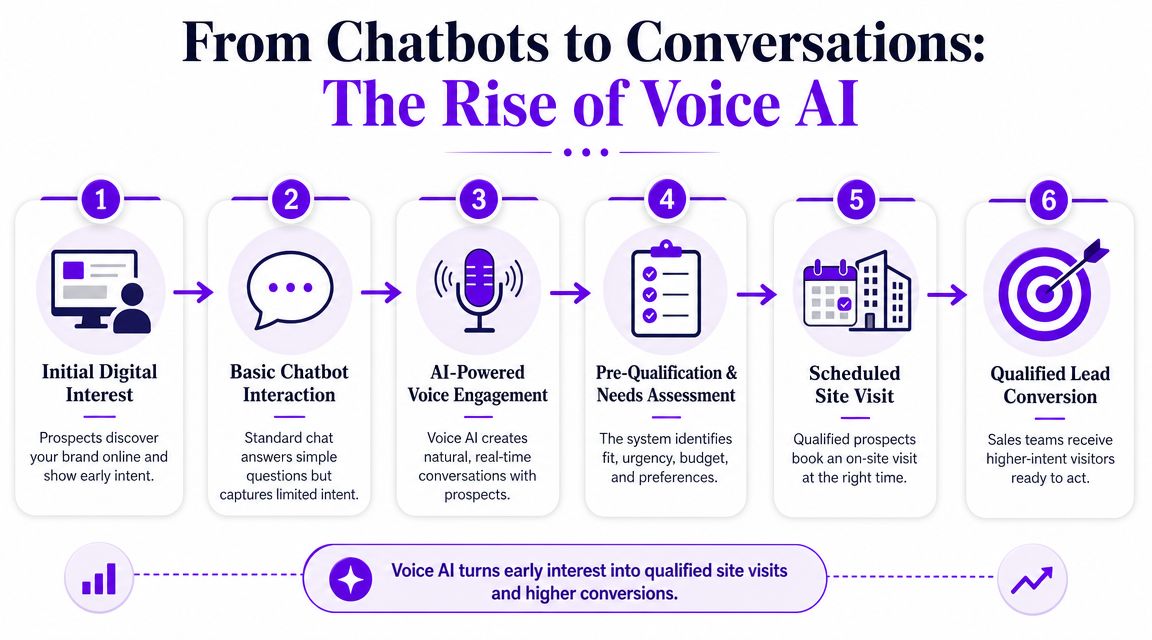
Voice AI addresses the point where standard automation loses momentum. It can initiate contact immediately, gather qualification details in a natural sequence, answer common project questions, and pass a structured outcome into the CRM for human follow-up or direct booking.
A practical workflow looks like this:
- Inbound trigger: A prospect submits a form, clicks on an ad, or misses a callback.
- Immediate outreach: The voice agent calls while purchase intent is still recent.
- Qualification capture: It checks budget, locality, timeline, property type, financing need, and language preference.
- Fit assessment: The system matches the enquiry to relevant inventory or identifies a mismatch early.
- Action completion: It books a site visit, schedules a sales callback, or routes the lead to the right team.
- Structured handoff: The call summary and disposition sync back to the CRM.
The economic objective is not to answer more questions, but rather to increase the share of enquiries that progress to a committed next step.
For teams assessing how this model works in live sales operations, this guide to an AI voice agent for real estate is useful because it focuses on qualification, follow-up, and booking workflows rather than general automation.
Where executives should start
The highest-return use case is usually the first conversation after lead capture. That is where delay is expensive and where human teams are often least consistent.
Voice AI tends to produce the clearest business case when four conditions exist:
- High enquiry volume: Sales teams cannot call every lead fast enough.
- Repeated discovery questions: Agents spend large portions of the day collecting the same inputs.
- Project complexity: Correct routing depends on budget, micro-market, inventory fit, or financing readiness.
- Frequent follow-up leakage: Prospects drop out between initial interest and appointment setting.
One example in the market is DialNexa Labs Private Limited, which provides voice AI agents for workflows including lead qualification, follow-ups, and site-visit booking in real-estate sales processes. The strategic point for a CXO is the operating model, not the vendor label. If AI handles repetitive early-stage conversations with consistent logic and full audit trails, human sales capacity shifts toward higher-value work such as objection handling, negotiation, and visit conversion.
Real estate firms do not have a lead generation problem alone. Many have a lead progression problem between enquiry and site visit. Voice AI is valuable because it reduces that gap at scale.
A Strategic Roadmap for AI Implementation
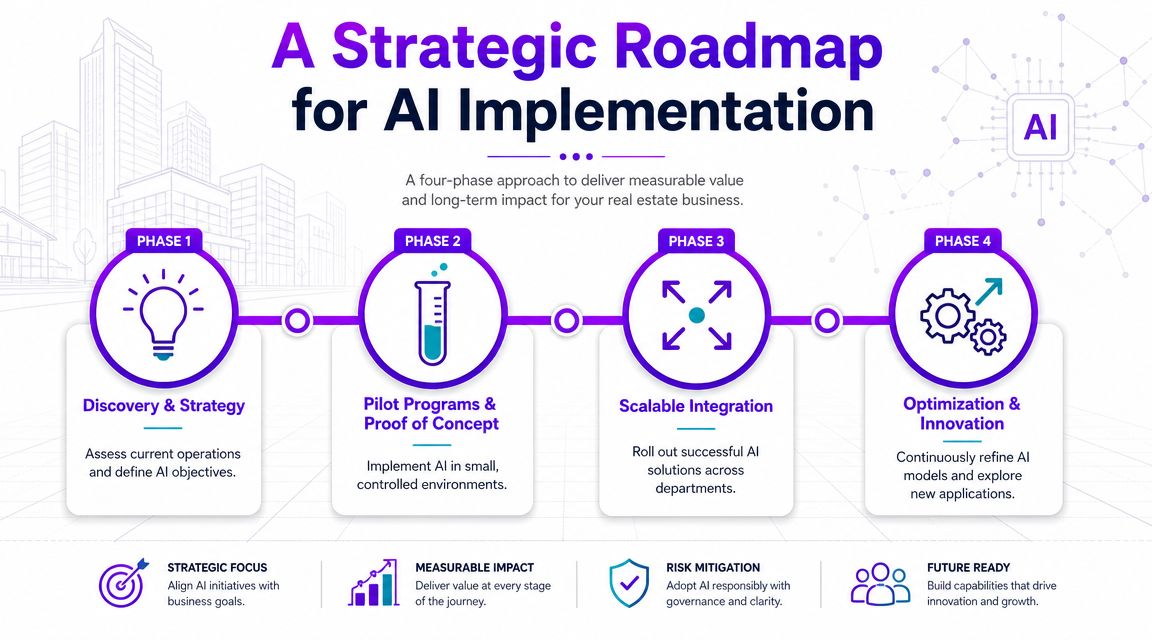
AI implementation fails when firms start with technology procurement instead of workflow design. The better sequence is narrower and more disciplined. Begin with one high-friction process, prove value, then standardise.
Phase one proves the business case
A strong first pilot usually sits inside lead qualification, appointment setting, or follow-up management. These workflows are repetitive, measurable, and close to revenue.
Executive teams should define success in operational terms before launch. Good pilot questions include:
- Which workflow breaks first under scale
- Where do human teams spend time on repetitive conversations
- What decision or handoff should the AI complete before a human intervenes
The pilot should also define key parameters. Which questions can the system answer? Which claims require escalation? Which outcomes count as successful completion?
For firms exploring how agents use AI in field selling and follow-up, this resource on AI for real-estate agents is useful because it ties automation to day-to-day sales execution rather than abstract transformation language.
Phase two standardises the operating model
Once the pilot works, the next challenge isn't scale. It's consistency.
That means codifying the workflow into playbooks, CRM fields, routing logic, and exception handling. If one project qualifies by budget and possession timeline while another uses unstructured notes, leadership won't get comparable performance data. Standardisation is what turns a successful pilot into a management system.
A practical phase-two checklist often includes:
- CRM integration: Push summaries, lead status, and disposition tags into the system of record.
- Prompt and script control: Keep qualification logic aligned across projects and campaigns.
- User training: Sales managers need to know how to interpret AI outputs and escalation notes.
- Review cadence: Audit conversation samples and routing outcomes regularly.
Phase three scales with governance
Enterprise rollout should happen only after workflow discipline is in place. Otherwise the company scales inconsistency.
At this stage, leaders should formalise ownership. Someone needs to own data quality. Someone needs to own compliance controls. Someone needs to own business outcomes such as booked visits, lead disposition quality, and sales acceptance of AI-qualified leads.
Scale only the workflows you can audit. In real estate, unmanaged automation creates operational noise faster than it creates value.
The best AI roadmaps look less like a software deployment and more like a business process redesign programme. They're narrow at the start, measurable in the middle, and governed at scale.
Navigating Risk Data Compliance and AI Governance
The most under-covered issue in ai for real estate isn't capability. It's trust. Many tools can produce fluent answers. Far fewer can do so safely in a regulated selling environment.
That matters in India because buyer questions often touch approvals, timelines, amenities, handover status, payment obligations, and locality details. Inaccurate statements in those areas create legal exposure and reputational damage. The challenge, as discussed in this V7 Labs analysis of AI in real estate, is building controlled and auditable conversation flows that prevent misinformation, especially around RERA-related disclosures and project claims.
Trust depends on constrained answers
Generative systems are attractive because they sound natural. That's also the risk. If the model can improvise beyond approved information, it can present uncertain information as fact.
The safer pattern is governed conversation design. In practice, that means:
- Approved answer sets: The AI answers from validated project and policy data only.
- Escalation rules: Sensitive questions route to a human or require a verified callback.
- Audit trails: Teams can review exactly what the system said and why.
- Role boundaries: Qualification, scheduling, and status updates remain automated. Legal interpretation doesn't.
A generic chatbot may answer more broadly. A governed system answers more safely.
Governance should sit inside the workflow
Many firms treat governance as a legal review after implementation. That's late. Governance should be embedded inside the product and process from day one.
A practical governance model includes three control layers:
| Control area | What leadership should require |
|---|---|
| Data governance | Central control over project facts, disclosures, and inventory data |
| Conversation governance | Approved scripts, fallback responses, and escalation paths |
| Operational governance | Routine review of transcripts, exception handling, and correction loops |
This is also where voice AI becomes strategically more interesting than many generic chatbot deployments. A governed voice workflow can narrow the task to qualification and next-step orchestration while maintaining auditability. That fits the needs of regulated selling better than open-ended conversational generation.
Reliability is a product feature in real estate. If the system can't be audited, it shouldn't be customer-facing.
For the C-suite, the conclusion is direct. Don't ask whether the AI sounds human. Ask whether it stays inside policy under pressure.
Selecting Your AI Partner A CXO Checklist
Vendor selection in ai for real estate should start with operational fit, not product demos. The right partner understands where value is created in your workflow and where risk sits if the system gets the answer wrong.
The fastest way to separate mature vendors from feature-heavy vendors is to ask questions that expose delivery discipline.
Questions that reveal vendor maturity
A serious evaluation should test six areas.
- Workflow understanding: Do they understand lead qualification, project matching, appointment booking, follow-ups, and escalation in real-estate terms?
- Integration depth: Can the system update CRM records, apply lead statuses, and trigger downstream actions without manual copying?
- Scalability: Can the platform handle high interaction volumes while preserving consistency in routing and answer quality?
- Governance: How do they prevent unsupported statements about project timelines, approvals, and disclosures?
- Auditability: Can your managers review transcripts, outcomes, and exceptions easily?
- Support model: Will they help refine workflows after launch, or do they stop at implementation?
A strong partner also accepts constraints. If a vendor claims the system can answer everything, that's often a warning sign rather than a strength. In real estate, disciplined limitations are usually a sign of operational maturity.
AI Vendor Evaluation Checklist
| Evaluation Criteria | Key Questions for the Vendor |
|---|---|
| Industry expertise | How have you mapped AI to real-estate workflows such as qualification, site-visit booking, inventory routing, and follow-up handling? |
| Use-case clarity | Which specific workflow do you recommend automating first, and why does it produce the fastest measurable business value? |
| Data readiness | What data fields, taxonomies, and historical records are required for the system to perform reliably? |
| Integration capability | Which CRMs, telephony systems, and lead sources can you connect to, and what data is written back automatically? |
| Conversation control | How do you define approved answers, escalation triggers, and off-limit topics? |
| Compliance safeguards | What mechanisms prevent unsupported claims about approvals, possession timelines, pricing, or disclosures? |
| Audit and reporting | How can managers review transcripts, classifications, handoff reasons, and outcomes? |
| Scalability and resilience | How does the platform maintain performance during peak campaign periods or across multiple projects? |
| Change management | What training, workflow redesign, and adoption support do you provide to sales and operations teams? |
| Commercial alignment | How is pricing structured relative to usage, business outcomes, and phased rollout plans? |
The final strategic point is often missed. AI partner selection isn't just a software buying decision. It determines whether your company builds an operational advantage or just another disconnected toolset.
Leaders in Indian real estate won't win by having the most AI. They'll win by applying it where speed, qualification quality, and governed customer communication matter most.
DialNexa Labs Private Limited builds voice AI agents for qualification, customer support, and presales workflows, including real-estate use cases such as lead handling and site-visit booking. If your team is assessing where conversational AI can reduce repetitive calling while keeping workflows structured and auditable, explore DialNexa Labs Private Limited as one option in your evaluation process.

Excellent analysis that clearly explains how AI and Voice AI are transforming real estate from simple lead generation to efficient lead-to-site-visit conversion. The focus on operational ROI, faster qualification, and better sales productivity makes this a valuable read for industry leaders.