

Call Center Scheduling: A Strategic Guide for CXOs
An Indian call centre agent may handle up to 180 customers a day, work 48 to 54 hours a week, and operate at an occupational intensity of 81% to 84% according to Workforce.com's reporting on India's call centre conditions. That changes the frame. Call center scheduling isn't an administrative exercise. It's one of the few executive levers that touches revenue capacity, service quality, compliance exposure, and workforce stability at the same time.
Most operators still treat scheduling as a local optimisation problem owned by HR or operations. Boards should see it differently. A schedule decides when your best agents are available, which customer queues are protected, how much paid time disappears into avoidable shrinkage, and whether peak demand turns into booked revenue or abandoned intent. In sectors like EdTech, BFSI, real estate, e-commerce, hospitality, software, and healthcare support, that's a strategic question, not a clerical one.
Table of Contents
- Why Scheduling Is a C-Suite Concern Not Just an HR Task
- The Core Engine of Workforce Management
- Measuring What Matters The KPIs That Drive Performance
- Common Scheduling Pain Points and How to Mitigate Them
- The Automation Advantage How AI Is Revolutionising Scheduling
- Your Phased Roadmap to Modern Scheduling
- Frequently Asked Questions About Call Centre Scheduling
Why Scheduling Is a C-Suite Concern Not Just an HR Task
Call centres routinely operate with attrition high enough to erase planning assumptions within a quarter. In a business where labour is both the largest controllable cost and the main driver of customer response times, scheduling sits inside the executive agenda, not at its edge.
The reason is simple. A schedule allocates revenue capacity hour by hour. It determines when qualified agents are available for high-intent enquiries, how quickly service failures are contained, and whether payroll is being converted into productive customer contact or wasted idle time.
Poor scheduling creates three direct economic costs. It leaves peak demand understaffed, which reduces conversion and raises abandonment. It overcovers low-demand periods, which inflates labour cost without improving outcomes. It also increases avoidable attrition when shifts feel unpredictable or consistently unfair. Those losses show up in margin, customer experience, and hiring spend.
Scheduling is a revenue and risk control system
For a sales leader, scheduling affects speed to lead, callback discipline, and the odds that a prospect reaches a trained rep while purchase intent is still high. For a customer leader, it affects queue times, escalation rates, and whether service failures cluster during the most sensitive customer moments. For a finance leader, it affects unit economics. Payroll can rise while output stays flat if staffing patterns do not match demand patterns.
This is why scheduling deserves the same scrutiny as pricing, channel mix, and sales capacity planning.
The strategic question is not who administers the rota. The strategic question is whether the current schedule supports the company's commercial priorities and risk thresholds. If the board reviews conversion velocity, retention, CSAT, or cost to serve, it should also review the operating choices that shape those numbers.
A practical example makes the point. An EdTech admissions team often sees enquiry spikes after campaign launches and again in the evening when working professionals are available. If staffing still follows a standard office-day model, the business pays for quiet hours and then misses the hours with the highest conversion potential. Real estate teams face the same issue around launch windows, listing enquiries, and site-visit coordination.
Executive teams should treat scheduling as part of management control, not an isolated workforce administration task. One effective approach is to review staffing alignment alongside the same call center dashboards used in leadership reviews, so service levels, labour efficiency, and commercial outcomes are assessed together.
For organisations building that discipline from the ground up, TimeTackle's guide on getting started with workforce management is a useful reference because it places scheduling inside the wider operating system rather than reducing it to shift allocation alone.
The Core Engine of Workforce Management
Call center scheduling only works when leaders understand its place inside a broader workforce system. Scheduling is not the first step. It is the output of several upstream decisions about demand, staffing, skills, compliance, and real-time control.
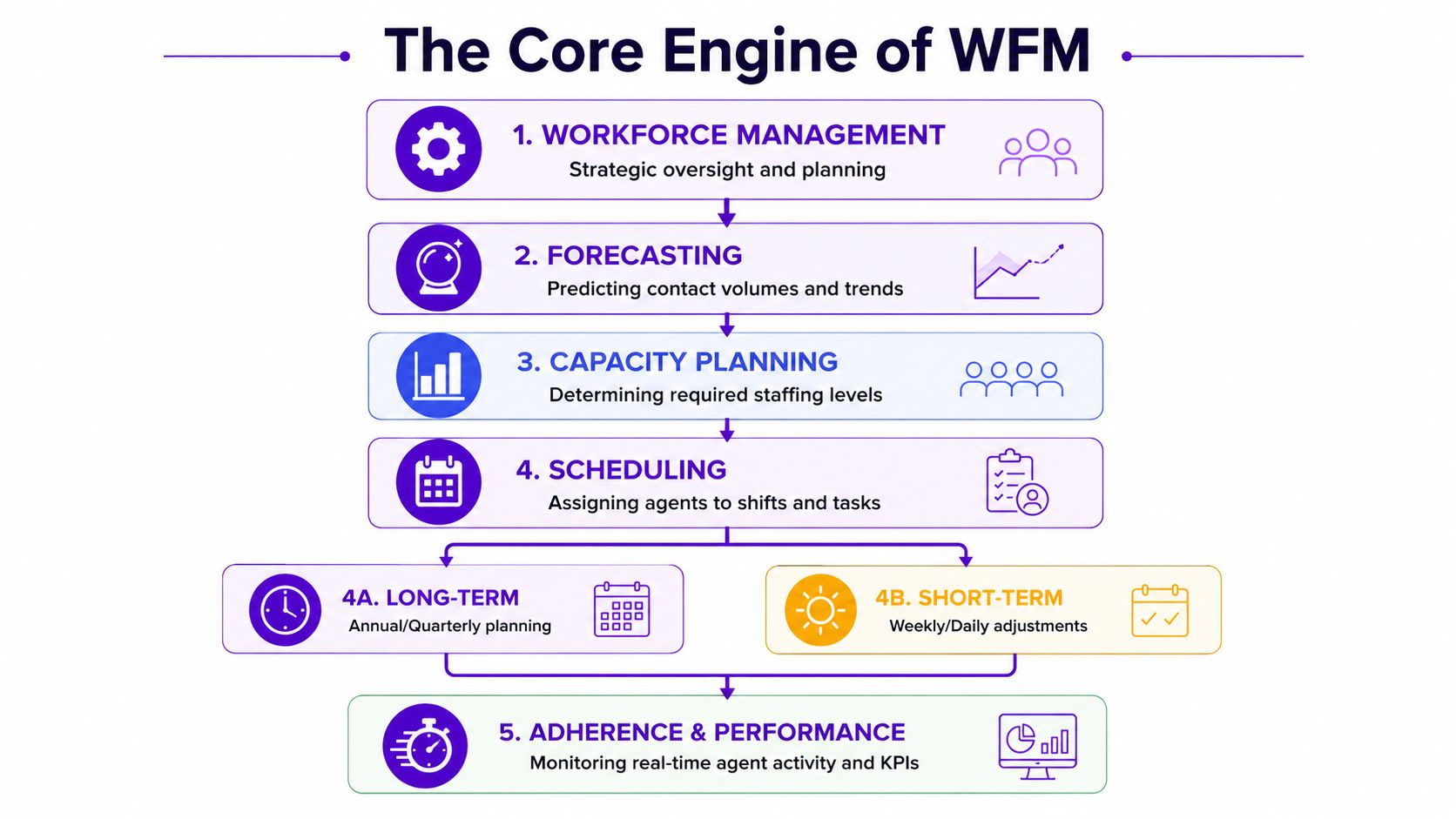
Forecasting before headcount decisions
If forecasts are wrong, every schedule built on top of them is organised error. The first executive test is whether the organisation forecasts by interval, queue, skill, and business event, rather than relying on monthly averages.
That matters because staffing demand is rarely uniform. A BFSI support queue may need more compliance-trained agents at market open. A healthcare booking line may peak around appointment reminders. A multilingual software support desk may need language-specific coverage at different times of day.
For leaders who want a strong primer on the full operating stack, TimeTackle's guide on getting started with workforce management is useful because it places scheduling in context instead of treating it as a standalone rota problem.
Scheduling as capital allocation
Best practice requires assigning top performers to peak call periods and designing shift patterns around break lengths, shift durations, labour regulation compliance, historical demand, and skill needs such as language coverage, as outlined by Giva's guidance on call center scheduling. That's a more complex mandate than many teams realise.
A practical example. A real estate contact centre serving buyers in multiple cities may need Hindi, English, and region-specific language support during overlapping time zones. The schedule cannot solely optimise for total headcount. It has to optimise for qualified headcount by interval.
Three questions help CXOs judge whether the engine is sound:
- Can the team forecast demand credibly? Historical volume matters, but so do campaign calendars, billing cycles, launch events, and known service disruptions.
- Do shifts reflect business reality? Static shifts often fail when customer demand clusters around evenings, weekends, or specific product events.
- Are skills mapped to queues? If premium or complex interactions are routed to whoever is merely available, customer value is left to chance.
A strong workforce model doesn't ask, “How many agents are on duty?” It asks, “Do we have the right skills, at the right hour, for the interactions that matter most?”
The engine executives should expect
The most resilient operations usually organise workforce management in this sequence:
- Demand forecasting based on actual contact patterns and expected business triggers.
- Capacity planning that converts forecast demand into staffing requirements.
- Schedule design that balances service coverage, breaks, shift rules, and fairness.
- Skill-based assignment so complex work lands with capable agents.
- Adherence and intraday control so plans survive real-world variance.
When this machinery works, the schedule stops being a spreadsheet. It becomes a reliable operating instrument.
Measuring What Matters The KPIs That Drive Performance
Scheduling quality shows up first in financial results, not in the rota. If leaders review only daily averages, they can miss the exact intervals where revenue is lost, service deteriorates, and labour spend stops producing return.
Executive teams need a compact KPI set that answers three questions. Are staffing levels aligned to real demand by interval? Is paid time converting into customer-facing output? Are service failures caused by forecasting error, schedule design, or execution drift?
The metrics that reveal economic performance
The most misunderstood scheduling metric is internal shrinkage. It captures paid time that is unavailable for live customer work because of breaks, coaching, training, system issues, meetings, or administrative tasks. If shrinkage is treated as a rough assumption instead of a measured operating input, staffing plans become optimistic by design.
The implication is straightforward. A centre can appear fully staffed in the weekly plan and still run short during peak demand because the available capacity was overstated. In board terms, that is not a minor planning error. It is a conversion problem, a customer retention problem, and a margin problem caused by weak workforce governance.
A second metric deserves more executive attention than it usually gets: interval coverage accuracy. Planned versus required staffing should be tracked in 15-minute or 30-minute blocks, then reviewed with volume weighting. A five-agent shortfall at 11:00 a.m. on a low-volume Tuesday is not economically equal to the same shortfall during a billing spike, product launch, or renewal surge. Therefore, leaders must read staffing plans through the lens of demand concentration, not simple daily averages.
A board-ready KPI view
The KPI set below gives senior leaders a clearer line of sight from scheduling decisions to business outcomes.
| KPI | What leaders should look for | Strategic importance |
|---|---|---|
| Service Level | Performance by interval, especially in high-value demand windows | Indicates whether the operation is meeting customer demand at the promised standard |
| Average Speed to Answer | Trend direction and spike periods, not just weekly averages | Shows where wait time is increasing abandonment risk and reducing conversion |
| Schedule Adherence | Consistent execution against published shifts | Reveals whether the schedule is realistic, trusted, and operationally usable |
| Agent Occupancy | Sustained pressure versus healthy range over time | Signals burnout risk, queue strain, and whether labour is being overextended |
| Agent Utilisation | Share of paid time spent on productive work | Helps distinguish capacity gaps from process waste |
| Average Handle Time | Movement by queue, channel, and issue type | Converts demand patterns into staffing requirements and exposes complexity shifts |
| First Contact Resolution | Trend by skill group and interaction type | Tests whether staffing quality matches customer need |
| Abandonment Rate | Concentration during undercovered intervals | Identifies where demand is being lost before an agent engages |
| Internal Shrinkage | Measured weekly and forecasted explicitly | Prevents false confidence in nominal staffing levels |
One pattern shows up repeatedly in underperforming centres. Leadership teams celebrate acceptable weekly averages while customers remember the one hour each day when service fails. That gap between average performance and lived experience is where brand damage and avoidable churn start.
For that reason, scheduling KPIs should sit inside the same governance model as revenue, cost-to-serve, and retention metrics. A useful reference point is this broader contact centre KPI framework for operational governance, which helps connect workforce decisions to enterprise performance rather than treating them as isolated operational reporting.
The right question is not whether the centre was staffed for the day. It is whether the centre was staffed for the moments that carried the most customer and commercial value.
This is also where AI changes the executive equation. Once interval-level forecasting, shrinkage patterns, and adherence behaviour are modelled continuously, scheduling moves from retrospective reporting to forward control. The strategic advantage is clear. Faster correction, lower labour waste, better customer access, and a workforce model that scales without relying on managerial guesswork.
Common Scheduling Pain Points and How to Mitigate Them
Scheduling failures usually appear first in the income statement, not in the roster. Revenue slips when high-value queues are understaffed, cost-to-serve rises when overtime becomes routine, and attrition climbs when the same agents absorb the hardest intervals week after week.
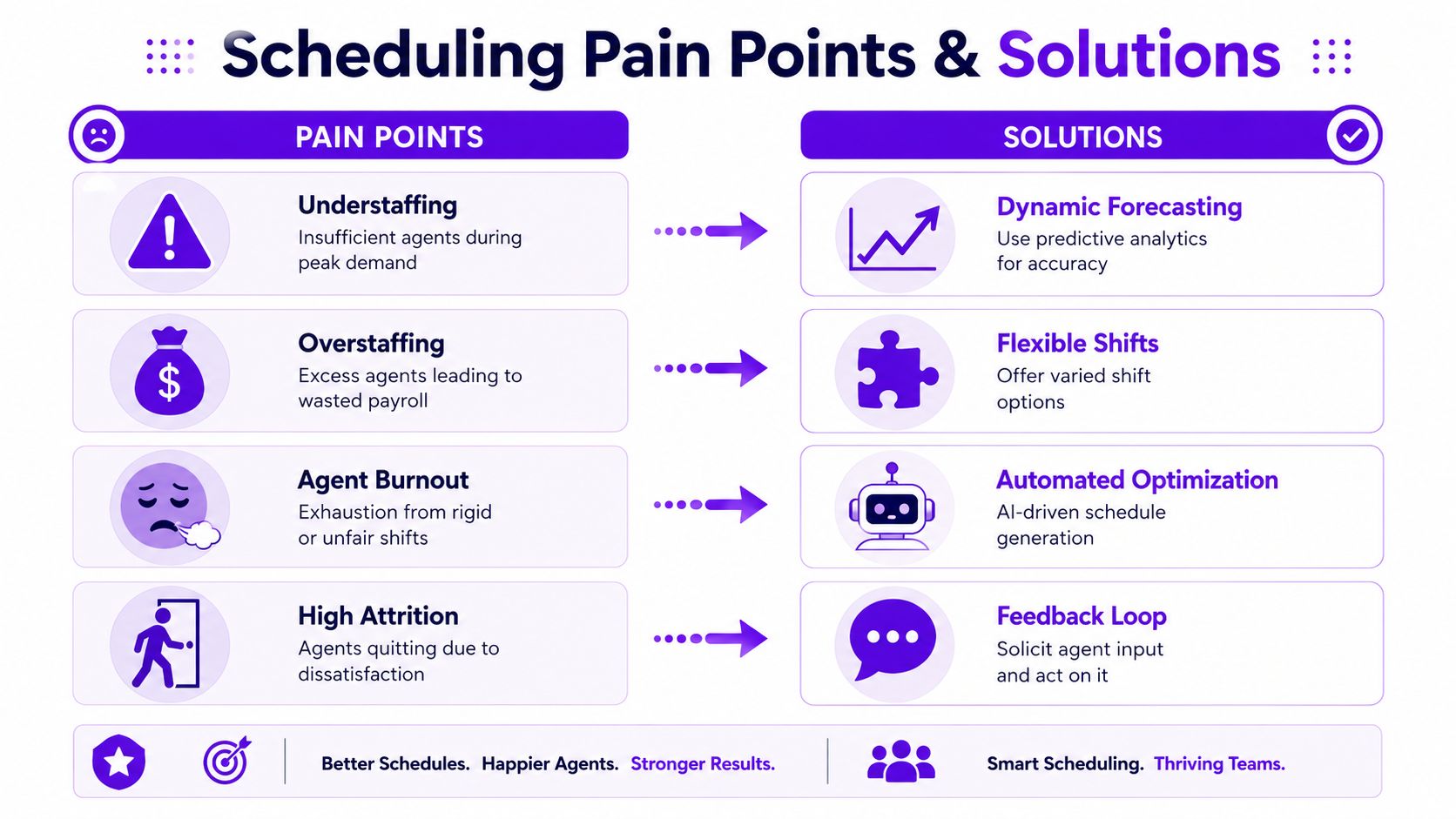
What poor scheduling looks like on the floor
The most expensive scheduling problems rarely look dramatic. They look ordinary. Afternoon queues run long for just 90 minutes. Breaks overlap in one specialised team. Escalations concentrate around a few senior agents. Coaching gets postponed to protect service levels, then postponed again.
That pattern creates a leadership blind spot. Weekly averages can still look acceptable while the business is repeatedly failing during the intervals that shape customer memory and conversion outcomes.
A practical example makes the point. During a major e-commerce promotion, planners forecast order-related contacts reasonably well but miss the secondary wave of delivery, refund, and status queries that follows. Supervisors extend shifts, cancel one-to-ones, and redeploy experienced agents into complaint-heavy queues. Service holds for the event itself. The operational bill arrives later through higher absence, lower adherence, weaker quality scores, and slower recovery in the following week.
Leaders should treat burnout as a consequence of scheduling design as much as management culture. If the schedule repeatedly concentrates cognitive load, emotional strain, and undesirable shifts on the same group, attrition is a predictable output.
Mitigation that protects both service and staff
Strong mitigation starts with design principles, not manager heroics.
- Build capacity for variability: A schedule built only for average demand leaves no room for absences, campaign spikes, or queue-specific surges. Contingency capacity protects revenue during volatility and reduces dependence on last-minute overtime.
- Match staffing to interval value, not daily totals: Some hours carry more commercial and reputational risk than others. Coverage should be densest where abandonment, delay, or mishandling has the highest financial cost.
- Plan breaks by skill mix, not headcount alone: Total staffing can look adequate while service still degrades if multilingual agents, escalation handlers, or sales-qualified staff leave the queue together.
- Distribute strain deliberately: Overtime, split shifts, late finishes, and emotionally difficult contacts should be tracked as operational load. Fairness affects retention, and retention affects capacity.
- Protect coaching and recovery time: Cancelling development time to patch service creates a short-term fix and a long-term capability problem.
Practical rule: If the same employees repeatedly absorb peak pressure, the business is trading future retention for current service levels.
This issue is especially visible in sectors such as real estate, healthcare, and admissions, where not all interactions carry the same cognitive or emotional weight. A schedule based only on total enquiry volume can overload teams handling complex consultations and escalations, even when headline occupancy appears efficient.
The better model separates work by contact type, skill requirement, and fatigue profile. That is one reason many operators are reassessing AI call center software for workforce planning and scheduling decisions. The objective is not merely to fill shifts. It is to allocate labour in a way that protects service quality, preserves employee capacity, and improves the economics of the centre over time.
The Automation Advantage How AI Is Revolutionising Scheduling
Manual scheduling fails where modern contact centres are most complex. It struggles with volatile demand, multilingual queues, multi-skilled agents, and the constant need for intraday correction. AI changes that because it doesn't just speed up planning. It changes the quality of decisions available to the business.
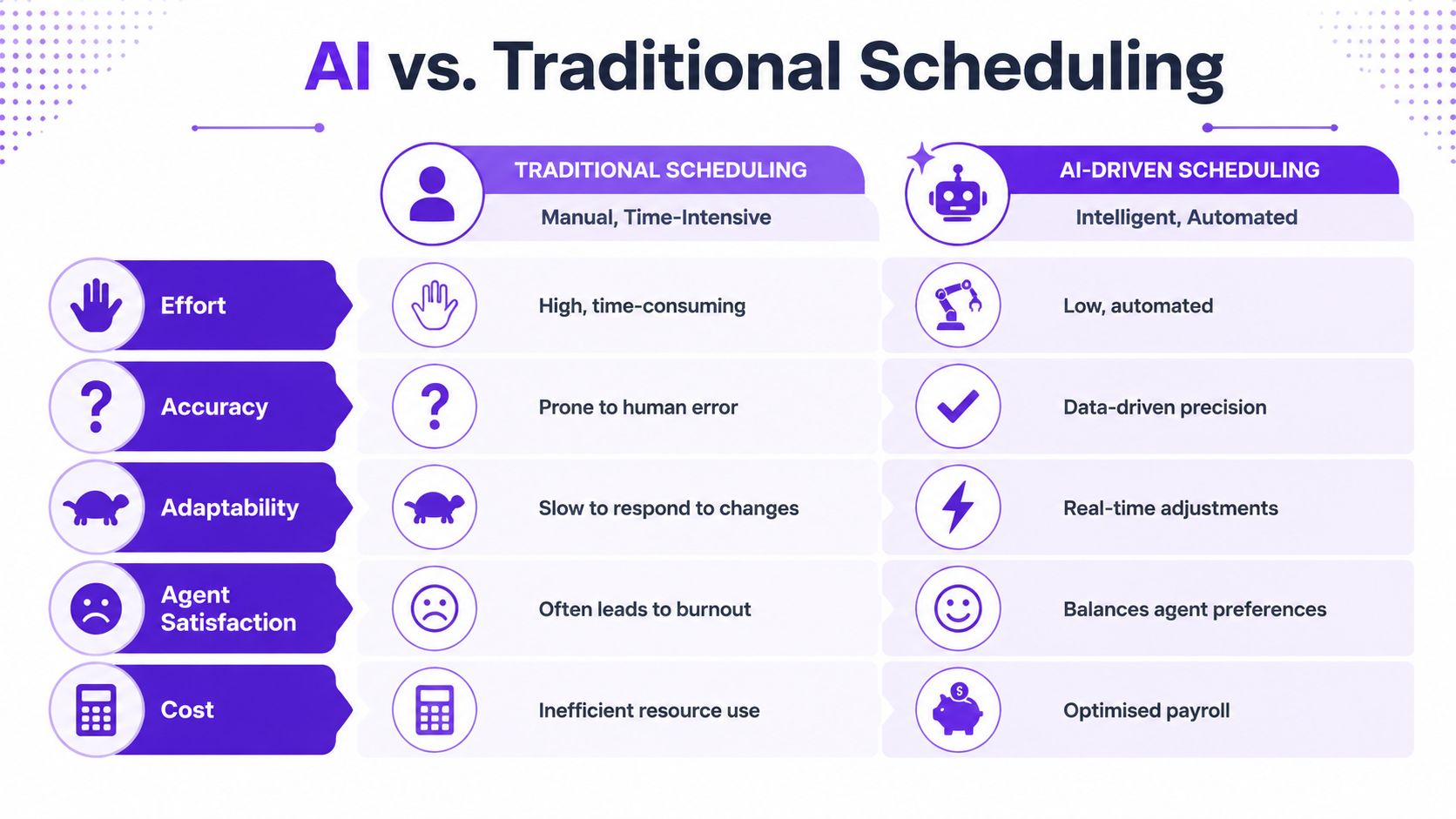
Why AI changes the economics
According to Eleveo's overview of call center scheduling, AI forecasting can predict call volume with 95% accuracy. The same source states that skill-based scheduling can improve customer satisfaction by 12% to 18% and reduce agent turnover by 20%.
Those figures matter because they connect planning quality to both customer outcomes and labour stability. That's the strategic leap. Traditional scheduling systems mainly try to avoid failure. AI-enabled systems can actively improve service quality while lowering operational strain.
The same source recommends a flexible model with a 25% part-timer reserve pool as a rule of thumb for balancing cost and flexibility. It also notes that overstaffing can increase labour costs by 10% to 15% unnecessarily. That gives executives a clear framing. Scheduling precision is not only about reducing understaffing. It is also about stopping avoidable labour dilution.
Here's the practical implication for a SaaS support team. Product releases, outages, and onboarding waves create short-lived spikes that fixed schedules can't absorb elegantly. AI-led forecasting and reserve capacity make it easier to protect service without permanently loading cost into every shift.
A useful way to understand the software layer behind this shift is to look at how modern AI call center software combines forecasting, routing, and automation into one operating model.
Where automation has the highest executive payoff
The biggest value from AI usually appears in four places:
Forecast quality improves
Better forecasts reduce both panic staffing and passive overstaffing. Leaders can make staffing decisions earlier and with more confidence.
Skill-based matching gets operationalised
In a multilingual BFSI or healthcare support environment, matching the right customer to the right agent is not a nice-to-have. It affects resolution quality, compliance handling, and customer trust.
Real-time adjustments become realistic
AI systems can react to live service signals far faster than spreadsheet-led operations. That matters when campaigns outperform, collections calls spike, or escalations suddenly rise.
Human agents are reserved for higher-value work
Automation can absorb repetitive or low-complexity interactions, reducing queue pressure before it reaches the human team.
This video gives a quick visual overview of how intelligent scheduling systems are reshaping contact centre operations.
Better scheduling used to mean better planning. With AI, it also means better timing, better matching, and better protection of human effort.
For boards, the takeaway is straightforward. AI in call center scheduling isn't an efficiency gadget. It is an operating model upgrade that improves precision, resilience, and service consistency at the same time.
Your Phased Roadmap to Modern Scheduling
Large scheduling transformations fail when leaders try to buy the future before fixing the basics. The better path is phased. Each stage should solve a real operational weakness, produce visible learning, and create enough trust for the next investment.
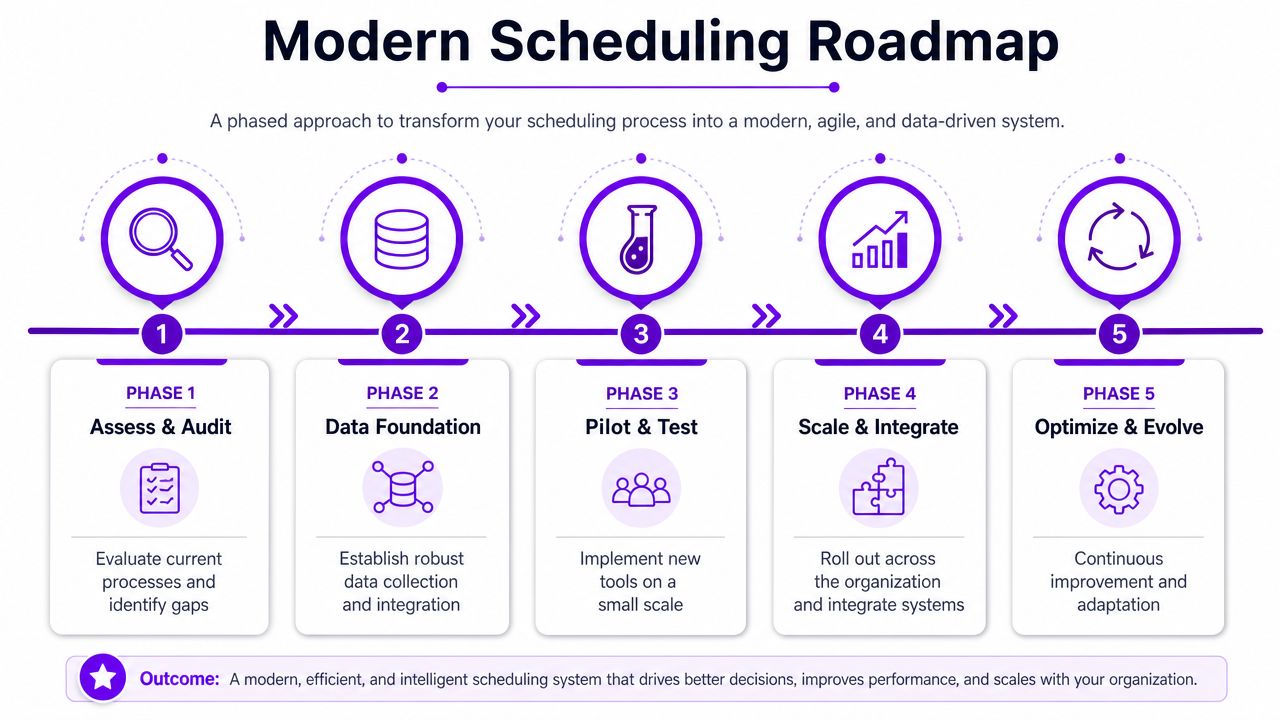
Phase 1 and Phase 2 stabilise the base
Phase 1 begins with an audit. Review forecast inputs, staffing assumptions, break placement, overtime patterns, adherence trends, and queue coverage by interval. The purpose is to identify where the current schedule diverges from actual demand.
A practical example helps. An online learning platform may discover that counsellor capacity is concentrated in daytime hours, while serious applicant conversations cluster in the evening. That gap isn't a technology problem yet. It is a planning diagnosis.
Phase 2 builds the data foundation. Standardise the metrics, clean the historical data, and create one version of truth for volume, handle time, shrinkage, and adherence. If teams argue about whose report is correct, no scheduling model will remain credible.
At this stage, leaders should insist on a few behaviours:
- Track demand at interval level: Daily averages hide operational failure.
- Map agent skills cleanly: Language, product line, escalation authority, and channel competence should be visible.
- Record planned and actual shrinkage: Many capacity models frequently falter here.
Phase 3 to Phase 5 create strategic lift
Phase 3 is the pilot. Introduce new scheduling logic or technology in one queue, region, or business unit. Choose an area where demand is meaningful but manageable. A pilot in a support queue with clear demand cycles often produces faster learning than a highly chaotic environment.
Phase 4 scales what works. Once the pilot proves the operating model, expand into adjacent teams. For this expansion, integration becomes important. Forecasting, workforce management, telephony, and reporting systems need to support the same scheduling logic.
Execution test: If managers still maintain shadow spreadsheets after the pilot, the process hasn't really been integrated.
Phase 5 is continuous optimisation. Mature scheduling isn't static. Teams review weekly variance, refine assumptions, and adjust workforce mixes as customer behaviour changes. In this phase, strategic value compounds because the organisation learns faster than competitors do.
A useful executive roadmap looks like this:
| Phase | Leadership Priority | Expected Result |
|---|---|---|
| Assess and audit | Diagnose structural scheduling gaps | Visibility into where service and labour misalign |
| Data foundation | Clean and standardise inputs | Higher confidence in planning decisions |
| Pilot and test | Prove a new model in one area | Controlled learning with limited risk |
| Scale and integrate | Extend the model across teams | Consistency across operations |
| Optimise and evolve | Create a review rhythm | Continuous improvement instead of periodic crisis management |
Different industries apply the roadmap differently. A real estate business may start with lead qualification queues. A BFSI platform may begin with support lines that need stronger skill matching. An e-commerce brand may pilot around returns or payment issues where volume swings sharply. The sequence holds across all of them.
The executive discipline is to avoid chasing software before building operating clarity. Technology amplifies whatever planning logic already exists. If the logic is poor, automation makes errors faster.
Frequently Asked Questions About Call Centre Scheduling
How should a global operation schedule multilingual coverage without wasting capacity
Start with demand by language and interval, not demand by total volume. A queue may look adequately staffed overall while still failing customers who need a specific language or specialist capability. Build schedules around required skill mixes for each interval, then layer flexibility through reserve capacity and intraday adjustments. This matters most for global support, BFSI service, and healthcare coordination where misrouting creates both delay and quality risk.
How much schedule flexibility should leaders give agents without losing control
Give flexibility where it improves adherence and retention, but keep control over peak coverage, specialist queues, and compliance-sensitive windows. Shift swaps, preference capture, and transparent publication usually help. Open-ended flexibility doesn't. The right model allows agent input while preserving management control over the hours that matter most to service and revenue.
What should a smaller company do if it lacks enough historical data for forecasting
Begin with what the business already knows. Campaign calendars, sales peaks, launch dates, billing cycles, and support events often reveal demand patterns before formal forecasting is mature. Use short planning cycles, review outcomes weekly, and tighten schedules as evidence accumulates. Smaller teams don't need perfect data to improve. They need disciplined observation and a willingness to revise quickly.
For many leadership teams, the main mistake is waiting for ideal systems before improving basic workforce decisions. Better scheduling usually starts with cleaner operating questions, not bigger software budgets.
DialNexa Labs Private Limited helps organisations modernise customer conversations with human-like Voice AI agents for qualification, support, recruitment, and presales. If your team is rethinking call centre capacity, looking to smooth peak demand, or trying to free agents for higher-value interactions, DialNexa can help you evaluate where automation fits into the operating model without adding unnecessary complexity.

Leave a Reply