
KPI of Team Leader in BPO: Drive Executive-Level Excellence in Your Support Teams
TL;DR
The KPI of team leader in BPO should cover efficiency, service quality, customer experience, and team stability. The seven key metrics are FCR, AHT, SLA adherence, occupancy, quality score, schedule adherence, and attrition or escalation rate.
These KPIs work best when tracked together. A lower AHT means little if FCR or quality drops, while high occupancy is not sustainable if it leads to burnout. A balanced scorecard helps team leaders improve performance without creating problems elsewhere.
Introduction
A team leader typically oversees far more people than most executives realise. COPC Inc.’s Global Benchmarking Series research found the typical ratio is one team leader to 16 agents, according to COPC Inc., which means the quality of one person’s coaching, scheduling, and escalation handling shapes the output of an entire floor.
That span of control is exactly why the KPI of team leader in BPO matters more than most job scorecards. A team leader is judged on outcomes they can move: service levels, call efficiency, resolution quality, schedule discipline, and team stability, focusing on controllable indicators rather than broad company metrics like total revenue or enterprise-wide NPS that sit several layers above the floor.
The fastest way to misuse a scorecard is to load it with metrics a team leader cannot directly influence. In our review of contact-centre performance frameworks, the useful KPI set was narrower than most executive decks suggest: pick metrics the leader can change through coaching, queue management, schedule control, escalation handling, and process feedback.
This guide walks through the operational, quality, and people-management KPIs that make up a fair scorecard, how to read them together instead of in isolation, the KRA-to-KPI mapping executives ask about most, and how voice AI is starting to change what a team leader spends their day doing.
The Balanced Scorecard Approach
A common mistake is to over-reward one metric and create damage elsewhere. A much smarter approach is to use a balanced scorecard built on a few interconnected pillars.
- Operational efficiency: productivity and cost-control metrics such as AHT, SLA adherence, and occupancy show whether the floor is running efficiently.
- Quality assurance: CSAT, QA scores, and FCR show whether efficiency is being achieved without weakening customer outcomes.
- People management: attrition, schedule adherence, absenteeism, coaching completion, and agent satisfaction show whether the team can sustain performance over time.
The strategic value of a team leader sits at the intersection of these pillars. A leader who improves throughput but burns out the team is not creating durable value. A leader who protects morale but misses client commitments is also underperforming.
How We Selected the KPI of Team Leader in BPO
We selected the KPI set in this article using four practical tests:
- Direct control: can a team leader improve the number through coaching, scheduling, call-flow discipline, floor support, or escalation management.
- Client relevance: does movement in the metric affect SLA delivery, cost-to-serve, customer experience, or compliance risk.
- Comparability: can the metric be reviewed weekly or monthly across teams without heavy interpretation.
- Balance: does the metric need a companion measure to prevent distortion.
We also prioritised metrics that appear repeatedly in contact-centre management guidance from recognised industry sources. ContactBabel and ICMI research consistently treat service level, quality, and workforce discipline as core operating measures. For practical floor management ideas, there is also a useful shortlist from Intelligent Contacts that aligns with what experienced leaders watch.
Driving Profitability with Operational Efficiency KPIs
If you need a practical answer to what a BPO team leader is usually measured on, start here: most TL scorecards are built around a compact group of queue and productivity metrics that show whether the team is meeting client demand at the right cost and with acceptable customer outcomes.
Top Team Leader KPIs in BPO: The Shortlist
If you need a clean scorecard, these are the 7 metrics most often worth tracking first.
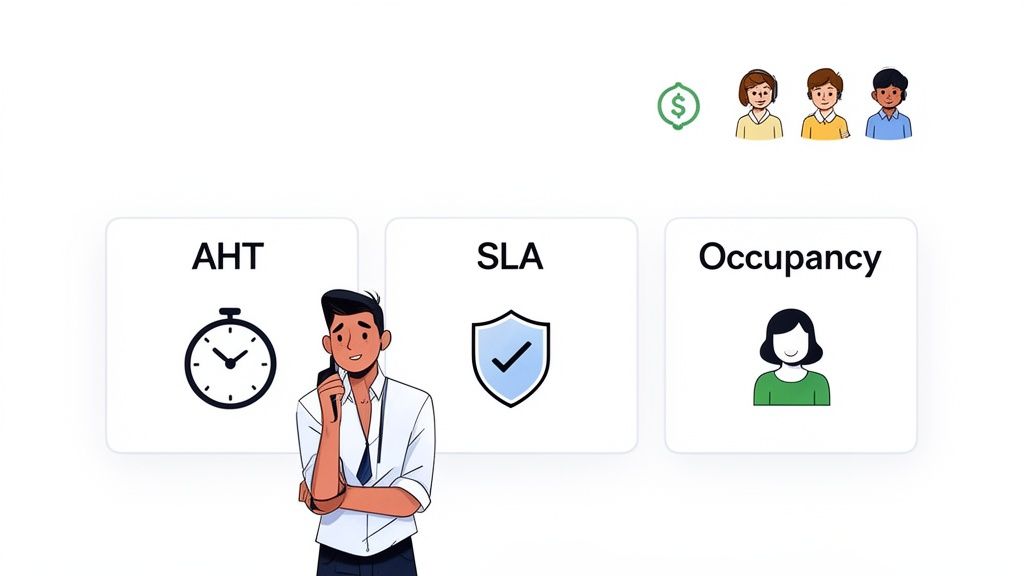
- First Contact Resolution (FCR): share of issues resolved in the first interaction, it matters because repeat contacts raise cost and lower satisfaction.
- Average Handle Time (AHT): total talk, hold, and after-call work per contact, it matters because it drives staffing requirement and cost-per-contact.
- Service Level Agreement (SLA) adherence: the percentage of contacts answered within the target threshold, it matters because it reflects contractual delivery.
- Occupancy rate: share of logged-in time spent handling work, it matters because it shows utilisation pressure and burnout risk.
- Quality assurance score: evaluation of process, accuracy, compliance, and communication, it matters because speed without quality is expensive rework.
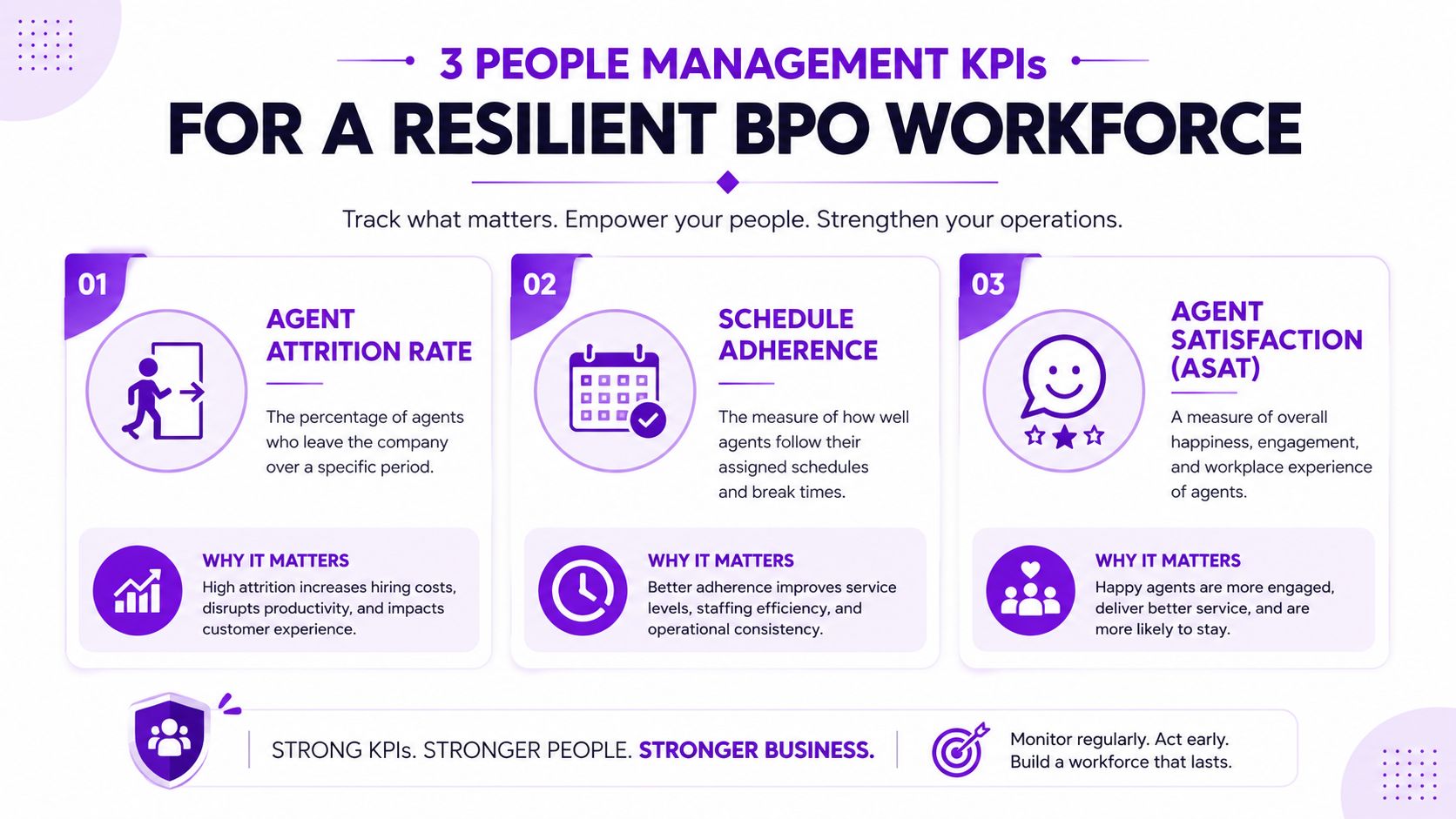
- Schedule adherence: extent to which agents follow assigned shifts and breaks, it matters because weak adherence quickly becomes an SLA problem.
- Escalation rate or repeat-contact rate: share of interactions needing transfer, callback, or repeat handling, it matters because it exposes process or coaching gaps.
That shortlist is a better starting point than a bloated dashboard. In our review, once teams go much beyond these without a strong reason, leaders spend more time reporting than correcting performance.
How to Read the Main Operational Metrics
Average Handle Time (AHT) measures the average time an agent spends on an interaction, including talk time, hold time, and after-call work. For the Indian BPO sector in 2024-25, a commonly cited good range is 5 to 8 minutes per call according to CloudConnect. AHT matters because it directly affects staffing demand, but it should never be pushed down in isolation.
Service Level Agreement (SLA) adherence shows whether the team is meeting the client’s response commitment, such as answering 80% of calls within 20 seconds. For a team leader, this is less about the headline percentage and more about whether schedule discipline, queue management, and shrinkage control are strong enough to maintain it.
Occupancy rate shows the proportion of logged-in time spent on call-related work. NICE notes that occupancy is a critical workforce metric, but sustained overloading can damage agent well-being and customer experience.
First Contact Resolution (FCR) measures the percentage of issues solved without follow-up or transfer. In the Indian BPO market for 2024-25, a good range is often placed between 70% and 80%, while performance above 85% is associated with stronger cost savings and customer satisfaction according to Superworks.
Quality score captures whether the interaction was accurate, compliant, and appropriately handled. A low-error, low-escalation floor rarely comes from low AHT alone, it usually comes from strong process discipline and coaching.
The Trade-Offs That Matter
The right reading is not “lower AHT is always better.” It is “lower AHT is good if FCR, quality, and SLA remain healthy.” That distinction matters.
- If AHT falls while FCR also falls, the team may be ending calls too quickly.
- If SLA improves while occupancy spikes, the floor may be meeting target at an unsustainable workload.
- If occupancy is low but SLA still misses, staffing or scheduling may be misaligned rather than insufficient.
- If quality is high but AHT rises sharply, the issue may be process friction, poor tools, or avoidable after-call work rather than weak agent skill.
A strong TL earns trust by diagnosing the system behind the metric instead of rewarding superficial movement. We see this most often when leaders compare queue conditions, call drivers, and QA comments before coaching anyone on speed.
A Practical Scenario in Logistics
Imagine a team leader supporting a logistics client notices AHT has climbed for three straight weeks while SLA has started to slip. Instead of ordering agents to hurry, the leader reviews call categories, hold reasons, and after-call notes. The pattern shows up quickly: a new dispatch tool is forcing agents through extra screens before they can confirm shipment exceptions.
The intervention is not generic coaching. The leader runs focused refresher training on the software workflow, rewrites the quick-reference guide, and flags the screen-navigation issue to operations support. Two weeks later, AHT improves, SLA recovers, and QA remains stable because the fix addressed friction rather than forcing rushed behaviour.
Protecting Brand Reputation with Quality and CSAT KPIs
While getting things done quickly keeps the lights on, it’s the quality and customer satisfaction KPIs that help protect your brand. These metrics shift the focus from speed to service excellence, revealing what the customer felt, which is what builds loyalty and long-term value.
Defining the Pillars of Service Excellence
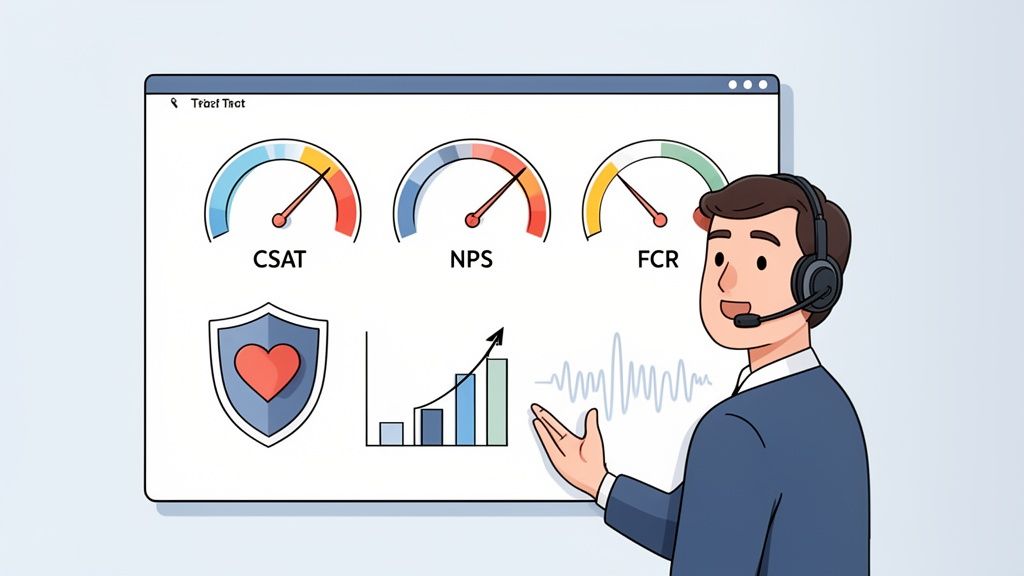
- Customer Satisfaction (CSAT): the most direct feedback loop, measuring how happy a customer was with a specific interaction, usually on a simple scale like 1 to 5.
- Net Promoter Score (NPS): the big picture metric, asking how likely a customer is to recommend your entire brand, useful as a gauge of long-term loyalty.
- First Call Resolution (FCR): tracks the percentage of customer problems solved in a single interaction, cutting operational cost because there are fewer repeat calls.
These three KPIs are connected. A team that nails FCR will often see its CSAT and broader loyalty signals improve, because solving a problem quickly and completely is the foundation of a strong customer experience.
The High Cost of Poor Quality
Letting these quality metrics slide is an expensive mistake. A low FCR directly hurts your bottom line because repeat contacts raise labour demand, increase queue pressure, and frustrate customers who expected resolution the first time.
Every unresolved call is more than just a bad data point, it’s a crack in your brand’s foundation. It erodes customer trust and adds avoidable expenses to your bottom line.
This financial drain shows why a team leader’s coaching on quality isn’t a soft skill, it’s a critical business function. They are on the front line, preventing customer churn and protecting profitability every single day.
Practical Application in Financial Services
Imagine a team leader at a BPO that supports a major financial services client. She notices a worrying trend: the team’s CSAT scores have dropped over the last quarter, specifically on calls related to fraud alerts.
Instead of giving a generic “we need to do better” speech, the leader digs into the data. Using call analytics, she listens to recordings of the low-scoring calls and spots a clear pattern. The agents are technically correct, but their tone is uncertain when talking to anxious customers.
Armed with this insight, the leader rolls out targeted coaching sessions focused on empathy and confident communication for high-stress situations, running role-playing exercises that simulate panicked customer calls. The result is better customer reassurance, stronger first-contact resolution on sensitive interactions, and fewer repeat calls driven by uncertainty.
Building a Resilient Workforce with People Management KPIs
People management is where many articles get vague, even though it is one of the clearest parts of a team leader’s remit. In BPO operations, the confusion usually comes from mixing up KRAs and KPIs.
The simplest distinction is this: KRAs are the responsibility areas a leader owns, KPIs are the measurements used to judge performance inside each area. A KRA says what the leader is accountable for. A KPI says whether that responsibility is being delivered well.
For a BPO team leader, the main KRAs are usually team performance, client SLA delivery, quality and compliance, coaching and development, attendance and workforce discipline, and escalation handling.
Key Metrics for a Stable and Engaged Team
Below is a practical KRA-to-KPI mapping that works well for most voice and blended BPO programs.
- Team performance: AHT, FCR, productivity per FTE, repeat-contact rate, and queue backlog show whether the team is converting staffing hours into completed work without excess rework.
- Client SLA delivery: SLA adherence, response time, abandonment rate, schedule adherence, and occupancy form the most visible contractual layer of performance.
- Quality and compliance: QA score, critical error rate, compliance breaches, audit pass rate, and escalation quality protect accuracy, process discipline, and regulatory exposure.
- Coaching and development: coaching sessions completed, post-coaching improvement, certification completion, and bottom-performer improvement rate bridge observing issues and fixing them.
- Attendance and workforce discipline: schedule adherence, absenteeism, late login rate, shrinkage exceptions, and leave-pattern risk, since weak discipline creates immediate queue stress.
- Escalation handling: escalation rate, reopen rate, resolution TAT for escalations, and complaint recurrence, since a leader should absorb and resolve preventable escalations before they reach the client.
That mapping also answers a common executive question: what is the KRA and KPI structure for a team leader in BPO? The KRA defines the bucket of responsibility, the KPI shows whether the leader is succeeding inside that bucket.
The Financial Case for Reducing Attrition
Attrition is still one of the most expensive people issues a BPO can face, but it should be read carefully. A TL influences attrition through coaching quality, schedule flexibility within policy, floor culture, and escalation support. They do not control every reason someone leaves, which is why attrition is best paired with agent satisfaction, absenteeism, and coaching completion rather than used as a blunt standalone verdict.
For a deeper dive into managing team stability, these strategies for reducing attrition rates cover getting to the root cause of why people leave. You can also explore how speech analytics improves coaching to give your team leaders even more support.
In practice, when attrition rises alongside absenteeism and falling agent satisfaction, the floor usually has a leadership, workload, or process problem worth investigating. When attrition rises but satisfaction and quality remain healthy, the cause may sit outside the immediate control of the TL. That distinction matters for fair performance management.
How Voice AI Gives Team Leaders Superpowers
While the traditional KPIs give a solid baseline, bringing voice AI into the mix provides a significant boost to a team leader’s impact. This isn’t about replacing your leaders. It’s about handing them a toolkit that turns good leaders into phenomenal ones by boosting efficiency, sharpening quality oversight, and making coaching sessions effective.
Supercharging Quality Assurance and Coaching
Manually sifting through calls for quality checks is one of the biggest time sinks for any team leader. It’s usually a tiny, random sample of calls, which means important learning moments get missed and coaching is based on only part of the picture.
Imagine calls monitored automatically for patterns like customer frustration, potential compliance slips, or standout agent behaviour. Instead of spending hours hunting for a coachable moment, a team leader gets a prioritised list of the specific calls that need attention right now.
When voice AI handles the heavy lifting of call monitoring, team leaders can reinvest more of their time directly into high-impact, targeted coaching.
An India voice AI report analysing over a million AI-assisted business calls found similar patterns: automated monitoring surfaces a far higher share of coachable moments than manual, random-sample QA sampling ever catches.
Boosting Operational Efficiency Through Automation
A huge chunk of customer interactions are simple, transactional queries. They’re necessary, but they chew up a massive amount of an agent’s time. By automating these routine tasks, you free up human agents to do what they do best: handle complexity and build relationships.
Take an e-commerce BPO, for example. Deploying voice AI to handle order-status calls can create a ripple effect across your key metrics. You can learn more about this synergy in how AI voice agents transform CX.
Driving Real Business Outcomes
Integrating voice AI gives your team leaders the ability to deliver better business outcomes that VPs and the C-suite care about, improving how leaders monitor quality, prioritise coaching, and allocate human attention where it matters most.
A BPO working with a financial services client could use voice AI for the initial, repetitive KYC verification steps, supporting compliance consistency and freeing skilled agents for more sensitive conversations. The team leader in this scenario isn’t just managing a call queue anymore, they’re orchestrating a hybrid human-AI team.
Designing an Executive Dashboard for BPO Leadership
Raw data is just noise. For VPs and directors, the goal is to cut through that noise and find a clear signal to guide strategic decisions. A well-designed executive dashboard, centred on the KPI of team leader in BPO, does exactly that.
The best dashboards achieve a delicate balance, blending real-time operational data with longer-term trend analysis, so you get the full story of performance, not just a snapshot.
Crafting a Strategic View
A powerful executive dashboard should be organised into three core areas, almost like a balanced scorecard for evaluating your leaders.
- Real-time operational pulse: live metrics like SLA adherence, current call queues, and agent availability, functioning as an early warning system for immediate operational fires.
- Quality and customer experience trends: trend lines for CSAT and FCR over time, since a dip is a strong warning sign of potential brand reputation issues.
- People management health: the monthly agent attrition rate and a risk matrix that flags leaders whose teams show high absenteeism or poor satisfaction scores.
Connecting the Dots Visually
The true value of a dashboard isn’t just showing data, it’s showing how different data points relate to each other, revealing cause-and-effect relationships that are hidden in a spreadsheet.
Plot Average Handling Time against First Call Resolution. If AHT is going down but FCR is falling right alongside it, a team leader may be pushing for speed at the expense of quality, which usually means more repeat callers and higher operational cost.
This approach turns your dashboard from a simple reporting tool into a diagnostic system. For a deeper dive, see the essential voice agent KPIs that feed into these high-level dashboards.
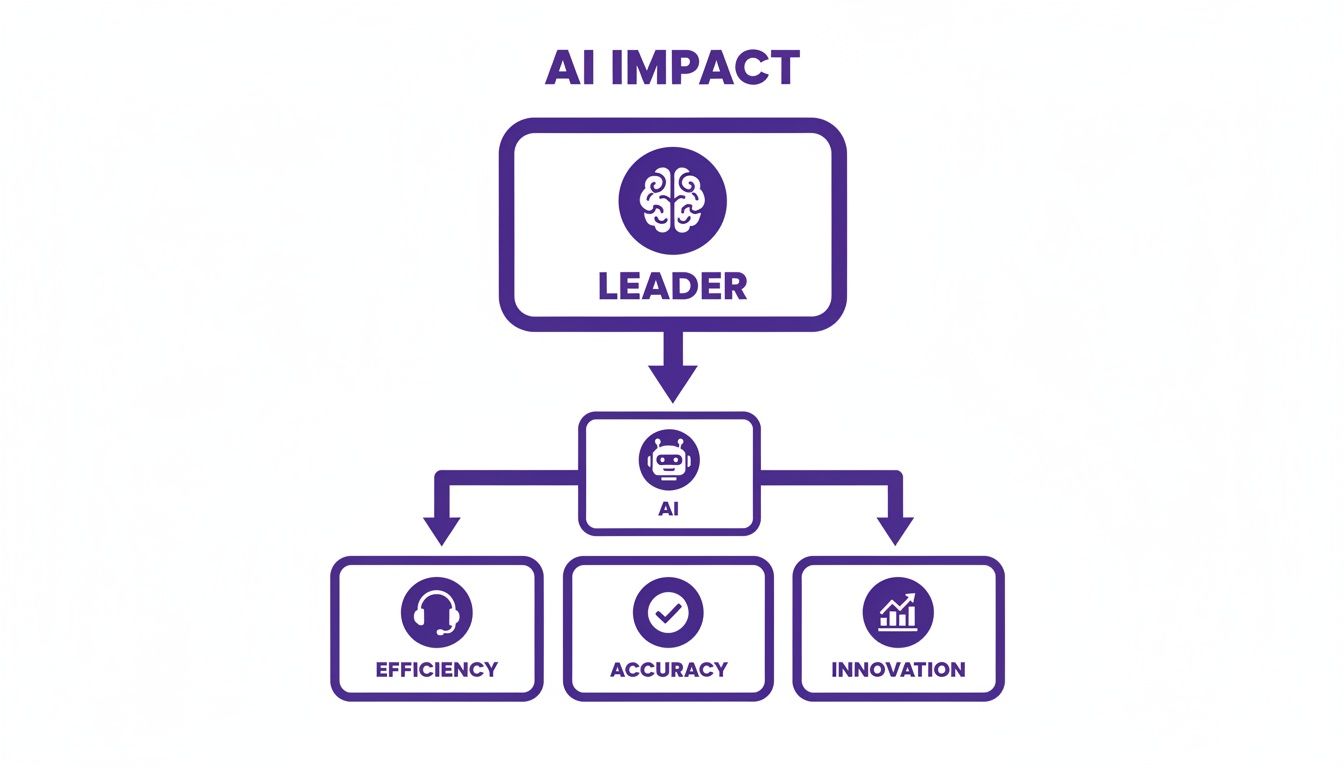
Ultimately, this visual flow demonstrates that AI acts as a force multiplier, helping leaders drive better results across their most critical metrics. By building a dashboard like this, you create a transparent, data-driven culture that celebrates excellence and flags issues long before they become crises.
Conclusion
The KPI of team leader in BPO only works as a balanced set, not a single headline number. Speed without quality, occupancy without adherence, and CSAT without FCR all reward the wrong behaviour if read alone.
Ready to equip your team leaders with the tools they need to make a real impact? DialNexa offers voice AI agents that handle the routine work, so your leaders can get back to what they do best: coaching people and driving growth.
FAQs
1. What is the KPI of a team leader?
A team leader is rarely measured on one KPI alone. In BPO operations, the most reliable view combines operational delivery, quality, and people management: typically AHT, FCR, SLA adherence, quality score, schedule adherence, and attrition or agent satisfaction. The right mix depends on whether the account is more sensitive to cost, compliance, or customer experience.
2. What are the 5 key performance indicators in BPO?
If you need a practical top five, start with FCR, AHT, SLA adherence, quality score, and schedule adherence. Together, these show whether the team is resolving issues efficiently, meeting client commitments, and showing up ready to handle volume.
3. What is KRA and KPI for team leader in BPO?
KRA means Key Result Area, which defines what the team leader is responsible for, such as SLA delivery, team performance, quality, coaching, and attendance discipline. KPI means Key Performance Indicator, which measures success inside those KRAs, such as AHT under team performance or QA score under quality. In short, KRA is the responsibility, KPI is the score.
4. What are the 7 key performance indicators?
A practical seven-metric set for a BPO team leader is FCR, AHT, SLA adherence, occupancy, quality score, schedule adherence, and attrition or escalation rate. This mix, echoed in Intelligent Contacts’ shortlist of what elite leaders track, covers speed, resolution, utilisation, service quality, workforce discipline, and team stability without becoming bloated.

Written by
Aditya Kamat | Published Jan 19, 2026 | Updated May 31, 2026
Co-Founder, DialNexa
Co-Founder of DialNexa. Expert in voice AI, conversational technology, and enterprise telephony. Building the future of AI-powered customer engagement.

This is an excellent breakdown of how modern BPO leadership goes far beyond managing AHT alone. The balanced approach to operational, quality, and people KPIs clearly shows how strong team leaders drive both customer satisfaction and long-term profitability.