
A CXO Guide to BPO Quality Parameters for Operational Excellence
At their core, BPO quality parameters are the strategic yardsticks executives use to measure the performance and ROI of an outsourced operation. These are the specific, measurable metrics that reveal operational efficiency and effectiveness. Key Performance Indicators (KPIs) like First Call Resolution (FCR), Customer Satisfaction (CSAT), and Service Level Agreement (SLA) adherence are not just operational data points; they are direct indicators of your business's financial health and its ability to deliver on client promises.
Why BPO Quality Is a Strategic Business Imperative
For a VP, Director, or CXO, viewing BPO quality parameters as mere operational data is a significant strategic misstep. These metrics are the primary gauges on your business's dashboard, acting as direct levers for sustainable growth and profitability.
Consider your BPO partnership a high-performance engine for your enterprise. The quality parameters are the real-time diagnostics revealing its health, efficiency, and power output. A sophisticated understanding of these metrics is essential for identifying friction points in the customer journey and maximizing the return on every dollar invested in operations. For instance, a leading financial services firm discovered that a 10% improvement in SLA adherence for their back-office processing team directly correlated with a 2% reduction in customer churn, adding over $1.5M to their annual revenue.
This becomes especially critical in high-growth markets. The Indian BPO sector, for example, is currently valued at USD 16.80 billion and is projected to soar to USD 56.53 billion by 2034, growing at a compound annual rate of 12.90%. The entire foundation of this expansion rests on the rigorous enforcement of Service Level Agreements (SLAs), which are built and measured using these very parameters. You can read more about the Indian BPO market's growth and its deep reliance on SLAs.
Connecting Metrics to C-Suite Objectives
For executives, the strategic power of BPO quality parameters lies in their direct link to bottom-line results. Each metric tells a crucial part of the story about your company's ability to compete and scale effectively.
- Customer Lifetime Value (CLV): Strong FCR and CSAT scores are directly tied to customer loyalty. It’s a well-established principle that a 5% lift in customer retention can increase profitability by anywhere from 25% to 95%. A telecommunications giant, for example, found that customers whose issues were resolved on the first call had a 60% higher CLV over three years.
- Operational Profitability: Metrics like Average Handle Time (AHT) and agent adherence directly impact your cost-per-contact. By implementing AI-driven call routing, a major e-commerce BPO reduced AHT by 30 seconds per call, resulting in annual operational savings of 18%, equivalent to over $2.2M.
- Brand Reputation and Market Share: Consistently meeting SLAs and maintaining high QA scores builds critical market trust. This isn't just with your customers; it's with your outsourcing partner, cementing your brand's reputation for reliability and operational excellence.
To help leaders quickly grasp the strategic importance of these KPIs, here’s a quick-reference table.
Core BPO Quality Parameters at a Glance
| Parameter | What It Measures | Strategic Business Impact |
|---|---|---|
| First Call Resolution (FCR) | The percentage of issues resolved on the first contact. | Boosts customer loyalty and reduces repeat call volume, lowering operational costs by up to 30%. |
| Customer Satisfaction (CSAT) | Customer happiness with a specific interaction or service. | Directly impacts retention, brand perception, and lifetime value. A 10-point CSAT increase can correlate to a 2% revenue uplift. |
| Average Handle Time (AHT) | The average duration of a single customer interaction. | A key driver of operational efficiency and labour cost management. |
| SLA Adherence | How consistently the BPO meets contractually agreed targets. | Crucial for partnership trust, brand reliability, and avoiding penalties that can reach 5-10% of monthly invoices. |
| Quality Assurance (QA) Score | Agent performance against a predefined quality scorecard. | Ensures consistent service delivery and identifies coaching needs, reducing agent errors by up to 40%. |
This table isn't just a list; it’s a strategic map showing how day-to-day operational metrics directly fuel high-level business goals like profitability and market leadership.
For the specific breakdown of each measurable dimension, DialNexa’s guide to the 10 essential quality parameters for BPO success walks through every one in detail.
The diagram below perfectly illustrates how these core BPO parameters work together to drive business growth by improving efficiency, profitability, and customer value.
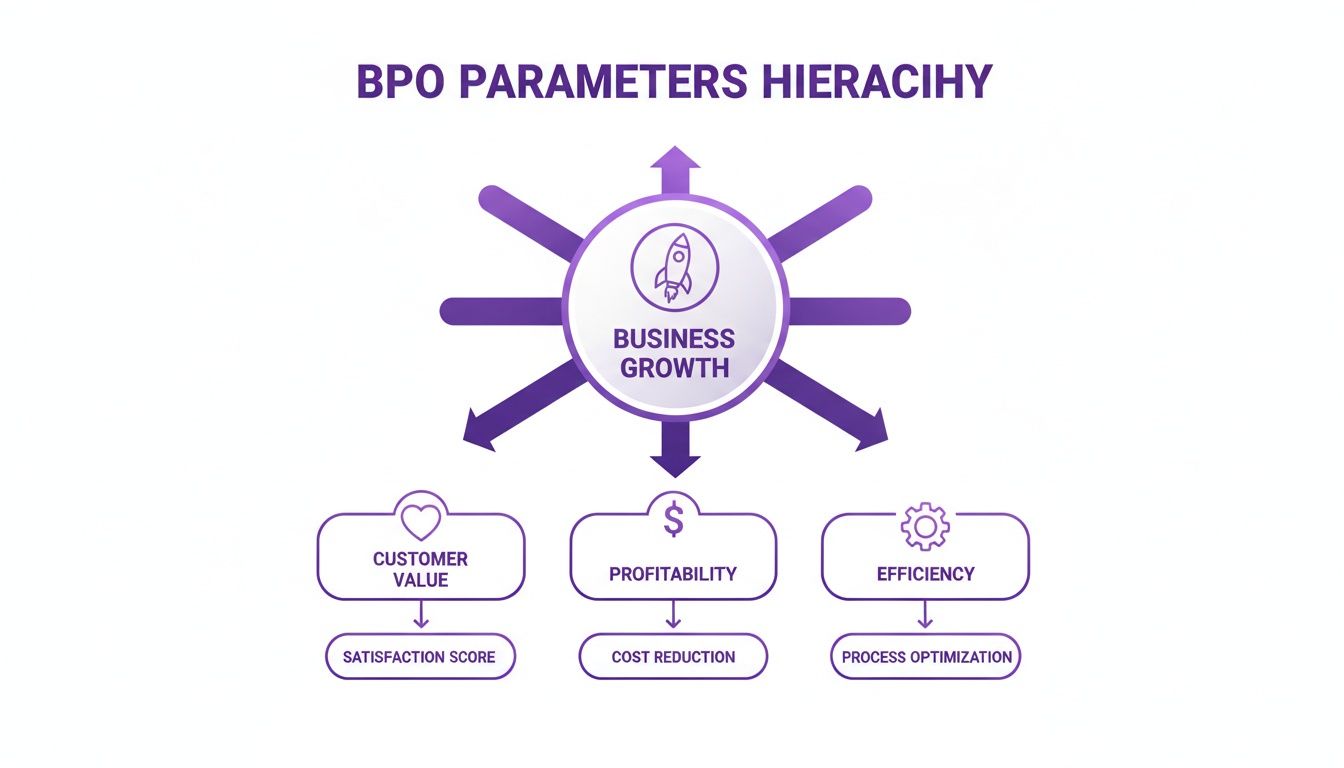
As you can see, these individual metrics aren't just isolated data points. They are interconnected drivers that, when managed strategically, converge to create tangible business expansion and a formidable competitive edge.
Turning Core BPO Metrics into Business Intelligence
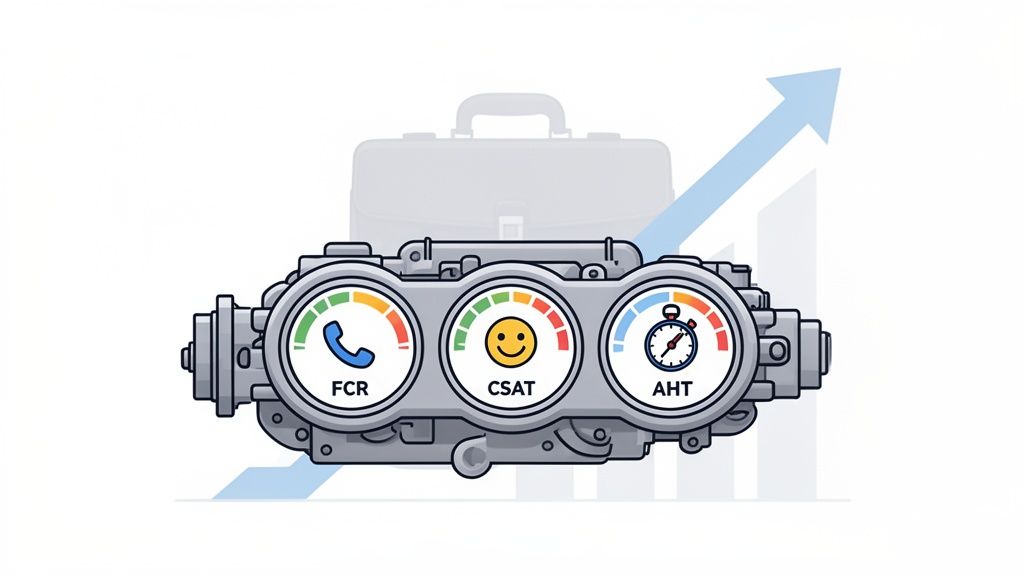
Viewing BPO quality parameters as a simple operational checklist is akin to owning a Formula 1 car and only monitoring the fuel gauge. To gain a competitive advantage, you must translate these raw metrics into actionable business intelligence. Each KPI is a diagnostic tool revealing specific vulnerabilities and strategic opportunities within your customer experience ecosystem.
By moving past superficial definitions, we can discern how these metrics interrelate and influence major business outcomes. For instance, the relationship between Average Handle Time (AHT) and First Call Resolution (FCR) is a classic strategic balancing act. Mismanage it, and you jeopardize both your budget and customer loyalty. They are not disparate figures; they are two sides of the same coin: efficiency versus effectiveness.
The AHT and FCR Balancing Act
Pressuring agents to reduce AHT can appear as a quick win for efficiency, but this approach often backfires, creating significant downstream costs. A compelling example from the Banking, Financial Services, and Insurance (BFSI) sector serves as a powerful cautionary tale.
A large retail bank implemented a corporate mandate to cut AHT by 15% for its support teams. While AHT metrics did indeed decline, this triggered a severe unintended consequence: a massive 30% spike in repeat calls. Agents, under pressure to conclude interactions rapidly, provided incomplete or rushed solutions, forcing frustrated customers to call back.
This not only eroded customer trust but actually drove operational costs higher than they were before the AHT reduction initiative. This singular focus on one metric created a larger, more expensive problem elsewhere. It is a potent reminder of why a holistic, integrated view of your data is paramount, a concept we explore in our guide on how data and AI will transform contact centres for financial services.
A low AHT is a vanity metric if it devastates your FCR. The true measure of efficiency isn’t how quickly an agent disconnects, but how effectively the customer's problem is resolved on the first attempt.
First Call Resolution as a Driver for Customer Loyalty
First Call Resolution (FCR) is arguably one of the most powerful BPO quality parameters because it directly measures your ability to resolve a customer's issue without friction. A high FCR is a clear indicator of well-trained agents, robust knowledge bases, and streamlined internal processes.
For an e-commerce brand, achieving a 90% FCR on queries about returns or delivery status can prevent negative online reviews and directly encourage repeat purchases. For an EdTech platform, resolving a student's access issue on the first call ensures uninterrupted learning, thereby protecting the institution's brand reputation and reducing subscriber churn.
The strategic importance of FCR has soared, with top-tier BPO centres now achieving rates of 85%—a significant leap from the 70% benchmark seen before 2020, driven largely by Robotic Process Automation (RPA). In sectors like real estate and e-commerce, this intense focus has helped elevate lead connection rates from a mediocre 47% to an impressive 91%.
Customer Satisfaction and Its Impact on Your Bottom Line
While FCR measures operational effectiveness, Customer Satisfaction (CSAT) quantifies the emotional outcome of that interaction. It is the ultimate pulse check on the customer experience, and it has a direct, measurable link to your revenue.
To read these signals correctly, pair CSAT with its counterpart metric: our guide on CSAT vs DSAT explains how tracking satisfaction and dissatisfaction together pinpoints where experience is leaking revenue.
Numerous studies have established a clear correlation between CSAT and customer retention. Consider these industry-specific examples:
- Real Estate: A positive CSAT score following a client's inquiry about a property viewing can be the definitive factor that leads them to choose your agency over a competitor, directly impacting commission revenues.
- EdTech: For a platform offering professional certifications, high CSAT scores from enrollment counselling sessions are directly linked to a 15% higher conversion rate from prospect to paying student.
- E-commerce: In this hyper-competitive market, a mere 5% increase in overall CSAT can lead to a 25% increase in customer retention over a 12-month period, directly boosting Customer Lifetime Value (CLV).
This data transforms CSAT from a "soft" metric into a hard financial KPI. It becomes a reliable predictor of future revenue, making it an essential focus for any executive serious about long-term, sustainable growth. By understanding the strategic story each number tells, you can make smarter decisions that fortify your operations and propel the entire business forward.
Building a High-Impact Quality Assurance Framework
Metrics are merely numbers on a page until you implement a system to imbue them with meaning. For any executive, a robust Quality Assurance (QA) framework is what transforms raw data from your BPO quality parameters into a tangible strategic advantage. This involves elevating QA from a simple compliance-checking exercise into a powerful engine for business growth, ensuring every agent interaction aligns with your company's highest strategic objectives.
A truly effective framework is not about retroactively catching errors; it is about proactively designing success into your operations. This means moving beyond generic scorecards to create a process that is transparent, consistent, and directly tied to the financial health of your organization.
Designing a Balanced and Strategic QA Scorecard
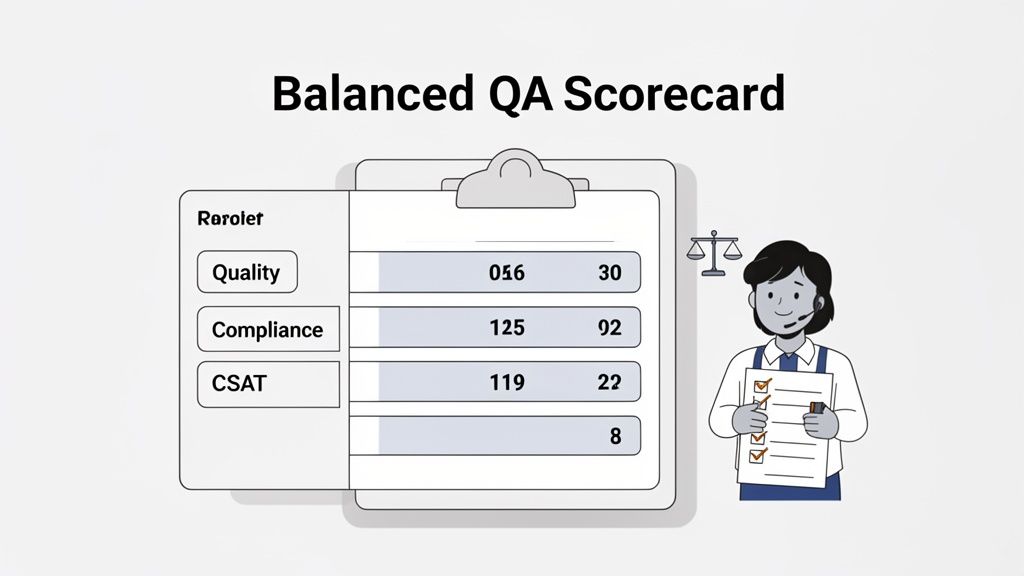
The QA scorecard is the heart of your framework, yet one of the most common executive-level mistakes is deploying a one-size-fits-all version. A far more strategic approach is to weight the parameters based on what truly drives business value at any given time.
Is the current quarter's priority to reduce operational expenditure? Then metrics like First Call Resolution (FCR) and Adherence to Process should carry more weight, as they directly impact efficiency. Is the strategic focus on increasing customer lifetime value? In that case, Customer Satisfaction (CSAT) and an agent's demonstrated ability to show empathy should be paramount.
By dynamically weighting your scorecard, you ensure that your method of evaluating agent performance is always in lockstep with top-level business priorities.
Example E-commerce QA Scorecard (Post-Purchase Support)
Let’s consider an e-commerce company with a strategic mandate to increase customer retention by 10% year-over-year. For their post-purchase support team, the scorecard could be structured as follows:
| Section | Parameter | Weight | Business Impact |
|---|---|---|---|
| Customer Experience | Demonstrated Empathy & Active Listening | 30% | Boosts CSAT and builds powerful brand loyalty, reducing churn. |
| Accurate and Complete Resolution | 25% | Drives FCR, preventing customer frustration and costly repeat contacts. | |
| Operational Efficiency | Correct Use of CRM and Ticketing Tools | 20% | Guarantees data integrity for analytics and helps reduce handle time. |
| Adherence to Returns/Refunds Process | 15% | Minimizes revenue leakage and costly procedural errors. | |
| Compliance | Adherence to Data Privacy Protocols | 10% | Protects the business from significant legal and financial risk. |
This structure sends an unequivocal message to agents and managers: while efficiency is important, the customer's emotional journey is the top priority, directly fueling the company's core retention strategy.
The Critical Role of Calibration Sessions
A brilliant scorecard is useless if it's not applied consistently. This is where calibration sessions are non-negotiable for leadership. These meetings bring your QA analysts, team leaders, and operations managers together to score the same interaction and then discuss their rationale.
The objective is not to force consensus but to cultivate a shared, standardized understanding of what "excellent" performance truly entails. By conducting these sessions bi-weekly, organizations can reduce scoring variance among analysts from a typical 15-20% down to less than 5%. This level of consistency is absolutely vital for building agent trust in the QA process and ensuring your data is reliable enough for high-stakes strategic decisions.
A QA framework without consistent calibration is like a corporate compass that points in a different direction every day. It creates confusion, erodes trust, and renders your quality data unreliable for steering the business.
From Operational Data to Executive Dashboards
As a VP or Director, you don’t have time to sift through raw QA scores—that is operational noise. The real strategic value emerges when that data is distilled into high-level executive dashboards that offer clear, actionable insights. A world-class dashboard doesn't just display numbers; it tells a compelling business story.
Instead of a flat report showing an average CSAT of 85%, a strategic dashboard would reveal:
- A 10% quarter-over-quarter increase in CSAT, directly correlated with a new agent coaching program, demonstrating a clear ROI on training investment.
- The top three drivers of customer dissatisfaction, pinpointed through sentiment analysis of call recordings, enabling targeted process improvements.
- A side-by-side performance comparison of QA scores between different teams or BPO partners, highlighting top performers and areas needing intervention.
These kinds of insights transform quality data into a predictive tool. They empower leaders to spot emerging trends, allocate resources for maximum impact, and rectify systemic issues before they affect the bottom line. This is where tools offering deeper analysis, as detailed in guides on how speech analytics helps improve coaching and training, become indispensable for feeding your dashboards with information that truly matters. This strategic approach elevates QA from a cost center to a genuine value driver for the entire organization.
Using AI to Give Your Quality Assurance a Much-Needed Overhaul
For decades, Quality Assurance in the BPO industry has operated on a foundation of statistical guesswork. With human auditors typically reviewing less than 2% of all customer interactions, leadership teams have been forced to make critical strategic decisions based on a minuscule, often unrepresentative, sample of reality. This approach creates vast blind spots where systemic issues, compliance risks, and escalating customer frustrations can fester undetected, posing a significant threat to the business.
This is where AI doesn't just offer an improvement—it precipitates a paradigm shift. Modern AI tools are not a minor upgrade; they represent a fundamental change in how we manage and measure BPO quality parameters. By integrating AI, you can finally transition from sampling a tiny fraction of conversations to analyzing 100% of them. Your entire customer interaction database is instantly transformed from a cost center into a goldmine of actionable business intelligence.
This total visibility allows you to identify subtle yet powerful trends that would be physically impossible for a human team to ever detect.
Uncovering Hidden Revenue and Keeping Customers Happy
Consider a real-world example from the SaaS industry. A fast-growing company was battling a stubborn 15% early-stage customer churn rate, but their traditional manual QA process, which sampled only 1% of support calls, offered no clear explanation.
They deployed an AI-powered conversation intelligence platform. In a single afternoon, the system analyzed six months of support calls—over 50,000 interactions. The AI quickly flagged a recurring issue with a specific onboarding step, a problem mentioned in just 0.5% of calls. This detail was far too infrequent for human auditors to ever connect the dots. By rectifying this one seemingly minor process glitch, the company reduced its early-stage churn by a full ten percentage points, directly adding $4M in annual recurring revenue.
That is the strategic power of 100% analysis in action. It elevates quality assurance from a reactive, problem-finding chore to a proactive, value-creating engine. It directly links QA to business outcomes by pinpointing the hidden friction points that quietly erode your revenue and customer loyalty.
AI transforms quality assurance from an audit function into a strategic intelligence engine. By analysing every single interaction, you gain an unparalleled, data-backed understanding of the customer experience that manual sampling could never provide.
Automating for Consistency and a Smarter Focus
Beyond identifying hidden trends, AI introduces unparalleled efficiency and accuracy to the QA process itself. It is well known that manual call scoring is tedious and highly subjective, riddled with human bias that leads to inconsistent feedback and agent disengagement.
AI-driven QA automation solves this by scoring 100% of interactions against your custom scorecard with machine precision. These systems can achieve accuracy rates as high as 97%, ensuring every agent is evaluated fairly and consistently, every single time.
This automation delivers on two critical business objectives:
- It Guarantees Compliance: AI can screen every interaction for mandatory disclosures, mentions of sensitive data, and adherence to regulatory scripts. This dramatically mitigates the risk of costly compliance fines, which can run into millions of dollars.
- It Frees Up Your Human Talent: By automating the repetitive task of scoring, your experienced QA professionals can transition from simply listening to calls to acting on insights. They can focus their time on high-value activities like coaching agents, designing superior training programs, and identifying systemic process improvements.
This is where you find the real return on investment. For DialNexa clients in sectors like hospitality and SaaS, this intelligence has been a game-changer. They've seen AI-qualified leads match human accuracy at 97%, turning routine support calls into valuable conversion opportunities while reducing operational costs by 40-50%.
Ultimately, integrating AI into your QA framework is not just about accelerating existing processes. It’s about gaining a profoundly deeper, more accurate understanding of your operations and empowering your teams with the insights they need to drive meaningful business results. You can learn more about transforming customer interactions in real time to see how this technology is being put to work today.
Actionable Strategies for Improving Key BPO Metrics

Understanding your metrics is one thing; strategically improving them is another. For senior leaders, the critical challenge is translating insights from BPO quality parameters into concrete actions that deliver a measurable return on investment. This is not about theory—it's about implementing intelligent, data-driven strategies that produce tangible business results.
Let’s move beyond the 'what' and into the 'how' with proven tactics for elevating performance across your most critical metrics, each presented as a mini-case study for executive-level clarity.
Driving Down Repeat Calls by Empowering Agents
A high repeat call rate is not just a dashboard metric; it's a direct tax on your profitability and a clear signal of customer friction. To combat this, a major telecommunications provider focused on improving its First Call Resolution (FCR) by equipping agents with superior tools, not just imposing stricter targets.
They deployed a dynamic, AI-powered knowledge base that provided real-time, context-aware information during live calls. This meant agents no longer had to frantically search through static documents. They gained instant access to the precise troubleshooting steps and account details relevant to each specific customer's problem.
The results were swift and significant. Within six months, they achieved a 22% reduction in repeat calls. This not only increased customer satisfaction but also freed up thousands of agent hours, directly cutting operational costs and proving a simple truth: empowering agents with the right technology is far more effective than just demanding speed.
Optimising Handle Time Without Hurting Quality
The relentless corporate push to lower Average Handle Time (AHT) often backfires, leading to rushed, inadequate interactions that create more problems than they solve. A far more intelligent strategy is to use targeted automation to identify and eliminate the true sources of inefficiency.
Consider a financial services BPO that was struggling with long call durations. Analysis revealed the culprit wasn't the customer interaction itself, but the laborious post-call administrative work. Agents were spending an average of 90 seconds after each call manually typing notes and updating records across three disparate systems.
By implementing Robotic Process Automation (RPA), they fully automated this after-call workflow. The impact was substantial: AHT dropped by an average of 75 seconds per call, which translated to a 15% boost in team productivity. Crucially, this was achieved without reducing the actual customer conversation time by a single second, ensuring service quality remained high while efficiency soared.
True efficiency isn't about rushing customer conversations. It’s about surgically removing the non-value-added tasks that bloat handle times and prevent your agents from focusing on what they do best—solving customer problems.
Boosting CSAT with Proactive, AI-Driven Follow-Ups
Waiting for customers to complain means you're already on the back foot. A forward-thinking hospitality client reversed this dynamic by using AI to predict dissatisfaction before it could escalate. They integrated an AI-powered sentiment analysis tool to monitor customer interactions in real time.
The system was trained to detect subtle cues—a slight frustration in a customer's tone, hesitant language—that indicated a negative experience was developing. When the AI flagged a call as high-risk for dissatisfaction, it automatically triggered a proactive follow-up, such as an immediate call-back from a senior agent or a personalized email from a manager offering a resolution.
This proactive outreach completely transformed their customer service model. The company saw a remarkable 15-point increase in its overall Customer Satisfaction (CSAT) score in just one quarter. It was a powerful lesson in using technology not just to measure sentiment, but to actively shape it. The investment quickly paid for itself through stronger customer loyalty and a 5% reduction in churn.
By focusing on these specific, actionable strategies, leaders can transform their BPO operations from a necessary cost center into a powerful engine for customer retention and profitable business growth.
Where Does BPO Quality Go From Here?
The management of BPO quality is at a major inflection point. For years, the industry has been trapped in a reactive cycle, reviewing a small fraction of calls after the fact. The future, however, lies in proactively shaping outcomes with intelligent, automated systems. The BPO quality parameters we’ve discussed are not just compliance metrics; they are the foundational elements for building a customer-centric, resilient, and highly profitable enterprise.
Imagine a future where AI seamlessly handles routine, high-volume customer queries with 100% compliance and accuracy. This doesn't render human agents obsolete. On the contrary, it elevates your best talent to handle complex, high-stakes conversations where empathy and sophisticated problem-solving are paramount. They become strategic specialists, augmented by real-time AI coaching that guides them through the most challenging customer issues. This is not science fiction; it is the next logical evolution for any BPO committed to operational excellence.
Intelligent automation is no longer a "nice-to-have" for BPO partnerships—it is essential for survival and growth. The BPOs that embrace this now will unlock unprecedented efficiencies, cultivate fierce customer loyalty, and build a durable competitive advantage.
As a VP or Director, it's time to critically assess your current QA framework. Is it merely an audit of past performance, or is it an active creator of strategic value for the future? Moving forward demands the adoption of intelligent automation. It is the key to transforming your quality function from a cost center into a strategic powerhouse that drives growth and consistently outmaneuvers the competition.
Frequently Asked Questions
As a senior leader, you’re not just looking at metrics; you're looking for how those numbers connect to the bigger picture. Here are some of the most common questions we get from executives trying to bridge the gap between operational data and strategic business outcomes.
How Do We Balance AHT and FCR Without Sacrificing Quality?
This is the classic contact centre dilemma. Chasing a low Average Handle Time (AHT) can feel like a win for efficiency, but it often backfires spectacularly. When agents are pressured to end calls quickly, they often provide rushed, half-baked answers. The result? Frustrated customers call back, your First Call Resolution (FCR) rate plummets, and your operational costs actually go up.
The real answer isn’t to pick one metric over the other; it’s to empower your agents to solve problems effectively the first time. Think of it this way: give them a great toolkit. This means a single, easy-to-search knowledge base, AI-powered assistants that feed them information in real-time, and the autonomy to actually fix the customer's issue.
An agent who spends five minutes on a complex call (a higher AHT) but nails the solution on the first try (a perfect FCR) is infinitely more valuable than an agent who rushes off a call in two minutes, only to have that same customer call back even angrier.
What Is the Real ROI of Investing in QA Automation?
The immediate cost savings from reducing manual audits are just the tip of the iceberg. To truly understand the return on investment from QA automation, you have to look at the much larger, strategic financial gains.
When calculating the ROI of QA automation, you must include the money saved from fewer compliance penalties (AI can hit 99% accuracy), the reduced costs of agent turnover because of fairer, data-driven feedback, and the new revenue generated by keeping customers happy for longer.
Let’s put some numbers to it. A study by Bain & Company found that a mere 5% boost in customer retention can increase a company's profitability by more than 25%. That's the kind of impact you can see when QA automation analyses 100% of your calls and pinpoints exactly what drives great service.
How Do We Align BPO Parameters with C-Suite Business Goals?
BPO metrics can't live on an island. If they aren't directly tied to your company's core objectives, they're just numbers on a spreadsheet. The trick is to translate what the C-suite cares about into tangible KPIs for your BPO partner. It’s all about creating a clear line of sight from the agent’s screen to the boardroom.
Here’s how that translation works in practice:
- If the goal is to increase market share: Your focus should be on creating loyal brand ambassadors. That means making Customer Satisfaction (CSAT) and Net Promoter Score (NPS) your hero metrics.
- If the goal is to improve profitability: The spotlight shifts to operational efficiency. You’ll want to obsess over metrics like Cost-Per-Contact, Agent Utilisation, and, of course, FCR to stamp out waste.
When you explicitly link every BPO quality parameter to a top-level business priority, you change the narrative. Your contact centre stops being a cost centre and becomes a strategic engine for growth.
Ready to turn every customer conversation into a conversion-ready outcome? DialNexa delivers human-like Voice AI agents that scale your operations, reduce costs, and improve lead qualification with 97% accuracy. Explore how our custom AI agents can transform your business at https://dialnexa.com.
For the complete set of BPO quality benchmarks across FCR, Connect Rate, AHT, CSAT, Schedule Adherence and QA scorecard design by industry, see our full guide to quality parameters for BPO.

[…] growth?" To have that strategic discussion, it's also helpful to understand the related BPO quality parameters that paint the full picture of service excellence. This guide will give you the framework you […]
[…] and technology to deliver on your word. This commitment to delivery is one of the most critical BPO quality parameters for building a business that […]
This is an insightful explanation of how BPO quality metrics evolve from operational KPIs into powerful business intelligence. The strong connection between FCR, CSAT, AI-driven QA, and long-term profitability highlights a truly modern approach to customer experience management.
[…] The commercial case is stronger than many executive summaries admit. DialNexa’s own guidance notes that stronger CSAT and FCR are tied not just to cleaner reporting but to lower repeat contact volume and better revenue retention; one industry guide cited there says a 10-point CSAT increase can correlate with a 2% revenue uplift and that stronger FCR can reduce repeat calls by up to 30% in some environments, as discussed in this BPO quality parameters overview. […]