
8 Perfect Telephone Conversation Example Scripts for Leaders in 2026
In today's competitive landscape, inconsistent communication is a direct threat to revenue and customer retention. Senior leaders are increasingly realising that every customer touchpoint, especially the telephone conversation, is a high-stakes interaction that dictates brand perception and operational efficiency. Unstructured calls lead to missed opportunities, compliance risks, and soaring operational costs—challenges that directly impact the bottom line. As leaders standardize conversations to drive ROI across various touchpoints, they are actively engaging in the customer interaction revolution, recognising that structured communication is no longer a choice but a core business strategy.
This article moves beyond theory, presenting eight meticulously crafted telephone conversation example scripts designed for high-stakes business environments across sectors like real estate, EdTech, and healthcare. We will dissect each script, providing a strategic blueprint for Directors, VPs, and CXOs to deploy scalable, efficient, and profitable communication strategies.
You will find actionable guidance for:
- Real Estate: Property discovery and site visit booking.
- EdTech: Programme counselling and student enrollment.
- BFSI: KYC compliance and account verification.
- SaaS: Demo scheduling and presales qualification.
- E-commerce: Customer feedback and retention calls.
- Healthcare: Patient appointment booking and reminders.
- Recruitment: Initial candidate screening.
We'll explore how standardisation can transform call outcomes, citing real-world data like boosting connect rates from a typical 47% to an industry-leading 91% and improving lead-to-booking conversions from a mere 2% to an impressive 8%. This is your playbook for turning conversations into conversions, at scale.
1. Real Estate Property Discovery & Site Visit Booking
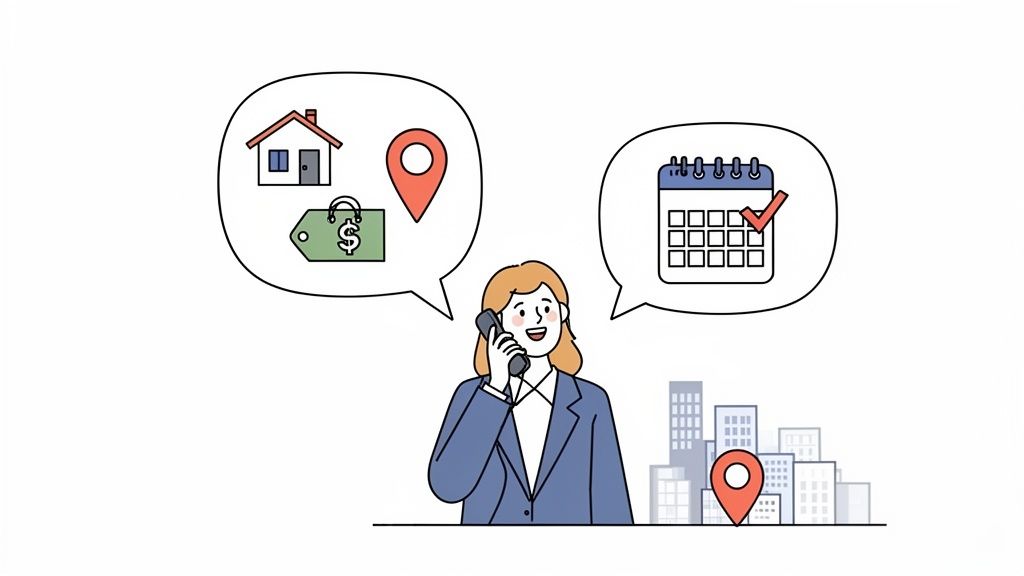
Converting inbound leads into tangible site visits is a critical bottleneck for real estate developers and brokerages. This telephone conversation example is specifically engineered to qualify prospects, accurately capture their property requirements, and seamlessly book a site visit, often using a Voice AI agent to handle calls at scale. The goal is to move beyond simple information collection to a confirmed appointment, directly impacting sales pipelines.
This model works by guiding the caller through a structured yet conversational needs analysis. The AI or agent asks about location preferences, budget, property type (e.g., 2BHK, 3BHK), and must-have amenities. Based on these inputs, it matches the caller with suitable properties from a portfolio and proposes a site visit to the most relevant options.
Strategic Breakdown
This approach excels by automating the top of the sales funnel. For CXOs, this means a significant reduction in the cost per lead qualification and a higher throughput of genuinely interested buyers being passed to the sales team. For instance, major Indian real estate platforms have used ready-made personas from providers like DialNexa to manage inquiries for multi-property portfolios, achieving up to a 40% increase in scheduled site visits from the same volume of inbound calls. The key is to create a natural, non-robotic interaction that builds trust from the first sentence.
Key Takeaway: The primary objective is not just to answer questions but to guide the prospect towards a clear next step: a physical or virtual tour. This transforms a passive inquiry into an active sales opportunity.
Actionable Tips for Implementation
- Localise Credibility: Mention specific landmarks, recent project launches in the prospect's preferred locality, or upcoming infrastructure developments to build trust and demonstrate local expertise.
- Use Soft Closing Techniques: Instead of asking "Do you want to visit?", frame the question as "We have slots available this Saturday at 11 a.m. or Sunday at 2 p.m. Which would work better for you?". This technique alone can increase booking rates by 15-20%.
- Develop Fallback Options: If a perfectly matching property is unavailable, train the AI or agent to suggest a similar alternative with an added benefit, like a special offer or superior amenity, to retain the prospect's interest.
For real estate professionals, mastering the initial outreach is crucial; learn from these examples for successful telephone conversations. For more inspiration, this guide on 7 High-Converting Real Estate Cold Calling Scripts provides excellent frameworks.
2. EdTech Program Counselling & Enrollment Call
For EdTech platforms, converting a prospective student's interest into a confirmed enrollment is the ultimate goal. This telephone conversation example is designed to function as a structured counselling session, guiding learners through program details, career outcomes, and admission procedures. It aims to build a relationship of trust and authority, positioning the platform not just as a course provider but as a career partner. The key is to transform a simple enquiry into a confident decision to enrol.
This model operates by first understanding the student's career aspirations, current skill level, and potential apprehensions. An agent, whether human or AI, then maps these needs to the most suitable courses, explaining the curriculum, faculty credentials, and potential return on investment in terms of job placements or salary hikes. This consultative approach helps demystify the learning journey and facilitates a smooth enrollment process.
Strategic Breakdown
This approach automates the critical, high-volume student counselling phase, allowing human counsellors to focus on more complex cases. For VPs and Directors of Admissions, this translates to a dramatic increase in conversion rates from leads to applications. For instance, major Indian EdTech platforms have leveraged ready-made personas from providers like DialNexa to manage the surge during admission seasons. They have seen a 30% rise in qualified enrollments by ensuring every lead receives instant, personalised, and accurate counselling, irrespective of call volume. The conversation is engineered to be empathetic, addressing student anxieties directly.
Key Takeaway: The goal extends beyond providing information. It is about building a clear, compelling value proposition that aligns the course offering with the student's personal and professional ambitions, thereby accelerating their decision-making process.
Actionable Tips for Implementation
- Use Success Stories: Have placement statistics and alumni testimonials ready. Phrases like, "Students from our last batch saw an average salary increase of 60%, with placements at companies like…" are powerful social proof.
- Offer Flexible Next Steps: Not every student is ready to enrol immediately. Provide options like a free demo class, access to a recorded introductory session, or a scheduled callback with a senior academic counsellor. Providing these options can increase lead nurturing success by 25%.
- Create Urgency Ethically: Frame offers around batch commencement dates or limited-time scholarships. For example, "The next cohort begins on the 15th, and the early-bird scholarship is available for the next 48 hours. Shall I help you complete the application to secure it?"
- Implement Smart Handoffs: Train the system to recognise complex queries about intricate scholarship criteria or customised curriculum needs and seamlessly transfer the call to a specialised human counsellor to ensure a high-quality experience.
Mastering this type of telephone conversation example is fundamental for EdTech growth. For deeper insights into student engagement, this guide on student recruitment strategies offers valuable frameworks.
3. BFSI KYC (Know Your Customer) Compliance & Account Verification
For financial services, digital banks, and trading platforms, the Know Your Customer (KYC) process is a non-negotiable regulatory hurdle. This telephone conversation example is designed to automate and standardise KYC and account verification, ensuring strict compliance with regulatory bodies like RBI, SEBI, and IRDAI. The core objective is to securely collect and verify customer information for account opening or updates, without compromising the customer experience.
This model operates as a guided, compliant dialogue, often deployed using a Voice AI agent. The system methodically walks the customer through required data points, such as PAN, Aadhaar details, and address verification, while maintaining a secure and professional tone. It confirms the authenticity of the customer and prepares the groundwork for document submission, streamlining what is often a friction-filled step in customer onboarding.
Strategic Breakdown
Automating KYC calls provides a massive strategic advantage by ensuring 100% compliance adherence at scale, drastically reducing the risk of human error and associated penalties. For a CXO in the BFSI sector, this translates to faster customer onboarding, lower operational costs, and an enhanced security posture. For instance, leading Indian trading platforms and digital banks have utilised ready-made personas from providers like DialNexa to automate these regulated conversations, resulting in a 60% reduction in manual verification efforts and accelerating the average onboarding time from 72 hours to just 15 minutes. The key is a script that is both rigorously compliant and conversationally efficient.
Key Takeaway: The primary objective is to complete a mandatory regulatory process with maximum accuracy and minimal customer friction. This transforms a compliance necessity into a seamless, positive first interaction with the brand.
Actionable Tips for Implementation
- Ensure Regulatory Alignment: Regularly update the script to reflect the latest guidelines from RBI, SEBI, or other relevant authorities to avoid compliance breaches.
- Implement Secure Data Capture: Use DTMF (dual-tone multi-frequency) masking or secure voice capture methods to handle sensitive information like Aadhaar or PAN numbers, ensuring data is never exposed. This is critical for maintaining PCI DSS compliance.
- Build in Clear Handoffs: Create a clear protocol for escalating flagged cases or complex verifications to a human compliance officer to manage exceptions effectively.
- Use Encrypted Call Recording: Maintain encrypted recordings of all verification calls as a secure, auditable trail for regulatory review and internal quality assurance.
In the financial services industry, compliant and efficient communication is paramount; discover how data and AI will transform contact centres for financial services.
4. Customer Support & Technical Issue Resolution
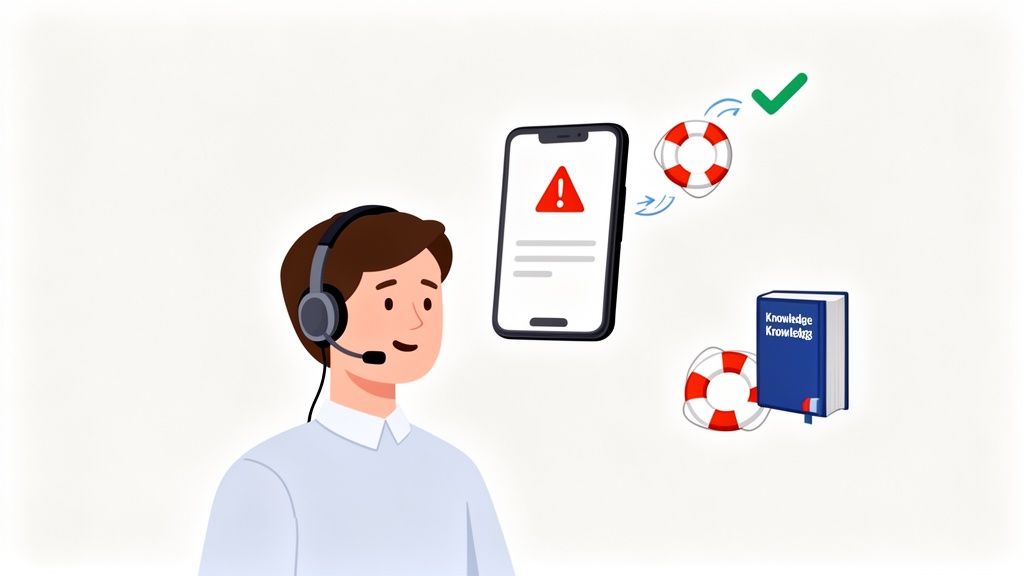
Effective customer support is the backbone of retention, especially in tech-reliant industries like SaaS, e-commerce, and telecommunications. This telephone conversation example is built around a structured troubleshooting script designed to diagnose customer issues, provide clear solutions, and escalate complex problems efficiently. The objective is to resolve issues on the first call, minimising customer frustration and reducing operational costs associated with repeat calls and manual escalations.
This model functions by creating a clear, logical path for problem resolution. A Voice AI or human agent first identifies the customer and the nature of their issue (e.g., login trouble, order status, billing query). It then follows a pre-defined decision tree, asking targeted questions to isolate the root cause before offering a step-by-step solution. For high-volume, repetitive issues like password resets or delivery tracking, this approach can be fully automated.
Strategic Breakdown
From a CXO's perspective, this methodology directly impacts the bottom line by improving First Call Resolution (FCR) rates and deflecting tickets from expensive human support tiers. According to data from Forrester, improving FCR by just 1% can translate into a $276,000 annual operational saving for the average call center. For instance, SaaS platforms using AI-powered support personas from providers like DialNexa have automated over 60% of their Tier-1 support queries, leading to a 30% reduction in support agent overhead. The key is to blend efficiency with empathy, ensuring the customer feels heard and supported even during an automated interaction.
Key Takeaway: The goal is to provide a swift, accurate, and empathetic resolution. A well-structured support call not only solves the immediate problem but also reinforces customer trust and loyalty, turning a potential complaint into a positive brand experience.
Actionable Tips for Implementation
- Design Intelligent Decision Trees: Map out common customer issues and create logical troubleshooting paths. Ensure there are clear and seamless exit points to a human agent when the AI detects high frustration (via sentiment analysis) or a complex, unresolvable issue.
- Integrate Empathy Statements: Train the AI or agent to use phrases like "I understand how frustrating that must be" or "Let's get this sorted out for you right away". Acknowledging the customer's emotion is crucial for de-escalation.
- Log and Analyse Interactions: Systematically log every call's outcome, duration, and resolution path. Use this data to identify recurring issues, refine your knowledge base, and continuously improve the support scripts for both AI and human agents.
For leaders aiming to enhance their service delivery, understanding how AI voice agents are transforming customer service and sales is a critical first step. You can explore this topic further in this in-depth guide from DialNexa.
5. SaaS Demo Scheduling & Product Presales Call
For B2B software and SaaS companies, the initial presales call is a pivotal moment that separates high-potential leads from unqualified inquiries. This telephone conversation example is designed to efficiently qualify prospects, diagnose their specific business challenges, and secure a product demonstration with key decision-makers. The objective is to bridge the gap between marketing-generated interest and a formal sales engagement, ensuring that the sales team's valuable time is spent on well-vetted opportunities.
This model operates by focusing on problem discovery rather than a premature feature pitch. The agent, human or AI, asks targeted questions about the prospect's current processes, pain points, and desired business outcomes. By understanding the prospect's world first, the conversation can then strategically position the SaaS product as the ideal solution, making the request for a demo a logical and compelling next step.
Strategic Breakdown
This approach radically improves the efficiency and ROI of the sales development function. For VPs of Sales and CXOs, this translates directly to a lower cost of customer acquisition (CAC) and a shorter sales cycle. By automating this crucial qualification step, companies ensure only prospects with a genuine need and budget enter the pipeline. SaaS leaders using ready-made personas from providers like DialNexa have reported a 30-50% increase in the conversion rate from initial call to a completed demo, effectively filling their sales calendars with high-quality appointments.
Key Takeaway: The goal is not to "sell" the product on the first call, but to "sell" the value of the next meeting. The conversation must establish a clear link between the prospect's pain and the product's promised gain, making the demo an unmissable event.
Actionable Tips for Implementation
- Focus on Business Impact: Instead of listing features, frame the conversation around outcomes. Ask, "How much time is your team currently spending on manual data entry?" and follow up with how your solution can reclaim those hours.
- Create Scarcity: To encourage prompt scheduling, use phrases like, "Our senior product specialist has a couple of openings next week on Tuesday and Thursday. Which works better for you?". This implies high demand for expert time.
- Qualify the Attendee: Before confirming a time, gently verify the decision-maker's presence. You can ask, "To ensure we can answer any technical or pricing questions, who else from your team should be on the call?". This simple question can increase the close rate from demos by over 20% by ensuring the right people are in the room.
For SaaS sales professionals, perfecting this initial conversation is paramount. These strategies are critical for building a robust and predictable sales pipeline.
6. E-commerce Customer Feedback & Retention Call
For direct-to-consumer (D2C) brands and e-commerce platforms, the customer journey doesn't end at delivery. This proactive telephone conversation example is designed to transform a transactional relationship into a long-term, loyal one. By systematically gathering feedback and addressing concerns, brands can significantly reduce churn and increase customer lifetime value (CLV), turning post-purchase interactions into powerful retention opportunities.
This model involves contacting customers shortly after they receive their order. The conversation, often handled by a trained agent or a sophisticated Voice AI, aims to gauge their satisfaction with the product and the delivery experience. It's a strategic touchpoint to resolve issues before they become public complaints and to offer personalised incentives that encourage repeat business.
Strategic Breakdown
This proactive outreach strategy directly impacts key e-commerce metrics by building a robust feedback loop. For CXOs, this translates to a tangible reduction in customer acquisition costs by focusing on retaining existing buyers. Proactive engagement can lower churn rates by up to 15% and increase repeat purchase frequency. For example, D2C lifestyle brands using specialised e-commerce personas from providers like DialNexa have successfully used these calls to identify product quality issues early, preventing widespread dissatisfaction and costly returns, which often exceed 5% of gross sales.
Key Takeaway: The goal extends beyond a simple "How was your order?" It is a strategic intervention to demonstrate that the brand values the customer's opinion, thereby fostering loyalty and turning satisfied customers into brand advocates.
Actionable Tips for Implementation
- Time it Right: Place the call 24-72 hours after confirmed delivery. This ensures the experience is still fresh in the customer's mind, leading to more specific and valuable feedback.
- Ask Open-Ended Questions: Instead of asking "Are you happy with the product?", try "What was your first impression when you unboxed the product?". This encourages detailed, authentic responses.
- Personalise the Incentive: Use the customer’s purchase history to offer a relevant incentive. If they bought a skincare product, offer a discount on a complementary item rather than a generic store-wide coupon. Personalised offers can boost redemption rates by over 50%.
7. Healthcare Patient Appointment Booking & Reminder
For healthcare facilities, from large hospital networks to specialised clinics, managing patient appointments efficiently is paramount to both operational success and patient care. This telephone conversation example is designed to automate the booking, confirmation, and reminder process in a HIPAA-compliant manner. The goal is to reduce costly no-shows, optimise practitioner schedules, and improve patient access to care, often leveraging Voice AI for 24/7 availability.
This model functions by guiding the patient through a secure and straightforward scheduling process. The AI or agent verifies patient identity, understands the reason for the visit (e.g., new consultation, follow-up, specific test), and offers available slots with the appropriate doctor or department. It then confirms the appointment and can schedule automated reminders, significantly decreasing the administrative load on front-desk staff.

Strategic Breakdown
This automated approach directly tackles one of the biggest revenue leaks in healthcare: patient no-shows, which can cost the US healthcare industry over $150 billion annually. For healthcare administrators and CXOs, implementing this system means a measurable improvement in clinic utilisation rates and a drastic reduction in staff time spent on repetitive scheduling calls. For instance, dental office chains and telehealth platforms have used healthcare-specific personas from providers like DialNexa to manage bookings, resulting in up to a 30% reduction in missed appointments and a more predictable revenue stream.
Key Takeaway: The core objective is to create a frictionless, reliable, and secure channel for patients to manage their appointments. This enhances the patient experience while maximising the operational efficiency and revenue of the healthcare provider.
Actionable Tips for Implementation
- Ensure HIPAA Compliance: All communication, especially when handled by an AI, must adhere strictly to privacy and data security regulations. Ensure patient data is encrypted and handled with the utmost confidentiality.
- Use Clear and Empathetic Language: Medical scheduling can be stressful for patients. Train the agent to use simple, reassuring language and avoid clinical jargon. The tone should be helpful and patient, not transactional.
- Implement Smart Escalation: For complex medical queries, symptoms that require triage, or distressed callers, the system must have a seamless and immediate handoff protocol to a human agent or nurse.
- Automate Pre-Visit Communication: Once an appointment is booked, automatically send pre-visit instructions, intake forms, or telehealth links via SMS or email to prepare the patient and save time during the visit.
By automating routine scheduling, healthcare organisations can free up valuable human resources to focus on providing excellent patient care. Exploring the role of AI in healthcare further can offer more insights; you can learn more about how Voice AI is transforming healthcare on DialNexa.com.
8. Recruitment & Job Candidate Screening Call
For HR departments and recruitment agencies, the initial candidate screening process is a high-volume, repetitive task that consumes significant resources. This telephone conversation example is designed to streamline and automate the first-pass screening of job applicants. The primary goal is to efficiently assess core qualifications, verify experience, and filter the most promising candidates for subsequent interview rounds, dramatically accelerating the hiring pipeline.
This model functions by using a structured, question-based script to quickly qualify or disqualify applicants. An HR representative or a Voice AI agent asks a series of predefined questions about qualifications, years of experience, key skills, and salary expectations. This conversation ensures that only candidates who meet the non-negotiable criteria are advanced, saving valuable time for hiring managers and improving the quality of the final interview pool.
Strategic Breakdown
Automating the top of the recruitment funnel offers a substantial competitive advantage. For CXOs and Heads of HR, this translates into a lower cost-per-hire and a faster time-to-fill for critical roles. For instance, large IT companies and staffing agencies processing thousands of applications for entry-level tech roles have leveraged ready-made recruitment personas from providers like DialNexa to handle initial screenings 24/7. This has led to a 60% reduction in manual screening time and a 35% improvement in the quality of candidates shortlisted for technical rounds.
Key Takeaway: The objective is to systematically vet candidates against a clear set of criteria, transforming a vast applicant pool into a high-quality, manageable shortlist. This shifts HR focus from logistical coordination to strategic talent assessment.
Actionable Tips for Implementation
- Use a Scoring Rubric: Design a simple scoring system for candidate responses. This allows you to objectively compare applicants and make data-driven decisions on who moves forward. This quantitative approach can reduce hiring bias by up to 40%.
- Incorporate Behavioural Questions: Include one or two light behavioural questions (e.g., "Tell me about a time you had to learn a new skill quickly") to get a preliminary feel for a candidate's soft skills and cultural fit.
- Be Transparent and Set Expectations: Clearly outline the next steps in the hiring process and provide a realistic timeline. Transparency improves the candidate experience, even for those who are not selected.
For recruiters aiming to enhance their process, this type of structured telephone conversation example is invaluable. To further refine your approach, this guide on How to Conduct an Effective Phone Screen offers additional best practices.
8-Scenario Telephone Conversation Comparison
| Solution | Implementation Complexity 🔄 | Resource Requirements 💡 | Expected Outcomes ⭐📊 | Ideal Use Cases | Key Advantages ⚡ |
|---|---|---|---|---|---|
| Real Estate Property Discovery & Site Visit Booking | Medium — requires market/inventory customization and fallback flows 🔄 | CRM & property inventory, calendar integration, local market training, follow-up automation 💡 | ⭐⭐⭐⭐; 📊 Lead→booking improvement (2%→8%), connect rate 47%→91% | Real estate developers, brokers, high-volume inquiry campaigns | ⚡24/7 qualification, consistent messaging, richer CRM data |
| EdTech Program Counselling & Enrollment Call | Medium — program-level customization and handoff logic 🔄 | Curriculum content, FAQs, multilingual support, counselor escalation, enrollment flows 💡 | ⭐⭐⭐; 📊 higher enrollment rates, reduced time-to-enroll | Online learning platforms, universities, certification providers | ⚡Scales counselling, consistent info delivery, analytics capture |
| BFSI KYC Compliance & Account Verification | High — strict regulated flows, frequent updates, audit trails required 🔄 | Secure data capture, encryption, compliance updates, audit logging, trained compliance reviewers 💡 | ⭐⭐⭐⭐⭐; 📊 100% regulatory compliance, faster KYC processing, audit-ready records | Banks, trading platforms, NBFCs, digital wallets onboarding | ⚡Reduces manual KYC time, ensures compliance, fewer collection errors |
| Customer Support & Technical Issue Resolution | Medium — needs robust KB integration and escalation rules 🔄 | Knowledge base, diagnostic flows, escalation routing, sentiment analysis, ticketing integration 💡 | ⭐⭐⭐⭐; 📊 40–60% faster resolution, improved first-contact resolution | SaaS, e-commerce, telecom, software support centers | ⚡Reduces repetitive work, 24/7 support, consistent troubleshooting |
| SaaS Demo Scheduling & Product Presales Call | Low–Medium — structured qualification + scheduling logic 🔄 | CRM, calendar integration, pre-demo assets, discovery templates, sales handoff 💡 | ⭐⭐⭐⭐; 📊 higher demo attendance, improved lead quality, shorter sales cycle | B2B SaaS, enterprise sales teams, presales operations | ⚡Pre-qualifies leads, improves demo relevance, saves sales time |
| E-commerce Customer Feedback & Retention Call | Low — survey + incentive flows with timing rules 🔄 | Order history, loyalty program integration, incentives budget, feedback logging 💡 | ⭐⭐⭐; 📊 reduced churn, increased repeat purchases, product insights | D2C brands, subscription platforms, post-delivery follow-up programs | ⚡Scales feedback collection, identifies at-risk customers, drives retention |
| Healthcare Patient Appointment Booking & Reminder | High — HIPAA/privacy, secure flows, clinician handoffs 🔄 | Encrypted systems, HIPAA-compliant storage, insurance verification, clinician escalation, reminder automation 💡 | ⭐⭐⭐⭐; 📊 reduces no-shows 20–40%, improves utilization and compliance | Hospitals, clinics, telehealth services, specialty practices | ⚡Reduces no-shows, 24/7 booking, frees front-desk staff |
| Recruitment & Job Candidate Screening Call | Medium — role-specific scripts and scoring rubrics 🔄 | Job templates, scoring rubrics, interview scheduling, integration with ATS, feedback logging 💡 | ⭐⭐⭐⭐; 📊 reduces time-to-hire, improves candidate quality, consistent screening | Staffing agencies, high-volume hiring, IT and entry-level recruitment | ⚡Screens large candidate volumes quickly, enforces consistent evaluation |
From Script to Scale: Implementing Your High-Impact Conversation Strategy
Throughout this guide, we have moved beyond mere scripts to deconstruct the anatomy of impactful communication. Each telephone conversation example, from a high-stakes BFSI compliance call to a delicate healthcare appointment booking, serves as a strategic blueprint. We have analysed the core components: setting clear goals, anticipating objections, employing tactical probing questions, and crucially, preparing for the inevitable integration of Voice AI. The fundamental lesson is that a successful conversation is never an accident; it is the result of meticulous design, strategic foresight, and a deep understanding of human (and artificial) interaction.
For the forward-thinking Director or CXO, these examples are not just templates to be copied. They are proof of concept for a much larger opportunity: the systemisation of conversational excellence across the entire organisation. The true value is unlocked when you transition from ad-hoc agent training to building a scalable, data-driven conversation engine that consistently delivers measurable business outcomes.
Synthesising the Core Strategic Pillars
Across all the verticals we explored, a few universal truths emerged. Mastering these pillars is non-negotiable for any leader aiming to transform their contact centre from a cost centre into a strategic growth driver.
- Goal-Oriented Design: Every successful call begins long before the phone rings. It starts with a clearly defined primary objective (e.g., book a site visit, complete KYC, schedule a demo) and a secondary objective (e.g., gather market intelligence, gauge purchase intent). Without this clarity, conversations drift and opportunities are lost.
- Proactive Objection Handling: The examples demonstrate that objections are not roadblocks; they are signposts indicating a need for more information or reassurance. A well-prepared strategy involves not just rebuttals, but a framework for understanding the root cause of the objection and addressing it with empathy and precision.
- The Art of the Probe: The most effective agents are not those who talk the most, but those who listen the most effectively. Strategic probing questions, as highlighted in each telephone conversation example, transform a monologue into a dialogue, uncovering invaluable customer insights that can inform everything from product development to marketing strategy.
- AI as an Amplifier, Not a Replacement: The future of customer communication is not a binary choice between human and AI. It is a hybrid model where AI handles predictable, high-volume interactions, freeing up human agents to manage complex, high-value conversations. The key is designing conversation flows that facilitate a seamless handover and leverage the strengths of both.
Actionable Next Steps: From Blueprint to Business Impact
Reading about effective strategies is one thing; implementing them is another. The path to operationalising these insights requires a structured approach.
- Audit Your Current Conversations: Begin by recording and analysing a sample of your existing calls. Where are conversations failing? At what point do customers drop off? Use the frameworks in this article to benchmark your current performance against the strategic examples provided. Identify the top three areas for immediate improvement.
- Develop a Centralised Playbook: Do not leave conversational quality to chance or individual agent skill. Create a dynamic, internal playbook based on the detailed examples we have covered. This should be a living document, updated regularly with new objections, successful tactics, and insights from call data.
- Invest in a Conversation Intelligence Platform: You cannot optimise what you cannot measure. Modern platforms provide the infrastructure to not only deploy sophisticated conversation flows but also to analyse performance at an unprecedented scale. Metrics like call success rate, average handling time, and customer sentiment score are no longer 'nice-to-haves'; they are essential KPIs for managing a modern contact centre.
Ultimately, mastering the art and science of the telephone conversation is about building a powerful, resilient, and scalable engine for customer engagement. The detailed telephone conversation example for each industry is a starting point, a tactical guide to winning one interaction at a time. The real strategic victory, however, lies in embedding these principles into your organisation's DNA. By doing so, you create a formidable competitive advantage, enhance customer loyalty, and directly impact your bottom line, turning every call into an opportunity for growth.
Ready to transform your theoretical knowledge into a scalable, AI-powered reality? The blueprints in this article are most effectively implemented with a platform built for intelligent automation. Discover how DialNexa can help you deploy, analyse, and optimise high-impact voice conversations at scale, turning every telephone conversation example into a measurable business outcome.

Great insights on how structured call scripts can turn everyday conversations into measurable business outcomes. The industry-specific examples and data-backed strategies make this a valuable guide for improving conversions, customer experience, and operational efficiency at scale.