
Quality Center Software: A CXO’s Guide to AI Integration
Most executives still classify Quality Center software as a maintenance burden. That's the wrong frame. A mature ALM repository with structured requirements, linked test evidence, defect histories, and audit trails is exactly the kind of high-integrity operational data that modern AI programmes usually lack.
That is the counterintuitive opportunity. OpenText positions Quality Center as a platform for consistent, repeatable processes across requirements, test planning, result analysis, and defect management, with end-to-end visibility across the application lifecycle through OpenText Application Quality Management. In parallel, enterprise teams report a serious integration problem: 68% struggle with data portability from legacy ALM tools to cloud-native AI platforms. The implication is strategic, not technical. The firms that solve this bridge first can turn a compliance repository into an intelligence layer for customer operations.
That matters far beyond QA. In sectors where calls carry risk, such as KYC support, admissions counselling, mortgage eligibility screening, or property lead qualification, Voice AI performs best when its prompts, workflows, and exception paths come from controlled enterprise data rather than ad hoc scripts. Quality Center often already contains that logic in a governed form. For leaders modernising service operations, the playbook used in a strong contact centre and BPO model now intersects directly with software quality governance.
Table of Contents
- Introduction From Legacy Tool to Strategic Asset
- Understanding Quality Center Software Strategically
- Core Capabilities That Drive Operational Excellence
- Industry Use Cases With Measurable ROI
- The Bridge Connecting Quality Center to Voice AI
- A CXOs Checklist for Vendor Selection and Implementation
- Conclusion From Quality Centre to Intelligence Centre
Introduction From Legacy Tool to Strategic Asset
Many leadership teams see Quality Center software as valuable only because auditors and release managers still need it. That view underestimates its strategic value. A governed ALM platform captures how your organisation defines correctness, handles exceptions, documents failure states, and proves that a process was followed. Those are not legacy artefacts. They are training-grade business logic.
The strongest reason to revisit Quality Center now isn't nostalgia for enterprise QA. It's the growing cost of deploying AI into workflows that lack structured operating knowledge. When teams build Voice AI from scattered SOPs, tribal knowledge, and call notes, they inherit inconsistency at scale. When they start from validated requirements, approved test paths, and documented defect patterns, they give AI a far better operating boundary.
Practical rule: Treat Quality Center as a governed source of decision logic, not just a test repository.
This reframing changes budget discussions. Instead of asking whether to keep funding an older platform, a CXO can ask a sharper question: where do we already hold auditable, reusable process knowledge that can improve automation outcomes? In many enterprises, especially those with process-heavy environments, Quality Center is one of the clearest answers.
There's also a competitive angle. Organisations that can repurpose existing governance assets into AI operations move faster than those starting from a blank page. They spend less time reconstructing process logic and more time validating production use cases. That can influence presales responsiveness, support consistency, and compliance posture at the same time.
Understanding Quality Center Software Strategically
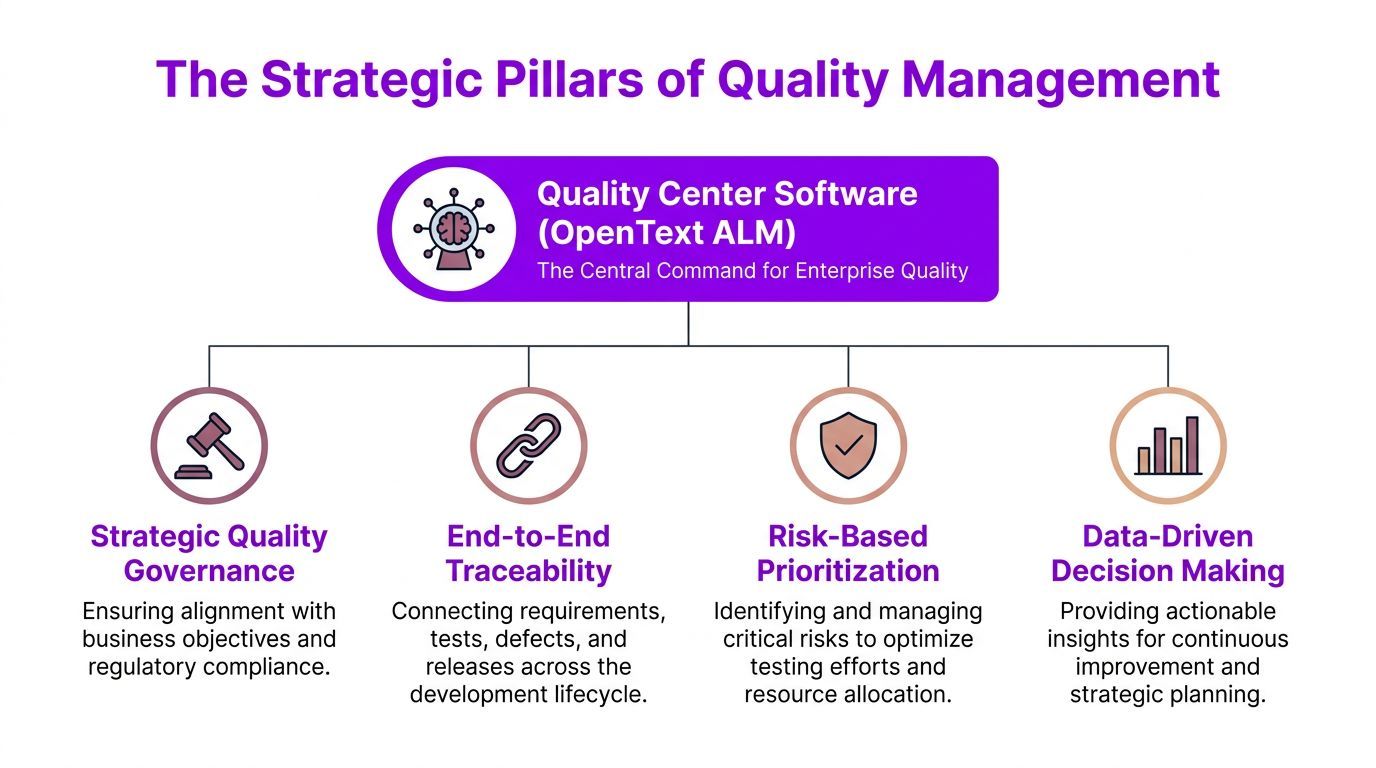
Quality Center software matters because it preserves the operating logic of the enterprise in a form leadership can inspect, govern, and reuse. For a CXO evaluating AI investment, that shifts the platform from a QA cost centre to a source of structured process intelligence.
Why its lineage matters to the board
Quality Center's product history runs from Mercury Interactive to HP, then Micro Focus, and now OpenText, as summarised in the OpenText Quality Center history. For a board or operating committee, that continuity signals something practical. The platform was built for enterprises that need evidence, approvals, and repeatable release discipline across long time horizons.
That matters in regulated and process-heavy organisations where system replacement carries direct switching cost, retraining burden, and audit risk. A younger tool may present a cleaner interface. Quality Center often carries a stronger record of institutional fit because it was adopted to support controlled delivery, not lightweight team collaboration.
The strategic implication is straightforward. If a company already holds years of validated requirements, test assets, and defect histories in Quality Center, replacing that estate without a clear value migration plan can destroy usable operational knowledge.
Quality Center as a system of decision evidence
At its best, Quality Center acts as the formal record of how the business defines acceptable performance. It documents what was required, what was tested, what failed, who approved remediation, and what evidence supported release decisions. That record is useful far beyond software delivery.
For executives, it supports four management priorities:
| Strategic use | What leadership gets |
|---|---|
| Governance | A record of whether approved controls and workflows were followed |
| Traceability | Links between requirements, execution activity, defects, and release outcomes |
| Auditability | Evidence that can be reviewed without rebuilding the story from spreadsheets and email |
| Visibility | A clearer view of where operational risk is accumulating across teams and processes |
This matters in BFSI, telecom, healthcare, and IT services because disputes rarely start with code. They start with unclear ownership, inconsistent handling, weak evidence, or an inability to prove that a required process was followed. Quality Center helps reduce that exposure by preserving an inspectable history.
It also creates a practical bridge to AI operations. A modern Voice AI platform such as DialNexa can perform tasks like lead qualification, call QA, or compliance checks more reliably when it is grounded in approved workflows rather than inferred from fragmented call notes. Enterprises exploring that path should align QC artefacts with the work of a quality assurance specialist in AI-driven operations so test logic, exception paths, and acceptance criteria can be translated into production-grade automation.
Quality Center produces the highest return when leadership treats it as a governed repository of business rules and evidence, then reuses that asset to improve automation quality, compliance control, and decision speed.
Core Capabilities That Drive Operational Excellence
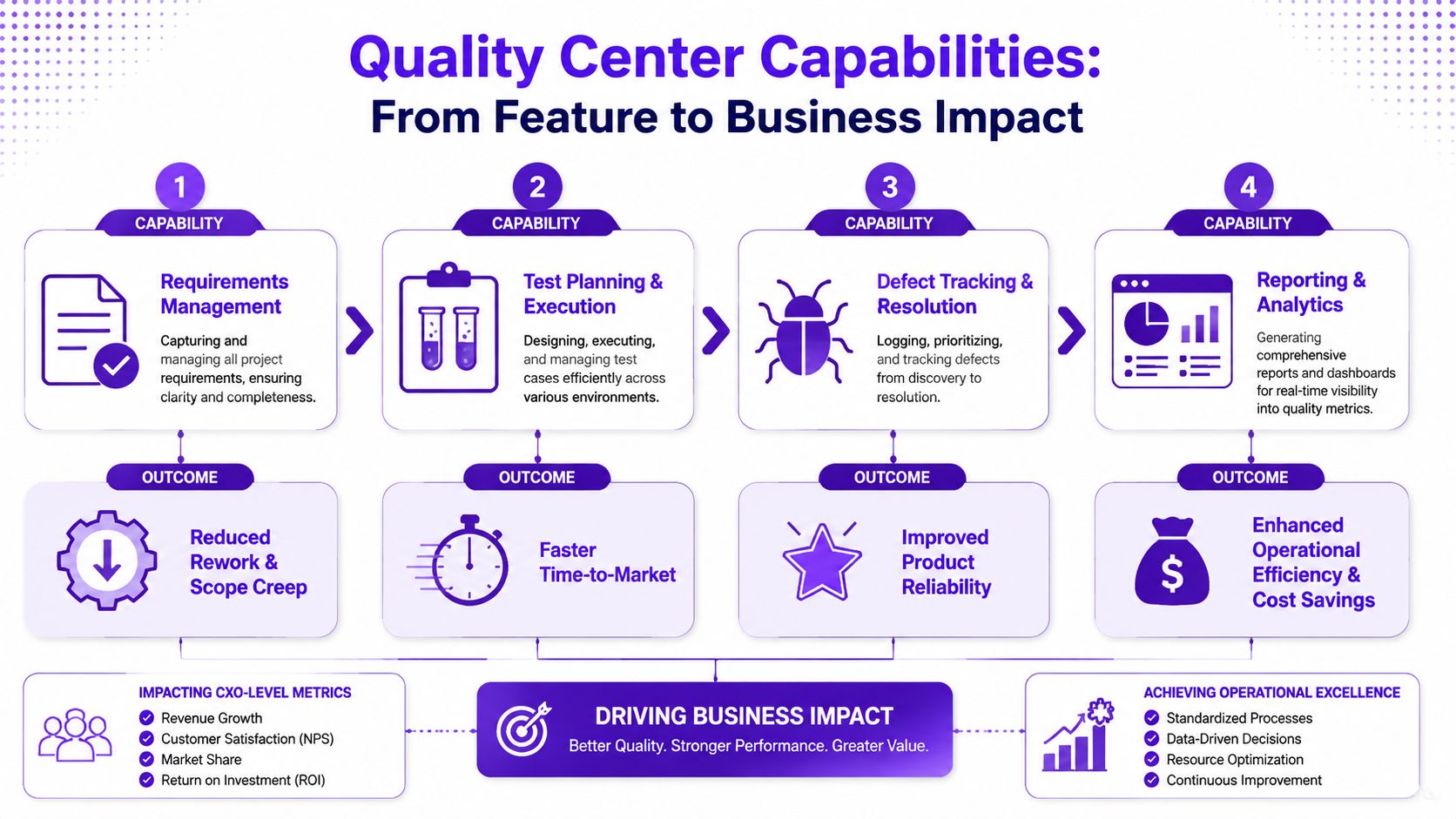
Quality Center earns budget when it reduces uncertainty in decisions that affect revenue, compliance, and release timing. Its value is not the feature list. Its value is the ability to convert operational intent into inspectable execution data that leaders can act on.
Traceability as an executive control mechanism
The strongest Quality Center deployments create a chain from business requirement to test evidence to defect history and release status. The Micro Focus ALM Quality Center datasheet describes that linkage in product terms. The business implication is more important. When an issue reaches production, leaders can identify which requirement failed, what validation exists, who owns correction, and whether adjacent process paths may carry the same exposure.
That changes the quality conversation at the executive level. Instead of asking whether testing is “on track,” operating leaders can ask whether critical requirements have evidence, whether policy-sensitive flows were exercised under exception conditions, and whether recurring defects point to a design problem rather than an isolated miss.
This same discipline underpins reliable service operations. A well-defined contact centre KPI framework depends on process instrumentation that ties outcomes back to specific workflow steps, ownership decisions, and failure patterns.
Four capabilities that matter economically
Quality Center's operational value tends to concentrate in four areas, each with a direct management benefit.
- Requirements management: A controlled requirements baseline reduces interpretation drift between business, compliance, and delivery teams. That lowers the cost of rework and makes scope decisions easier to defend.
- Test planning and execution: Structured test cycles show whether critical paths, edge cases, and control points were exercised. Release decisions become evidence-based instead of schedule-based.
- Defect management: A central defect record improves prioritisation, ownership, and root-cause analysis. Teams spend less time reconstructing incident history across email, chat, and disconnected trackers.
- Reporting and analysis: Cross-project reporting exposes repeat failure patterns in approvals, environments, data quality, and handoffs. That gives leadership a clearer basis for process redesign and capital allocation.
The less obvious benefit appears when firms treat these records as reusable operating logic, not archived project artefacts.
A Voice AI platform such as DialNexa can automate lead qualification, call QA, or compliance verification more safely when it inherits approved decision paths, exception conditions, and acceptance criteria from Quality Center. That shortens the path from documented process to production automation. It also reduces the risk that an AI workflow will improvise in a regulated or revenue-sensitive interaction.
For a CXO, the strategic conclusion is straightforward. Quality Center is not only a legacy testing system. It is a structured repository of business rules, failure modes, and validation evidence that can improve automation quality, strengthen compliance execution, and increase decision speed across customer-facing operations.
Industry Use Cases With Measurable ROI
Quality Center software becomes strategically interesting when leaders connect its governed workflows to revenue-sensitive or risk-sensitive operations. The strongest use cases aren't abstract. They sit inside industries where failed processes create either regulatory exposure or lost conversion opportunity.
BFSI and regulated customer journeys
In BFSI, Quality Center often acts as the control ledger behind onboarding, servicing, and complaint-resolution flows. A bank or fintech might store requirements for KYC steps, test the exception paths for missing documentation, and log defects when rule enforcement breaks under edge conditions. That gives the organisation an auditable map of how the process is supposed to work and where it has failed before.
The ROI case isn't just “better testing”. It's lower operational ambiguity. When compliance, operations, and technology use the same evidence base, escalation cycles shorten and policy interpretation becomes more consistent. That can support safer automation later because AI teams can inherit approved process logic instead of rewriting it from memory.
EdTech and high-volume advisory workflows
EdTech platforms often manage complex admissions, counselling, enrolment, payment, and support journeys across multiple systems. Quality Center can serve as the repository where academic policies, eligibility conditions, workflow steps, and exception handling are captured in a testable form.
A practical example: an institution launches a new programme admissions flow. If the eligibility rules, document checks, and payment exceptions are already linked in Quality Center, leaders can validate whether the digital journey and the advisory script reflect the same logic. That reduces friction between product, support, and counselling teams.
Better alignment brings forth hidden ROI, leading to fewer contradictory answers to prospective students, smoother handoffs from website to call interaction, and stronger confidence that service teams are operating from approved logic.
Real estate and conversion-sensitive platforms
Real estate firms live with a different pressure. Their lead pipeline depends on reliable CRM updates, site-visit booking, inventory visibility, and follow-up sequencing. Quality Center can help govern those underlying systems by preserving the rules and defects associated with each process path.
Consider a developer running a campaign during a major launch window. If booking workflows fail, duplicate leads appear, or CRM fields misfire, the impact is immediate. A disciplined Quality Center estate gives operations leaders a better ability to identify where process failures originated and which rules need to be enforced before scaling outreach.
Here's the broader pattern across sectors:
| Industry | Quality Center asset | Strategic outcome |
|---|---|---|
| BFSI | KYC rules, audit trails, defect history | Safer compliance automation |
| EdTech | Admissions logic, exception workflows | More consistent advisory operations |
| Real estate | CRM process rules, booking path validation | Better conversion reliability |
None of these examples requires Quality Center to be the front-end operating tool. Its value comes from being the governed back-end source that defines how the business should behave.
The Bridge Connecting Quality Center to Voice AI
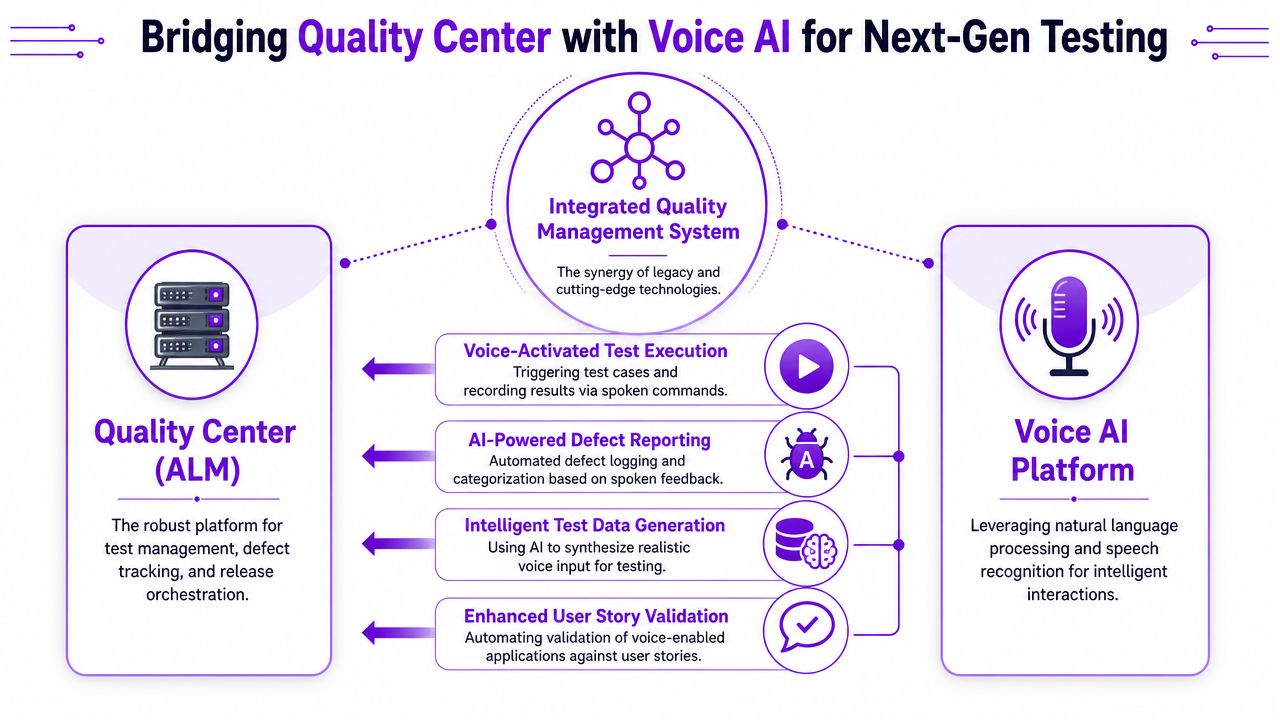
The most underexploited move in enterprise AI today is using Quality Center software as a source of structured operational truth for Voice AI. Most firms treat ALM data as too technical and conversational AI data as too unstructured. That division is artificial. Quality Center often contains the exact process logic that high-stakes voice interactions need.
Why Quality Center is useful training data
The challenge is widely felt. 68% of enterprise teams struggle with data portability from legacy ALM tools to cloud-native AI platforms. At the same time, there's a clear gap in practical guidance on using Quality Center's structured audit trails to train Voice AI agents for tasks such as KYC guidance or automated presales qualification.
That gap creates a market advantage for teams willing to do the integration work. Quality Center stores approved flows, test conditions, negative scenarios, and defect patterns. Voice AI needs exactly those ingredients to decide what to ask, when to escalate, how to handle edge cases, and how to remain within compliance boundaries.
A short demonstration helps frame the opportunity.
A practical integration pattern
The most effective pattern is not a wholesale migration of ALM data into an AI stack. It's selective extraction.
Start with approved requirements
Pull only business-approved requirements and workflow descriptions tied to customer-facing processes. For a BFSI team, that might mean KYC checks, disclosure language, identity validation steps, and escalation conditions.Map test cases into dialogue logic
Each positive and negative test path can become a conversational branch. If a test case checks what happens when a customer provides incomplete information, that branch can inform the AI agent's retry, clarification, or transfer behaviour.Use defects as exception intelligence
Defect histories are especially valuable because they reveal where the process breaks. Those patterns can shape guardrails. If a recurring defect involved incorrect eligibility handling, the AI workflow should be constrained around that condition until policy and system behaviour are aligned.Validate with production call metadata
The final layer is operational telemetry. In voice environments, signals such as call routing context and identity cues matter. Teams designing handoffs may find practical guidance in this write-up on inbound caller ID for AI agents, because routing context often determines whether an AI agent should continue, authenticate, or escalate.
Don't train Voice AI on everything. Train it on the parts of Quality Center that represent approved customer-facing logic and known exception boundaries.
Operational details leaders often miss
The integration challenge isn't only technical. It's organisational.
- QA owns validated process evidence
- Operations owns real-world exception handling
- Compliance owns the language boundaries
- AI teams own orchestration and evaluation
If those groups work separately, the AI agent will sound polished but behave inconsistently. If they work from a shared extracted model derived from Quality Center, the organisation can produce a much more defensible interaction layer.
The business case is straightforward. Quality Center already contains expensive institutional knowledge. Reusing it for Voice AI lowers the amount of process rediscovery required for automation and creates stronger auditability for customer-facing AI decisions.
A CXOs Checklist for Vendor Selection and Implementation
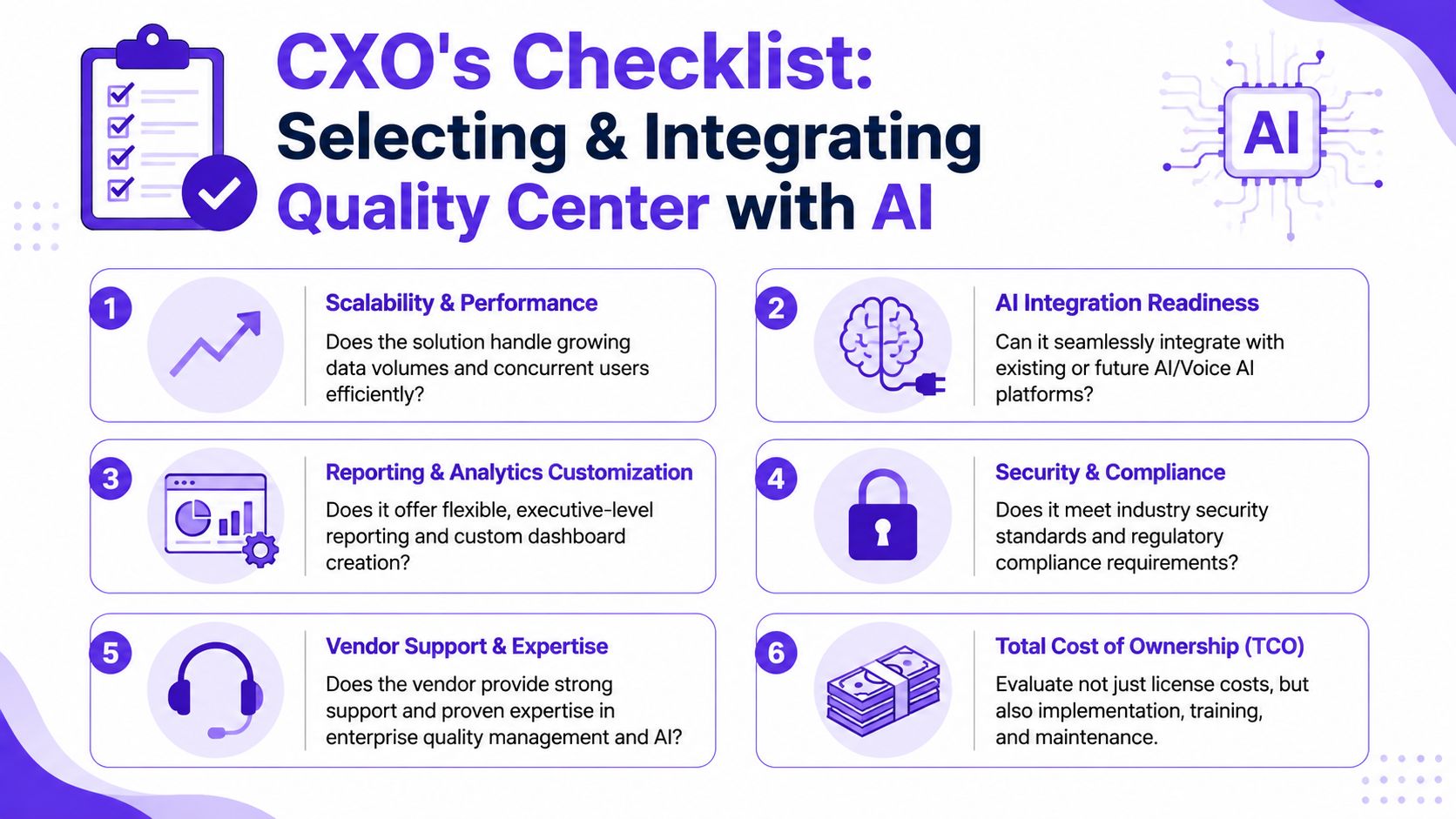
The decision to keep, modernise, or integrate Quality Center software should be made with implementation reality in mind. Many programmes fail because leaders evaluate features but ignore extraction readiness, performance planning, and operating model fit.
Questions that expose AI readiness
Use these questions in vendor and partner reviews.
- Can data be exported in a structured form? If requirements, tests, and defects can't be extracted cleanly, AI reuse will stall before it starts.
- Can traceability survive outside the core platform? The exported model should preserve relationships, not just records.
- Can the partner show a governance method for customer-facing AI? Many firms can build prompts. Fewer can preserve auditability.
- Can reporting be adapted for executive oversight? AI integration creates a new need for dashboards that connect process logic, interaction outcomes, and exception rates.
- Can implementation teams work across QA, operations, and compliance? Tool skill alone isn't enough.
A related but often overlooked area is language data handling. If your Voice AI roadmap includes converting validated conversations into training and review artefacts, these expert tips for audio transcription are useful because transcription quality directly affects downstream review, annotation, and compliance checks.
Implementation choices that affect TCO
Infrastructure planning matters more than many buying teams expect. The published system baseline for the Quality Center or ALM stack includes Windows Server 2022, 2016, or 2012 R2, a quad-core AMD64-class CPU, 8 GB RAM minimum, and 8 GB free disk space, while the Quality Insight component recommends 32 GB RAM and requires disk capacity at a 1:5 ratio to database size, according to the ALM support matrix.
Those numbers tell an important story. Core repository services are relatively modest. Analytics and insight workloads are not. If leadership expects Quality Center to become a reusable intelligence source, then reporting, extraction, and cross-project analysis capacity should be part of the TCO model from the start.
A practical checklist for the operating committee:
| Decision area | What to verify |
|---|---|
| Infrastructure | Core stack sizing versus heavier analytics workloads |
| Security | Whether traceability supports your industry's audit expectations |
| Integration | Availability of structured exports and relationship mapping |
| Change management | Whether QA and operations teams will adopt shared governance |
| Support model | Whether the vendor or partner can sustain long-lived enterprise usage |
Executive filter: The right choice isn't the platform with the most features. It's the one that lets your organisation preserve governance while reusing process knowledge in AI-driven operations.
Conclusion From Quality Centre to Intelligence Centre
Quality Center software still gets dismissed as a legacy testing platform. That misses its real strategic value. In many enterprises, it is the most structured and auditable record of how critical processes are meant to work, how they've been validated, and where they've failed.
That makes it far more than a compliance tool. It can become a controlled intelligence source for Voice AI, service automation, and higher-confidence customer operations. The companies that recognise this won't just defend an old asset. They'll extract new value from it.
The shift in mindset is simple. Stop treating Quality Center as a cost of governance. Start treating it as a foundation for governed AI execution.
DialNexa Labs Private Limited helps organisations turn structured operational knowledge into production-ready Voice AI. If your team wants to connect governed workflows, qualification logic, and customer support processes to AI-driven calling, explore DialNexa Labs Private Limited to see how custom agents can support compliant, scalable conversations across BFSI, EdTech, real estate, software, and more.

Leave a Reply