
The Quality Assurance Specialist: Impact for CXOs
83,200 people were employed in the closest official labour-market analogue to a quality assurance specialist in 2024, with projected growth of 3% to 4% through 2034 and 10,600 projected openings over that decade, according to the Government-linked occupation profile on O*NET. That should change how boards think about quality. This isn't a niche support role. It's a formal, process-heavy profession embedded in release decisions, compliance evidence, corrective action, and operational control.
For CXOs, the important shift is conceptual. A quality assurance specialist shouldn't be managed as overhead for spotting mistakes after the fact. The role protects revenue before a launch goes wrong, preserves customer trust before complaints spread, and reduces waste before teams burn capacity on rework. In regulated and digitally mediated businesses, that makes QA a business-control function with direct influence on retention, brand credibility, and scale readiness.
Table of Contents
- The Strategic Shift From Defect Finder to Value Driver
- Defining the Modern Quality Assurance Specialist
- Core Responsibilities and Their Business Impact
- Skills and Certifications That Drive Performance
- The QA Toolkit Metrics and Tools for the C-Suite
- Quality Assurance in Action Industry Scenarios
- Building Your High-Impact Quality Assurance Capability
The Strategic Shift From Defect Finder to Value Driver
Quality assurance used to be treated as a downstream inspection activity. The modern role is different. Historically, quality assurance has shifted from simple defect-checking to standardised, statistics-informed process control, a change documented in the U.S. Bureau of Labor Statistics overview of adjacent quality control work. For high-volume sectors such as BFSI, e-commerce, and healthcare, that evolution matters because operational errors now move quickly across systems, channels, and customer journeys.
A board should read that shift in business terms. When a company waits until the end of a process to detect failure, it pays several times over. Teams rework tasks, support handles avoidable complaints, managers escalate exceptions, and compliance leaders assemble evidence under pressure. A quality assurance specialist intervenes much earlier, where a workflow can still be redesigned.
Why this role now sits closer to risk than inspection
In many organisations, the hidden cost isn't the defect itself. It's the repeatability of the defect. A failed KYC workflow, a broken onboarding sequence, or inconsistent call documentation can be fixed once by operations. If the root cause remains untouched, the same issue returns in every batch, sprint, or customer interaction.
That is why mature organisations place QA closer to governance and operating discipline than to simple checking.
Quality failures rarely stay inside one department. They move from operations into revenue, compliance, and brand perception.
The strategic value comes from prevention. A strong quality assurance specialist translates standards into checkpoints, documentation rules, escalation paths, and evidence trails that operating teams can follow consistently. That improves predictability, and predictability is what lets firms scale without losing control.
Measuring workforce efficiency is part of that same predictability story: teams that track an agent utilization formula in BPO alongside quality scores can tell whether a leaner process is actually working as intended, not just moving faster.
Why executives should care now
For leadership teams, QA is one of the few functions that sits across process design, service delivery, and audit readiness at the same time. It can tell you whether growth is becoming fragile. It can also tell you whether customer dissatisfaction is being created by one-off errors or by a broken operating model.
Three executive signals usually indicate that QA deserves a strategic upgrade:
- Growth is outrunning process discipline. New launches, channels, or vendors create variability that frontline managers can't manually govern.
- Compliance exposure is becoming operational. Requirements aren't limited to policy documents. They affect handoffs, logs, approvals, and release controls.
- Customer trust depends on consistency. In digital services, users don't distinguish between a product flaw and a process flaw. They experience both as poor quality.
That's why the quality assurance specialist belongs in discussions about revenue protection and operational excellence, not only in defect reviews.
Defining the Modern Quality Assurance Specialist
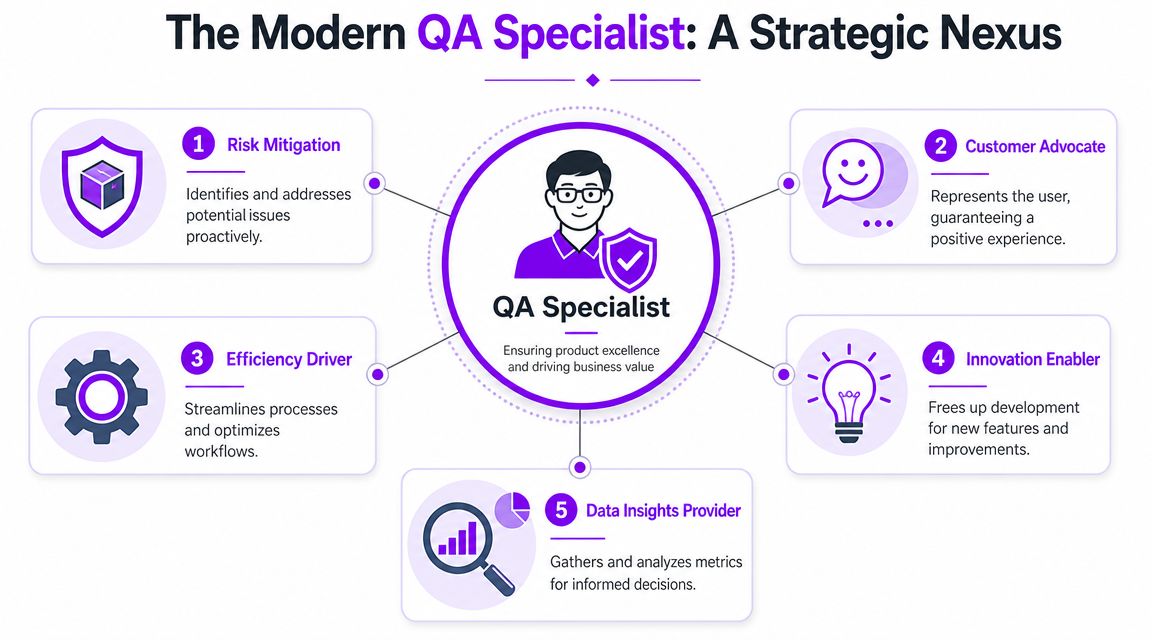
A modern quality assurance specialist works like an internal control architect for execution. The role defines how work should be performed, what evidence must exist, where risk is most likely to appear, and how teams correct failure before it spreads into customer experience, compliance exposure, or revenue leakage.
Why executives misread the role
Many leadership teams still map QA to software testing, call scoring, or final inspection. That interpretation is outdated because it treats quality as an endpoint activity instead of a system for governing reliability. In practice, the role often spans regulatory compliance, documentation control, audit readiness, process verification, release discipline, and traceability across digital workflows.
The business implication is larger than job design. If executives define QA too narrowly, they fund detection and underfund prevention. That usually produces the same operating pattern: recurring incidents, repeated remediation work, fragmented evidence for audits, and customer-facing inconsistency that weakens trust over time.
The better executive question is simple. Can the organisation produce consistent outcomes at scale, and prove it?
A modern QA specialist typically operates across five layers:
- Process design: setting checkpoints, decision rules, acceptance criteria, and control points
- Evidence management: maintaining logs, approvals, records, and traceability needed for review or audit
- Risk detection: identifying where variation could create customer harm, compliance breaches, or service failure
- Corrective discipline: driving root-cause action so teams remove failure sources instead of repeating them
- Cross-functional translation: turning technical, operational, and regulatory findings into actions leaders can manage
Teams that need a refresher on understanding quality assurance and control often find that role clarity improves once prevention, verification, and inspection are separated.
QA versus QC in practical terms
Quality assurance focuses on process capability. It asks whether the design of work is likely to produce reliable outcomes.
Quality control focuses on output verification. It checks whether the finished work meets the defined standard.
That distinction matters because each function protects a different part of enterprise value. QC protects the immediate deliverable. QA protects the operating model that produces thousands of deliverables, transactions, releases, or customer interactions.
In a BPO or service environment, for example, a quality analyst may review calls and score deviations after they occur. A quality assurance specialist examines whether scripts, training, system prompts, escalation logic, documentation requirements, and exception handling are creating those deviations across the operation. DialNexa's explanation of what a quality analyst in BPO does is useful because it shows where monitoring fits inside a broader assurance model.
For boards and senior operators, that is the true distinction. QC answers whether a single output passed. QA answers whether the business can grow without quality becoming less predictable.
Core Responsibilities and Their Business Impact
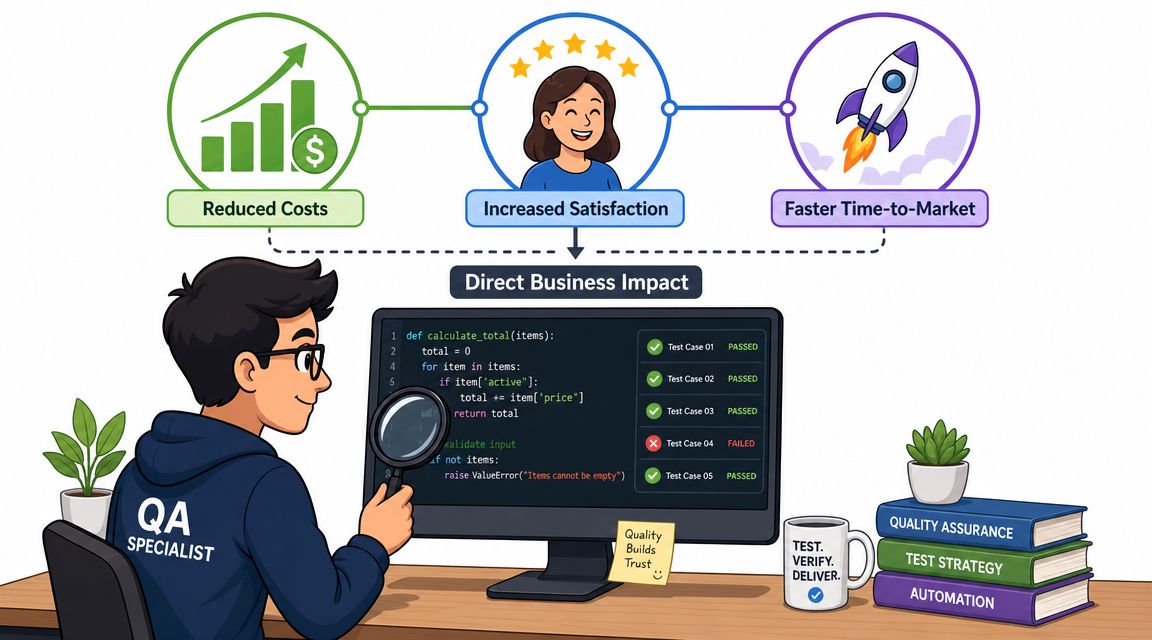
A quality assurance specialist creates value when they reduce preventable variation in work. That sounds technical, but the commercial impact is straightforward. Fewer process failures mean fewer customer complaints, fewer compliance surprises, less rework, and more confidence when the business launches something new.
Where the role changes business outcomes
The title “run tests” undersells the role. In practice, several core responsibilities map directly to executive priorities.
Process auditing as scalability control
When QA audits a workflow, the point isn't paperwork. It's to determine whether the same process will produce the same result under pressure, across teams, and over time. That matters in high-growth environments where local workarounds often multiply faster than leaders can see them.
A practical example: an e-commerce business may discover that return approvals vary by shift, channel, or vendor handoff. A quality assurance specialist doesn't just identify inconsistent decisions. They trace the inconsistency back to rule ambiguity, system gaps, or incomplete documentation. The business outcome is a repeatable service standard, which is what protects customer trust.
Documentation control as audit readiness
Documentation is often treated as administrative burden until the first serious review, complaint, or regulator query. Then it becomes obvious that missing version control, weak traceability, or informal approvals create commercial risk.
In regulated services, a QA specialist turns documentation into operating evidence. That includes controlled templates, approval discipline, change logs, and records that can withstand scrutiny. Executives should read this as resilience. If a business can't prove what it did, when it did it, and why, it loses negotiating power with customers, partners, and regulators.
Nonconformance tracking as early warning
Patterns in nonconformance tell leadership where the operation is becoming unstable. A single exception might be noise. Repeated exceptions in the same step usually indicate a process defect.
A strong QA function tracks those patterns and escalates them early. That gives management a chance to intervene before downstream teams absorb the cost.
Practical rule: If the same quality issue appears in support tickets, internal escalations, and audit findings, the business doesn't have three problems. It has one root cause showing up in three places.
Why CAPA belongs in board conversations
In organisations aligned to ISO 9001, QA specialists act as risk-control professionals who design inspection checkpoints, track nonconformance trends, and use Corrective and Preventive Action to remove recurring failures at the source, a practice described in the Randstad profile of the quality assurance specialist role. For a CXO, the key phrase is “at the source”.
Corrective and Preventive Action, or CAPA, has direct business value because it disciplines the response to failure:
- Corrective action addresses what went wrong now.
- Preventive action changes the process so it's less likely to happen again.
That is where QA stops being a reporting function and becomes an improvement engine.
A simple scenario makes the point. A healthcare platform sees frequent scheduling errors in remote patient bookings. Operations could fix each case manually. A QA specialist would map the failure points across data entry, workflow triggers, and confirmation logic, then create controls to stop recurrence. The result isn't just cleaner operations. It's fewer failed appointments, stronger patient trust, and less management attention spent on avoidable exceptions.
This short explainer is worth watching if your team needs a visual primer on how assurance connects to delivery discipline.
Skills and Certifications That Drive Performance
The best quality assurance specialists don't just know how to inspect work. They know how to read a business process, identify where it can fail, and persuade other teams to fix it. That combination is rarer than most hiring managers assume.
The skills that create business value
A useful way to assess the role is to separate technical capability from organisational influence.
| Capability | What it enables | Why leadership should care |
|---|---|---|
| Analytical thinking | Detects patterns in recurring defects or deviations | Helps isolate costly bottlenecks before they spread |
| Process mapping | Shows where a workflow breaks under volume or complexity | Supports scale without adding unmanaged exceptions |
| Documentation discipline | Creates traceability and evidence | Strengthens audit readiness and decision defensibility |
| Root cause analysis | Distinguishes symptoms from systemic flaws | Reduces repeated rework and policy churn |
| Cross-functional communication | Turns findings into action | Increases adoption of process improvements |
Technical competence still matters. In software and digital operations, that may include test design, automation awareness, database literacy, API validation, or performance testing. In manufacturing, healthcare, or compliance-led environments, it may lean more heavily toward SOP governance, validation, supplier evidence review, and controlled records.
But the business differentiator is often communication. A quality assurance specialist who can't influence product, operations, compliance, and customer-facing teams becomes a checker. One who can align them becomes a performance multiplier.
Leaders hiring for this role often find it helpful to compare their internal expectations with practical guidance on quality assurance skills, especially when they want someone who can operate beyond test execution.
What certifications actually signal
Certifications don't guarantee judgement, but they can signal disciplined exposure to standard methods and vocabulary. For employers, that matters less as a badge and more as shorthand for how someone is likely to structure problems.
Examples often discussed in hiring include:
- ISTQB: commonly associated with structured software testing knowledge
- ASQ credentials: often read as evidence of quality systems literacy and process orientation
- ISO-related exposure: useful where documentation, audits, and controlled improvement matter
What executives should infer from a certification is limited but useful. It may indicate that the candidate understands formal terminology, risk framing, and repeatable methods. It does not prove they can tie quality work to business outcomes.
A strategic QA hire explains not only how they tested something, but what failure would have cost the business if they hadn't intervened.
That's the standard worth using in interviews and promotion discussions.
The QA Toolkit Metrics and Tools for the C-Suite
Executives don't need a tour of every testing platform. They need a small set of metrics that reveal whether quality is protecting growth or constraining it. Tools matter only because they capture evidence, surface patterns, and help teams act faster.
The dashboard questions that matter
A CXO should expect the QA function to answer questions like these:
- Where are defects or process failures escaping into the customer experience?
- How quickly are teams resolving the highest-risk issues?
- Which recurring nonconformances show that a process is unstable?
- Are releases, service changes, or vendor handoffs increasing quality risk?
- Can the business prove compliance with a clean evidence trail?
Those questions are better than asking which tool the team uses. A weak process can look impressive inside Jira, TestRail, Zephyr, Selenium, Postman, or Grafana. A strong process can often work across several stacks as long as leadership sees the right signals.
Key Quality Assurance Metrics for Executive Dashboards
| Metric | What It Measures | Why It Matters to a CXO |
|---|---|---|
| Defect Escape Rate | How often issues reach customers or downstream teams | Indicates whether internal controls are catching failures early enough |
| Mean Time to Resolution | How long it takes to close important quality issues | Shows operational responsiveness and cross-team execution discipline |
| Cost of Quality | The business effort spent preventing, detecting, and correcting issues | Helps leadership judge whether quality investment is reducing waste |
| Nonconformance Trend | Frequency and pattern of deviations from expected process | Reveals whether issues are isolated or systemic |
| CAPA Closure Quality | Whether corrective and preventive actions are completed and sustained | Distinguishes genuine process improvement from cosmetic follow-up |
| Audit Readiness | Completeness and traceability of records and controls | Signals how exposed the business is to scrutiny or disruption |
| Release Readiness Confidence | Whether changes meet agreed quality gates before launch | Reduces avoidable instability in customer-facing rollouts |
No single metric is enough. The point is to create a management view that links quality to customer experience, compliance resilience, and operating efficiency.
Tools are secondary to visibility
Tool selection should follow the workflow, not the other way round. Most organisations need some mix of:
- Test management systems for cases, evidence, and release traceability
- Automation tools for repeatable checks in software-heavy environments
- Monitoring platforms for uptime, latency, and service reliability
- Documentation and QMS platforms for controlled records, approvals, and SOP management
- Analytics layers that reveal trend lines rather than isolated incidents
For customer interaction quality, speech and conversation analysis can extend QA beyond forms and tickets into actual service behaviour. Teams evaluating voice and support workflows may find Cloud Tech Gurus' conversational analytics expertise useful because it reflects how QA increasingly depends on reviewing interaction patterns, not just static outputs.
One practical example belongs here. DialNexa Labs Private Limited provides voice AI agents for workflows such as qualification, support, recruitment, and presales. In a quality context, a platform like that becomes relevant when leaders need to validate script adherence, call-flow consistency, escalation logic, and auditable interaction records across distributed customer conversations.
The executive principle is simple. Don't ask, “What tools do we have?” Ask, “What decisions can we make because the data is visible?”
Quality Assurance in Action Industry Scenarios
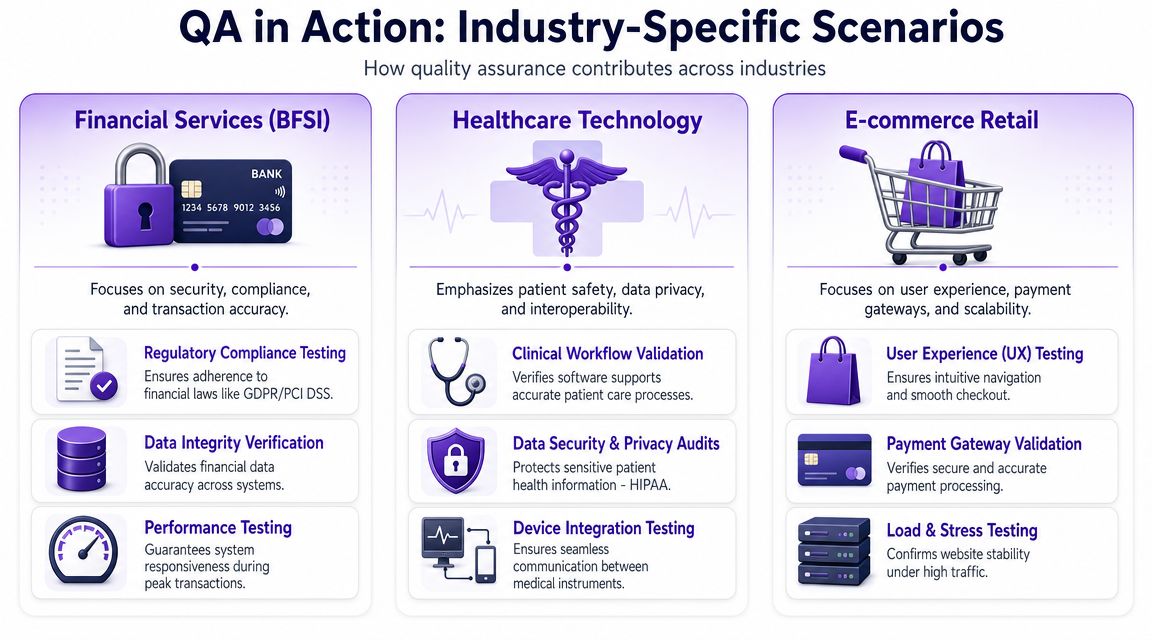
Quality failures rarely stay inside operations. In regulated and digital service businesses, they surface as lost conversion, repeat contact, audit exceptions, and customer churn. That is why the title quality assurance specialist means different things by sector. The role should be designed around the economics of failure in that environment, not around a generic testing checklist.
BFSI and the cost of preventable friction
A fintech onboarding flow shows why QA belongs in business control, not only in release validation. Product leaders may optimise for completion rate. Compliance teams may focus on KYC adherence. Operations may watch exception queues and handling time. The QA specialist is one of the few roles that can test whether those goals hold together under real customer behaviour.
In that environment, QA typically checks:
- Document handling rules so required evidence is captured and retrievable
- Decision-path accuracy so applicants are not wrongly approved, rejected, or stalled
- Escalation logic so exceptions move into controlled review paths
- Customer communication consistency so users receive clear, compliant next steps
The commercial logic is straightforward. If onboarding breaks at any of those points, acquisition spend is wasted, support demand rises, and compliance teams absorb avoidable manual work. A well-designed QA function protects revenue by reducing failure before scale magnifies it.
EdTech, healthcare, and multi-step service delivery
In service sectors, the defect is often not a broken screen or failed transaction. It is a broken journey.
An EdTech provider, for example, may see lower enrolment conversion and assume the problem sits with lead quality or counsellor performance. QA often finds a broader control issue: inconsistent handoffs across calls, reminders, form completion, eligibility checks, and document collection. The same pattern appears in healthcare booking and e-commerce recovery workflows, where service quality depends on many small operational decisions happening in sequence.
| Scenario | What QA checks | Business effect |
|---|---|---|
| Student onboarding | Data capture, status updates, counselling handoffs | Fewer avoidable drop-offs and cleaner enrolment operations |
| Remote healthcare booking | Documentation integrity, workflow compliance, scheduling accuracy | More dependable patient booking and stronger traceability |
| E-commerce support | Refund logic, fulfilment updates, escalation handling | More consistent service recovery and lower repeat contacts |
The strategic point is that QA in these sectors is measuring process reliability across the full customer path. Boards should view that as a retention and margin issue. Every preventable handoff failure increases service cost and weakens trust at the exact point where the customer is deciding whether to continue.
Leaders building cross-functional delivery models can use this benchmark on how high-performing quality assurance teams are structured to align QA scope with customer and compliance risk, rather than limiting it to end-stage checking.
AI voice systems raise the stakes
AI and voice workflows make the business case for QA even stronger because a failure can be replicated at scale. A voice agent can answer every inbound call and still damage performance if it gives inconsistent guidance, mishandles exceptions, or records outcomes incorrectly.
A quality assurance specialist in that setting should test:
- Intent recognition quality across accents, phrasing, and background noise
- Compliance and brand consistency in disclosures, scripts, and response boundaries
- Fallback behaviour when confidence is low or the request falls outside scope
- Auditability so managers can review what happened and why
- Workflow integrity so bookings, KYC prompts, or support outcomes are logged correctly
DialNexa Labs Private Limited is one example of where this matters in practice. Its voice AI agents are used in workflows such as qualification, support, recruitment, and presales. In those environments, QA is not judging whether the bot answered. QA is verifying whether the interaction met business, operational, and governance standards that leadership can defend.
For software-centric organisations, these essential QA tips for SaaS are useful because they connect release discipline with customer-facing reliability, which is where revenue protection is evident.
Sector knowledge changes the standard of quality. A generic tester may confirm that the system functions. A strategic QA specialist confirms that it functions consistently, compliantly, and in a way that protects revenue, reputation, and operating control.
Building Your High-Impact Quality Assurance Capability
Quality capability creates enterprise value only when leadership builds it as a control system, not as a downstream inspection function. The strongest QA teams reduce preventable revenue loss, shorten recovery time after incidents, improve audit performance, and stop repeat failures before they spread across channels, products, or geographies.
That starts with role design.
How to hire for strategic QA, not checklist QA
A weak job description attracts candidates who can execute test cases. A stronger one attracts people who can identify risk patterns, challenge poor process design, and produce evidence that executives can use in governance reviews.
The brief should define business accountability with precision:
- Role mandate: design and maintain quality controls that improve release confidence, documentation integrity, and operating consistency
- Operating scope: work across product, operations, compliance, and customer teams to identify recurring nonconformance and drive corrective and preventive action
- Success definition: reduce repeat incidents, improve traceability, and strengthen control over high-risk workflows
Resume signals matter. Candidates with strategic range usually show examples of process intervention, not only test execution.
Useful indicators include:
- Led root cause analysis for repeated service failures and coordinated corrective action across operations and compliance
- Built pre-launch quality checkpoints for new workflows to improve readiness and evidence capture
- Standardised documentation, approvals, and exception handling to support auditability across distributed teams
Leaders designing the function itself should also review this guide to quality assurance teams, particularly when deciding whether QA should report into product, operations, or a central governance structure.
Interview questions that reveal business judgement
Tool knowledge is necessary. It is rarely the differentiator at senior levels.
A stronger interview process tests how candidates prioritise risk, weigh control against throughput, and decide what evidence is sufficient for sign-off. Questions such as these expose that judgement:
- A recurring customer issue appears in support tickets, refunds, and audit exceptions. How would you determine whether the root cause sits in training, process design, or system logic?
- Describe a situation where you changed a workflow rather than a test case. What commercial or compliance risk were you reducing?
- Which quality issues warrant immediate escalation to leadership, and which should stay within operational remediation?
- What evidence would you require before approving a remote, automated, or AI-supported service process?
- How would you respond if an operations leader argued that a proposed control reduces throughput too much?
Strong candidates answer with a control logic. They explain severity thresholds, failure frequency, customer impact, and the cost of recurrence. They also recognise that the cheapest fix is often upstream, before poor quality reaches a customer, regulator, or revenue event.
What the labour market signals about capability planning
Earlier in this article, the labour market data showed that quality-related work is spread across more than traditional manufacturing contexts. That shift matters for boards. It suggests that QA capability now belongs in service operations, digital workflows, and regulated customer journeys where a single failure can trigger churn, rework, refunds, or compliance exposure.
The practical implication is straightforward. Organisations should plan QA as part of enterprise capability, with clear decision rights, escalation paths, and performance metrics tied to business outcomes.
For software and SaaS leaders, practical operating discipline still matters. Teams looking for implementation ideas can review essential QA tips for SaaS and adapt them to their release, monitoring, and governance model.
An effective executive blueprint includes five decisions:
- Define the risk model first. Identify which failures threaten revenue, retention, compliance, or brand trust.
- Place QA upstream. Involve the function before launch, procurement, and workflow change approval.
- Track recurrence, not just volume. A low defect count can still hide a weak process if the same failure keeps returning.
- Give QA cross-functional access. Systemic issues rarely sit inside one team.
- Treat documentation as operating evidence. In disputes, audits, and post-incident reviews, evidence quality affects both speed and credibility.
DialNexa Labs Private Limited helps organisations design and deploy Voice AI agents for workflows such as qualification, customer support, recruitment, and presales. For teams scaling customer conversations across sectors such as EdTech, BFSI, real estate, healthcare, e-commerce, or software, quality capability matters because consistency, traceability, and control determine whether automation protects margin or creates hidden operational risk.

[…] fragmented call notes. Enterprises exploring that path should align QC artefacts with the work of a quality assurance specialist in AI-driven operations so test logic, exception paths, and acceptance criteria can be translated into production-grade […]
This is an excellent perspective on how QA has evolved from inspection to a strategic function that protects revenue, compliance, and customer trust. The emphasis on prevention, root-cause analysis, and scalable process control is especially insightful for modern businesses.