
What Is ASR and How Can It Transform Your Business Strategy?
Let's get straight to the point: what exactly is Automatic Speech Recognition (ASR)? At its core, ASR is the technology that allows machines to understand human speech and convert it into readable text. Think of it as the foundational engine behind Siri, Alexa, or any system that responds to your voice commands.
More Than Tech—It’s Your Untapped Strategic Asset
For years, your business has been sitting on a mountain of incredibly valuable, yet completely unused, data. Every single customer call, sales negotiation, and support interaction is a stream of raw intelligence. ASR is the key that unlocks this data goldmine.
It takes those fleeting spoken words and turns them into structured, searchable data. For a C-suite executive, this isn't just about fancy tech; it's about gaining unprecedented visibility into your operations and market. Imagine knowing, in real-time, the top five customer complaints this month without waiting for a report, or pinpointing the exact moment a high-value sales pitch starts to lose a prospect's interest. That’s the strategic clarity ASR delivers.
From Spoken Words to Strategic Wins
By turning voice into text, ASR provides the foundational data needed to drive smarter, faster business decisions. The impact is almost immediate. Suddenly, your organisation can:
- Truly Understand Your Customers: Go beyond surface-level surveys. ASR allows you to analyse thousands of customer conversations to grasp intent, sentiment, and identify emerging pain points directly from their own words. For example, a retail VP could discover that 20% of support calls mention a specific competitor's new product, signalling a direct market threat. This leads to faster, more empathetic, and strategically-informed service.
- Streamline and Scale Operations: Automate tedious tasks like transcribing board meetings or manual data entry for your CRM. More strategically, you can intelligently route calls based on a customer's actual request, not just which number they dialled. For instance, a customer saying "I need to dispute a charge" can be routed directly to the fraud department, bypassing two levels of IVR and slashing operational costs. This frees up your team to focus on high-value work.
- Outmanoeuvre the Competition: Analyse thousands of customer conversations to spot emerging market trends, get unfiltered feedback on your products, and make data-backed decisions that put you miles ahead. A Director of Product could learn that customers are repeatedly asking for a feature that isn't on the roadmap, providing a data-driven case to pivot development priorities.
A Quick Clarification for Our Indian Readers
It’s important to note that in the Indian business context, the acronym ASR can mean two very different things. Here, we’re talking about Automatic Speech Recognition. However, in the Indian telecom industry, ASR often stands for Access Service Revenue.
While both are important in their fields, they are worlds apart. In telecom, ASR and Average Revenue Per User (ARPU) are critical metrics for financial performance. They reflect the tough balancing act Indian operators face: keeping services affordable for a massive user base while ensuring the business remains profitable.
For a business leader, ASR isn't just another piece of technology—it's about gaining visibility. It makes the voice of your customer something you can measure, manage, and act on, turning your biggest data blind spot into your most powerful strategic advantage.
Getting to grips with this technology is the first step. To see it in action, you can explore various speech-to-text programs that are built on ASR. Playing around with these tools gives you a practical feel for how spoken words are captured and converted, which is the foundation for everything else.
How ASR Technology Translates Voice into Value
To get a real handle on ASR, it’s best to forget the complex algorithms for a moment. Think of it more like a highly skilled digital transcriber, but one that works at lightning speed across your entire enterprise. The journey from a spoken word to a strategic data point breaks down into three logical steps.
The process hinges on three core parts: an acoustic model, a language model, and a decoder. Each plays a critical role. Understanding these components gives you the confidence to evaluate different ASR solutions and ensure the technology aligns with your business objectives, without getting bogged down in technical jargon.
The Acoustic Model: The Ears of the Operation
The first step is all about listening. This is the job of the Acoustic Model, which acts like a human ear. Its task is to take the raw audio—the sound waves from a voice—and break it down into the smallest units of sound, called phonemes. For example, the word “call” is broken down into the phonemes /k/, /ɔː/, and /l/.
This model is trained on thousands of hours of speech from diverse voices. It learns to connect specific sound patterns to their corresponding phonemes. A robust acoustic model is critical for accurately transcribing conversations in noisy environments, like a busy contact center, or understanding customers with various accents and dialects.
The diagram below gives you a high-level picture of this flow from voice to text.
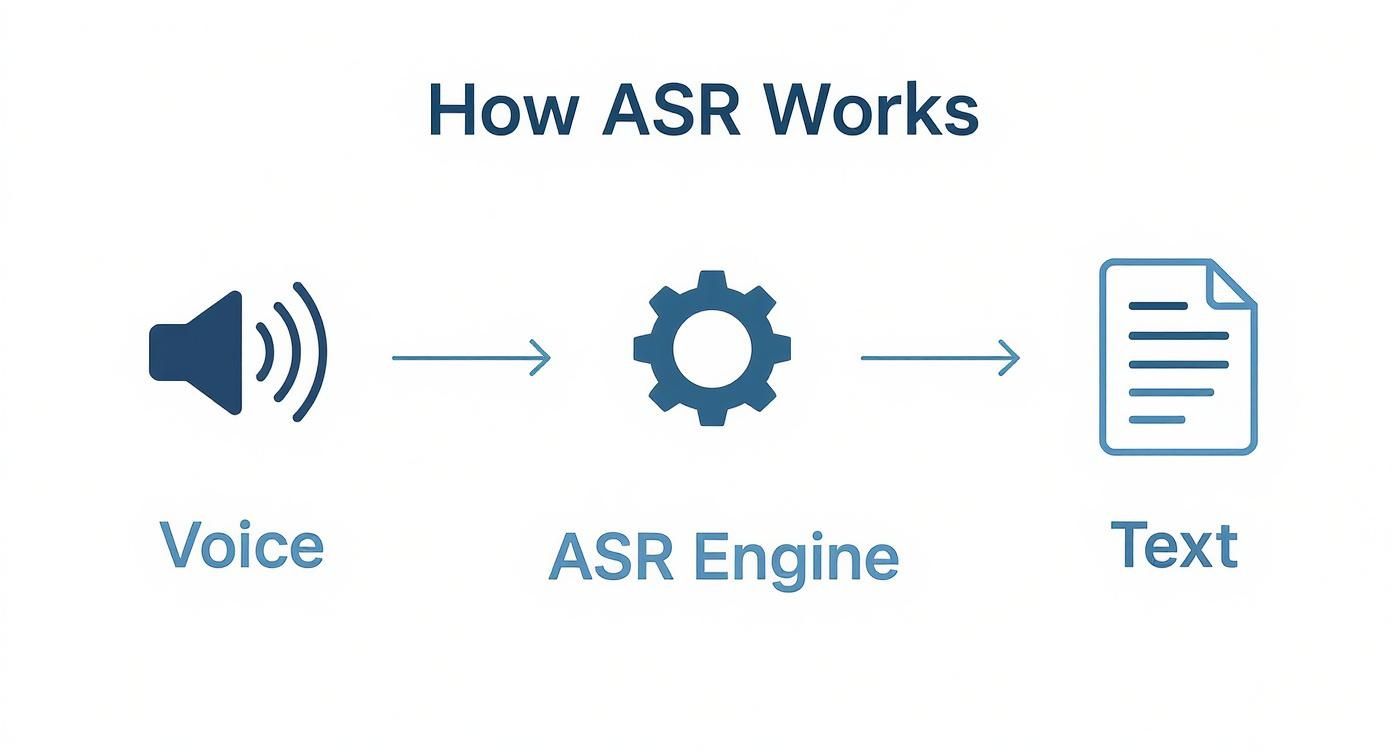
This simple illustration shows how raw voice input is processed by the ASR engine to produce structured text output, turning conversation into data.
The Language Model: The Brain That Provides Context
Once the acoustic model has identified the sequence of sounds, the Language Model steps in. Think of this as the 'brain' of the operation. It examines the string of phonemes and uses its knowledge of grammar, syntax, and common word pairings to predict what was actually said.
For example, a practical business scenario: The acoustic model might hear sounds that could be either “recognise speech” or “wreck a nice beach.” The language model, especially one tuned for a corporate environment, knows that “recognise speech” is a far more probable phrase. It works by calculating the statistical odds of word sequences, ensuring the final text is coherent and makes business sense.
A sophisticated language model is what separates a basic transcription tool from a strategic business asset. It's the component that allows the ASR system to understand industry-specific jargon, product names, and unique customer phrasing, dramatically improving accuracy.
This is where customisation is key for any director or VP. A generic system trained on everyday conversations would likely fail when transcribing financial terms or medical diagnoses. A language model fine-tuned for your specific industry will produce far more accurate and valuable data.
The Decoder: The Hand That Writes the Final Transcript
Finally, the Decoder puts it all together. It’s like the hand of a human transcriber, taking the analysis from both the acoustic and language models to produce the most likely text.
The decoder weighs the probabilities from both sides—what sounds were heard versus what sentence makes the most sense—and generates the final written transcript. This is the step that turns a customer's spoken request or a prospect's objection into a line of text. That text can then be logged, analysed, and acted upon, creating a powerful new source of business intelligence.
Real-World ASR Applications That Drive ROI
Understanding the theory behind Automatic Speech Recognition is one thing, but seeing it deliver real, measurable business value is something else entirely. For any business leader, the question isn't just "What is it?" but "What can it do for my bottom line?" The answer is found in how ASR is already solving critical problems and creating returns in industries right now.
This isn't about chasing the latest tech trend. It's about applying a targeted solution to specific business pains—like physician burnout, compliance risks, or leaky sales funnels—and drawing a straight line from implementation to a tangible ROI.
Revolutionising Patient Care And Operations In Healthcare
In healthcare, physician burnout is a massive challenge, often fuelled by a mountain of administrative paperwork. ASR provides an immediate and practical solution by automating clinical documentation.
Practical Example: A doctor finishes a patient consultation. Instead of spending the next 15 minutes typing notes into an Electronic Health Record (EHR), they simply speak their findings aloud. A well-trained ASR system, fluent in medical jargon, transcribes the conversation directly into the patient's chart with high accuracy.
This simple change gives hours back to a doctor's week, freeing them up to see more patients or dedicate more time to complex cases. The business outcome is a reduction in administrative overhead by up to 45% and improved job satisfaction, which directly impacts the quality of patient care and staff retention.
Securing Transactions And Ensuring Compliance In BFSI
For the Banking, Financial Services, and Insurance (BFSI) sector, everything hinges on security and compliance. ASR is proving to be a game-changer for both.
Practical Example (Security): A high-net-worth client calls to authorise a large transaction. Instead of fumbling with passwords or security questions, they state their request. The ASR system powers a voice biometrics engine that verifies their identity in seconds based on their unique vocal signature, providing a seamless and highly secure experience.
Practical Example (Compliance): An investment advisor's call with a client is transcribed in real-time. The system automatically flags non-compliant phrases like "guaranteed returns," triggering an immediate alert to a compliance officer. This shifts compliance from a slow, reactive audit process to a proactive, automated safeguard, drastically reducing regulatory risk and potential fines.
Powering The Next Wave Of E-Commerce And Retail
E-commerce and retail leaders are constantly seeking ways to reduce friction in the buying process. ASR opens up a powerful new channel for customers to engage: their voice.
- Voice Search: A customer can say, "Show me red running shoes in a size nine." ASR understands the natural language and pulls up precise results. This frictionless experience has been shown to lead to a 10-20% increase in conversion rates.
- Effortless Ordering: A busy professional can re-order their usual purchase by saying, "Re-order my last coffee purchase" to a smart speaker while making breakfast. It removes all friction and builds powerful brand loyalty.
The potential here is enormous, especially as digital access grows. In fast-growing markets, the telecom infrastructure is the foundation for this shift. For instance, India’s telecom market, valued at $52.79 billion in 2024, is expected to skyrocket past $114 billion by 2033. This growth, driven by 5G and more smartphones, is creating a massive audience ready for voice-powered commerce. You can read more about Indian telecom market dynamics on GlobeNewswire.
Transforming The Contact Centre Into A Profit Centre
The contact centre is where ASR's impact is perhaps most immediate and profound. By transcribing and analysing every single call, businesses can finally get a clear, data-driven picture of customer sentiment, agent performance, and operational weaknesses.
ASR turns your contact centre from a cost centre into a strategic intelligence hub. Every conversation becomes a data point you can use to improve products, train staff, and predict customer churn.
Practical Example: An ASR system analyses call transcripts and automatically flags that 30% of all incoming calls are about a confusing section on the company's billing statement. This gives leadership the insight needed to redesign the bill and fix the root cause, rather than just handling an endless stream of calls. This is also the foundation for smart automation. You can learn more about how AI voice agents are transforming customer service and sales in our guide on the topic. This move helps slash agent handle time and boost first-call resolution, directly strengthening the bottom line.
The Real-World Hurdles of Putting ASR to Work
Bringing Automatic Speech Recognition into your business isn’t just about plugging in a new piece of tech; it’s a serious strategic move. While the upside is huge, a successful rollout means being honest about the challenges that can trip up performance and security right out of the gate. For any leader, spotting these hurdles early is the first step to building a voice strategy that actually works.
The journey starts with a simple truth: not all audio is clean. Your real-world environment, whether it's a buzzing contact centre or a sales call made from a noisy street, is full of background chatter. This acoustic chaos is a major reason why generic, off-the-shelf ASR models so often fall flat in a business setting.

Getting Past the Acoustic and Language Barriers
A surprisingly common blind spot for executives is underestimating the complexity of human speech. Your customers aren't a uniform group—they represent a rich tapestry of accents, dialects, and speaking patterns. An ASR system that works perfectly for one region might completely fail with another, leading to frustrated customers and garbage data.
On top of that, every industry speaks its own language. A model trained on everyday conversation will inevitably stumble over critical jargon in specialised fields like finance or healthcare. This isn't just a minor accuracy issue; it's a genuine business risk. Imagine the fallout from a mistranscribed medical diagnosis or a financial product name.
To get ahead of these problems, you need to:
- Insist on Specialised Models: Look for ASR vendors who offer models specifically trained on your industry’s terminology and your region’s accents.
- Demand a Real-World Test: Before you sign anything, test the system with your own audio files. Give it the messy stuff—calls with background noise, multiple speakers, and heavy accents.
- Focus on Noise-Robust Systems: For high-stakes environments like contact centres, you need a solution built to handle noise. You can learn more in our guide on choosing a noise-robust ASR system.
Dealing with Latency and Real-Time Performance
In many ASR applications, speed is everything. If you’re using a voice AI agent to handle live customer calls, any noticeable delay—what we call latency—shatters the illusion of a natural conversation and ruins the experience. The system has to listen, process, and respond almost instantly to feel human.
High latency can turn a brilliant AI assistant into a clunky, frustrating mess. When you’re evaluating ASR platforms, you have to dig into their real-time performance metrics. Ask potential partners for hard numbers on their processing speed and how it performs at peak call volumes. This ensures the tech actually improves customer interactions instead of hindering them.
For a CXO, latency isn't just a technical spec; it's a direct measure of customer experience. A delay of even a few hundred milliseconds can be the difference between a seamless conversation and a lost customer.
Protecting Data and Staying Compliant
This is the big one. For any executive, the most critical hurdle is keeping customer data secure and compliant. Voice recordings are highly sensitive personal information, falling under strict regulations like GDPR in Europe or industry-specific rules like HIPAA in healthcare.
Handling this data demands an ironclad security framework. Every step—storing, transcribing, and analysing voice data—must protect customer privacy and meet all legal standards. A data breach involving voice recordings can be catastrophic, resulting in massive fines and permanent damage to your brand’s reputation.
A solid strategy includes:
- Data Anonymisation: Put protocols in place to scrub personally identifiable information (PII) from transcripts and audio files.
- Thorough Vendor Vetting: Only partner with ASR providers who can show you proof of their security credentials (like SOC 2) and compliance with the regulations that matter to you.
- Clear Data Governance: Establish firm internal policies that define who can access voice data and exactly why they need to.
By getting out in front of these challenges, you can confidently move your ASR project from a promising pilot to a secure, scalable, and high-performing asset for your business.
How to Measure ASR Performance: Moving from Technical Jargon to Business Results
So, you've invested in ASR. How do you actually know if it's working? It’s easy to get lost in technical weeds, but for business leaders, the real question isn't about algorithms—it's about the return on investment.
The conversation needs to shift from pure accuracy scores to tangible business outcomes. To make smart decisions, you must understand the core ASR metrics, but more importantly, translate them into what really matters: operational efficiency, customer satisfaction, and revenue growth.
The Go-To Technical Metric: Word Error Rate
In any ASR discussion, you'll inevitably hear the term Word Error Rate (WER). It's the industry-standard technical benchmark.
Simply put, WER counts the number of mistakes the ASR system makes compared to a perfect human transcription. A lower WER is better, with a score of 0% being a flawless performance.
Practical Example: A customer says, "check my account balance," but the ASR hears it as "wreck my account balance." That single incorrect word increases the error rate. While WER is a decent starting point for judging a system's raw capabilities, it doesn't paint the full picture for a business leader. A low error rate is great, but it’s not the end goal. For a deeper dive into the technical side, check out our guide on understanding ASR accuracy benchmarks.
Beyond WER: Focusing on KPIs That Actually Matter
True success isn't measured in word-for-word perfection; it's measured by its impact on your Key Performance Indicators (KPIs). Obsessing over WER alone is like judging a salesperson by how many words they spoke instead of the revenue they generated.
To see real ROI, you need to track metrics that connect directly to business performance.
Comparing ASR Performance Metrics
Understanding how to measure ASR success requires looking at it from two angles: the technical "how well did it hear?" and the business "so what?" This table breaks down the key metrics for a more complete view.
| Metric | What It Measures | Why It's Important for Leaders |
|---|---|---|
| Word Error Rate (WER) | The percentage of words transcribed incorrectly compared to a human transcript. | A foundational technical check. High WER can signal underlying problems, but it doesn't directly measure business impact. |
| Intent Recognition Rate | How often the system correctly understands the customer's goal, not just their words. | This is where the magic happens. A high rate means the system is effectively solving problems and reducing the need for human intervention. |
| First-Call Resolution (FCR) | The percentage of customer issues resolved by ASR-powered agents on the first attempt. | A direct measure of customer satisfaction and operational efficiency. Better FCR means happier customers and lower support costs. |
| Average Handle Time (AHT) | The average time an interaction takes, from start to finish. | ASR can slash AHT by automating tasks. A reduction here is a clear win for productivity and frees up human agents for high-value work. |
Ultimately, the metrics you choose to focus on will determine the success of your ASR implementation. While technical accuracy is the foundation, business outcomes are the structure you build upon it.
For a CXO, the most important question is not "How accurate is the transcription?" but rather, "How much faster did we solve the customer's problem?" This reframes the entire evaluation process around tangible business value, not just technical perfection.
Interestingly, this idea of connecting a technical term to financial results has parallels elsewhere. In India's telecom sector, 'ASR' also means Adjusted Signal Ratio, a crucial part of calculating Average Revenue Per User (ARPU). In FY2025, Indian telcos saw their ARPU climb to ₹200 from ₹184, which helped boost industry revenue by 12-14%. As detailed by Telecom Review Asia, a technical-sounding acronym there is directly tied to the bottom line.
By adopting that same business-first mindset for Automatic Speech Recognition, you ensure your technology investment is judged by the real value it creates.
The Future of ASR: From Transcription to Conversation
So far, the journey of Automatic Speech Recognition has been all about mastering transcription—getting spoken words into text, accurately. And while that's an impressive feat, it's really just the first step. For any leader looking ahead, the real game-changer isn't just recording conversations but actively participating in them. The technology is evolving from a passive listener into an intelligent conversational partner.
We’re already moving past basic voice commands and simple dictation. The future is all about creating sophisticated Conversational AI that understands the subtle cues of human interaction. In this new world, ASR is the essential sense of ‘hearing’ for the AI, feeding it the raw data needed for more advanced models to pick up on things like sentiment, sarcasm, and urgency.
From Simple Commands to Complex Conversations
Picture a customer service call that isn't just automated but genuinely helpful. Instead of being stuck in a rigid, robotic script, a voice agent built on next-gen ASR can navigate a complex, back-and-forth conversation with real intelligence.
- Here's a practical example: A customer calls their bank, clearly stressed, and says, "I think my card has been stolen, I saw a strange transaction, but I'm not sure what to do." A basic system might just latch onto the words "stolen card." But an intelligent agent hears the panic in their voice and understands the uncertainty ("I think," "I'm not sure"). It can then calmly guide them through checking recent transactions and securing their account, all in a natural, reassuring way.
This leap forward is only possible with an ASR that doesn't just catch words but delivers the high-fidelity audio data needed for sentiment analysis and intent recognition. To really grasp where this is all heading, it's worth exploring the predictions around the future of voice technology.
The next frontier for ASR isn't about hitting 100% transcription accuracy. It's about enabling an AI to understand 100% of the speaker's intent, context, and emotional state—turning a simple interaction into a meaningful connection.
Reshaping Your Entire Business Operation
This shift from transcription to true conversation is set to reshape how entire businesses operate. We're looking at a future where AI-powered agents become a core part of the team, amplifying human capabilities and driving efficiency like never before.
Think about the strategic impact across different departments:
- For Sales VPs: Imagine voice agents handling initial lead qualification calls. They could ask smart, insightful questions based on a prospect's answers and then book a meeting directly with a human salesperson, providing a full transcript and a sentiment summary. This lets your top closers focus their energy only on high-intent, fully qualified leads.
- For CXOs: Envision a support system where AI agents manage 80% of routine inquiries with human-like empathy. They could instantly escalate complex or emotionally charged cases to the right human expert. This doesn't just slash operational costs; it boosts customer satisfaction and employee morale by letting your team handle more meaningful work.
The bedrock for this entire vision is a highly accurate, low-latency ASR engine. Without the ability to hear and understand clearly in real-time, the promise of truly intelligent voice interaction is just talk. By embracing this future now, leaders can start building a business model that is more responsive, efficient, and genuinely connected to the voice of the customer.
Your ASR Questions, Answered
Let's cut through the noise. When you're considering a technology like ASR, you need straight answers to the big questions. Here's a look at what business leaders most often ask about implementation, cost, and finding the right technology partner.
What's The Real Difference Between ASR And NLP?
Think of it as a two-step process. ASR is the "ears" of the operation, while NLP is the "brain."
First, ASR does the heavy lifting of converting raw speech into written text. It hears someone say, “I need to check the balance on my savings account,” and turns it into those exact words. But at this point, the words are just data.
That's where Natural Language Processing (NLP) steps in. The NLP "brain" reads the text and figures out what it actually means—the user's intent is to get financial information about a specific account. You need both to build any kind of smart voice assistant; one without the other is incomplete.
How Much Does An ASR Solution Actually Cost?
The price tag can swing wildly. On one end, you have simple pay-as-you-go cloud services. On the other, you could be looking at a major investment for a custom, on-premise system built to handle unique industry jargon or challenging accents.
For most companies, the sweet spot is an integrated Voice AI platform. This approach usually gives you the best mix of performance, cost-effectiveness, and the ability to scale up or down as needed. Don't just look at the initial quote. You need to calculate the total cost of ownership, which includes everything from maintenance and integration headaches to the cost of inaccurate transcriptions.
The true cost of a bad ASR system isn't what you pay the vendor. It's the frustrated customers you lose and the flawed data you collect from faulty transcriptions. The real ROI comes from performance on your audio, not a vendor's perfect demo.
How Do We Pick The Right ASR Vendor Or Platform?
Look beyond the polished sales pitches and generic accuracy percentages. The right partner needs to prove their system works with your real-world audio—complete with all the background noise, interruptions, and specific terminology your business deals with every single day. A proof-of-concept isn't a nice-to-have; it's essential.
When you're vetting potential partners, dig into these three areas:
- Security and Compliance: Do they hold certifications like SOC 2, HIPAA, or others that are non-negotiable in your industry?
- Ease of Integration: How well will this technology play with your existing CRM, contact centre software, and other critical systems? Is it a simple API call or a complex, months-long project?
- The Bigger Picture: Are they just selling a transcription tool, or are they a genuine AI partner with a forward-thinking roadmap?
You're not just buying a feature. You're looking for a strategic partner whose technology will evolve alongside your business.
At DialNexa, we build our human-like Voice AI agents on a foundation of world-class ASR. This allows our agents to do more than just transcribe—they understand, engage, and drive conversations toward a successful outcome, whether that's qualifying a lead or resolving a customer issue. To see how our platform can reshape your operations, explore DialNexa's solutions.

[…] your team needs a technical baseline before procurement, this primer on what ASR is and how it works covers the mechanics. For enterprise buyers, the more important question is narrower: can the model […]
[…] For an enterprise buyer, that changes the investment case. Marathi speech recognition is not only a productivity tool for support teams. It affects conversion, first-contact resolution, quality monitoring, and the defensibility of audit trails. Teams that need a grounding in the core speech stack should start with this overview of automatic speech recognition systems. […]
Excellent explanation of how ASR evolves from simple transcription into a strategic business asset that drives customer insights, operational efficiency, and competitive advantage. The practical examples make it clear that voice data is no longer an untapped resource but a powerful engine for smarter decision-making and growth.