
Marathi Speech to Text: A CXO’s Guide to AI Integration
Marathi speech to text isn't a niche capability. It's access to one of India's largest language markets. Marathi is spoken by approximately 83 million people worldwide, with 99 million total speakers identified across India, and it remains the third most widely spoken language in India. In Maharashtra alone, roughly 8.3 crore people speak Marathi as their native language out of a total population of 12.62 crore (Soniox comparison page on Marathi).
For CXOs, that changes the conversation. This isn't about adding one more language option to a product roadmap. It's about deciding whether your customer operations, sales workflows, and support infrastructure can function in the language many users prefer when money, trust, urgency, or compliance are involved.
In practice, marathi speech to text matters most when the audio is messy, the speaker switches between Marathi and English, the domain vocabulary is specialised, and the interaction has business consequences. That's where many pilots stall. Clean demos look excellent. Production traffic reveals gaps.
The organisations that get this right treat ASR as a business system, not a transcription widget. They evaluate latency, dialect handling, vocabulary control, data handling, and downstream workflow design together. That broader shift is already shaping Indian voice adoption, especially as multilingual systems become central to customer engagement. A useful market view is this analysis of India's voice AI funding surge and multilingual breakthroughs.
Table of Contents
- Tapping into India's Third Largest Language Market
- Why Marathi Speech to Text Is a Business Imperative
- Evaluating Technical Approaches Cloud APIs vs Open Source
- Key Business Use Cases in Indian Markets
- A Practical Guide to Integrating Marathi ASR
- Boosting Accuracy and Real-Time Performance
- Future-Proofing Your Voice Strategy with Scalable ASR
Tapping into India's Third Largest Language Market
A large share of enterprise language strategy in India still over-indexes on Hindi and English. That leaves a clear gap in western India, where Marathi sits at the centre of consumer interaction across education, finance, media, government, and local commerce.
Marathi is not just widely spoken. It's spoken in one of India's most commercially important regions. When a business fails to support Marathi interactions properly, the impact shows up in lower call quality, weaker qualification, more human intervention, and slower resolution.
Where market size becomes operational reality
The strongest demand for marathi speech to text usually appears in high-volume workflows:
- Customer support operations: Teams need searchable transcripts for issue categorisation, escalation review, and QA.
- Presales and qualification: Voice systems need to capture intent, budget signals, location references, and objections accurately.
- Media and accessibility: Broadcasters and digital publishers need captions, archives, and indexing.
- Public-facing services: Institutions serving regional users often need voice interfaces that work without language friction.
This is why Marathi ASR shouldn't be treated as a localisation afterthought. In production, it becomes part of revenue operations, service delivery, and compliance.
Operational reality: A speech system that performs well in English but breaks on Marathi accents doesn't reduce workload. It shifts the workload to manual review.
Leadership teams should frame Marathi support as market infrastructure. If Maharashtra is a target geography, voice systems need to understand the language customers use under real conditions, not only in polished sample clips.
Why Marathi Speech to Text Is a Business Imperative
Language choice affects revenue, service quality, and compliance long before it shows up in an AI budget line.
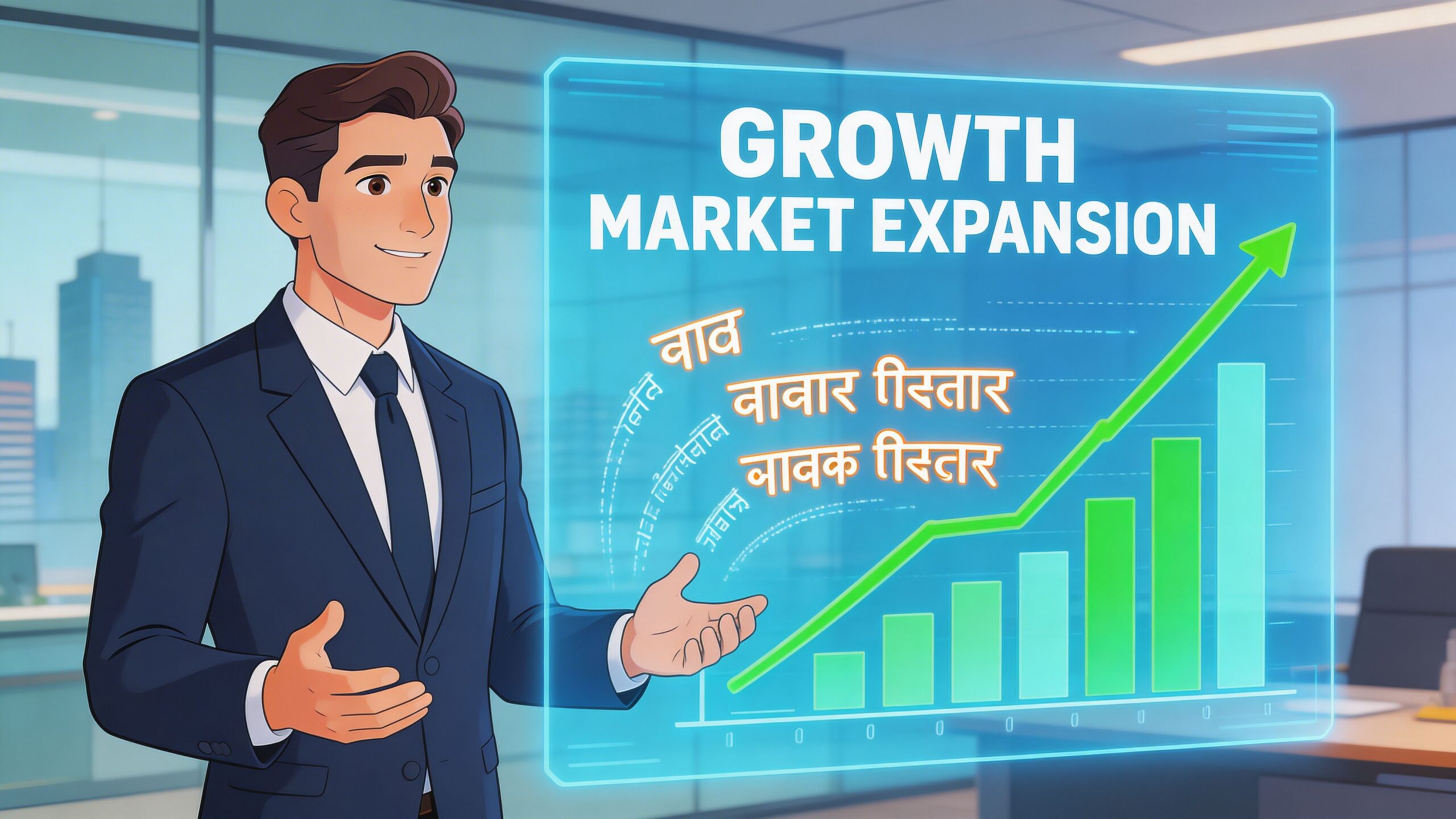
In Maharashtra, customers often begin a journey in English or Hindi, then switch to Marathi at the point where the conversation becomes commercially important. That shift usually happens during pricing discussions, eligibility checks, claims details, repayment concerns, service complaints, or family decision-making. If the ASR layer drops accuracy at that moment, the business loses context exactly where intent is strongest and risk is highest.
For an enterprise buyer, that changes the investment case. Marathi speech recognition is not only a productivity tool for support teams. It affects conversion, first-contact resolution, quality monitoring, and the defensibility of audit trails. Teams that need a grounding in the core speech stack should start with this overview of automatic speech recognition systems.
The business case is operational, not cosmetic
I have seen leadership teams treat regional-language ASR as a channel add-on. In production, it behaves more like core transaction infrastructure.
The pressure points are predictable in Indian deployments:
| Business area | What high-accuracy Marathi ASR supports | What generic or weak ASR creates |
|---|---|---|
| Lead qualification | Better capture of buying intent, location cues, and next actions | Misrouted leads and lower conversion quality |
| Customer support | Faster summaries, cleaner case notes, and better QA review | Repeat calls, agent rework, and slower resolution |
| Regulated workflows | Searchable records for audits, dispute review, and policy checks | Ambiguous transcripts and weak evidentiary value |
| Management reporting | Reliable trend analysis across calls, complaints, and field interactions | Bad analytics built on noisy text |
This is especially true in Marathi because production audio is messy. Call center recordings include crosstalk, mobile network distortion, regional pronunciation shifts, code-switching with Hindi and English, and domain-specific vocabulary such as product names, local place references, or government scheme terms. A model that looks acceptable in a benchmark test can still fail in the workflow that matters.
Accuracy has to survive real Indian audio
Enterprise teams usually underestimate two issues. The first is dialect variation across urban Mumbai, Pune, western Maharashtra, Vidarbha, and rural districts. The second is noise. Background television, traffic, shared-room conversations, speaker overlap, and low-end handset microphones all reduce transcript quality fast.
Those errors are not academic. They break downstream systems. Intent classification gets weaker. Agent-assist prompts fire late or not at all. Complaint categories drift. Supervisors spend more time listening to recordings because they cannot trust the text.
Executives do not need more transcripts. They need transcripts reliable enough to automate decisions, monitor risk, and reduce manual review.
Compliance raises the bar
The DPDP Act changes how enterprises should evaluate Marathi ASR deployments. Voice data can contain names, addresses, financial details, health context, and other sensitive personal information. That makes architecture decisions material at the board level. Data residency, retention controls, redaction, access logging, and vendor governance matter as much as headline accuracy.
Such situations cause many open-source pilots to stall. The model itself may be inexpensive, but the full production burden includes secure hosting, monitoring, fine-tuning, scaling, model updates, human review loops, and policy controls. For low-risk internal use, that trade-off can make sense. For customer service, BFSI, insurance, healthcare, or public-sector workflows, the cheaper model often becomes the more expensive operating decision.
For companies expanding into Maharashtra, Marathi ASR is required infrastructure for customer access, service quality, and execution discipline.
Evaluating Technical Approaches Cloud APIs vs Open Source
Teams choosing marathi speech to text typically compare two routes. They either buy a managed API from a specialist provider, or they assemble an open-source stack around models such as Whisper and then adapt it for Indian production traffic.
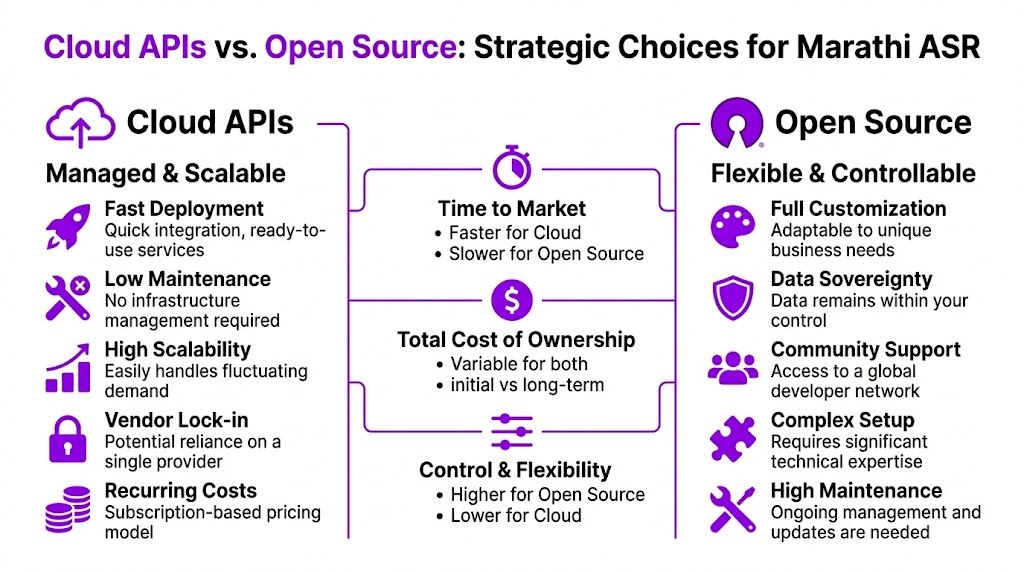
The right answer depends less on ideology and more on operating constraints. If your team needs a primer on the building blocks, this short explainer on what is ASR is a useful baseline.
What cloud APIs solve quickly
Managed providers such as Soniox, Sarvam AI, Speechmatics, ElevenLabs, and Deepgram reduce the time between pilot and rollout. They typically offer streaming APIs, transcription events, timestamps, speaker labels, and developer tooling out of the box.
That matters when the business priority is speed. A cloud API is usually the strongest choice when:
- Time-to-market is tight: Product and operations teams want a pilot live quickly.
- Internal ML bandwidth is limited: The company has application engineers, not a speech research team.
- Call volumes fluctuate: Managed scaling is easier than self-provisioning.
- Speech is one layer in a larger workflow: The business needs ASR to feed LLMs, routing systems, CRM notes, or QA pipelines.
Cloud services also tend to perform better on operational basics such as monitoring, retries, and streaming stability.
Where open source makes sense
Open source becomes attractive when data control and customisation dominate the decision.
It usually fits organisations that need:
- Full control over deployment: Data sovereignty requirements may push teams towards self-hosting.
- Custom adaptation: Internal teams want to fine-tune around domain audio, dialect mix, or noisy channels.
- Flexible experimentation: Product teams need to swap models, test decoding strategies, and iterate independently.
- Longer-term platform ownership: The organisation wants to avoid deep vendor dependence.
The trade-off is straightforward. You gain control, but you take on evaluation, infra operations, model updates, observability, and support burden.
A practical decision lens
The weakest enterprise choice is often a generic open-source deployment with minimal adaptation. That's where teams underestimate how hard Marathi audio can be in live use, especially with mixed language utterances, call-centre noise, and regional variation.
Use this lens before deciding:
- If the workflow is business-critical and customer-facing, bias towards reliability.
- If the workflow is internal, batch-oriented, and tolerant of review, open source can be viable.
- If compliance requires stronger custody of audio and transcripts, architecture matters as much as model quality.
- If code-switching is common, test that explicitly before procurement.
A strong API with enterprise controls often wins for immediate deployment. A tuned open-source stack can win when the business has the technical maturity to own the full lifecycle.
Buy convenience when speed matters. Build control when differentiation matters. Don't confuse the two.
Key Business Use Cases in Indian Markets
The clearest way to assess marathi speech to text is to look at where transcript quality changes business outcomes, not where it merely saves a few minutes.
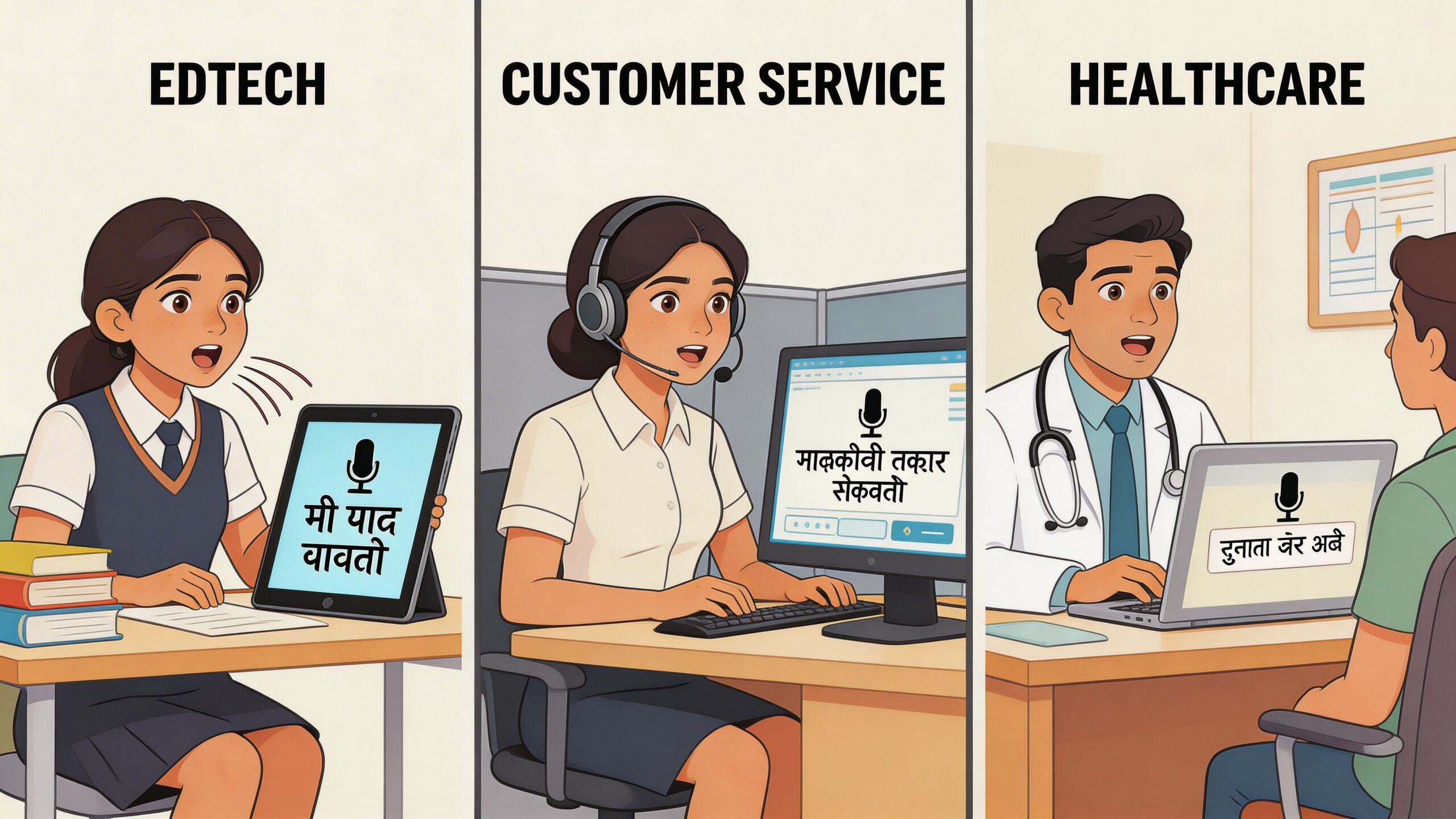
In business contexts like BFSI contact centers in Maharashtra, generic ASR models often show high word error rates of 20-30% for regional dialects. NASSCOM reports that 70% of these centers face speech recognition gaps, leading to 15-20% failed automations and impacting lead qualification and support quality (ElevenLabs Marathi page).
EdTech counselling and follow-ups
In education sales and counselling, conversations often combine course names, fee questions, eligibility details, and parental concerns. Generic systems frequently misread programme names or regional pronunciation, which then breaks CRM tagging and follow-up logic.
A better setup does three things well:
- Captures intent clearly: Is the student exploring, comparing, or ready to apply?
- Preserves domain terms: Course names and intake references shouldn't be normalised into nonsense.
- Supports bilingual flow: Counselling calls often move between Marathi and English naturally.
Teams evaluating conversational stacks often study examples of advanced AI Voice Agents to understand how ASR, call logic,…co/best-ai-voice-agents/) to understand how ASR, call logic, and workflow automation fit together.
BFSI service and compliance workflows
BFSI is less forgiving. Product names, consent language, account issues, and dispute details all need high transcript fidelity. Even small recognition errors can create review overhead or weaken the value of audit records.
For BFSI leaders, the practical questions are sharper:
| Requirement | Why it matters in Marathi calls |
|---|---|
| Speaker attribution | Distinguishes customer statements from agent prompts |
| Searchable transcripts | Supports QA, complaint review, and trend analysis |
| Domain vocabulary support | Preserves financial product terminology |
| Stable streaming | Helps live-assist and real-time guidance tools |
When the model struggles with dialect-heavy speech, teams usually revert to manual spot checks. That defeats the economics of automation.
Real estate lead qualification
Real estate is where poor ASR often hurts before anyone notices. A prospect may state budget, location preference, family need, or visit timing in Marathi. If that information is transcribed poorly, the lead still enters the funnel, but the sales team acts on weak data.
Good Marathi recognition helps classify:
- Budget intent
- Project or locality preference
- Booking urgency
- Site visit willingness
The commercial difference isn't just transcript accuracy. It's whether the field team receives a lead summary they can trust.
A Practical Guide to Integrating Marathi ASR
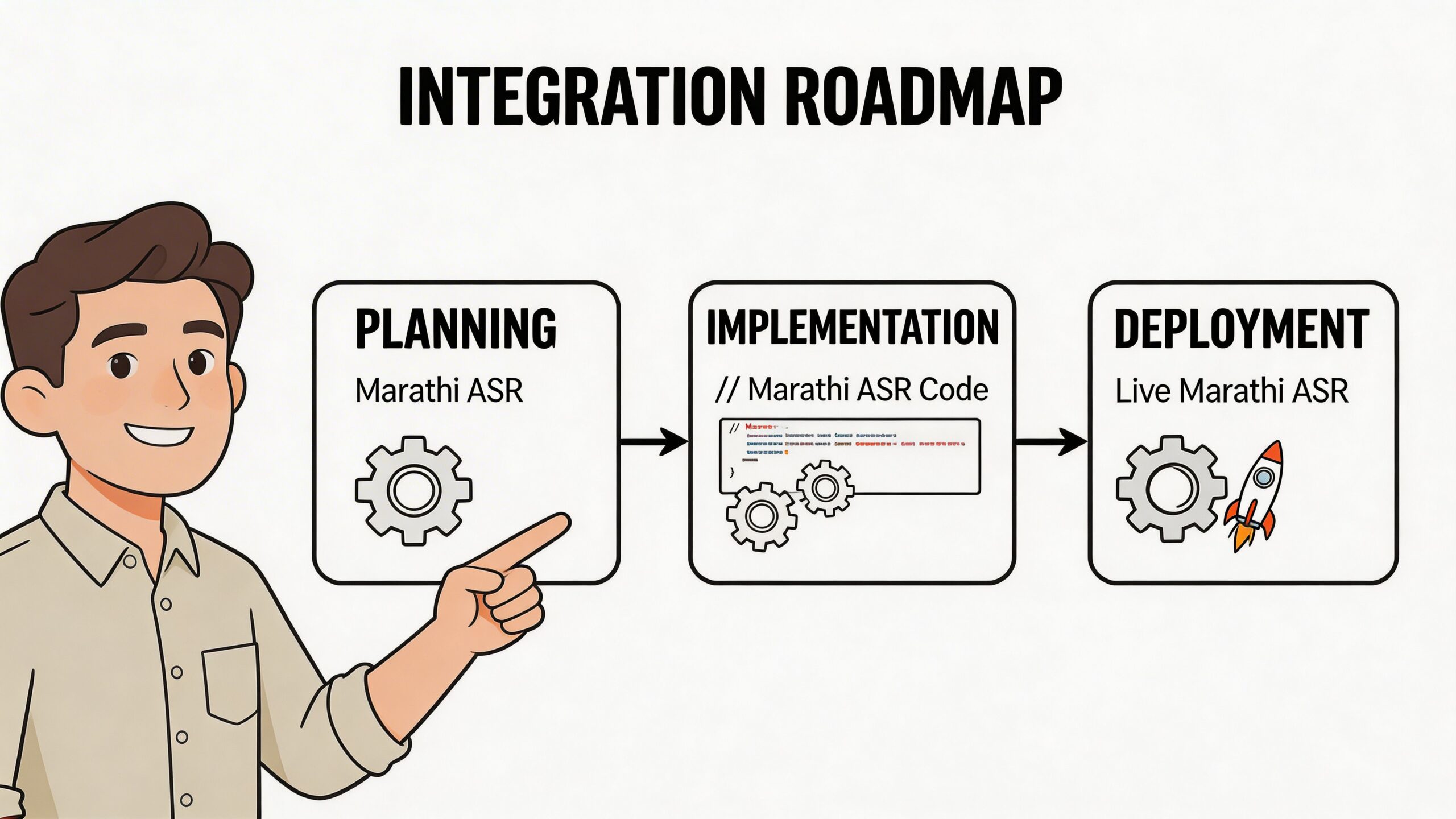
The best integrations start with business logic, then connect ASR into that flow. Teams that begin with model benchmarking alone usually end up measuring the wrong thing.
Start with the workflow not the model
Map the actual conversation path first.
For example, a customer support flow might require live transcript display, intent classification, agent-assist prompts, post-call summary, and searchable storage. A lead qualification flow may instead prioritise real-time extraction of budget, location, and callback timing.
A practical pilot should define:
- Audio source such as telephony, app microphone, or recorded files.
- Mode such as real-time streaming or batch transcription.
- Downstream action such as summarisation, ticket creation, QA tagging, or CRM update.
- Failure path for low-confidence or unclear sections.
Use context injection early
Production Marathi ASR systems like Soniox support request-time context injection, allowing developers to add domain-specific Marathi vocabulary such as educational programmes or financial products to the transcription stream. This improves accuracy for specialised terms without the latency overhead of retraining models (Sarvam AI Marathi speech-to-text API).
This feature is one of the most underused levers in enterprise deployment.
Use it for:
- Product names
- City and locality lists
- Programme catalogues
- Financial terms
- Internal entity names
If your team wants to see how consumer-facing tools position this capability, services that transcribe Marathi can help frame the user expectation, even though enterprise integration demands much tighter workflow control.
Design for exception handling
No ASR system is perfect in live traffic. Plan for difficult audio from the start.
When confidence drops, don't force full automation. Route the moment, not the entire account, to human review.
That means keeping fallback paths for overlapping speech, repeated low-confidence segments, and terms that the vocabulary list didn't cover. Integration quality depends as much on these exception rules as on the model itself.
Boosting Accuracy and Real-Time Performance
Enterprise Marathi ASR succeeds or fails on two dimensions. The transcript has to be good enough to trust, and it has to arrive fast enough to be useful in conversation.
Why low latency changes conversation quality
Modern Marathi ASR pipelines use Mel Frequency Cepstral Coefficients, or MFCCs, for feature extraction and achieve sub-250ms latency via persistent streaming connections. This real-time performance is critical for conversational AI, where benchmarks show specialised models like ElevenLabs' Scribe achieving a 5.5% word error rate on Common Voice, significantly outperforming Whisper Large v3 at 42.5% WER (Speechmatics Marathi speech-to-text overview).
That architecture matters because downstream systems don't need to wait for the entire utterance. They can begin intent handling, prompt generation, or agent guidance while the customer is still speaking.
For leaders evaluating live voice systems, low-latency model design is a major part of the user experience. This analysis of low latency speech models is useful when assessing conversational responsiveness.
What improves accuracy in production
Benchmarks are helpful, but production audio is harder. Background noise, weak mobile networks, cross-talk, and mixed Marathi-English phrasing all create friction.
The strongest improvements usually come from operational tuning:
- Pre-process audio carefully: Noise suppression and channel normalisation reduce avoidable errors.
- Handle accent diversity explicitly: Regional pronunciation patterns need evaluation data, not assumptions.
- Test code-switching on real calls: Mumbai and urban Maharashtra conversations often mix languages naturally.
- Use speaker-aware output when needed: Diarisation helps when multiple participants speak.
- Feed downstream systems partial transcripts: Real-time reasoning gets better when transcript chunks arrive continuously.
One more point matters. Clean-dataset performance can create false confidence. Production readiness comes from testing on your own call patterns, your own terminology, and your own noise conditions.
Future-Proofing Your Voice Strategy with Scalable ASR
A Marathi ASR decision shouldn't be made on demo quality alone. It should be made on whether the system can survive enterprise realities. High call volumes, regional accents, bilingual conversations, compliance review, and variable network quality all show up eventually.
For high-volume use cases with 1000+ daily calls, cost-effectiveness and latency are paramount. While some APIs claim under 300ms latency, real-world performance with Indian accents can exceed 500ms. Scaling with a service like AWS Transcribe India can cost over ₹50,000 per month, which is why pricing and data residency need careful review for DPDP Act compliance (Deepgram Marathi speech-to-text page).
A sound CXO checklist should include:
- Scalability: Can the provider handle sustained concurrency, not just pilot traffic?
- Residency and privacy: Where does audio go, and how is it stored?
- Workflow fit: Does the output support your CRM, QA, analytics, and audit stack?
- Code-switch resilience: Can the system cope when the speaker moves between Marathi and English?
- Commercial clarity: Are pricing and support predictable once usage grows?
The long-term winners in this space won't be the teams with the most impressive demos. They'll be the ones that choose a speech stack aligned with operational reality in India and treat voice as a core business interface.
If you're evaluating enterprise voice automation for Marathi-speaking users, DialNexa Labs Private Limited is worth a look. The company builds Voice AI agents for qualification, support, recruitment, and presales workflows across sectors such as EdTech, BFSI, real estate, healthcare, hospitality, e-commerce, and SaaS, with deployment paths designed for real production environments rather than lab demos.

Excellent analysis that clearly explains why Marathi speech-to-text is a business infrastructure investment rather than a simple localization feature. The strong focus on operational realities, compliance, and real-world deployment challenges makes this highly valuable for enterprise leaders.