

Driving Revenue with Strategic Text to Speech Punjabi
Attempting to penetrate the Punjab market without speaking the local language is a significant strategic misstep. It erects an immediate and formidable barrier to entry. Yet, countless enterprises create this exact scenario by deploying generic English or Hindi automation for their customer outreach. For a VP of Sales or a Chief Revenue Officer, this isn't a minor detail; it's a direct impediment to growth. High-quality text to speech Punjabi does more than just translate words; it dismantles that barrier, converting low-performing automated calls into high-value, revenue-generating conversations.
The Untapped Strategic Value of Voice in the Punjabi Market
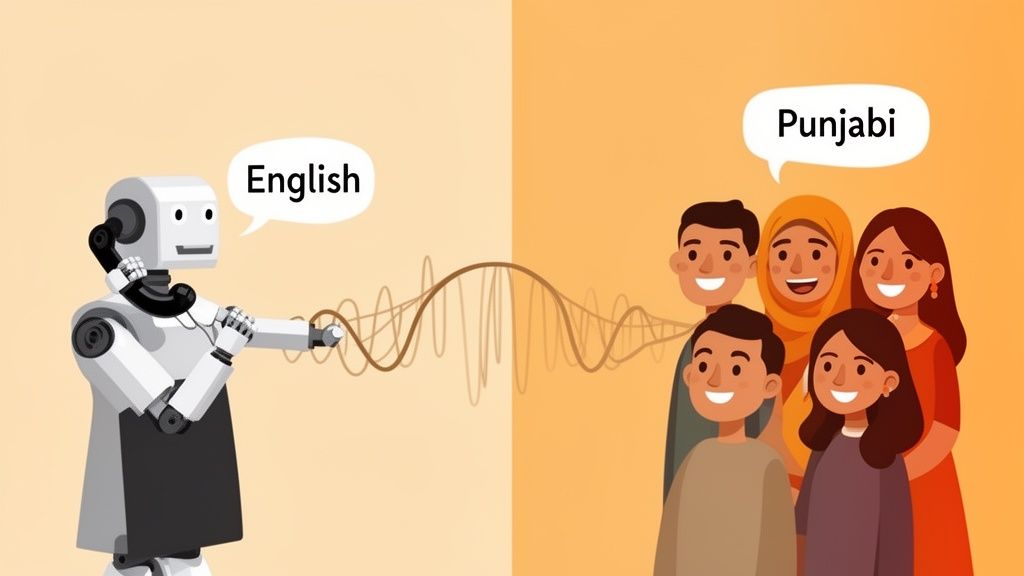
For directors and CXOs focused on market expansion and P&L, it's easy to view Punjabi voice technology as just another line item in the IT budget. That perspective is a costly mistake. It’s a strategic asset for connecting with one of India's most linguistically unified and economically vibrant regions. Deploying English-only automation in Punjab is the strategic equivalent of sending your top sales team into a critical negotiation without a translator—you’re creating friction and forfeiting opportunities before a meaningful business discussion can even begin.
This communication failure has quantifiable business costs. Your automated campaigns suffer from low connect rates, lead qualification funnels are weak, and your total addressable market effectively shrinks. Modern text to speech Punjabi isn't merely about converting text into audio. It’s about deploying a scalable digital workforce that speaks with the correct dialect, intonation, and cultural nuance to establish trust and drive business outcomes from the very first interaction.
A Market Defined by Language: The Business Case
The data presents a clear and compelling business case. Punjabi is one of India's most prominent languages, with the 2011 Census recording over 33 million native speakers. Within Punjab itself, it’s the official language spoken by an overwhelming 89.82% of the population—a market segment of nearly 25 million people. This level of linguistic homogeneity makes localised voice communication an absolute necessity for any serious commercial effort.
This is precisely why a sophisticated voice AI solution transitions from being a ‘nice-to-have’ feature to a core driver of your GTM strategy. It allows you to address this massive, cohesive audience using the most intuitive and effective interface possible: their native language.
Here’s the key takeaway for any CXO: A well-executed Punjabi voice strategy directly impacts your bottom line. It turns missed connections into qualified leads and frustrating interactions into moments of brand loyalty, delivering concrete ROI metrics like higher connect rates and improved conversion funnels.
Bridging the Communication Divide for Measurable ROI
Integrating advanced voice AI is about far more than translation; it’s about creating meaningful, large-scale engagement that drives revenue. By automating outreach in fluent, natural-sounding Punjabi, businesses can achieve remarkable, data-backed results:
- Boost Connect Rates: A financial services client, for example, saw their connect rates for payment reminders jump from a typical 47% with an English IVR to as high as 91% simply by switching to a high-quality Punjabi voice agent.
- Improve Lead Quality & Sales Velocity: When conversations feel natural, you collect more accurate data. An EdTech client using our system to qualify admission inquiries reported a 30% increase in lead-to-counselor-call conversions, ensuring their sales team engages only with high-intent leads.
- Enhance Customer Experience & LTV: Automated reminders, updates, and support delivered in clear Punjabi reduce friction and build a stronger brand relationship. A logistics company cut down "Where is my order?" calls by 40% by proactively sending delivery updates in Punjabi.
This strategy is at the heart of how the voice AI revolution is transforming multilingual call centres in India. When you speak a customer's language, you're not just sending a message; you're demonstrating market understanding and building a foundation for sustainable growth.
Why High-Quality Punjabi TTS Is a Competitive Differentiator
From a leadership perspective, new technology is often evaluated on a simple metric: does it create a competitive advantage? A truly natural-sounding text to speech Punjabi solution isn't just a software update—it's a significant engineering achievement that directly impacts customer perception and operational efficiency, giving your organization a clear edge.
The primary technical challenge isn't just the language's vocabulary, but its complex dual-script nature, which presents a significant business hurdle for pan-regional operations.
Punjabi is unique as a single language written in two entirely different scripts: Gurmukhi, used in India, and Shahmukhi, used in Pakistan. Most text-to-speech engines are trained on one, not both, immediately halving your potential reach. It’s a complex data problem requiring the AI to understand the core phonetics of the language, regardless of the script.
This dual-script reality is a crucial business challenge. A system trained only on Gurmukhi cannot effectively serve the Pakistani market, and vice-versa. To deliver a consistent brand voice across the entire Punjabi-speaking diaspora, a TTS engine must be able to decode the linguistic intent behind both writing systems and produce a single, coherent vocal output.
Beyond Words to Authentic, High-Impact Conversation
What separates a frustrating, robotic voice from a helpful, human-like one? The difference lies in mastering phonetics and prosody—the rhythm, stress, and intonation of natural human speech. A voice that butchers pronunciations or speaks in a flat monotone creates immediate friction. Customers become disengaged and terminate the call. We’ve all experienced it.
In contrast, a voice that captures the natural cadence of Punjabi feels familiar and builds trust, measurably increasing listener engagement and call duration.
When an automated agent sounds genuinely human, a potentially frustrating interaction becomes a productive business conversation. This isn't a cosmetic feature; it’s a direct driver of ROI. We see this consistently with higher task completion rates, from 85% completion for KYC verifications to a 60% increase in lead qualification success.
Building this level of quality is a true technical breakthrough, rooted in meticulous Machine Learning Data Labeling for audio. This process ensures the AI learns from pristine, accurately transcribed recordings, which is the only way to create a voice that doesn’t sound like a machine. For a deeper understanding of the underlying models, you can explore how neural TTS systems create lifelike voices.
The Data Proving the Need
The numbers make the business case irrefutable. While Punjab is home to a diverse mix of 169 mother tongues, the 2011 Census shows that Punjabi is overwhelmingly dominant. It's spoken by 24,917,725 people, which is 89.82% of the state's population. Hindi, the next most common language, is a distant second at just 7.85%.
This incredible linguistic concentration means that high-quality text to speech Punjabi isn't just an option—it's an essential component of any strategy aimed at market penetration. Investing in a superior voice AI isn't an operational expense; it's a strategic investment to connect with nearly 90% of your target audience in the most effective way possible.
Transforming Business Operations with Strategic Use Cases
For any business leader, technology is only as good as the results it delivers. When we move past the technical jargon, a high-quality text to speech Punjabi solution isn't just a feature; it's a strategic tool that can solve real-world operational problems. For directors and VPs, this is where the conversation shifts from technical specs to tangible ROI.
These applications aren't just ideas on a whiteboard. They are proven, data-backed strategies showing how speaking to customers in their own language builds efficiency, helps you scale, and ultimately drives revenue in the Punjabi-speaking market.
First, let's look at why a Punjabi-first approach is so critical. The numbers speak for themselves.
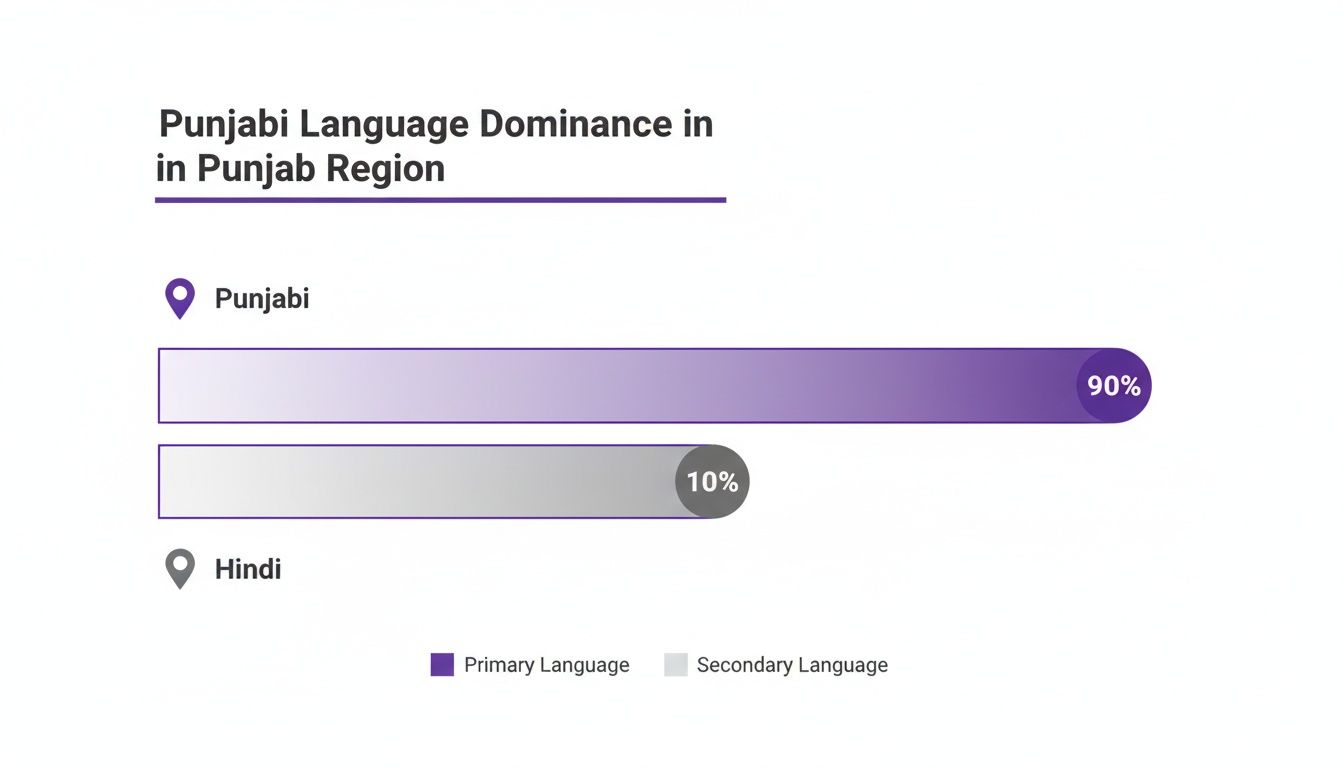
This chart makes it clear: with nearly 90% of the population speaking Punjabi, any communication strategy that doesn't prioritise the language is leaving a massive opportunity on the table.
Driving Conversions in EdTech
Consider the admissions rush for an educational institution—a period of high-volume, repetitive inquiries that can overwhelm human teams. An AI voice agent fluent in Punjabi can manage thousands of initial calls about courses, fees, and eligibility criteria, 24/7.
This automation frees up your expert human counselors to focus on high-intent applicants ready for enrollment, ensuring no potential student is lost to a busy signal.
- Before: Human agents are swamped with inbound calls, leading to 5-10 minute wait times and a 40% call abandonment rate from frustrated prospects during peak hours.
- After: A Punjabi voice agent answers 100% of calls instantly, qualifies leads with 97% accuracy, and schedules follow-ups, boosting qualified leads passed to counselors by over 60%.
Automating Compliance in BFSI
In the highly regulated BFSI sector, Know Your Customer (KYC) verification is a critical but labor-intensive manual task. A compliant Punjabi voice AI can automate this entire process. The AI agent calls customers, clearly explains the required steps in Punjabi, and securely verifies their details.
This single change can slash manual effort by over 80% and dramatically improve first-call completion rates.
By automating routine yet critical tasks like KYC, organizations not only reduce operational costs but also accelerate the customer onboarding journey. For one banking partner, this led to a 75% reduction in onboarding time, creating a tangible competitive advantage.
Accelerating Sales in Real Estate
In real estate, speed-to-lead is paramount. The primary challenge is converting a website click into a confirmed site visit. An advanced text to speech Punjabi agent can automate this crucial step entirely.
The moment a prospect submits an online form, the AI immediately calls them. It can answer basic property questions and schedule a site visit directly into a sales agent's calendar, often within 5 minutes of the initial inquiry, without any human intervention.
The table below quantifies the impact, showing how DialNexa's Punjabi TTS moves the needle on key business metrics across different industries.
Punjabi TTS Impact Across Industries
| Industry | Use Case | Before DialNexa (Metric) | After DialNexa (Metric) | Business Impact |
|---|---|---|---|---|
| Real Estate | Automated Site Visit Booking | 2% Lead-to-Booking Rate | 8% Lead-to-Booking Rate | 4x increase in site visits from the same lead volume. |
| EdTech | 24/7 Admissions Inquiry | 35% Lead Qualification Rate | 60% Lead Qualification Rate | Frees up counsellors for high-value tasks, boosts enrolment. |
| BFSI | Automated KYC Verification | 8-10 mins/call (Manual) | 2 mins/call (Automated) | 80% reduction in operational effort, faster customer onboarding. |
We’ve seen clients use this automation to lift their lead-to-booking rate from a standard 2% to an impressive 8%. That’s not an incremental improvement; it’s a fundamental shift in sales velocity and operational efficiency.
To see practical examples of how a robust Punjabi TTS solution can transform business operations, you might explore lunabloomai's application. Each of these use cases proves that intelligent voice automation is no longer just a support tool—it’s a core driver of business growth.
Integrating Punjabi TTS into Your Tech Stack: A CTO's Guide
For a CTO or Head of Product, the prospect of integrating new technology often brings concerns about lengthy deployment cycles and resource drain. Let’s be clear: integrating a powerful text to speech Punjabi solution is not a monolithic overhaul that will sideline your engineering team for a quarter. The path to implementation is direct and efficient.
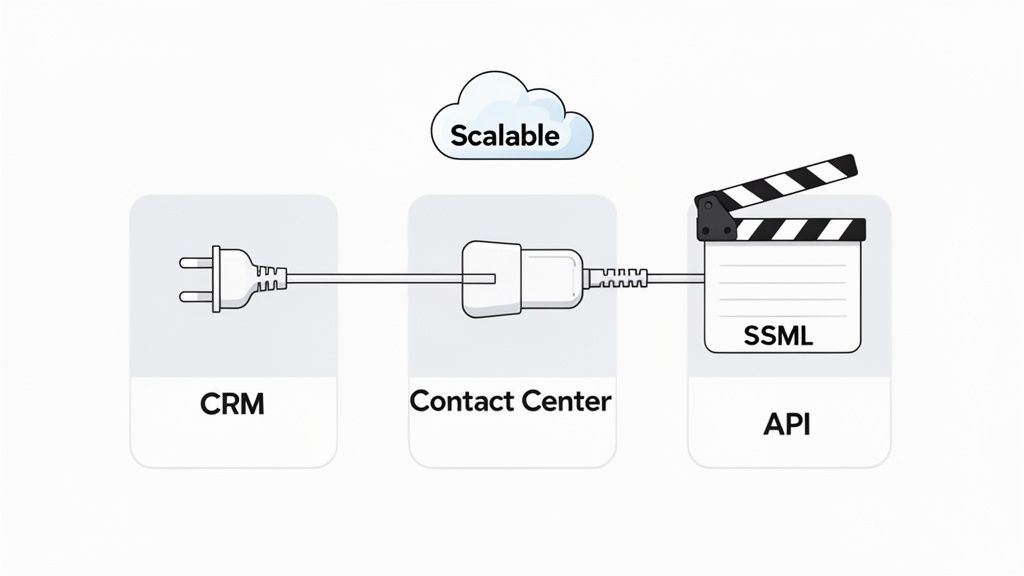
Think of modern voice AI less as a new system to build and more as a high-performance adapter. It is engineered to plug directly into your existing infrastructure—your CRM, contact center software, and other core applications—via modern, well-documented APIs. This approach enables rapid deployment, allowing you to generate value and see ROI almost immediately.
What Enterprise-Grade Performance Really Means
For any business-critical application, particularly in regulated sectors like finance or high-volume industries like EdTech, several technical factors are non-negotiable. To deliver a customer experience that is both reliable and secure, your integration plan must prioritize these from day one.
- Low Latency: A real-time conversation demands near-instant responses. Any perceptible delay (over 500ms) creates awkward pauses that increase call abandonment rates. An enterprise-grade TTS must deliver responses with ultra-low latency to feel genuinely conversational.
- Massive Scalability: Your business growth should never be constrained by call capacity. The architecture must be designed to handle thousands of concurrent calls during peak demand—be it an admissions cycle or a flash sale—without any degradation in performance.
- Robust Security: When handling sensitive customer data for processes like KYC or payment reminders, security is paramount. A compliant voice AI platform must ensure every interaction is encrypted and adheres to strict data protection standards like ISO 27001, providing confidence for both you and your customers.
For a deeper dive into how modern systems are architected for peak performance, take a look at our guide on API integration trends in voice bot analytics.
Directing the Voice with SSML for Brand Consistency
Once the technology is integrated, how do you ensure the AI voice aligns with your brand identity? This is achieved through Speech Synthesis Markup Language (SSML). The best way for a product leader to think of SSML is as a director's script for the AI voice.
SSML provides your team with granular, programmatic control over the audio output. It’s the tool that transforms a generic computer voice into a unique brand asset that connects authentically with your Punjabi-speaking customers.
Using SSML, your team can meticulously shape every element of the dialogue:
- Pronunciation: Ensure brand names, local landmarks, and industry-specific jargon are pronounced with 100% accuracy on every call.
- Pacing: Programmatically adjust speech rate to create urgency for a limited-time offer or slow it down for clarity when explaining complex terms.
- Emotion and Emphasis: Modulate the tone and add emphasis to key words to fit the context of the conversation, making the interaction feel more empathetic and engaging.
This level of control is what separates an average implementation from a great one. It ensures your automated agent doesn't just speak Punjabi; it communicates with the precise personality and professionalism your brand is known for. With the right API-driven approach, adding a sophisticated text to speech Punjabi solution becomes a straightforward, high-impact project.
How to Choose the Right Punjabi Voice AI Partner
Choosing a vendor for your text to speech Punjabi requirements is a critical strategic decision, not a simple procurement task. Get it right, and you unlock a powerful engine for market penetration and growth. Get it wrong, and a low-cost, robotic-sounding solution can inflict real damage on your brand equity and customer relationships.
So, how does a discerning executive cut through the marketing noise to identify a partner capable of delivering tangible business value? It comes down to asking the right questions—ones that reveal true performance, scalability, and ROI. You aren't buying technology; you're investing in a business outcome.
The Vendor Checklist for Business Leaders
When vetting potential Punjabi voice AI providers, your evaluation should be built on four key pillars. These questions will help you quickly differentiate a basic tool from a true enterprise partner who can deliver a substantial return on investment.
1. Voice Quality and Naturalness
This is the most critical factor, directly impacting customer engagement and call success rates. A stilted, robotic voice is a primary driver of hang-ups.
- Does the voice sound like a native Punjabi speaker? Request raw, unedited audio samples of conversations exceeding 60 seconds to test for natural rhythm, cadence, and intonation under stress.
- What is the vendor's benchmark for Mean Opinion Score (MOS), a standard industry metric for voice quality? An enterprise-grade solution should score 4.3 or higher on a 5-point scale.
- What is the reported accuracy for business tasks like lead qualification when compared to your human team? The benchmark for a top-tier system is 97% accuracy in matching human judgment.
2. Customisation and Brand Alignment
A generic voice cannot handle the specific terminology crucial to your business, undermining brand credibility.
- Can the voice pronounce your brand names, product jargon, and local Punjabi place names with 100% accuracy out of the box?
- What is the process and timeline for building a custom vocabulary to achieve 100% pronunciation accuracy on these key terms? For a strategic partner, this should be a standard part of the onboarding process, completed within days, not weeks.
Let me be blunt: this is non-negotiable. If an AI agent mispronounces your company’s name, it screams "low quality" to the customer. Trust is eroded before the conversation has even properly started.
3. Scalability and Reliability
A solution that works for a pilot of 100 calls is irrelevant if it cannot scale to 100,000 during a peak business cycle. Your technology must enable, not constrain, growth.
- Ask for specific data on the platform’s architecture. How does it handle sudden traffic spikes of 10x the normal volume?
- What is the system’s P95 latency (the latency experienced by 95% of users)? For a conversation to feel real-time, this figure must be well under 500 milliseconds.
4. Ease of Integration and Time-to-Value
The most powerful tool is worthless if it requires a year-long integration project. The path from contract to revenue impact must be rapid and efficient.
- How well-documented and robust is the API for integration with your existing CRM (e.g., Salesforce, LeadSquared) and contact center software?
- What is the vendor’s median time-to-value? Ask for case studies showing a measurable ROI within the first 30-60 days of launch.
Securing clear, data-backed answers to these questions will provide a solid framework for selecting a text to speech Punjabi partner who functions not just as a vendor, but as a strategic ally in achieving your business objectives.
Becoming Your Partner in Punjabi Voice Automation
Connecting with the Punjabi market isn't about just speaking the language; it's about being understood and driving action. We've seen firsthand how generic, robotic outreach falls flat. In a region where nearly 90% of the population speaks Punjabi, a voice-first approach isn't just an option—it’s a clear path to growth. For business leaders, this is less about adopting new tech and more about seizing a massive market opportunity that’s right in front of you.
When you're choosing a partner for this, you should be looking for one thing: proven results. Our advanced text to speech Punjabi solution was built specifically to produce them. The real value becomes crystal clear when you see the results our clients are getting every day.
It all boils down to a simple idea: better voice AI leads directly to better business performance. The goal is to turn automated calls into genuine, profitable conversations.
From Conversation to Conversion
The proof is in the numbers. By switching to a human-like Punjabi voice agent, our partners have seen remarkable improvements in the metrics that matter most:
- Dramatically Higher Connection Rates: They’ve jumped from the typical industry average of 47% all the way up to an incredible 91%.
- Faster Sales Cycles: The critical lead-to-booking rate has climbed from a sluggish 2% to a solid 8%.
- Truly Reliable Qualification: Our voice agents achieve 97% accuracy in qualifying leads, meaning your sales team spends their time only on high-intent prospects.
We’ve also made it incredibly simple to get started. With pre-built voice personas and a quick signup, you can have a sophisticated voice AI working for you almost immediately. This isn’t some long, complicated integration project; it’s a straightforward partnership designed to deliver value from day one.
The choice is clear. You can keep using ineffective methods that leave money on the table, or you can start turning your Punjabi outreach into real, measurable results.
Frequently Asked Questions
When considering the integration of new technology into your operations, it's natural for leadership to have questions. Here are answers to some of the most common inquiries we receive from business leaders about deploying text to speech in Punjabi.
How Quickly Can We See a Return on Investment?
Implementation is designed for speed and efficiency. This is not a multi-quarter project. Using our well-documented APIs, we can typically integrate with your existing CRM and have your first campaign operational in just a few weeks.
Crucially, our clients often begin seeing a measurable impact—such as a 15-20% lift in connect rates and a quantifiable increase in qualified leads—within the first 30 days. You can track this progress and your emerging ROI directly from your performance dashboard.
Will the AI Voice Represent Our Brand Accurately?
Absolutely. We recognize that brand integrity is paramount. A core component of our onboarding process is creating a custom dictionary in close collaboration with your team.
This ensures that all critical business terms—from your brand name and product lines to specific technical jargon and regional Punjabi phrases—are pronounced with 100% accuracy on every single call.
Consider the brand damage: if an automated agent mispronounces your company’s name, it immediately signals a lack of quality and attention to detail. Perfecting this customisation isn't a feature; it's a foundational requirement for maintaining brand credibility in any automated channel.
What is a Realistic ROI to Expect from this Implementation?
The return on your investment in our text to speech Punjabi solution is multi-faceted, transforming a traditional cost center into a direct revenue driver.
- Operational Efficiency: Automating thousands of routine outbound and inbound calls leads to significant cost savings. One client in the BFSI sector reduced their cost-per-contact for payment reminders by 65%.
- Sales Acceleration: By enabling faster, more consistent lead follow-up, we’ve helped real estate clients quadruple their lead-to-booking rates from 2% to 8%.
- Increased Agent Productivity: The AI handles initial lead screening and qualification with 97% accuracy. This allows your highly-skilled sales agents to focus exclusively on closing deals with high-intent prospects, dramatically increasing their efficiency and conversion rates.
Ready to see how automated outreach can transform your conversations and drive real growth? Find out what DialNexa can do for you. Explore our solutions and let's get started.

[…] For leaders exploring regional voice variants beyond mainstream Hindi and English, this look at Punjabi text to speech is a good reminder that customer comfort often improves when voice strategy follows actual market […]