

Text to Speech Indian Accent: A CXO’s Guide for 2026
Regional voice is no longer a cosmetic choice. It is a revenue and risk decision. A 2025 NASSCOM report found that 78% of Indian BFSI firms using Voice AI reported 25-35% higher customer engagement and satisfaction when the AI’s accent matched the caller’s regional demographic.
That one fact should change how boards think about text to speech indian accent strategy. If your organisation still treats “en-IN” as a single voice setting, you’re leaving trust on the table, weakening conversion, and increasing the odds that customers disengage before your systems even reach the actual business objective.
Voice is now part of acquisition, qualification, service, collections, counselling, scheduling, and retention. In India, accent fit shapes whether those interactions feel familiar, credible, and worth continuing.
Table of Contents
- From Feature to Strategy Why Indian Accents Are Your Next Growth Lever
- The Myth of the Single Indian Accent and Its Business Cost
- How Authentic Voice AI Is Engineered for India
- Evaluating TTS Providers A Framework for Decision Makers
- Use Cases Driving ROI in Real Estate EdTech and BFSI
- Your Implementation Checklist for Scalability and Compliance
- Conclusion Building Your Competitive Edge with Authentic Voice AI
From Feature to Strategy Why Indian Accents Are Your Next Growth Lever
Most executives still buy text to speech like a utility. That’s outdated.
In India, voice isn’t just an interface layer. It is often the first live interaction a prospect or customer has with your brand. When that voice sounds generic, imported, or regionally off, trust drops before your workflow begins. When it sounds familiar, customers stay on the line long enough for qualification, counselling, servicing, or booking to happen.
That matters because the business case is already visible in operational deployments. Organisations using voice agents for outreach and qualification have reported stronger connect rates, more productive multi-minute conversations, and better lead qualification outcomes when the voice experience aligns with the audience and task. The strategic lesson is simple. Voice quality influences funnel quality.
Voice now affects revenue not just support
A good board asks three questions.
- Does this improve customer trust: In India, familiar accent patterns reduce friction in sales and service conversations.
- Does this lower operating cost: Automation only works when customers engage with it.
- Does this grow revenue: If more conversations stay active, more leads move to booking, enrolment, or verification.
A hyper-regional voice strategy does all three. It helps organisations route the right tone and accent to the right geography, product line, and stage of the journey.
Board view: Treat voice like market segmentation. You wouldn’t run one national campaign with one message for every state. Don’t do it with AI speech either.
The companies that win in 2026 won’t be the ones with “AI voice” on a slide. They’ll be the ones that use regionally appropriate voices to turn more calls into commercially useful outcomes.
The Myth of the Single Indian Accent and Its Business Cost
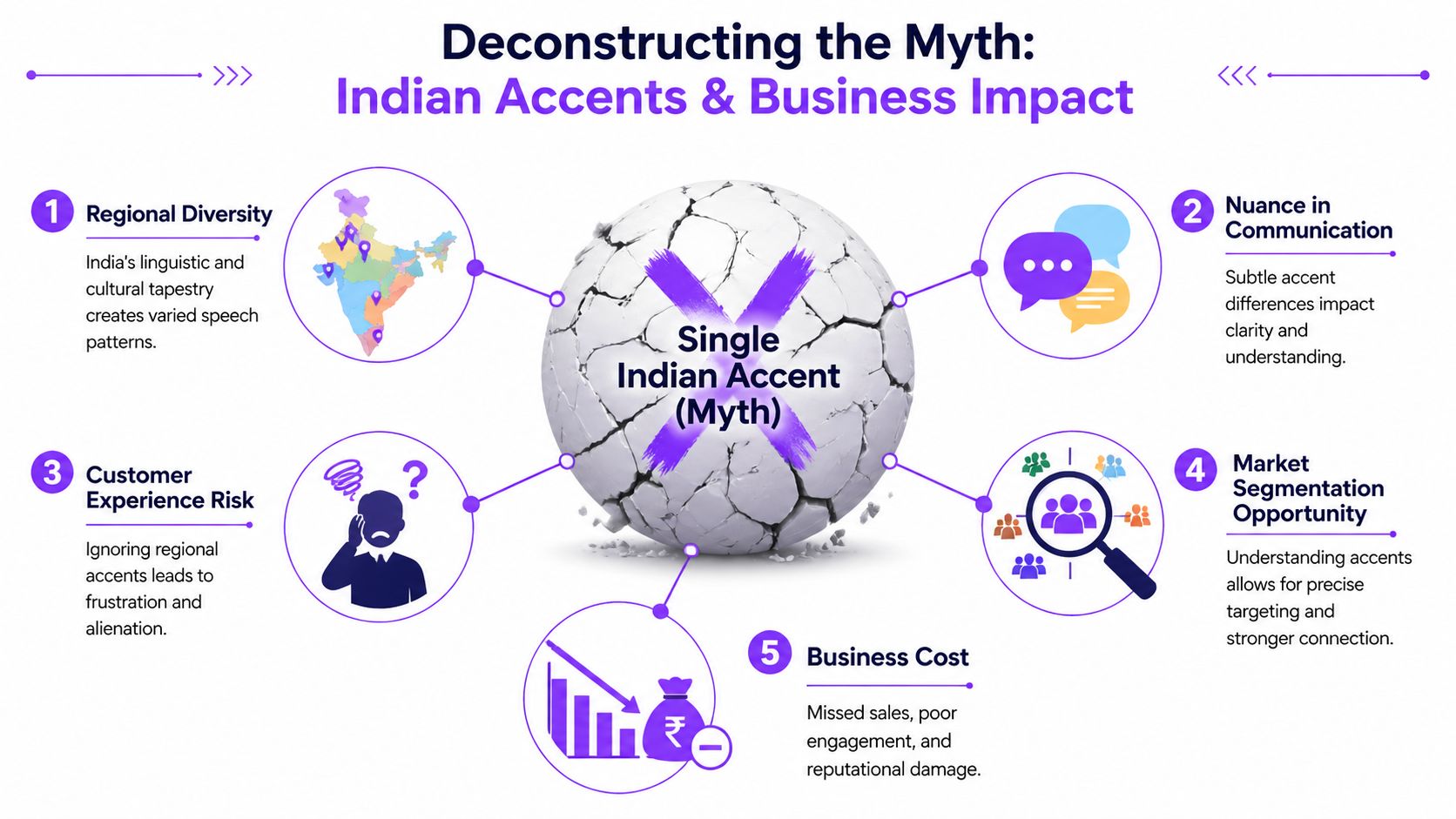
Relying on the label “Indian accent” is a costly shortcut.
India is not one speech market. It is a cluster of regional listening expectations shaped by cadence, vowel stress, code-mixing, local language transfer, and sector vocabulary. A single en-IN voice may pass a vendor demo. It will fail in live revenue and service environments where customers judge credibility in seconds.
Why en-IN is too blunt for serious operators
Generic en-IN voices erase differences customers hear immediately in Chennai, Pune, Kolkata, Lucknow, Hyderabad, and Ahmedabad. Procurement teams often miss this because they evaluate text to speech in controlled demos, not in high-friction moments like lead qualification, collections, KYC, counselling, or appointment booking.
The commercial cost shows up in small failures that stack fast. Customers pause longer. They ask for repeats. They transfer to human agents sooner. Completion rates drop. Cost per successful interaction rises.
As the NASSCOM report previously mentioned, BFSI firms using Voice AI saw stronger engagement and satisfaction when the AI accent matched the caller’s regional demographic. The board-level conclusion is straightforward. Accent fit affects conversion, handle time, and trust.
This also has a compliance dimension.
In regulated sectors, misunderstanding a verification step, consent prompt, repayment reminder, or policy disclosure creates avoidable risk. If the voice sounds socially distant or regionally off, customers are less likely to process the message correctly and more likely to abandon the flow. That pushes work back to human teams and increases audit exposure.
Where the business loss appears
Accent mismatch usually hurts four operating areas first:
- Lead qualification: Prospects disengage earlier when the voice feels generic or out of place for the region.
- Collections and payment reminders: Customers show less patience and lower cooperation when the caller sounds detached from their context.
- KYC and verification flows: Repetition increases average handling time, agent escalation, and failure rates.
- Education counselling and high-consideration sales: Students and families respond better to voices that sound locally credible.
The fix is not to build a custom model for every district. The fix is to segment the voice estate the same way you segment channels, offers, and customer cohorts. Prioritise regions with the highest revenue concentration, highest service volume, or highest compliance sensitivity. Then assign voice profiles by geography, use case, and stage of the customer journey.
That is the strategic shift CXOs should demand. Move from one national default voice to a managed portfolio of region-appropriate voices. A Maharashtra KYC flow should not sound like a North India education campaign. A South India site-visit booking flow should not use a generic national voice designed to offend nobody and persuade nobody.
Teams that need to support this at scale also need hiring capacity across speech, ASR, and localization operations. The Guide to ASR talent acquisition is a useful reference for building that capability.
Treat hyper-regional voice design as a revenue and risk-control decision, not a cosmetic one. That is how text to speech indian accent strategy starts producing measurable commercial advantage.
How Authentic Voice AI Is Engineered for India
Authentic Indian voice AI starts with data, not polish.
If the training data is generic, the output will be generic. If the data captures real regional pronunciation, rhythm, and usage, the output can sound far more natural in live business interactions. That is why serious providers invest in India-specific datasets and fine-tuning instead of relying on a global English base model and hoping it generalises.

The data decides the voice
One of the clearest examples comes from IIT Madras. Training on the IITM Speech Lab Indian English dataset improved word accuracy in recognition models from 55.1% to 84.23%, showing what region-specific data can do when models are tuned for Indian speech rather than treated as a generic English problem.
For a board, the strategic point is straightforward. Better regional data produces better speech systems. Better speech systems create smoother conversations. Smoother conversations reduce handling friction and make automation commercially viable.
Here’s what authentic engineering usually includes:
Region-specific speech data
Native speakers from different states and backgrounds supply the variation a model needs to learn actual Indian English patterns.Transfer learning
Providers start with a strong pre-trained model, then fine-tune it using Indian speech data. This is faster and more practical than building from zero.Prosody control
Strong systems shape pace, pauses, stress, and emphasis so the output sounds conversational rather than robotic.Code-mixing support
India doesn’t speak in clean language silos. Business conversations switch across English and local language fragments constantly.
Practical rule: If a vendor talks mostly about “voice cloning” and barely mentions India-specific training data, they probably don’t have a serious advantage in Indian deployment quality.
Build versus buy is mostly a data question
Many firms assume they can assemble a voice stack internally with enough engineering effort. Sometimes they can. Most shouldn’t.
The bottleneck isn’t API integration. It is data access, annotation quality, model tuning, evaluation discipline, and specialist talent. If your leadership team is assessing whether to build capability in-house, this Guide to ASR talent acquisition is useful because it makes the resourcing challenge concrete.
Boards should treat authentic Indian voice as an expertise-heavy layer. Buying from a provider with proven regional depth is often the faster route to commercial value. Building makes sense only when voice is a durable strategic asset, not just an operational tool.
Evaluating TTS Providers A Framework for Decision Makers
Most TTS evaluations are badly run. Teams compare sample voices, ask for pricing, and stop there.
That process selects a demo. It does not select a platform.
If you’re buying text to speech indian accent capability for customer-facing operations, the provider has to perform across naturalness, speed, control, and regional relevance. A strong voice sample with weak latency or weak code-mixing support will fail in production.
The right scorecard focuses on business outcomes
The vendor shortlist should start with known market capabilities. ElevenLabs’ Indian accent offering includes over 160 Indian accent voices and reports MOS above 4.5 for naturalness. The same source also highlights the importance of voice design controls. On the India-first side, Sarvam AI’s Bulbul V3 is positioned around sub-200ms latency and handling code-mixing, which matters for live interactions where delays and awkward language switching hurt completion.
Those details matter because they map directly to business outcomes:
- Naturalness affects trust.
- Accent range affects segmentation.
- Low latency affects interruption handling and live conversation flow.
- Code-mixing support affects real-world usability.
If your team is comparing mainstream options, it’s also worth reviewing how a more standardised platform behaves in production settings. This breakdown of Amazon Polly text to speech is a useful contrast point when you want to separate basic synthesis from strategic voice fit.
Questions that expose weak vendors quickly
Use a board-level evaluation table, not a feature checklist.
| Evaluation Criterion | Why It Matters for Business | Key Question for Vendors |
|---|---|---|
| Voice library depth | Broader regional options support segmentation and better customer fit | Which Indian regional voice variations can you demonstrate for our target states? |
| Naturalness | Robotic audio weakens trust and lowers call completion | How do you evaluate naturalness for Indian English in production conditions? |
| Code-mixing support | Real customer conversations mix English with local language usage | Can the model handle Hinglish or other mixed-language prompts without breaking cadence? |
| Latency | Delayed responses make live agents sound fake and frustrate callers | What is your live generation latency under realistic call load? |
| Prosody controls | The same script needs different delivery for sales, support, and reminders | What controls do we get for speed, emphasis, and tone? |
| API and orchestration | Integration speed affects time to value and operating complexity | How does your API handle streaming, fallbacks, and workflow triggers? |
| Compliance posture | Regulated sectors can’t outsource risk to a vendor brochure | Where is data processed, and what localisation options are available for India? |
| Scalability | Pilots are easy, national rollouts are not | How do you maintain consistency across large call volumes and multiple voice personas? |
A polished sample is not proof. Ask for a live workflow demo with your scripts, your customer names, and your code-mixed phrasing.
The right provider is the one that holds up under operational pressure, not the one with the best marketing reel.
Use Cases Driving ROI in Real Estate EdTech and BFSI
Regional voice strategy becomes valuable when it changes outcomes inside actual workflows.
That is where many voice programmes either justify themselves or stall. Boards don’t need another AI concept. They need repeatable gains in qualification, booking, enrolment, and service efficiency.
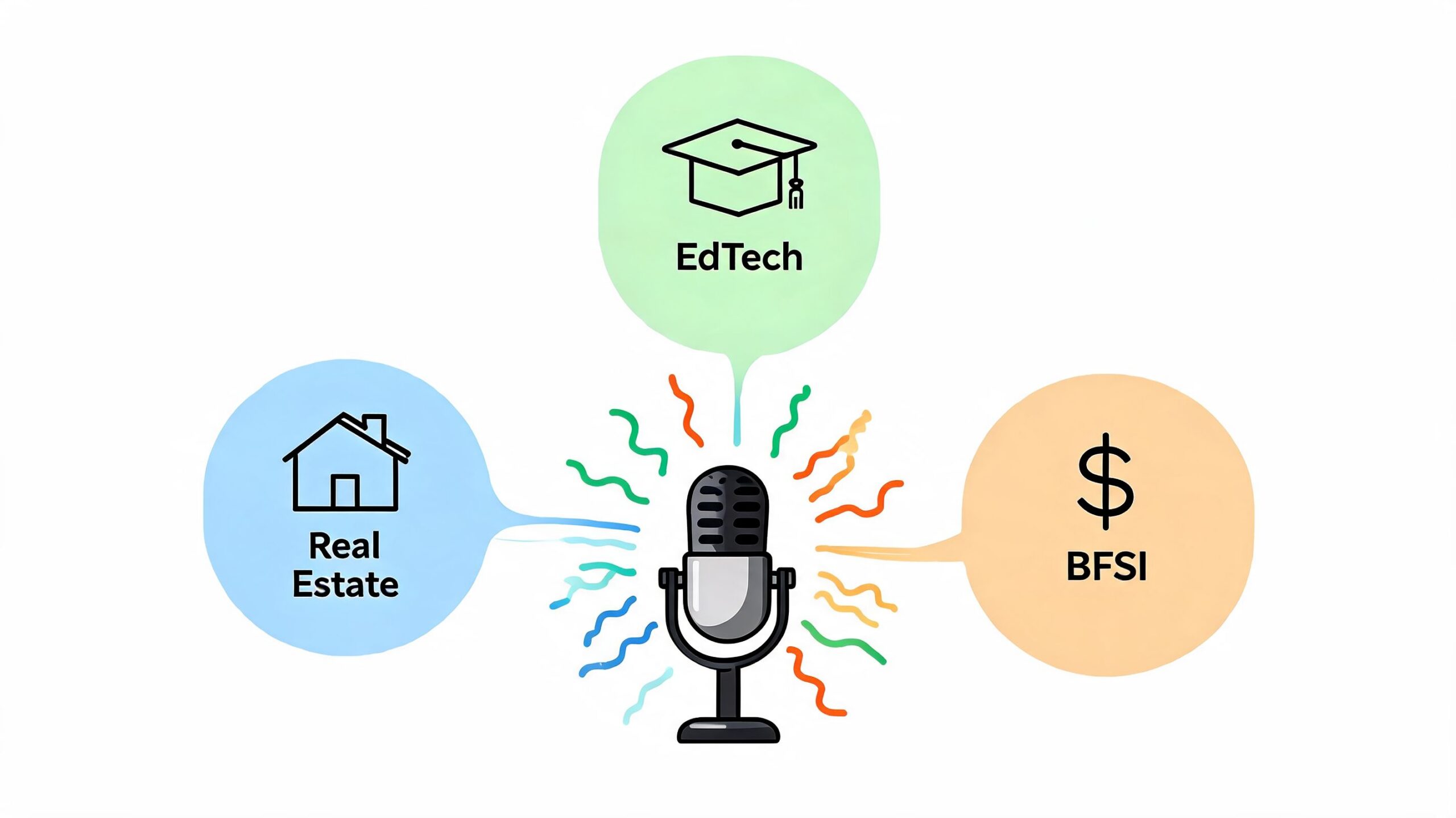
Real estate voice that sounds local books more visits
A property developer running outbound calls in Chennai shouldn’t default to a flat national English voice. A regionally tuned voice can make discovery calls feel more credible, especially when the script includes local place names, pricing context, and booking language. When voice systems are deployed well in business workflows, teams report stronger connect rates and better lead-to-booking performance.
That same logic applies to follow-ups. Site-visit reminders, missed-call callbacks, and broker coordination all work better when the voice sounds familiar rather than outsourced. For leaders exploring regional voice variants beyond mainstream Hindi and English, this look at Punjabi text to speech is a good reminder that customer comfort often improves when voice strategy follows actual market geography.
The same principle holds for western India: a dedicated Gujarati text to speech voice will usually outperform a generic en-IN default in Ahmedabad and Surat lead, collections, and booking flows.
EdTech counselling improves when the voice fits the learner
Education is one of the clearest use cases for text to speech indian accent investment.
India’s NPTEL2020 dataset from AI4Bharat contains 15,700 hours of speech across 6,253,389 chunks, making it a major training resource for South Asian English in the education domain, as described in the AI4Bharat NPTEL2020 dataset repository. The same benchmark showed Google Speech-to-Text at 0.4895 WER, AWS Transcribe at 0.3438 WER, and actual transcripts at 0.1451 WER in tests from May 2020, which underlines why India-specific tuning matters in education audio.
For EdTech operators, the business implication is practical. Student counselling, course reminders, fee follow-ups, and onboarding guidance all depend on comprehension and trust. A neutral but locally intelligible voice can keep students engaged long enough to move from enquiry to enrolment.
A working example helps:
- A North India counselling flow may need clean English with natural Hinglish tolerance.
- A South India support flow may need clearer handling of local names and pronunciation patterns.
- A national platform may need different voices for sales, retention, and parent communication.
Here’s a live view of how voice AI is being positioned for customer interaction workflows:
BFSI needs voice precision not just automation
BFSI has the highest penalty for getting voice wrong.
Calls involve identity, money, compliance, and trust. Customers need to hear a voice that is clear, calm, and regionally appropriate enough to sustain verification and support flows. In that setting, voice quality affects both completion and auditability.
Regional TTS in BFSI should be judged like branch operations. If it can’t build trust quickly and stay consistent, it should not face customers.
For KYC guidance, payment reminders, claims support, and account servicing, the winning pattern is the same. Use voice variants aligned to the customer base, keep latency low, and make the conversation feel native to the context rather than merely automated.
Your Implementation Checklist for Scalability and Compliance
PwC’s 2024 Global CEO Survey found that trust is a top factor in whether customers adopt AI-driven experiences. In India, that trust breaks fast when voice systems sound generic, mishandle personal data, or fail under peak demand. That makes implementation discipline a revenue and risk decision, not an IT task.
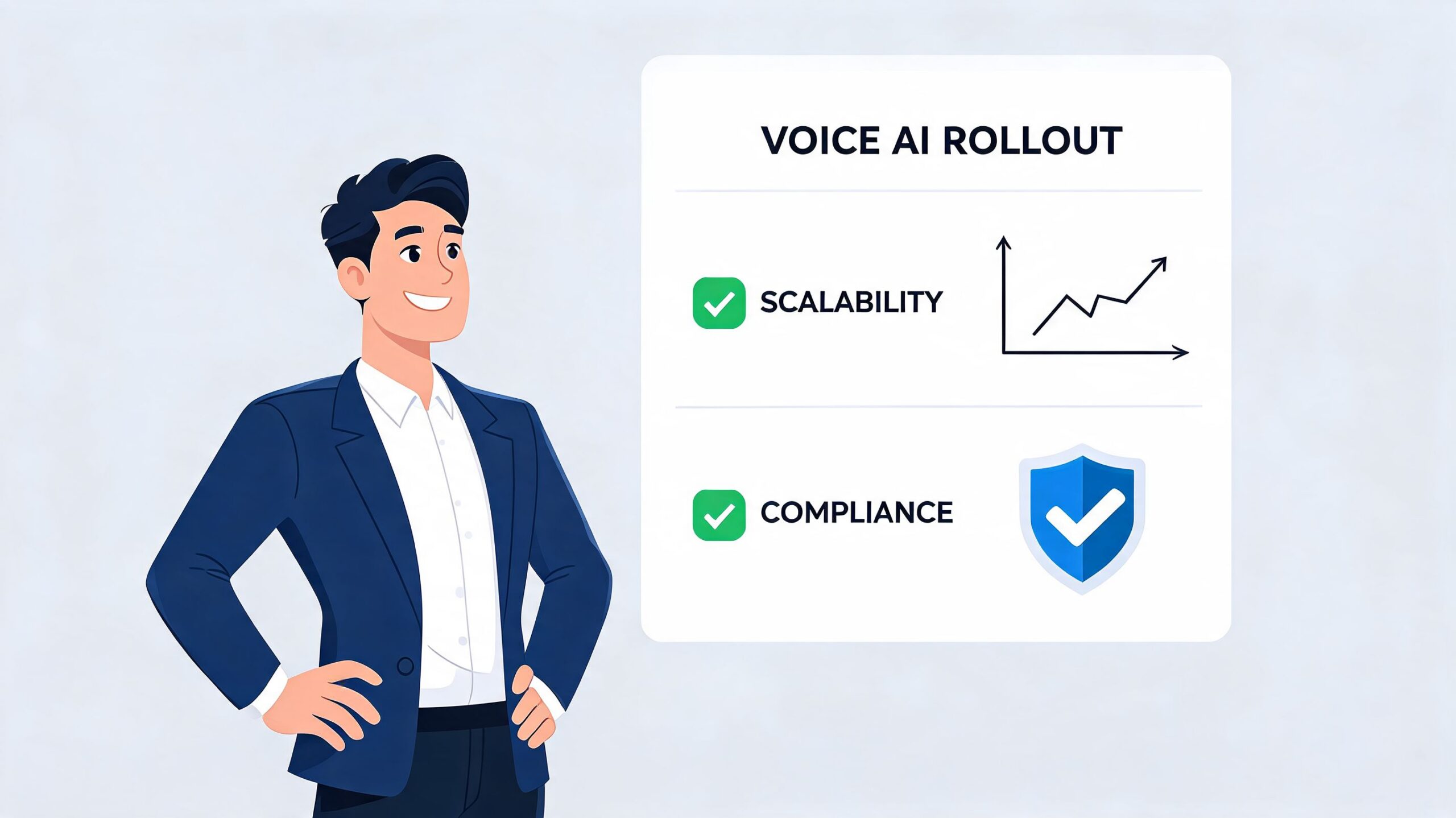
Board level checklist before go live
Use this as the minimum standard for any customer-facing rollout:
Define voices by revenue segment, not by language label
Do not approve a single en-IN voice for a national deployment. Assign voice variants by region, customer value, journey stage, and regulated use case. Hyper-regional alignment improves trust and reduces drop-off in sales, collections, servicing, and verification flows.Test production conversations, not vendor demos
Run live scripts that include local names, code-mixed phrases, addresses, policy terms, financial terminology, and escalation language. If the voice fails on real customer inputs, it will fail at scale.Stress test concurrency and latency under peak load
Ask for proof at the volume your business expects, including campaign spikes, payment reminder bursts, and seasonal surges. A voice system that degrades under load increases repeat calls, agent transfers, and cost per resolution.Set hard fallback rules before launch
Define what happens when pronunciation fails, audio quality drops, consent is unclear, or the customer asks for a person. Clear handoff logic protects CSAT and keeps regulated interactions auditable.Install an operating review loop
Your operations team should review transcripts, sample calls, error patterns, and completion rates every week. Retire weak voices fast. Promote voice variants that improve conversion, containment, and compliance outcomes.
A useful external reference for deployment discipline is Cloud Move's AI voice bot. It is not built around India’s accent complexity, but it helps leadership teams assess orchestration, workflow design, and rollout control.
Compliance has to be designed into the stack
Compliance failures do not stay in the legal department. They damage trust, delay scale, and create direct financial exposure.
India’s Digital Personal Data Protection Act, 2023 sets clear duties around lawful processing, consent, and data handling. For voice AI, that means your team must know where audio is processed, what is stored, who can access it, how long it is retained, and how a customer can withdraw consent or seek redress. The law is available on the Government of India’s Digital Personal Data Protection Act page.
The checklist for regulated environments is straightforward:
Confirm data residency and processing flows
Map where voice data, transcripts, prompts, logs, and analytics are created and stored.Document consent, retention, and deletion rules
Voice interactions often capture personal and financial information. Your policy must cover collection, storage, retrieval, and deletion in operational terms.Maintain audit trails that can survive scrutiny
Keep retrievable records of prompts, outputs, handoffs, and system actions for high-stakes interactions.Apply sector controls by workflow
BFSI, insurance, healthcare, and education each require different disclosures, retention practices, and escalation rules. One policy will not cover every use case.Test vendors on plain-language compliance answers
If a provider cannot explain localisation, subcontractors, logging, and incident response clearly, stop procurement.
For leaders tracking how regulation is shaping vendor selection and deployment design, this analysis of India’s voice AI policy overhaul connects policy direction to execution choices.
Scale keeps service running. Compliance keeps the business protected. Hyper-regional voice strategy ties both to growth by raising trust where generic en-IN deployments fail.
Conclusion Building Your Competitive Edge with Authentic Voice AI
The old way of buying voice technology was simple. Pick a vendor, pick a pleasant voice, connect the API, and launch. That approach won’t hold in India.
The companies that outperform will treat text to speech indian accent capability as a strategic layer tied to segmentation, trust, and regulatory execution. They’ll stop asking for a single en-IN voice and start asking which voice should speak to which customer, in which region, for which outcome.
That shift changes the economics of Voice AI. Better voice fit keeps customers engaged. Better engagement improves qualification, support completion, and booking outcomes. Better architecture reduces rework and prevents compliance mistakes that can become board-level problems.
The key decision is not whether to adopt voice. It is whether to adopt it with enough regional and operational discipline to create an advantage. Generic voice gets you automation. Authentic voice gets you adoption.
If your organisation is evaluating its next move, make the standard higher. Demand region-aware voices, production-grade controls, live performance under load, and a compliance posture that can survive scrutiny. That is how Voice AI becomes an asset instead of another tool.
If you want to turn regional voice strategy into measurable business outcomes, DialNexa Labs Private Limited is built for that job. The platform helps teams deploy human-like Voice AI agents for qualification, customer support, presales, and follow-ups across EdTech, BFSI, real estate, healthcare, e-commerce, and software. If your board is ready to move beyond generic en-IN voices and build a scalable, compliant, conversion-focused voice operation, DialNexa is a strong place to start.

Excellent insights on why hyper-regional voice strategy is a competitive advantage rather than a cosmetic feature in India’s diverse markets. The connection between authentic voice design, customer trust, compliance, and revenue outcomes makes this a highly valuable perspective for business leaders.