
Service Level Formula: The C-Suite’s Guide to Boosting Loyalty, Efficiency & Growth
At its core, the service level formula is a straightforward measure of your organization's accessibility. It quantifies the percentage of customer interactions—typically calls—that are addressed within a predetermined time threshold.
A classic industry benchmark is the 80/20 rule: answering 80% of calls within 20 seconds. For senior leadership, this simple figure is incredibly revealing, offering a high-level snapshot of operational efficiency and customer experience delivery.
Why Your Service Level Formula Is a C-Suite Concern
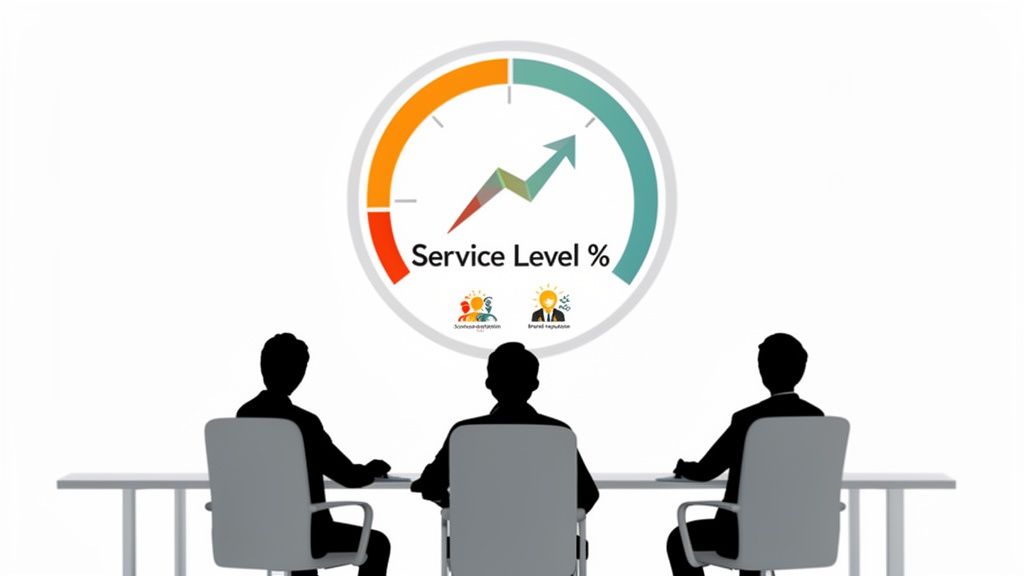
While service level might seem like just another operational dashboard metric, it’s actually a direct reflection of your organisation’s health. For VPs and CXOs, this isn't just a contact centre number; it’s a strategic tool for steering growth, profitability, and market positioning.
A poor service level isn't a minor hiccup—it’s a financial leak. When customers can't reach you quickly, they don’t always wait patiently. They hang up, and in over 60% of cases, head straight to a competitor. A recent study by a leading consultancy revealed that subpar customer service costs U.S. businesses over $75 billion annually in lost revenue, primarily due to this exact issue.
Translating Metrics to Business Outcomes
Knowing the formula is one thing. The real power for leadership comes from connecting that percentage to tangible business results. A high service level has a ripple effect across several key financial and strategic goals:
- Reduced Customer Churn: Quick, accessible service is a cornerstone of a great customer experience. A 5% improvement in customer retention can increase profitability by 25% to 95%. Hitting your service level target consistently shows customers you value their time, which directly impacts loyalty.
- Increased Lead Conversion: For any sales-focused team, every unanswered call is a lost opportunity. Consider a SaaS company that improves its service level from 70% to 85%. By ensuring more inbound leads connect with a sales rep on the first try, they can see a 10-15% uplift in qualified demos booked, directly impacting the sales pipeline.
- Enhanced Brand Reputation: In our hyper-connected world, stories of frustratingly long wait times travel fast. A strong service level, on the other hand, builds a reputation for reliability and being customer-first—a powerful differentiator that can command premium pricing and attract top talent.
Think of your service level as the pulse of your customer experience. A strong, steady pulse signifies a healthy, growing business. A weak or erratic one signals deeper problems that need executive attention.
Ultimately, getting this metric right impacts everything from operational costs to brand perception and revenue. The conversation has to evolve from, "Are we answering calls fast enough?" to, "How is our service accessibility driving profitable growth?" To have that strategic discussion, it's also helpful to understand the related BPO quality parameters that paint the full picture of service excellence. This guide will give you the framework you need.
For the specific list of measurable quality parameters most BPOs track day to day, DialNexa’s guide to quality parameters for BPO breaks each one down.
Calculating Your Service Level Formula Step by Step
While it's easy to see the big-picture importance of service level, the real power for any operations director comes from mastering the calculation itself. The good news is that the formula is quite simple, giving you a crystal-clear window into your contact centre's performance in real time.
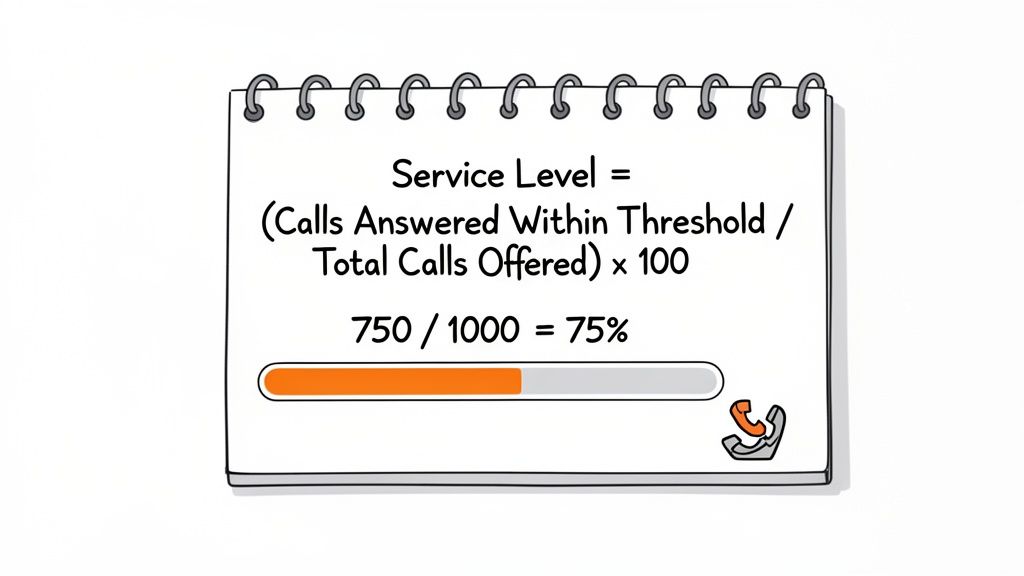
Service Level Formula: (Calls Answered Within Threshold / Total Calls Offered) x 100
At its core, this formula reveals the percentage of customer calls handled within your target timeframe. Think of it as a direct measure of your team's accessibility. Getting this right is similar to understanding how to calculate conversion rate; both metrics depend entirely on having a rock-solid definition for each part of the equation.
Breaking Down the Components
Before you can plug in any numbers, you have to be absolutely clear on what each variable means. Any fuzziness here will skew your results and can lead you to make the wrong decisions.
Let's unpack the key terms in the formula.
Service Level Formula Variables Explained
| Variable | Definition | Example (from 1000 total calls) |
|---|---|---|
| Calls Answered Within Threshold | The count of calls your agents answer before your time limit runs out. If your target is 20 seconds, any call picked up at or before the 20-second mark is included. | 750 calls |
| Total Calls Offered | Every legitimate call that enters the agent queue. This excludes short abandons (e.g., calls dropped in <5 seconds) and calls fully resolved in the IVR. | 1,000 calls |
As you can see, defining these inputs is the most critical step.
A common trip-up is how you define "Total Calls Offered." You should only count calls that were genuinely intended for an agent. Calls that are abandoned in the first few seconds (often wrong numbers) or those handled completely by your IVR system should be excluded to keep your data clean.
Setting a realistic time threshold is also a huge part of the strategy. The industry often defaults to the "80/20 rule," which means aiming to answer 80% of calls within 20 seconds. But this isn't a one-size-fits-all solution. A high-urgency financial services firm, for example, might aim for a much more aggressive 95/15 target to prevent high-value clients from dropping off.
A Practical E-commerce Example
Let's make this real. Imagine an e-commerce brand right in the middle of a massive festive sale. The support lines are ringing off the hook with customers asking about their orders.
Here’s a snapshot of their performance during one peak hour:
- Total Calls Offered: 1,000 calls hit the queue for a live agent.
- Time Threshold: The company’s internal goal is to answer calls within 20 seconds.
- Calls Answered Within Threshold: Out of those 1,000 calls, agents managed to answer 750 within the 20-second window.
Now, we just need to plug these figures into our formula:
(750 / 1,000) x 100 = 75%
The team achieved a 75% service level. This result instantly tells a story. They are 5% below their 80/20 target, meaning one in four customers waited longer than the business intended. For an operations leader, this isn't just a number; it's a signal that there's a bottleneck somewhere that needs immediate attention.
It’s a powerful, data-driven starting point for improving your processes. If you find this useful, you might also want to explore a related metric in our guide to the talk time formula.
Service Level in Action Across Key Industries
The service level formula is much more than a number on a dashboard. In the real world, it’s a powerful lever that can directly impact revenue, ensure compliance, and fuel growth. While the theory is straightforward, its true power comes from seeing how it performs in different business environments.
Let's move beyond the numbers and look at how smart organisations adapt their service level targets to achieve very specific, high-stakes goals in Banking, Real Estate, and Education Technology.
BFSI: The Compliance and Anti-Drop-Off Weapon
In the Banking, Financial Services, and Insurance (BFSI) sector, service level isn't just about keeping customers happy—it's a critical tool for compliance and revenue protection. Think about something as common as video-based Know Your Customer (KYC) verification. Every second a potential customer waits in a queue increases the odds they'll simply give up.
Imagine a leading digital bank handling 5,000 KYC verification calls every day. Their service level was initially 70/40, meaning 70% of calls were answered within 40 seconds. During this time, they were seeing a 12% drop-off rate in the middle of the verification process. Frustrated by the wait, people were abandoning the entire onboarding journey.
For a bank looking to acquire thousands of new customers, a 12% drop-off isn't a small leak; it's a gaping hole in the funnel, representing a massive loss of high-value accounts and a direct blow to growth targets. Annually, this could translate to over $10 million in lost customer lifetime value.
By reorganising agent schedules and introducing a smarter call-routing system, they pushed their service level to an ambitious 90/20. The results were immediate and striking:
- The KYC drop-off rate plummeted from 12% to a mere 3%.
- This simple change meant they retained nearly 450 additional customers each day.
- Compliance also strengthened, as more verifications were successfully completed within the timeframes mandated by regulators.
In this case, a higher service level wasn’t a cost centre. It became a direct driver of both revenue and compliance.
Real Estate: Converting Hot Leads into Site Visits
For a real estate agency, speed is everything. A prospect who fills out an online form about a property is almost certainly looking at five other listings at the same time. The first agent who makes contact and books a site visit usually wins.
Consider a large real estate firm getting around 200 high-intent leads daily. Their initial service level for callbacks was a sluggish 70/30—contacting 70% of leads within 30 minutes. This approach was only converting 8% of leads into actual site visits.
After digging into the data on lost leads, they had a revelation: the 30-minute window was far too long. They set a new, aggressive target of 80/10, aiming to connect with 80% of all incoming leads within just 10 minutes. This demanded a dedicated outbound team and better lead distribution tech, but the payoff was enormous:
- The site visit booking rate shot up from 8% to over 18%.
- This one adjustment directly contributed to a 15% increase in their total monthly bookings and a 22% quarter-over-quarter revenue growth.
By applying the service level formula to lead response time, the agency transformed it into their most effective tool for turning marketing spend into real sales opportunities.
EdTech: Driving Higher Programme Completion Rates
In the crowded EdTech market, student support is what separates the winners from the losers. When a student hits a technical glitch or gets stuck on a curriculum question, they need help—fast—to stay motivated and on track.
An online university platform spotted a clear link between their support response times and how many students actually completed their programmes. With a service level of 75/60 (75% of support tickets answered within 60 seconds), their main six-month certification programme had a completion rate of 65%.
They decided to invest in a 24/7 support model, with the goal of hitting a 90/30 service level. By making support faster and more accessible, they cut down on student frustration and helped them maintain their learning momentum. A year later, the numbers confirmed their strategy: the programme completion rate climbed from 65% to 75%—a 10-point jump that was directly tied to better, faster service and resulted in a significant increase in referral-based enrollments.
The Hidden Metrics Driving Your Service Level
Hitting your target service level isn’t a one-off action; it’s the end result of many smaller, moving parts. For any director or executive, real operational control comes from getting a handle on the underlying KPIs that feed directly into your service level formula. A low score is just a symptom. The real story lies in these hidden metrics.
It's a common mistake to see service level as just a number on a dashboard. Think of it more like the final score of a cricket match—it’s influenced by every single ball bowled and shot played. The secret is to stop obsessing over the final score and start managing the individual plays that actually determine the outcome.
The Levers That Control Your Service Level Score
So, let's pull back the curtain on the metrics that have the biggest impact on your ability to hit that all-important service level target. These are the levers you can actually pull to figure out what’s going wrong and make real improvements. For any CXO, these are the dials that truly matter.
- Average Speed of Answer (ASA): This one is the most direct culprit. ASA simply measures the average time it takes for an agent to answer a customer's call. If your ASA is creeping up to 60 seconds when your threshold is just 20 seconds, you're guaranteed to see your service level score take a nosedive.
- Abandonment Rate: This metric shows you the percentage of callers who get tired of waiting and hang up before an agent ever picks up. A high abandonment rate—often anything above 5-8%—is a glaring red flag that your wait times are too long. It drags down your service level by directly cutting the number of calls that get "answered" within your target time.
- First Call Resolution (FCR): This might seem less direct, but its impact is huge. When agents can't solve a problem on the first try, customers are forced to call back, which artificially inflates your call volume. That extra traffic puts a strain on your agents, pushes up your ASA, and ultimately sinks your service level. Just improving FCR from 70% to 80% can dramatically cut down on repeat calls, freeing up your team to answer new calls much faster.
This diagram shows how different industries set their service level standards to align with what their customers expect.
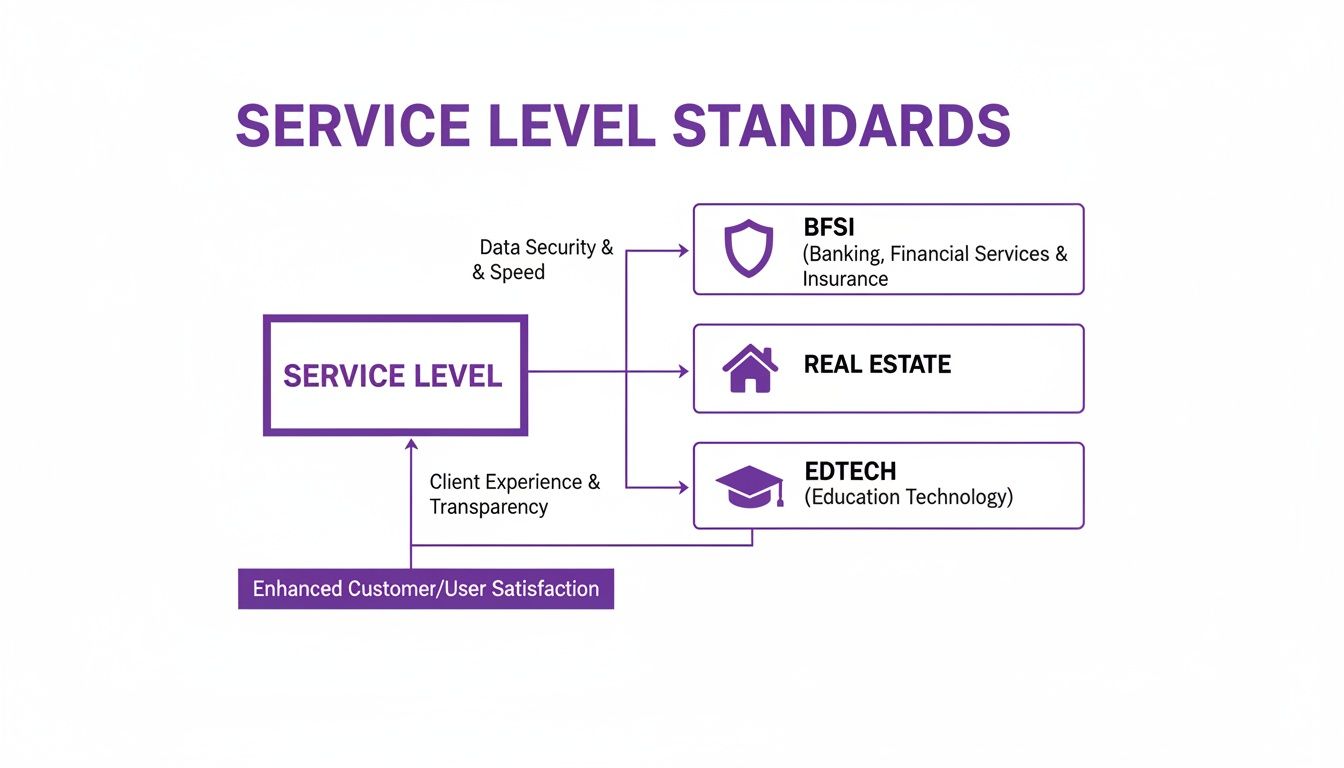
You can see that while the core formula doesn't change, the way it's used does. It can range from meeting strict compliance needs in banking to ensuring speedy lead follow-up in real estate, showing just how strategically flexible it is.
Connecting Metrics to Revenue and Cost
For a VP or CXO, drawing a straight line from these metrics to the balance sheet is crucial for justifying new resources or strategic shifts. For instance, a high abandonment rate isn't just a mark of poor customer experience; it's a direct hit to your revenue.
Let’s say your e-commerce business gets 1,000 calls a day with an average order value of ₹4,000. An 8% abandonment rate means you are losing 80 potential orders. At a 50% conversion rate for answered calls, that's 40 lost sales, or ₹1,60,000 in revenue, disappearing every single day. That small percentage adds up to a massive financial drain over the course of a year.
By keeping a close eye on these underlying metrics, you can shift from a reactive management style to a proactive one. Instead of asking, "Why was our service level so low last month?" you can start asking, "Our ASA is creeping up; what can we do to optimise agent scheduling before it damages our service level?" This kind of foresight is what separates the operationally excellent companies from everyone else.
Common Mistakes in Service Level Management to Avoid
Just tracking your service level isn't enough. The real challenge is hitting your targets without creating a mess somewhere else in the business. I’ve seen many well-meaning teams fall into common traps that turn a helpful metric into a source of stress and burnout. A poor strategy here doesn't just fall short—it can actively damage your operation.
One of the most frequent missteps is setting incredibly ambitious targets without the staff to back them up. Trying to force a team to hit a 95/10 service level when you’re understaffed is a recipe for disaster. It creates a pressure-cooker environment that leads directly to agent burnout and high turnover, which can climb by as much as 30% and send your recruitment costs soaring.
Chasing Speed Over Substance
Another classic mistake is chasing the number on the dashboard at all costs. Sure, answering every call in five seconds looks fantastic in a report. But what happens if the agent, trying to meet that target, rushes the customer off the phone with a half-baked solution?
The customer just calls back, which doubles your call volume and completely erases any efficiency you thought you’d gained. This relentless focus on speed is a surefire way to erode customer loyalty. It only takes one bad interaction to destroy years of goodwill. It's the perfect example of winning the battle (hitting the service level) but losing the war (keeping your customers).
The goal isn't just to answer calls faster; it's to resolve customer needs effectively and efficiently. A successful service level formula is balanced with a high First Call Resolution (FCR) rate, ensuring you solve problems, not just acknowledge them quickly.
Ignoring External Security and Compliance Risks
Your service level isn’t just an internal performance metric anymore. Forgetting to factor in security and compliance is a huge oversight, especially if you’re in a regulated field like finance or healthcare. The Global Cybersecurity Outlook 2026 found that 23% of public-sector organisations have weak cyber-resilience, compared to just 11% in the private sector.
On top of that, with 30% of organisations now switching vendors over geopolitical concerns, proving your service is secure is more important than ever for retention. You can dive deeper into these global security trends to understand their impact. Ultimately, a modern service framework must be both fast and secure to build a customer operation that truly stands out.
How Voice AI Transforms Your Service Level Metrics
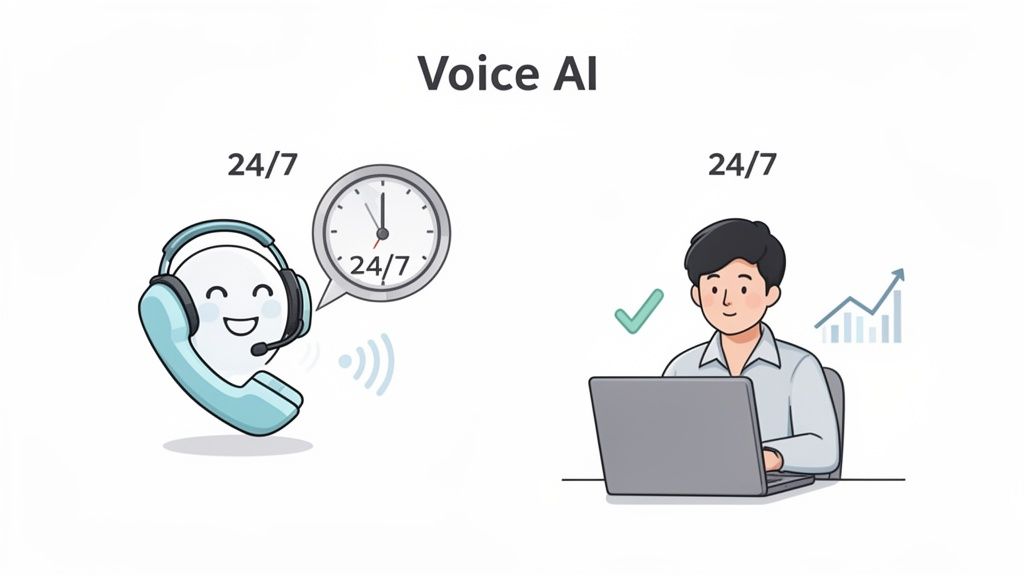
Hitting your service level targets consistently is a tough balancing act. But what if you could answer every single call the moment it comes in, pushing your service level toward 100% without overwhelming your team? This is where the service level formula meets modern technology.
Advanced Voice AI, like the conversational agents we build at DialNexa, offers a practical way to boost performance by ensuring every caller gets an immediate, helpful response, any time of day.
Think of it as a powerful assistant for your call centre team. Instead of leaving customers waiting in a queue, a Voice AI agent can field that initial wave of calls. It handles the routine stuff—like answering common questions or qualifying new leads—at a scale that’s impossible for a human-only team. This single change can have a massive, positive knock-on effect on all your key metrics.
From Good Theory to Great Results
By taking over the repetitive conversations, like KYC verifications or basic appointment scheduling, Voice AI gives your skilled human agents the breathing room they need. They can finally focus their expertise on the complex, high-value interactions that truly require a human touch. The result is a more efficient, smarter operation that you can see reflected in your bottom line.
Just look at the numbers some of our customers have seen after bringing Voice AI on board:
- Connect rates soared from an average of 47% to an impressive 91%.
- Lead-to-booking rates quadrupled, climbing from 2% to 8%.
These aren't just vanity metrics; they represent real revenue and a tangible return on your investment. The technology proves its worth by turning more conversations into successful outcomes. You can discover how to automate call center operations and see more of these benefits in action.
At its core, DialNexa's Voice AI isn't just about speed. It’s about intelligence—making sure the right conversations happen with the right resource, turning a simple performance metric into a reliable engine for business growth.
Frequently Asked Questions About Service Level
When leaders start digging into the service level formula, a few practical questions always pop up. Getting these answers right is the first step toward building a strategy that actually works for your customers and your budget. Here’s our take on the most common queries.
What Is a Good Service Level Target to Aim For?
Everyone knows the classic 80/20 rule—answering 80% of calls within 20 seconds. It’s a solid starting point, but it's definitely not one-size-fits-all. The 'right' target really depends on your industry and what your customers expect.
For a high-stakes trading platform where every second costs money, a 90/15 target might be non-negotiable. But for a team handling less urgent administrative queries, a 70/30 goal could be far more cost-effective. The best move? Analyse your own call data and customer feedback to find that sweet spot between amazing service and operational reality.
How Does Service Level Differ from a Service Level Agreement?
It's a simple but important distinction. Think of it this way: your service level is an internal performance goal, while a Service Level Agreement (SLA) is an external, contractual promise you make to a client.
- Service Level: An internal metric you use to manage your team’s performance day-to-day.
- Service Level Agreement (SLA): A formal commitment to a client that guarantees specific performance levels and outlines penalties if you don't meet them.
Basically, your internal service level is the speedometer in your car; the SLA is the speed limit you've promised authorities you won't break.
Can We Improve Service Level Without Hiring More Agents?
Absolutely. In fact, hiring more people should be your last resort, not your first move. Before you start drafting job descriptions, look at optimising your existing team's schedules to better match your peak call times. You should also refine your call routing to boost First Call Resolution (FCR), which cuts down on repeat calls and frees up agent capacity almost instantly.
The most impactful step is to use technology like Voice AI. To fully harness the power of Voice AI in transforming your service level metrics, it's essential to understand the underlying infrastructure of a robust Voice over IP phone system. This technology automates routine inquiries, instantly increasing your capacity to answer calls quickly, allowing your current team to focus on complex issues and drive significant service level improvements without increasing headcount.
Ready to see how human-like Voice AI can push your service level towards 100%? At DialNexa, we help you build, train, and deploy custom AI agents that transform customer engagement. Explore how our platform can deliver better outcomes at https://dialnexa.com.

[…] to show how staffing logic, routing, and automation will improve answer performance against a clear service level calculation for inbound teams, not just promise better […]
[…] For a deeper dive into how service levels are calculated in this new environment, check out our guide on the service level formula. […]