
Talk Time Formula: A Strategic Guide for VPs and Directors to Boost CX Efficiency & Revenue
On the surface, the talk time formula is simple arithmetic: divide your total talk time by the total number of calls. But for anyone in a leadership role, from VPs to Directors and CXOs, it's so much more than that. When you look closer, this metric is a powerful diagnostic tool for driving strategic growth, elevating the customer experience, and ultimately, scaling revenue.
Why the Talk Time Formula Is a Powerful Growth Metric
If you're in a senior position, you know that operational metrics are only useful if they tie back to clear business outcomes. Talk time is often misunderstood and seen purely as a cost-cutting KPI. The real value, however, comes from seeing it as a measure of conversational effectiveness. The strategic aim isn't to hurry customers off the phone; it's to solve their problems more efficiently, which builds loyalty and fuels measurable growth.
This change in perspective is vital. When your teams can resolve issues quickly and accurately, it’s a strong signal that your processes, agent training, and technology are all working together seamlessly. For a VP of Operations, this means higher asset utilization and lower cost-per-interaction. For a Director of Customer Experience, it translates to less customer frustration and more opportunities for positive, brand-defining interactions.
From Cost Centre to Growth Driver
When you start thinking of talk time as a strategic metric, its entire purpose shifts. A shorter, more effective conversation in real estate lead qualification means your agents connect with more high-intent buyers each day, directly boosting the sales pipeline. For a fintech company, a clear and concise support call that resolves an issue in under four minutes builds the kind of trust that reduces customer churn by a measurable percentage. For instance, a 5% reduction in churn can increase profitability by 25% to 95%.
This single metric gives you a direct window into your team’s performance and the clarity of your communication. It helps you pinpoint inefficiencies with surprising precision. For instance, are agents spending 60% of their talk time on basic, repetitive questions? This is a data point that screams for process automation or an improved IVR, not just agent coaching.
For VPs and CXOs, mastering the talk time formula means transforming a traditional contact centre KPI into a strategic asset. It’s about creating a highly efficient, scalable engine for customer interaction that directly supports revenue goals and enhances brand reputation.
Technology has a massive role to play here. In India’s fast-growing contact centre market, for example, the call centre AI sector was valued at USD 103.8 million in 2024 and is projected to explode to USD 452.5 million by 2030. This growth, detailed in a report by Grand View Research, shows how AI-driven optimisation is helping key sectors like EdTech and BFSI scale. In some cases, human-like AI agents have boosted connect rates from 47% to an incredible 91%.
Here is a quick look at how a strategic approach, enhanced by AI, can dramatically shift business outcomes. This table is perfect for showing senior leadership the tangible value of optimising talk time.
Impact of Strategic Talk Time Optimisation
| Metric | Before Optimization (Traditional) | After Optimization (AI-Enhanced) |
|---|---|---|
| Agent Focus | Handles all calls (high & low value) | Handles complex, high-value calls |
| Customer Experience | Inconsistent, long wait times | Fast, standardised, 24/7 support |
| Operational Cost | High, scales with agent headcount | Lower, scales efficiently with tech |
| Revenue Impact | Limited to agent capacity | Unlocks new revenue opportunities |
The data speaks for itself. Optimisation isn’t just about trimming seconds; it’s about fundamentally changing how your contact centre operates and contributes to the bottom line.
By introducing Voice AI, you can automate routine conversations, freeing up your human agents to manage the complex, high-value interactions that really matter. This not only improves talk time across the board but also empowers your team to focus on activities that deliver significant business results. When used correctly, a deep understanding of how to use Voice AI analytics can unlock new revenue enablement opportunities right from within your contact centre.
How to Calculate and Apply the Talk Time Formula
Alright, let's get practical. Moving from big-picture strategy to on-the-ground execution means getting comfortable with key performance indicators. For any Director or VP overseeing a sales or support function, the talk time formula is your starting point for diagnosing conversational efficiency. It gives you a clean, simple baseline for quantifying what’s working and what isn’t.
The formula itself couldn't be simpler. It's designed to zero in on the time your team is actively talking to customers or leads, and nothing else.
Average Talk Time = Total Talk Time (in minutes) / Total Number of Calls
This equation cuts through the noise. It ignores peripheral activities like hold time or after-call work, giving you a pure measure of the conversation's duration. This is how you start turning vague performance goals into solid data that informs strategic decisions.
A Practical Example in Real Estate
Let's see how this plays out for a Director of Sales at a real estate firm. Your presales team’s primary objective is to qualify new inbound leads. In one week, their call log shows they made 1,000 calls. Digging into your call analytics, you see the total time they spent in active conversation with potential buyers was 5,000 minutes.
Now, we just plug those numbers into our formula:
- Total Talk Time: 5,000 minutes
- Total Number of Calls: 1,000 calls
- Calculation: 5,000 minutes / 1,000 calls = 5 minutes
Your team's average talk time is 5 minutes per call. This number is your new benchmark. From a leadership perspective, the real questions begin. Is 5 minutes too long for a qualification call, indicating an inefficient script? Or is it too short, suggesting agents aren't building enough rapport to secure a site visit? For example, if your data shows that calls over 6 minutes have a 15% higher conversion rate, a 5-minute average is a problem to be solved. This is where analysis truly starts.
Spreadsheet-Ready Formulas for Your Team
You can make this incredibly easy for your team leads to track. Give them a simple, ready-to-use formula for their spreadsheets. This turns data tracking into a simple daily habit, not a huge project.
In a Google Sheet or Excel file, if 'Total Talk Time' is in Column A and 'Total Calls' is in Column B, the formula is just:
=SUM(A2:A100)/SUM(B2:B100)
With this, managers can quickly calculate the average talk time for a specific campaign or a group of agents by dropping in the raw data. Of course, this only works if you're capturing that data accurately in the first place. You can learn more about getting this right by reading our guide on what is call logging and why it matters.
Distinguishing Talk Time from Average Handle Time (AHT)
This is a critical point that can lead to flawed strategic conclusions if misunderstood. Talk time is not the same as Average Handle Time (AHT).
- Talk Time: This is purely the time spent in conversation between the agent and the customer. That's it.
- Average Handle Time (AHT): This is the holistic metric. It includes the talk time, any time the customer was on hold, and all the after-call work (ACW) the agent does to wrap up.
A high AHT of 12 minutes might seem alarming. However, if the talk time is only 5 minutes, the problem isn't the conversation. The issue lies in the remaining 7 minutes, which could be due to slow systems (long ACW) or understaffing (long hold times). By analysing the talk time formula separately, a VP can correctly diagnose whether the issue requires agent training or a technology infrastructure review.
Talk time and AHT also sit alongside the service-level targets your contact centre is contractually held to. If you outsource, those targets are defined in a Service Level Agreement – see our explainer on what SLA means in BPO for how the 80/20 benchmark, FCR, and AHT fit together in a single performance framework.
Benchmarking Your Talk Time Across Industries
As a leader, you know that raw numbers only tell part of the story. The real insights come when you place those numbers in a competitive context. Calculating your average talk time is a great first step, but the crucial question for any CXO is: "How does our performance compare to the industry standard?"
What "good" looks like depends entirely on your industry and the call's intent. A five-minute average talk time might be fantastic for an e-commerce agent confirming an order. But for a financial advisor explaining a complex investment product, that same five minutes would be a sign of dangerously superficial service. Without the right context, your talk time metric is just a number floating in space.
What Is a Good Talk Time in India?
Every sector has its own unique rhythm of customer interaction, which directly shapes what a healthy talk time should be. A conversation about course specifics in EdTech will naturally take more time than a real estate agent booking a quick site visit. The complexity of your product or service is the single biggest factor.
Your goal as a leader shouldn't be to chase some generic, one-size-fits-all number. It’s about understanding the benchmark for your specific industry and using it as a starting point to spot inefficiencies and find smart ways to optimise.
Before you can compare, you need to be sure you're calculating your average correctly. It's a straightforward formula, as this visual breaks down.
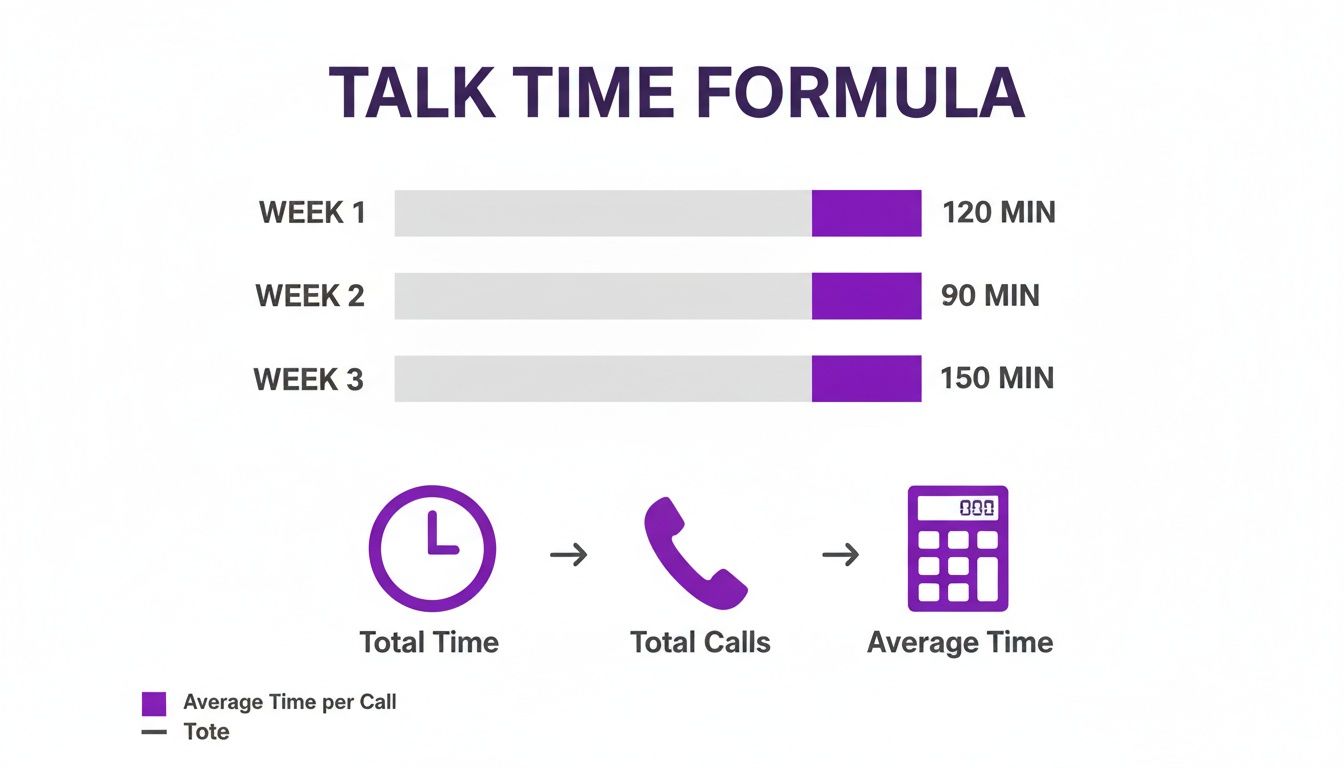
Getting this fundamental calculation right is the foundation for any meaningful analysis or benchmarking exercise that follows.
Of course, technology is now completely changing what's possible. According to the "State of CX India 2025" report, which surveyed 400 Indian companies, leaders are increasingly turning to tech to deliver better, faster service. Take Bajaj General Insurance, for example. They now use an AI bot to handle 40% of all their contact centre conversations. This bot autonomously processes 76% of cashless claims, slashing talk time on these routine queries by over 30%. You can learn more about how Indian companies are driving exceptional CX in the full report.
Industry Talk Time Benchmarks and Performance Metrics (India)
So, where does your operation stand? The following table provides a comparative look at average talk time and related efficiency metrics across key Indian sectors. Use this to gauge your own performance and identify strategic opportunities for optimisation.
| Industry | Typical Average Talk Time (Human Agent) | AI-Optimised Talk Time (Routine Tasks) | Benchmark Agent Occupancy |
|---|---|---|---|
| EdTech | 6-8 minutes | 2-3 minutes | 75-85% |
| Real Estate | 4-6 minutes | 1-2 minutes | 70-80% |
| BFSI | 7-10 minutes | 2-4 minutes | 80-90% |
| E-commerce | 3-5 minutes | 1-2 minutes | 75-85% |
The data paints a very clear picture for strategic planning. AI is incredibly effective at managing high-volume, low-complexity tasks, such as initial lead qualification or order status checks, bringing down talk times dramatically. This frees up your human agents—your most expensive resource—to focus their expertise on more complex, high-value conversations where they can truly impact revenue and customer loyalty.
Occupancy benchmarks like these only hold if you have already netted out non-productive time using the BPO shrinkage formula, since a schedule that ignores shrinkage will always look busier on paper than it performs on the floor.
Actionable Levers to Optimise Your Talk Time
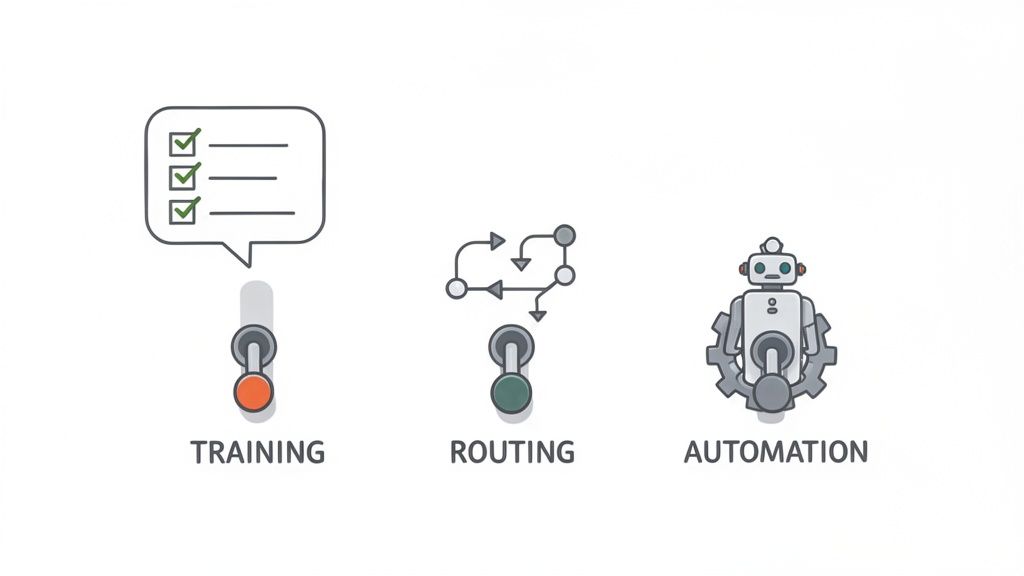
Understanding your talk time metrics is one thing, but for senior leaders, the real value comes from taking decisive action. To truly improve performance, you need to pull the right strategic levers. This means getting past simply monitoring the talk time formula and starting to actively implement changes that make conversations more efficient and boost your business outcomes.
A blind mandate to "cut talk time" is a short-sighted game that often backfires. Real optimisation comes from making every minute of every conversation more valuable. This requires a balanced approach that fine-tunes your people, processes, and technology all at once, ensuring that any efficiency gains don't come at the expense of customer satisfaction.
Agent Training and Script Optimisation
Your agents are the heart of your contact centre. Their effectiveness is directly linked to the quality of their training and the tools you give them. If scripts are vague or agents lack deep product knowledge, they’re forced to put customers on hold while they scramble for answers. This just needlessly inflates talk time.
A practical example: A financial services company noticed talk time for a new investment product was 35% higher than average. Analysis revealed agents were consistently unsure about tax implications. The fix was not to rush them, but to provide targeted training. The result: talk time dropped by 20% and First Call Resolution (FCR) increased by 15%. This is the kind of ROI VPs should look for.
Intelligent Call Routing
One of the surest ways to drive up talk time is a messy first point of contact. When a customer gets bounced between departments or agents who can't help, frustration skyrockets and the conversation drags on. Every single transfer adds minutes and chips away at customer trust.
Intelligent call routing is the antidote. By using technology to get customers to the right agent—or even an automated system—from the very beginning, you eliminate those wasteful transfers. You can learn more about how an advanced IVR system improves your contact centre by making sure every call starts on the most efficient path possible.
For a CXO, the goal isn't just shorter calls; it's smarter calls. By routing routine queries (e.g., "What's my account balance?") to automated systems and complex issues (e.g., "I suspect fraudulent activity") to specialised agents, you align your most valuable resources—your people—with the interactions that require a human touch.
The Strategic Power of Voice AI
For a modern contact centre, the most powerful lever you can pull is the strategic use of Voice AI. By deploying human-like AI agents, you can automate huge chunks of your call volume, especially at the top of the funnel. These AI agents are perfect for handling initial lead qualification, answering common questions, and booking appointments with flawless consistency.
This takes a massive load off your human team. Just imagine an AI agent handling 10,000 initial outreach calls per week, filtering out the 95% of unqualified leads, and passing only the 500 high-intent prospects to your sales team. This is how you don't just reduce talk time—you make the remaining human talk time exponentially more valuable.
For DialNexa's EdTech and D2C clients, this combination of optimised routing and AI-powered follow-ups has lifted connect rates to a staggering 91%. It also increased their lead-to-booking conversions from 2% to 8%. This impact is even bigger in the outsourcing sector, where AI helps manage thousands of daily calls with standardised messaging, bringing down operational costs in a big way.
How Voice AI Reduces and Standardises Talk Time
While it’s easy to get fixated on the talk time formula, experienced leaders know the real objective isn’t just to talk less—it's to talk better. The secret to a scalable, high-quality customer experience is consistency, and this is where Voice AI moves from a simple metric-booster to a core component of your operational strategy.
Imagine if every new lead was pitched with your best-performing script, or every customer received the exact same clear guidance for a common issue, 24/7. That’s what Voice AI brings to the table. It removes the human variability that leads to inconsistent service and wildly different talk times. A well-trained, human-like AI agent can follow the ideal call flow with near-perfect adherence.
For instance, an AI guiding a customer through a complex financial KYC process or handling a real estate discovery call can stick to the approved script with 97% accuracy. This level of precision means every conversation is compliant, on-brand, and laser-focused on its goal, without the detours or omissions that extend human calls.
The Power of Predictable Performance
Think about what this kind of standardisation means for a VP of Sales. It means every single lead at the top of the funnel is qualified with the exact same questions and messaging you've already proven to be effective. No more off-days, no forgotten discovery questions, and no rushed calls that miss crucial details. The direct result is a much more predictable pipeline filled with genuinely qualified leads, improving forecast accuracy.
It's a similar story for a Director of Support. When AI handles common queries like "Where is my order?" or "How do I reset my password?", you can be certain that customers are getting the right information, every time. This drastically cuts down on frustrating repeat calls and escalations that happen when different agents give slightly different answers. The talk time for these interactions not only gets shorter but also becomes incredibly consistent.
The real power of Voice AI is its ability to set a new, higher standard for your everyday interactions. It creates a reliable and efficient foundation, freeing up your human experts to use their skills where they count the most: on complex, high-value conversations that drive revenue and loyalty.
This operational discipline makes a huge difference, particularly in heavily regulated or process-heavy industries. It’s why there’s growing use of voice AI in healthcare, where it can automate conversations and documentation with pinpoint accuracy. By standardising processes like patient intake or appointment scheduling, AI cuts down on administrative work and talk time by up to 40%, letting clinical staff concentrate on patient care.
Elevating Your Human Team
By letting AI handle the repetitive, high-volume conversations, you aren't replacing your team—you're upgrading their role. When the predictable work is automated, your human agents can focus their energy on solving tricky problems, building real customer relationships, and handling escalations with the empathy and creative thinking that only a person can provide.
This smart division of labor makes your team's own talk time far more valuable. Instead of spending their days on monotonous qualification calls, they’re having conversations that directly grow revenue, build loyalty, and demand sophisticated human judgement. In the end, Voice AI helps you improve your entire communication ecosystem, not just one isolated metric.
Common Mistakes to Avoid in Talk Time Analysis
Talk time is a powerful metric, but it's also one of the most easily mishandled. For VPs and Directors, interpreting this data correctly is crucial for sound strategic decision-making. If you're not careful, misinterpreting the data can lead to directives that damage both customer trust and your bottom line.
The most dangerous trap is chasing talk time reduction at all costs. When you pressure agents to just "be faster," quality is almost always the first casualty. An agent might rush through a complex financial query to hit their target, but they leave the customer confused and anxious. The result? A 5% drop in talk time might look great on a dashboard, but not when it causes a 10% nosedive in your Customer Satisfaction (CSAT) score and a spike in follow-up calls that erodes any initial cost savings.
Ignoring Crucial Context
Another all-too-common error is looking at a single, blended talk time number without its context. A ten-minute conversation with a new real estate client exploring property options is time well spent building rapport. A ten-minute call just to confirm a site visit? That's a huge red flag for inefficiency. Without segmenting your calls by their purpose—sales, technical support, simple enquiries—your average talk time is a vanity metric.
A single, blended talk time average for your entire operation is practically useless for strategic decisions. True insight comes from comparing apples to apples: segmenting by team, agent, and call intent to uncover specific coaching opportunities and process bottlenecks.
When you fail to segment your data, you can't see who's really performing well and who's struggling. Your best sales agents might have longer talk times because they’re fantastic at building rapport and closing deals. Lumping their numbers in with simple support queries completely hides their value and might even flag them as "inefficient."
Visualising Data for Better Decisions
When reporting to executives, never present talk time in a vacuum. The real story emerges when you visualise it alongside crucial outcome metrics like First Call Resolution (FCR) and CSAT. A dashboard showing talk time decreasing while FCR and CSAT are increasing tells a powerful story of successful optimisation. This complete picture ensures you're not accidentally sacrificing quality for the sake of speed.
Ultimately, great analysis isn't about the numbers themselves, but about asking the right questions. Moreover, learning how to write transcripts that create actionable outcomes is a game-changer. It helps you dig into the why behind the numbers, turning raw data into a clear roadmap for real improvement.
Common Questions About the Talk Time Formula
If you're leading a team, you need straightforward answers, not just data. Let's tackle some of the most common questions we hear from VPs and Directors about using the talk time formula to get real results.
What’s the Difference Between Talk Time and Average Handle Time (AHT)?
This is a critical distinction for any leader. Think of it this way: talk time diagnoses the conversation, while Average Handle Time (AHT) diagnoses the entire process.
- Talk Time: Purely the time an agent and a customer spend speaking to each other.
- Average Handle Time (AHT): The total time an agent is occupied with an interaction. The formula is:
(Total Talk Time + Total Hold Time + After-Call Work) / Total Number of Calls
For a Director, if AHT is high but talk time is low, the problem isn’t your agents' conversational skills; it’s your operational efficiency—slow systems or poor staffing.
Can a Really Low Talk Time Be a Bad Thing?
Absolutely. An unusually low talk time is often a major red flag for a CXO. It can mean agents are rushing, not actively listening, and pushing customers off the phone before their issue is truly solved.
This just leads to frustrated customers and, more often than not, an increase in repeat calls, driving up overall interaction costs. For example, a 1-minute drop in talk time that causes a 5% increase in repeat calls is a net loss for the business.
That's why you should never look at talk time in a vacuum. Always analyse it alongside your quality metrics, like Customer Satisfaction (CSAT) and First Call Resolution (FCR).
How Can We Reduce Talk Time Without Hurting Service Quality?
The strategic goal isn't just to be faster; it's to be smarter. The best way to achieve this is by automating simple, repetitive tasks that clog up your agents' day. Think about things like booking standard appointments, answering basic FAQs, or processing simple payments.
Using Voice AI to handle these routine queries frees up your human agents to focus on complex, high-value conversations where their expertise really matters. A good, realistic goal to start with is aiming for a 15-20% talk time reduction on the specific call types you choose to automate, while closely monitoring CSAT to ensure a positive customer experience.
Ready to turn your conversations into conversions? DialNexa provides human-like Voice AI agents that standardise and scale your customer interactions. Explore how our platform can reduce operational costs and accelerate lead evaluation for your team.
Visit us to learn more: https://dialnexa.com

[…] consistency. Review whether talk, hold, and wrap-up are defined the same way inside your talk time reporting model, across queues and channels. That discipline is what turns AHT from a dashboard average into a […]