
Inbound Call Center Software: 2026 CXO Strategy Guide
Poor inbound call handling is not a service issue. It is a growth issue.
If your contact centre treats inbound calls as a queue management problem, you are underinvesting in one of the highest-intent moments in the customer journey. Every incoming call carries one of three things: a service cost, a conversion opportunity, or a retention risk. Good inbound call center software decides which one it becomes.
In the Indian market, that decision is getting harder. Language diversity, compliance pressure, peak-hour congestion, and rising customer expectations have made legacy call routing and menu-heavy IVRs inadequate. Boards should stop asking whether they need better telephony. They should ask whether their current stack can route, resolve, document, and scale conversations precisely.
The standard for evaluation has changed. A platform now needs to improve agent utilisation, preserve compliance, support multilingual demand, and create measurable movement in conversion and resolution. If it cannot do all four, it is not strategic infrastructure. It is a bottleneck.
Transforming Customer Conversations into Strategic Assets
Most leadership teams budget for inbound operations as if they are paying to answer questions. That is the wrong frame.
Inbound call center software is the operating system for revenue-adjacent conversations. It governs how quickly a prospect reaches the right counsellor, how safely a BFSI query is handled, and how consistently a support interaction protects retention. In sectors such as EdTech, real estate, healthcare, e-commerce, and BFSI, the platform is no longer back-office tooling. It is customer-facing infrastructure.
Why the legacy model fails
Traditional inbound setups break in predictable ways:
- Queues replace judgement: Calls are sent to whoever is free, not whoever is best equipped to resolve the issue.
- Agents work blind: Without integrated customer context, teams repeat verification, miss buying signals, and extend call duration.
- Scale creates inconsistency: As volume rises, service quality depends too heavily on agent memory and supervisor intervention.
- Leadership sees lagging signals: Reports arrive after the damage. By then, abandonment and missed conversions have already happened.
That model creates hidden cost. It also creates brand risk.
What modern software changes
Modern inbound call center software centralises call intake, routing, context, monitoring, and reporting. For a CXO, the practical shift is simple. You move from reactive call answering to controlled conversation management.
A strong platform should let you do five things well:
- Classify intent early
- Route by skill, urgency, or language
- Surface customer history at the moment of contact
- Monitor quality in real time
- Measure outcomes at queue, agent, and business-unit level
Boards should treat inbound capability the way they treat payments, CRM, or core ERP. If it fails, the commercial and operational impact is immediate.
The companies winning here are not only adding channels. They are redesigning how inbound demand gets processed. That is why the software decision matters. You are not buying call handling. You are buying control over speed, compliance, utilisation, and revenue capture.
Deconstructing Inbound Call Centre Software Core Features
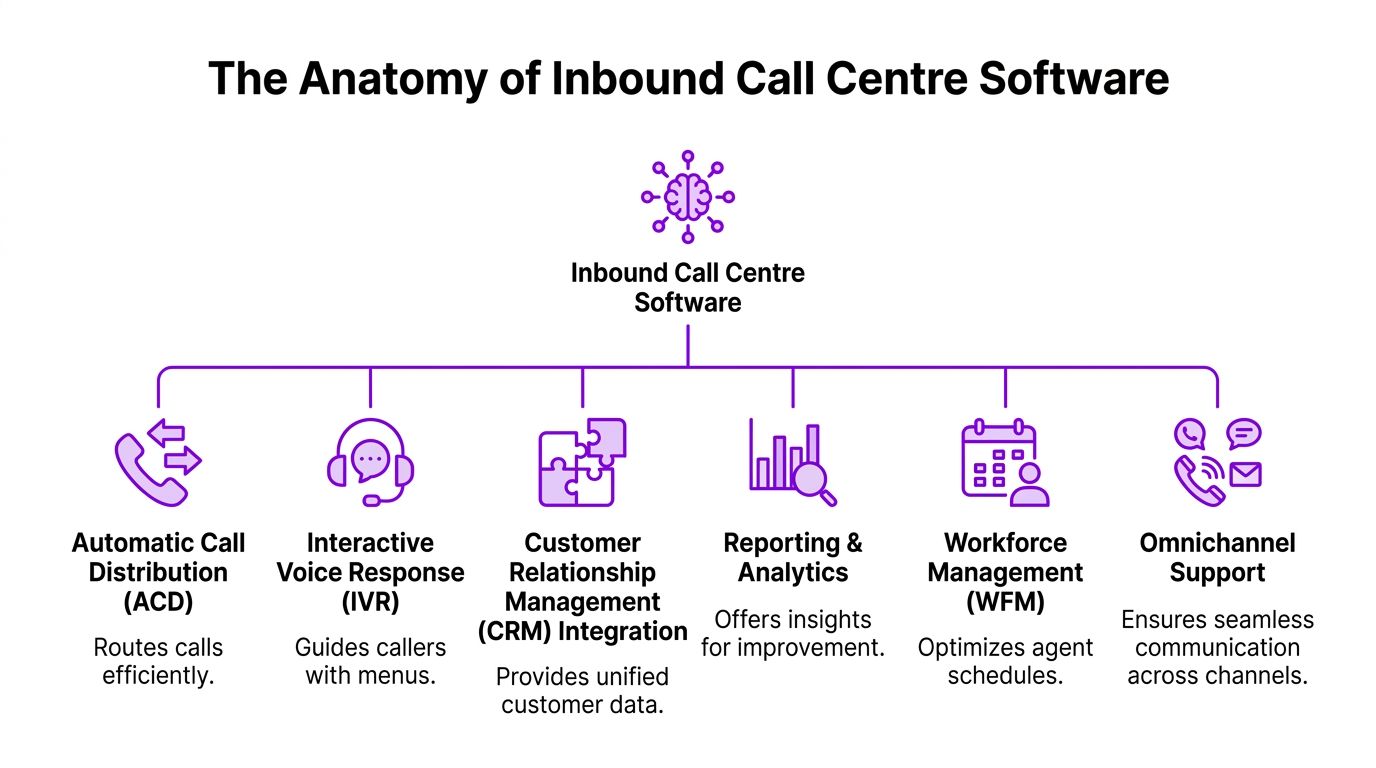
Inbound call center software is the operating system for customer demand. It controls who gets through, where each interaction goes, what context the agent sees, and how fast leadership can correct failure. In the Indian market, that baseline is no longer enough. The standard is shifting from rules-based call handling to AI-powered conversational platforms that classify intent earlier, automate simpler journeys, and escalate higher-value conversations with full context.
That shift changes how boards should evaluate features. Do not ask whether the platform has a long checklist. Ask whether it improves routing precision, lowers avoidable agent workload, and creates more revenue from inbound intent. DialNexa sets the right benchmark here. It reflects what leading Indian businesses now expect from modern inbound infrastructure, not from legacy telephony with a cloud wrapper.
ACD still matters, but intelligence now matters more
Automatic Call Distribution (ACD) remains the control point for inbound operations. It decides who receives the call, in what order, and under which priority logic.
That matters because poor routing drives cost in three places at once. Handle time rises. Transfers increase. Conversion drops when high-intent callers wait too long or reach the wrong team.
Traditional ACD relies on fixed rules such as round-robin, least-occupied, or static skill groups. That is useful but limited. Better platforms combine routing rules with live signals such as caller history, intent captured at entry, language preference, open case status, and predicted conversion value. That marks the progression from inbound call center software to conversational AI infrastructure. The system should not only distribute traffic. It should decide which conversations deserve the fastest path to human expertise and which can be resolved safely through automation.
In regulated Indian sectors such as BFSI, insurance, and healthcare, that distinction matters operationally and commercially. High-risk or high-value interactions should move straight to trained agents. Routine balance checks, appointment confirmations, and policy status requests should not consume premium agent time.
IVR should qualify demand in seconds
Interactive Voice Response, or IVR, should reduce decision time at the top of the funnel.
Legacy IVRs fail because they are built as menu trees. Customers press keys, repeat themselves, and still end up in the wrong queue. That design increases abandonment and trains callers to distrust the channel.
The better model is conversational intake. The system captures the reason for contact, identifies urgency, confirms language, and passes that information into routing or automation. If the query is simple, an AI voice agent can complete it. If it is complex, the caller reaches a human with the relevant context already attached.
That is a better operating model. It cuts wasted talk time before resolution starts.
CRM integration turns each call into a revenue and retention event
An agent without customer context is not only slower. That agent is more expensive and less likely to protect or grow account value.
Inbound call center software should pull CRM data into the live interaction window at the moment of answer. The agent should see prior conversations, account tier, open tickets, recent purchases, policy or loan status, and any active risk or upsell flags. That shortens verification, reduces repetition, and changes the quality of the conversation.
For leadership, the strategic value is straightforward:
- Service teams resolve issues with less repeat effort.
- Sales teams identify purchase intent while the customer is already engaged.
- Retention teams see churn signals early enough to intervene.
- Compliance teams reduce errors caused by fragmented systems.
Here, AI-powered platforms start to outperform traditional stacks by a wide margin. They do not only display data. They can summarise prior interactions, recommend next-best actions, and guide the agent toward the outcome with the highest business value.
Live oversight matters more than retrospective reporting
Monthly reporting is governance theatre. Inbound operations need live control.
Leaders should expect real-time visibility into queue buildup, abandonment risk, transfer patterns, service-level breaches, agent occupancy, and unresolved call reasons. Supervisors also need immediate intervention tools such as monitoring, whisper, and barge when quality, compliance, or conversion value is at risk.
A useful platform reports what happened and helps management intervene while the outcome can still change. That is the difference between operating a contact centre and managing a revenue and risk engine.
Workforce tools and omnichannel support come after flow control
Vendors win meetings with feature volume. Ignore that.
Callbacks, workforce management, WhatsApp integration, QA scorecards, and omnichannel dashboards all have value. They do not fix weak routing, poor context flow, or ineffective intake. If the platform cannot classify demand well, route it intelligently, and present the right customer history instantly, the rest of the stack becomes expensive decoration.
Board-level buyers should rank core capabilities in this order. First, intent capture. Second, routing logic. Third, context delivery. Fourth, live oversight. Fifth, automation through AI voice and agent assist.
Buy for decision quality at the point of contact. That is what lowers cost and lifts conversion.
The Business Case Measurable Gains in Cost and Conversions
A board should treat inbound call centre software as a margin decision.
The right platform cuts avoidable demand, raises conversion from high-intent enquiries, and gives management tighter control over labour cost. The wrong one turns inbound volume into an expensive sorting exercise. That distinction matters even more in India, where rising customer acquisition costs and uneven service quality punish every missed call, transfer, and repeat interaction.
The strategic shift is clear. Traditional inbound software helped teams queue and distribute calls. AI-powered conversational platforms do more. They identify intent earlier, automate routine conversations, support agents in live calls, and move qualified demand to the right specialist faster. That is the benchmark now. DialNexa’s performance in the Indian market shows what buyers should expect from a modern platform, not what they should admire as an exception.
Cost reduction comes from demand control
Labour remains the largest operating cost in inbound service. Boards know that. The larger opportunity is cutting the volume of work that should never reach a human agent in the first place.
Poor call handling creates hidden cost in three places. Customers call back because the first interaction failed. Agents spend time collecting information the business already has. Supervisors react after service levels have already slipped. AI-first inbound platforms address all three. They capture intent at the start of the interaction, complete basic verification and triage automatically, and route only the conversations that need skilled human judgment.
That changes the unit economics. Fewer low-value calls reach agents. Skilled staff spend more time on exceptions, revenue opportunities, and regulated interactions. Managers gain a cleaner operation with lower repeat demand and less wasted occupancy.
Service level discipline also matters because queue delays create direct revenue leakage. Boards should expect vendors to show how staffing logic, routing, and automation will improve answer performance against a clear service level calculation for inbound teams, not just promise better dashboards.
Conversion gains come from faster qualification
Inbound conversion is won before the agent speaks. If the system identifies intent correctly, confirms context, and sends the caller to someone equipped to close, conversion rises. If it misclassifies the enquiry or forces the customer through a generic queue, revenue drops.
This separates the market. Legacy platforms still focus on queue management. AI conversational platforms focus on qualification quality. That matters in sectors where one call can represent substantial revenue.
In education, the platform should identify course interest, budget range, geography, and urgency before handoff. In real estate, it should distinguish a browsing enquiry from a booking-ready buyer. In BFSI, it should separate service from sales and direct regulated queries to certified staff without delay.
DialNexa’s benchmark is useful here because it reflects Indian operating conditions, not imported assumptions from US or European contact centres. Buyers should expect AI voice workflows to reduce friction at the top of the funnel and increase the share of calls that reach a revenue-capable team in a ready state.
Call quality affects revenue, not just operations
Voice quality has a commercial impact. Poor audio increases repetition, lengthens calls, lowers customer confidence, and weakens close rates. That is not an infrastructure footnote. It is conversion drag.
One reason AI platforms outperform older inbound stacks is this. They are designed as end-to-end conversation systems, not only routing layers. The business benefit is simple. Clearer conversations produce cleaner intent capture, better compliance handling, and fewer dropped opportunities.
What boards should demand from vendors
Procurement should force a business case, not a feature tour.
Ask every vendor to quantify five outcomes:
- Reduction in repeat contacts and transfer volume
- Increase in qualified calls reaching the right team first time
- Improvement in service level and abandonment control
- Deflection of low-value or repetitive demand through automation
- Commercial uplift from faster handling of high-intent enquiries
If a vendor cannot connect its platform to those outcomes, exclude it. Inbound technology should now be judged against the standard set by AI-powered conversational platforms. In the Indian market, that means faster qualification, lower cost per resolved conversation, and better conversion from every serious enquiry.
Key Performance Indicators That Drive Business Outcomes
Executive reviews of contact centre performance are often too soft. They drift into anecdotes about difficult customers, staffing pressure, or “high volumes”. None of that helps a board make decisions.
You need a small set of KPIs that diagnose whether the operation is resolving demand efficiently, protecting brand trust, and creating commercial upside.
Read KPIs as operating signals
Each KPI tells you something different.
First Call Resolution points to process design and routing quality. If customers must call back, the operation is either misrouting, undertraining, or failing to give agents enough context.
Average Handle Time can indicate efficiency, but leaders should use it carefully. A lower number is not necessarily better. If you force short calls by rushing agents, you often create repeat volume later.
Abandonment Rate is one of the clearest warning signs in inbound operations. Customers do not abandon because they enjoy self-service. They abandon because queues, routing, or expectations are broken.
CSAT and NPS matter, but they are lagging indicators. They reflect what your operation has already done. They are useful for governance, not for minute-to-minute control.
Essential Inbound Call Centre KPIs for CXOs
| KPI | What It Measures | Why It Matters to a CXO | Industry Benchmark |
|---|---|---|---|
| First Call Resolution | Whether the customer issue is resolved in the first interaction | Lower repeat demand, better customer experience, stronger operational efficiency | Significant improvement in FCR seen with skill-based ACD in Indian deployments using IVR pre-qualification data flows |
| Average Handle Time | The total time agents spend handling each call | Signals process complexity, agent readiness, and whether workflows are efficient | No universal benchmark cited here. Track by queue and intent type |
| Call Abandonment Rate | The share of callers who disconnect before being served | Direct indicator of lost opportunities and customer frustration | Significant abandonment can occur in escalation-heavy peak-hour environments |
| Agent Idle Time | How much agent capacity is unused | Shows whether staffing and routing are wasting labour cost | Significant reduction when ACD, real-time monitoring, and callbacks work together |
| Throughput per Agent | Productive call volume handled per agent | Connects platform design to labour efficiency and service capacity | Increased productive call volume per agent in a cloud-based setup |
| Service Level | How quickly calls are answered against a defined target | Helps leadership manage staffing, queue performance, and customer wait expectations | Define by business priority. For the formula and setup logic, see this guide on the service level formula |
How to use the numbers properly
Do not look at these metrics in isolation.
If AHT falls while FCR also falls, you are probably encouraging shallow handling. If abandonment rises during the evening while agent occupancy remains uneven, the routing design likely needs work. If CSAT stays flat but repeat calls increase, the survey may be masking operational friction.
A strong CXO dashboard should let you compare performance by:
- Queue or business unit
- Call intent
- Language
- Time band
- Agent skill group
The point of KPI governance is not surveillance. It is diagnosis. Metrics should tell leadership where the operating model is leaking value.
What good management looks like
The best teams review KPI movements against customer journey stages, not just contact centre hierarchy. They ask where friction appears first, where it compounds, and which queues create the most downstream cost.
That is how inbound call center software becomes a management system rather than just a phone system.
The AI Revolution From IVR to Intelligent Voice Agents
Traditional IVR solved one problem well. It sorted traffic. It solved almost nothing else.
That was acceptable when companies only needed basic menu routing. It is unacceptable now. Customers expect to speak naturally. Businesses need richer qualification, tighter compliance, and more scalable handling. That is why the key shift in inbound call center software is not from on-premise to cloud. It is from menu-driven automation to conversational intelligence.
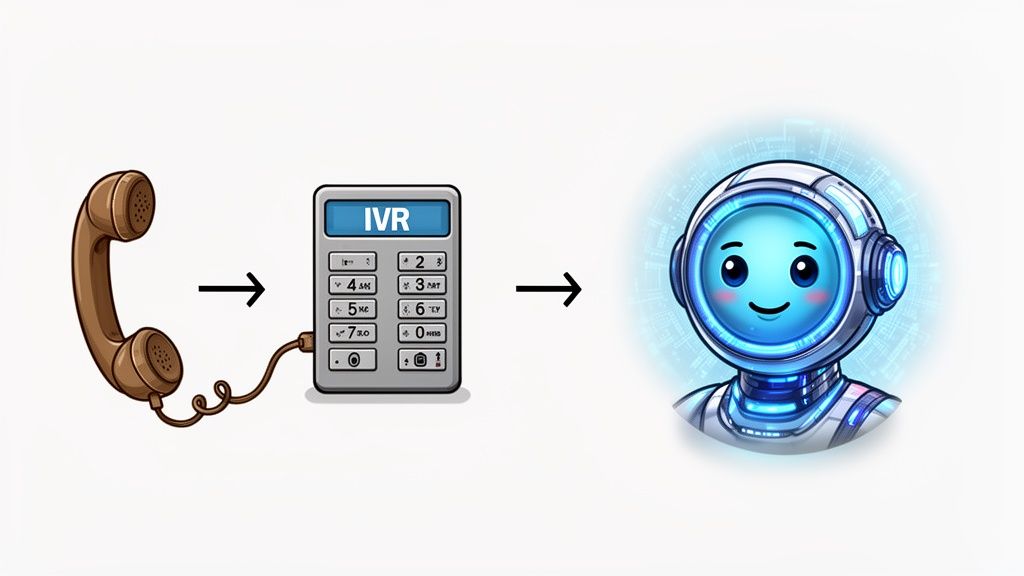
Why classic IVR has reached its limit
Press-1 menus are efficient only when the issue is simple, the caller is patient, and the organisation can tolerate drop-off. Many cannot.
In high-intent categories, callers want answers, not navigation. If someone is trying to complete KYC, book a consultation, resolve a payment issue, or ask detailed programme questions, menu trees become friction. They also capture very little nuance. A keypad input cannot reveal urgency, confidence, objections, or buying intent.
That is the gap intelligent voice agents fill.
What voice AI changes operationally
A voice AI agent can hold a natural conversation, qualify intent, answer follow-up questions, and pass a structured outcome into the workflow. That is far beyond call deflection.
In India, this shift matters most where compliance and complexity meet. According to Enghouse Interactive’s discussion of inbound contact centre software, integration and compliance requirements for voice AI agents in BFSI and healthcare remain poorly addressed despite RBI mandates for KYC and data localisation under the DPDP Act 2023. The same source notes that a 2025 NASSCOM report found 68% of BFSI firms face AI compliance delays due to unresolved voice data sovereignty issues.
That is the board-level issue. Most vendors talk about AI as a feature. Regulated sectors need AI as compliant operating infrastructure.
The BFSI lesson is blunt
If your voice AI cannot document, route, and operate within Indian regulatory constraints, it is a demo, not a deployment.
The same Enghouse-cited market view notes that human-like AI agents have demonstrated 97% accuracy in KYC guidance and improved connect rates from 47% to 91% in BFSI pilots. That benchmark matters because it reframes AI from a support accessory into a serious front-line tool.
For BFSI leaders, the implication is clear:
- Compliance must be native, not patched on
- Auditability has to be designed into the workflow
- Routing logic must recognise regulated intents early
- Escalation to certified staff should be seamless
A useful primer on how legacy IVR differs from modern conversational flows is available in this overview of IVR interactive voice response software.
AI is now handling richer conversations
Many executive teams underestimate the category.
A modern voice agent is not limited to FAQ handling. It can run a multi-turn inbound conversation for qualification, support, appointment setting, or pre-sales triage. That is especially valuable in sectors with repetitive but high-value conversations such as EdTech counselling, software demo scheduling, healthcare bookings, and property enquiries.
The key difference is not only automation. It is consistency at scale. Human agents vary. AI agents can standardise discovery, data capture, and next-step handling across every call.
This short video is useful for understanding the shift in practical terms.
Where boards should draw the line
Not every inbound interaction should be automated. That is a suboptimal implementation model.
Use AI where consistency, speed, and structured handling matter most. Keep humans on conversations where negotiation, emotional sensitivity, exception management, or relationship depth matter more. The strongest operating model is blended. AI handles repeatable complexity. Humans handle strategic exception.
The right question is not “should AI replace agents?” It is “which inbound conversations should never depend on manual handling alone?”
For 2026 planning, that is the strategic frontier in inbound call center software.
Your Strategic Evaluation and Implementation Checklist
Most software selections fail before the contract is signed. Leadership teams ask the wrong questions, accept polished demos, and underestimate implementation discipline.
Inbound call center software should be evaluated like any other core system. You need to test strategic fit, operational resilience, integration depth, and governance readiness.
The vendor questions that matter
Start with questions that expose architectural strength, not sales polish.
- Scalability under stress: Ask how the platform handles sudden call surges, seasonal peaks, and multi-queue overflow.
- Indian compliance readiness: Require a clear explanation of data handling, localisation posture, audit trails, and support for regulated workflows.
- Integration proof: Do not accept “we integrate with Salesforce or HubSpot” at face value. Ask to see a real workflow with customer context flowing into and out of the call.
- Operational control: Verify queue callbacks, live monitoring, whisper, barge, and reporting depth.
- Total cost of ownership: Demand clarity on implementation, training, support, telephony, custom integration, and future expansion costs.
If your team is comparing deployment models, this guide on cloud solutions for call centers is a useful starting point.
What to test in a pilot
A pilot should examine:
- Routing accuracy for a defined set of call intents
- Supervisor usability in live conditions
- CRM and data sync quality under actual agent workflows
- Reporting usefulness for both operations and leadership
- Customer experience quality during peak periods
Do not let the vendor set vague success criteria. Define them internally before launch.
Implementation discipline is essential
Three implementation mistakes appear repeatedly.
First, companies migrate telephony without redesigning flows. That preserves old bottlenecks inside new software.
Second, they go live without clear ownership between operations, IT, and compliance. That creates drift.
Third, they train supervisors too lightly. Supervisors are the influential layer. If they cannot manage the platform well, adoption weakens quickly.
A practical deployment sequence
Use a phased approach.
| Phase | Leadership focus | Operational objective |
|---|---|---|
| Pilot | Validate fit and expose friction | Test one queue with real customer demand |
| Controlled rollout | Stabilise process and reporting | Add teams gradually while refining routing |
| Full deployment | Standardise governance | Align service, sales, and compliance workflows |
| Optimisation | Improve ROI | Tune queues, staffing, and automation rules |
Buy slowly, implement deliberately, and expand only after the first queue performs cleanly.
A major software decision should reduce uncertainty over time. If deployment complexity keeps rising after pilot, stop and reassess.
Strategic FAQs for Inbound Call Centre Software
Senior leaders ask better questions than buying committees. They want to know whether the system will hold up in Indian operating conditions, whether it can support revenue goals, and whether the investment creates a defendable advantage.
Can inbound software really handle multilingual Indian demand well
It can, but only if the platform goes beyond English-first IVR logic.
According to The CX Lead’s review of inbound call centre software, 75% of India’s 1.4B population prefers regional languages, based on 2025 TRAI data. The same source notes 35% e-commerce inbound spikes in Tier-2 and Tier-3 cities, and a Q1 2026 Redseer report found 52% call abandonment in non-metro real estate and EdTech due to poor dialect recognition.
That is the core issue. A vendor can claim “multilingual support” and still fail in live Hindi, Tamil, or mixed-language conversations. CXOs should insist on demonstrations with regionally realistic caller behaviour, not scripted English prompts.
What should BFSI and healthcare leaders prioritise first
Compliance architecture.
If the platform cannot support Indian regulatory requirements around sensitive voice interactions, do not proceed. Features are irrelevant if legal and operational teams cannot sign off on data handling, auditability, and escalation logic.
In these sectors, the right sequence is compliance first, workflow second, automation third. Many buying teams do it in reverse and create avoidable rework.
How should a board think about ROI
Use three buckets.
First, calculate labour efficiency. Look for reductions in repeat calls, idle time, misroutes, and manual effort.
Second, estimate revenue protection and uplift. Ask how many high-intent inbound calls currently wait too long, reach the wrong queue, or lose momentum because the first conversation is weak.
Third, account for risk reduction. Better auditability, stronger routing discipline, and cleaner call handling reduce avoidable compliance and service failures.
You do not need a perfect model to make a sound decision. You need a credible one tied to your busiest queues and most valuable call types.
Is AI optional, or is it now part of the core platform decision
For many organisations, it is now core.
That does not mean every company needs a fully autonomous voice layer on day one. It means the platform should be capable of conversational automation, structured handoff, and scalable quality control when the business is ready. Buying a stack that cannot evolve into that model is short-sighted.
What separates a good platform from a bad one in practice
A good platform does four things reliably:
- Routes accurately
- Gives agents context immediately
- Keeps leadership informed in real time
- Supports scale without degrading customer experience
A bad one hides behind feature lists and forces your teams to compensate manually.
What is the most common buying mistake
Choosing on feature breadth instead of workflow fit.
The best inbound call center software for your organisation is the one that handles your actual call mix, your compliance exposure, your language reality, and your operating model. Not the one with the longest product page.
For Indian businesses, that decision is now strategic. Inbound conversations are too valuable to run on generic infrastructure.
DialNexa Labs Private Limited helps organisations move beyond basic call handling into human-like Voice AI operations that qualify leads, support customers, and manage high-volume inbound conversations at scale. If your team is evaluating how to modernise inbound call center software for EdTech, BFSI, real estate, healthcare, e-commerce, or SaaS workflows, explore DialNexa Labs Private Limited to assess what a more conversational, scalable model can look like.

[…] Teams modernising this layer usually start by replacing static templates with dynamic flows tied to intent, caller profile, and next-best action. That’s also where software starts to matter. If your current tooling can’t support adaptive paths, live data prompts, and controlled variation, the script won’t scale cleanly. This is one reason many teams reassess their inbound call centre software stack. […]
This is an excellent analysis that reframes inbound call center software as a strategic revenue and customer experience engine rather than just a telephony tool. The emphasis on AI-driven intent capture, intelligent routing, and measurable business outcomes offers valuable guidance for leaders evaluating modern customer engagement infrastructure.