
Mastering Quality Parameters in BPO for Executive Leaders
Quality parameters in BPO are the measurable standards used to judge whether customer interactions, agent behaviour, process compliance, and service outcomes meet the level your business expects. In practice, they sit inside a QA scorecard and help teams answer a simple question: did this call, chat, email, or back-office task meet the standard for quality?
For leaders, the important distinction is this: quality parameters score how well the work was done, while broader business KPIs report what the operation produced. AHT, service level, cost per contact, and occupancy matter operationally, but a QA auditor is usually scoring whether the agent verified correctly, communicated clearly, resolved accurately, followed process, and handled the customer professionally.
In our review of common BPO scorecards, teams no longer rely on a single metric. As outsourcing matured from pure cost control into experience management, providers and buyers shifted to balanced scorecards spanning customer experience, efficiency, workforce quality, and financial performance, as outlined in this 2026 BPO performance framework.
A practical way to think about the framework is:
- Customer outcome metrics: whether the customer got a correct and satisfactory resolution.
- Agent behaviour metrics: how clearly, professionally, and empathetically the interaction was handled.
- Process and compliance metrics: whether required steps, disclosures, and verification rules were followed.
- Efficiency metrics: whether the work was completed in an acceptable time without avoidable rework.
How We Chose These Quality Parameters in BPO
We selected the parameters in this guide using five editorial filters: recurring use in real QA scorecards, relevance across both voice and non-voice processes, clear measurability, observable impact on customer outcomes, and practical usefulness for coaching. We excluded vanity metrics that may look impressive in monthly decks but do not help a supervisor decide what to fix on the floor.
In our review of how BPO teams structure audits, the best parameters share one trait: an evaluator can score them consistently across interactions. “Professional greeting” is scoreable. “Sounded good” is not. “Accurate resolution” is scoreable if you define the expected outcome. “Customer seemed happy” is too vague unless tied to CSAT or a post-contact survey.
We also favored metrics that work beyond call centers. That is why this article includes items like turnaround time and accuracy, which matter heavily in email support, claims processing, collections, order management, and other back-office environments. Where a metric is better treated as a KPI than a QA line item, we say so explicitly.
Finally, we kept the list grounded in what leaders can use in scorecards, calibrations, and vendor reviews. In our experience, the most useful quality parameters are the ones that survive contact with operations: they can be audited, coached, weighted, trended, and tied back to customer impact.
Turning BPO Metrics into Tangible Business Value
Viewing your BPO partner as a simple cost centre is a legacy mindset that leaves significant value on the table. They are a direct extension of your customer experience, and the quality parameters attached to their work define what “good service” means in observable terms.
Quality parameters in BPO are the standards a QA team uses to evaluate whether an interaction met expectations for customer handling, process adherence, compliance, resolution quality, and efficiency. On a call, that might mean checking whether the agent opened correctly, verified the customer, listened actively, diagnosed the issue, gave an accurate answer, documented the case, and closed professionally. In non-voice work, the same concept applies to accuracy, timeliness, policy adherence, and completion quality.
A QA score and a business KPI are related, but they are not interchangeable. QA scoring usually ends at the quality of the interaction or completed task. Broader performance reporting continues into operational and commercial outcomes such as queue performance, staffing efficiency, repeat contact volume, conversion, revenue, or cost per resolution. We see teams get into trouble when they treat speed metrics as if they are quality metrics; that is how an operation can hit AHT targets while damaging FCR and CSAT.
A simple scorecard example makes the distinction clearer. A QA analyst reviews a billing call and scores: greeting and verification 10%, active listening 15%, probing 10%, policy compliance 15%, accuracy of resolution 25%, communication clarity 10%, empathy and professionalism 10%, call control 5%, and proper closing/documentation 10%. The agent may earn 92/100 on that interaction. Separately, operations may report that the same queue had a 6-minute AHT, 78% service level, and 84% CSAT that week. Both views matter, but they answer different management questions.
Why a Quality Framework is a Strategic Must-Have
For any executive, a relentless focus on BPO quality yields tangible dividends across the enterprise. It’s the difference between a reactive, fire-fighting posture and proactively building enterprise value. A well-designed framework ensures:
- You Protect Your Brand's Reputation: High-quality service guarantees a consistent brand experience for every customer, cementing loyalty and protecting the brand equity you've painstakingly built. For example, a luxury retail brand outsourcing its support must ensure agents mirror its premium, white-glove service ethos on every call, not just resolve technical issues.
- You Reduce Operational Risk: A clear quality system, fortified by stringent service level agreements (SLAs) and compliance checks, dramatically reduces the risk of data breaches, regulatory fines, and service disruptions that carry staggering financial consequences.
- You Drive Sustainable Growth: When your BPO partner operates with precision and excellence, you gain more than just cost savings. You unlock operational efficiencies, boost customer lifetime value through higher retention, and empower your internal teams to focus on innovation and core business growth.
A well-defined quality assurance programme isn't an expense. It's an investment in consistency, customer loyalty, and the long-term health of the partnership. It elevates the relationship from a simple vendor contract to a powerful strategic alliance.
The commercial case is stronger than many executive summaries admit. DialNexa’s own guidance notes that stronger CSAT and FCR are tied not just to cleaner reporting but to lower repeat contact volume and better revenue retention; one industry guide cited there says a 10-point CSAT increase can correlate with a 2% revenue uplift and that stronger FCR can reduce repeat calls by up to 30% in some environments, as discussed in this BPO quality parameters overview.
For a deeper dive into effectively understanding customer satisfaction metrics, there are great resources that explore how to move beyond just vanity numbers.
Ultimately, mastering quality parameters gives you the strategic control to steer your outsourcing investment toward predictable, positive outcomes. It provides the data-driven oversight needed to hold partners accountable and foster a culture of continuous improvement. For those looking to apply these principles, you can learn more about how to measure the success of your outbound campaigns with our AI voice agent in our detailed guide. This leadership-level focus is the first step toward transforming your BPO from a service provider into a true growth engine.
The Core Metrics That Drive BPO Performance
Most BPO QA scorecards use 8-12 quality parameters depending on process complexity, regulatory exposure, and channel mix. Simpler inbound support programs may score eight core items. Heavily regulated financial, healthcare, or collections environments often use ten to twelve because compliance, documentation, and disclosure handling need separate checks.
A useful scorecard framework is a countable list combining customer outcome, behaviour, compliance, and efficiency. Exact weighting should vary by process; the core parameters below are commonly tracked in some form.
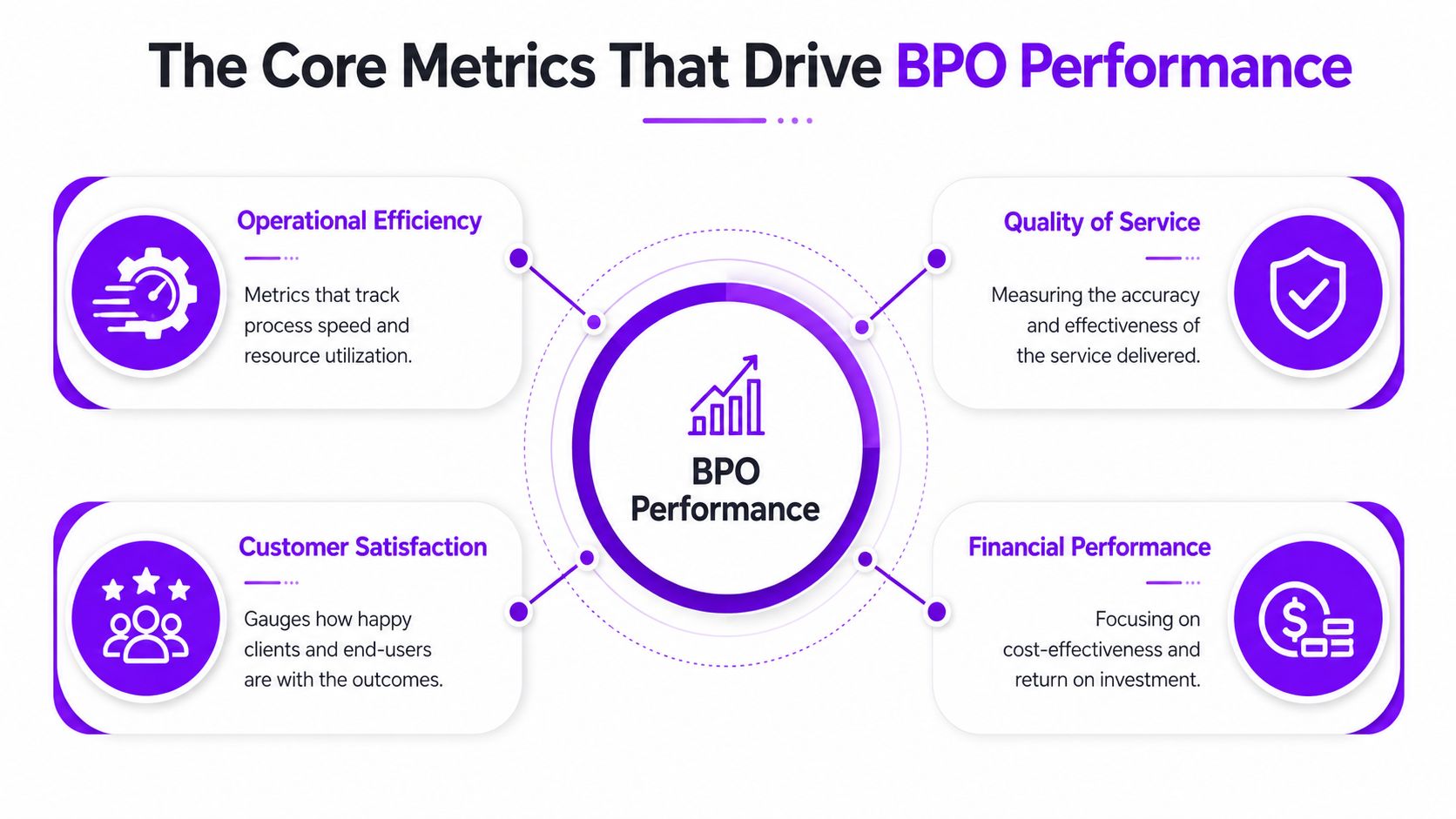
This concept map illustrates precisely how BPO quality is intrinsically linked to mitigating risk, safeguarding your brand's reputation, and enabling sustainable business growth.
1. First Contact Resolution (FCR)
How it is measured: the percentage of customer issues fully resolved in the first interaction without repeat contact within the defined window.
Why it matters: FCR is one of the clearest indicators that the agent, process, and knowledge base worked together effectively. DialNexa’s guidance places typical FCR ranges at 70-75% in general BPO support, 80-85% in technical support, 85-90% in premium support, and 75-80% in e-commerce and retail, based on process type in this quality parameters for BPO guide.
Common tradeoff or failure mode: teams sometimes report strong FCR while hidden repeat contacts move to another channel, or they push quick closes that suppress callbacks temporarily without solving the root issue.
2. Customer Satisfaction (CSAT)
How it is measured: post-contact surveys, usually on a 1-5 or 1-10 scale, summarized as the percentage of satisfied responses.
Why it matters: CSAT captures the customer's immediate reaction to the interaction. It is especially useful when paired with QA score because a technically compliant interaction can still feel cold, confusing, or rushed.
Common tradeoff or failure mode: CSAT response rates can be low and skew toward highly satisfied or highly unhappy customers, so it should inform quality review, not replace it.
3. Average Handle Time (AHT)
How it is measured: total talk, hold, and after-call work time divided by the number of handled contacts.
Why it matters: AHT reflects efficiency and process design. It helps leaders understand whether agents have the tools and workflows to resolve issues without unnecessary delay.
Common tradeoff or failure mode: we see teams over-index on AHT when budgets tighten. That usually creates rushed calls, weaker probing, more repeat contacts, and lower resolution quality. AHT works best as a balancing metric, not a standalone success target.
4. Compliance and Process Adherence
How it is measured: scored checks for required steps such as verification, disclosures, consent, authentication, script adherence, documentation, and policy-following.
Why it matters: quality intersects with legal, financial, and reputational risk. In regulated programs, a single missed disclosure can outweigh several otherwise positive interaction behaviours.
Common tradeoff or failure mode: over-scripted compliance programs can sound robotic if auditors score box-ticking but do not also measure clarity and customer understanding.
5. Communication Clarity
How it is measured: QA scoring for clear explanations, correct language use, structure, pacing, and avoidance of jargon or contradictory instructions.
Why it matters: a correct answer only helps if the customer can understand and act on it. Clarity is often the hidden driver behind both CSAT and repeat contact volume.
Common tradeoff or failure mode: agents may read approved language word-for-word and technically remain compliant while still sounding unnatural or confusing.
6. Empathy and Professionalism
How it is measured: behavioural scoring for tone, courtesy, acknowledgement of the customer's issue, respect, and emotional control.
Why it matters: this parameter is essential in complaint handling, billing disputes, retention conversations, and any queue where frustration is common. It also carries outsized brand impact because customers remember how they were treated.
Common tradeoff or failure mode: some scorecards define empathy too vaguely, which leads to inconsistent auditor scoring. It works better when tied to observable behaviours such as acknowledging inconvenience or confirming understanding.
7. Accuracy
How it is measured: whether the information provided, form completed, case updated, or transaction processed was factually and procedurally correct.
Why it matters: accuracy is a foundational parameter across both voice and back-office work. In claims, underwriting, collections, and order processing, a fast interaction with an incorrect outcome is rework waiting to happen.
Common tradeoff or failure mode: teams sometimes separate “customer handling” from “transaction completion” so completely that errors in downstream processing are not traced back to the original interaction.
8. Resolution Quality
How it is measured: QA review of whether the issue was solved completely, correctly, and in line with policy, not merely closed in the system.
Why it matters: resolution quality goes deeper than closure status. It tests whether the customer’s real need was addressed and whether the chosen solution was sustainable.
Common tradeoff or failure mode: agents can hit closure targets by applying temporary fixes, escalating too quickly, or ending contacts before confirming understanding.
9. QA Audit Score
How it is measured: the weighted score an evaluator assigns based on the full scorecard for an interaction or completed task.
Why it matters: this is the roll-up view of quality across several parameters. It is useful for coaching trends, calibrations, vendor governance, and incentive design.
Common tradeoff or failure mode: a single overall score can hide what needs fixing if the scorecard weights are poorly designed or if critical failures are not separated from minor misses.
Turning that roll-up score into coaching action is usually the job of the floor leader, and DialNexa’s KPI of team leader in BPO guide maps QA scores like these onto the metrics a team leader is actually held accountable for.
10. Schedule Adherence or Turnaround Time
How it is measured: for voice teams, adherence compares actual logged time against scheduled time. For non-voice work, turnaround time measures how quickly tasks, emails, tickets, or cases are completed.
Why it matters: quality cannot be divorced from delivery discipline. Even accurate work becomes a customer issue when queues are understaffed or tasks sit untouched too long.
Common tradeoff or failure mode: aggressive adherence management can reduce flexibility for complex contacts, while pure speed targets in back-office work often create avoidable errors.
11. Hold and Transfer Handling
How it is measured: whether holds were necessary, explained, appropriately timed, and whether transfers were warm, accurate, and minimal.
Why it matters: this parameter is especially important in call centers because customers often interpret unnecessary holds and blind transfers as incompetence.
Common tradeoff or failure mode: low transfer rates can look positive until they encourage agents to keep contacts they are not equipped to solve.
12. Documentation and Case Notes
How it is measured: whether notes are complete, accurate, timely, and usable by the next agent or downstream team.
Why it matters: poor documentation destroys continuity. It increases repeat contact time, causes duplicate effort, and makes root-cause analysis harder.
Common tradeoff or failure mode: agents under pressure on AHT often rush after-call work, leaving partial notes that push costs into the next interaction.
Sample scorecard weighting: voice support vs back-office work
A voice support scorecard might weight the parameters like this: compliance 15%, communication clarity 10%, empathy and professionalism 10%, probing and diagnosis 10%, accuracy 15%, resolution quality 20%, documentation 5%, hold/transfer handling 5%, opening and closing standards 10%.
A back-office scorecard usually shifts the emphasis: accuracy 30%, process adherence 20%, turnaround time 15%, documentation quality 10%, exception handling 10%, productivity 10%, communication with internal stakeholders 5%.
That difference matters. In our experience, teams copy a voice scorecard into non-voice operations too often, then wonder why the audit output feels disconnected from actual business risk.
Managing Risk Through Security and Compliance
When you outsource business processes, you are not just delegating tasks; you are entrusting a partner with sensitive corporate and customer data. For any CXO, this represents a significant area of enterprise risk. A data breach originating from your BPO partner isn't a mere technical issue—it's a full-blown corporate crisis that can shatter brand reputation and inflict severe financial damage.
This is why security and compliance are not ancillary IT concerns; they are fundamental quality parameters in BPO. A partner who treats data protection as a checkbox exercise is a profound liability. True quality in this domain is demonstrated by a proactive, multi-layered defense architecture designed to protect your most valuable asset: your information.
Think of your BPO's security posture as a digital fortress. A single wall is insufficient. Its true strength lies in a series of interconnected defenses, from stringent access controls to continuous, real-time threat monitoring. This is the critical differentiator between a simple vendor and a trusted strategic partner.
Building a Fortress with International Standards
The foundation of any secure BPO partnership is its adherence to globally recognised security standards. These are not merely badges for a website; they are attestations of a disciplined, audited approach to information security management. They create a shared framework for risk and provide you with tangible proof of your partner's capabilities.
Key standards that must be upheld include:
- ISO 27001: The global benchmark for information security management systems (ISMS), demonstrating a systematic process for identifying, managing, and mitigating risks.
- GDPR: For any business with exposure to EU citizens, compliance with the General Data Protection Regulation is required, enforcing strict rules on data privacy and user consent.
- HIPAA: For organisations in the healthcare sector, the Health Insurance Portability and Accountability Act sets rigid requirements for protecting patient health information (PHI).
For example, leading BPO providers in India adhere to these international certifications to ensure strong regulatory compliance. They build clear Service Level Agreements (SLAs) and track performance metrics to keep standards high. This culture of security is often supported by real-time dashboards and continuous monitoring built directly into their quality assurance frameworks. This approach is exemplified in how Indian BPOs leverage these standards for global success.
Practical Safeguards That Matter
Beyond certifications, tangible, day-to-day security measures your partner has implemented matter. As a leader, you must probe deeper and validate these practical defenses. It’s the difference between a simple lock on the door and a full security system with alarms and 24/7 surveillance.
A mature security posture is proactive, not reactive. It’s about anticipating threats and neutralising them before they can cause harm, ensuring that efficiency gains from outsourcing are never achieved at the expense of security.
Key practical measures include end-to-end encryption for all data, both in transit and at rest, along with regular vulnerability scanning and penetration testing to identify and remediate weaknesses. Additionally, identity and access management (IAM) protocols are essential to enforce the principle of least privilege, ensuring individuals can only access sensitive information on a need-to-know basis.
Continuous Monitoring and Proactive Defence
Given the evolving threat environment, an annual security audit is no longer sufficient. Leading BPOs employ continuous monitoring tools like security information and event management (SIEM) systems and real-time dashboards, which provide immediate visibility into potential threats and enable them to act preemptively rather than reactively cleaning up a breach.
This commitment to constant vigilance is a critical quality parameter. New technologies are also adding powerful layers of protection. For instance, forward-thinking organisations are now elevating AI voice agent security with advanced voice biometrics to create far stronger authentication mechanisms. By making this level of security a priority in your partner selection process, you ensure your outsourcing strategy strengthens your business without exposing it to unacceptable risk.
Using Technology to Achieve Quality at Scale
When your BPO partner manages thousands of customer interactions daily, how do you ensure impeccable quality consistently? For C-suite leaders, manual spot-checks are not a scalable or reliable strategy. The definitive answer lies in embedding technology directly into your quality framework.
This is not merely about operational efficiency; it’s about securing a genuine strategic advantage. By evolving beyond archaic methods like random call sampling, you gain a level of insight and control previously unattainable. Modern tools provide a full, real-time view of performance, transforming quality assurance from a reactive, forensic exercise into a proactive, data-driven discipline.
This technological shift is a primary force reshaping the outsourcing industry. The Indian BPO market, for example, is projected to grow at a Compound Annual Growth Rate (CAGR) of nearly 13% through 2035, a surge driven largely by the adoption of AI-powered automation and cloud solutions that directly enhance service quality. This is already in practice, with AI analytics drastically reducing costly, error-driven rework in sensitive document processing for financial and healthcare clients. You can read more on the growth of the Indian BPO market.
The Power of 100% Interaction Analysis
For decades, the standard for quality monitoring was random sampling, auditing a tiny fraction of interactions and hoping they were representative of the whole. This approach is flawed, creating massive blind spots where poor customer experiences can proliferate undetected.
AI-powered speech and text analytics revolutionizes this process. Imagine analyzing 100% of your customer interactions—every call, chat, and email—automatically. This technology transcribes and analyzes every conversation, using sentiment analysis to pinpoint key emotions like frustration, confusion, or satisfaction at scale.
Instead of waiting for a poor survey result to appear in a monthly report, you can receive a real-time alert the moment a customer is at risk of churning. This enables your BPO partner to intervene immediately, transforming a potential complaint into a powerful brand recovery moment.
This total visibility offers strategic benefits that resonate at the executive level. It allows you to identify systemic issues, codify the behaviors of top-performing agents, and ensure 100% script and compliance adherence—not just on the handful of interactions you happen to review.
Eliminating Human Error with Automation
Many BPO functions, particularly in back-office operations, are built on repetitive, rules-based tasks like data entry, claims processing, or invoice management. These are fertile grounds for human error, where a single mistake can cascade into significant financial or compliance repercussions.
Robotic Process Automation (RPA) is a highly effective tool for mitigating this risk. RPA "bots" can be configured to execute these tasks with near-perfect accuracy, 24/7, without fatigue.
A Practical Example: Mortgage Application Processing
A financial services firm outsources its mortgage application data entry. Manually, agents have a 2% error rate, leading to costly rework and frustrating delays for customers. By implementing an RPA bot to extract data from application forms and input it into the core system, the error rate plummets to less than 0.1%. As a bonus, the processing time is slashed by 70%. This doesn't just improve a critical quality metric; it accelerates the entire lending cycle.
Predictive Analytics for Proactive Management
The most advanced BPOs are now leveraging predictive analytics to address quality issues before they arise. By analyzing historical data on agent performance, customer behavior, and interaction outcomes, these models can identify patterns that predict future problems. This data-first mindset is especially critical in high-stakes industries like finance. For a closer look, you can explore our guide on how data and AI will transform contact centres for financial services.
This capability shifts quality management from reactive to predictive. It’s the difference between reviewing last month's dismal CSAT scores and receiving an alert that a specific agent is exhibiting early signs of burnout and is likely to underperform next week. For a director or VP, such foresight is invaluable for making intelligent, strategic decisions that protect both the customer experience and the bottom line.
Building a Framework for Continuous Improvement
Achieving top-tier BPO performance is not a singular event, it’s a continuous journey of optimization and refinement. As a CXO, a cursory review of monthly performance dashboards is merely playing defense. A strategic approach involves architecting a scalable framework for continuous improvement, a system that transforms your quality program from a static report card into a dynamic engine for innovation.
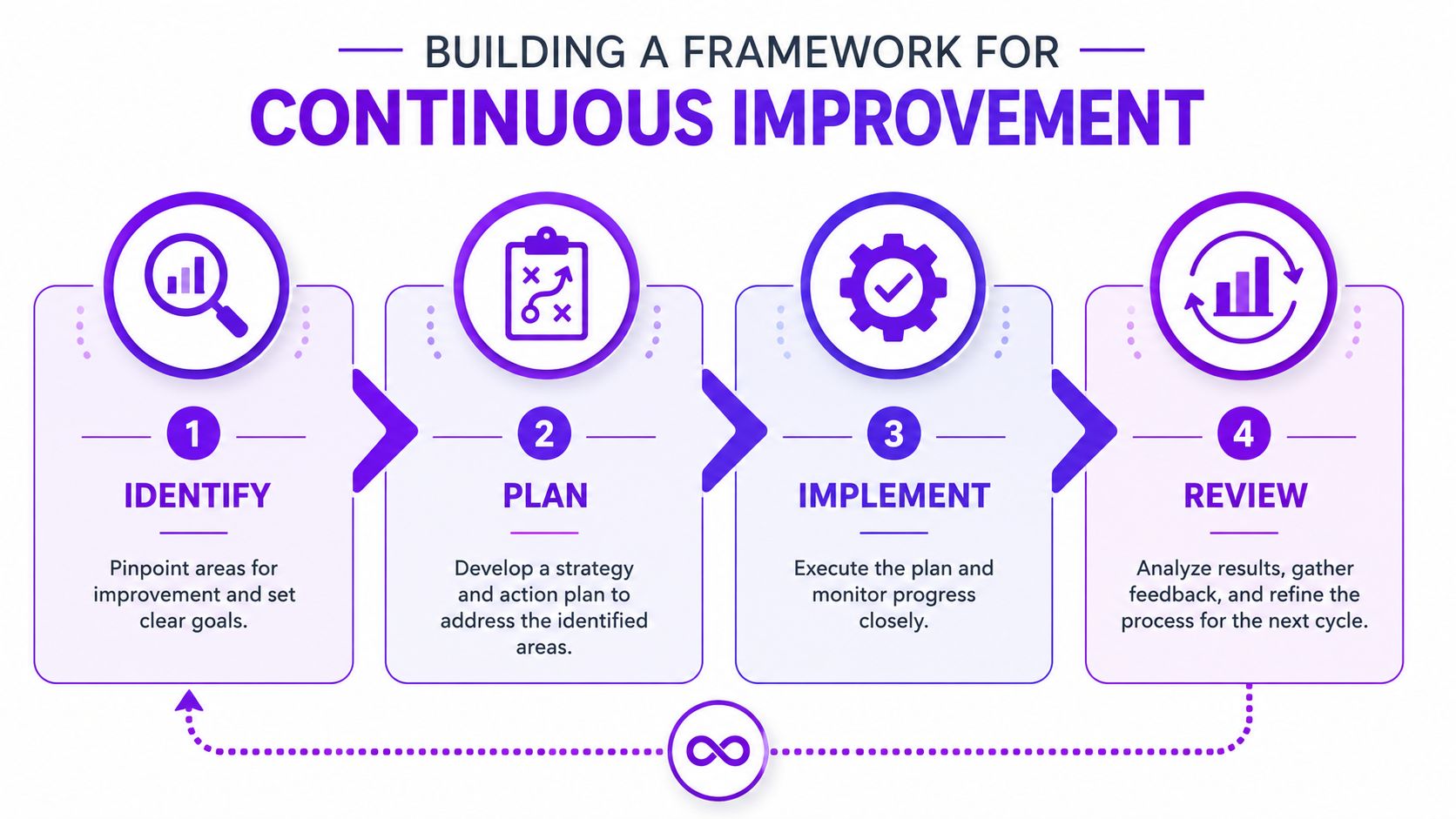
Move beyond tracking quality parameters in BPO. Embed a culture where both your team and your partner proactively seek superior ways to operate. That forward-thinking posture distinguishes a competent vendor from a true strategic partner who consistently delivers exponential value.
To sustain excellence, you must embrace the principles of continuous improvement and weave a culture of ongoing refinement into your BPO's operational DNA. This philosophy is realized through practical, collaborative processes that yield tangible, measurable results.
Aligning on Excellence with QA Calibration
One of the most potent tools for continuous improvement is the QA calibration session. This is a structured meeting where your internal quality team and the BPO’s quality auditors convene to score the same set of customer interactions—typically a mix of calls, emails, or chats.
The objective is not to find fault but to achieve perfect alignment. What constitutes an "excellent" customer interaction? Does a "good" rating signify the same standard to your team as it does to your partner's? Misalignment here means you are operating with skewed data, rendering coaching efforts ineffective.
Practical Example: A Calibration Session in Action
Imagine your brand's key differentiator is "empathetic service." During a calibration session, your team scores an agent a 7/10 on empathy. The agent was polite but failed to acknowledge the customer's palpable frustration. The BPO's team, however, scores that same interaction a 9/10 because the agent solved the technical issue.
This delta is invaluable. It initiates an important strategic dialogue. You clarify that for your brand, the emotional connection is as vital as the technical resolution. This insight then cascades directly into the BPO’s coaching and training modules, ensuring their agents deliver the precise experience your customers expect.
Calibration ensures that when you see a '95% QA Score' on a report, it reflects a standard of quality that you have personally defined and validated. It replaces assumptions with a shared, concrete definition of success.
Getting to the 'Why' with Root-Cause Analysis
When a key metric like CSAT or FCR declines, the immediate question from leadership is always, "Why?" A superficial answer like "agents are struggling" is insufficient. A structured Root-Cause Analysis (RCA) provides the deep, actionable insights required to resolve the problem at its source.
RCA is a methodical process for digging past surface-level symptoms to uncover the fundamental driver of a performance issue. It prevents the misallocation of resources on temporary fixes and facilitates lasting improvements.
A Step-By-Step RCA Process
Consider a common scenario: a BPO partner flags a 15% drop in First Contact Resolution for a specific product line. Instead of initiating a broad retraining program, a savvy director launches an RCA process.
- Define the Problem: FCR for "Product X" support tickets has declined from 85% to 70% over the past month.
- Gather Data: The team analyzes call transcripts, QA scores, and agent notes. A pattern emerges: numerous unresolved calls mention confusion around a recent "feature update."
- Identify Causal Factors: They brainstorm all possibilities. Is agent training inadequate? Is the knowledge base article ambiguous? Is the feature itself poorly designed?
- Determine the Root Cause: After reviewing training materials and the knowledge base, they isolate the culprit. The documentation for the new feature is outdated and lacks clear troubleshooting steps. Agents are operating with flawed information.
- Implement Corrective Actions: The solution is not a costly, large-scale retraining initiative. It is a precise, surgical strike: update the single knowledge base article and conduct a targeted briefing for the "Product X" team. The problem is resolved faster and at a fraction of the cost.
This systematic approach transforms quality management from a reactive, finger-pointing exercise into a collaborative, problem-solving discipline. By embedding calibration and RCA into your partnership governance, you build a self-correcting system that doesn't just maintain standards—it consistently elevates them.
The Big-Picture Questions Every Leader Should Ask About BPO Quality
As an executive, your role is not to be mired in the minutiae of daily metrics; that is the purview of your operations team. Your responsibility is to maintain a strategic perspective, asking the incisive questions that connect operational data to tangible business outcomes. Securing clear, substantive answers is how you guide the partnership, ensuring it delivers significant value and a strong return on investment.
This section focuses on the leadership questions that matter most once the scorecard is built: are we measuring the right things, are we coaching the right behaviours, and are we confusing business KPIs with interaction quality? In our experience, that last mistake is the one that most often distorts vendor reviews.
How Do We Make Sure Our BPO Sounds Like Our Brand?
This is arguably the most critical question. Your BPO agents are, for all intents and purposes, the voice of your brand. A dissonance between your marketing promise and your support delivery creates a brand perception problem that can be difficult to reverse.
The solution lies in moving beyond generic scripts and standard metrics.
Here’s a real-world example: A fintech brand's promise is "transparent and empowering." A typical BPO might focus on lowering Average Handle Time (AHT) for efficiency. But a strategically-aligned partner would prioritize metrics like First Contact Resolution (FCR) and coach agents on explaining complex financial terms clearly, even if calls take longer. They understand that true empowerment comes from clarity, not speed.
To achieve this brand alignment, you must:
- Go beyond the brand book. Don't just email a PDF. Invite your BPO's leadership and training teams to your headquarters. Allow them to immerse themselves in your corporate culture.
- Codify brand values into the QA scorecard. Instead of a vague item like "politeness," get specific. Add measurable criteria like "Demonstrated empathy for the customer's situation" or "Proactively educated the customer." This transforms abstract values into measurable, coachable behaviors.
What are the quality parameters of a call center in practical terms?
For call centers, the scorecard usually becomes more behaviour-specific than a generic BPO framework. The most common checks are: call opening, customer verification and compliance, active listening, probing, product or process accuracy, resolution, communication clarity, hold and transfer handling, documentation, and call closing.
A typical QA form may score whether the agent greeted correctly, confirmed identity, listened without interrupting, asked relevant questions, gave the right answer, managed holds properly, and closed with next steps. We find this translation useful because many teams understand “BPO quality” in the abstract but still need to see how it appears on an actual call audit.
Which five BPO KPIs should leaders watch alongside QA parameters?
Five commonly tracked BPO KPIs are FCR, CSAT, AHT, service level, and schedule adherence or productivity. These are management indicators that show whether the operation is solving issues efficiently, meeting staffing expectations, and keeping customers reasonably satisfied.
The important caveat is that not all KPIs belong inside a QA scorecard. QA parameters assess the quality of the interaction itself; KPIs report operational results at queue, team, or program level. I would not let AHT dominate an audit form unless the process depends on strict time control.
What's the Right Level of Oversight? (Without Micromanaging)
This is a delicate balance every leader must manage. Insufficient oversight risks a gradual decline in quality. Excessive oversight stifles your partner's initiative, turning them into order-takers rather than proactive problem-solvers. The result is a dependent vendor, not a strategic partner.
The answer is to manage outcomes, not tasks.
Trust, but verify with data. Set up crystal-clear Service Level Agreements (SLAs) and a robust reporting system. If the key quality metrics are consistently on target, you have the confidence to step back from the day-to-day grind.
Focus your energy on high-impact governance activities: quarterly business reviews (QBRs), joint strategic planning sessions, and collaborative innovation workshops. This demonstrates respect for their operational expertise while holding them accountable for the results that matter to your business.
How Do We Future-Proof This Partnership?
Business conditions are in constant flux, and your BPO partnership must be architected for adaptability. A model that works today could be obsolete tomorrow. Future-proofing means cultivating a relationship that can scale, adapt, and integrate new technologies seamlessly.

Your strategic conversations should center on three key areas:
- Their Technology Roadmap: What is their concrete plan for integrating AI, automation, and advanced analytics? Demand a clear demonstration of how their technology investments will improve core quality parameters in BPO over the next 18-24 months.
- Their Human Capital Strategy: As routine tasks become automated, how are they upskilling their workforce for more complex, high-value roles? A forward-thinking partner is already investing in training for advanced problem-solving, data analysis, and emotional intelligence.
- Agility and Scalability: How quickly can they scale services up or down to meet fluctuating market demand without compromising quality? Investigate the specifics of their resource planning, cross-training programs, and business continuity plans.
By asking these strategic questions, you shift the dialogue from a retrospective review to a collaborative vision for the future. This helps ensure your BPO partnership remains a durable competitive advantage, able to grow with your business and consistently deliver the quality your customers demand.
Frequently Asked Questions
What are the quality parameters of a call center?
The usual call-center quality parameters are call opening, verification and compliance, active listening, probing, product knowledge, communication clarity, empathy, resolution quality, hold and transfer handling, documentation, and call closing. Different industries adjust the weights, but most QA forms use some version of these items.
What are quality parameters in BPO?
They are the measurable criteria used to judge whether a customer interaction or business process met the required standard. They typically cover customer outcome, agent behaviour, process compliance, and efficiency rather than broad business performance alone.
How many quality parameters are typically used in BPO?
Most BPO teams use between 8 and 12 quality parameters in a standard scorecard. Simpler customer service processes may use fewer, while regulated or complex programs often use more to separate compliance, documentation, and resolution checks.
What are the 5 KPIs in BPO?
A practical set of five BPO KPIs is First Contact Resolution, Customer Satisfaction, Average Handle Time, service level, and schedule adherence or productivity. These are commonly used because they show whether the operation is resolving demand, meeting staffing expectations, and delivering an acceptable customer experience.
Are quality parameters and KPIs the same thing?
No. Quality parameters are usually the scored standards on a QA form, such as empathy, accuracy, compliance, and resolution. KPIs are broader operational or business measures, such as AHT, occupancy, cost per contact, or service level.
Which quality parameter matters most?
There is no single universal winner, but FCR, accuracy, compliance, and resolution quality usually matter most because they affect both customer experience and downstream cost. In practice, the best scorecards balance customer outcome with process discipline instead of chasing one headline metric.
DialNexa helps organisations turn more conversations into conversion-ready outcomes by deploying human-like Voice AI agents that scale outreach and support. By automating routine calls, our customers see dramatic gains in connect rates, lead qualification, and operational efficiency, freeing up their teams to focus on high-value interactions. To learn how Voice AI can transform your communication strategy, visit us at https://dialnexa.com.
Written by Aditya Kamat | Published Dec 14, 2025 | Updated May 31, 2026
Co-Founder, DialNexa
Co-Founder of DialNexa. Expert in voice AI, conversational technology, and enterprise telephony. Building the future of AI-powered customer engagement.

Excellent insights on how BPO quality management directly influences brand reputation, customer loyalty, and long-term business growth. Treating BPO partners as strategic allies rather than cost centres is a powerful approach that creates sustainable value and operational excellence.