
Knowledge Based Agent in AI: A Strategic Asset for Executive Leadership
Think beyond basic automation. A knowledge based agent in AI is more than just a tool; it's a digital expert with your company's entire knowledge base at its fingertips. For VPs, Directors, and CXOs, this isn't merely an operational upgrade—it's a strategic asset engineered to drive revenue, slash costs, and create a sustainable competitive advantage. This move from rigid, rule-based systems to context-aware intelligence is how today's leading businesses are widening the gap.
The Strategic Shift to Intelligent AI Agents
In today’s hyper-competitive market, the gap between leaders and laggards is defined by the quality and speed of customer and lead interactions. We've all been frustrated by traditional automation like old-school interactive voice response (IVR) systems. They stick to a rigid script, fail at the first sign of complexity, and often create more problems than they solve, leading to a direct negative impact on brand perception and revenue.
A knowledge based agent completely changes the game. Imagine your top consultant—available 24/7, armed with deep institutional knowledge, and ready to apply it flawlessly to every single interaction. It doesn’t just follow a script; it listens, reasons, and solves problems in real-time. For a leadership team, this means predictable, high-quality performance at a scale that is humanly impossible.
From Cost Centre to Revenue Driver
For any executive, the real question is about the bottom line. This technology directly transforms customer operations from a necessary cost centre into a powerful engine for revenue generation. This isn't a future prediction; it's a current reality delivering tangible financial results.
For example, companies leveraging DialNexa’s knowledge based agents are reporting transformative performance metrics:
- Connect rates have jumped from a typical 47% to an exceptional 91%, meaning sales teams are spending time on live conversations, not dialing dead ends.
- Lead-to-booking conversions have soared from a standard 2% to an impressive 8%—a 4x improvement that directly impacts top-line revenue.
These aren't marginal gains. They represent a fundamental acceleration of the sales cycle and a direct lift in revenue, all powered by intelligent automation.
A knowledge based agent is more than an advanced chatbot; it's a strategic tool that embeds your company's collective expertise into every conversation, ensuring consistency, accuracy, and efficiency at scale.
To truly understand this shift, let's look at how the impact of knowledge based agents stacks up against traditional automation.
Knowledge Based Agents vs Traditional Automation Impact
| Capability | Traditional Automation (e.g., IVR) | Knowledge Based AI Agent (e.g., DialNexa) |
|---|---|---|
| Customer Experience | Follows rigid, linear scripts. Often leads to high drop-off rates and customer frustration. | Adapts to user intent in real-time. Provides personalised, context-aware conversations. |
| Problem Solving | Limited to pre-defined "if-then" scenarios. Cannot handle complex or novel queries. | Reasons through problems using a vast knowledge base. Solves complex issues independently. |
| Business Impact | Functions as a cost-saving tool by deflecting simple calls. Limited impact on revenue. | Acts as a revenue driver by improving conversion rates and accelerating sales cycles. |
| Operational Efficiency | Automates repetitive tasks. Requires constant manual updates for new scenarios. | Learns and scales with the business. Drastically reduces the need for human intervention. |
The table makes it clear: we're moving from a simple cost-reduction mindset to a strategy focused on intelligent revenue growth. Adopting this technology is quickly becoming a mainstream business decision. To get the full picture, it's crucial to understand the core components of an AI agent platform and how it all works together to deliver these outcomes.
The Growing AI Market in India
This strategic shift is happening within a booming market, particularly in India. The nation's AI market is projected to hit $6 billion by 2027, growing at a remarkable CAGR of 33.7%.
For executives, this is not just hype. The adoption rates are already high, with 87% of Indian IT decision-makers reporting significant progress in their AI strategies and 76% already seeing a positive ROI. These numbers confirm that knowledge-based agents are practical, proven tools delivering real business value today.
How an AI Agent Thinks, Reasons, and Learns
Before any executive team builds a strategy around a new technology, they need to understand how it actually works. A knowledge-based agent in AI isn't a black box; it's a logical system built to mirror the reasoning of a human expert. Understanding its mechanics reveals why these agents are such powerful, reliable tools for business.
Let's use an executive analogy. Imagine all of your company's collective wisdom—every product spec sheet, sales script, compliance document, and customer history—all organised into one massive, secure digital library. This library is the agent's Knowledge Base (KB). It's the single source of truth it relies on for every decision, ensuring brand consistency and accuracy.
Now, think of your most seasoned analyst or strategist. This isn't someone who just fetches data; they understand the context, connect disparate information, and derive insights. This expert is the Inference Engine. It intelligently links information from the Knowledge Base to answer complex questions it's never seen before, mirroring expert-level problem-solving.
Finally, the Learning Component acts as your continuous improvement process. With every interaction handled, it refines its approach based on outcomes, getting sharper over time. These three core parts work together seamlessly to create conversations that are adaptive, intelligent, and drive business objectives.
The Core Components Powering AI Reasoning
A well-structured Knowledge Base is the bedrock of a successful AI agent. When this digital library is meticulously organised and fed with high-quality data, it enables the agent to achieve incredible results—like 97% lead qualification accuracy. That’s a figure that puts it on par with, or even above, a seasoned sales professional. This kind of reliability gives leaders the confidence to deploy these agents in critical, customer-facing roles.
Here’s a simple breakdown of how these components function together:
- Knowledge Base (KB): The agent's memory. It stores both declarative knowledge (facts, like "our premium plan includes X feature") and procedural knowledge (rules, like "if a customer asks for a demo, schedule it").
- Inference Engine: The agent's brain. It applies logical rules to process queries against the KB, deducing the best response or action to take. For instance, it can cross-reference a customer's budget with available product tiers to make a tailored recommendation.
- Learning Mechanism: The agent's growth engine. By analysing the outcomes of its conversations (e.g., successful bookings), it can update its knowledge and improve its performance, ensuring it stays effective as your business evolves.
This visual shows how the industry is shifting from simple automation to intelligent agents that actively drive revenue.
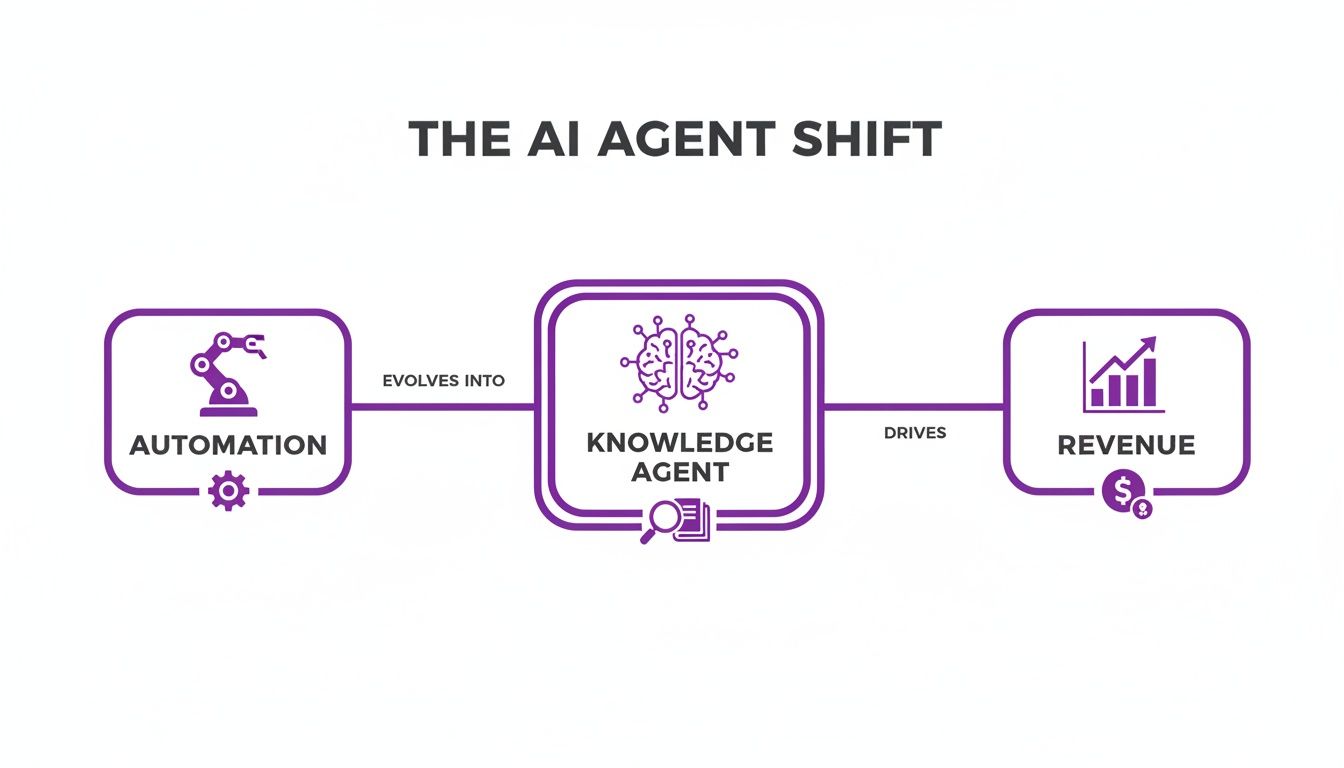
The key takeaway is that automation isn't the final destination; it's the starting point. It paves the way for intelligent systems that become core assets for business growth.
Steering the Agent's Thought Process
Understanding how an AI agent thinks is directly linked to how we communicate with it. The quality of our instructions—our "prompts"—has a huge impact on the quality of its output. For executives looking to align these systems with business goals, a solid grasp of What is Prompt Engineering is essential.
By mastering how to ask the right questions, business leaders can unlock the full potential of their AI agents, ensuring they operate with maximum precision and business relevance.
This isn't just a simple command-and-response system. It's a continuous cycle: the agent perceives its environment (a customer's question), consults its Knowledge Base, performs an action (answers or asks a clarifying question), and then learns from the outcome.
This structured approach to thinking is what truly separates a knowledge-based agent from a basic chatbot that just matches keywords to pre-written scripts. For a deeper look into this cognitive loop, check out our guide on agentic reasoning and how AI agents make decisions.
Driving Tangible Business Outcomes with AI Agents
While the technology itself is fascinating, for any business leader, it all boils down to one question: what’s the ROI? A knowledge based agent in AI isn't just a clever piece of tech; it's a powerful engine for real-world business results. By turning your company's collective expertise into an automated, intelligent conversationalist, these agents directly boost revenue, drive efficiency, and elevate customer satisfaction.
Let's move past theory to tangible business value. The true power of this technology shines when applied to solve expensive, time-consuming problems in specific industries. These agents aren’t just handling basic FAQs; they’re stepping into complex roles once reserved for human experts, delivering consistent, high-quality outcomes around the clock.
Transforming Key Industry Workflows
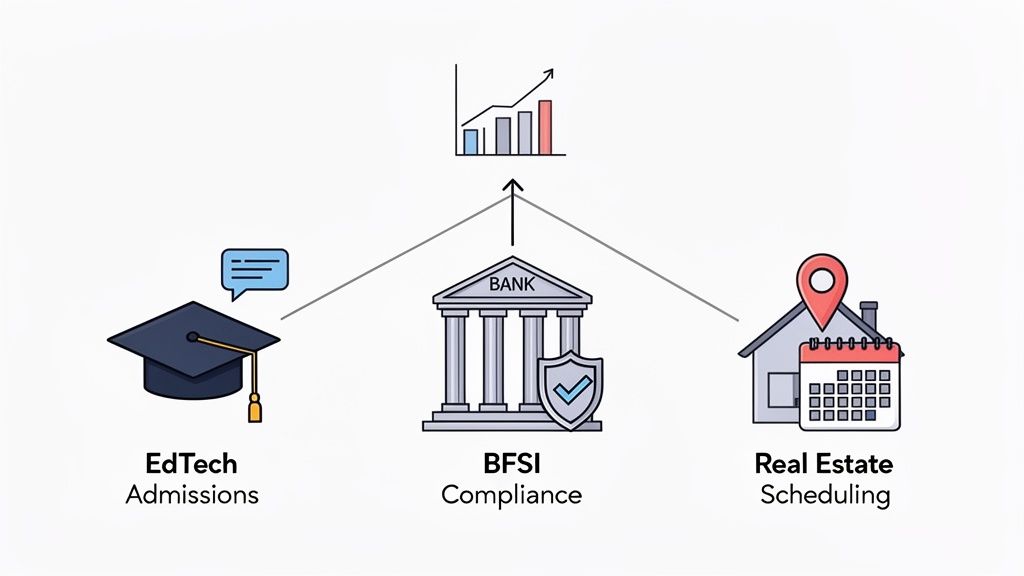
Every industry has unique hurdles, from navigating complex regulations to delivering hyper-personalised service. A knowledge based agent can be tailored to these specific demands, acting as a digital specialist that not only enhances performance but also frees up your human team for high-value strategic work.
-
In EdTech: An AI agent acts as a tireless admissions counsellor, available 24/7. It can instantly pull intricate program details, eligibility rules, and fee structures from its knowledge base to qualify potential students with 97% accuracy. It answers detailed questions any time of day, ensuring no high-value lead goes cold. A leading university client saw a 22% increase in qualified applications within the first quarter of deployment.
-
In BFSI: The agent acts as a meticulous compliance officer for the Know Your Customer (KYC) process. Drawing from a deep well of financial regulations, it ensures every step is followed to the letter, achieving 100% compliance and slashing the risk of costly human errors. This reduced the average customer onboarding time from 3 days to under 4 hours.
-
In Real Estate: An agent can expertly handle thousands of simultaneous inquiries about property features, amenities, and market trends. It then integrates with calendars to schedule site visits, shortening the sales cycle by turning initial curiosity into qualified appointments automatically. One client achieved a 40% increase in scheduled site visits, directly boosting their sales pipeline.
The blend of conversational AI and deep knowledge is a major trend, with Gartner predicting that 70% of professionals will use these tools in their daily work by 2025. In finance, for example, agents analyse past transactions to flag fraud risks in real time. This directly tackles huge compliance and efficiency challenges. You can explore more on this topic by reading about knowledge-based agents in AI on iTechnotion.com.
From Operational Cost to Profit Centre
The ultimate win for any executive is turning a cost centre into a profit driver. A knowledge based agent does precisely that. It cuts operational expenses, accelerates sales cycles, and empowers your people to focus on big-picture initiatives instead of getting bogged down in repetitive tasks.
By automating complex, knowledge-intensive conversations, you're not just saving money on headcount. You're creating a scalable system that qualifies leads, supports customers, and closes deals faster and more reliably than ever before.
Think about the ripple effect. When an agent handles initial lead qualification with 97% accuracy, your sales team is freed up to engage with only the most serious, pre-vetted prospects. This single shift has a massive impact on conversion rates and shortens your time-to-revenue.
Quantifiable Industry-Specific ROI
To make this even clearer, let's look at the direct financial impact. The table below breaks down the measurable benefits and specific use cases across key industries where DialNexa’s knowledge based agents are already making a significant difference.
Industry-Specific ROI with Knowledge Based Agents
| Industry | Primary Use Case | Key Metric Improved | Example ROI |
|---|---|---|---|
| EdTech | 24/7 Admissions Counselling & Lead Qualification | Student Enrolment Rate | +30% increase in qualified leads converted to enrolments by ensuring immediate, accurate responses. |
| BFSI | Automated KYC & Compliance Verification | Regulatory Compliance & Onboarding Time | -50% reduction in customer onboarding time while ensuring 100% audit trail compliance. |
| Real Estate | Property Inquiry Handling & Visit Scheduling | Site Visit Booking Rate | +40% lift in scheduled site visits by instantly engaging and qualifying online leads. |
| E-commerce | Post-Purchase Support & Order Management | Customer Satisfaction Score (CSAT) | +25% improvement in CSAT by providing instant, accurate order status and return information. |
As you can see, each of these examples maps a clear line from technology to tangible value. The goal is to show, not just tell, how these agents generate profit. By implementing a knowledge based agent, you are investing in a system designed to deliver measurable, predictable, and scalable growth for your business.
Integrating AI Agents into Your Workforce
For any executive, bringing in new technology often raises concerns about disrupting the team. The key is to think of a knowledge-based agent in AI not as a replacement for your people, but as a powerful "digital teammate." Its job is to handle the high-volume, repetitive work, freeing up your human experts to focus on complex strategy, relationship-building, and closing deals. The aim here is smooth augmentation, not disruptive overhaul.
This process starts with a strategic, business-first mindset. The rollout can be surprisingly straightforward if you approach it correctly. The key is to identify one high-impact, well-defined task to start with—think lead qualification or post-purchase support. A successful pilot delivers a quick, measurable win that builds stakeholder confidence and sets the stage for enterprise-wide scaling.
A Phased Approach to Deployment
A successful rollout isn’t a single, massive event. It’s an incremental journey of proving value and building momentum. Forget the lengthy, "big bang" implementations that burn through resources and delay your return on investment. Instead, a phased strategy gets you live sooner, allowing you to collect real-world data and fine-tune as you go.
Here are the practical steps for a smooth rollout:
-
Identify a High-Impact Pilot: Kick things off with a single, specific workflow where you can see immediate value. A fantastic starting point is qualifying inbound leads. Automating this frees your sales team from a repetitive chore, letting them focus their energy on high-potential conversations. For example, a pilot could aim to reduce the time-to-first-contact for new leads from 2 hours to under 2 minutes.
-
Define Success Metrics: Before you even begin, decide what a win looks like. Are you aiming to increase qualified leads by 20%, cut down response times by 90%, or book more appointments? Having clear KPIs is crucial for demonstrating the agent’s value to stakeholders.
-
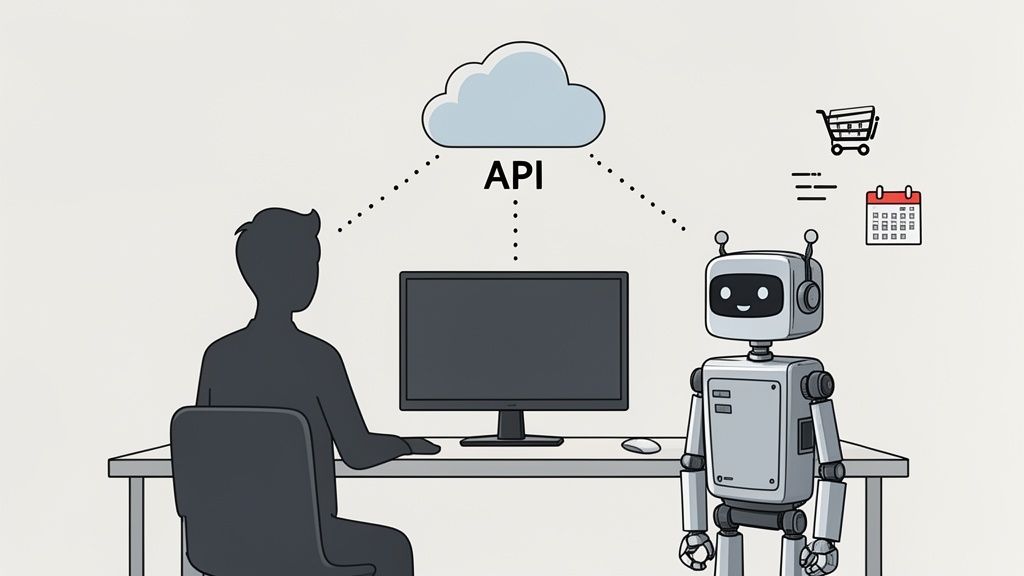
Leverage API-Driven Integration: Your agent needs to talk to your existing tools, like your CRM or calendar. Modern platforms like DialNexa are built with robust APIs that make this happen seamlessly, connecting the agent’s actions directly into your business workflows with minimal technical overhead.
This kind of strategic, phased deployment is quickly becoming the norm. In fact, confidence among business leaders in India is sky-high, with 93% expecting AI agents to join their workforce within the next 12 months. This signals a major shift—agents are now seen as tools that enhance human capabilities, not threaten jobs. For a deeper look at these workforce trends, you can discover more insights on YouTube.
Built for Rapid and Scalable Deployment
The era of multi-month, engineering-heavy AI projects is behind us. The right platform means you don't need a massive technical lift to get started. You can move from an idea to a live deployment in a fraction of the time, which is where platforms designed for rapid implementation really shine.
For business leaders, the goal is to achieve value within weeks, not months. A platform that provides pre-built agent personas, intuitive dashboards, and straightforward API documentation is critical for turning strategy into reality without getting bogged down in technical complexities.
Platforms like DialNexa are engineered for exactly this. There's no need to build an agent from the ground up. You can simply pick a pre-built persona for your industry—whether it's real estate, EdTech, or BFSI—and tweak it to match your specific business rules. This approach slashes setup time and lets you concentrate on the results.
This model lets you start small, prove the concept, and then scale with confidence. Once your first pilot shows a clear ROI, you can easily expand the agent's responsibilities or deploy more agents in other departments. This iterative process ensures every step of your AI integration is backed by proven success, building solid internal support for a wider rollout. For more on this, check out our guide on putting teams of GenAI agents to work.
Best Practices for Scaling Your AI Strategy
Taking a successful AI pilot and rolling it out across the entire enterprise is where the real magic happens. This is the moment a knowledge based agent in AI goes from a promising experiment to a core business asset. For leaders, making this jump requires a solid playbook. It’s not about flipping a switch; it's about building a robust framework that can grow without breaking and consistently deliver real value.
The guiding principle is simple: start small, prove the value, and then scale thoughtfully. This approach mitigates risk, builds stakeholder buy-in, and allows you to refine your strategy using real performance data. For example, once you’ve nailed a pilot for qualifying sales leads that delivers a 4x increase in bookings, you have a powerful business case to expand the agent's role into customer support or even recruitment.
Maintain a Living Knowledge Base
An AI agent is only as smart as the information it can access. Think of its knowledge base not as a static manual but as a living, breathing resource. It needs constant care and attention to avoid "data decay." Your business is always changing—new products, updated policies, different promotions—and your agent must keep up in real-time.
To maintain peak agent performance, implement a disciplined update process:
- Regular Audits: Schedule quarterly reviews of the entire knowledge base to hunt down and eliminate outdated or irrelevant information.
- Feedback Loops: Create a simple process for your human team to flag when the agent gives a wrong or incomplete answer. This simple step turns your staff into a frontline quality control team.
- Automated Triggers: The most effective approach is to connect your knowledge base to your other core business systems via API. For instance, when your product team updates the product information management (PIM) system, it should automatically push that update to the AI agent’s knowledge base.
This diligent upkeep ensures your agent remains a trusted source of truth, delivering the kind of accuracy that builds customer confidence and keeps your operations running smoothly.
Monitor Performance Against Business KPIs
To justify continued investment and guide your expansion strategy, you must connect the agent's performance to the metrics that matter most to the business. It’s easy to get stuck on operational stats like call volume, but the real story is in the impact on key performance indicators (KPIs).
A successful AI strategy isn't measured by how many calls an agent handles, but by how much it moves the needle on key business outcomes like revenue growth, customer retention, and operational efficiency.
Start tracking the metrics that get the C-suite’s attention:
- Lead-to-Booking Rate: Are the leads qualified by your AI converting into actual business at a higher rate than leads from other channels? (e.g., Target: Increase from 2% to 8%).
- Customer Lifetime Value (CLV): Does providing instant, 24/7 support via an AI agent make customers stick around longer and spend more? (e.g., Target: 15% increase in CLV for AI-serviced customers).
- Cost Per Acquisition (CPA): How much does automating the initial outreach and qualification process lower the cost of bringing in a new customer? (e.g., Target: Reduce CPA by 30%).
Platforms like DialNexa come with intuitive dashboards that make it simple to track these vital KPIs, giving you a crystal-clear picture of your return on investment.
Establish Robust Governance and Ethical Guardrails
As your AI initiative grows, having clear governance isn't just a good idea—it's essential for risk management. This means setting firm rules around data privacy, ensuring the agent is used ethically, and being transparent about its operation. A solid governance framework protects your brand and builds trust with customers and employees alike.
Here are the key pillars of strong AI governance:
- Data Handling Protocols: Be explicit about what data the agent can access and how it can use it. This is non-negotiable for complying with regulations like GDPR and other data protection laws.
- Escalation Paths: Design clear, automated triggers for the agent to hand off a conversation to a human expert when things get too complex or sensitive. For instance, any mention of "complaint" or "legal" should automatically route to a human.
- Transparency Statements: Always let customers know when they're talking to an AI. It’s a simple, ethical practice that builds trust.
Finally, scaling successfully demands an infrastructure that won't buckle under pressure. Platforms like DialNexa are built to handle thousands of simultaneous calls while maintaining perfect message consistency. This kind of reliability is crucial when you're depending on AI for mission-critical outreach and support. To get a deeper look at managing these kinds of intensive AI workloads, check out our guide on how to run multiple AI workloads on a single GPU.
Building Your Competitive Edge with DialNexa
The debate is over. For any leader serious about growth, a knowledge based agent in AI is no longer a "nice-to-have"—it's a core component of a modern business strategy. This technology separates the businesses that are just keeping up from the ones actively capturing market share. It’s how you transform your customer operations from a cost centre into a predictable, scalable revenue engine.
Sitting on the sidelines is an active choice to accept lower connect rates, longer sales cycles, and bloated operational costs. Meanwhile, your competitors are pulling ahead. We’ve seen it happen time and again: businesses that implement this technology see dramatic lifts in efficiency and lead quality, freeing up their human teams to do what they do best—think strategically and close high-value deals.
Your Next Step to Measurable Growth
Understanding the potential is one thing; acting on it is what creates value. The results speak for themselves. We’re talking about connect rates jumping from 47% to a staggering 91%, and lead-to-booking conversions rocketing from 2% to 8%. These aren't just abstract figures—they represent real revenue and a stronger, more defensible market position.
Adopting a knowledge based agent is a direct investment in your bottom line. It’s about building a scalable, intelligent system that consistently delivers superior customer conversations and measurable, conversion-focused results.
This doesn't have to be a painful, high-risk project. With DialNexa, we make the transition incredibly straightforward. We believe in offering a clear, low-risk path to modernising how you engage with customers. Our transparent pricing and simple signup process are designed to get you started fast, so you can begin demonstrating the value of intelligent automation to your stakeholders right away.
Don’t let outdated systems define your future. The tools to build a lasting competitive advantage are right here, and they're more accessible than you think. The only real question is, are you ready to use them?
Ready to see how a knowledge based agent can redefine your business outcomes? Explore DialNexa's solutions and start your journey toward smarter, more profitable customer conversations today.
Frequently Asked Questions
When considering new technology, executives need to know it will deliver real, measurable value. Here are some of the most common questions we hear from business leaders about how a knowledge-based agent can make a tangible difference to the P&L.
What’s the Real Difference Between a Knowledge-Based Agent and a Regular Chatbot?
This distinction is crucial for any strategic decision-maker. A standard chatbot is essentially a digital FAQ page that operates via keyword matching. It follows a script and fails when a query deviates from its pre-programmed paths.
A knowledge-based agent in AI, on the other hand, truly understands and reasons. It doesn't just match keywords; it connects disparate pieces of information from its knowledge base to solve problems it hasn't been explicitly trained for.
Practical Example: A chatbot might fail with a complex query. But a knowledge-based agent can flawlessly handle, "Show me pet-friendly properties under ₹50 lakhs that are open for a site visit this Saturday." It synthesizes multiple data points (location, price, pet policy, agent availability) to provide a genuinely helpful answer, leading to conversations that directly drive revenue.
How Much Technical Know-How Do We Need to Get Started?
This is where the right platform makes all the difference. Building a knowledge-based agent from scratch requires a dedicated team of AI specialists, a significant budget, and a long timeline—a massive undertaking.
However, modern platforms like DialNexa are designed to remove this barrier entirely. We’ve done the heavy lifting so you don't have to. With clear API documentation, pre-built agent templates for industries like EdTech and BFSI, and intuitive dashboards, your team can deploy a powerful voice AI agent without writing a single line of complex code. This allows you to focus on business strategy, not the underlying technology. Deployment can often happen in weeks, not years.
How Do We Actually Measure the ROI on an AI Agent?
Measuring the return on investment must be straightforward and tied directly to core business goals. We’re not talking about fuzzy benefits; we mean hard numbers you can present to the board.
Here’s what you should be tracking:
- Cost Savings: Calculate the reduction in human agent hours spent on repetitive tasks. Many businesses see a 40% reduction in manual call time for lead qualification, translating to significant operational savings.
- Revenue Impact: Measure the direct increase in conversions from AI-qualified leads. Seeing your lead-to-booking rate jump from 2% to 8% is a clear indicator of a high-performing investment.
- Operational Efficiency: Track the increase in meaningful connections. An increase in connect rates, say from 47% to 91%, means your sales team is spending their valuable time on revenue-generating conversations.
The best way to prove an agent's worth is to connect its performance directly to your bottom line. A good platform will give you the tools to do this. For instance, DialNexa includes built-in dashboards that track these essential KPIs in real-time, offering a transparent, data-driven view of how your investment is paying off.
Ready to see what a DialNexa knowledge-based agent could do for your business? Explore DialNexa's solutions and discover how smarter conversations can lead to better outcomes.

[…] building on retrieval-heavy workflows often benefit from patterns similar to those used in a knowledge-based agent in AI, where answer quality depends on precise grounding rather than generic model […]
This is an excellent explanation of how knowledge-based AI agents move beyond basic automation to become true revenue drivers. The practical examples and ROI metrics clearly show why intelligent AI adoption is becoming a competitive advantage across industries.
[…] reliably draw from approved internal content, it will fail under live pressure. This explainer on a knowledge-based agent in AI is a good companion topic for evaluation […]