
IVR Software in India for 2026: How
IVR software is a cloud-based call-routing system that uses voice prompts and keypad inputs to direct inbound callers to the right department or agent, while modern Voice AI IVR replaces menu trees with natural-language understanding that can qualify leads, answer questions, and complete actions without human intervention. India's contact-centre software market is estimated at USD 1.7 billion in 2025 and projected to reach USD 9.6 billion by 2034, so IVR is no longer a minor telephony add-on. (IMARC)
The counterintuitive problem is that many enterprises have invested in automation that callers actively try to escape. A 2026 India-focused playbook reports that approximately 70% of callers press zero or say “agent” to bypass IVR menus. (ConveriQo) For a CXO, that isn't merely a menu-design flaw. It signals wasted platform capacity, unnecessary transfers, avoidable agent workload, and a customer journey that starts with resistance.
Table of Contents
- Why Most IVR Systems Fail And What Changes in 2026
- What IVR Software Is and How It Works
- Core Capabilities That Define Modern IVR
- Compliance and Security Requirements for Indian Enterprises
- Traditional Menu-Based IVR versus Conversational Voice AI
- Choosing an IVR Provider in India Vendor Landscape and Evaluation Framework
- Real-World Use Cases and Implementation Path for Indian Enterprises
Why Most IVR Systems Fail And What Changes in 2026
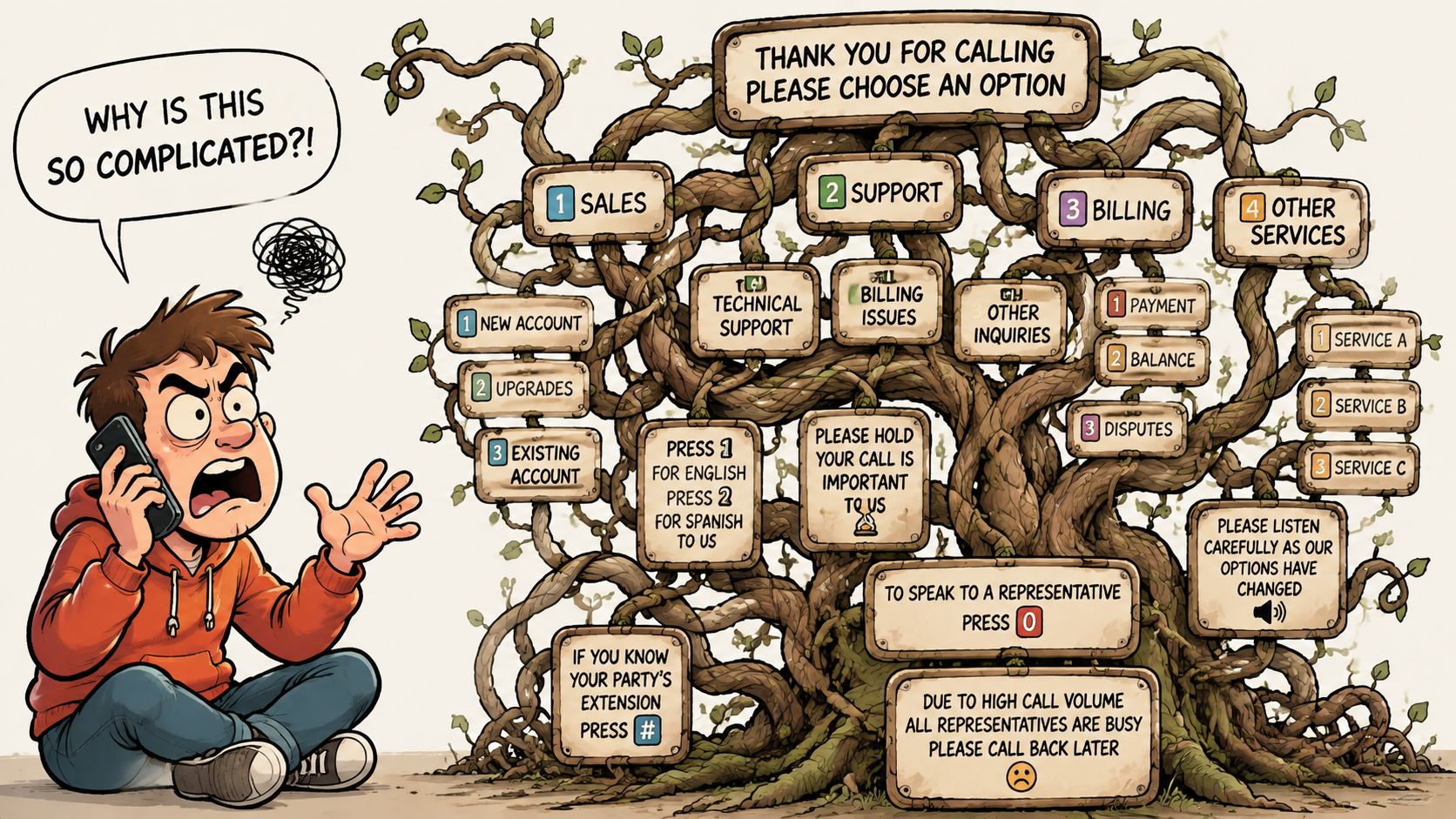
An IVR can complete every programmed step and still fail the customer. An insurer's caller may be asked for language, product, policy type, and claim category, yet not know which category fits the problem. One wrong key can restart the journey, leading the caller to say “agent” or abandon the call.
IVR software is a cloud-based call-management system that automates inbound calls and routes customers to agents or workflows. The MyOperator IVR system illustrates this India-facing model through automated inbound handling and agent routing. The implementation, however, depends on telephony, customer data, compliance, language support, analytics, and workforce operations working together.
Failure usually starts with treating IVR as a one-time menu project. Operations teams often arrange options around departments instead of caller intent. A bank may present cards, loans, deposits, and collections while the caller needs to dispute an unfamiliar debit. A healthcare provider may organise the menu by clinic, although patients usually want to book an appointment, check a report, describe symptoms, or cancel a visit.
Practical rule: Design the first interaction around what callers are trying to accomplish, not how the organisation is divided.
IVR should be managed as a living stack. Menu logic, integrations, language models, compliance controls, analytics, and escalation paths need review as products and customer behaviour change. Traditional keypad routing remains suitable for predictable, high-volume tasks. A conversational layer can handle requests such as changing an EMI date without forcing callers through several menu branches. Teams assessing that layer can review this guide to voice AI agents for developers.
For Indian CXOs, the investment case rests on operating outcomes, not on adding another phone number. The system should reduce avoidable live-agent demand while preserving trust, language access, regulatory control, and a reliable human handoff. Vendor evaluation must therefore test the full operating stack, including how quickly teams can change journeys, connect business systems, measure containment, and recover when speech recognition or automation fails.
What IVR Software Is and How It Works
IVR software is a connected operating stack, not just a recorded menu. Its quality depends on how telephony, recognition, business systems, routing rules, automation, and human escalation work together from the first ring to the final outcome.
The call flow
The caller connects. The public business number reaches a cloud telephony or contact-centre platform. The system identifies the number, applies business-hours rules, and plays a greeting.
The caller provides an input. In a traditional flow, the caller presses a DTMF key. DTMF, or dual-tone multi-frequency signalling, is the keypad method used to communicate selections during a call. A speech-enabled flow accepts a request such as “billing dispute” or “track my order”. For a focused explanation, see what DTMF means in telephony.
The system interprets the input. A keypad selection maps directly to a programmed branch. Spoken input passes through automatic speech recognition, or ASR, which converts audio into text. Natural-language processing and natural-language understanding, known as NLP/NLU, then classify the caller's intent.
The routing engine applies rules. The dialog manager evaluates intent, caller data, language, time of day, location, queue availability, and business rules. It can send the call to a collections team, regional support queue, specialist, or self-service workflow.
The platform completes or transfers the interaction. Text-to-speech, or TTS, generates an automated response. If a transfer is required, the platform passes relevant context to the agent. It also records calls, selections, transfers, outcomes, and other events for reporting.
A bank customer disputing a billing entry shows how these components interact. A conventional IVR might ask the customer to select cards, then billing, then disputes. A cloud IVR can use the caller's number to retrieve the customer record through a CRM integration, request limited verification, identify the dispute intent, and display that context to the agent before the conversation begins.
The difference between legacy and cloud IVR is architectural as well as visual. Older deployments often rely on dedicated telephony hardware and fixed call logic. A cloud system runs on communications-platform-as-a-service infrastructure and exposes APIs for retrieving account information, creating tickets, generating dynamic prompts, initiating callbacks, and connecting an external voice AI engine.
Every component introduces a possible failure point. ASR may mishear an accent, NLU may classify an ambiguous request incorrectly, TTS may sound unnatural, and routing rules may send a valid intent to the wrong queue. Test the complete workflow, including DTMF fallback for callers who prefer keypad input, rather than approving each component in isolation.
Core Capabilities That Define Modern IVR
A competent IVR answers calls. A modern deployment also helps operations leaders understand demand, apply policy, and complete routine work without forcing callers through the organisation's internal structure.
Routing that reflects business reality
Intelligent routing can combine skill, geography, language, queue availability, and time-of-day rules. A BFSI operation might send a collections call to the relevant loan team while directing an unauthorised-transaction complaint to a customer-protection queue. A regional healthcare provider can use language and location to direct callers to the appropriate centre.
Natural-language processing creates another route into the system. The platform can classify different forms of the same request instead of mapping every sentence to a separate menu item. That reduces caller effort, but it does not remove the need for fallback paths, clear intent boundaries, and keypad input when speech recognition fails.
Data before the agent answers
CRM and CTI integrations let the IVR retrieve caller context before transfer. Depending on permissions and workflow, this may include an account record, open ticket, policy details, appointment information, or previous interaction history. The operational benefit is specific: customers spend less time repeating information already held by the business.
Analytics must expose more than total call volume. Directors need visibility into abandonment, menu-level drop-off, queue waits, routing accuracy, average handling time, self-service completion, and first-call resolution. Review these measures by queue, language, intent, and time period to identify flows that create avoidable transfers or cause callers to leave.
Language as an operating requirement
Multilingual support involves more than translated greetings. The platform must handle language selection, local pronunciation, speech recognition, prompts, agent routing, escalation, and reporting by language. TRAI rules require complaint centres to provide service in the local language of the service area in addition to Hindi and English. Where IVR is installed on a consumer care number, the first IVR level must offer language selection. Government guidance has also advised telecom providers to extend IVR and customer care across all Eighth Schedule languages. (Lok Sabha guidance)
Language therefore affects the full operating design. A fluent English vendor demonstration does not show that the same flow will handle code-switching, regional accents, or noisy mobile calls. Test real caller recordings, transfer behaviour, and reporting by language before approving the deployment.
India's contact-centre software market places IVR within a wider category covering routing, self-service, and customer operations. The market estimate of USD 1.7 billion in 2025 and projected USD 9.6 billion by 2034 provides context for investment decisions. (IMARC market estimate)
Reliability needs operational testing. Ask how the provider handles carrier failure, traffic spikes, failover, recording continuity, incident communication, and recovery testing. A feature-rich flow that cannot answer calls consistently is not a successful IVR deployment. Ensure the design also supports a controlled rollback when a routing change or AI model update produces unexpected results.
Compliance and Security Requirements for Indian Enterprises
Indian enterprises shouldn't approve an IVR design before mapping its regulatory purpose. The same platform may handle inbound complaints, outbound reminders, consent acquisition, identity verification, and recorded customer interactions. Each use case creates different controls around messaging, consent, access, retention, and escalation.
DLT and commercial consent
TRAI has moved commercial communication consent handling towards a unified Digital Consent Acquisition, or DCA, process backed by Distributed Ledger Technology, or DLT. Access providers must develop a DCA facility, and consent data is shared on DLT for scrubbing. The first phase permitted only subscriber-initiated consent acquisition. (TRAI DCA direction)
For an IVR or outbound-calling programme, the consent journey should clearly state the purpose, scope, and principal entity or brand name. The same direction requires approved links, applications, OTT links, or callback numbers in consent-seeking messages and supports SMS, IVR, or online revocation of unwillingness. A system that can collect consent but can't record its source, status, scope, or revocation event creates an avoidable governance problem.
TRAI's 2025 regulation states that DLT supports preference recording, consent acquisition and verification, complaint handling, entity registration, and content-template registration. It also states that DCA records consent on DLT after OTP verification. A customer who has revoked consent can opt in again, but the sender may re-acquire consent only after 90 days from revocation or opt-out. (TRAI 2025 regulation)
Verification workflows and retention
The DoT/CDOT subscriber tele-verification procedure shows how specific a regulated IVR flow can become. The sequence includes:
- Language selection, followed by document-type selection.
- Entry of the last four digits of the identity document.
- Year of birth in YYYY format.
- Database matching before activation.
- Up to 3 retries after failure, followed by escalation to a human agent.
- Preservation of IVR logs for the applicable CAF retention period.
These aren't optional UX preferences in that workflow. They are process controls. (DoT/CDOT IVR procedure)
Security evaluation should therefore cover role-based access, recording permissions, audit trails, encryption practices, retention configuration, redaction options, vendor subprocessors, and the location where recordings and logs are stored. The applicable storage requirement depends on the enterprise's sector, contract, and regulatory obligations, so buyers should obtain written answers rather than assume that a generic cloud deployment satisfies them.
The platform must also support local-language complaint handling alongside Hindi and English where TRAI rules require it. A useful TRAI and DLT registration guide can help teams organise the registration questions, but legal and regulatory review should remain part of the deployment process.
Traditional Menu-Based IVR versus Conversational Voice AI
Traditional IVR remains the better tool when intent is predictable and the required action is narrow. Payment reminders, appointment confirmations, language selection, order-status checks, and transfers to known departments can run efficiently through fixed menus. The failure begins when a complex customer request is forced into a rigid tree, creating repeated prompts, wrong transfers, and avoidable agent work.
India-focused voice AI reporting identifies Hindi-English code-switching as the dominant language configuration in production. The same dataset describes deployments across 10+ Indian languages, average response latency below 500 ms, and voice agents handling 30-50% of Tier-1 queries across BFSI, telecom, e-commerce, and healthcare. (Edesy India voice AI report) These are reported industry results, not a forecast for every enterprise. Performance depends on speech data, integration quality, escalation design, and the types of calls included in the measurement.
Contact-centre operators also report increasingly complex customer interactions. That operating reality supports a hybrid design: conversational AI identifies intent and completes routine work, while trained agents take over sensitive, ambiguous, emotional, or commercially important conversations with the relevant context attached.
| Dimension | Traditional menu-based IVR | Conversational Voice AI |
|---|---|---|
| Caller input | DTMF keys and fixed voice commands | Natural language, with keypad fallback where required |
| Experience | “Press 1 for…” menu navigation | Caller describes the request in their own words |
| Flow design | Predefined branches and routing rules | Dynamic dialogue, intent detection, and workflow actions |
| Best fit | Simple routing, reminders, status checks, predictable self-service | Qualification, support conversations, booking, verification, and routine resolution |
| Multilingual handling | Separate prompts and language branches | Speech recognition and responses designed for local languages and code-switching |
| Compliance fit | Strong for controlled, deterministic flows | Requires guardrails, disclosures, logging, verification, and human escalation |
| Human fallback | Usually a menu escape or transfer | Contextual transfer after the system identifies the request |
| Cost structure | Platform, telephony, configuration, and usage charges | Platform, telephony, usage, integration, and conversation-design charges |
An EdTech admissions line illustrates the distinction. A conventional menu can separate existing students from new applicants. A conversational agent can ask which programme the applicant is considering, answer approved questions, collect eligibility information, schedule a counselling call, and send the admissions team a structured lead summary. It should not improvise fees, promise admission, or continue with an uncertain request without escalation.
The practical decision depends on control and variation. Use menu-based IVR for deterministic processes with defined inputs, strict verification, or predictable routing. Add conversational Voice AI where callers express varied intent and the business gains from qualification, data capture, or completed actions. Teams assessing that middle ground can review this guide to an AI call bot.
Choosing an IVR Provider in India Vendor Landscape and Evaluation Framework
Provider selection should start with the operating model, not a demo script. India's call and contact-centre outsourcing market generated USD 3,859.7 million in 2024 and is projected to reach USD 9,037.8 million by 2030, with voice the largest revenue-generating type in 2024. (Grand View Research) For enterprises supporting outsourced or distributed voice operations, IVR becomes infrastructure that affects staffing, service consistency, and compliance.
The following providers are neutral market references, not a ranking. Public information and commercial terms change, so procurement teams should validate current capabilities directly.
IVR and Voice AI Providers in India, Comparison Overview
| Provider | Type | IVR strengths | Voice AI capability | Primary use cases | Pricing model |
|---|---|---|---|---|---|
| MyOperator | Cloud call-management and telephony provider | IVR, virtual numbers, toll-free numbers, cloud EPABX, automatic call distribution, call tracking, recording, and reports | Confirm the current conversational scope during evaluation | Business calling, support routing, number management, reporting | Public source material cited here doesn't provide a price |
| Exotel | Cloud telephony and CPaaS provider | Programmable voice, call flows, routing, and contact-centre integrations | Confirm current AI products and workflow depth with the provider | Enterprise communications, support, outbound operations, developer-led integrations | Confirm current commercial model directly |
| Knowlarity | Cloud communications and contact-centre provider | Business numbers, IVR, routing, and contact-centre functions | Confirm current conversational capabilities during procurement | Customer service, sales, and enterprise voice operations | Confirm current commercial model directly |
| DialNexa Labs Private Limited | Conversational Voice AI platform | Can complement traditional IVR with agent handoff and workflow routing | Voice AI agents for qualification, support, recruitment, and presales | EdTech, BFSI, real estate, healthcare, e-commerce, and software workflows | Review the current commercial offering directly |
Startup India describes MyOperator as a cloud-based call-management system offering IVR, virtual and toll-free numbers, cloud EPABX, automatic call distribution, call tracking and recording, and reports. (Startup India profile) That makes it a concrete comparison point for buyers assessing standard cloud telephony capabilities. The cited material doesn't provide public pricing, so a responsible buyer shouldn't treat an unverified figure as a quote.
A procurement checklist that survives the demo
- Language quality: Test real Indian accents, code-switching, background noise, interruptions, and fallback behaviour.
- Compliance readiness: Ask how the platform supports DLT processes, consent records, revocation, approved templates, audit logs, and regulated verification.
- Integration depth: Review CRM, ticketing, payment, scheduling, identity, and API workflows using a sandbox or controlled test.
- Analytics detail: Confirm whether reports expose abandonment by menu, transfer reasons, self-service completion, language, queue, and outcome.
- Peak resilience: Request documented handling for traffic surges, carrier disruption, failover, and recovery.
- Commercial clarity: Separate number rental, telephony usage, platform access, recordings, implementation, integrations, and AI conversation usage.
- Vendor governance: Assess support ownership, escalation paths, release management, data access, and exit options.
A broader vendor evaluation guide from TekRecruiter is useful for structuring the non-technical parts of the decision, particularly stakeholder alignment, risk review, and commercial evaluation. For a more focused look at the Indian market, compare the capabilities described in this guide to cloud telephony providers.
Real-World Use Cases and Implementation Path for Indian Enterprises
The right IVR architecture depends on the conversation that precedes the action. A collections call, an admissions enquiry, and a clinic reminder don't need the same prompts, data access, escalation rules, or success criteria.
BFSI collections and support
A borrower calls about an overdue loan. The system selects the language, verifies the caller through an approved workflow, identifies the loan type, captures the reason for calling, and routes collections, hardship support, or a complaint to the correct team. Leadership should monitor connection quality, correct routing, completed commitments, complaint escalation, and first-call resolution.
EdTech admissions
A prospective student asks about a programme, eligibility, fees, or the next counselling step. A conversational agent can collect the course preference, study mode, location, and callback availability, then create a qualified CRM record or schedule a human counsellor. The operational outcome is better visibility into lead quality, follow-up workload, and lead-to-booking movement, not merely a higher call count.
Real estate site visits
The caller expresses interest in a property. The system confirms the project, asks about preferred timing, checks agent availability through an integration, and sends the booking context to the sales team. The relevant measures include qualified enquiries, booked visits, confirmation completion, and the reduction in manual scheduling calls.
E-commerce order confirmation
An outbound call can confirm an order, validate a cash-on-delivery request, capture a cancellation reason, or route an exception to an agent. The business should track successful confirmations, unresolved exceptions, repeat attempts, and manual verification effort. Consent and communication controls must be established before launch.
Healthcare appointments
A multilingual IVR can confirm an appointment, collect a cancellation or rescheduling request, and issue a reminder through an approved workflow. A provider should test language accuracy, patient identity handling, escalation for clinical questions, and the effect on appointment attendance and staff follow-up effort without assuming that automation alone will reduce no-shows.
A controlled implementation path
- Map the use case and risk: Define caller intents, sensitive data, prohibited responses, escalation triggers, and the human owner for every exception.
- Complete compliance preparation: Review DLT and consent requirements for outbound communication, applicable registrations, recording retention, and local-language service obligations.
- Provision numbers and carrier connectivity: Confirm number ownership, inbound and outbound permissions, failover, and call-recording controls.
- Connect business systems: Integrate the CRM, ticketing platform, scheduling system, collections workflow, or order database before writing elaborate prompts.
- Design the conversation: Keep traditional menus narrow. Use Voice AI only where natural-language interaction creates a clear operational benefit.
- Test with real callers: Run multilingual UAT with interruptions, silence, accents, incorrect answers, busy queues, API failures, and requests for an agent.
- Roll out in phases: Start with a controlled workflow, review recordings and analytics, correct failure paths, and expand only after operations teams can handle escalation volume.
India's IVR market is moving towards a living stack that combines telephony, rules, data, language, analytics, and conversational automation. Traditional menus still provide predictable control. Voice AI adds flexibility where intent is difficult to predefine, but human fallback remains part of responsible design.
DialNexa Labs Private Limited offers conversational Voice AI agents for qualification, customer support, recruitment, and presales, with workflows that can complement traditional IVR across BFSI, EdTech, real estate, healthcare, and e-commerce. Visit DialNexa Labs Private Limited to review a voice AI-first approach for your call flows, integrations, and phased deployment plan.

This is a well-structured guide that clearly explains how modern IVR goes beyond simple menu-based call routing. The practical focus on multilingual support, compliance, analytics, and human escalation makes it especially valuable for Indian enterprises.
This is a well-structured guide that clearly explains how modern IVR goes beyond simple menu-based call routing.
This article offers useful insights into IVR software in India and its role in improving business communication in 2026. A practical read for businesses looking to streamline customer interactions and enhance their calling experience.
This is a detailed and practical guide that clearly explains how modern IVR systems are evolving from traditional menu-based routing to conversational Voice AI.
The focus on intelligent routing, multilingual support, compliance, security, and real-world use cases makes the article highly valuable for businesses evaluating IVR solutions.
The comparison between traditional IVR and conversational voice AI makes it easier to understand where each approach fits in real business operations.