

Boost Growth with AI-Powered Client Value Management
A major telecom operator delivered a +20% CLTV uplift after implementing an AI-powered CVM engine, a result that turns client value management from a soft customer initiative into a board-level growth lever, as noted by Simon-Kucher's analysis of CVM as a growth lever. That single data point changes the conversation.
Most leadership teams already manage accounts, service levels, renewals, and pipeline coverage. Few manage value with the same discipline. That gap matters because client value management is where commercial strategy, operating data, and customer outcomes meet. It gives management a way to decide which clients deserve more investment, which journeys require intervention, and which offers increase long-term value rather than short-term volume.
For executive teams, the attraction isn't conceptual. It's financial. Client value management gives the organisation a repeatable system for linking customer behaviour to P&L outcomes, then operationalising that insight through analytics, workflow design, and increasingly, Voice AI.
Table of Contents
- What Is Client Value Management and Why It Matters Now
- The Strategic ROI of Client Value Management
- A Practical Framework for Managing Client Value
- Implementing Your CVM Strategy A Practical Roadmap
- How Voice AI Revolutionises Client Value Management
- Client Value Management Use Cases in Your Industry
- The Future of CVM Your Strategic Advantage in 2026
What Is Client Value Management and Why It Matters Now
Client value management is the discipline of identifying, quantifying, delivering, and expanding the value created within a client relationship. That's different from conventional account management, which often focuses on activity, service responsiveness, or renewal timing rather than economic value creation.
A CRM tells you what happened. Account reviews tell you how the relationship feels. Client value management asks a harder question: where is value being created, where is it leaking, and what should the business do next?
Moving beyond account coverage
Many firms still run client relationships through functional silos. Sales owns acquisition. Service owns complaints. Finance reviews revenue after the fact. Marketing tracks engagement. The client experiences one journey, but the enterprise measures fragments.
Client value management replaces that fragmented view with a commercial one. It treats each account or segment as an asset whose value can be improved through better targeting, better timing, and better resource allocation.
A useful starting point is to separate customer value from customer satisfaction. Satisfaction can coexist with low profitability. Value management forces leadership teams to measure both. That's why a deeper look at customer value and satisfaction is helpful for teams trying to align service quality with economic returns.
Boardroom test: If your leadership team can describe top clients by revenue but can't explain their future value potential, you don't yet have a client value management discipline.
Why it matters now
The urgency comes from three pressures converging at once.
- Growth pressure: Boards want efficient growth, not just gross top-line expansion.
- Data availability: Organisations now capture enough interaction, transaction, and financial data to model value more precisely.
- Execution technology: AI systems can act on value signals far faster than manual teams can.
This changes the role of customer operations. What used to be a support function becomes a strategic mechanism for protecting revenue, increasing wallet share, and prioritising finite commercial effort.
What leaders should recognise early
Client value management works when leadership stops asking only operational questions and starts asking strategic ones:
| Executive question | Why it matters |
|---|---|
| Which client segments create the most long-term value? | It guides investment and coverage design. |
| Where do we lose value across the lifecycle? | It reveals hidden leakage in service, follow-up, and conversion. |
| Which interactions increase future profitability? | It helps teams scale what works instead of rewarding noise. |
The shift is subtle but decisive. The organisation stops managing contacts and starts managing economic outcomes.
The Strategic ROI of Client Value Management
A 20% increase in customer lifetime value can change enterprise valuation more than a similar gain in quarterly sales, because it improves both future cash flow and revenue durability. That is why boards should evaluate client value management as a growth system, not as a reporting upgrade.
ROI starts with revenue quality
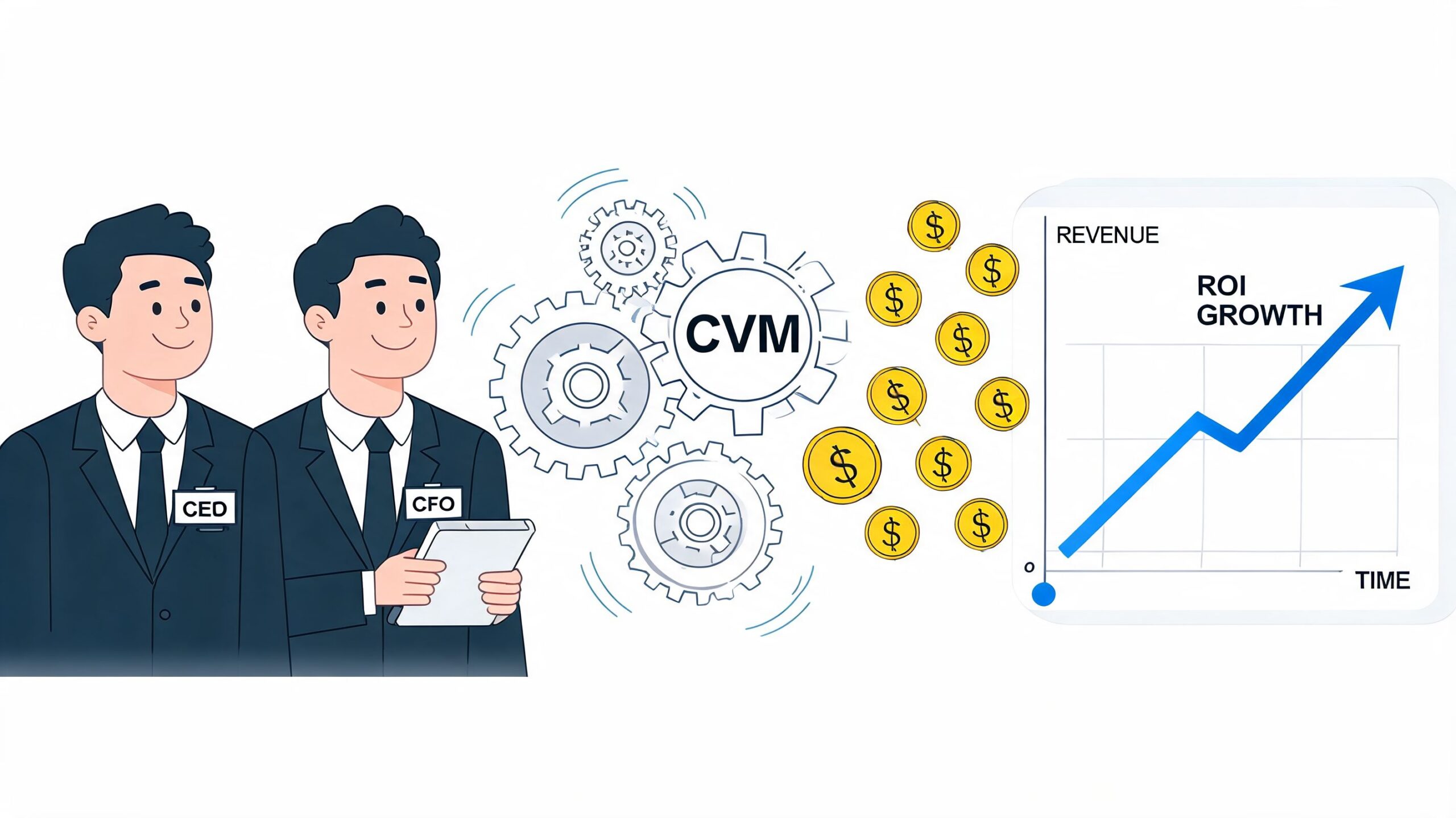
The strongest CVM business case appears when leadership measures how client actions change future economics. A telecom operator cited in earlier research achieved a 20% CLTV uplift after deploying an AI-based CVM engine. The implication for executives is straightforward. Better retention, better expansion timing, and better service allocation improve the value of the installed base, which usually carries higher margins than net-new acquisition.
This changes the investment debate. The question is not whether CVM produces cleaner dashboards. The question is whether it improves net revenue retention, raises customer lifetime value, and reduces the amount of commercial effort wasted on low-potential accounts.
CLTV gives finance and operations a common language
CLTV matters because it links commercial behaviour to enterprise value in a way both the CFO and the CRO can use. If a client generates more annual gross profit, stays longer, or expands earlier in the relationship, value rises. If churn occurs earlier than expected or high-cost service models are applied to low-potential accounts, value falls.
That sounds obvious. Many firms still manage the client base using period revenue, pipeline coverage, and service volume metrics that do not capture the economics of the relationship over time.
A board-level CVM discipline corrects this by asking a harder set of questions. Which accounts justify proactive intervention? Which service motions protect margin as well as retention? Which signals indicate expansion readiness before the renewal window appears? Teams that can answer those questions allocate resources with more precision.
The return comes from intervention, not analysis alone
Analytics identifies where value is likely to rise or leak. P&L impact appears only when those insights are turned into action across sales, success, service, and renewal workflows. That is where modern orchestration matters, especially when firms use structured client feedback and conversation data to trigger the next best action. A disciplined voice-of-client programme gives those decisions a stronger evidence base by connecting sentiment, friction points, and expansion opportunities to account-level economics.
Voice AI extends that model from passive reporting to active execution. It can detect churn risk in calls, surface missed upsell cues, route high-value accounts to the right team, and standardise follow-up at a speed manual teams cannot match. The strategic advantage is not automation for its own sake. It is the ability to act on value signals before revenue moves.
For data leaders building that operating model, this perspective on AI strategies for data teams is useful because tracking quality and model governance often determine whether CVM remains an insight project or becomes a repeatable growth discipline.
What boards should expect from a CVM programme
A well-run CVM programme should improve four financial outcomes:
- Higher net revenue retention: Expansion and retention resources are concentrated where future value is greatest.
- Stronger CLTV to CAC economics: The business gets more return from every acquired client, improving acquisition efficiency.
- Better margin discipline: High-cost service is reserved for accounts where the expected return justifies the investment.
- More reliable forecasting: Leadership reviews shift from account anecdotes to quantified value trajectories.
The non-obvious benefit is strategic focus. CVM gives management a way to rank clients by future economic contribution rather than current visibility or internal politics. Firms that do this well do not just retain more revenue. They build a more defensible growth model, because competitors can copy products faster than they can copy a system that identifies, measures, and acts on client value at scale.
A Practical Framework for Managing Client Value
A workable client value management model needs to do four jobs well. It must identify value, quantify it, communicate it clearly inside the business, and realise it through action. If one of those stages fails, the rest become theatre.
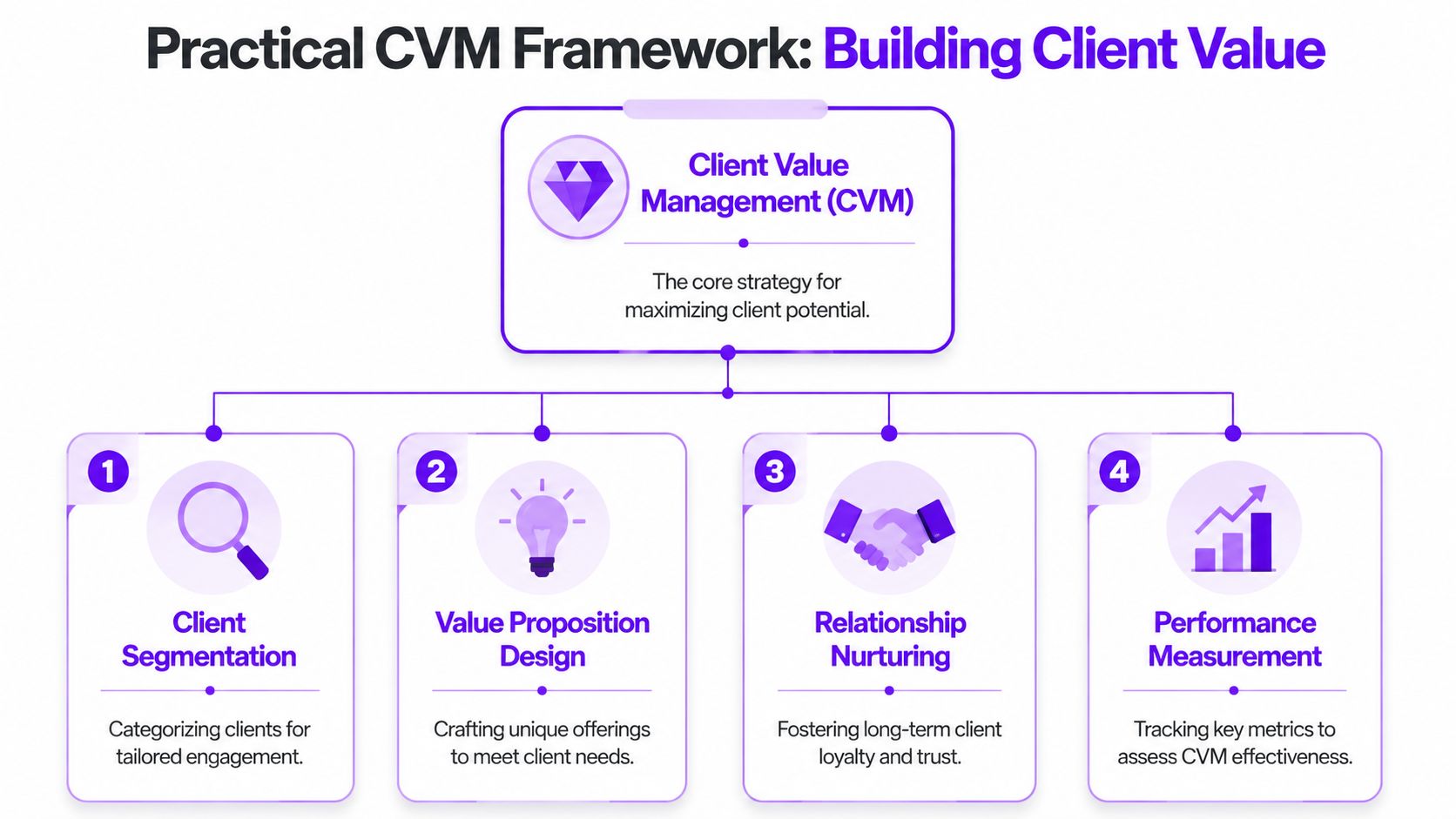
Value identification
This stage asks a foundational question. Where does value sit within the client base?
For some firms, value sits in high-frequency buyers. For others, it sits in clients with strong expansion potential, referral influence, or durable retention profiles. Leadership teams often misread this because they focus on current revenue rather than future economics.
The practical job here is segmentation. Not all clients deserve identical service design, outreach cadence, or executive attention.
Questions a CXO should ask:
- Which segments generate strategic value, not just near-term revenue?
- Which behavioural patterns signal rising or declining value?
- Which accounts appear healthy but are under-monetised?
Value quantification
Once the organisation identifies where value sits, it has to measure it credibly. Many programmes falter here, losing momentum. Teams describe value in broad language but don't connect it to a financial model.
Quantification means assigning economic logic to the relationship. That may include current revenue, expected duration, expansion opportunity, service cost, and risk indicators. In mature environments, Economic Value Estimation and lifecycle tracking prove useful, but the executive principle is simple: if value can't be measured, it can't be governed.
A concise way to sharpen this layer is to complement internal metrics with customer evidence. Teams building that capability often benefit from guidance such as LeadBlaze's guide to CX improvement, particularly when they need to connect experience signals to commercial action.
Practical rule: Treat value models as decision tools, not reporting artefacts. A score that doesn't change budget, coverage, or follow-up behaviour has no management value.
Value communication
Many companies generate useful insights but fail to distribute them in a way people can act on. Sales hears one message. Customer success sees another. Finance receives a late summary. The result is misaligned execution.
Value communication is the discipline of creating one shared interpretation of the client. That includes what matters to the client, what the business expects to gain, what risks exist, and what next best action is appropriate.
A strong complement to this work is a structured voice of client approach that captures what customers are signalling across interactions, rather than relying only on internal assumptions.
Value realisation
It is at this stage that the programme either earns credibility or doesn't. Realisation means converting insight into behaviour and outcomes. That includes targeted outreach, service intervention, pricing discipline, renewal planning, and expansion motion.
The strongest executive teams treat this stage as operational governance, not campaign management. They ask whether the company is consistently acting on what it knows.
| Stage | Core objective | Leadership focus |
|---|---|---|
| Value identification | Find where current and future value sit | Segmentation and prioritisation |
| Value quantification | Attach economic meaning to the relationship | Financial model integrity |
| Value communication | Align teams around one value narrative | Cross-functional clarity |
| Value realisation | Turn insight into measurable outcomes | Execution discipline |
A company becomes good at client value management when these four stages reinforce one another. Most don't fail because the idea is weak. They fail because one stage is missing.
Implementing Your CVM Strategy A Practical Roadmap
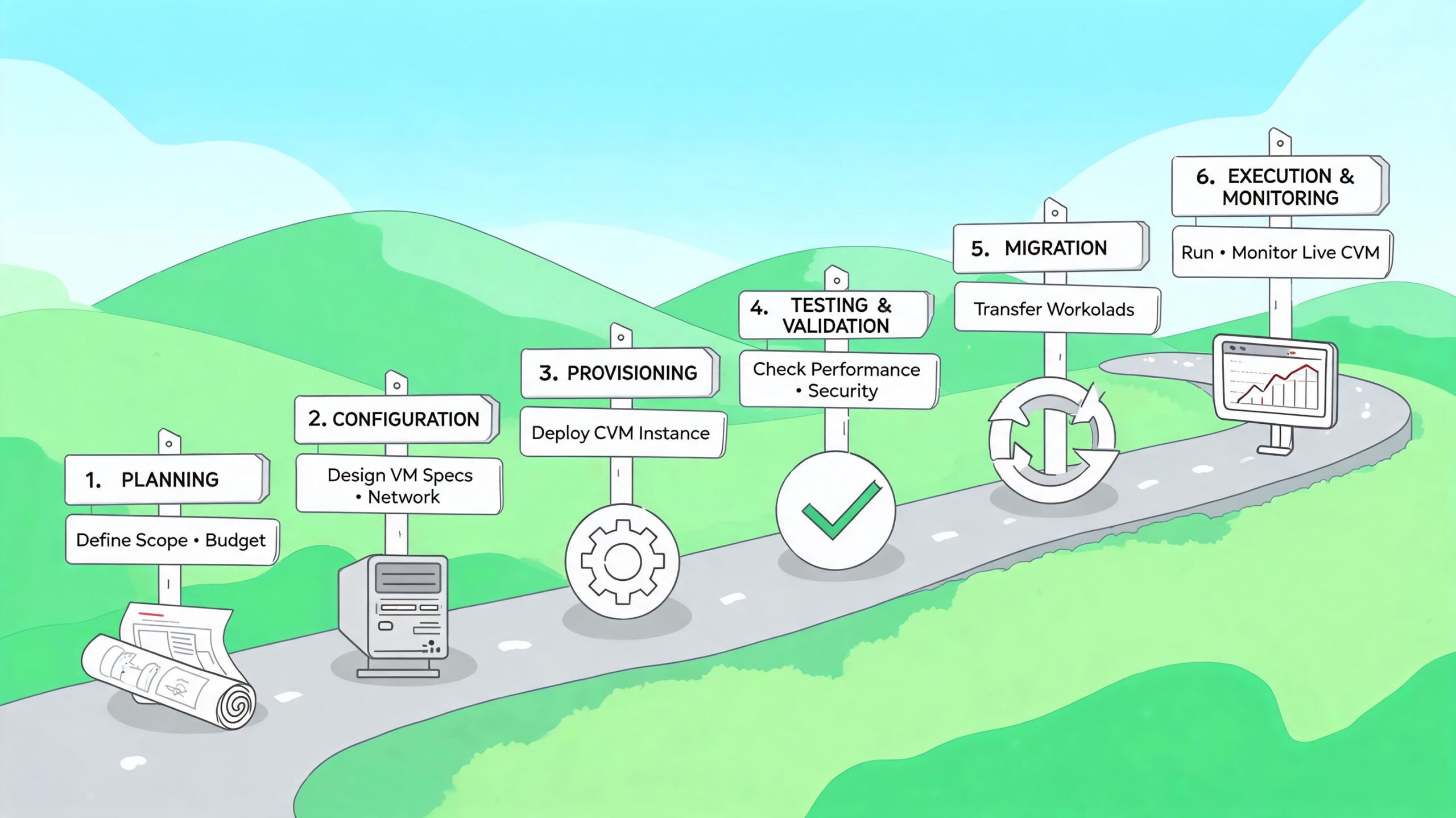
Most organisations shouldn't launch client value management as a large transformation programme. They should build it as a sequence of controlled capability upgrades, starting with data discipline and ending with operating rhythm.
Start with the minimum viable data model
Effective CVM relies on four data categories: customer firmographic data, customer transaction data, customer interaction and engagement data, and customer financial data, including lifetime value and acquisition cost, according to VisionEdge Marketing's explanation of CVM measurement. The same source notes that this supports evaluation across five value dimensions: lifetime, transaction, referral, influencer, and market share contribution.
That gives executives a clean implementation principle. Don't start by collecting everything. Start by making those four categories reliable and connected.
A practical first-pass data inventory often looks like this:
- Firmographic layer: Company, industry, geography, acquisition date.
- Transaction layer: Product mix, purchase timing, pricing, repeat activity.
- Interaction layer: Calls, support tickets, campaign responses, content behaviour.
- Financial layer: Acquisition cost, current value, profitability indicators.
Build a cross-functional operating team
Client value management fails when it lives in one department. The owner might sit in commercial strategy, customer success, or revenue operations, but the operating model must cross functions.
A useful governance pattern is to assign:
- Finance to validate economic logic
- Sales or account leadership to act on segment priorities
- Marketing to shape personalised journeys
- Operations and service to capture friction and intervention points
- Data and technology teams to maintain model quality and workflow integration
This isn't a committee for discussion. It's a decision group with authority over segmentation, intervention design, and measurement cadence.
Leadership should review value movement, not just pipeline movement. Those are related, but they aren't the same.
Sequence technology around decisions
Many teams buy platforms before they've defined decisions. That reverses the logic. Technology should support the management questions the business wants answered.
A sensible roadmap usually follows this order:
- Clean core systems so client records, interaction histories, and financial data can be reconciled.
- Create segment logic that distinguishes value pools and risk profiles.
- Introduce analytics models to estimate likely future value and churn signals.
- Connect execution tools such as CRM, contact centre systems, and conversational AI.
- Set review cadence so interventions are measured and refined.
The sequence matters because client value management depends on trust. Frontline teams won't act on value scores they don't understand, and finance leaders won't fund programmes they can't audit.
Use governance to prevent drift
CVM loses power when it becomes a reporting exercise. The remedy is governance with teeth.
| Workstream | First decision to lock down |
|---|---|
| Data | Which fields are mandatory and owned |
| Segmentation | Which value tiers trigger differentiated treatment |
| Intervention design | Which client signals require action |
| Measurement | Which outcome metrics prove value realisation |
This roadmap keeps the programme manageable. It gives leadership a way to build client value management without trying to redesign the entire enterprise in one move.
How Voice AI Revolutionises Client Value Management
Voice AI matters to client value management because it closes the gap between insight and action. Many firms already know which clients matter. They struggle to contact them consistently, personalise outreach at scale, and capture learnings from every conversation.
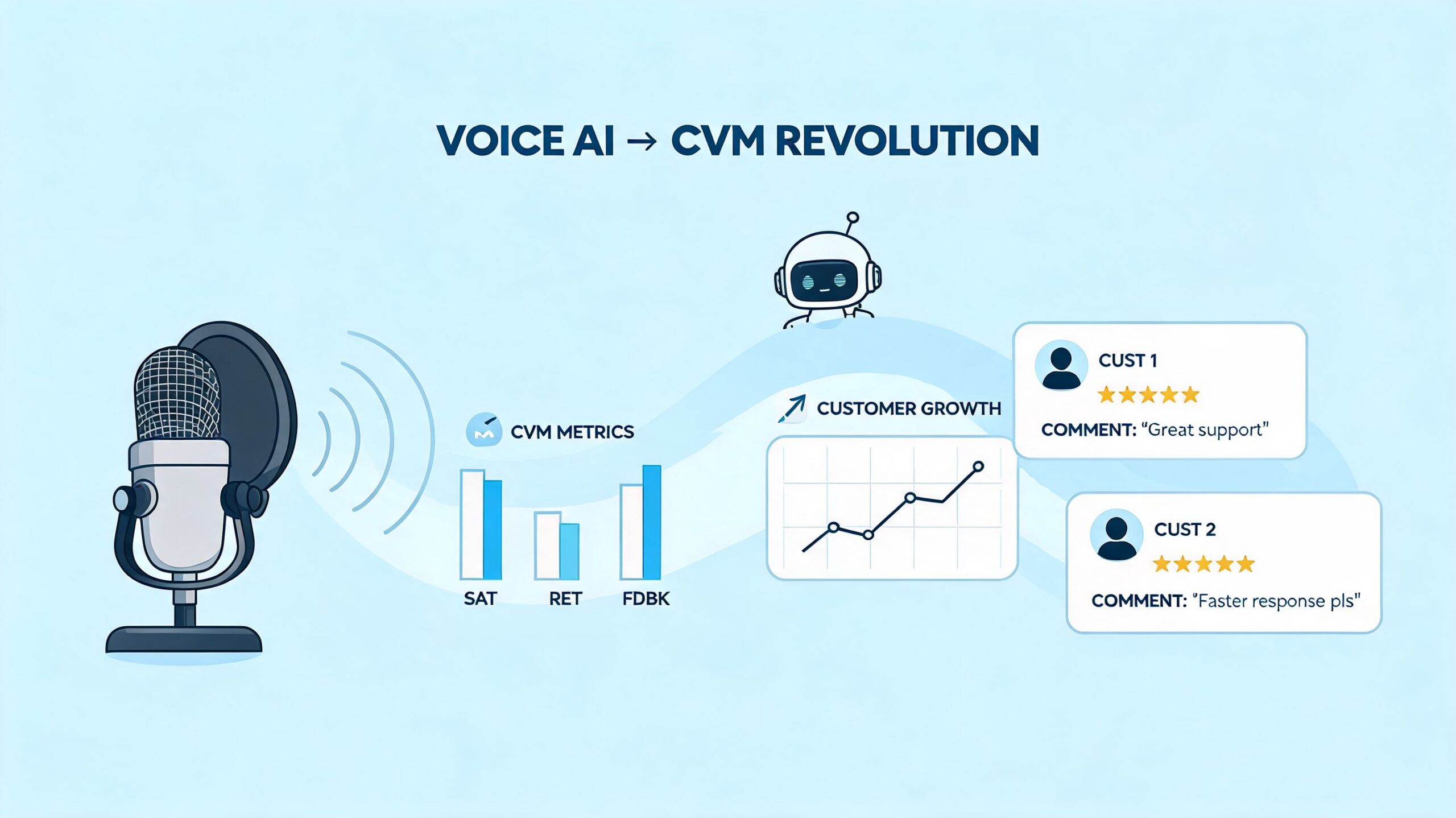
When conversational workflows are manual, teams prioritise only the most visible accounts. Follow-ups get delayed. Notes stay incomplete. Valuable customer signals disappear into call recordings or agent memory. Voice AI changes that operating reality by making conversations structured, searchable, and scalable.
From reactive calling to systematic value capture
The commercial benefit of Voice AI isn't only automation. It's consistency. Every interaction can follow a defined value logic: qualify, uncover need, respond appropriately, log outcomes, and trigger the next step.
That's especially important in client value management, where the aim is more than completing a call. It's to detect value signals and convert them into the right commercial action.
For teams trying to strengthen that operational loop, this guide on how to automate CRM updates with AI is useful because data capture discipline often determines whether Voice AI improves strategy or just adds another communication layer.
What changes operationally
Before Voice AI, many organisations run outreach as a queue. After Voice AI, they can run it as a value system.
A practical comparison looks like this:
| Before Voice AI | After Voice AI |
|---|---|
| Outreach depends on human capacity | Outreach scales across large volumes |
| Notes vary by agent | Data capture becomes more standardised |
| Follow-up timing is inconsistent | Triggers can launch immediately after calls |
| Learning sits in silos | Patterns become easier to analyse |
This is why Voice AI fits naturally inside a CVM operating model. It strengthens value identification through richer interaction data, improves value communication through timely and personalised engagement, and supports value realisation through measurable follow-through.
A strong example of the measurement mindset required here appears in this overview of metrics for contact centre Voice AI analytics deployments. The point isn't to track activity for its own sake. It's to monitor whether conversation design is improving commercially meaningful outcomes.
Why the conversation layer is strategic
Voice remains one of the highest-signal channels in many industries because customers reveal intent, hesitation, urgency, and objections in natural language. That makes the channel especially valuable for qualification, retention, counselling, and renewal contexts.
This demonstration gives a concrete feel for how conversational systems support that workflow in practice.
Organisations that use Voice AI well don't just reduce manual work. They create a feedback engine that continuously improves how value is identified and acted on.
That's the strategic leap. Voice AI turns client value management from a periodic review exercise into an always-on commercial capability.
Client Value Management Use Cases in Your Industry
In sector after sector, the commercial case for client value management appears in the gap between demand generated and value realised. Industry context determines where that gap sits, how large it becomes, and which intervention improves P and L outcomes fastest.
EdTech organisations and the hidden cost of lead leakage
EdTech growth often stalls long before market demand does. The constraint is usually poor conversion discipline across counselling, follow-up, and re-engagement.
According to Cuvama's guide to customer value management, AI-led CVM in India's EdTech sector can address 40% value leakage in lead-to-enrollment funnels, lift conversion rates by 4 to 6x, and, in BFSI settings, support 25 to 35% Net Revenue Retention improvement through more precise CLV prediction. Read at board level, the EdTech result matters because it reframes admissions operations. Counselling is not an administrative function. It is a revenue recovery system.
That has direct operating implications. Institutions should rank prospects by enrolment propensity and expected lifetime contribution, then use Voice AI and human counsellors in combination. Voice AI can handle immediate outreach, missed-call recovery, and structured follow-up at scale. Human advisors should focus on high-intent cases, complex objections, and financial commitment decisions. The result is faster speed-to-contact, lower lead decay, and better yield on acquired demand.
BFSI firms and the economics of predicting value early
In BFSI, future value matters as much as current revenue. Customer portfolios are uneven by design. A small share of accounts often drives a disproportionate share of margin through retention, wallet expansion, and lower servicing friction.
The management question is therefore not just who bought first. It is who is likely to become more valuable, more profitable, or more vulnerable to attrition over the next 12 months. Cuvama also notes that a 2024 NASSCOM report found ML models achieve 92% accuracy in forecasting 12-month CLV in Indian financial services. If that level of prediction is reliable in production, service models should change with it.
High-potential customers should receive faster resolution paths, better product matching, and earlier retention interventions. Lower-potential segments can be served efficiently through automated journeys without eroding economics. Voice AI is useful here because it captures intent signals that static CRM fields miss, including hesitation, urgency, dissatisfaction, and product curiosity. That improves the timing and quality of intervention, which is what ultimately moves NRR.
In BFSI, CVM is a capital allocation discipline expressed through customer operations.
Real estate firms and the long lifecycle problem
Real estate has a different value pattern. Demand arrives sporadically, buying cycles are extended, and prospects often disappear for reasons that are temporal rather than terminal.
A narrow sales view treats these contacts as stale leads. A CVM view treats them as deferred value with different probabilities attached to purchase, referral, and future re-entry. That distinction changes resource allocation.
Teams that apply CVM well tend to improve four decisions:
- Lead prioritisation: separate immediate buyers from research-stage prospects and passive investors
- Follow-up cadence: schedule outreach based on value potential and buying stage, not agent preference
- Referral management: treat former buyers and inactive prospects as future demand sources, not closed records
- Lifecycle measurement: track relationship value over time rather than judging performance only by this month's bookings
Modern execution proves vital. Voice AI can maintain contact with low-to-mid intent prospects at a cost base that human-only teams struggle to support. It can re-qualify old leads, capture changes in budget or timeline, and route revived opportunities back to agents. That improves sales productivity without giving up coverage across a long consideration cycle.
The strategic lesson across sectors
The pattern is consistent even though the failure points differ. EdTech loses value through delayed counselling and weak follow-up. BFSI loses value when firms fail to identify future high-value customers early enough to shape retention and cross-sell. Real estate loses value when long-cycle relationships are managed as if they were short-cycle transactions.
Client value management gives leadership a common operating model for all three. It links segmentation, service design, and intervention timing to measurable financial outcomes such as conversion, NRR, and CLTV. That is why CVM should be treated as a management discipline, not a customer programme. Firms that operationalise it with the right data and conversation infrastructure gain a durable advantage in the part of growth that competitors find hardest to copy: turning existing demand and existing relationships into higher lifetime value.
The Future of CVM Your Strategic Advantage in 2026
Margin pressure is rising across sectors, while acquisition costs remain difficult to control. That shifts executive attention to a harder question than pipeline growth alone. How much value can the company create, retain, and expand from the relationships it already has?
Client value management is increasingly the operating system for that decision. It gives leadership a way to connect customer behaviour, commercial policy, service economics, and technology investment to outcomes that matter on the P&L, especially net revenue retention, expansion revenue, and customer lifetime value. In 2026, that discipline will separate firms that grow efficiently from firms that keep buying growth at declining returns.
The companies that outperform will not be those with more reporting layers. They will be the ones that can identify high-value accounts earlier, quantify risk before revenue is lost, and trigger the right intervention through the right channel at a cost base that still makes sense. Voice AI matters here because it turns CVM from analysis into execution. It allows firms to maintain coverage across large account bases, long buying cycles, and service-heavy journeys without scaling headcount in direct proportion.
What this means for the board
For boards, the issue is capital allocation.
If management cannot show which client segments create the highest long-term returns, which moments drive expansion or churn, and which service motions improve retention economics, then budget decisions are being made with incomplete information. CVM closes that gap by giving finance, commercial, and operations teams a shared framework for deciding where to invest and where to stop spending.
A mature client value management model changes three board-level decisions:
- Growth investment: direct sales, service, and success resources toward accounts and segments with the highest expected lifetime value
- Risk management: identify value erosion earlier, including silent churn risk, declining engagement, or stalled expansion paths
- Technology deployment: use AI, workflow automation, and conversation intelligence where they improve coverage, response speed, and unit economics
The strategic benefit is not better reporting. It is better control over future cash flows.
The competitive divide in 2026
In many sectors, product differences narrow over time. Distribution channels get more crowded. Customer acquisition remains expensive, and in some categories it becomes structurally less efficient as paid channels mature. Under those conditions, competitive advantage moves toward firms that manage the economics of the installed base with more precision than their peers.
That is why CVM should be treated as a management discipline. It links strategy to execution across pricing, service design, account prioritisation, retention, and expansion. It also creates a practical route for applying Voice AI beyond cost reduction. The higher-return use case is selective, timely engagement at scale: checking sentiment, requalifying dormant opportunities, identifying intent changes, and routing valuable moments back to human teams before revenue is missed.
The board-level test is straightforward. Can your organisation show, with evidence, how it identifies, measures, and increases client value across the full lifecycle, or is it still managing relationships without managing their economics?
If your team is ready to operationalise client value management through scalable Voice AI, DialNexa Labs Private Limited offers human-like AI agents for qualification, customer support, recruitment, presales, KYC guidance, programme counselling, and high-volume follow-up workflows across EdTech, BFSI, real estate, hospitality, e-commerce, and software. It's a practical way to move from value theory to value execution.

[…] practical framework for this kind of long-term account growth sits inside client value management best practices, especially when customer success, service, and revenue teams need one operating […]
Excellent perspective on shifting from relationship management to true value management. The focus on CLTV, Voice AI, and data-driven interventions clearly shows how businesses can turn existing customer relationships into sustainable long-term growth.