
Hotel Management System Use Case Diagram: A CXO’s Guide
Most hotel leaders still treat a hotel management system use case diagram as a software team deliverable. In practice, it’s closer to an operating model. That shift matters because India’s hospitality sector has seen hotel management systems with use case diagrams drive a 35% increase in operational efficiency since 2018, and structured modelling has cut check-in times by 40% in major hotel chains, according to FHRAI.
If you're a CXO, that should change how you look at the diagram. This isn’t about UML for its own sake. It’s about making every guest interaction, billing rule, room-status update, and service handoff visible before inefficiencies harden into process debt.
Table of Contents
- Why a Use Case Diagram is Your Hotel's Strategic Blueprint
- Mapping Your Hotel's Core Operations and Actors
- Visualising Workflows with UML Relationships
- Modelling Complex and High-Value Operations
- The Future is Calling Integrating Voice AI Agents
- From Good to Great Use Case Diagram Best Practices
- Your Questions Answered
Why a Use Case Diagram is Your Hotel's Strategic Blueprint
A strong use case diagram does something most hotel transformation programmes struggle to do. It forces operational truth into the open.
In Indian hospitality, that matters because manual processes previously caused 15% revenue leakage across a market of 150,000+ hotels, as cited in the verified industry data. When leaders say, “we already know our process,” the diagram often proves otherwise. It shows where the booking journey fractures, where front desk workarounds replace policy, and where no one owns a guest-facing step.

The diagram is a management instrument
A hotel management system use case diagram maps who interacts with the system and what they must achieve. For a board or operating committee, that creates a practical advantage. You can test whether technology spend is aligned to guest experience, staff productivity, and revenue control before implementation starts.
That’s why mature teams use the diagram early, not after vendor selection. They use it to ask questions such as:
- Where does revenue leakage start: Is it during reservation capture, walk-in allocation, service upsell, or checkout reconciliation?
- Which handoffs fail most often: Front office to housekeeping is a common one. Billing to payment confirmation is another.
- What can be standardised: Repetitive tasks should be visible as repeatable use cases, not hidden in SOP documents.
- What needs executive attention: High-friction workflows usually cross departments.
Practical rule: If a process affects revenue, guest trust, or compliance, it belongs in the use case diagram before it reaches development.
Why CXOs should care before the tech team does
The reason these diagrams create business value is simple. They expose operating assumptions. A reservation may look like one task from a guest’s perspective, but operationally it may involve availability checks, room assignment rules, payment logic, special-request handling, and post-booking communication.
When those interactions aren’t modelled, hotels usually end up with fragmented systems and staff-owned workarounds. When they are modelled, leaders can decide where to automate, where to keep human judgement, and where to tighten control.
The best diagrams also improve internal alignment. Operations, finance, front office, and housekeeping stop discussing features in abstract terms and start discussing concrete business interactions. That is why this artefact belongs in strategic planning, not just solution design.
Mapping Your Hotel's Core Operations and Actors
The fastest way to get a weak diagram is to begin with software menus. Start with the actual operating environment instead.
A rigorous approach to defining actors and use cases can ensure 95% coverage of workflows, and a validated diagram can cut design errors by 35% while leading to 25% faster deployment times for new systems, according to EdrawMax’s hotel management system guidance.
Start with business reality, not software modules
Map the guest journey and the staff journey side by side. That usually reveals gaps that a departmental workshop misses.
For example, a guest may think in terms of booking, arrival, stay, and departure. Your teams experience the same timeline differently. Reception handles reservation changes and payment issues. Housekeeping manages room readiness. Managers care about inventory and rate control. Finance cares about GST billing and reconciliation.
If your team needs a structured way to do this before drawing UML, these Business Process Mapping Techniques are useful because they help separate user actions, approvals, and system-triggered events. For downstream system design, it also helps to compare the use case diagram with a more process-oriented model such as a data flow diagram. A practical reference is this resource on https://dialnexa.com/blogs/data-flow-diagram-for-hotel-management-system/.
The actor list that usually matters
In most Indian hotel environments, the core actor model should be grounded in operations, not theory.
| Actor | Role Description | Primary Use Cases |
|---|---|---|
| Guest | Initiates and experiences the stay journey | Search room, book room, modify booking, check in, request service, check out, pay bill |
| Receptionist | Runs front-desk execution | Manage reservations, verify booking, assign room, process check-in, process check-out, handle GST billing |
| Manager | Oversees commercial and service performance | Manage room inventory, approve rates, review reports, monitor occupancy, handle escalations |
| Housekeeping | Maintains room readiness and status accuracy | Update room status, mark cleaning complete, flag maintenance or inventory issue |
| Admin | Maintains access and system control | Manage users, configure system rules, monitor permissions, oversee platform settings |
| External System | Supports specialised transactions | Payment processing, notifications, channel sync, compliance-related actions |
A common mistake is treating “system” as one actor. It rarely is. Payment gateways, booking channels, notification engines, and compliance systems behave differently and should be represented separately when they matter to risk or revenue.
Most failed implementations don’t fail because teams forgot a screen. They fail because they forgot an interaction.
When actor identification is done well, the use case diagram becomes a management view of the hotel. It shows not only who does what, but also which workflows deserve automation, which ones require approval, and where your service promise depends on accurate cross-functional execution.
Visualising Workflows with UML Relationships
CXOs don’t need to memorise UML notation. They do need to know when the diagram reflects business logic and when it doesn’t.
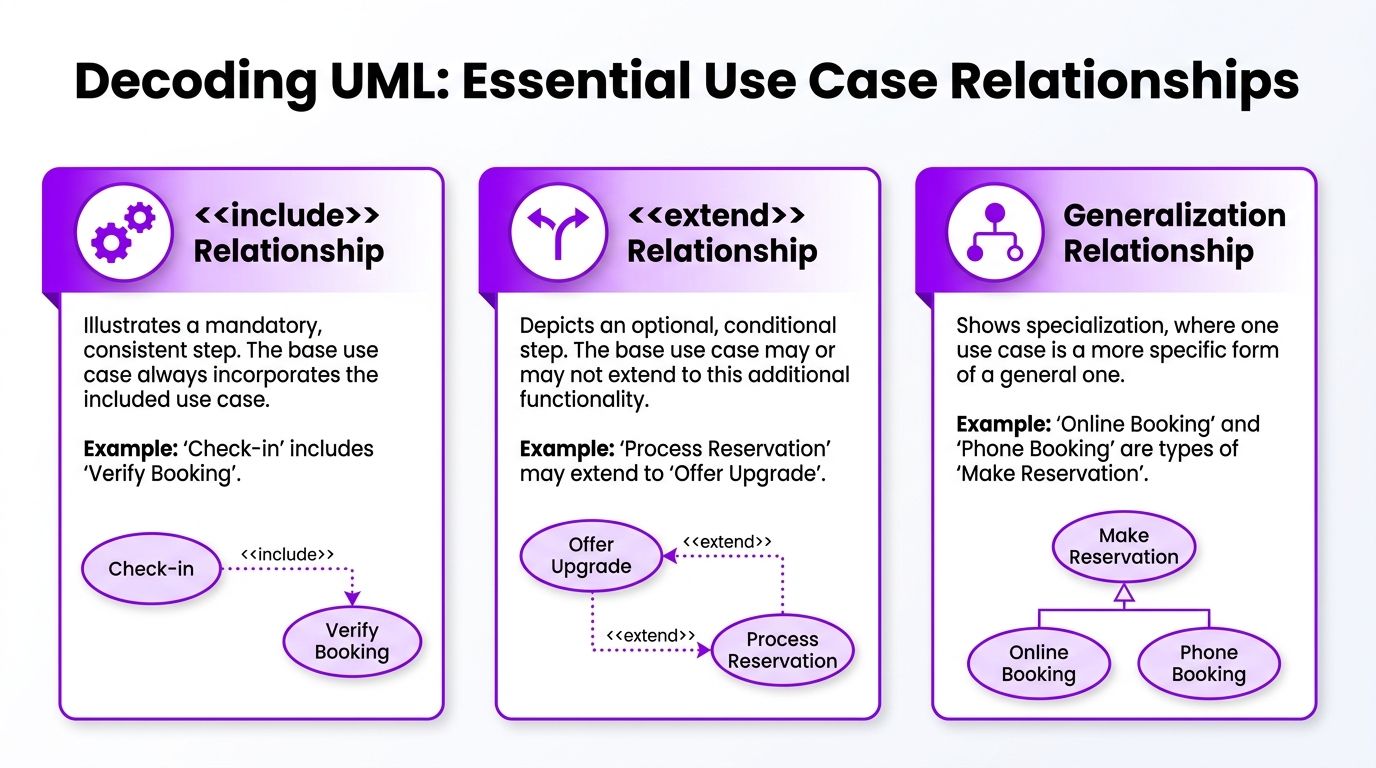
That’s where three relationships do most of the heavy lifting. <>, <>, and generalization are not technical decoration. They’re how you express mandatory steps, optional actions, and grouped variants without making the diagram unreadable.
If you want a non-technical explainer that helps business stakeholders evaluate a draft, this guide on how to read UML diagrams is a solid companion. It also helps to compare the diagram against the guest journey, not just the system specification. Journey thinking proves valuable here: https://dialnexa.com/blogs/what-is-customer-journey-mapping/com/blogs/what-is-customer-journey-mapping/
Include means mandatory
Use <> when one use case always requires another.
A front-desk example makes this obvious. “Check-in Guest” should include “Verify Reservation.” If the reservation isn’t verified, check-in shouldn’t proceed as a standard path. The included use case is not optional and not negotiable.
Use <> for actions such as:
- Verify booking: Required before check-in or modification.
- Check availability: Required before booking confirmation.
- Generate invoice: Required before final settlement.
- Make payment: Required whenever the booking flow demands financial closure.
This relationship helps leadership spot hidden dependencies. If a critical dependency is missing, the process usually depends on memory, informal judgement, or manual exception handling.
Extend means conditional
Use <> when the main use case can trigger an additional step under certain conditions.
“Process Reservation” may extend to “Offer Upgrade.” The reservation can still be completed without the upgrade. The extension exists only when conditions are met, such as room availability, guest profile, or business rules.
Good hotel examples include:
- Offer room upgrade during booking or check-in.
- Apply cancellation refund when a cancellation request matches policy rules.
- Request manager approval for special pricing or an exception.
- Add room service order after check-in for eligible stays.
A weak diagram often confuses optional upsell logic with mandatory process steps. That creates bloated workflows and unnecessary implementation complexity.
If everything looks mandatory in the diagram, teams will build rigid software and staff will invent workarounds around it.
Generalization keeps the diagram readable
Generalization is how you group similar use cases under one broader action.
Take payment. You may have UPI, card, and cash variants. Instead of drawing separate end-to-end billing flows for each, model a general “Payment” use case and let the variants inherit from it. That preserves clarity while still acknowledging operational difference.
The same approach works for reservation channels:
| General Use Case | Specialised Variants |
|---|---|
| Make Reservation | Online Booking, Phone Booking, Walk-in Booking |
| Payment | UPI Payment, Card Payment, Cash Payment |
| Room Allocation | Single Room, Double Room, Family Room |
For a CXO, the value is straightforward. You can review the diagram and quickly judge whether the system is designed for scale or whether it has been overdrawn into confusion. Good UML reads like operational policy made visible.
Modelling Complex and High-Value Operations
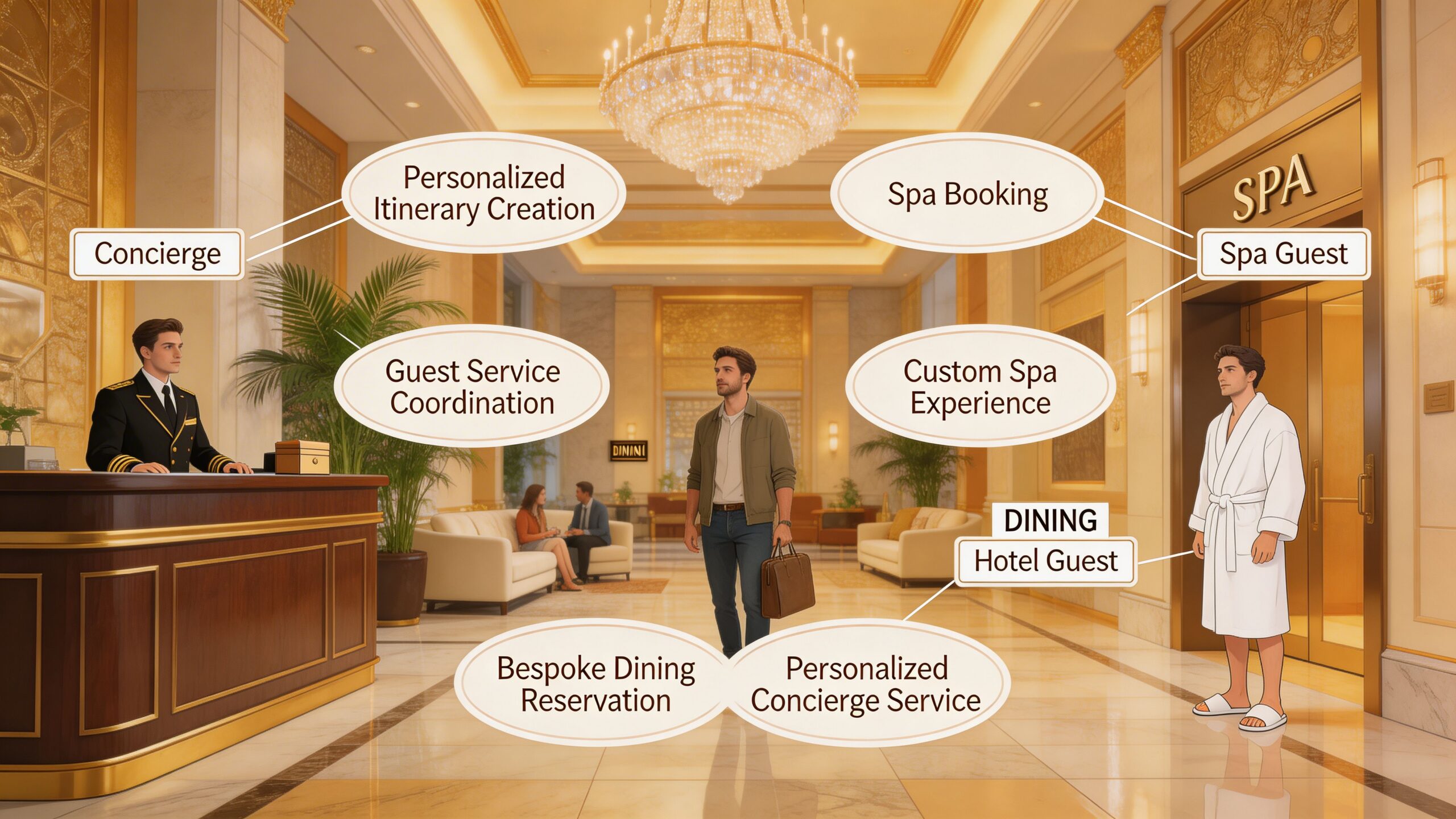
Simple booking and check-in flows are only the start. The true value of a hotel management system use case diagram appears when it captures the workflows that affect margin, service consistency, and integration quality.
That matters in a market where adoption of HMS use case diagrams in India’s tier-2 cities reached 78% by 2025, and hotels that digitised post-lockdown lifted RevPAR by 19% to INR 3,500, according to STR.
Where basic diagrams break down
Most starter diagrams are fine until the hotel adds operational nuance. Then they collapse into one of two problems. They either become too abstract to guide implementation, or too detailed to guide decision-making.
The pressure points are usually predictable:
- Group bookings: Room blocks, negotiated rates, staged payments, and custom invoices don’t fit neatly into a single “Book Room” oval.
- Front-desk upselling: Upgrade offers, late checkout, and ancillary sales are optional workflows tied to availability and policy.
- Housekeeping operations: Room status isn’t enough. Hotels often need to reflect linen turnover, consumable replenishment, and maintenance flags.
- Complex billing: GST-related handling, split payments, corporate billing, and booking-source adjustments need explicit modelling.
A good way to handle this is decomposition. Keep the executive-level diagram readable, then create subordinate diagrams for high-value domains. Group bookings can sit under a broader reservation capability while still having their own actor interactions and approval logic.
Integrations belong in the diagram
A hotel rarely operates as a closed system. OTAs, channel managers, payment gateways, and messaging services all influence guest-facing performance.
If you leave these out, the diagram gives a false sense of completeness. A booking flow that looks smooth on paper may still break because room availability doesn’t sync, payment confirmation doesn’t return cleanly, or invoice logic doesn’t reflect the source channel.
Model these systems as external actors when they affect the business outcome. That includes:
- OTA platforms: For incoming reservation updates and cancellations.
- Channel managers: For room inventory consistency across sources.
- Payment gateways: For authorisation, settlement, and transaction status.
- Notification services: For confirmations, reminders, and service updates.
The diagram should reflect the hotel’s real operating perimeter, not just the software your internal team controls.
For growing chains and ambitious independent properties, the use case diagram becomes a tech-stack control document. It clarifies responsibility boundaries. It also gives vendors less room to hand-wave around integration scope during procurement.
A CXO reviewing this level of diagramming should ask one simple question: does this model represent how revenue flows through the property? If the answer is no, the diagram isn’t finished.
The Future is Calling Integrating Voice AI Agents
Most hotel use case diagrams still assume every meaningful interaction starts with a human actor. That’s increasingly outdated in hospitality.
A critical gap in current diagramming is the omission of Voice AI agents, even though 68% of Indian hotels report manual booking inefficiencies, and available data shows AI can improve connect rates to 91% and lead-to-booking from 2% to 8%, as noted in this Creately-linked use case discussion.

Why the actor model has to expand
Hotels already accept that payment gateways and OTA systems are external actors. A Voice AI agent belongs in the same conversation because it performs business actions on behalf of the hotel.
It can answer reservation calls, qualify inbound enquiries, confirm booking intent, trigger reminders, and route exceptions to staff. That means it’s not merely a feature inside another use case. It should be modelled as an actor with defined interactions and boundaries.
In practice, this shift changes capacity planning. Human teams no longer need to absorb every repetitive phone interaction. They can focus on escalation handling, guest recovery, and high-value service moments.
A practical example set might include:
- Automate room reservations via phone
- Handle FAQs about availability, policies, and amenities
- Send pre-arrival reminders
- Escalate complex requests to front desk or reservations
- Capture lead details for follow-up
For leaders evaluating where AI fits operationally, this case-based reference can help: https://dialnexa.com/blogs/2024-vertical-market-case-studies-speech-technology-in-hospitality/
How to represent Voice AI in the diagram
Treat the Voice AI agent as a distinct actor connected to specific use cases, not as a vague extension of the reservation system.
A clean modelling pattern usually looks like this:
| Actor | Core Use Cases | Relationship Style |
|---|---|---|
| Voice AI Agent | Handle booking call, answer FAQ, capture intent, send reminder | Direct association |
| Book Room | Check availability, capture guest details, confirm booking | Includes mandatory sub-steps |
| Request Service | Triage request, verify room, route to department | May extend to escalation |
| Escalate to Staff | Transfer to receptionist or manager | Conditional extension |
Here’s a useful litmus test. If your hotel receives meaningful reservation or service volume over voice, and your diagram has no AI or automated telephony actor, the model no longer reflects reality.
A short walkthrough helps make that concrete:
The broader point is strategic. A modern hotel management system use case diagram shouldn’t document only today’s staff motions. It should also encode the interactions you want the operating model to hand over to automation.
From Good to Great Use Case Diagram Best Practices
The difference between an adequate diagram and a useful one is governance.
Many hotels do the hard part of assembling stakeholders, then lose value by producing a diagram that’s too vague for implementation or too cluttered for decision-making. The strongest teams keep the model readable, validated, and tied to business controls.
A compliance lens is essential. In India, 77% of hotels face regulatory audit issues, and 42% have incurred penalties for non-compliant billing. Modelling actors such as a GST Compliance System can reduce that risk, as noted in this EdrawMax template discussion on hotel management system use cases.
What strong teams do differently
They keep the diagram focused on behaviour, not implementation detail.
That means the diagram should answer “what must happen” rather than “which table stores it” or “which microservice executes it.” Database logic, field-level validations, and technical orchestration belong elsewhere.
Strong practice usually includes:
- Stakeholder validation: Front desk, housekeeping, finance, and management all review the same model.
- Business-first naming: Use labels such as “Generate GST Invoice” or “Verify Reservation,” not vague technical shorthand.
- Controlled scope: Keep the main diagram concise, then split out complex domains when needed.
- Versioning discipline: Review the model whenever pricing logic, compliance rules, service workflows, or channels change.
A diagram that no business stakeholder can read is not a governance tool. It’s a drawing.
Mistakes that create cost and compliance risk
The first mistake is omission. Teams leave out the actors that create real risk because they seem “back-office” or “integration-related.”
That includes compliance systems, payment intermediaries, and policy-driven approval paths. If the hotel has a billing rule, consent requirement, or audit trail obligation, it should appear in the model at the right level.
The second mistake is overcomplication. Teams sometimes stuff use case diagrams with schema-level or screen-level detail. The result is a document no CXO reviews and no operations leader trusts.
Use this quick checklist when approving a diagram:
- Can a non-technical GM read it and explain it back?
- Does it show high-risk billing and compliance interactions?
- Are mandatory steps separated from optional upsell or exception flows?
- Are external systems shown where they affect outcomes?
- Does the model reflect how the property runs, not how the vendor demo looked?**
When those answers are solid, the diagram becomes more than project paperwork. It becomes a durable operating reference.
Your Questions Answered
What tool should teams use?
Creately, EdrawMax, and similar UML-capable tools are fine. Tool choice matters less than stakeholder clarity.
How detailed should the main diagram be?
Keep the executive view readable. Break out group bookings, billing, or integrations into supporting diagrams.
Who should approve it?
Operations, finance, front office, housekeeping, and the implementation owner should all validate it.
When should it be updated?
Whenever your hotel changes workflows, channels, compliance requirements, or automation strategy.
If your team is rethinking reservation handling, guest communication, or AI-assisted service workflows, DialNexa Labs Private Limited can help you operationalise that vision with human-like Voice AI agents built for hospitality-scale conversations, follow-ups, qualification, and support.

Excellent insight on how use case diagrams serve as strategic tools rather than just technical documentation. The focus on operational alignment, revenue protection, and integrating Voice AI makes this a valuable framework for modern hospitality leaders.