
Winning the Skies: A C-Suite Guide to Customer Service Airline Strategy
In the razor-thin margins of the airline industry, customer service has evolved from a support function into the primary battleground for loyalty and market leadership. For executives, the outcome of this battle directly impacts passenger retention, market share, and ultimately, the bottom line.
For a broader view of what customer service means across the full passenger journey, from pre-flight through post-flight recovery, see DialNexa’s guide to customer service in the aviation industry.
The New Altitude of Airline Customer Service
For any airline executive, the first real step towards building a resilient brand is to stop thinking of customer service as a cost centre and start seeing it for what it is: a strategic asset. Every interaction—from a booking query to how a multi-leg disruption is handled—is a moment of truth that defines your brand's market position.
Investing in a superior customer experience (CX) delivers a clear return on investment. A Forrester study revealed that CX leaders achieve a 17% compound annual growth rate (CAGR), while laggards only manage 3%. Furthermore, improving the customer experience can push revenue 4-8% higher than the market average and drive operational efficiency by cutting service costs by 15-20%.
From Cost Centre to Profit Driver
The financial and reputational damage from a single service failure can be enormous. Consider a high-value corporate traveler who, despite top-tier status, is downgraded without explanation. This isn't an isolated incident; it's a direct threat to a high-yield revenue stream. A business traveler who books 20 international flights a year at an average of $5,000 per ticket represents $100,000 in annual revenue. Losing that single account due to poor service represents a tangible, quantifiable loss that goes far beyond the cost of one flight.
Today’s travellers are increasingly choosing airlines based on their service reputation, not just the cheapest fare. A single disruption handled with care and efficiency can earn you a customer for life. One bad experience can send them to your competitor for good.
This shift in passenger behavior necessitates a holistic view of the service journey, from digital booking platforms to the ground crew. To fully grasp how these components integrate, it’s worth exploring what customer service in the airport environment entails from a leadership perspective.
The Tangible Value of Advocacy
The ultimate goal for any CXO is to convert a passenger on the brink of frustration into a powerful brand advocate. This is achieved through consistent, empathetic, and efficient support. When an airline successfully navigates a complex problem—such as re-routing a family on partner airlines during a major weather event while proactively handling hotel and meal vouchers—it achieves far more than just retaining one booking.
That positive experience transforms into invaluable word-of-mouth marketing and positive social media sentiment, a form of advertising that cannot be purchased. The strategic contrast is stark:
- Service Failure: Leads to public complaints, regulatory fines, and direct financial losses from compensation payouts.
- Service Excellence: Builds sustainable loyalty, generates positive PR, and creates a brand premium that attracts new, high-value passengers willing to pay more for a reliable, stress-free journey.
By directly linking service quality to C-suite priorities like profitability, risk mitigation, and market position, the investment required to build a world-class customer service airline operation becomes not just justifiable, but essential for competitive advantage.
Understanding What Your Passengers Truly Value
It’s tempting for leadership to believe that on-time performance is the sole determinant of airline quality. While operational reliability is the price of entry, it is no longer a differentiator. The true battle for loyalty is won or lost in the moments of friction—when things inevitably go wrong.
A single poor support interaction can permanently divert a passenger's corporate and personal travel budget to a competitor. Conversely, a problem resolved with genuine care and efficiency can create your most passionate brand advocates. From a C-suite perspective, your support teams wield significant power over your brand's reputation and financial performance.
The Shift from Transaction to Experience
We are witnessing a fundamental shift in passenger valuation. The focus is no longer just on the flight but on the entire experience, especially the assurance of competent support during disruptions. This represents a strategic move away from a purely transactional relationship to one built on trust and a feeling of being valued.
The data underscores this strategic imperative. In India’s fiercely competitive airline market, customer service is the key differentiator for brand loyalty. A recent KPMG report found that an astonishing 52% of customers become brand ambassadors when their airline provides responsive, high-quality support. For a Director of Marketing, this means over half of satisfied customers will generate positive, cost-free marketing. You can analyze the full data set in the KPMG India CX Report 2025.
However, the report also contains a stark warning for executives: 46% of consumers are prepared to switch allegiances after feeling let down by staff hospitality or operational mismanagement. Great service builds a loyal base, but mediocre service actively drives revenue to competitors.
A passenger's journey isn't just physical; it's emotional. They will remember how an airline made them feel during a moment of high stress long after they’ve forgotten the flight details. That feeling is what builds—or breaks—loyalty.
What Empathy Is Worth to Your Bottom Line
So, where is the strategic investment opportunity? While operational excellence is expected, data shows passengers are willing to pay a premium for a less tangible but highly valuable asset: empathy. This translates to empathetic service from a human agent, whether via phone, chat, or at the airport.
This is not a "soft" metric; it is a direct driver of revenue and retention. When a business traveler is dealing with a missed connection that jeopardizes a critical meeting, an interaction rooted in empathy creates immense value.
- Transactional Service: A passenger is told, "Your flight is cancelled. The next one is tomorrow at 8 AM." This is factual but leaves the customer feeling abandoned and creates a high-stress problem for them to solve alone.
- Empathetic Service: An agent states, "I can see your flight was cancelled, and I understand this is incredibly disruptive to your plans. Let's immediately look at options on both our airline and our partners to get you to your destination tonight. While I do that, I'll also arrange for your hotel and transportation."
The empathetic approach transforms the situation from a crisis into a managed event. It turns a potential brand detractor into a loyal customer by demonstrating that the airline values their time and well-being, not just their ticket revenue. This is how you build a relationship that withstands price wars and secures long-term customer lifetime value.
Anatomy of an Airline Service Meltdown
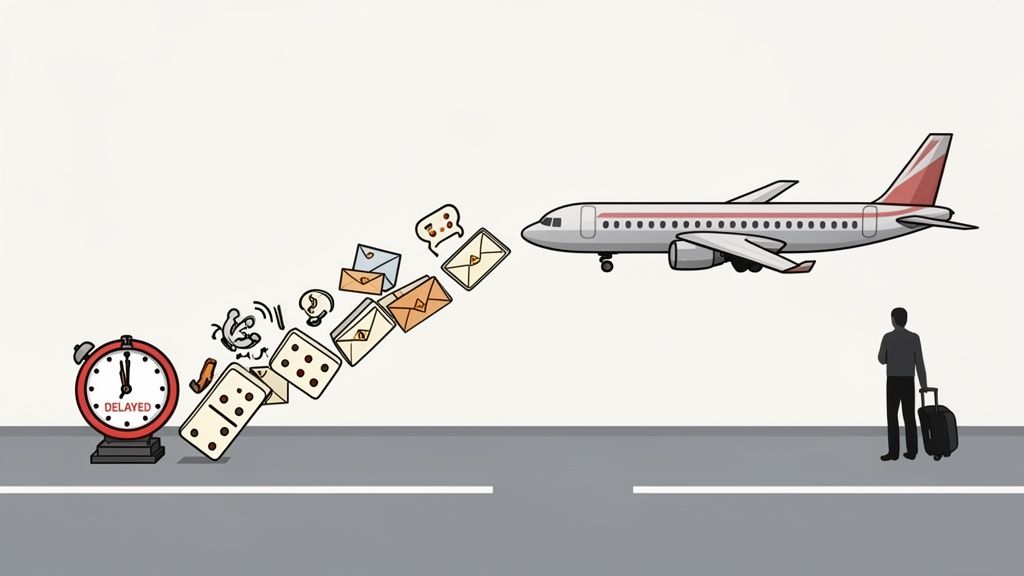
In the airline industry, external disruptions are a certainty. Severe weather, air traffic control mandates, and unforeseen maintenance are operational realities. A full-blown service crisis, however, is an entirely different and almost always preventable event.
A crisis occurs when a routine operational disruption escalates into a brand-damaging meltdown, typically caused by brittle customer support systems and a failure in communication strategy. For any executive, understanding this domino effect is critical, as it directly connects your customer service strategy—or lack thereof—to the company's financial health and market standing.
These same failure patterns – unclear escalation authority, slow disclosure, and no single owner for the problem – recur across other well-documented poor customer service examples, from airline cancellation battles to breach response.
It all follows a painfully predictable script. An operational failure, such as a network-wide IT outage, grounds hundreds of flights. This event immediately floods every customer service channel, creating the first, and most crucial, point of failure for an unprepared airline.
The Financial Fallout of a System Under Strain
When service infrastructure is not designed for scalability, the contact center becomes an immediate bottleneck. Call wait times escalate from minutes to hours. Social media channels are inundated with public complaints from stranded passengers. Airport ground staff face overwhelming crowds with limited information and support.
The financial hemorrhage begins at that moment. This is not a theoretical risk; it is a recurring reality with quantifiable costs.
A stark example from December 2025 demonstrates the financial devastation. During a period of widespread disruption, passenger-related complaints filed with the DGCA against India's domestic airlines soared to 29,212. One major carrier’s cancellation rate hit 9.65%, forcing the industry to pay out over ₹24 crore (approximately $2.9 million) in direct compensation and facilitation fees in a single month.
Despite these massive reactive expenditures, the volume of complaints about poor communication and failed re-accommodation continued to rise, proving that post-crisis spending does not repair the underlying service failure. You can review the complete report on these air traffic and complaint figures on Outlook Business.
For leadership, the cascading costs are staggering. The following table provides a forensic breakdown for CXOs.
The Financial and Market Impact of a Service Breakdown
| Metric | Data Point (December 2025) | Implication for CXOs |
|---|---|---|
| Direct Complaints | 29,212 logged with DGCA | A clear signal of failure in primary resolution channels, leading to increased regulatory risk and cost. |
| Cancellation Rate | 9.65% for one major carrier | Represents a significant operational failure that directly fuels customer anger and escalates service demand beyond capacity. |
| Immediate Payouts | >₹24 crore in compensation | A direct, quantifiable hit to the P&L that excludes the long-term cost of eroded customer loyalty and lifetime value. |
| Brand Damage | Negative press, social media firestorm | The erosion of public trust can take years and millions in marketing spend to repair, impacting future bookings and market share. |
This analysis serves as a wake-up call, highlighting the enormous financial and brand risk associated with a customer service airline strategy not architected for resilience under stress.
The true cost of a service meltdown isn't the compensation you pay. It’s the permanent erosion of passenger trust, the negative headlines that stick around for months, and the high-value flyers who quietly swear they will never fly with you again.
Operational Insurance Through Scalable Service
The key lesson for any leadership team is that investing in scalable customer service technology is not an optional expense—it is essential operational insurance. When your service infrastructure can absorb a sudden 10x spike in interaction volume, a potential catastrophe is downgraded to a manageable operational event.
A resilient service model transforms the outcome:
- Proactive Communication: Passengers receive automated alerts with pre-booked alternatives, turning a negative surprise into a managed solution.
- Instant Self-Service: Travelers can rebook, request refunds, or track baggage via an app or AI voice agent, deflecting thousands of calls from the contact center.
- Empowered Human Agents: Freed from repetitive queries, human agents can focus their expertise on complex, high-emotion cases that secure customer loyalty.
Ultimately, a service meltdown does not create new weaknesses; it merely exposes those that were latent during normal operations. Building a resilient, scalable service infrastructure is the only viable strategy to safeguard your brand and balance sheet against the next inevitable disruption.
Future-Proofing Your Contact Centre with AI
The traditional airline contact centre, with its linear staffing models and high operational costs, is often the first system to break during a disruption, quickly becoming the epicentre of a brand meltdown. By strategically integrating AI, that bottleneck can be transformed into your most scalable and efficient service engine.
For airline leaders, the objective is not to replace human capital but to augment it. The goal is to create a resilient, blended model where AI and human agents collaborate. AI handles the high-volume, repetitive queries, empowering your human experts to manage the complex situations that require empathy and critical thinking.
From Bottleneck to Scalable Service Engine
The fundamental vulnerability of a traditional contact centre is its fixed capacity. During a weather event or system outage, call volumes surge, wait times explode, and customer frustration boils over. Voice AI addresses this by offering near-infinite scalability. Imagine an AI agent capable of handling thousands of concurrent interactions, providing instant answers to common queries.
A major U.S. airline implemented a generative AI platform and achieved a 49% increase in customer self-service adoption within just 39 days. This proves that passengers will readily adopt automated systems that are effective and solve their problems without a long wait.
Modern AI agents can manage a wide range of tasks that typically overwhelm phone lines:
- Flight Status & Updates: Providing real-time information on delays, cancellations, and gate changes.
- Baggage Tracking: Instantly locating bags using a PNR or tag number.
- Simple Rebookings: Assisting passengers with rebooking on the next available flight after a cancellation.
- Ancillary Services: Processing requests for seat assignments, meals, or extra baggage.
This automation delivers a direct and measurable impact. A recent project documented a 91% first-contact resolution rate, a 21% improvement, demonstrating AI's ability to resolve issues effectively on the first attempt. For executives interested in the technical specifics, our guide on how AI call bots work provides a detailed overview.
Enhancing Performance and Consistency
Beyond scalability, AI introduces a level of service consistency that is difficult to achieve with a large, distributed human team. Every interaction is handled according to brand guidelines, ensuring a uniform standard of service 24/7. This mitigates performance variability, which is crucial for protecting brand reputation.
Furthermore, these systems generate a wealth of structured data. Future-proofing your contact centre involves implementing advanced Speech to Text Contact Center technologies, which can integrate with existing systems. This unlocks real-time sentiment analysis and trend-spotting, providing leadership with an early warning system. For instance, a sudden spike in callers asking about a specific flight can flag a potential operational issue long before it escalates into a crisis.
This blended model is the optimal defense against a service meltdown. Instead of a system collapsing under pressure, you have a resilient front line that absorbs the initial shock, provides immediate answers, and empowers your human agents to deliver the empathy and complex problem-solving that define exceptional airline customer service.
The KPIs That Truly Measure Airline CX Success
To gain strategic control over your airline's customer service, you must measure what truly matters. For decades, contact centres have been managed by operational metrics like Average Handle Time (AHT), which incentivized agents to end calls quickly, often at the expense of resolution. This model is not just outdated; it actively damages customer relationships and increases operational costs.
The C-suite conversation must shift from purely operational metrics to Key Performance Indicators (KPIs) that track business outcomes. These are the figures that provide a true measure of customer experience and align directly with executive priorities: passenger loyalty, operational efficiency, and long-term financial health.
Shifting from Efficiency to Experience
Moving beyond legacy metrics requires a philosophical change. Instead of asking, "How quickly did we end the interaction?" the critical question becomes, "Did we resolve the passenger's issue effectively and make them feel valued?" Unresolved issues are a significant cost driver, leading to repeat contacts, customer churn, and negative word-of-mouth.
An AI-powered contact centre provides the foundation for delivering superior outcomes by balancing efficiency, 24/7 availability, and genuine, empathetic service.
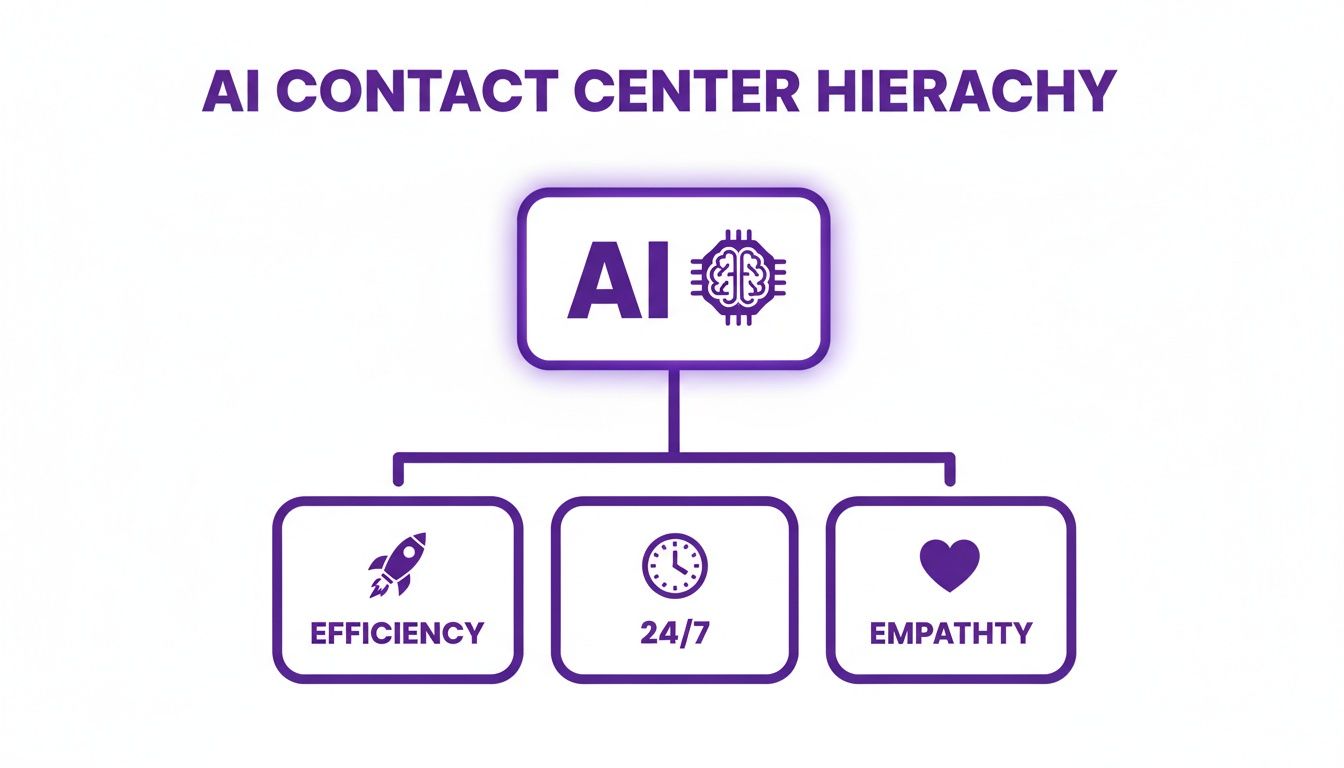
This structure is not merely technological; it enables the human-centric pillars that support the modern KPIs defining a premier passenger experience.
Here are the four essential KPIs every airline leader should be tracking:
First Contact Resolution (FCR): This is the gold standard of service effectiveness. It measures the percentage of issues resolved in a single interaction. A high FCR is a direct indicator of an efficient service organization, as it slashes repeat contact rates and operational costs. For instance, one major airline saw its FCR jump to 91% after implementing a voice AI solution—a 21% improvement that dramatically reduced costly follow-up calls.
Customer Satisfaction (CSAT): This metric provides an immediate post-interaction pulse check via a simple survey ("How satisfied were you?") on a 1-5 scale. A consistently high score, such as the 92% CSAT achieved by a carrier after modernizing its tech stack, validates that your service delivery is meeting passenger expectations.
Net Promoter Score (NPS): This metric measures long-term loyalty by asking how likely a passenger is to recommend your airline. NPS classifies customers into Promoters, Passives, and Detractors. A high NPS is a leading indicator of future revenue growth, as Promoters drive repeat business and positive word-of-mouth.
Customer Effort Score (CES): CES measures the ease of a service experience by asking, "How easy was it to get your issue resolved?" It is a powerful predictor of loyalty. Clear data from Gartner shows that 94% of customers who have a low-effort experience will remain loyal.
Modernising Your Measurement Framework
Adopting these KPIs requires a re-evaluation of how your airline measures performance. To understand the true ROI of service initiatives, you need the right data. You can learn more about how to implement and track these essential KPIs for customer service success to begin applying them within your own organization.
The following table contrasts the outdated efficiency-at-all-costs mindset with a modern, passenger-centric approach designed to help leadership refocus their teams on what builds loyalty and drives sustainable growth.
Modern Versus Outdated Airline CX Metrics
| Modern KPI | What It Measures | Outdated Metric It Replaces | Why the Shift Matters for Leadership |
|---|---|---|---|
| First Contact Resolution (FCR) | The ability to solve an issue in a single interaction. | Average Handle Time (AHT) | FCR focuses on definitive problem-solving, which reduces operational costs and improves satisfaction. AHT incentivizes speed over quality, leading to repeat contacts and churn. |
| Customer Effort Score (CES) | The ease of the passenger's service journey. | Number of Calls Handled | CES is a strong predictor of future loyalty. A low-effort experience retains customers, whereas high call volume is often a symptom of process failure. |
| Net Promoter Score (NPS) | Overall brand loyalty and willingness to recommend. | Service Level Agreements (SLAs) | NPS tracks the health of the customer relationship. Meeting an internal SLA (e.g., answering 80% of calls in 60 seconds) is irrelevant if the interaction ends in dissatisfaction. |
| Customer Satisfaction (CSAT) | Immediate satisfaction with a specific interaction. | Agent Occupancy Rate | CSAT provides direct, actionable feedback on service quality. High agent occupancy can be a sign of inefficiency or burnout, not productivity. |
By embracing these modern KPIs, airline executives can finally draw a direct line from customer service performance to the bottom line, transforming the contact centre from a traditional cost centre into a strategic engine for growth and passenger loyalty.
Your Blueprint for a Future-Ready Service Strategy
It’s time to stop thinking of customer service as a cost centre. A truly modern airline sees it for what it is: a strategic asset. Getting there isn’t about buying a single piece of software; it’s about fundamentally changing how you support your passengers.
This blueprint breaks that journey down into clear, actionable phases. We'll move from getting a real sense of your current operations to building a solid business case and, finally, rolling out new solutions intelligently. Each step builds on the last, making sure your investments in people and technology pay off with real returns.
Phase 1: Audit Current Capabilities and Pinpoint Weaknesses
You can't map out a new route without knowing your starting point. The first move is a completely honest look at your entire customer service operation. This means digging much deeper than surface-level metrics like total call volumes. You need to understand the actual experience your passengers are having.
Your audit should get straight to the heart of the matter with a few critical questions:
- Where are the real bottlenecks during normal operations, and where are the failure points during a service disruption?
- What is your true First Contact Resolution (FCR) rate? A low FCR is a major red flag indicating systemic issues that drive up costs and frustration.
- How much effort are passengers expending to get a simple resolution? A high Customer Effort Score (CES) indicates significant friction in your service delivery model.
Consider it in practical terms: if rebooking a cancelled flight requires a passenger to be transferred three times and switch from a chatbot to a phone call, you have identified a critical process failure. For example, if your data shows that 40% of calls related to baggage are repeat calls, you have pinpointed a specific, high-impact weakness to target.
Phase 2: Build a Compelling Business Case
Armed with a clear picture of what’s broken, you can now build a powerful business case for investing in the right technology. This isn't just about saving money on efficiency. It’s about connecting service improvements directly to the goals of your leadership team.
A major U.S. airline’s implementation of a generative AI platform was completed in just 39 days and delivered a 49% increase in customer self-service adoption. This demonstrates that rapid, high-impact transformations are achievable with the right strategy and technology.
Frame your investment proposal around outcomes the C-suite cares about. For example, demonstrate how deploying Voice AI for routine flight status inquiries can reduce contact center operational costs by 15-20%. Equally important, this frees up your skilled agents to manage complex, high-stakes scenarios that drive loyalty and protect high-value customers.
Crucially, tie the investment to risk mitigation. Remind leadership that a single month of service meltdowns can cost over ₹24 crore (approx. $2.9 million) in direct payouts, excluding brand damage. Framed this way, investing in a resilient system is not a cost but a strategic insurance policy against predictable financial and reputational loss.
Phase 3: Pilot and Scale Solutions Intelligently
With your business case approved, it's time to put the plan into action. The key here is to avoid a risky "big bang" rollout. Instead, start small with a targeted pilot project.
Identify a high-volume, low-complexity use case—such as baggage tracking or answering basic refund policy questions—and deploy a Voice AI solution to automate it. This creates a controlled environment to validate the technology and measure its impact on key metrics.
Track the pilot's performance against your core KPIs. A successful pilot might demonstrate a 30% reduction in calls for that specific issue, an FCR of 91% for the automated interactions, and an improvement in CSAT scores. This data provides the concrete evidence needed to justify a broader, phased rollout across other service functions.
As you scale, ensure your human agents are central to the transformation. Provide training not only on the new tools but on their elevated role as expert problem-solvers for your passengers' most critical issues. By allowing technology to handle the predictable, you empower your team to deliver the empathy and sophisticated resolutions that build unbreakable brand trust.
Frequently Asked Questions
When you're looking at a major shift in your airline's customer service strategy, the big questions always come down to cost, timing, and what it really means for your people and passengers. Let's tackle some of the most common concerns that come up in the boardroom.
How Quickly Can We See a Return on Investment?
The ROI is visible much faster than you might think, materializing across several key areas. For example, one major U.S. airline that implemented an AI platform saw its customer self-service rates increase by 49% in just 39 days.
This rapid adoption immediately reduces operational costs by deflecting routine calls from human agents. More strategically, it directly impacts the metrics that build loyalty. The same airline achieved a 91% first-contact resolution rate—a 21% improvement—meaning far fewer frustrated passengers making costly repeat calls. This demonstrates a clear and swift return through both cost savings and enhanced customer retention.
What Is the Real Cost of Inaction?
Delaying an upgrade to your service technology is not a cost deferral; it is an acceptance of future, larger costs. The widespread disruptions in December 2025 serve as a stark case study: Indian airlines were forced to pay out over ₹24 crore (approx. $2.9 million) in direct compensation and fees in a single month.
The true cost of doing nothing isn't just the financial payout when things go wrong. It’s the slow, steady erosion of your brand's reputation and the loss of valuable passengers who will happily switch airlines after just one bad experience. Think of investing in scalable service as a form of operational insurance.
That ₹24 crore figure does not account for the long-term brand damage from 29,212 official complaints or the subsequent loss of customer lifetime value. A modern, scalable system is not an expense—it is your most effective defense against these predictable and recurring financial hits.
Will This Technology Replace Our Human Agents?
Absolutely not. The strategic objective is to elevate your experienced team, not replace them. The most effective model is a blended one where technology handles high-volume, repetitive tasks, freeing human agents to focus on complex problem-solving and delivering empathy where it matters most.
The division of labor is clear:
- AI handles: Flight status updates, simple rebookings, baggage tracking, and answering standard policy questions.
- Human agents handle: Complex multi-leg itinerary changes, de-escalating high-stress situations, and providing nuanced support to high-value or distressed passengers.
This approach empowers your team, boosts morale by removing tedious work, and ensures that passengers with the most critical needs receive immediate, high-quality human support. It makes your entire service operation more efficient and more emotionally intelligent.
Ready to make your customer service a real competitive advantage? DialNexa Labs Private Limited provides human-like Voice AI agents that can scale your support, cut operational costs, and let your team focus on the interactions that matter most. See how our platform can transform your passenger experience by visiting DialNexa.

[…] airlines treat service design as part of the operating model. For a practical operator view, this analysis of aviation customer service systems shows how airlines are tying customer support more closely to operations and revenue […]
[…] revenue and retention. For leadership teams reassessing that operating model, this broader view of airline customer service operations is directly relevant because the reservation stack and the service stack now shape the same […]