

Boost Your Growth With Ecommerce Managed Services
Ecommerce Managed Services For Executives
Online retailers often think of managed services as a behind-the-scenes engine powering fulfilment, tech support and analytics. It’s a smart way to offload day-to-day tasks so leadership can zero in on growth and market moves. If you’ve noticed high-growth companies using these services, that’s because they need to expand rapidly without surprise costs or unhappy customers.

Here’s what executives gain:
- Scalability: On-demand resources flex up during peak sales periods.
- Cost Predictability: Fixed monthly fees keep budgets on track.
- Expertise On Tap: Dedicated teams manage operations, technology and support.
- Focused Leadership: Your CXOs and VPs steer innovation, not shipping labels.
Practical Example: A VP of Operations at a lifestyle brand leveraged managed fulfilment to handle a 40% Black Friday surge without hiring seasonal staff, reducing labour costs by 18% year-over-year.
Consider India’s soaring market: it’s set to reach $211.6 billion in 2025—up 12.5% year-over-year—thanks to over 900 million internet users and UPI processing more than 13 billion transactions every month in 2024. Read the full analysis about this surge.
Pit Crew Analogy Explained
Picture a Formula 1 team swapping tyres in seconds. Each specialist focuses on a single task with razor-sharp precision. That’s exactly how ecommerce managed services work—operations pros, tech gurus and customer care agents all lined up to minimise downtime and hit your strategic targets.
They operate in concert, so your leadership team never has to drop the ball on essentials. The result? Faster response times, higher customer satisfaction and a clear view of performance metrics.
Below is a quick snapshot of those service areas executives care about most.
Ecommerce Managed Services Quick Overview
| Service Area | Description | Impact |
|---|---|---|
| Operations Management | Order processing, inventory coordination | Boosts fulfilment speed and accuracy |
| Customer Support | Multichannel helpdesk, issue resolution | Raises CSAT scores and lowers churn |
| Tech Infrastructure | Cloud hosting, platform upkeep, security | Guarantees uptime and safeguards data |
| Analytics & Insights | Dashboards, custom reports, forecasting | Delivers data-driven strategy guidance |
| Fulfilment & Logistics | Warehousing, shipping, returns handling | Cuts delivery times and overhead costs |
This table gives you the essentials at a glance. Armed with these insights, executives can decide where to invest resources, reduce risk and keep customer experience front and centre.
Understanding The Key Concepts
Ecommerce managed services go beyond a simple SaaS subscription by taking on the day-to-day running of your online store. They weave together inventory, fulfilment, analytics and customer care under one umbrella.
That means senior leaders can pivot from firefighting operational glitches to shaping the next growth initiative. Outsourcing here isn’t just about cutting costs; it’s about tapping into specialist teams who optimise every layer and keep your platform humming.
Like a specialised pit crew tuning every part of your ecommerce engine, managed services keep operations race ready.
Key Components:
- Operations Management: Orchestrates order workflows, stock synchronisation and supplier coordination.
- Technology Stack: Encompasses hosting, API management, integrations and security tools.
- Support Services: Ranges from live helpdesks to chatbots and voice AI for smooth customer interactions.
Aligning with a trusted provider also means strict SLAs and security standards are baked into your roadmap. Executives gain a governance framework that fuels resilience and sustained performance.
Strategic Layers Explained
At the base, operations management safeguards order accuracy and speed. Teams keep an eye on supplier SLAs, monitor stock levels and streamline fulfilment.
Practical Example: A Director of Supply Chain at an electronics retailer saw processing times fall by 25% after implementing automated routing rules, cutting delivery windows from five days to three.
Features in Action:
- Real-time dashboard for low-stock alerts
- Automated routing to the nearest fulfilment centre
- Predictive demand forecasting accounting for seasonal spikes
Building A Robust Technology Stack
Think of the tech layer as the glue holding every service together. You need rock-solid cloud hosting, integration middleware and secure payment gateways.
Practical Example: A CFO at a growing D2C startup shifted to a managed cloud infrastructure and trimmed monthly hosting costs by 20% while improving uptime from 99.5% to 99.95%.
Core Elements:
- Cloud Infrastructure for scalable uptime
- API Management to enforce secure integrations
- Security Tools like WAF and DDoS protection
Support Services In Action
Great customer support is the backbone of loyalty. A blend of chatbots, voice AI and human experts ensures every query finds the right resolution path.
Process Flow:
- Customer reaches out via chat or phone
- AI agent handles routine issues instantly
- Complex cases escalate to dedicated support staff
For example, Reliance Retail boosted CSAT by 15 points after introducing managed chatbots. Their human agents then had more bandwidth to nurture VIP relationships and drive upsells.
Expert teams integrated across layers can reduce downtime to under 1% annually.
SaaS Versus Managed Models
Traditional SaaS hands you a toolkit; you still need in-house talent to configure, integrate and maintain it. Managed services embed that expertise directly into your operations, cutting the need for large IT teams and speeding up new channel launches.
| Feature | SaaS Platform | Managed Service |
|---|---|---|
| Ownership | In-house | Vendor-led |
| Integration | DIY | Turnkey |
CFOs often favour managed models for predictable cost structures and proactive performance tuning.
Driving Strategic Value
When managed services sync with corporate objectives, ROI stops being a guess and becomes a measurable story. Your innovation roadmap, budget planning and competitive edge all benefit.
Benefits at a Glance:
- Predictable costs through fixed-fee agreements
- Continuous improvement via vendor best practices
- Seamless scaling during flash sales or major events
VPs of Marketing and Operations alike can link these outcomes directly to sales uplift, reduced churn and improved customer lifetime value.
Real World Measurement
Set your KPIs early to tie service levels back to business goals. Framing technical metrics in executive terms bridges the gap between IT teams and the boardroom.
Key Metrics:
- Uptime tracked against a 99.9% recovery target
- Order Accuracy measured per 1,000 shipments
- CSAT gathered via post-purchase surveys
- Time To Market from concept approval to live channel
| Metric | Target | Impact |
|---|---|---|
| Uptime | 99.9% | Avoids downtime costs |
| Order Accuracy | 98% | Reduces returns |
Armed with these figures, CFOs can model ROI scenarios and secure budget sign-off. Meanwhile, technical teams know exactly where to focus their efforts.
With these core concepts and methods in hand, teams can align on strategy before diving into the finer details. Next, we explore the building blocks of operations, support and analytics.
Core Components Of Ecommerce Managed Services
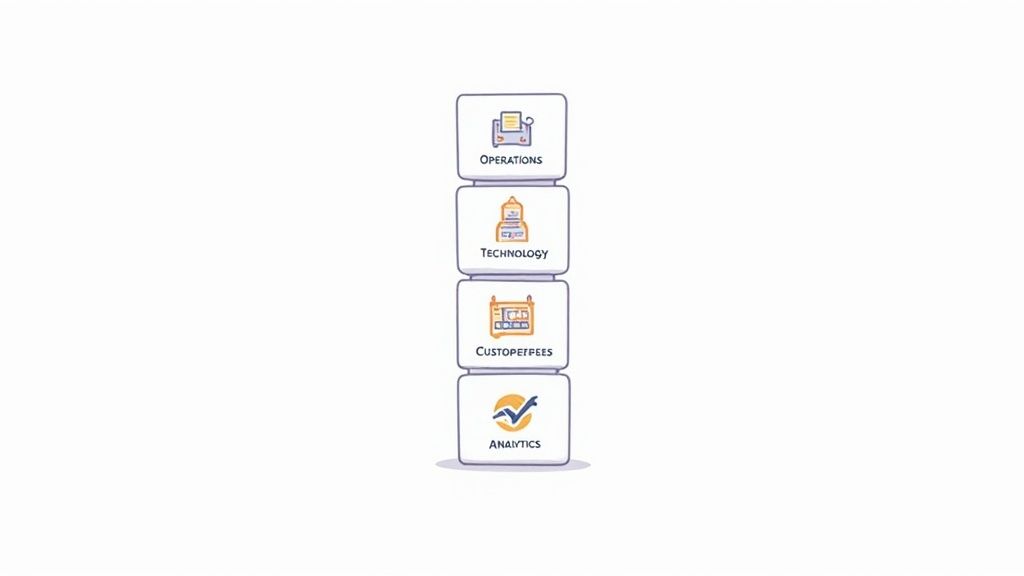
Ecommerce managed services hinge on five core areas that mesh together much like the gears in a clock. Each gear carries a distinct role, freeing leadership to steer growth rather than get bogged down in day-to-day tasks. Below, we explore each pillar with real-world stories and clear examples.
Operations Management
Smooth operations are about more than moving packages—they’re about precision from checkout to delivery. A dedicated team takes charge of order processing, stock synchronisation and supplier coordination so you don’t have to.
For instance, a D2C apparel brand saw 30% fewer order errors after handing off operations. That margin of error shrink meant their internal designers had time to roll out new collections within weeks.
Key Features
- Automated order routing to the closest fulfilment centre
- Real-time stock alerts to prevent overselling
- SLA tracking for supplier performance
VP Takeaway: Use these efficiency gains to reallocate budget toward growth initiatives or new market launches.
Customer Support
Outstanding support mixes empathetic human agents with smart bots for rapid resolutions. Think of chatbots as your front-door greeters, handling routine queries so agents can focus on complex issues.
Case Study
- A marketplace introduced voice-AI for returns questions
- First-response times dropped from 5 minutes to under 2
- Within three months, CSAT climbed by 12 points
“Problems that took days now wrap up in hours,” says a senior VP. And during festive peaks, the team flexes capacity without frantic hiring.
Technology Infrastructure
Your tech foundation is like the rails under a train—if it’s solid, everything else runs on time. This includes cloud hosting, secure integrations and ongoing protection against cyber risks.
Consider this: managed data centres are expected to expand at a 16.1% CAGR by 2025. They ensure high availability and guard sensitive data across multiple channels.
Components at a Glance
- Cloud Hosting: Scales compute and storage through peak traffic
- API Integrations: Links ERP, CRM and marketplaces for consistent data
- Security Services: WAF, DDoS protection and PCI DSS compliance
CFO Insight: Predictable hosting costs and reduced security incidents protect margins.
Warehousing And Fulfilment
Warehousing today isn’t just racks and boxes—it’s a network of hubs optimised for speed. Providers position centres close to customer hotspots, slicing delivery times and costs.
A grocery retailer partnered to open 650 festive delivery hubs in August 2025, creating 220,000 jobs. Come Diwali, orders moved faster without a hitch.
Essential Steps
- Choosing sites near Tier-2 cities
- Mapping inventory zones for efficient picking
- Embedding live-tracking for end-to-end visibility
Director’s Note: Faster deliveries drive repeat purchases and strengthen brand loyalty.
Analytics And Insights
Data by itself is noise; insights give it voice. Dashboards track metrics like order accuracy, lead times and CSAT so you can course-correct on the fly.
An electronics retailer tapped forecasting tools and cut stockouts by 30%, translating into a 15% revenue bump each month.
Critical Metrics
- SLA compliance rate
- Average processing time
- Customer satisfaction scores
“Context makes data actionable,” notes one analytics lead. Their team crafts the narrative that executives rely on.
Market Growth Context
India’s ecommerce market is on track for $200 billion by end-2025, riding a 27% CAGR since 2020. With 900 million internet users—70% shopping via mobile—robust backend support no longer feels optional.
Segment Projections
- Fashion: $15 billion
- Electronics: $20 billion
- Grocery: $24 billion
Meanwhile, UPI is set to handle over 130 billion transactions by end-2025, reaching INR 130.19 trillion in H2 2024 alone. These figures make clear why executives are betting big on managed services.
Read more about refining your brand approach in our guide: Enhance Your Ecommerce Branding Strategy With Google Trends
Comparison Of Core Service Components
The table below breaks down each core component, its primary role and the benefit it delivers to your ecommerce operation.
| Component | Function | Primary Benefit |
|---|---|---|
| Operations Management | Order processing, inventory and supplier coordination | Reduces errors and speeds fulfilment |
| Customer Support | Human agents plus AI for query resolution | Improves response time and satisfaction |
| Technology Infrastructure | Cloud hosting, integrations, security | Ensures uptime and data safety |
| Warehousing And Fulfilment | Storage, packing, logistics setup | Cuts delivery time and cost |
| Analytics And Insights | Dashboarding and forecasting | Drives revenue growth and efficiency |
By mapping out these building blocks, leaders can pinpoint where to invest and how each function delivers tangible gains. This clarity paves the way to the next section, where we’ll unpack business benefits and the KPIs CFOs and COOs track to align services with strategic objectives.
Business Benefits And Key Performance Indicators
Senior executives gauge the value of ecommerce managed services by tracking metrics that tie back to revenue growth and customer loyalty. They look for clear signs of operational health and cost efficiency. Below, we explore the most telling indicators and share real-world ROI stories.
At the top of the list:
- Uptime Percentage: A 99.9% uptime keeps checkout pages running even during traffic surges.
- Order Accuracy Rate: Hitting 98% accuracy slashes returns and complaint tickets.
- Time to Market: Measures how quickly you roll out new products or sales channels.
- CSAT and NPS Scores: Reflect how delighted customers are—and how likely they are to come back.
A D2C fashion label handed fulfilment and customer care over to specialists, and within six months:
- Operating costs dropped by 25%
- NPS climbed by 15 points
- Support tickets fell 40%, thanks to faster issue resolution
These changes freed the leadership team to focus on fresh designs and targeted ad campaigns.
Key Financial Metrics
Understanding financial metrics side by side clarifies ROI. Below is a snapshot of core KPIs and their impacts:
| KPI | Target | Business Impact |
|---|---|---|
| Uptime | 99.9% | Minimises revenue lost to downtime |
| Order Accuracy | 98% | Reduces return handling expenses |
| Time to Market | 30 days | Speeds up channel launches |
| CSAT | >85% | Drives repeat purchase rates |
Consistently track SLA compliance to prevent service drift and protect brand reputation.
CFO Perspective: Use these targets to align financial forecasts with operational projections.
Operational Efficiency Gains
Efficiency isn’t just a buzzword—it’s the engine that powers growth. By automating routine tasks, you can:
- Cut manual inventory updates by 70% with automated sync tools
- Reduce first response times by 60% using AI-driven chatbots
- Forecast stock needs and decrease out-of-stocks by 30% through predictive analytics
These savings translate directly into a stronger bottom line, better scalability and a more resilient operation.
Market Context For India
India’s ecommerce market reached Rs. 10,82,875 crore (US$125 billion) in 2024 and is projected to top Rs. 29,88,735 crore (US$345 billion) by 2030, growing at a 15% CAGR. In FY25, GMV hit Rs. 1.19 lakh crore (US$14 billion) with 12% YoY growth, while managed security services revenue is on track to hit US$414.43 million by 2025.
When you’re operating at that scale, monitoring security becomes non-negotiable:
- Threat Detection Rate measures how many risks are caught
- Incident Response Time tracks how fast you neutralise threats
- Compliance Audit Pass Rate ensures you meet all regulatory standards
You might also be interested in our guide on bounce and exit rate analytics to increase conversions.
Building A Measurement Framework
A robust framework turns raw data into actionable insights. Here’s a simple roadmap:
- Define Strategic Objectives that speak to growth and retention
- Map Each KPI to Those Objectives, so every metric has a clear purpose
- Implement Real-Time Dashboards for 360° visibility
- Schedule Monthly Reviews with cross-functional teams
- Adjust Service Scope based on what the data reveals
Tools like cloud monitoring platforms, automated reporting engines and integrated CSAT surveys feed live data into executive dashboards.
Translating Metrics To Action
Numbers only matter when they drive decisions. For instance, bumping order accuracy by 2% can free up enough budget to fuel a new social media campaign. Cutting downtime by a few hours could unlock thousands in extra sales.
Share trends in leadership forums and celebrate wins to keep momentum high. When VPs and CXOs see solid benchmarks and regular review cycles, they gain confidence in their managed service partners—and that confidence shows up in board meetings and investor decks.
Vendor Selection Checklist
Picking an ecommerce managed services partner is a bit like choosing a co-pilot for a long haul flight—you need someone who’ll keep you airborne, even when turbulence hits. Senior leaders must balance operational resilience, cost control and customer confidence. Below are the five areas that make or break that partnership:
- SLAs and Support Response Quality
- Data Security Certifications and Audit Evidence
- Integration Capabilities Across Systems and Channels
- Scalability Options for Peak Demand and Growth
- Transparent Pricing to Avoid Budget Surprises
Dive into each section to probe vendors and compare profiles side by side.
Service-Level Agreements And Support Response
Keeping your store live around the clock is non-negotiable. Every minute of unplanned downtime chips away at revenue and reputation.
Probing Questions
- What’s the guaranteed uptime percentage, and how do you track it?
- How quickly do you respond to critical incidents versus routine issues?
Red Flags
- SLA metrics with no financial penalties for missed targets
- Support tiers that lack clear escalation paths
Practical Example
A national D2C retailer insisted on a 99.95% uptime SLA, complete with credits for every hour of downtime during peak sale periods.
Clear SLAs align vendor performance incentives with business outcomes
Data Security And Compliance
You wouldn’t leave your front door unlocked. Treat customer data the same way. Look for vendors whose security credentials are backed by regular, third-party audits.
Probing Questions
- Can you provide recent PCI DSS, ISO 27001 and SOC 2 audit reports?
- How frequently do you run penetration tests and vulnerability scans?
Red Flags
- Security claims based solely on internal reviews
- No documented incident response plan for data breaches
Case Study
One leading apparel brand made quarterly SOC 2 Type II reports a deal-breaker for renewal—slashing their exposure to evolving threats.
Integration And Scalability
Imagine building a puzzle one piece at a time versus having the complete picture handed to you. Seamless API connections and elastic scaling shouldn’t feel like an afterthought.
Probing Questions
- Which out-of-the-box APIs do you offer for ERP, CRM and marketplace integrations?
- How fast can you ramp up capacity during flash sales or geographic expansions?
Red Flags
- Manual workarounds for order syncing or data exports
- Fixed resource limits that require new contracts to increase
Practical Example
In a two-week pilot, a multi-vendor marketplace tested ERP integration through sandbox APIs and—without changing a line of code—scaled smoothly to 10,000 orders a day.
Pricing Transparency And Cost Structure
Surprises in your monthly bill are a surefire way to derail ROI forecasts. Demand clarity on every charge, from core services to overages.
Checklist Items
- Detailed split of fixed fees versus usage-based charges
- Clear definitions of billable events, overage fees and change-order costs
- Advance notice period for any scope or pricing adjustments
Example
A mid-market electronics seller negotiated a capped usage fee set at 10% of monthly GMV, insulating them from unexpected cost spikes during major promotions.
After you’ve gathered answers, build a comparison table and share it with your executive team for a final decision.
| Criterion | Vendor A | Vendor B | Vendor C |
|---|---|---|---|
| SLA Uptime | 99.9% | 99.7% | 99.95% |
| Penalty for Downtime | 5% Credit/hr | None | 7% Credit/hr |
| Security Certifications | ISO 27001, SOC 2 | PCI DSS | ISO 27001 |
| API Integrations | 15 Platforms | 8 Platforms | 20 Platforms |
| Scalability Response | 1 Hour | 4 Hours | 30 Minutes |
| Pricing Model | Fixed + Usage | Fixed Only | Usage-Based |
Use this side-by-side view to match vendor strengths with your strategic goals. Document your scoring, involve cross-functional teams and revisit the checklist regularly as your ecommerce roadmap evolves. A disciplined selection process not only protects your margins and reputation but also accelerates time to value. Equip your executive team with these insights to choose confidently.
For a complete vendor evaluation toolkit and template, visit our resources page on the DialNexa website.
Implementation Roadmap With Targeted Use Cases
Rolling out a managed services programme takes more than signing a contract. You need a clear path from discovery through to optimisation, with checkpoints that keep everyone—VPs to CXOs—pulling in the same direction.
Discovery Phase
At this stage, your core teams map out current workflows and spot gaps before you involve any vendors.
Key tasks include:
- Current State Audit of operations, tech stack and support workflows
- Benchmarking metrics like order accuracy and fulfilment time
- Risk assessment for compliance and downtime
Practical Example: A VP of IT led a 6-week audit that uncovered a 15% overspend on legacy hosting, using those savings to fund a pilot with a managed provider.
These findings feed directly into your vendor requirements and help negotiate realistic SLAs. Typically, this phase runs for 4–6 weeks and wraps up with an executive briefing to greenlight pilot activities.
Pilot Testing Milestones
With vendors chosen, you carve out a short, focused pilot to validate your hypotheses and hit measurable targets.
For example, a fashion D2C brand aimed for a 15% reduction in order errors within 60 days.
Below is an infographic illustrating the vendor selection process flow highlighting uptime, security and scalability steps.
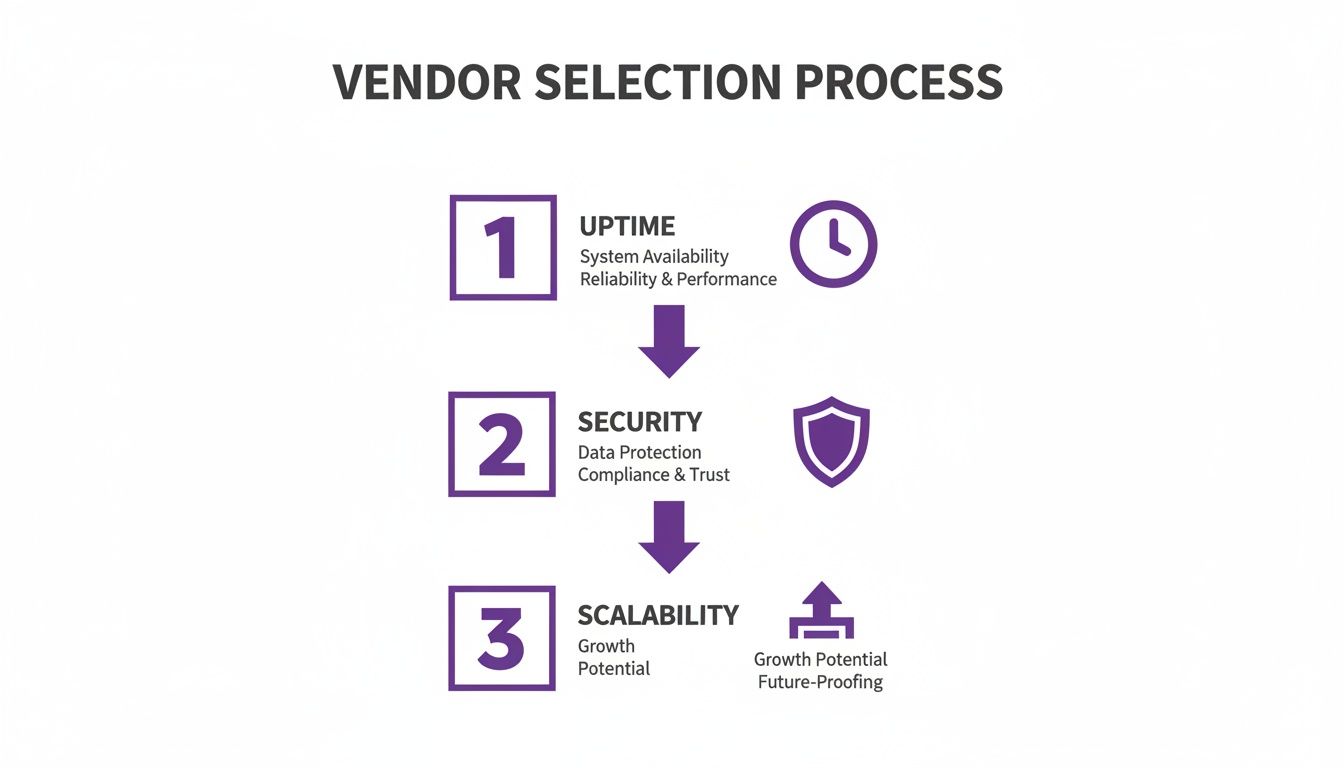
This graphic underlines that uptime, security and scalability form the pillars of vendor readiness.
Pilot milestones typically include:
- Integration of vendor APIs with ERP and CRM
- Validation of SLA adherence and incident response
- Initial CSAT survey to gauge customer support impact
- Financial review of pilot costs versus early ROI
“A structured pilot reduces unknowns and builds executive confidence,” notes a CIO at a leading retailer.
Pilot reports should blend quantitative KPI data with qualitative feedback to shape your scaling strategy.
Governance And Review
Strong oversight means assigning clear ownership at every step. A steering committee—made up of directors and VPs—meets monthly to:
- Track progress
- Surface risks
- Prevent scope creep
| Phase | Duration | Key Deliverable |
|---|---|---|
| Discovery | 4–6 weeks | Executive Alignment Report |
| Pilot Testing | 6–8 weeks | SLA Validation and CSAT Summary |
| Scaling | 3–4 months | Regional Rollout Plan |
| Optimisation | Ongoing | Quarterly Performance Scorecards |
Scaling Across Regions
Once the pilot hits its marks, you expand across geographies and product lines:
- Activate regional fulfilment centres and rebalance inventory
- Implement multilingual support to match local preferences
- Sync data across analytics platforms for unified reporting
Strong change management and clear communication keep all global teams aligned.
Continuous Optimisation
Even after go-live, the work isn’t done. You refine and tune to stay efficient:
- Adjust real-time monitoring for traffic spikes
- Retrain AI chatbots to lift resolution rates
- Hold quarterly business reviews to refine SLAs and pricing tiers
Executives should set quarterly scorecards to track impact and drive further improvements.
Targeted Use Cases
Here are three examples showing how different enterprises apply managed services:
- D2C Fashion Brand scaled fulfilment nationwide by adding micro-fulfilment hubs, cutting delivery time by 30% and boosting CSAT by 12 points.
- Multi-vendor Marketplace deployed voice AI for support, slashing average response time from 5 to 2 minutes and raising first-contact resolution by 25%.
- Q-commerce Grocer enabled same-day delivery in metro areas through real-time inventory and dynamic routing, increasing weekly order capacity by 40%.
Each story underlines lessons for VPs and CXOs: start small, enforce strict KPIs and foster cross-team collaboration.
Lessons Learned And Best Practices
- Begin with a narrow scope to validate vendor performance quickly
- Define clear, executive-aligned KPIs to measure success
- Use automated dashboards for transparent progress tracking
- Schedule regular governance reviews to address issues proactively
- Share wins and challenges with leadership to maintain alignment
Next steps include formal vendor contracting, stakeholder onboarding and establishing a communication plan. Leaders should also schedule quarterly strategy reviews to link managed service goals with growth targets.
Embracing ecommerce managed services frees your teams to innovate while maintaining operational excellence. Keep an agile mindset, revisit milestones often and you’ll drive sustained growth, predictable costs and outstanding customer experiences.
Consider leveraging DialDialNexa AI agents for scaling support and presales operations. You might be interested in our article on unlocking brand growth strategies for D2C and e-commerce marketers which explores complementary tactics: https://dialnexa.com/blogs/unlocking-brand-growth-strategies-for-d2c-and-e-commerce-marketers/
FAQ
Senior leaders often wonder what separates ecommerce managed services from a basic platform subscription. It’s more than just software access—it’s about having a dedicated team oversee operations, support and technology under firm SLAs. While your leadership zeroes in on strategic goals, specialists keep daily tasks running smoothly.
- Turnkey Operations Versus DIY Setup
How quickly can you expect ROI with a managed service model? Most organisations break even in 3–6 months, though results vary with order volume and complexity. For example, a D2C fashion brand slashed fulfilment costs by 20% and lifted CSAT by 12 points in a single quarter.
What security measures should you demand from vendors? Insist on PCI DSS compliance, regular penetration tests and 24/7 monitoring. Make ISO 27001 certification and real-time threat detection non-negotiable.
“Our cloud environment has stayed secure 100% of the peak season,” says a CTO at a top marketplace.
Integration Best Practices
Bringing an external team into your in-house crew calls for clear governance. Start with a RACI matrix to define roles, communication channels and data ownership. Then set up weekly syncs to monitor order accuracy, system uptime and other KPIs.
A real-world example: one multi-vendor platform onboarded an external support team and hit 95% SLA compliance within two months by using shared dashboards and joint training sessions.
What governance model keeps projects on course? Form a steering committee with VPs, directors and vendor leads. Meet quarterly to review SLA adherence, budget performance and risk management.
Key governance steps:
- Appoint executive sponsors from IT and operations
- Define escalation paths for high-impact issues
These checkpoints ensure transparency, accountability and alignment with your organisational goals. Addressing these questions clearly paves the way for a confident managed services journey.
Ready to transform your customer support and presales with voice AI? Visit DialNexa

Excellent overview of ecommerce managed services and how each component contributes to growth, efficiency, and customer satisfaction. The practical examples, KPIs, and vendor selection framework make this a highly valuable guide for business leaders planning long-term ecommerce success.