

Concurrent Lines Meaning in Hindi: Expert Guide
Most executives don’t lose alignment because they lack ambition. They lose it because multiple functions appear to be moving well, yet they aren’t meeting at one decisive point. That’s why a school-level idea like concurrent lines matters more than it first seems.
In Indian mathematics education, concurrent lines, known as ‘समवर्ती रेखाएँ’ (samvarti rekhaen), became a structured part of the Class 10 syllabus around 1965, and by 1970 they appeared in 62% of CBSE board exam papers, shaping a foundational concept for over 12 million secondary students according to the referenced educational material on concurrent lines in Hindi. That staying power tells you something. The idea is simple, but it trains a valuable habit of mind: separate random intersection from true alignment.
If you searched for concurrent lines meaning in hindi, you probably want the textbook definition. You’ll get that here. But you’ll also get something more useful. You’ll see how this geometry concept maps cleanly to strategic planning, operating models, governance, and organisational design.
Table of Contents
- Why a Geometry Lesson Is Crucial for Your Business Strategy
- What Are Concurrent Lines in Hindi and English
- Visualizing Key Points of Concurrency in Action
- The Algebraic Formula to Verify Concurrency
- Concurrent vs Parallel vs Collinear How to Spot the Difference
- Frequently Asked Questions About Concurrent Lines
- What is the meaning of concurrent lines in Hindi
- What is the common meeting point called
- Are concurrent lines always perpendicular
- Can two lines be called concurrent
- How do you find the point of concurrency
- Why do students confuse concurrent lines with intersecting lines
- Why should business leaders care about such a basic concept
Why a Geometry Lesson Is Crucial for Your Business Strategy
A business usually doesn’t fail because people aren’t working. It fails because people are working in different directions and calling it coordination. Geometry gives that problem a precise shape.
When three or more lines pass through one common point, they are concurrent. In business terms, that common point is your real objective. It could be qualified revenue, retention, successful implementation, regulatory compliance, or a successful product launch. If sales, product, and operations each optimise a different endpoint, you don’t have concurrency. You have motion without convergence.
The leadership lesson inside a maths term
For a CXO, concurrent lines meaning in hindi is more than a translation exercise. It’s a disciplined way to think about alignment. Every operating system has lines: incentives, workflows, reporting structures, approval chains, customer journeys. The question is whether those lines meet at one point or scatter into friction.
A useful technical parallel appears in concurrency in Go for system coordination. Software teams learn quickly that multiple processes running together don’t automatically produce order. The same is true in organisations. Parallel activity is not the same as integrated execution.
Strong companies don’t just move fast. They make different teams arrive at the same point for the same reason.
Why Indian classrooms treated it as foundational
The longevity of this topic in Indian education also matters. The cited educational reference notes that समवर्ती रेखाएँ entered structured school treatment around 1965 and appeared in 62% of CBSE board papers by 1970, which shows how central the concept became in problem-solving practice for students learning coordinate geometry and proof-based thinking through this Hindi explainer on concurrent lines.
That’s not accidental. Concurrency trains three habits executives also need:
- Precision of target: Teams must know the exact point they are meant to meet.
- Validation of structure: A neat-looking diagram can still be wrong, just as a polished strategy deck can hide operational misalignment.
- Sensitivity to failure points: If one line shifts, the common point disappears.
In geometry, the picture looks elegant only when the conditions hold. In business, the org chart looks elegant only when decisions, incentives, and execution still intersect where they should.
What Are Concurrent Lines in Hindi and English
The direct answer is simple. Concurrent lines are three or more lines that intersect at a single common point.
In Hindi, the standard term is समवर्ती रेखाएँ, often pronounced samvarti rekhaen. You may also see संगामी रेखाएँ in some educational contexts. Both point to the same core idea, though students often encounter समवर्ती रेखाएँ more commonly in school-oriented explanations.
Core definition: Concurrent lines are lines that all pass through one common point.
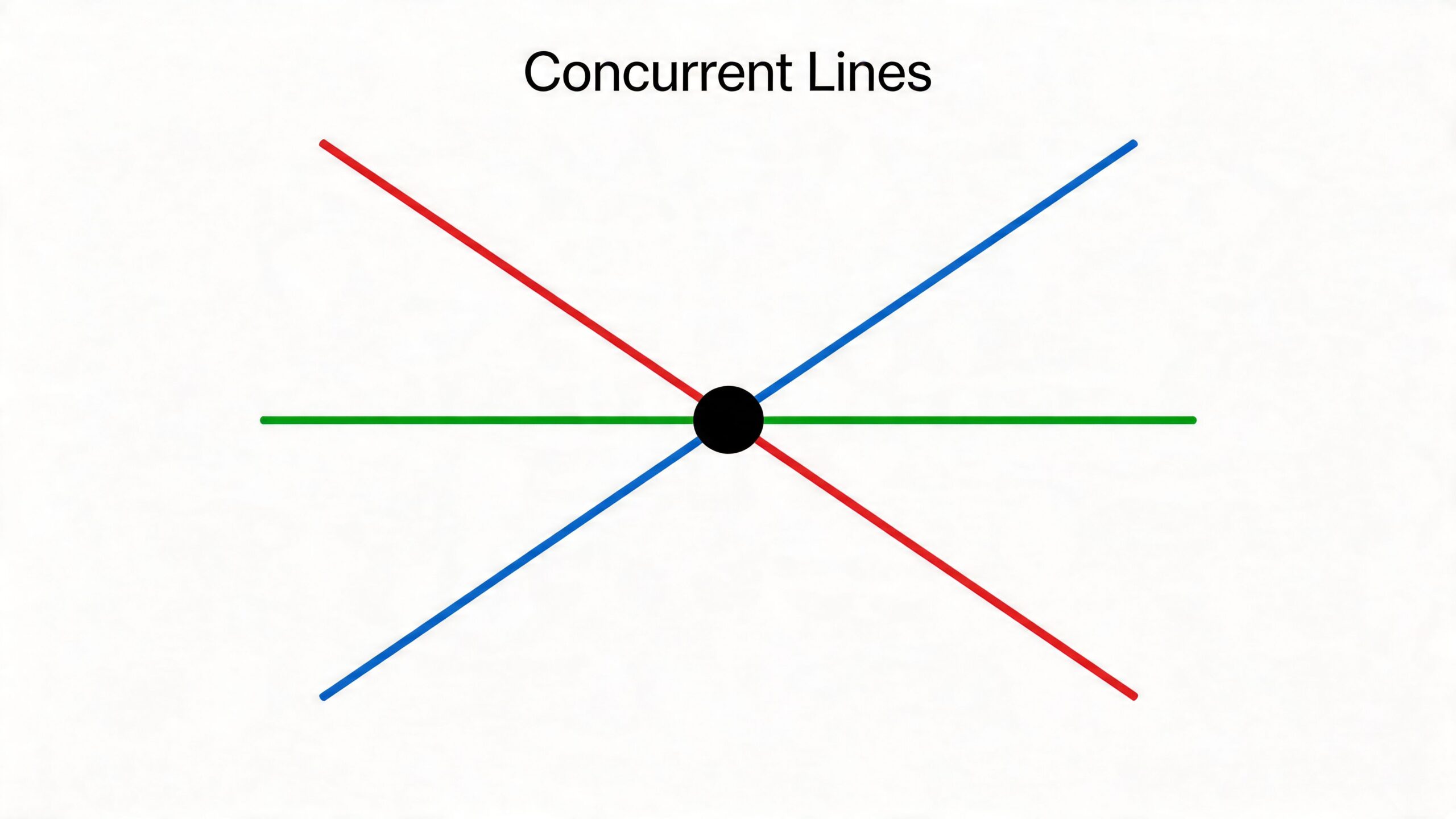
The meaning in plain language
Here’s the easiest way to understand it. Any two non-parallel lines can intersect. That alone doesn’t make the setup special. Concurrency becomes special when a third line, or more, also passes through that exact same point.
That “same point” part is where many learners get confused. They see several crossing lines in a diagram and assume they’re concurrent. But if the lines cross in different places, they are merely intersecting lines, not concurrent lines.
If you want a quick refresher on broader shape and line concepts before going deeper, this guide to Basic Geometry is a practical supporting resource.
Why language matters for learners
For Indian students, the phrase concurrent lines meaning in hindi often sits inside a bilingual learning experience. A teacher may say “find the point of concurrency” and then explain it as समवर्ती बिन्दु or the common intersection point in Hindi. That switching is normal, but it can also create hesitation if the terminology isn’t mapped clearly.
The same challenge appears in educational technology when teams localise explanations for multilingual audiences. A good example of why wording and pronunciation matter can be seen in thinking about localising voice agents for regional understanding. In maths, one mistranslated term can turn a clear concept into a memorised phrase with no mental picture.
A simple classroom sentence works best: three or more lines, one shared point, one idea.
Visualizing Key Points of Concurrency in Action
Some geometry ideas stay abstract until you see where they show up naturally. Concurrent lines become much easier once you look at triangle centres. A triangle contains several famous examples where different sets of lines meet at one exact point.
Start with this visual map.
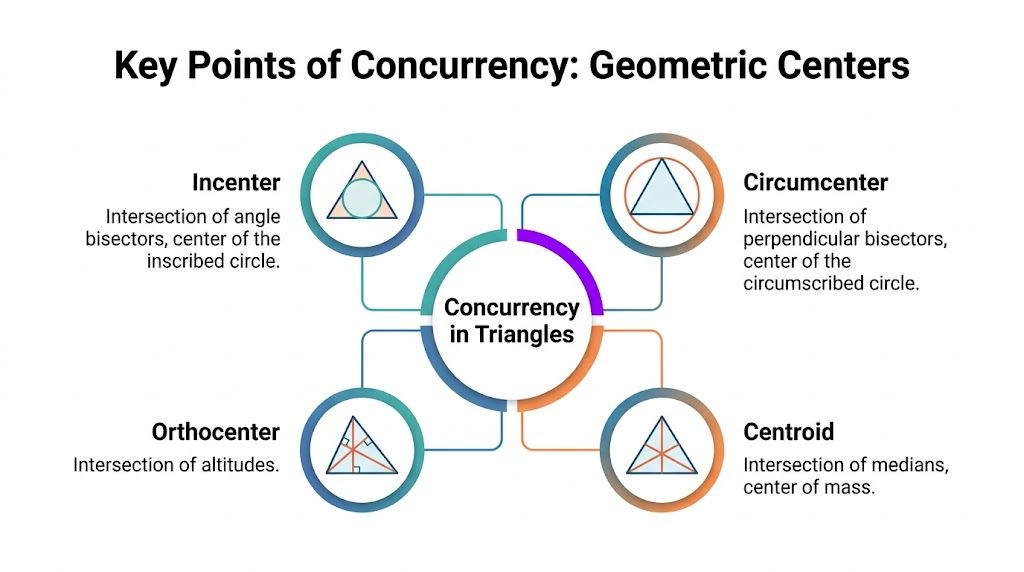
Centroid as the balance point
Take the three medians of a triangle. A median joins one vertex to the midpoint of the opposite side. All three medians meet at one point called the centroid.
In geometry, the centroid is the balance point. In business, it resembles the operating centre where effort, resources, and decision-making stay proportionate. When a leadership team asks whether one function is carrying too much load, they’re really asking whether the organisational shape still balances around a coherent centre.
A well-designed activity like the secret geometry of a mini city helps learners connect these abstract centres to structures and layouts they can imagine.
Orthocenter as the point of intensity
Now consider the altitudes. An altitude runs from a vertex and meets the opposite side at a right angle. These three altitudes are concurrent at the orthocenter.
This is a useful metaphor for escalation and problem-solving. In a company, difficult issues often travel down different reporting lines until they hit one shared point of constraint. That point may be quality control, customer trust, compliance review, or delivery capacity. Leaders who identify that point early can solve the underlying problem rather than treat symptoms in separate departments.
A short visual explanation often helps more than text alone, so this walkthrough is worth watching:
Circumcenter as the equidistant hub
Next are the perpendicular bisectors of the sides of a triangle. These are lines drawn at right angles through the midpoint of each side. They meet at the circumcenter.
The circumcenter has an elegant property. It is equally placed relative to the triangle’s vertices. In organisational terms, this looks like a service hub that supports multiple units fairly, without drifting too close to only one department’s priorities. Think of shared legal, analytics, platform engineering, or finance support. The location matters because bias in placement creates delay elsewhere.
Incenter as the point of internal fit
The infographic also includes the incenter, formed by the intersection of the angle bisectors. It sits at the centre of the inscribed circle within the triangle.
That makes it a useful analogy for internal fit. If the centroid is about balance and the circumcenter is about external reach, the incenter is about what fits neatly inside the system. Leaders encounter this when they ask whether a process sits comfortably inside the business, or whether it touches one side too tightly and leaves gaps elsewhere.
In geometry, different concurrent points answer different questions. The same is true in strategy. Alignment, balance, fairness, and fit are not identical problems.
These examples show why concurrency isn’t random. It emerges from a specific construction, and each construction reveals a different kind of order.
For education teams exploring clearer ways to teach abstract concepts, the broader challenge is similar to designing voice assistants in education. Explanations work when they convert technical structure into a memorable mental model.
The Algebraic Formula to Verify Concurrency
A clean diagram can mislead. The lines may look as if they meet at one point when they don’t. Algebra removes guesswork.
For three lines written in this form,
- a₁x + b₁y + c₁ = 0
- a₂x + b₂y + c₂ = 0
- a₃x + b₃y + c₃ = 0
they are concurrent when the determinant below equals zero:
[
begin{vmatrix}
a_1 & b_1 & c_1
a_2 & b_2 & c_2
a_3 & b_3 & c_3
end{vmatrix} = 0
]
This is the audit test. In business language, it’s the equivalent of checking whether three reporting claims reconcile in one operating reality.
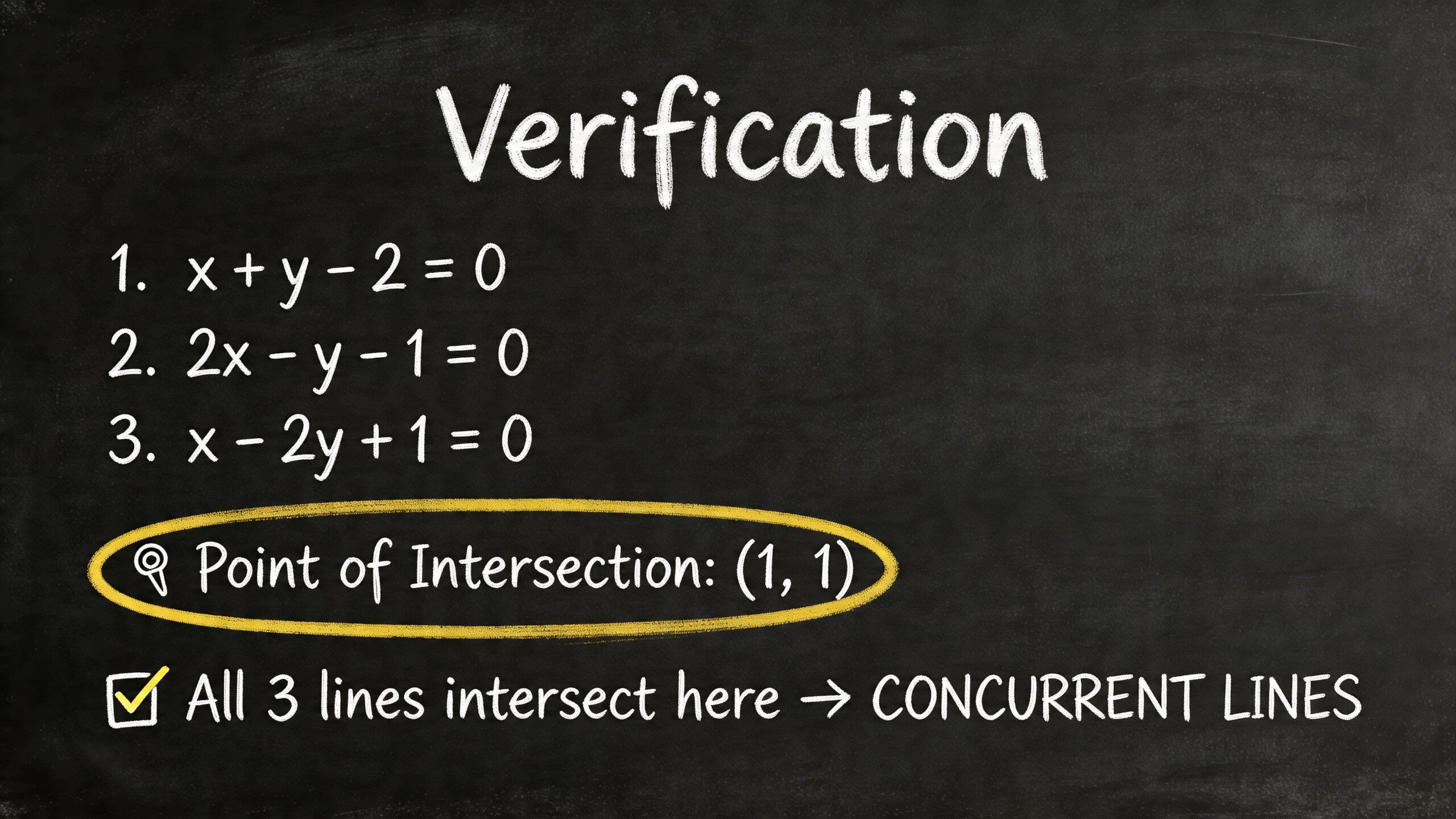
A worked example
Take these three lines:
- x + y – 2 = 0
- 2x – y – 1 = 0
- 3x – 4 = 0
Write their coefficients into a matrix:
[
begin{vmatrix}
1 & 1 & -2
2 & -1 & -1
3 & 0 & -4
end{vmatrix}
]
Now expand the determinant:
[
1((-1)(-4) – (-1)(0)) – 1((2)(-4) – (-1)(3)) + (-2)((2)(0) – (-1)(3))
]
[
= 1(4) – 1(-8 + 3) + (-2)(3)
]
[
= 4 – (-5) – 6 = 3
]
The determinant is not zero. So these lines are not concurrent.
Why this matters in exams and leadership
This method matters because it gives certainty. The verified exam data states that in India’s JEE Main, with over 1.2 million aspirants annually, concurrent lines have appeared in 22% of geometry questions between 2005 and 2025, making the determinant method important for students who need reliable verification in competitive settings, as noted in the referenced overview of concurrent lines and their geometric use.
For executives, the lesson is blunt. Visual alignment is not enough. You need a test. If marketing says one thing, finance says another, and customer success reports a third, the question isn’t whether the narrative sounds harmonious. The question is whether those lines mathematically meet.
Practical rule: If a claim about alignment can’t survive a verification step, treat it as a sketch, not a strategy.
Concurrent vs Parallel vs Collinear How to Spot the Difference
Students often mix up line relationships because the words sound technical and the diagrams look similar at speed. Leaders do something similar when they confuse collaboration with alignment, or overlap with focus.
The simplest fix is side-by-side comparison.
Geometric Line Relationships and Business Analogies
| Term | Geometric Definition | Business Analogy |
|---|---|---|
| Concurrent | Three or more lines meet at one common point | Sales, product, and operations all drive toward one shared business outcome |
| Parallel | Lines never meet, even if extended | Departments work efficiently but remain siloed, with no real integration |
| Intersecting but not concurrent | Lines cross, but not all at the same point | Teams hold meetings and exchange inputs, yet don’t converge on one decision |
| Collinear | Points lie on the same straight line | Multiple efforts become redundant because they follow the same path without adding range |
Fast recognition rules
A few mental checks make this easier.
- Ask one-point or many-points: If all the relevant lines meet at a single location, they’re concurrent.
- Look for never-meet behaviour: If the lines keep the same direction and distance, they’re parallel.
- Check whether only two lines cross: That’s intersection, but not necessarily concurrency.
- Notice sameness of path: Collinear setups are about lying on one straight line, not several lines meeting.
Where readers usually get confused
The biggest mistake is assuming “intersecting” automatically means “concurrent.” It doesn’t. Concurrency is stricter. Every concurrent set intersects, but not every intersecting set is concurrent.
The second mistake is mixing up lines and points. Collinear usually describes points on the same line. Concurrent describes lines meeting at the same point. Once you separate those two, the language gets much easier to manage.
For business readers, the distinction is practical. Parallel teams aren’t necessarily failing. They may be independent. Intersecting teams aren’t necessarily aligned. They may just be touching the same project briefly. True concurrency means multiple efforts truly converge on one decisive objective.
Frequently Asked Questions About Concurrent Lines
What is the meaning of concurrent lines in Hindi
Concurrent lines meaning in hindi is समवर्ती रेखाएँ. It refers to three or more lines that intersect at one common point. Some learners also come across संगामी रेखाएँ as an alternative term.
What is the common meeting point called
It’s called the point of concurrency. In specific triangle constructions, that point may have a special name such as centroid, orthocenter, circumcenter, or incenter.
Are concurrent lines always perpendicular
No. They don’t have to be perpendicular. The only requirement is that they all pass through the same point. Some special constructions involve right angles, such as altitudes or perpendicular bisectors, but concurrency itself doesn’t require perpendicularity.
Can two lines be called concurrent
In school geometry, the term is usually used for three or more lines meeting at one point. Two lines can intersect, but “concurrent” is generally reserved for a larger set.
How do you find the point of concurrency
There are two common ways:
- Graphically: Draw the lines carefully and identify the common intersection point.
- Algebraically: Solve two equations first to find their intersection, then check whether the third line also passes through that same point.
If you are given three equations in linear form, the determinant method gives a fast verification test.
Why do students confuse concurrent lines with intersecting lines
Because every concurrent setup includes intersection, but not every intersection creates concurrency. The hidden word is common. One shared point is the deciding condition.
Why should business leaders care about such a basic concept
Because it sharpens how you diagnose organisational alignment. A company can have active teams, clear reporting lines, and frequent communication, yet still miss a shared point of execution. Concurrent lines offer a clean mental model for checking whether structure, incentives, and action are meeting where they should.
If your organisation is building multilingual learning journeys, student support flows, or high-volume communication systems, DialNexa Labs Private Limited helps teams deploy human-like Voice AI agents for counselling, support, qualification, and follow-ups at scale. For EdTech leaders in particular, that means clearer learner interactions, more consistent communication, and systems that stay aligned from first contact to final conversion.

Excellent analogy connecting geometric concurrency with organizational alignment and leadership execution. The explanation makes a complex mathematical concept both memorable and highly relevant to business strategy and team coordination.