

Bengali Voice to Text: A C-Suite Guide to Unlocking Market Growth
TL;DR
- Bengali voice AI is a revenue lever, not just transcription. The connect rates jump from 47% to 91% when engaging India’s 100M+ Bengali speakers in their native language, with lead-to-booking conversion rising from 2% to 8%.
- Custom-trained models significantly outperform generic pretrained ones: providers trained on Indian Bengali datasets reach 6.3% Word Error Rate versus 14–16% for generic models.
- Early adopters report up to 92% cost reduction and 62% productivity gains from automating routine Bengali voice interactions.
- Start with one narrow, high-volume pilot (lead qualification or support triage) before a full rollout, DPDP compliance and Banglish (mixed Bengali-English) handling are the two deployment details most teams miss.
At its core, Bengali voice to text technology converts spoken Bengali into written text. However, for a forward-thinking executive, viewing it merely as a transcription tool is a strategic oversight. For enterprises aiming to establish a commanding presence in India, this technology is the key to transforming a communication barrier into a significant revenue-generating asset, particularly in high-stakes areas like lead qualification and customer support.
The Untapped ROI in Bengali Voice to Text
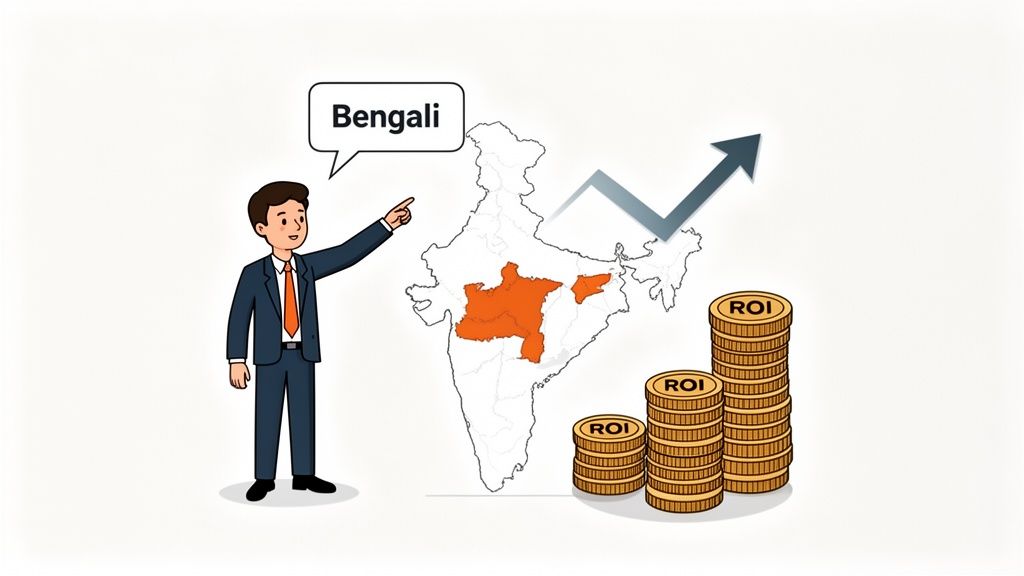
If your strategic roadmap includes expanding your footprint in India, the Bengali-speaking market is a goldmine you cannot afford to ignore. We’re talking about a market of over 100 million speakers. That isn’t just a demographic statistic; it’s a massive customer base that demonstrates significantly higher engagement when addressed in their native language. Adopting Bengali voice to text is the most direct and scalable way to unlock that potential.
This technology is the strategic link between native-language engagement and tangible business outcomes. When your systems interact with customers in fluent, natural-sounding Bengali, you’re not just providing a courtesy. You are building trust at scale and carving out a formidable competitive advantage. The impact is both immediate and measurable.
From Low Engagement to High Conversion
Let’s examine the data from the field. A standard call centre operating in English or Hindi often struggles with connect rates that hover around 47% in the Bengali-speaking market. That represents a significant loss of potential revenue. However, the results from early adopters integrating intelligent voice AI that speaks fluent Bengali are dramatic.
By engaging customers in their native language with a human-like tone, we’re seeing enterprises push their connect rates up to an incredible 91%. This is not an incremental improvement. It is a fundamental game-changer for customer acquisition and engagement.
This massive jump in engagement directly impacts the bottom line. When an AI can qualify leads with an accuracy rivaling your top human agents, your sales team’s productivity soars. They cease wasting valuable time on cold leads and focus exclusively on prospects primed for conversion. As you map out the ROI for Bengali voice to text, it’s imperative to think bigger about how you can increase revenue significantly with AI.
Real-World Business Impact
The practical applications of Bengali voice to text are already delivering substantial returns for industry leaders. This is not a theoretical projection; it’s a current operational reality.
-
Real Estate: Leading brokerage firms are using Voice AI to automate the initial round of discovery calls. The AI qualifies prospects by discussing budget, location, and property type, and books site visits entirely in Bengali. This has led to a 300% increase in qualified site visits per agent per month.
-
EdTech: Counselling platforms are now fielding thousands of daily inquiries about courses. The AI handles all routine questions, fee structure, duration, eligibility, freeing up human counsellors to manage complex, high-value conversations, resulting in a 40% increase in student enrollment for targeted courses.
-
BFSI: Financial firms are guiding customers through KYC verification and product queries in Bengali. This not only elevates the customer experience but also ensures compliance protocols are handled with 99.5% accuracy, reducing manual review costs by 70%.
For any enterprise serious about capturing market share in West Bengal, Tripura, and Assam, AI-powered voice is a strategic necessity. To get a better sense of the operational transformation, take a look at our guide on how the voice AI revolution is transforming multilingual call centres. The data confirms: investing in Bengali voice capabilities is a direct investment in your company’s growth trajectory.
Building Your Business Case for Bengali Voice AI
To secure executive buy-in for any new technology, the conversation must center on financial impact, specifically, how this investment will generate revenue or create significant cost savings. The business case for Bengali voice to text is not about novel features; it’s about tangible, board-level results. The argument rests on two powerful pillars: massive operational cost reduction and a significant boost in efficiency that translates directly to revenue growth.
We are already witnessing early adopters in the Indian market achieve remarkable results. Imagine reducing your operational costs by as much as 92% while simultaneously seeing your team’s productivity increase by 62%. These are not hypothetical figures. They represent the real-world impact of automating routine voice interactions and effectively serving the vast Bengali-speaking market.
Pretrained Models Versus Custom Solutions
You will immediately face a critical decision: leverage a ready-to-use pretrained model or invest in a custom-built solution. This choice will have a direct impact on your budget, timeline, and the strategic outcome of the initiative.
Think of a pretrained model like leasing a commercial vehicle. It’s fast, the upfront capital expenditure is low, and you can be operational almost immediately. By integrating with a third-party API, you can have a functional Bengali voice to text system within weeks. This is a sound approach for standard use cases, like transcribing general customer service calls.
Building a custom model, on the other hand, is like commissioning a fleet of specialized vehicles engineered for your specific logistics. It requires a larger initial investment in data collection, annotation, and model training. The timeline extends to months, not weeks. However, the result is a proprietary system that understands your specific business jargon, local customer accents, and unique operational call flows, delivering a significant competitive edge.
For a real estate firm, a custom model can be trained to recognize specific property names and local landmarks in Kolkata with over 98% accuracy. For a BFSI company, it can be fine-tuned to accurately transcribe complex financial terms during KYC calls, ensuring higher accuracy and regulatory compliance. The choice depends entirely on your strategic goals and the level of precision your business demands.
Quantifying the Impact on Your KPIs
To get that budget approved and win over stakeholders, you must present compelling numbers. Move beyond vague benefits and focus on the specific metrics Bengali voice AI will improve.
Here’s a simple framework to project the return on investment:
- Lead Conversion Uplift: This is one of the most compelling metrics. We’ve seen businesses in hospitality and real estate improve their lead-to-booking conversion rate from a typical 2% to as high as 8%. This is achieved by using AI that can qualify leads fluently in Bengali, 24/7, without fatigue.
- Cost Per Interaction: First, calculate your current fully-loaded cost for a single human-agent interaction. A voice AI agent can handle thousands of calls daily at a cost reduction of up to 92%, driving this core metric down significantly.
- Agent Productivity: How many person-hours do your skilled agents lose to repetitive, low-value work? Automating initial screening or data entry can free up hundreds of hours per month per team. That is time your best people can reallocate to closing deals or resolving complex issues that drive customer loyalty.
The pace of advancement in this field has been staggering. With over 100 million Bengali speakers in India, the demand for accurate voice technology is immense. Before 2020, Bengali automated speech recognition (ASR) was notoriously unreliable, with word error rates often exceeding 40%. However, recent advances, powered by massive, high-quality local datasets, have changed the entire landscape.
For instance, AI agents from providers like DialNexa can now handle thousands of calls a day with 97% lead qualification accuracy. This level of performance makes deploying this technology at scale not just a possibility, but a clear path to profitability. To understand the data foundation required, you can find more about Bengali data services for AI on Andovar.com.
Nailing the Technical Strategy: Data and Models
Getting your Bengali voice to text project right hinges on two critical components: the AI model you select and the data you use to train it. For any leader in sectors like healthcare or BFSI, this is not merely a technical decision, it’s a core business decision. Your choice determines whether your AI can accurately capture a patient’s booking over a noisy line or correctly process details during a video KYC call. A sound strategy from the outset prevents costly rework and delivers accurate, reliable results from day one.
The absolute foundation of any high-performing speech recognition system is its training data. This is where you’ll face your first major fork in the road. Do you license a massive, ready-made dataset, or do you invest in collecting your own custom data that truly reflects your industry’s language and your customers’ speech patterns?
Pretrained Models: A Fast Start with Some Big Catches
Going with a pretrained model is tempting because it’s fast. These models have been trained on huge volumes of general-purpose audio, so you can often get a proof-of-concept running with a simple API call. They handle a wide spectrum of common conversational Bengali pretty well.
But for a director overseeing operations, the real question is whether “good enough” is actually good enough for your business. General models often falter when they encounter real-world business complexities.
- Industry-Specific Terms: A pretrained model might hear “ULIP plan” and transcribe it as nonsensical gibberish, creating chaos in your financial services workflow and jeopardizing compliance.
- Strong Regional Dialects: While it might handle standard Kolkata Bengali, it will likely struggle with the distinct dialects from rural West Bengal or Assam, leading to a poor customer experience and high error rates.
- Noisy Environments: Call centre chatter, street traffic, or a poor mobile connection can cripple the accuracy of a model not explicitly trained for these conditions, rendering the output useless.
These limitations can quickly lead to frustrated customers and corrupt data, completely undermining the business objectives you set out to achieve.
The Strategic Power of Custom Data
This brings us to the more demanding, but far more rewarding, option: collecting custom data. Building your own dataset means recording and transcribing audio that is a perfect match for your business operations. For achieving top-tier accuracy in specialised fields, this is the gold standard.
Consider this: to teach an AI to understand real estate conversations in Bengali, it needs to hear thousands of examples with terms like “BHK,” “stamp duty,” and specific locality names. Building a custom dataset ensures your model speaks the same language as your agents and customers, with accuracy exceeding 98% for key terms.
Creating a solid data strategy is a detailed process, but it’s completely manageable. For a deeper dive into the nuts and bolts, you can explore our guide on the essential steps for acquiring and preparing high-quality voice training data for AI projects.
Bengali Speech-to-Text in the Indian Market
The surge in Bengali voice technology in India is no surprise. With over 275 million total speakers and 100+ million users in India alone, the demand is fuelling applications across BPOs, EdTech, and more. A major breakthrough came in 2023 with AI4Bharat’s Nirantar dataset, which provided 3,240 hours of transcribed conversational speech, with a strong focus on Bengali to capture its rich regional accents.
This has been a game-changer. Models trained on such relevant data have delivered 94% time savings and 92% cost reductions for platforms transcribing Bengali content. We’re now seeing providers achieve a Word Error Rate (WER) as low as 6.3% for Bengali, a massive leap forward. For real estate developers and online learning platforms, this superior accuracy translates directly into results, with connection rates jumping from 47% to 91% when using human-like Voice AI.
Here’s a look at how some top providers compare when processing Bengali, especially after being trained on localised Indian datasets.
Bengali ASR Model Performance Comparison (2026)
| Provider | Word Error Rate (WER) for Bengali | Key Feature |
|---|---|---|
| Provider A (Custom Indian Training) | 6.3% | Fine-tuned on diverse Indian dialects. |
| Deepgram | 8.1% | Strong performance in noisy environments. |
| Provider B (General Model) | 14.5% | Basic support without dialect-specific training. |
| Provider C (General Model) | 16.2% | Struggles with industry-specific terminology. |
As the table shows, models trained specifically on Indian Bengali data perform significantly better, highlighting why a tailored data strategy is so crucial for success.
When you’re ready to get technical, bringing in specialised ASR expertise is one of the smartest moves you can make. Experts who live and breathe this work can guide you through the complexities of data collection, annotation, and model fine-tuning, ensuring your final product meets the high accuracy standards your business depends on.
From Pilot Project to Full-Scale Deployment
A great strategy on paper is one thing, but execution is where it all comes together. Rolling out a new technology like Bengali voice to text across an entire organisation can feel overwhelming. My advice? Don’t try to boil the ocean. A carefully planned, phased approach is the only way to go, starting with a manageable pilot project to prove the concept before you even think about scaling up.
This isn’t about a flashy, “big bang” launch that risks falling flat. It’s about being smart. Find one high-impact, low-risk use case where you can demonstrate real value, fast. If you’re a VP of Sales, that means automating lead qualification for a small, focused team. If you’re a Director of Operations, it could be handling the first wave of common customer support queries to free up your experienced agents.
How do you identify the right pilot project for Bengali voice AI?
The entire purpose of a Bengali Voice to Text pilot is to generate clear, measurable results that secure enterprise-wide buy-in. You’re looking for that quick win that builds internal confidence and silences the sceptics.
A fantastic place to start is with a process that’s repetitive, high-volume, and currently consuming your skilled employees’ time. Think about the first touchpoint in your sales or support cycle.
- For a Real Estate Brokerage: Imagine you’re running a major marketing campaign generating thousands of inbound calls. A pilot could focus on these. The voice AI handles the initial discovery, asking about budget, preferred location, and property type and then passes only the genuinely qualified, high-intent leads to your human agents. The result: agents’ closing rates can increase by over 25% as they only speak to warm leads.
- For an EdTech Platform: Your pilot could manage all initial inquiries for your most popular course. The AI instantly answers common questions about fees, duration, and eligibility. This frees up human counsellors to have more meaningful conversations, leading to a 15% increase in conversion from inquiry to enrollment.
By zeroing in on a specific workflow like this, you can accurately measure the impact. You can track crucial metrics like the number of qualified leads, the reduction in agent handling time, and the transcription accuracy. This data becomes a powerful internal case study that makes the argument for expansion for you.
This chart breaks down the essential data strategy needed to power a Bengali Voice to Text pilot like this, moving from licensing foundational data to refining it for your specific business needs.
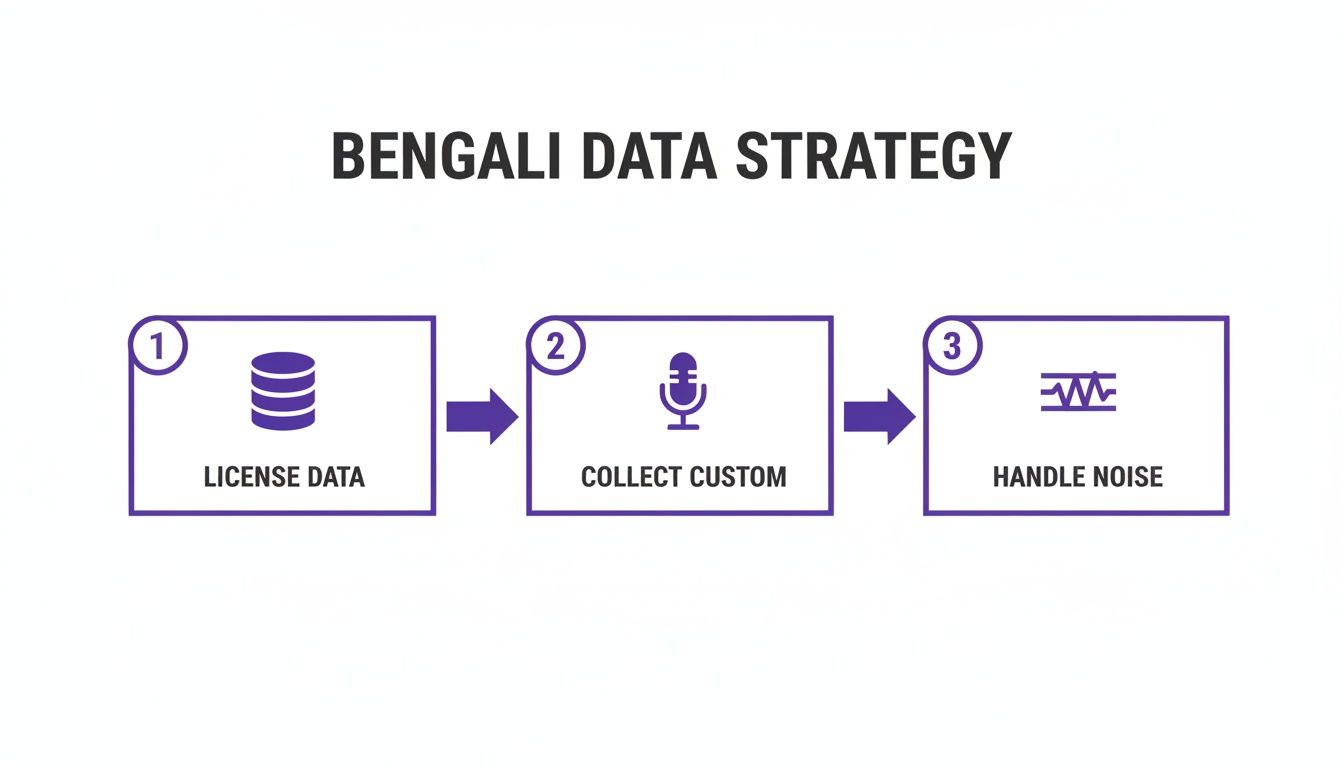
As you can see, a solid data foundation is built in layers. You start with broad datasets and then layer on custom, business-specific audio to really nail the accuracy for your use case.
What are the technical essentials for deploying Bengali voice AI?
With your pilot project scoped out, it’s time to get your hands dirty with the technical setup. This is where you physically connect the voice AI to your existing systems. The good news is that modern platforms are built for this, making integration less of a technical nightmare and more of a strategic exercise.
Your first big technical decision will be choosing between real-time and batch processing.
- Real-time Transcription: This is non-negotiable for any live interaction. When an AI agent is on a call with a customer, it needs to transcribe their speech instantly to understand what’s being said and respond intelligently. This is what you’ll use for live lead qualification or support calls.
- Batch Processing: This is for everything that happens after the call ends. You can process thousands of call recordings overnight to pull out business insights, perform compliance checks, or score agent performance. This is a goldmine for business intelligence and quality assurance, often revealing customer sentiment trends or product feedback at scale.
A truly successful deployment also means integrating with the tools your business already runs on, like your CRM. When your Bengali voice AI qualifies a lead, you want the transcribed notes, a call summary, and the outcome pushed directly into your CRM. This creates a seamless, no-friction handover to your sales team. A pilot project is the perfect sandbox to test and perfect this CRM integration on a small scale.
Navigating Deployment Details
Beyond the core tech, a few practical details can make or break a full-scale deployment. For the Bengali-speaking market, two areas demand special attention.
The first is how you handle ‘Banglish’, the common, everyday mix of Bengali and English words. A top-tier model must be trained to recognise and correctly transcribe these mixed-language phrases. It’s simply how a large segment of your customers naturally speaks. Failure to handle this results in unusable transcripts.
The second is compliance. With India’s Digital Personal Data Protection (DPDP) Act in place, how you handle customer data is under a microscope. Your chosen voice AI provider must offer enterprise-grade security, data encryption, and transparent policies on data residency and processing. This is the only way to ensure you remain fully compliant, especially in sensitive sectors like BFSI and healthcare. You can dive deeper into building these robust systems in our guide to contact centre voice AI analytics and production strategies.
By starting small with a focused pilot, you get the chance to iron out all these technical and operational wrinkles. This completely de-risks the project and hands you a proven blueprint for smoothly scaling your Bengali voice to text solution to handle thousands of daily interactions across the entire organisation.
Measuring Success and Optimising for Long-Term ROI
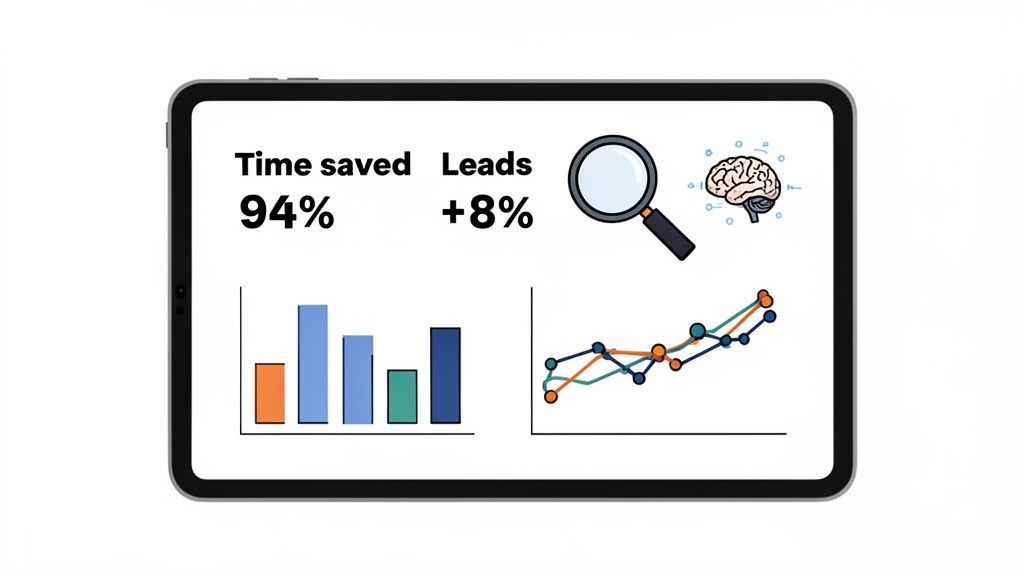
Deploying your Bengali voice to text system is a significant achievement, but from a leadership perspective, it is merely the starting point. The real, enduring value is generated through continuous measurement and refinement to drive tangible business outcomes. This is the process that transforms a one-time project into a core strategic asset.
It’s easy to get bogged down in technical statistics like Word Error Rate (WER), but this metric alone fails to tell the full business story. As a CXO, you must ask more strategic questions. Are you actually realizing the 94% time savings that best-in-class models can deliver? Is your Customer Satisfaction (CSAT) score improving? Critically, are the leads your AI identifies as ‘high-quality’ converting into actual revenue?
Moving Beyond Technical Metrics to Business KPIs
To truly gauge the impact, your dashboard must speak the language of the boardroom, not just the engineering lab. While your technical team fine-tunes the model, your focus must remain on the key performance indicators (KPIs) that link directly to the bottom line.
Here are the business-centric metrics I always recommend tracking for any Bengali voice AI initiative:
- Lead Quality Score: How does the AI’s lead scoring compare to your best human agents? With platforms like DialNexa, the goal is to hit a 97% match with human judgement. This ensures your sales team isn’t wasting time on poorly qualified prospects.
- Cost Per Qualified Lead: This metric is simple but powerful. Calculate the cost for the AI to surface a conversion-ready lead versus a human agent. A reduction from, for example, ₹800 per human-qualified lead to ₹50 per AI-qualified lead makes the business case for automation undeniable.
- Agent Efficiency Gains: Track the drop in average handling time (AHT). More importantly, measure the increase in high-value tasks your team can now handle, like complex negotiations or relationship-building, since they’re freed from repetitive call analysis.
- Conversion Rate Uplift: This is the ultimate proof point. Monitor the percentage of AI-qualified leads that become paying customers. Taking this number from a standard 2% to 8% is a massive win and a clear indicator of a healthy ROI.
By keeping a close eye on these KPIs, you gain a data-driven, 360-degree view of your investment’s performance, enabling smarter decisions about where to scale your efforts next.
Continuous Improvement Through Error Analysis
Let’s be realistic: no AI model is perfect out of the box. Your system will make mistakes, especially in the initial stages. The objective isn’t instant perfection but building a feedback loop for constant improvement. This is where diving into error analysis becomes your most valuable optimisation tool.
Error analysis simply means systematically reviewing the transcripts where the AI stumbled. You’re looking for patterns, and the insights you’ll find are invaluable.
You might discover your model consistently misspells a specific real estate term or struggles with a dialect common in your primary customer region. This isn’t a failure; it is a clear road map for what to fix.
Every error provides a specific, actionable data point. Once you identify these weak spots, you can build a targeted plan to retrain the model. That could mean adding more audio samples of industry jargon or sourcing data from a specific region to improve dialect recognition. It’s this iterative cycle of analysing and retraining that turns a static tool into a living system that gets smarter and more valuable over time.
The Power of Localised Performance Data
The adoption of Bengali voice to text has exploded in India for one simple reason: a sharp focus on localised performance. Models are now trained on massive datasets covering the country’s 100 million+ Bengali speakers, which has a direct impact on everything from customer service in Kolkata to legal transcription across West Bengal.
For instance, some benchmarks now report 96% word accuracy for Bengali because they’ve incorporated features like speaker diarization and can handle dialectal nuances, essentials for analysing discovery calls in real estate. This focus on detail has pushed performance even higher, with some specialised solutions hitting 99% accuracy. This is what enables the kind of time savings needed for scheduling SaaS demos or hospitality site visits efficiently. For a deeper dive into these benchmarks, you can explore Bengali speech-to-text advancements on Speechmatics.com.
Committing to this cycle of measuring, analysing, and optimising ensures your investment in Bengali voice technology becomes more than just an initial win. It evolves into a strategic advantage that delivers compounding returns, strengthening your connection with one of India’s most vital customer bases.
Your Top Questions About Bengali Voice AI, Answered
As a leader, you need straightforward answers, not technical jargon. Let’s cut to the chase and address the most common and critical questions we hear from executives evaluating Bengali voice to text technology.
What’s the Real ROI of Implementing Bengali Voice to Text?
The return on investment manifests quickly and in two primary areas. First, operationally, we have seen enterprises reduce their call handling costs by up to 92%. By automating routine inquiries and processes, teams achieve a 62% productivity boost almost immediately.
But the strategic value lies in growth. When you engage customers in their native language from the first touchpoint, you build instant rapport. For example, we’ve worked with real estate firms that saw their lead-to-booking rates increase from a typical 2% to as high as 8%. That is a direct line from superior communication to increased revenue.
How Difficult Is Integration with Our Existing CRM and Call Centre Platforms?
This is far less complex than most executives assume. Modern voice AI is not a clunky, standalone system; it’s designed with APIs to integrate seamlessly with your existing technology stack. Connecting the AI to your CRM (like Salesforce or HubSpot) or your call centre software is typically a matter of weeks, not months. The most critical factor is selecting a provider with clear, robust API documentation and support.
Our strategic advice is to always begin with a small-scale pilot project. It’s a low-risk method to validate the integration in a live but controlled environment. This allows your technical team to build expertise and resolve any issues before a full-scale, enterprise-wide rollout.
Our Customers Speak Different Bengali Dialects. How Accurate Will It Be?
This is a crucial question, and the answer distinguishes a truly effective business tool from a frustrating gimmick. Standard, off-the-shelf models can indeed struggle with regional dialects, leading to unacceptably high error rates.
However, a solution properly trained on diverse Indian datasets, including dialects like Kolkata Bangla and Rarhi can achieve impressive accuracy, often over 96%. The best-in-class models now report a Word Error Rate (WER) as low as 6.3%. For a gold-standard result, especially if you have highly specific industry terminology, the optimal approach is to fine-tune the model with a small sample of your own call data. This teaches the AI your unique vocabulary and customer accents, pushing accuracy even higher.
What Are the Compliance Implications for BFSI and Healthcare?
In sectors like banking, finance, and healthcare, compliance is non-negotiable. You are handling highly sensitive information, whether for KYC processes, patient records, or financial transactions. It is absolutely imperative that you partner with a provider that is fully compliant with India’s Digital Personal Data Protection (DPDP) Act and other stringent international security standards like SOC 2 and ISO 27001.
Before engaging a vendor, rigorous due diligence is required. Demand to see their policies on data encryption (both in-transit and at-rest), secure storage, and data anonymisation capabilities. Scrutinise their compliance certifications and data processing agreements. This is not a checkbox exercise; it is a critical step to mitigate risk and protect both your business and your customers.
Ready to see how human-like Voice AI can transform your customer conversations and drive real business growth? Explore DialNexa to build, train, and deploy custom AI agents that scale your operations and turn more calls into conversions. Find out more at https://dialnexa.com.

Leave a Reply