
AI Powered Virtual Assistant: A Strategic Guide for Executive Leadership
An AI-powered virtual assistant is far more than a customer service chatbot. For executive leadership, it represents a strategic asset—an intelligent software agent engineered to understand complex human intent and execute high-value tasks at scale. These assistants manage nuanced conversations, qualify high-intent leads, and drive customer engagement 24/7, functioning less like a software tool and more like a scalable, high-performance division of your workforce.
Why an AI-Powered Virtual Assistant Is Your New Growth Engine
For VPs, Directors, and CXOs, viewing an AI assistant as mere automation is a significant strategic miscalculation. The proper lens is to see it as your next strategic hire: an infinitely scalable team of elite performers, programmed to deliver measurable, bottom-line results. This isn't about incremental budget savings; it's about architecting a sustainable, formidable competitive advantage.
Forward-thinking organizations have already evolved past simple automation. They are leveraging conversational AI to fundamentally redesign customer interaction, transforming every touchpoint into a tangible opportunity for revenue growth.
Beyond Cost Cutting to Revenue Creation
The strategic value of an enterprise-grade AI assistant lies in its direct impact on top-line revenue. While operational efficiencies are a welcome byproduct, the true ROI is realized through its revenue-generating capabilities.
- 24/7 Lead Qualification: Your assistant operates around the clock, engaging inbound leads the moment interest is shown. For example, a real estate developer using an AI assistant saw a 300% increase in qualified site visits by ensuring every online inquiry received a call within 60 seconds, day or night. This eliminated lead decay and capitalized on peak prospect intent.
- Infinite Scalability: An AI-powered virtual assistant can manage thousands of concurrent conversations without degradation in quality. A leading EdTech firm, for instance, handled over 10,00 to 15,000 inbound admission inquiries per day during peak season, a volume that would require hiring and training hundreds of temporary staff, with the AI maintaining a consistent, on-brand experience for every potential student.
- Data-Driven Engagement: Every interaction is a source of strategic intelligence. The AI captures and analyzes customer objections, frequently asked questions, and sentiment, providing a real-time feedback loop. A financial services company used this data to identify a common point of confusion in their onboarding process, allowing them to refine their marketing collateral and reduce customer friction by 25%.
To fully grasp the strategic implications, it's worth exploring the broader benefits of AI in customer service that extend beyond a single tool.
An AI assistant doesn’t just answer questions; it actively accelerates the sales cycle. By automating initial outreach, follow-ups, and appointment setting, it liberates your human sales force to focus exclusively on closing high-value, pre-qualified deals. This creates a direct, measurable pathway to accelerated revenue growth.
Tapping into a High-Growth Market
This is not a fleeting technological trend; it is a fundamental market shift backed by significant capital investment and exponential growth. Consider India's conversational AI market as a bellwether. Valued at USD 653.24 million in 2025, it is projected to surge to USD 5,907.5 million by 2034, reflecting a compound annual growth rate (CAGR) of an astounding 25.61%.
This explosive growth signals a clear directional shift in business operations. Early adopters are not merely gaining efficiency; they are defining the new industry standard for customer engagement and operational excellence. By integrating an AI voice agent, your organization is not just keeping pace—it is positioning itself at the vanguard of a market transformation.
If you require further validation, consider these 5 reasons to implement an AI voice agent in your business.
Deconstructing How AI Voice Assistants Actually Work
For any executive, endorsing a new technology requires a clear understanding of its mechanics. An AI-powered virtual assistant is not an inscrutable "black box"; it is a sophisticated, engineered system designed to replicate and, in many cases, surpass the efficacy of human conversation.
To demystify the process, conceptualize each interaction as a three-part flow. This is not a simple stimulus-response loop. It's about discerning intent, processing context, and responding in a manner that feels natural and achieves a specific business objective, thereby creating a value-added experience for your customer.
The process is architected to advance a conversation from an initial query to a concrete business outcome, serving as a reliable engine for scalable growth.
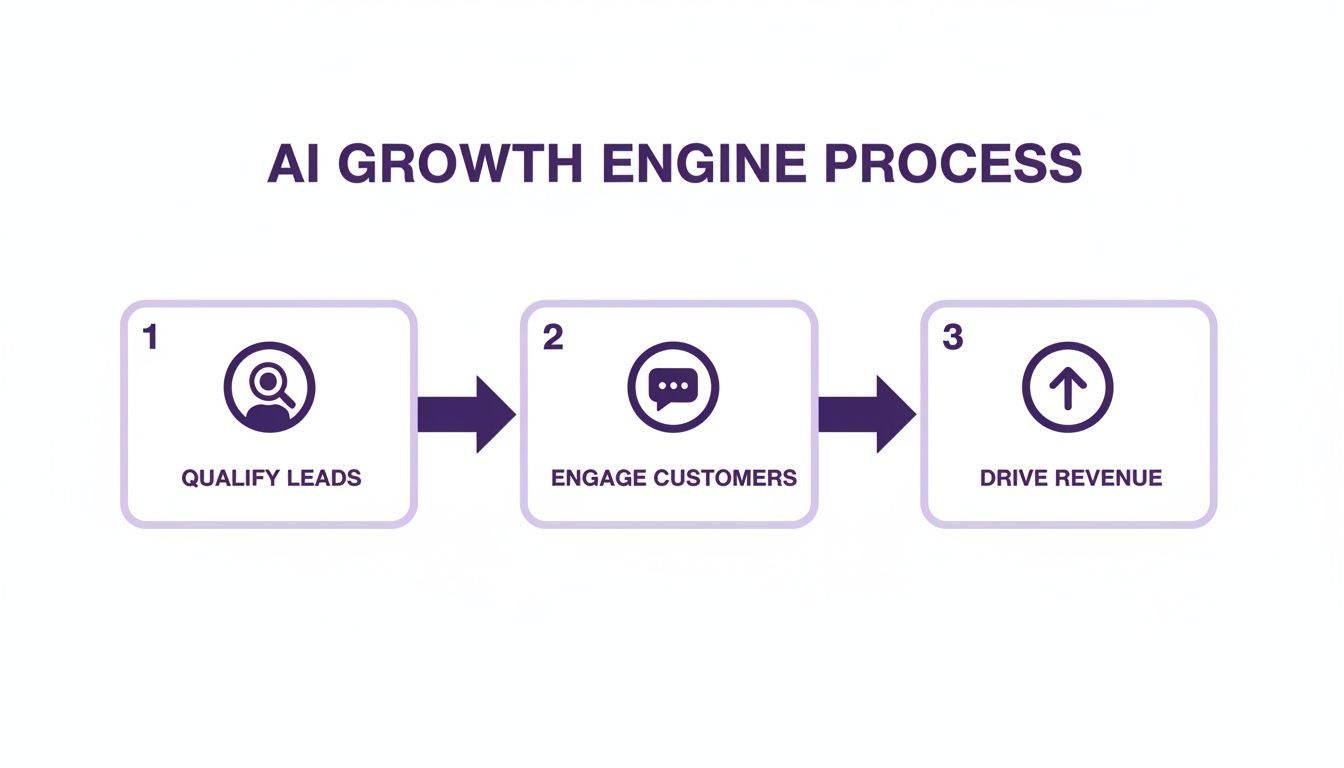
As illustrated, the assistant is not a passive tool but an active participant in your revenue cycle, engineered to qualify, engage, and drive commercial conversations forward.
Step 1: Hearing the Customer's Voice
The process initiates the moment a customer speaks. The foundational step is ‘Hearing,’ driven by Automatic Speech Recognition (ASR). This technology serves as the AI's auditory cortex, transcribing spoken language into machine-readable text with over 95% accuracy.
Consider ASR an ultra-fast, highly accurate transcriptionist, trained on millions of hours of diverse human speech. It can adeptly recognize various accents, dialects, and speaking cadences, ensuring the integrity of the input data. To delve deeper into the technicals, it is beneficial to understand the fundamentals of Automatic Speech Recognition (ASR).
Step 2: Understanding Customer Intent
Once the speech is transcribed, the core intelligence is activated. The second phase, ‘Understanding,’ leverages Natural Language Processing (NLP) and Natural Language Understanding (NLU). Here, the AI moves beyond literal transcription to analyze context, interpret sentiment, and identify the speaker's core objective.
For instance, a customer might state, "I need to check my application status," while another asks, "Where’s my application at?" A well-trained AI-powered virtual assistant recognizes these as identical intents. It can even detect subtle tonal cues like urgency or frustration, which can be used to dynamically prioritize or route calls. The underlying models are highly sophisticated; you can explore the architecture in our article on encoders and decoders in transformer models.
A critical differentiator between a basic bot and an enterprise-grade assistant is its ability to manage conversational interruptions. If a customer interjects with an off-topic question, a sophisticated AI can pause the current flow, address the new query, and seamlessly return to the original conversation—a capability that is distinctly human-like and crucial for maintaining a natural conversational rhythm.
Step 3: Responding Intelligently
The final step is ‘Responding.’ After accurately interpreting the customer's intent, the AI formulates and delivers a relevant, natural-sounding response using Text-to-Speech (TTS) technology. Modern TTS engines are light-years beyond the robotic voices of the past; they can be configured to convey specific brand personas, whether that's empathetic, confident, or professional.
Here is a practical, real-world call flow:
- AI Dials: The assistant initiates an outbound call to a new lead from a CRM list of 5,000 prospects.
- Customer Responds: The prospect answers with a cautious, "Hello?"
- AI Interprets: ASR and NLP models instantly analyze the single word, confirm it's a human response, and deploy the introductory script within milliseconds.
- Customer Interrupts: The lead interjects, "Look, I'm busy. Can you call back later?"
- AI Adapts & Responds: The NLU model immediately identifies the "reschedule" intent and pivots. "Of course. Is tomorrow morning at 10:15 AM a better time for you?"
- AI Logs Outcome: Post-call, the assistant automatically logs the outcome, detailed call notes, and the scheduled follow-up directly into the CRM, triggering the appropriate sales workflow.
This entire exchange, which would require significant cognitive load and manual data entry from a human agent, is executed flawlessly in seconds. This demonstrates how an AI-powered virtual assistant transcends simple scripting to become a dynamic, adaptable, and highly efficient extension of your team.
Calculating the Real ROI of an AI Powered Virtual Assistant
Every significant capital expenditure must be justified by a clear and compelling business case. For leaders evaluating an AI powered virtual assistant, this requires moving beyond qualitative promises of "efficiency" to a quantitative framework for measuring return on investment (ROI). The focus must be on hard metrics that directly impact your P&L statement.
The financial argument for Voice AI is uniquely powerful because it addresses both sides of the ledger. It is a rare strategic investment capable of simultaneously reducing operational expenditures and creating new revenue streams.
Let's examine the financial mechanics.
Dissecting the Cost Reduction Formula
The most immediate financial impact is realized through operational cost savings. Traditional contact center operations are burdened by high labor costs, continuous training requirements, and significant employee churn. An AI powered virtual assistant systematically mitigates these expenses.
Consider the cost-per-call. A human agent's cost includes salary, benefits, infrastructure, and training overhead. In contrast, an AI agent operates at a fraction of this cost, typically on a usage-based pricing model (per minute or per call). This allows for massive scaling of outreach efforts without a corresponding increase in headcount.
Agent training and attrition are substantial hidden costs. Industry data indicates that replacing a single call center employee can cost up to 20% of their annual salary. AI assistants eliminate this churn entirely, providing a consistently trained, peak-performing "agent" from day one.
The strategic logic is clear: automate high-volume, repetitive interactions to free up your human capital for complex, high-value engagements where their expertise is indispensable. This is not merely cost-cutting; it is strategic resource optimization.
The market data underscores this paradigm shift. In 2025, the India AI agents market, encompassing these advanced virtual assistants, generated USD 417.0 million in revenue. This figure is projected to explode to USD 15,209.7 million by 2033, driven by a massive compound annual growth rate (CAGR) of 57.4%. This is not a market trend; it's a fundamental restructuring of business operations. You can explore more insights about these market trends.
Unpacking the Revenue Generation Engine
While cost reduction is significant, the primary objective for growth-focused leadership is revenue generation. An AI powered virtual assistant is not a passive cost-center; it is a proactive sales and conversion engine capable of executing outreach with unparalleled speed, consistency, and scale.
The impact is directly observable in your sales funnel metrics:
- Dramatically Higher Connect Rates: Human agents struggle with low connect rates. Through automated dialing, predictive analytics, and instant follow-ups, our clients have seen connect rates increase from an industry average of 47% to over 91%. More connections translate directly to more qualified conversations.
- Accelerated Lead Qualification: An AI assistant can process thousands of leads daily, executing complex qualification scripts and scoring them based on predefined criteria. This ensures your sales team invests its time exclusively on prospects with high purchase intent.
- Increased Sales Conversions: By ensuring every lead receives immediate, professional follow-up, AI assistants enhance the customer experience from the very first touchpoint. For a real estate client, this led to a direct increase in their lead-to-booking rate from 2% to 8%—a 4x improvement in conversion and a direct boost to top-line revenue.
The Bottom Line: A Clear Financial Picture
To truly grasp the impact, let's put the numbers side-by-side. The traditional manual approach has inherent limitations in scale, speed, and cost, which directly affects the bottom line. In contrast, an AI-powered system rewrites the rules of engagement, delivering tangible financial gains across the board.
ROI Comparison: Manual Outreach vs AI Powered Virtual Assistant
| Metric | Manual Outreach (Industry Average) | AI Powered Virtual Assistant (DialNexa Data) | Financial Impact |
|---|---|---|---|
| Connect Rate | 47% | 91% | Nearly 2x more qualified conversations from the same lead list. |
| Lead Qualification Time | Hours to Days | Minutes | Sales team engages with hot leads instantly, not after they've gone cold. |
| Cost Per Qualified Lead | ₹800 – ₹1,200 | ₹150 – ₹250 | 75-80% reduction in lead acquisition cost, freeing up marketing budget. |
| Agent Training Cost | ₹20,000 – ₹30,000 per agent | ₹0 | Eliminates costs associated with onboarding, training, and agent churn. |
| Conversion Rate (Lead-to-Booking) | 2% | 8% | 4x increase in actual bookings, directly boosting top-line revenue. |
As the data clearly demonstrates, the financial argument is irrefutable. You are not only reducing the cost to engage your market but also generating significantly more qualified opportunities and closing more business from the same initial lead pool.
This dual impact—slashing operational costs while accelerating the sales cycle—is the hallmark of a transformative technology. An AI powered virtual assistant ceases to be an expense and becomes a strategic investment that delivers a compounding return, serving as a powerful engine for sustainable, scalable growth.
Where the Rubber Meets the Road: AI in Action Across Industries
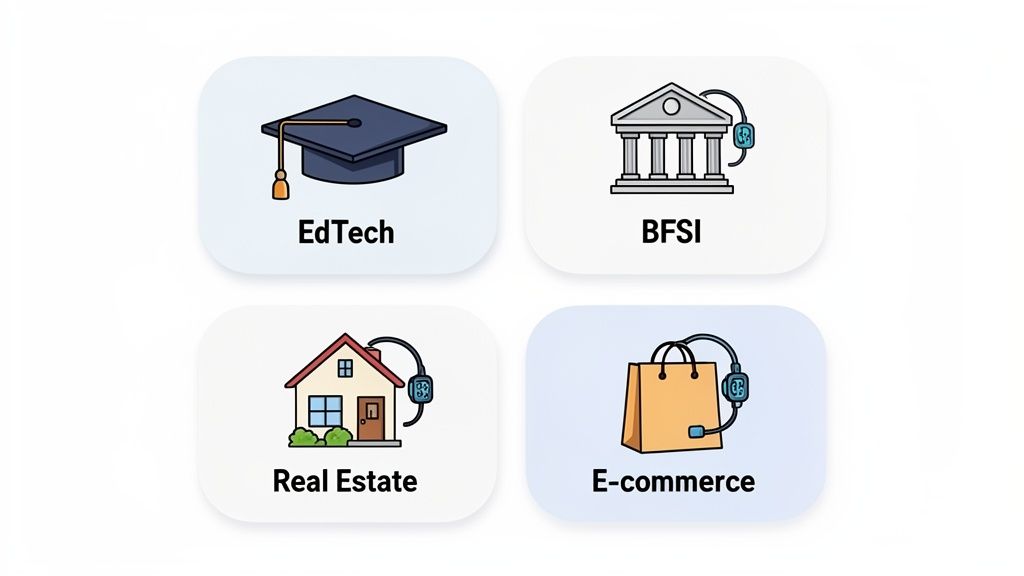
Theoretical frameworks and ROI models are essential, but the true strategic value of an AI-powered virtual assistant is realized when it is deployed to solve specific, high-stakes business challenges. This is not a generic, one-size-fits-all solution. Its power lies in its adaptability to address the unique operational bottlenecks that challenge leaders across different sectors.
Let's examine practical blueprints for success, detailing how AI assistants are delivering tangible results in key industries, converting persistent operational challenges into significant growth opportunities.
EdTech: Revolutionising Student Outreach
The EdTech sector is characterized by high-volume, time-sensitive lead flow. The core challenge is engaging prospective students while their interest is at its peak. Admissions teams are frequently overwhelmed, leading to delayed follow-ups and a significant drop-off rate of over 50% for leads not contacted within the first hour.
An AI-powered virtual assistant fundamentally alters this dynamic.
Instead of a lead languishing for hours or days, an AI agent connects within seconds of a form submission. It can handle initial qualification questions regarding courses, eligibility, and fees, nurturing interest and scheduling a detailed follow-up with a human counselor. This immediate, professional engagement has a dramatic impact on enrollment conversion rates.
- The Challenge: A leading EdTech platform was constrained by a lead-to-counseling session booking rate of just 5%. Their human team was operationally incapable of managing thousands of daily inquiries effectively.
- The Solution: An AI assistant was deployed to manage the initial contact for 100% of new leads. The assistant called prospects, assessed their level of intent using a weighted scoring model, and seamlessly booked qualified leads into counselors' calendars.
- The Result: The platform's counseling session booking rate soared to 20%—a 400% improvement. This was achieved because every lead received an immediate, consistent, and professionally executed follow-up, a feat impossible to replicate with human agents at that scale.
BFSI: Automating Compliance and Customer Support
In Banking, Financial Services, and Insurance (BFSI), the operational mandates are accuracy, security, and unwavering compliance. Processes like Know Your Customer (KYC) verification are mission-critical but also manual, time-consuming, and prone to human error, which can result in significant regulatory fines.
This is a prime use case for an AI assistant.
An AI agent can guide customers through the entire KYC process over the phone, verifying data against secure databases in real time. It can also manage thousands of concurrent inquiries about account balances, policy details, or loan statuses, liberating human agents to focus on complex, high-value advisory roles.
A key strategic advantage for BFSI is the AI's ability to ensure perfect compliance. Every script is followed verbatim, every necessary disclosure is made, and every interaction is meticulously logged for audit trails, effectively eliminating the risk of costly human error and regulatory penalties.
For example, a major trading platform deployed an AI-powered virtual assistant to follow up on incomplete KYC applications. The AI called new users, specified the exact missing documentation, and answered common questions. This initiative resulted in a 97% accuracy rate in data collection and reduced the average customer onboarding time by 60%.
Real Estate: Qualifying Leads at Scale
The real estate market is intensely competitive, where speed-to-lead is often the determining factor for success. However, agents spend up to 70% of their time on low-value activities, chasing down unqualified leads, leaving less time for showing properties and closing deals.
An AI-powered virtual assistant acts as a tireless inside sales agent, operating 24/7. It can dial an entire lead database, execute a multi-point qualification script—covering budget, location preference, and purchase timeline—and identify prospects who are ready for a site visit.
- The Challenge: A real estate developer was generating hundreds of leads daily but converting only 2% into site visits. Their sales team was inundated and unable to effectively filter and prioritize high-intent prospects.
- The Solution: An AI assistant was configured to call every new lead within five minutes. It confirmed interest, qualified them against project-specific criteria, and then directly scheduled the site visit in the sales team's calendar via API integration.
- The Result: The developer’s lead-to-booking rate increased from 2% to 8%—a 4x improvement. The sales team's productivity skyrocketed as they now exclusively engage with pre-qualified, high-intent buyers. You can learn more about how AI voice agents are transforming customer service and sales in these high-stakes environments.
E-commerce: Enhancing the Customer Journey
In e-commerce, customer experience is the primary differentiator. An AI-powered virtual assistant can automate post-purchase communication at scale, managing everything from order confirmations and shipping updates to return processing and feedback collection.
This proactive communication reduces customer anxiety and slashes "Where is my order?" (WISMO) inquiries, which can account for up to 50% of customer service call volume.
Consider this workflow: a customer receives a delivery notification. Moments later, an AI assistant calls to confirm receipt and inquire about their satisfaction with the product. This simple, personalized interaction builds significant brand loyalty and can be used to gather valuable product feedback or offer a targeted discount on a future purchase. It transforms a transactional relationship into a supportive, ongoing customer journey.
How to Choose the Right AI Virtual Assistant Partner
Selecting a vendor for an AI-powered virtual assistant is not an IT procurement decision; it is a strategic partnership. The right partner becomes an extension of your operations, directly influencing customer experience and defining your capacity for scalable growth. For executive decision-makers, this requires looking beyond superficial feature lists to evaluate the core capabilities that drive tangible business outcomes.
A robust evaluation framework is critical. Potential partners must be assessed against criteria that align with your long-term strategic objectives. The goal is to secure a technology platform that not only solves today's operational challenges but also offers the flexibility to adapt to future market demands.
Assess Proven Scalability and Performance
The primary diligence question for any executive should be: can this platform perform flawlessly under peak load? A solution that functions adequately at low volumes may fail catastrophically when scaled. True enterprise-grade scalability means maintaining impeccable performance and conversational quality under extreme pressure.
Demand empirical data from potential vendors. Ask for case studies demonstrating their ability to manage massive call volumes, such as successfully handling over 10,000 concurrent calls per day for an EdTech client during admissions season. This type of battle-tested performance is what distinguishes a robust, enterprise-ready platform from less mature solutions.
Prioritise Deep Customisation and Control
Your business has unique workflows, a distinct brand identity, and specific commercial objectives. A generic, one-size-fits-all AI-powered virtual assistant will inevitably fail to meet your requirements. The premier partners provide platforms with deep customization capabilities, allowing you to build an AI agent that is a true extension of your brand and strategy.
This extends far beyond modifying a welcome script. You must have granular control to:
- Tailor Personas: Fine-tune the voice, tone, accent, and linguistic style to precisely match your brand's persona.
- Build Custom Workflows: Design complex, multi-turn call flows that mirror your specific sales funnels, support processes, and objection-handling protocols.
- Integrate Knowledge: Connect the AI directly to your internal knowledge bases, enabling it to answer company-specific questions with accuracy and confidence.
Without this level of control, you are simply deploying a third-party tool that will feel disconnected from your brand and fail to achieve its core objectives.
Insist on Seamless Integration Capabilities
An AI assistant that cannot communicate with your existing systems is not a solution; it's a data silo. Seamless integration with your technology stack, particularly your Customer Relationship Management (CRM) system, is a non-negotiable requirement. This is the mechanism that transforms conversational data into actionable business intelligence.
Look for a vendor with a well-documented, robust API and a library of pre-built connectors. The AI must be capable of automatically logging call dispositions, updating lead statuses in your CRM, and triggering follow-up tasks without any human intervention. This creates a powerful, closed-loop system where data flows seamlessly, providing a 360-degree view of every customer interaction and ensuring no opportunity is lost.
Pro Tip: The quality of a vendor’s API documentation is a strong indicator of their commitment to integration. A partner that provides clear, comprehensive documentation for your technical team is one that understands the strategic importance of a unified technology ecosystem.
Evaluate Conversational Quality and Intelligence
Ultimately, the efficacy of your AI-powered virtual assistant is determined by its ability to conduct a natural, human-like conversation. This is the critical moment of truth that defines the customer experience. A clunky, robotic interaction can inflict more brand damage than no interaction at all.
During your evaluation, demand to listen to raw, unedited call recordings. Assess the AI's ability to handle interruptions, understand nuanced context, and maintain conversational flow. A top-tier assistant can navigate complex queries, manage unexpected conversational turns, and maintain a rhythm that keeps callers engaged. For example, DialNexa's agents are engineered to sustain natural, multi-minute conversations, demonstrating a high degree of conversational intelligence essential for complex tasks like lead qualification or customer support.
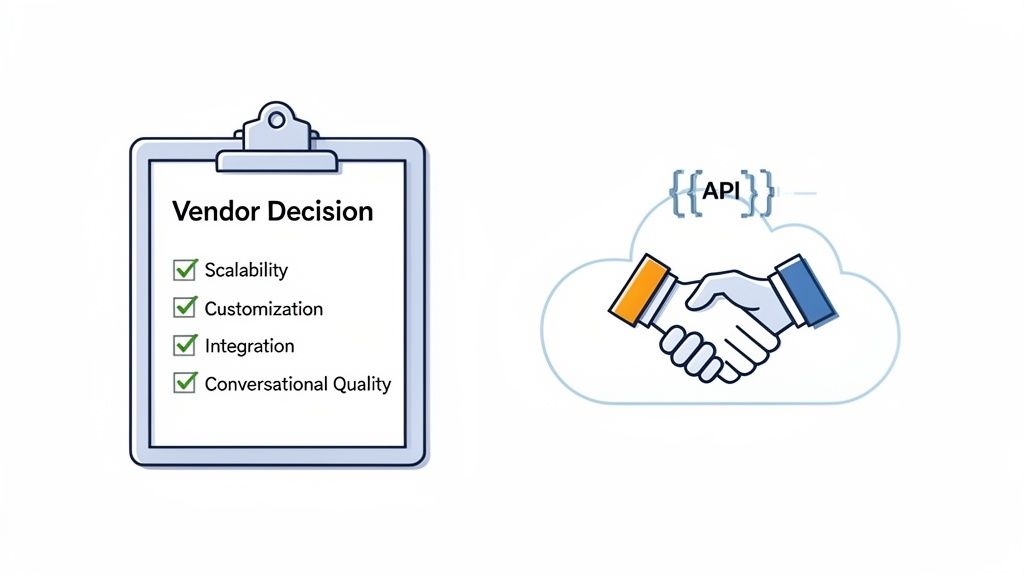
Putting It All Together: A Vendor Checklist
To facilitate a data-driven, strategic decision, use this checklist to guide your evaluation process and compare potential partners based on criteria that truly matter for long-term success.
Vendor Evaluation Checklist for AI Virtual Assistants
| Evaluation Criterion | Key Questions to Ask | Why It Matters |
|---|---|---|
| Scalability | Can you provide data on handling >10,000 calls daily? What is your uptime guarantee? | Ensures the platform can support your business during peak periods without performance degradation. |
| Customisation | How deeply can we customise the AI's persona and scripts? Can we build our own call flows? | Guarantees the assistant aligns with your brand and executes your specific business processes correctly. |
| Integration | Do you have robust APIs and documentation? Can you integrate with our specific CRM? | A well-integrated AI creates a unified data ecosystem, eliminating manual work and data silos. |
| Conversational AI Quality | Can we review unedited call recordings? How does the AI handle interruptions and complex questions? | The quality of the conversation directly impacts customer experience, lead qualification accuracy, and brand perception. |
By systematically addressing these questions, you can cut through marketing jargon and assess a vendor's true capabilities, ensuring you select a partner equipped to deliver sustained, measurable value.
Frequently Asked Questions About AI Virtual Assistants
It is prudent for any leadership team to conduct thorough due diligence before integrating a new technology, particularly one as impactful as an AI-powered virtual assistant. Despite the clear strategic benefits, practical concerns regarding implementation timelines, data security, and performance under real-world conditions must be addressed.
This section provides direct, executive-level answers to these critical questions, aiming to instill the confidence that this technology can not only meet but exceed your strategic expectations.
How Long Does It Take to Implement an AI Powered Virtual Assistant?
Dispel any notions of lengthy, multi-quarter enterprise software rollouts. Modern, API-first platforms have dramatically accelerated the implementation timeline for an AI-powered virtual assistant. A foundational system can be operational in a matter of days, not months, enabling a significantly faster path to realizing a return on investment.
The deployment process is designed for speed and collaboration, ensuring a rapid launch without compromising on quality.
- Defining Your Goals: The process begins with a strategic workshop to define the primary business objective. Whether it's qualifying real estate leads with a specific BANT (Budget, Authority, Need, Timeline) criteria or automating KYC verification for a financial product, a clear goal is established first.
- Training the Persona: Next, the AI is trained on your specific call scripts, objection-handling protocols, and the desired brand persona. This ensures it operates as a seamless extension of your team.
- CRM Integration and Launch: The final step involves connecting the assistant to your CRM via API for a closed-loop data flow. For industries like EdTech or BFSI, we leverage pre-built models to expedite this stage.
A fully customized agent, meticulously tuned to your unique operational workflows, is typically handling live calls within a few weeks. This agile methodology ensures the AI not only aligns perfectly with your brand voice but also begins achieving its performance targets with high accuracy from day one.
Is an AI Virtual Assistant Secure for Sensitive Industries?
Absolutely. For any organization handling sensitive data, particularly in regulated sectors like BFSI and healthcare, security is a foundational requirement, not an optional feature. Enterprise-grade AI platforms are architected with a security-first design philosophy. This allows you to automate sensitive processes with confidence, without exposing your organization to unnecessary risk.
Robust security protocols are embedded at every layer of the technology stack.
Data is encrypted both in transit (using protocols like TLS 1.2) and at rest (using AES-256 encryption). The entire infrastructure is designed for compliance with stringent data privacy regulations like GDPR and CCPA. This unwavering commitment to security is paramount for maintaining customer trust.
When vetting a partner, demand to see their security certifications (e.g., SOC 2, ISO 27001) and inquire about customizable data retention policies. The right platform will enable you to automate processes like KYC verification or patient appointment reminders while adhering to the highest standards of data protection, thereby leveraging automation to enhance, not compromise, your security posture.
How Does the AI Handle Complex Customer Questions?
Today’s virtual assistants are engineered for dynamic, real-world conversations, not rigid, linear scripts. Powered by sophisticated Natural Language Processing (NLP), they discern the intent behind a user's words, not just the keywords. This enables a natural, multi-turn dialogue capable of navigating the inherent unpredictability of human conversation.
For queries that fall outside the AI's trained scope, a clear and intelligent escalation protocol is activated.
- Clarification: The AI will first attempt to re-prompt or ask clarifying questions to better understand the customer's need.
- Knowledge Base Access: If integrated with a knowledge base, it can perform a real-time search to find and deliver an accurate answer.
- Intelligent Handoff: If the query is too complex or requires human empathy, the AI-powered virtual assistant executes a seamless, context-aware transfer to a live agent. The full transcript and a summary of the interaction are passed along, so the customer never has to repeat themselves.
This tiered process ensures a frictionless customer experience. The AI manages the high volume of routine inquiries efficiently, while complex issues are escalated to human experts without causing customer frustration, thereby protecting valuable leads and customer relationships.
Can the AI Persona Be Customised to Match Our Brand?
Yes, and this is a critical component of a successful deployment. A consistent brand voice is a key driver of customer trust. The undifferentiated, robotic voices of early-generation AI are obsolete. Leading platforms now offer extensive control over the AI persona, allowing you to design a virtual agent that is a perfect representation of your brand.
This customization extends to every nuance of the conversational experience. You can select from a wide array of voices, accents, and tones—from formal and professional to empathetic and energetic. You can even fine-tune pacing, intonation, and linguistic style. A polished, authoritative tone for a financial institution is just as achievable as a warm, friendly voice for a direct-to-consumer brand.
This level of customization ensures every customer interaction is authentic and on-brand. More importantly, it fosters an engaging conversation that advances your business objectives while reinforcing your brand identity on every single call.
Ready to see how a custom-built AI agent can transform your outreach and support? At DialNexa, we build human-like Voice AI that drives real business outcomes. Discover how our AI-powered virtual assistants can scale your operations and accelerate growth today.

[…] is done properly. If you want a concrete look at that style of implementation, this overview of an AI-powered virtual assistant shows how voice-led workflows are being structured around real business tasks rather than generic […]
Your article does a great job of positioning AI assistants as strategic growth engines rather than simple automation tools. The real-world examples and ROI insights clearly show how conversational AI can drive scalability, efficiency, and measurable revenue impact across industries.