
AI Chatbot for Ecommerce: The Executive’s Guide to Driving Growth
An AI chatbot for ecommerce isn't a futuristic concept for a tech roadmap; it's a strategic imperative for today's C-suite. It functions as your most efficient digital sales associate and a customer service expert who operates 24/7. This technology transcends simple, scripted replies. It immerses customers in real-time, personalised conversations that directly impact top-line revenue, operational efficiency, and customer lifetime value. For any executive focused on market leadership, mastering this tool is a cornerstone of a competitive strategy.
Why AI Chatbots Are No Longer Optional in Ecommerce

The chasm between rising customer expectations and legacy operational capabilities is widening daily. Modern consumers demand instant, personalised guidance at any hour—a standard that is operationally and financially unfeasible for human teams alone. This is precisely where an AI chatbot for ecommerce transitions from a 'nice-to-have' into a mission-critical asset.
Consider your website as your digital flagship store. Operating without a sophisticated AI chatbot is akin to leaving this prime real estate unstaffed after hours. Potential customers can browse, but they receive no guidance, no answers to critical questions, and no assistance at the point of decision. This friction leads directly to abandoned carts and frustrated prospects who exit, likely to a competitor.
The Shift From Cost Centre to Revenue Engine
Historically, customer support has been classified as a necessary cost centre. Astute executives, however, now recognise AI-powered conversational platforms as potent revenue engines. By automating routine, high-volume inquiries, these systems liberate your human experts to focus on complex, high-value interactions that require strategic thinking and nuanced problem-solving.
An AI chatbot isn’t just deflecting support tickets; it’s proactively creating sales opportunities. It transforms every customer interaction into a potential conversion, guiding users from initial query to final purchase within a single, seamless conversation.
For example, a customer at a home appliance company asks, "What's the warranty on this dishwasher?" The chatbot provides the answer instantly. But it doesn't stop there. It then suggests, "Customers who bought this dishwasher also frequently purchase our recommended installation kit and extended warranty plan for complete peace of mind. Would you like to add them?" This simple, proactive upsell boosts average order value (AOV) at a scale no human team could replicate.
Meeting the Modern Customer's Demands
The contemporary customer journey is fragmented across multiple touchpoints—a social media ad, a product review blog, and finally, your mobile site. A well-integrated AI chatbot provides a consistent, intelligent brand presence across this entire ecosystem, unifying the experience and making it feel effortless for the consumer.
This strategic importance is fueling explosive market growth. The Indian chatbot market, valued at USD 316.5 million in 2024, is projected to soar to USD 1,260.8 million by 2030, representing a compound annual growth rate (CAGR) of 25.9%. This trend underscores the executive consensus on conversational AI's critical role. You can explore the insights on the conversational AI market to get a deeper sense of this trend.
This guide will deconstruct how a strategic AI chatbot implementation isn't merely a technology adoption. It’s a fundamental business transformation that strengthens market position, enhances operational leverage, and drives bottom-line results.
Boosting Conversions and Customer Lifetime Value
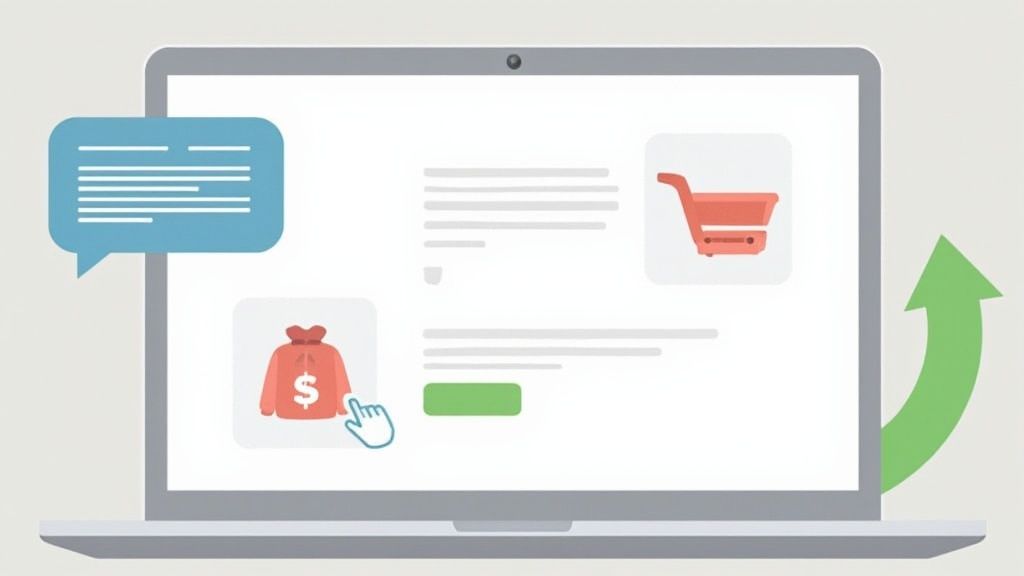
Deploying an AI chatbot for ecommerce transcends operational efficiency; it directly impacts the key metrics that command executive attention: conversion rates and Customer Lifetime Value (CLV). For any business leader, the line between technology investment and bottom-line growth must be unequivocal. An AI chatbot draws that line with precision, converting passive browsers into engaged, confident buyers.
Imagine a potential customer on a product page for a high-performance laptop, hesitating over the purchase due to a technical question about GPU compatibility. Without immediate assistance, that moment of indecision is a lost sale. A strategic chatbot detects this hesitation, intervenes with a relevant, "I see you're comparing our gaming laptops. Can I help clarify the differences in graphics card performance?", and provides the specific data needed to close the deal. This interaction removes friction at the most critical point in the sales funnel.
From Abandoned Carts to Recovered Revenue
Cart abandonment is a significant source of revenue leakage for every ecommerce enterprise. An intelligent AI chatbot acts as a powerful recovery agent, transforming these near-misses into confirmed sales. When a user with a high-value cart attempts to exit the site, the bot can re-engage them with a targeted, value-driven message.
This is far more sophisticated than a generic "Did you forget something?" pop-up. The AI's approach is strategic:
- Clarify Doubts: "Before you go, did you have any questions about our 2-day shipping or our 30-day return policy? I can answer them right now."
- Provide Incentives: For a cart exceeding a certain threshold, the bot could be authorized to offer a one-time 10% discount or free shipping to secure the conversion.
- Offer Support: "If now's not the right time, I can save your cart and email you a link to pick up where you left off. Would you like me to do that?"
This proactive recovery mechanism turns a probable loss into a tangible win. The data is compelling. In the Indian ecommerce market, 12.3% of shoppers who engage with an AI-powered chat complete a purchase, compared to just 3.1% of those who don’t. This represents a nearly four-fold increase in conversion rates—a figure that speaks directly to ROI. You can discover more insights about AI's impact on ecommerce conversions.
By intervening at the exact moment of hesitation, an AI chatbot doesn't just save a single transaction. It actively teaches the customer that your brand is responsive and helpful, setting the stage for future loyalty.
This strategic re-engagement is a perfect example of how an AI chatbot for ecommerce acts as a direct revenue-driver, not just a simple support tool.
Let’s look at a clear comparison of how an AI chatbot can influence key ecommerce metrics. The difference is stark, highlighting how interactive engagement moves the needle on everything from conversion rates to customer satisfaction.
AI Chatbot Impact on Key Ecommerce Metrics
| Metric | Without AI Chatbot Engagement | With AI Chatbot Engagement | Business Impact |
|---|---|---|---|
| Average Conversion Rate | 1-2% | 4-6% | Drastic increase in sales from existing traffic. |
| Cart Abandonment Rate | 70% | 55% | Significant revenue recovery and reduced lost sales. |
| Customer Satisfaction (CSAT) | 75% | 90% | Higher loyalty, repeat business, and positive reviews. |
| Average Response Time | 5-10 minutes (human agent) | Instant | Eliminates customer frustration and reduces bounce rates. |
| Revenue Per Visitor (RPV) | ₹50 | ₹85 | Maximises the value of every single website visitor. |
As the table illustrates, integrating a chatbot isn't just a marginal gain. It creates a powerful lift across the board, turning passive browsing into active purchasing and building a foundation for long-term customer relationships.
Extending Value Beyond the First Purchase
The true measure of a robust ecommerce business is not the first sale, but the cultivation of repeat business. Here, an AI chatbot drives long-term value by streamlining the post-purchase experience—a frequent source of customer friction.
Post-transaction, customers invariably have questions: "Where is my order?", "How do I initiate a return?". Handling these inquiries manually is both costly and slow. A chatbot automates this entire workflow, providing customers with 24/7, instantaneous self-service for tracking shipments or processing returns.
For example, a customer who receives a damaged item can initiate a return directly through the chat interface, upload a photo, and receive a shipping label within minutes, without ever needing to speak to an agent. This transforms a negative experience into a remarkably efficient and positive one, reinforcing their decision to shop with you again. This seamless support doesn't just reduce operational costs—it actively fortifies customer relationships, driving CLV and building a more profitable enterprise.
Weaving Your Chatbot into the Fabric of Your Business
An AI chatbot for ecommerce realizes its full potential when it evolves from a standalone website widget into a deeply integrated component of your entire business architecture. The strategic objective is to create a seamless flow of data between your chatbot and other core platforms. This integration provides a unified, intelligent view of each customer, transforming fragmented interactions into a single, continuous conversation.
A standalone chatbot is like a new sales associate who hasn't been shown the inventory system; they can greet customers but can't confirm stock. An integrated chatbot, however, has real-time access to the entire operational backend. This architectural shift from a siloed tool to a connected hub is what unlocks exponential value.
Connecting to Your Ecommerce Platform
The foundational integration is with your ecommerce platform, whether it’s Shopify, Magento (now Adobe Commerce), or BigCommerce. This link provides the chatbot with a live feed of your product catalogue, inventory levels, and order data, producing an immediate and dramatic impact on the customer experience.
Consider a customer asking, "Do you have the AlphaTech X1 running shoes in a men's size 10?"
- An unintegrated chatbot fails: "Please check the product page for availability." This creates a dead end and adds friction.
- An integrated chatbot converts: "Yes, we have three pairs left in stock. I've added them to your cart. Are you ready to check out?"
This distinction is critical. It transforms a moment of potential frustration into a frictionless sale. The chatbot can also deliver more intelligent product recommendations based on real-time availability, preventing customer disappointment before it occurs.
Building Richer Profiles with CRM Integration
The next critical integration point is your Customer Relationship Management (CRM) system, such as Salesforce or HubSpot. Every chatbot conversation is a source of valuable zero-party data—information customers willingly provide. Integrating your chatbot and CRM ensures this intelligence is captured and leveraged.
When a customer interacts with the chatbot, the complete transcript can be automatically appended to their profile in the CRM. This builds a far richer customer persona, logging their specific questions, product interests, and past support issues.
This integration turns simple chat data into sharp business intelligence. A customer asking about running shoes can be automatically tagged with an "interest in athletics" in your CRM. Now, your marketing team knows to include them in the next email blast about new sportswear.
This creates a powerful data feedback loop. The CRM provides the chatbot with customer history to personalize the current conversation, while the chatbot feeds new insights back into the CRM, enriching the customer profile for future marketing and sales initiatives. If you're just getting started, you can learn the basics by reading our guide on integrating an AI agent for customer service.
Unifying the Entire Customer Journey
To architect a truly cohesive customer experience, these integrations must extend into your core backend systems. This is where your AI chatbot graduates from a conversational tool to a central operational hub.
Key advanced integrations that drive enterprise value include:
- Payment Gateways: Allow customers to complete their purchase directly within the chat window, removing the friction of a separate checkout page—a common point of cart abandonment.
- ERP Systems: For complex B2B or manufacturing environments, linking to your Enterprise Resource Planning (ERP) system enables the chatbot to answer detailed queries about custom configurations, bulk pricing, or complex supply chain logistics.
- Helpdesk Software: When an issue requires human expertise, the chatbot can execute a seamless, intelligent handoff to a live agent. The agent receives the full chat transcript and customer history, eliminating the need for the customer to repeat themselves.
By strategically connecting these systems, you ensure your AI chatbot for ecommerce becomes a core pillar of your digital strategy, driving both operational efficiency and a superior, personalized customer experience.
Your High-Level Implementation Roadmap
Implementing an ai chatbot for ecommerce is not a technology project; it is a business initiative that demands a strategic roadmap. For an executive, this roadmap ensures the project remains aligned with commercial objectives, demonstrates value at each stage, and mitigates the risk of costly missteps. The approach is not a monolithic launch, but a deliberate, phased rollout designed to build momentum and prove ROI from the outset.
The journey begins not with technology, but with clearly defined business goals. Before evaluating vendors, the leadership team must align on the definition of success. Is the primary goal to reduce customer service operational costs by 25% within six months? Or is it to increase the conversion rate for first-time website visitors by 15%?
Defining these key performance indicators (KPIs) provides clear direction. It transforms a technology initiative into a focused mission to solve specific business challenges, which simplifies stakeholder buy-in and streamlines the measurement of return on investment.
Phase 1: Define and Discover
This foundational phase is dedicated to strategy and analysis. The objective is to identify the "low-hanging fruit"—the areas where a chatbot can deliver the greatest impact with the least complexity. This requires a thorough analysis of the current customer journey to pinpoint the most significant points of friction.
Your discovery process should map common customer pathways:
- Pre-Purchase Questions: Where do prospects hesitate? Is it during product comparison, understanding shipping policies, or finding correct sizing?
- Post-Purchase Support: What are the top three drivers of support calls? Typically, these are order tracking, returns processing, and warranty information.
- High-Intent Scenarios: Identify high-traffic product pages with below-average conversion rates. These are prime candidates for proactive chatbot engagement.
For example, if data shows that 40% of all support tickets are "Where is my order?" (WISMO) inquiries, automating this single use case becomes the clear priority for Phase 2. It is a high-volume, low-complexity task that delivers a rapid and measurable win by freeing up agent capacity.
Phase 2: Pilot and Prove
With a primary use case identified, the next step is a controlled pilot program. Instead of a site-wide launch, the chatbot is deployed to a specific audience segment or is limited to handling a single query type, such as order tracking. This agile methodology minimizes risk and allows for the collection of real-world performance data.
During this phase, your team collaborates with your technology partner to train the AI model on your product catalogue, brand voice guidelines, and historical customer interaction data. The goal is to refine the chatbot's responses for accuracy, helpfulness, and brand alignment before exposing it to your entire customer base.
A successful pilot builds your internal business case. When you can present a concrete metric, like a 30% reduction in WISMO tickets within the first 30 days, you have the empirical evidence needed to justify a broader rollout and further investment.
This data-driven approach removes subjectivity and builds confidence across the organization.
Phase 3: Scale and Integrate
With a successful pilot validating the strategy, the project moves into a full-scale rollout. This involves progressively expanding the chatbot's responsibilities to include more complex functions like personalized product recommendations, guided selling, and deep integration with other business systems.
The diagram below illustrates the data flow in a fully integrated architecture, connecting the ecommerce platform with CRM and ERP systems.
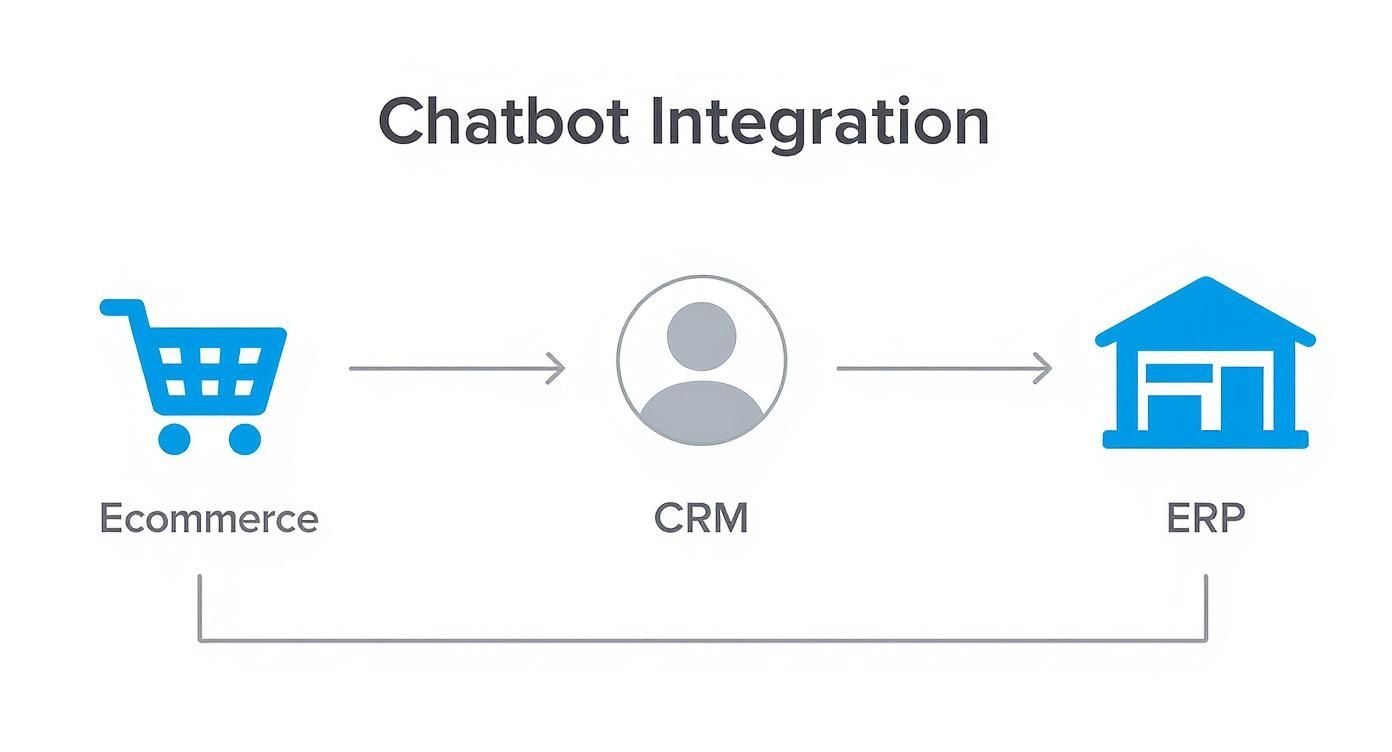
As shown, proper integration creates a unified data ecosystem. The chatbot can now pull data from all key business platforms to deliver a truly seamless customer experience. For instance, by accessing CRM data, the chatbot can greet a returning customer by name, acknowledge their past purchases, and offer recommendations based on their known preferences, making the interaction significantly more effective.
This structured roadmap ensures your ai chatbot for ecommerce is implemented not as a siloed tool, but as a strategic asset directly linked to your company's growth objectives.
Measuring Success and Proving ROI to Stakeholders
Any significant technology investment demands rigorous proof of value. An ai chatbot for ecommerce is a strategic asset, and its success must be demonstrated with clear, compelling data that resonates in the boardroom.
The focus must shift from vanity metrics, such as total chat volume, to key performance indicators (KPIs) that directly link chatbot activity to business outcomes. As a leader, your priority is ROI, and a well-monitored chatbot provides a clear, defensible business case for the investment. It's time to measure this technology not as a support tool, but as a core component of your commercial engine.
Core KPIs for Executive Oversight
To accurately assess performance, your executive dashboard must focus on metrics that bridge operational efficiency and revenue generation. These are the numbers that provide a high-level view of the chatbot's contribution to the bottom line.
Here are the essential KPIs every leader should be tracking:
-
Containment Rate: What percentage of customer inquiries are fully resolved by the chatbot without human intervention? A high containment rate—targeting 70-80% for routine queries—is a direct indicator of operational efficiency and a primary driver of cost savings.
-
Conversion Rate from Chat: Of the users who engaged with the chatbot, what percentage completed a purchase? This KPI draws the most direct line between conversational assistance and revenue generation.
-
Average Order Value (AOV) of Chat-Assisted Sales: Are customers who interact with the chatbot spending more? A comparison of AOV between chat-assisted and non-assisted sessions proves the chatbot's effectiveness in upselling and cross-selling.
-
Reduction in Customer Service Costs: This metric quantifies direct savings. The formula is simple: (Number of contained chats) x (Average cost per human-led interaction) = Total Cost Savings. This provides a hard dollar value for the chatbot's efficiency.
Tracking these metrics gives you an undeniable view of performance. It’s also wise to keep an eye on your site’s overall user behaviour to get the full story; you can learn more by exploring our guide on bounce and exit rate analytics.
Visualising Performance for Stakeholders
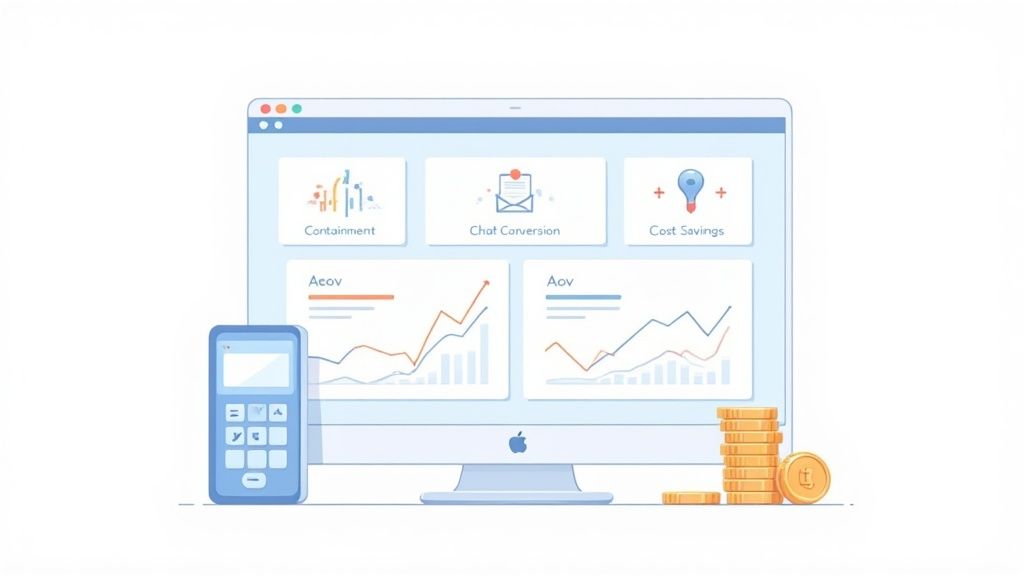
Board-level communication requires clarity and impact, not raw data. The most effective way to report on these KPIs is through a clean, visual executive dashboard that tells a story at a glance. Imagine a simple layout with four primary widgets, each dedicated to a core KPI and showing performance trends over time.
A line graph could illustrate the containment rate increasing month-over-month, while a bar chart could visually contrast the higher AOV of chat-assisted sales against the site average. This visual evidence makes the chatbot's value proposition immediately apparent to stakeholders who are not involved in day-to-day operations.
The ultimate measure of success is a clear and compelling ROI calculation. This isn't a vague estimate; it's a straightforward formula comparing the total cost of ownership (software, implementation, maintenance) against the financial gains (increased revenue from conversions and AOV lift) and operational savings.
Calculating a Defensible Return on Investment
To construct the business case, begin by calculating the total investment. Then, quantify the returns. For example, if over one year the chatbot contributes ₹1 Crore in attributed sales and saves ₹30 Lakhs in support costs, the total value generated is ₹1.3 Crore. If the total cost of ownership for that year was ₹25 Lakhs, the ROI is substantial and easily defended in any budget review.
This data-driven approach is critical. India's AI-powered e-commerce market is projected to reach $8.65 billion by 2025. By measuring success with this level of rigor, you ensure your investment in an ai chatbot for ecommerce is strategically positioned to capture a share of this immense growth.
Navigating Data Privacy and Compliance
Integrating an AI chatbot into your ecommerce ecosystem is not merely a technological upgrade; it's an assumption of new data stewardship responsibilities. This is a boardroom-level issue that directly impacts brand reputation, customer trust, and legal liability. A single data privacy incident can erode years of brand equity.
Therefore, any AI strategy must be architected on a non-negotiable foundation of security and compliance from day one.
This is particularly acute in jurisdictions like India, where regulations such as the Digital Personal Data Protection Act (DPDPA) impose strict rules on the collection, processing, and storage of personal information. Your chatbot cannot be a compliance afterthought; it must be engineered to respect these legal frameworks, ensuring every customer interaction is both effective and lawful. This starts with obtaining clear, explicit user consent before any data collection begins.
Securing Customer Trust and Data
Your chatbot will handle a spectrum of sensitive information: names, contact details, purchase histories, and browsing behavior. Protecting this data requires a robust, multi-layered security posture. End-to-end encryption is the baseline standard, both for data at rest (in databases) and in transit (moving between systems).
Furthermore, a clear data retention policy is essential. How long will chat transcripts be stored? For what specific purpose? The DPDPA emphasizes data minimisation—collect only the data necessary for a defined purpose and dispose of it securely once that purpose is fulfilled. Proactively addressing these governance questions is fundamental to compliant operations.
A secure and compliant chatbot does more than just avoid regulatory penalties. It sends a powerful message to your customers: you value their privacy as much as their business. This turns a potential risk into a real competitive advantage.
This commitment to ethical data handling is how modern brands build and sustain trust in a privacy-conscious market.
A Leader's Checklist for Vetting Vendors
When selecting an AI chatbot partner, their security and compliance frameworks are as critical as their technology's feature set. This vendor becomes a sub-processor of your customer data, demanding rigorous due diligence.
Use this checklist to conduct a thorough vetting process.
- Data Handling and Processing Protocols: Demand detailed documentation on their data handling procedures. Where is data stored? Who has access? Ensure their protocols align strictly with DPDPA requirements.
- Encryption Standards: Confirm they use industry-standard encryption, such as AES-256, for all customer data. This is non-negotiable.
- Data Residency and Sovereignty: Verify the physical location of their data centres. For many Indian businesses, ensuring that customer data remains within national borders is a key compliance requirement.
- Consent Management Tools: Does the platform provide robust, built-in tools for managing and documenting user consent? This must be a core feature, not an add-on.
- Audits and Certifications: Request evidence of third-party security audits and relevant certifications, such as ISO 27001. This provides independent validation of their security claims.
By addressing these governance issues proactively, you can deploy an ai chatbot for ecommerce that not only enhances commercial performance but also strengthens customer trust, creating a secure and ethical AI program built for long-term success.
Straight Answers to Your Toughest Questions
As a leader, you require the bottom-line analysis. Investing in an AI chatbot for ecommerce is a significant strategic decision, and you have critical questions about its practical implementation—from brand alignment to resource allocation. Here are the clear, executive-level answers needed to inform your strategy.
How Do We Make Sure the Chatbot Sounds Like Us?
Ensuring the chatbot embodies your brand's unique voice is a core part of the implementation process. This is achieved through sophisticated AI training, not simple scripting. We begin by feeding the AI model your corporate brand guidelines, high-performing marketing copy, and historical transcripts of exemplary customer service interactions. The system learns your specific tone, terminology, and conversational style directly from your best content.
For example, a luxury automotive brand’s chatbot would be trained on polished brochure copy and concierge-level service logs to develop a sophisticated, precise, and courteous tone. In contrast, a direct-to-consumer streetwear brand’s bot would learn from its social media voice and casual customer chats to be more edgy and informal.
Leading platforms allow for the fine-tuning of the chatbot’s personality with specific behavioral traits. However, this is not a one-time setup. Your marketing and CX teams will periodically review chat logs, providing a continuous feedback loop to refine the bot’s voice over time, ensuring it remains perfectly aligned with your brand identity.
What's a Realistic Timeline for Seeing a Payoff?
A tangible return on investment can be realized much faster than you might anticipate through a phased implementation. A pilot program targeting a high-volume, low-complexity use case—such as automating "Where Is My Order?" inquiries—can be launched in as little as 4-6 weeks. Within this initial phase, you should observe an immediate and measurable reduction in related support tickets and associated costs.
A more comprehensive deployment, involving deep integration with your CRM and inventory systems for personalized shopping, will naturally have a longer timeline, typically 3-6 months. The key is an agile approach: start with a narrow, high-impact objective, prove the value with hard data, and then scale the initiative. You will see positive business impact long before the full-scale project is complete.
How Much Babysitting Does This Thing Need After Launch?
While the objective is automation, human oversight is critical for success, particularly in the initial stages. Post-launch, your team should allocate a few hours per week to review conversation logs. This process is essential for identifying areas where the AI's responses can be improved and discovering new automation opportunities. As the AI learns from thousands of interactions, this time commitment decreases significantly.
The role of your human team evolves strategically. They transition from handling repetitive, low-value queries to managing complex, high-stakes customer conversations that require empathy, strategic problem-solving, and human judgment. The model is not about replacing your team; it’s about augmenting their capabilities by blending the efficiency of AI with the irreplaceable expertise of your people.
Ready to see how a human-like Voice AI agent can transform your customer interactions? DialNexa helps ecommerce brands automate support, scale outreach, and turn more conversations into conversions. Explore our solutions today.

[…] retailers exploring conversational touchpoints inside that journey, this perspective on an AI chatbot for ecommerce is useful because it shows how support and conversion signals increasingly feed the same customer […]
I completely agree with the article’s point that AI chatbots are shifting from cost centres to revenue engines—this resonates deeply with my experience. In fact, one of our clients saw a 28% increase in average order value after implementing a chatbot that didn’t just answer questions but proactively offered personalized add-ons based on purchase intent, exactly as described in the “From Abandoned Carts to Recovered Revenue” section. It wasn’t just about support; it was about timing and relevance. I’ve watched customers who were犹豫 at checkout go from hesitation to completing a purchase because the chatbot gently reminded them of a relevant accessory right when they needed it. That kind of frictionless, intelligent intervention is what turns passive browses into loyal buyers. It’s no longer about automation for efficiency—it’s about growth through empathy.