
CRM Software for Retail: Drive Growth & ROI in 2026
Most retail leaders still buy CRM as if they're buying software. They're not. They're deciding whether customer knowledge will sit at the centre of the operating model or remain scattered across POS terminals, marketplace dashboards, spreadsheets, support tools, and store teams.
That distinction now matters at board level. India is a top global market for CRM spending, 91% of companies with over 10 employees use a CRM, and the average return is $8.71 for every $1 spent on CRM software, according to this 2026 CRM market review. For retail, that changes the category entirely. CRM is no longer a place to log contacts after a sale. It's the system that determines whether repeat purchases, service recovery, loyalty activation, and omnichannel coordination happen consistently or not at all.
For an Indian retailer, the implication is sharper than it appears. Competitive advantage no longer comes only from assortment, store footprint, or discounting power. It comes from whether the business can recognise the same customer across stores, website, app, support conversations, loyalty interactions, and post-purchase journeys, then act on that knowledge faster than competitors can. If it can't, growth leaks out through duplicate records, mistimed campaigns, poor service handoffs, and low repeat rates.
That's why CXOs evaluating CRM software for retail should stop asking, “Which platform has the most features?” The better question is, “Which platform becomes the control layer for growth?” For leaders looking for a practical primer on how smaller and mid-sized businesses approach that transition, the Purple blog on CRM software is a useful companion read.
Table of Contents
- Introduction Why CRM Is Your Most Critical Retail Asset in 2026
- Beyond a Digital Rolodex What Retail CRM Truly Is
- Core vs Advanced Features That Drive Revenue
- The Omnichannel Imperative CRM for E-commerce D2C and Brick-and-Mortar
- Measuring What Matters KPIs and ROI From Your CRM Investment
- Implementation Roadmap and Integration Best Practices
- Your Executive Checklist for Choosing the Right Retail CRM
Introduction Why CRM Is Your Most Critical Retail Asset in 2026
CRM will decide which retailers compound growth in 2026 and which ones keep buying revenue at rising acquisition costs.
The reason is operational, not theoretical. In Indian retail, the customer journey now cuts across marketplaces, brand websites, WhatsApp, store visits, call centres, and loyalty programs. If those interactions sit in separate systems, the business does not have a customer strategy. It has disconnected channel activity.
That makes CRM an enterprise asset with balance-sheet consequences. Merchandising can improve assortment. Pricing can lift conversion. Store expansion can add reach. Yet long-term value depends on whether the business can recognise the same customer across touchpoints, respond with context, and turn one purchase into a repeatable relationship.
Why the strategic stakes are rising
Retail growth is getting harder to win through media spend alone. Acquisition costs remain volatile, discounting erodes margin, and customers compare options faster than most retailers can adjust. The strategic win in omnichannel retail is not presence on many channels. It is maintaining one memory of the customer across all of them.
That is where many retail models now break. A shopper browses online, asks a product question on messaging, visits a store, and later contacts support. Each team often sees only its own fragment. The result is wasted marketing spend, inconsistent service, weaker conversion, and avoidable churn.
A weak CRM rarely creates a visible crisis. It shows up in missed recognition, poor follow-up, duplicate outreach, and frontline teams making decisions with partial information.
For a CXO, that shifts the CRM discussion out of IT procurement and into growth strategy. The question is no longer which tool stores contacts more neatly. The question is whether the business can build a single customer identity that supports retention, service quality, and cross-channel revenue at scale. The Purple blog on CRM software makes a useful supporting point. CRM value increases when teams use it to coordinate decisions, not just record activity.
What a CXO should infer from market adoption
The market signal is straightforward. CRM is now standard operating infrastructure across growth-oriented businesses, and analysts at Grand View Research expect the global CRM market to keep expanding through the decade in response to demand for customer data integration and automation, according to its CRM industry analysis.
The implication for retail leaders is sharper than "competitors have CRM." Competitors are improving how quickly they identify high-value customers, recover at-risk ones, personalise outreach, and connect service with commerce. Delay gives rivals time to improve retention economics while your teams continue reconciling records manually.
A better test is to ask where the current business model loses value today:
- Customer recognition fails when store staff, e-commerce teams, and service agents cannot see the same shopper history.
- Marketing efficiency falls when campaigns target channels, not households or individuals.
- Service quality drops when complaint history, order status, and loyalty context live in separate tools.
- Forecast accuracy weakens when leadership cannot connect customer behaviour to inventory, promotions, and repeat purchase trends.
These are not software inconveniences. They are structural barriers to profitable growth in a hybrid online-offline retail market.
Beyond a Digital Rolodex What Retail CRM Truly Is
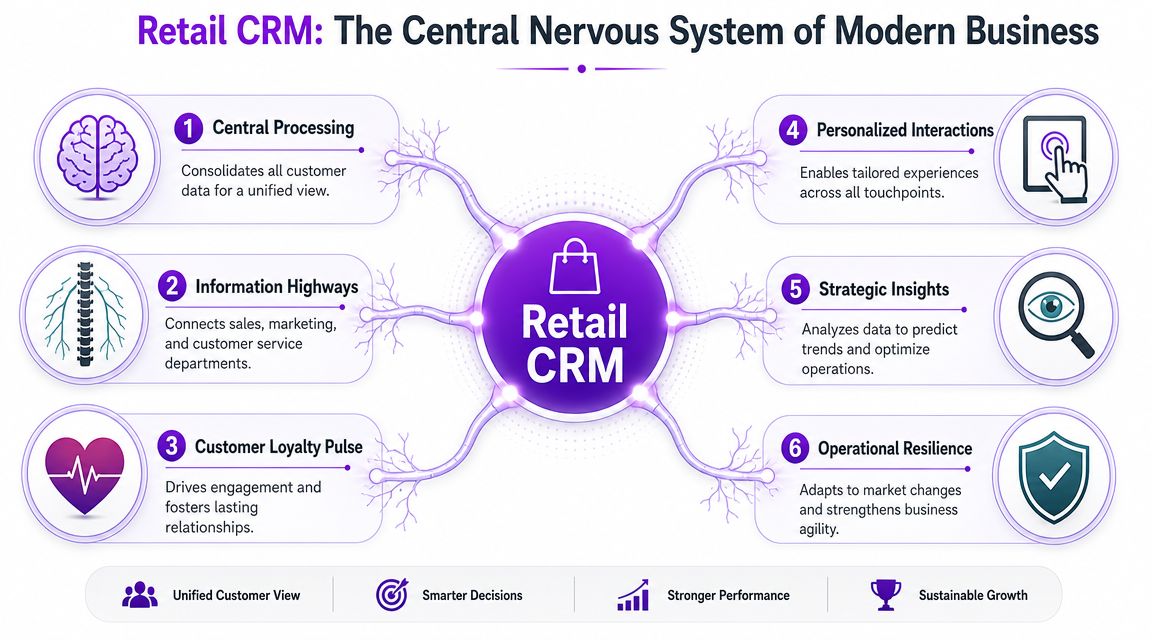
A modern retail CRM is best understood as the business's central nervous system. It is not limited to storing names, phone numbers, and transactions. It gathers signals from across the organisation, interprets them in context, and enables each team to respond coherently.
That distinction matters because many retail CRM projects still fail at the framing stage. Leaders buy a contact database and expect a customer intelligence layer. The result is predictable. Data gets stored, but not unified. Teams log activity, but don't change decisions. Campaigns become more automated, but not more relevant.
From records to responsiveness
The primary function of CRM software for retail is to make the whole organisation respond as if it knows the customer personally. That requires more than a customer master table. It requires unified customer data, purchase history, behavioural signals, service interactions, and channel context.
Businesses using modern CRM systems report a 29% increase in sales, a 34% rise in sales productivity, and a 42% improvement in sales forecast accuracy, according to this retail CRM overview. Those numbers matter because they point to a deeper operational truth. Unification improves both customer-facing execution and internal decision quality.
A practical analogy helps. In the human body, nerves don't create value by “storing information”. They create value by transmitting the right signals to the right place at the right time. Retail CRM works the same way.
- Sales teams need visibility into past purchases and active opportunities.
- Marketing teams need segmentation logic tied to actual customer behaviour.
- Service teams need full interaction history before they reply.
- Leadership teams need reliable visibility into trends, cohorts, and forecast confidence.
Why unification changes economics
The economic value comes from coordination. When teams work from fragmented data, retailers overspend on acquisition, underperform on repeat business, and make loyalty programmes less effective than they look on paper. When data is unified, the business can time offers better, resolve issues faster, and personalise journeys without creating chaos for the front line.
Practical rule: If a platform can't help the store associate, marketer, and support agent see the same customer context, it isn't yet functioning as retail CRM in the strategic sense.
This is also where many executives confuse CRM with adjacent systems. CDPs, service platforms, loyalty engines, and commerce platforms each play different roles. For support and CX leaders trying to map that boundary clearly, Deciphering CDP and CRM for support leaders gives a helpful distinction between customer data management and operational action.
The strongest retail CRM programmes don't start with “How many features are available?” They start with “What decisions should improve once every team sees the same customer?”
Core vs Advanced Features That Drive Revenue
Most CRM evaluations become feature audits too early. That's a mistake. A CXO shouldn't first ask whether a platform offers advanced automation or advanced scoring. The first question is whether it solves the operating problems that suppress revenue today.
The most important technical capability is a single customer view that merges POS, e-commerce, and service interactions into one consolidated record, as described in this retail CRM capability analysis. That unified repository is what makes omnichannel order management and personalised campaigns possible in practice.
Core foundations that stabilise execution
These are the capabilities that make the business run with less friction. They aren't glamorous, but they determine whether anything more advanced will work.
| Capability Tier | Key Features | Business Outcome |
|---|---|---|
| Core Foundation | Single customer profile across POS, e-commerce, loyalty, and service | One identity layer for recognition, follow-up, and service continuity |
| Core Foundation | Data normalisation for fields such as customer ID, phone number, order ID, store ID, and consent status | Fewer duplicates, cleaner segmentation, more reliable reporting |
| Core Foundation | POS and commerce integrations through APIs or middleware | Operational visibility across online and offline journeys |
| Core Foundation | Basic workflow automation for post-purchase, service updates, and customer tagging | Less manual coordination across teams |
A retailer that lacks these basics will struggle with almost every revenue initiative that follows. Personalisation becomes guesswork. Loyalty records drift. Support escalations multiply because no one has a complete view.
For teams comparing CRM and lead workflows before tackling retail complexity, this guide to CRM and lead management is a practical reference point.
Advanced capabilities that create leverage
Once the data foundation is stable, a second layer starts to matter. These capabilities don't just organise customer information. They improve growth velocity.
Consider the difference:
- Foundational segmentation tells you who bought in the last period.
- Advanced orchestration lets you trigger targeted actions based on channel behaviour, service status, or loyalty activity.
- Foundational reporting tells you what happened.
- Advanced analytics helps leadership identify which cohorts are worth more attention and which journeys are underperforming.
A simple maturity model helps.
Recognition stage
The retailer can identify a customer across channels and suppress duplicates.Coordination stage
Teams share context. Service doesn't ask for information marketing already has. Store staff can see relevant history.Activation stage
The business launches automated, personalised workflows that reflect actual customer state.Optimisation stage
Leadership uses customer and channel data to refine investment decisions, retention tactics, and revenue mix.
The wrong way to buy CRM is to purchase stage-four features before stage-one identity is under control.
A practical retail example makes this real. A fashion chain may want to send lapsed buyers a targeted offer. That sounds simple. In reality, it only works if the system knows the buyer who purchased in-store with a phone number is the same person who browsed the app and opened a support ticket. Without that unification, the campaign either misses the customer or sends the wrong message.
That's why advanced features should be treated as multipliers, not substitutes. They only create competitive advantage when the underlying identity, integration, and workflow layers are already sound.
The Omnichannel Imperative CRM for E-commerce D2C and Brick-and-Mortar
The Indian retail challenge isn't only multichannel. It's mixed-identity retail at scale. Deloitte notes that India's retail market is projected to reach about USD 1.6 trillion by 2030, while a recent Bain and PhonePe estimate puts the country at 250 to 300 million online shoppers in 2024. At the same time, the sector still serves a large physical-store customer base, with the challenge often framed as managing the 80% of customers who still transact through physical stores while also engaging digital buyers, as discussed in this analysis of CRM for retailers.
That's why CRM software for retail in India has to solve identity first, channel second.
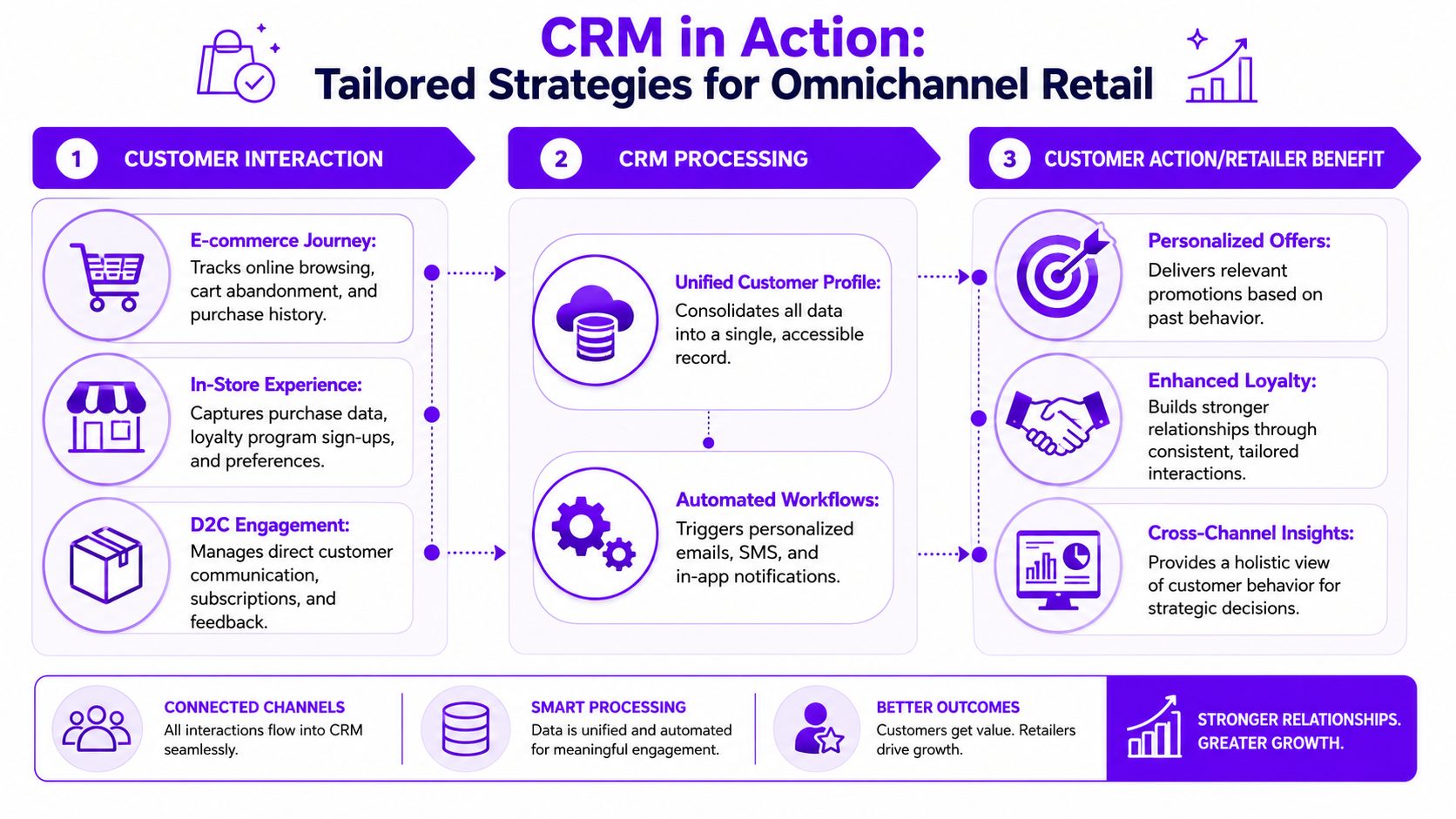
Three customers one brand three fragmented identities
Take three common retail journeys.
The first customer buys through a marketplace listing after discovering the product on mobile. The retailer gets limited direct customer context, a shipping profile, and partial behavioural insight.
The second customer shops through the brand's D2C app, browses multiple times, abandons a cart, then completes purchase after receiving a reminder.
The third customer walks into a physical store, pays through UPI, shares a phone number at checkout, and later asks a product question on WhatsApp.
To most organisations, these appear as three separate operational streams. To the customer, they're one relationship with one brand.
That's where a strong CRM changes the operating model:
- Identity resolution links a phone number, loyalty profile, UPI-linked behaviour, or messaging interaction to one customer record.
- Journey continuity allows marketing and service teams to act on complete context rather than isolated events.
- Cross-channel follow-up means a store purchase can trigger a relevant digital message, and a digital complaint can inform in-store service.
For retailers exploring conversational touchpoints inside that journey, this perspective on an AI chatbot for ecommerce is useful because it shows how support and conversion signals increasingly feed the same customer record.
What the operating model looks like when CRM works
When the CRM layer is configured properly, each channel stops competing for ownership of the customer. The organisation starts coordinating around the customer's actual behaviour.
A practical scenario makes the point. Suppose an electronics retailer sees that a customer purchased in-store, later checked warranty information through WhatsApp, and then browsed accessories online. In a fragmented stack, those touchpoints sit in separate systems and no one acts coherently. In a unified CRM, that same journey can trigger a service-aware follow-up, a relevant accessories recommendation, and a cleaner support interaction because the agent already sees the purchase history.
The strategic win in omnichannel retail isn't “being present on many channels”. It's recognising that the customer expects one memory across all of them.
This matters most in India because many retailers still treat offline and online as separate P&Ls with separate data habits. That structure hides the true leakage. The issue isn't channel underperformance. It's that the same customer keeps getting split into different identities, which weakens loyalty and inflates operational effort.
A retail CRM worth funding should reduce that fragmentation. If it can't, it may improve reporting, but it won't transform the business model.
Measuring What Matters KPIs and ROI From Your CRM Investment
Most CRM business cases fail because they focus on implementation activity rather than commercial outcomes. Boards don't invest in cleaner records for their own sake. They invest when the programme can show a direct link to revenue quality, customer retention, and operating efficiency.
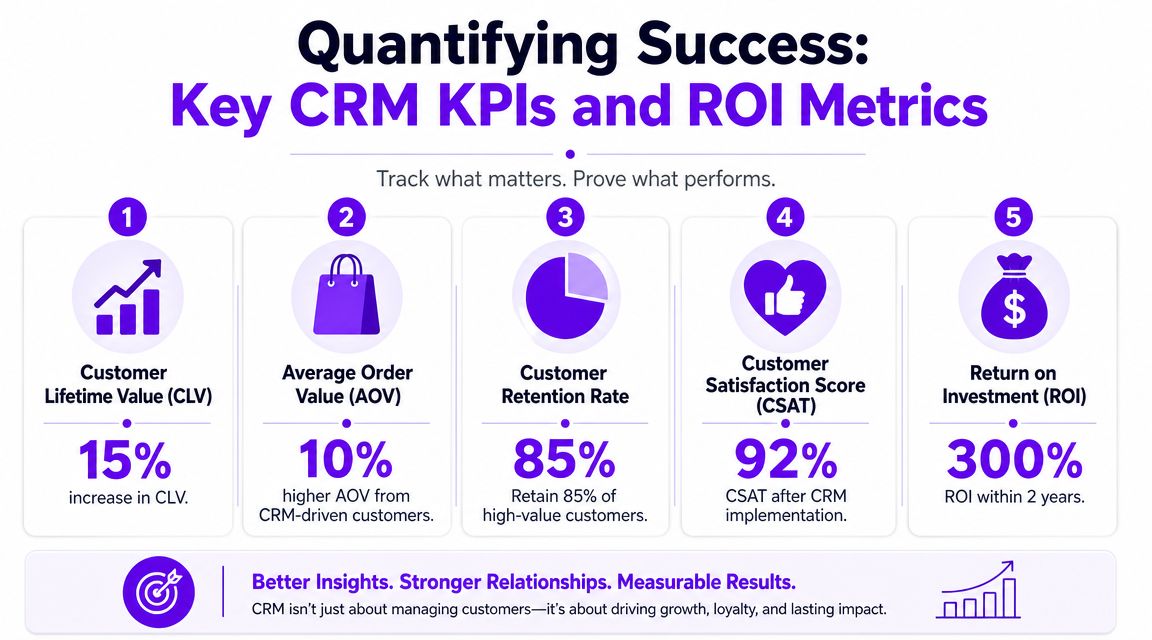
In retail, the most relevant KPI set is straightforward. The measurable value of CRM lies in the metrics it improves, including repeat purchase rate, average order value, cart abandonment, and customer retention, with a 30- to 60-day pilot recommended to attribute improvements to the CRM workflow itself, according to this retail CRM implementation guide.
A visual summary helps frame the dashboard that matters.
The KPI set that belongs in the steering committee
A good retail CRM dashboard should answer four executive questions.
- Are customers buying again? Repeat purchase rate shows whether the business is building habits, not just transactions.
- Are customers spending better? Average order value helps test whether recommendations, bundles, and targeted offers are working.
- Where is demand leaking? Cart abandonment highlights friction in digital journeys and weak follow-up logic.
- Are we keeping customers longer? Retention indicates whether service, relevance, and post-purchase engagement are improving.
These KPIs matter because they connect directly to operating decisions. If repeat purchase remains flat, loyalty strategy may be weak or customer recognition may still be fragmented. If AOV improves in one cohort, merchandising and CRM teams can examine which campaign logic or customer segment drove the change.
Boardroom test: If your CRM vendor can't show how these KPIs will be instrumented, attributed, and reviewed, you're still in a software demo, not an investment discussion.
The following video is useful if your team wants a quick visual explanation of CRM measurement and business impact.
How to prove value without waiting for a full transformation
Leaders often make one of two mistakes. They either demand immediate enterprise-wide ROI before the system is ready, or they accept a long implementation period with no disciplined measurement. Both approaches weaken the programme.
A better approach is to pilot in a defined environment and measure deltas that can be linked to workflow changes. That pilot could sit in one store cluster, one category, or one digital customer segment. The aim isn't to prove every strategic benefit at once. It's to prove that better identity, better follow-up, and better orchestration create measurable movement in the right KPIs.
A realistic board-level framing looks like this:
- Choose a narrow pilot scope with clear customer journeys.
- Define baseline metrics for repeat purchase, AOV, abandonment, or retention.
- Launch CRM-led workflows such as triggered follow-up, better tagging, or service-linked communication.
- Review commercial deltas and operational usage together.
The strongest insight for a CFO is simple. CRM ROI usually appears first in better execution, then in better economics. If the front line uses the system and the customer identity layer is sound, the KPI improvements become easier to defend.
Implementation Roadmap and Integration Best Practices
Retail CRM implementations rarely fail because the software is impossible to deploy. They fail because the organisation treats the project as an IT rollout instead of an operating change. Integration gets delayed, ownership becomes unclear, and front-line teams receive a new interface without a new way of working.
A better roadmap starts with governance. Someone on the executive team has to own commercial outcomes, not just implementation milestones. The CIO may lead architecture. The CMO may drive activation. The COO may shape store workflows. But one sponsor has to decide what “success” means commercially.
Phase one build the customer spine
The first phase is not campaign automation. It's identity and data hygiene.
Retailers should prioritise the fields that make cross-system recognition possible: customer ID, phone number, order ID, store ID, and consent status. Data doesn't need to be perfect before launch, but it does need to be consistent enough that duplicate profiles don't undermine every later workflow.
The practical sequence is usually:
- Map source systems such as POS, e-commerce, loyalty, support, and messaging tools.
- Define the master record logic so teams know which fields take precedence when systems disagree.
- Use APIs or middleware carefully to normalise records before broad orchestration begins.
- Set usage rules early so teams don't create new data chaos after migration.
For organisations already operating in the Microsoft ecosystem, this look at AI-powered chat for Dynamics 365 CRM is useful because it shows how service and conversational layers can plug into CRM workflows once the core record structure is stable.
Phase two make the front line use it
A retail CRM only creates value when store staff, service agents, and sales teams trust it enough to use it in live customer situations. That means workflow design matters more than training manuals.
Front-line adoption improves when the CRM answers immediate questions:
- Who is this customer?
- What did they buy?
- Is there an unresolved issue?
- What follow-up is due?
- What should I do next?
If those answers are buried behind multiple screens, adoption drops. If they're visible in one place, usage becomes part of daily work rather than an administrative burden.
Phase three activate automation with governance
Only after identity and usage are stable should the retailer expand into broader automation. That includes post-purchase follow-ups, lapsed-customer outreach, support-linked triggers, and channel-specific campaigns.
This is also the stage where adjacent tools matter. Some retailers add voice or chat layers to capture interactions and update records automatically. For example, DialNexa Labs Private Limited provides voice AI agents that can connect with CRMs and internal systems to log interactions, qualify conversations, and update workflows. The value in such tools isn't novelty. It's reducing manual handoffs while preserving customer context.
Teams integrating CRM with broader sales and service infrastructure may also find this guide on inbound and outbound integration in Salesforce helpful for thinking through process design across systems.
Implementation discipline comes down to one rule. Don't automate confusion. Fix identity, clarify workflows, then scale.
Your Executive Checklist for Choosing the Right Retail CRM
Most vendor evaluations are too polite. Buyers ask for demonstrations, roadmap decks, and reference architectures. Vendors respond with feature breadth, implementation confidence, and product terminology. None of that gets to the core issue quickly enough.
The right retail CRM should solve a hard commercial problem: how to recognise customers consistently, coordinate action across channels, and improve measurable business outcomes. If the vendor can't defend that chain, the platform may still be capable, but the buying process isn't rigorous enough.
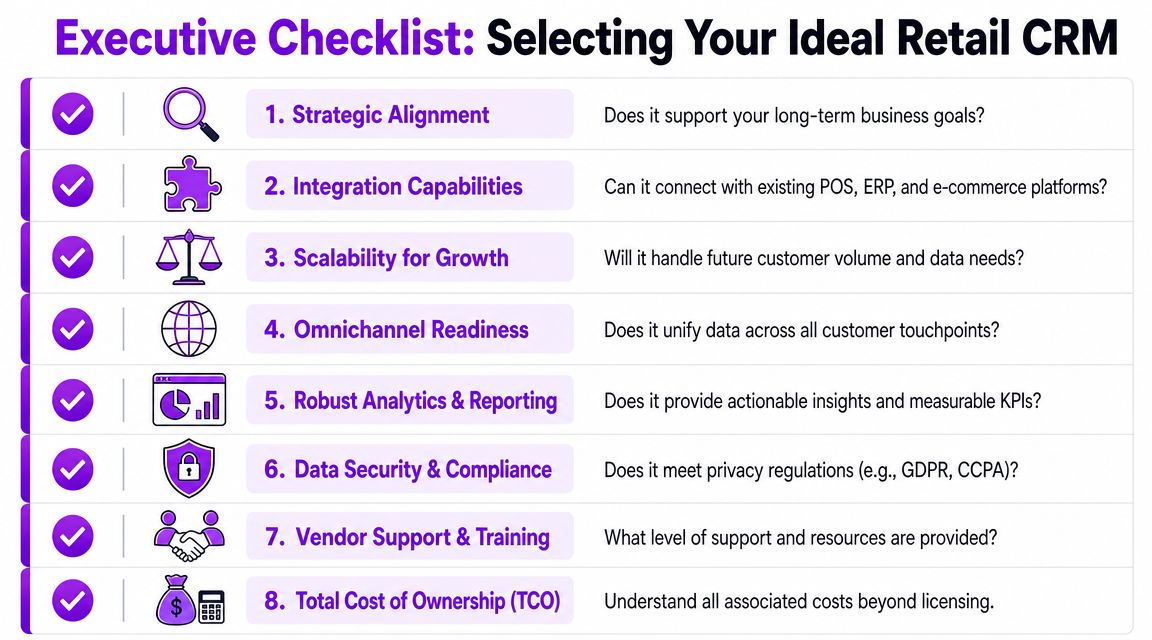
The questions that expose weak platforms quickly
Use the checklist below in every serious vendor conversation.
- Identity resolution: Can the platform unify a customer across store purchase history, app behaviour, support interactions, and messaging channels without producing duplicate profiles?
- Integration realism: How does it connect with your existing POS, e-commerce, service, ERP, and loyalty systems? Ask what has to be customised versus configured.
- Front-line usability: Can a store associate or support agent see the relevant context fast enough to use it during a live interaction?
- Workflow flexibility: Can the business launch practical automations without depending on engineering for every change?
- Measurement clarity: Which KPIs will be available from the start, and how will the team attribute changes to CRM-led workflows?
- Scalability: Will the same architecture hold up as customer volume, store footprint, and channel complexity increase?
- Governance and compliance: How are consent, permissions, and data controls managed across customer touchpoints?
- Total cost of ownership: What costs sit outside licence fees, including implementation, support, integration, and change management?
What strong answers sound like
The best answers are concrete, not theatrical.
A strong vendor won't say, “Yes, we support omnichannel.” They'll explain how customer IDs are resolved, how duplicate prevention works, what middleware is needed, and what users will see at the moment of action. They'll also be willing to narrow scope for a pilot instead of pushing a maximalist rollout.
A strong internal team will also challenge itself. If your own organisation can't define the target customer journeys, priority KPIs, and system owners, no platform selection process will save the project.
Choose the vendor that understands your operating model, not the one that gives the most polished demo.
That's the final test for CRM software for retail. You are not selecting a database with campaigns attached. You are choosing the system that will hold customer memory, govern service continuity, and shape how efficiently the business turns fragmented interactions into profitable relationships.
If your team is evaluating how CRM should connect with conversational channels, support operations, or lead qualification workflows, DialNexa Labs Private Limited is one option to review alongside your broader stack planning. Its Voice AI agents can connect with CRM and internal systems to log interactions and support workflow automation, which can be relevant for retailers looking to extend customer context beyond web and store touchpoints.

This is a well-structured and insightful article that clearly explains why CRM has evolved from a simple database into a strategic growth engine for modern retail businesses. The focus on omnichannel customer experience, measurable KPIs, and practical implementation makes it highly valuable for retail leaders in 2026.
The framing that retail leaders are buying “customer knowledge” rather than software is exactly the mindset shift our team needed. Most CRM failures I’ve seen come from treating it as a tool rollout instead of a data and process strategy. A grounded read heading into 2026.