
The CXO’s Guide to AI Call Bot Transformation
At its core, an AI call bot is an intelligent software solution that uses artificial intelligence to conduct natural, human-like voice conversations with your customers over the phone. Forget the clunky, robotic systems of the past. Today’s AI bots understand conversational nuances, discern intent, and respond intelligently, making them a strategic asset for everything from qualifying sales leads to handling complex support queries.
Why an AI Call Bot Is Your Next Strategic Move
For any CXO focused on sustainable growth, the conversation around customer engagement has fundamentally shifted. An AI call bot is no longer a futuristic concept; it is a practical, strategic tool available today to scale revenue and dramatically elevate the customer experience. This is about achieving a quantum leap in operational efficiency, not just incremental improvements.
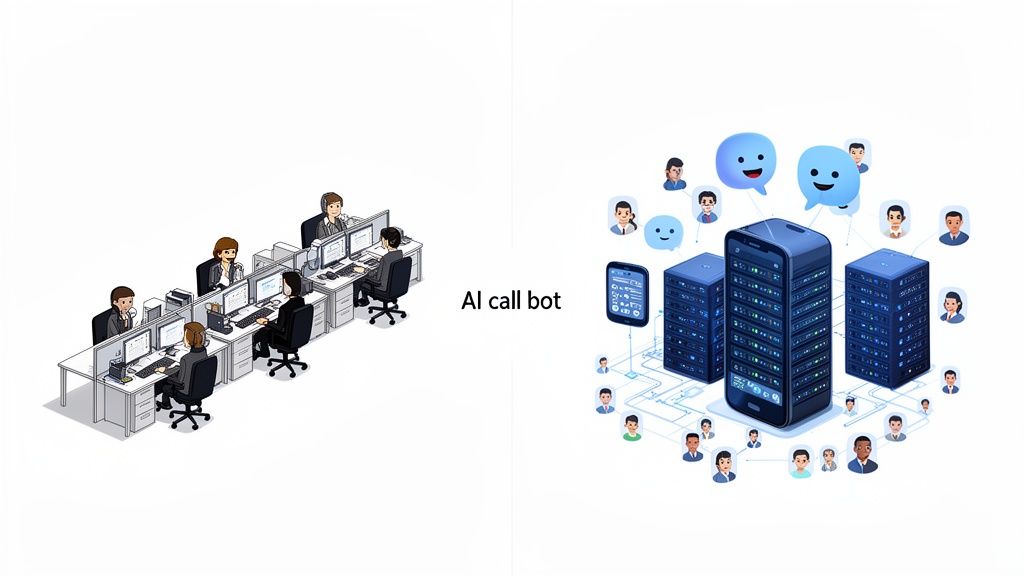
Consider your current call centre. It operates like a manual assembly line—effective, but constrained by headcount, business hours, and significant operational costs. To handle a 2x increase in call volume, you must hire 2x the agents. This linear growth model is unsustainable in a hyper-competitive market.
Now, envision an AI call bot as a fully automated, intelligent factory. It operates 24/7, engaging with thousands of customers simultaneously, all while maintaining a perfect, consistent brand voice. For example, a financial services firm can deploy an AI bot to make 50,000 legally-mandated compliance calls over a single weekend—a task that would take a human team weeks to complete. This isn't just about answering calls; it's about executing your business strategy with unprecedented precision and scale.
The Shift from Operational Tool to Competitive Differentiator
The true power of an AI call bot lies in its ability to transform your entire approach to customer interaction. It evolves your call centre from a reactive cost centre into a proactive revenue and data-generation engine.
Let's examine the business impact from a strategic perspective:
- Massive Scalability: A single AI can manage tens of thousands of calls daily without performance degradation. This means you can launch large-scale outreach campaigns or absorb sudden inbound call spikes—like those following a product launch—without the logistical nightmare and cost of hiring temporary staff. A retail brand, for instance, can handle 100,000+ inbound support calls during a peak holiday season with a small team of AI bots, ensuring zero wait time.
- Enhanced Customer Experience: Modern AI bots deliver natural, empathetic conversations. By eliminating hold times and providing instant, accurate answers, they meet—and exceed—modern customer expectations. The result is a direct impact on customer satisfaction (CSAT) scores, which studies show can increase by up to 20% with effective AI implementation.
- Data-Driven Insights: Every conversation is a valuable data point. The AI captures and analyses this interaction data in real-time, providing leadership with a clear, quantified view of customer sentiment, common pain points, and emerging market trends. This transforms anecdotal feedback into actionable business intelligence.
For a CXO, the crucial takeaway is this: an AI call bot industrialises your conversations. It standardises outreach, perfects messaging, and executes flawlessly at scale. What was once a variable, human-dependent process becomes a predictable, measurable, and infinitely scalable system.
Strategic Comparison Human Agent vs AI Call Bot
To fully grasp the strategic advantages, a direct comparison from an executive viewpoint makes the difference in operational capability crystal clear.
| Metric | Traditional Human Agent | Modern AI Call Bot |
|---|---|---|
| Operational Hours | 8-10 hours/day, 5-6 days/week | 24/7/365, including holidays |
| Call Capacity | 1 concurrent call per agent | Thousands of concurrent calls |
| Cost Per Interaction | High and variable (salary, benefits, training) | Up to 70% lower and predictable (subscription-based) |
| Performance Consistency | Varies by agent, time of day, and mood | 100% consistent, always on-script |
| Data Capture | Manual notes, often incomplete or inconsistent | Automatic, structured data for every interaction |
This table makes it obvious that while human agents are indispensable for complex, high-value negotiations, a significant portion of routine communication can be automated far more efficiently.
If you'd like to dive deeper into making this shift, check out our guide on how to automate your call centre for maximum strategic impact. By deploying an AI call bot, you empower your expert human team to focus on what they do best: closing enterprise deals and solving your customers' most challenging problems.
How Modern Voice AI Actually Works
So, how does this all work under the hood? To truly appreciate why an AI call bot is a strategic game-changer, you must understand the technology that drives it. This isn't a deep dive into code, but a CXO-level overview of the intelligent systems that make these conversations possible.
Let’s be clear: this is nothing like the "press 1 for sales" IVR systems we've all learned to despise. A traditional IVR is a rigid maze, forcing every caller down a few predefined paths. If their issue doesn't fit, they hit a dead end. It's a recipe for customer frustration and brand damage.
A modern AI call bot is fundamentally different. Think of it less like a maze and more like a sophisticated GPS. It listens to the user's destination (their goal), understands it in plain language, and maps the most efficient route. If the caller asks something unexpected ("By the way, can you also check my last payment?"), it simply recalculates in real-time without breaking the flow.
This intelligence is orchestrated by several core technologies working in perfect harmony.
The Brains, Voice, and Engine of the Operation
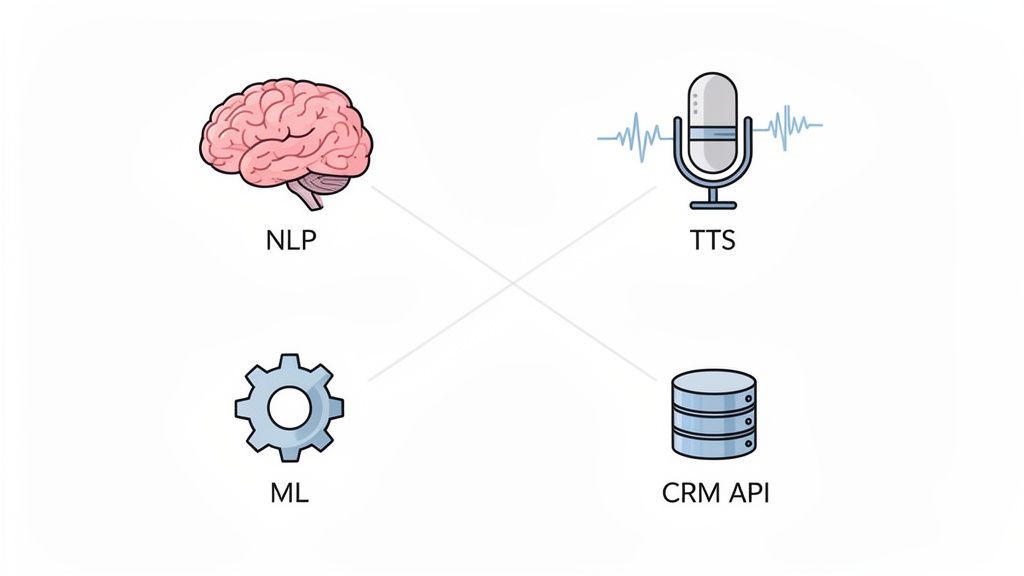
When broken down, an AI call bot relies on three key technological pillars. Each has a distinct role, but together they create a conversational experience that is surprisingly human.
Natural Language Processing (NLP): The 'Brain'
This is the bot's comprehension engine. NLP is the brain of the operation, decoding not just words but the intent behind them. For example, a customer might say, "My delivery hasn't arrived," "Where's my stuff?" or "I need a status update on order 12345." NLP understands that all three phrases have the same goal: check order status. It achieves this without relying on rigid keywords, allowing for natural, human-like dialogue.Text-to-Speech (TTS): The 'Voice'
Once the AI understands what’s needed and formulates a response, the TTS engine gives it a voice. Modern TTS has evolved far beyond robotic monotones. It can now produce voices with lifelike intonation, pacing, and emphasis, allowing you to craft a voice persona that perfectly aligns with your brand—be it empathetic and reassuring for healthcare, or energetic and persuasive for sales.Machine Learning (ML): The 'Engine'
This is what makes the system self-improving. ML is the engine that learns from every single call. It analyses conversational data to identify which phrases lead to successful outcomes and which cause friction. For instance, if it detects that 15% of callers are dropping off after a certain question, the system can flag this for review. This continuous feedback loop means the AI refines its own performance over time, becoming more effective without constant manual developer intervention.
Seamless Integration with Your Existing Systems
A common concern among business leaders is that adopting an AI call bot will require a costly and disruptive overhaul of their existing tech stack. The reality is the opposite. These bots are designed to act as an intelligent orchestration layer that enhances your current systems. This is made possible by core technologies like Speech to Text Technology and robust APIs.
The linchpin is the Application Programming Interface (API). An API is a secure bridge enabling different software systems to communicate and exchange data automatically.
For a CXO, this is a critical point: The AI bot isn't a standalone silo. It plugs directly into your CRM (e.g., Salesforce, HubSpot), ERP, and telephony systems, acting as a central hub that pulls and pushes data where it's needed most.
Consider a practical sales example. An AI bot calls a lead from a marketing campaign. Through an API, it first pulls the lead's name and company from Salesforce. During the call, it qualifies the lead. Upon completion, it uses another API call to:
- Update the lead status in Salesforce to "Sales Qualified."
- Create a new task for the assigned sales representative.
- Log the full call transcript and a summary directly into the contact's activity history.
This is how the bot transitions from a mere conversational tool to a powerful automation engine for your entire revenue operation.
Measuring the Tangible ROI of Your AI Call Bot
As a business leader, every investment must be justified with clear, measurable results. An AI call bot is no different. We must move beyond the hype and focus on the concrete, data-backed KPIs that demonstrate a real financial and operational return. This is about delivering a tangible return on investment, not chasing technology for technology's sake.
The impact begins at the very first touchpoint: making a connection. Many outbound sales teams struggle with connect rates hovering around 40-50%. By leveraging data to optimise call timing and outreach cadence, an AI bot can dramatically improve these initial numbers. This isn't a minor tweak; it's a fundamental shift in top-of-funnel efficiency.
This initial boost in connectivity paves the way for greater wins down the funnel. A well-designed AI call bot does more than just make contact; it executes the persistent, multi-touch follow-up sequences that are critical for nurturing a prospect toward a decision.
From Cost Centre to Revenue Engine
The most direct way to measure ROI is by tracking the financial impact. A strategically implemented AI call bot can transform a traditionally high-cost operational unit into a powerful revenue-generating asset. The key is automating the right tasks—the high-volume, repetitive calls that consume your expert agents' time.
Lifting Conversion Rates: Persistent, automated follow-up is a proven revenue driver. For example, a leading EdTech company using an AI bot to re-engage dormant leads saw its lead-to-application conversion rate increase by 150% in the first quarter. We've seen organisations lift their lead-to-booking conversions from a standard 2% to as high as 8%. This directly boosts top-line revenue without adding headcount.
Boosting Connect Rates: Smart AI platforms can increase connect rates from a typical 47% to over 91% by analysing historical data to determine the optimal time to call each lead. More connections mean more qualified opportunities for your sales team. A 91% connect rate means your message is actually heard, not lost to unanswered calls.
Significant Cost Reductions: Automating thousands of daily qualification and support calls frees your human experts. Instead of spending 80% of their day on repetitive tasks, they can focus 100% of their time on high-value, complex interactions that require human nuance. The result is a typical cost-per-call reduction of 50-70%.
The core strategy is simple: use automation for scale and consistency, and reserve human expertise for high-stakes negotiation and relationship-building. This dual approach maximises the efficiency of your entire revenue operation.
To see what this looks like in practice, it’s helpful to look at real-world examples, such as how a consumer electronics brand achieved 50% cost savings after deploying an AI solution in their technical support division.
Quantifying the Operational Impact
Beyond direct revenue, an AI call bot delivers powerful operational efficiencies that compound over time. These metrics are equally crucial for building a robust business case. If you're curious about the evolution from basic IVR software to conversational AI in our detailed article, you can explore the technological leap there.
For platforms like DialNexa, this translates to tangible wins. We consistently see connect rates on qualification calls jump from an industry average of 47% to an impressive 91%. This allows the AI to conduct multi-minute, natural conversations that qualify leads with 97% accuracy, on par with seasoned human agents.
By closely monitoring these KPIs—conversion lift, connect rates, cost per lead, and agent productivity—executives can build a clear, data-driven narrative that proves the value of their investment. The ROI ceases to be a projection and becomes a visible, repeatable metric on your executive dashboard, providing the solid business case needed to champion wider adoption across the organisation.
Real-World Use Cases Driving Revenue Growth
Theory is one thing, but P&L impact is what matters. For any business leader, the question isn't just "What does this technology do?" but rather, "How will this solve my specific problems and drive measurable revenue growth?"
The answer is found in applying AI call bots to specific, high-value industry challenges. This is not about a one-size-fits-all solution; it’s about surgically targeting the high-volume, repetitive tasks that are currently bottlenecking your growth. Across diverse sectors, leaders are wrestling with the same core issues: how to scale outreach, manage lead velocity, and deliver exceptional support without exponentially increasing costs. A well-configured AI call bot addresses these pain points directly, transforming operational bottlenecks into automated, revenue-generating functions.
These metrics demonstrate the immediate impact an AI call bot can have on your core business operations.
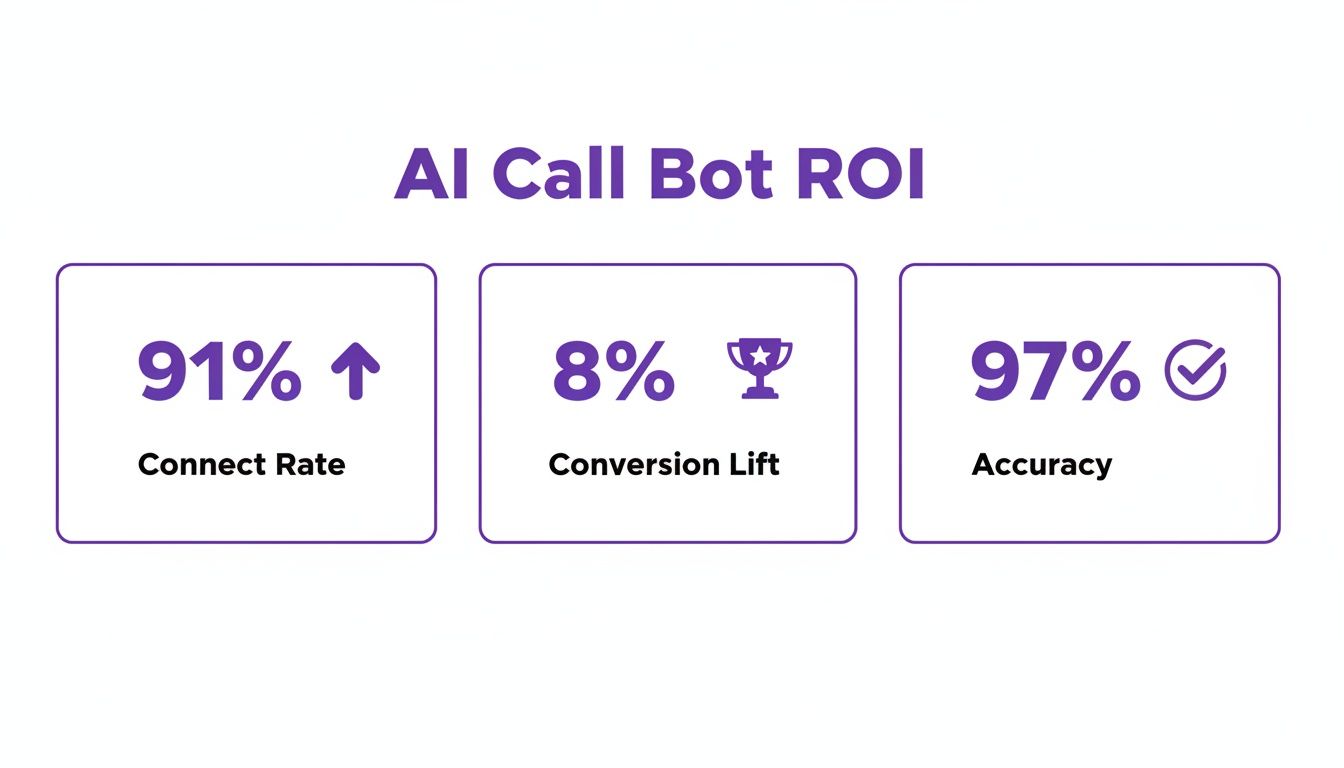
The data is unequivocal. With connect rates soaring over 90%, a tangible lift in conversions, and accuracy rivalling human experts, the performance gains are undeniable.
EdTech Admissions at Scale
Picture an Admissions Director at a growing university facing a deluge of 10,000 inquiries each semester. Their team of 20 human counsellors can only engage a fraction, leading to lost opportunities as potential students go to competitors who responded faster.
An AI call bot rewrites this operational reality. The bot can:
- Autonomously call every new lead within 5 minutes of their inquiry.
- Ask qualifying questions to gauge program interest, academic background, and financial aid needs with 98% accuracy.
- Seamlessly book qualified applicants into a human counsellor’s calendar, complete with pre-call notes.
The result: Counsellors shift from low-value screening to high-value advising. One university client saw a 35% increase in applications and a 15% lift in enrollment from the same lead pool after implementing an AI bot.
Capturing Real Estate Leads 24/7
For the CEO of a real estate brokerage, speed-to-lead is everything. A Zillow study found that a 5-minute response time increases lead conversion by 21x. Waiting until the next business day often means losing that high-intent lead forever.
This is a prime use case for an AI call bot. It operates 24/7 to:
- Instantly call every web form submission, regardless of the time of day.
- Verify the prospect's interest, confirm their budget, and log their property requirements (e.g., "3-bedroom, near a good school").
- Schedule a property viewing with an available agent directly on their calendar.
The impact on the bottom line is immediate. By providing 24/7 engagement, brokerages have seen their lead-to-booking conversions jump from a typical 2% to over 8%. This isn't just an operational tweak; it’s a direct path to capturing more market share.
Compliant Automation in BFSI
In the highly regulated world of Banking, Financial Services, and Insurance (BFSI), a Chief Compliance Officer's dual mandate is to ensure strict adherence to regulations while delivering prompt customer service. The operational drag from tasks like KYC reminders or collection calls is immense.
An AI call bot is perfectly suited to handle these sensitive, high-volume interactions with flawless consistency and audibility. The bot can:
- Automate 100,000+ outbound calls per month for payment reminders or KYC compliance, logging every interaction for audit trails. This reduced one bank's manual workload by 8,000 agent hours per month.
- Provide immediate, first-level support for common inquiries, answering questions about account balances or transaction status with 99% accuracy.
- Intelligently escalate complex issues (e.g., fraud reports) to a specialist, providing the human agent with a full transcript and summary for seamless handover.
By automating these processes, financial institutions achieve 100% compliance on mandatory outreach while freeing up skilled agents to handle high-value customer issues, improving both operational efficiency and customer trust.
Your Executive Playbook for AI Bot Implementation
Deploying an AI call bot is a strategic initiative, not merely a technical task. For VPs and Directors, a structured playbook is essential for navigating the process, aligning stakeholders, and ensuring a tangible return on investment from day one. This is your leadership guide to a successful implementation.
Think of it as building a high-performance engine. You don't start by randomly assembling parts; you begin with a clear blueprint and a specific performance goal. The same principle applies to your AI bot strategy.
It starts with specificity. A vague objective like "improve efficiency" is a recipe for failure. To succeed, you must define clear, measurable targets that the entire business can rally behind.
Define Crystal-Clear Business Objectives
Before any technology is discussed, your leadership team must align on what success looks like. These objectives become the project's North Star, guiding every decision from script design to ROI reporting.
Translate broad goals into specific, time-bound KPIs. For example:
Instead of: "Improve lead qualification."
Use: "Increase the number of Sales-Qualified Leads (SQLs) passed to the sales team by 30% in Q3."
Instead of: "Reduce costs."
Use: "Decrease the average cost-per-qualified-lead from $150 to $90 within six months."
Instead of: "Engage leads faster."
Use: "Achieve a 5-minute response time for 100% of all new inbound web leads, 24/7."
With targets this specific, the AI call bot becomes a precision tool for achieving your most critical business goals.
Select a High-Impact Pilot and Audit Your Systems
With clear objectives, select your first project. Don't try to boil the ocean. Start with a single, high-volume process where automation can deliver an immediate and visible win. Outbound qualification of marketing leads or inbound appointment setting are excellent candidates. A successful pilot builds momentum and internal buy-in for future expansion.
Simultaneously, conduct a data audit. An AI is only as good as the data it's given. If your CRM is a graveyard of outdated contact information, your bot will fail. Assess the health of your contact lists and the integrity of your CRM data.
As a leader, this is your opportunity to champion data hygiene. The rollout of an AI call bot can serve as the perfect catalyst for a long-overdue CRM cleanup, establishing higher data standards across the organisation.
Design the Bot and Plan for Integration
Now you can design the bot itself. Crafting the bot's persona is a strategic decision. It defines how your brand communicates in an automated world. Should it be formal and concise for a compliance call, or warm and conversational for a welcome call? This personality must align with your brand and customer expectations.
Next, map the integrations. Your bot cannot be an operational island. It must communicate seamlessly with your CRM, telephony, and marketing automation platforms. This requires planning the data flow: what information (e.g., lead name, last purchase) does the bot need to pull pre-call, and where does it need to push the outcomes (e.g., call disposition, notes, recording) post-call?
Finally, design your reporting dashboard from day one. You need a clear, CXO-level view that tracks the business objectives defined in step one. This dashboard is what will justify the investment and provide the data-driven confidence needed to scale the initiative. Following this playbook ensures a deployment that delivers predictable, measurable results.
Justifying Investment and Ensuring Governance
When considering an AI call bot, every leader ultimately asks two questions: "What is the ROI?" and "How do we control the risk?" Securing executive buy-in requires more than a promise of efficiency; it demands a solid business case with clear financial projections and a robust governance plan to manage compliance and brand reputation.
Let's cut to the chase. An AI call bot impacts the P&L in two ways: it saves money (cost avoidance) by automating repetitive tasks, and it makes money (revenue generation) by scaling sales and lead generation far beyond human capacity. To justify the investment, you must quantify both sides of this equation.
Calculating the ROI of Your AI Call Bot
Building your business case is a practical exercise using your own operational data. The formula is straightforward.
The ROI Formula:
(Revenue Generated + Cost Savings) – Monthly AI Bot Cost = Net Monthly Return
Let's walk through a tangible example for a B2C company focused on generating qualified sales appointments.
Cost Savings (Reduced Agent Hours): Assume your team of 10 agents spends 50% of their time (approx. 800 hours/month) on initial lead qualification calls. At a fully-loaded agent cost of $25/hour, that represents $20,000 in monthly labour costs that can be automated.
Revenue Generation (Increased Qualified Appointments): Now, let's say your AI call bot subscription is $5,000/month. By operating 24/7 and following up persistently, it books 100 additional qualified appointments that your human team would have missed. If your average revenue per closed deal is $2,000 and your appointment-to-close rate is 10%, each appointment is worth $200. This adds $20,000 (100 appointments x $200) in new pipeline value.
Net Monthly Return: ($20,000 + $20,000) – $5,000 = $35,000 in net positive return, every single month.
Suddenly, the AI bot isn't an expense; it's a self-funding growth engine. These are the clear, defensible numbers that resonate with your board and CFO.
Ensuring Compliance and Brand Governance
Scaling outreach is great, but not at the expense of your company's reputation or legal standing. When an AI bot handles thousands of conversations, strict control over compliance and quality is non-negotiable.
Regulatory adherence is paramount. In the U.S., this means strict compliance with TCPA guidelines regarding consent and calling hours. In India, it's the TRAI regulations. A reputable AI platform must have built-in safeguards to manage this automatically, such as DNC list scrubbing, consent logging, and time-zone-aware dialing.
For a leadership team, the key assurance is that the AI call bot operates as a compliant extension of your brand, not a rogue agent. Modern AI platforms are designed for control, not chaos, with built-in safeguards to protect your reputation.
Equally critical is ensuring a high-quality customer experience. Poorly managed automation can damage your brand. Robust governance turns your bot into a consistent brand asset. Best practices include:
- Script Versioning & A/B Testing: Maintain a clear audit trail of all call scripts. This allows you to test different messaging ("Version A" vs. "Version B") to see what resonates most with customers and quickly roll back any underperforming changes.
- Sentiment Analysis: Continuously monitor the emotional tone of conversations. Is the bot causing frustration? A spike in negative sentiment is an early warning system, allowing you to refine the dialogue before a small issue becomes a widespread problem.
- Continuous Monitoring & Escalation: Use real-time dashboards to track call outcomes, conversation durations, and escalation rates (how often a call is transferred to a human). This constant oversight ensures the bot remains effective and on-brand.
As AI evolves, staying abreast of the regulatory landscape is vital. For a deeper analysis, you can learn more about navigating future standards and voice AI regulatory updates. By pairing a strong ROI case with a robust governance framework, you can confidently lead your organisation into the next era of customer engagement.
The C-Suite's Most Pressing Questions
As a leader, you need direct, data-backed answers before committing to new technology. Let's address the most common and critical questions we hear from executives considering an AI call bot.
How Is This Any Different From Our Old IVR?
This is a crucial distinction. The difference is best understood as a one-way street versus a dynamic, two-way conversation.
A traditional IVR is a rigid, one-way street. It offers a fixed menu—"press 1 for sales, press 2 for support"—and forces callers down a predefined path. If their issue doesn't fit a category, they become frustrated. This process has been shown to decrease CSAT scores by an average of 15-20 points.
An AI call bot enables a genuine conversation. It uses Natural Language Processing (NLP) to understand the intent behind a caller's words, not just keywords. This allows for a fluid, back-and-forth dialogue. For example, a customer can say, "I need to change my flight, but I also want to use my points," and the AI can handle both parts of the complex query, creating a positive experience that protects and enhances your brand.
Will an AI Bot Sound Robotic and Hurt Our Brand?
This is a valid and frequent concern, rooted in experiences with outdated technology. The robotic voices of a decade ago are a distant memory.
Modern Text-to-Speech (TTS) engines are incredibly sophisticated. They can generate voices with natural intonation, pacing, and even emotion. A healthcare bot can be configured to sound calm and empathetic, while a sales bot can be upbeat and persuasive.
The key is persona-driven design. It’s not just about a voice; it's about crafting a character that is a true extension of your brand. We work with your team to define this persona, ensuring every interaction feels helpful and on-brand, never robotic. The goal is to deliver an experience that customers find genuinely valuable.
What Does the Implementation Timeline Really Look Like?
No executive wants to sign off on a massive IT project that drains resources for 12-18 months. Fortunately, deploying a modern AI call bot is a lean and rapid process.
A typical pilot program, focused on a specific use case like lead qualification, can be designed, built, and launched in as little as 4-6 weeks.
This speed is possible because the core AI platform is already built and battle-tested. Your team's role is not to build technology, but to provide the business context—the "what" and "why" of the conversations. We typically only need one dedicated project lead from your side to provide scripts and business rules. Our team handles the technical integration and deployment, enabling you to see a measurable ROI within a single business quarter.
Ready to see how a human-like voice AI can scale your operations? DialNexa helps you build, train, and deploy custom agents that deliver real business outcomes. Discover what’s possible at https://dialnexa.com.

[…] Directors should treat voice AI as an operating system for customer interactions, not a feature experiment. Engineering leads should measure it the same way they would any revenue-affecting platform: uptime, median response latency, failure recovery, observability, integration accuracy, and cost per completed task. Teams that want a concrete benchmark for business-ready calling workflows can compare against DialNexa's AI call bot reference implementation. […]
[…] teams building this workflow, DialNexa's guide to AI call bots is relevant because it focuses on call automation patterns rather than generic chatbot […]
[…] support fixed prompt trees. Others support more adaptive flows connected to data and routing logic. DialNexa’s AI call bot workflows are one example of a system designed for qualification, support, and presales flows where the […]
[…] that want a clearer benchmark for automation economics should review how an AI call bot for banking self-service and support changes containment, routing accuracy, and cost per resolved […]
[…] For operators comparing delivery models, the pattern is clear. Industries with high variability in customer emotion or problem definition still need strong human coaching. Industries with high call volume and repeatable workflows can increasingly codify best practice through systems such as an AI call bot used in production outbound workflows. […]
[…] This is about focusing on the quality of the conversation, not just the quantity of calls. You can dive deeper into architecting these intelligent systems in our guide on building an effective AI call bot. […]