

Outbound Training Meaning: A CXO’s Guide to Scaling Sales
A well-run outbound programme doesn’t just improve morale. In Indian corporate research, communication skills improved by 35 to 40 per cent, trust among peers rose by 28 per cent, and problem-solving capabilities increased by 32 per cent after structured outbound training programmes, according to the IJSTR study on the impact of outbound training. That should change how boards think about the term.
For most executives, “outbound training” still sounds like an HR activity, a sales induction module, or an offsite with ropes and facilitators. That framing is too small. Its fundamental meaning, especially for revenue leaders, is operational conditioning for teams that must initiate conversations, qualify demand, manage objections, and do it consistently enough to scale.
That matters even more now because the outbound function is no longer purely human. Organisations are training two systems at once: people and software. Human teams need judgement, confidence, message discipline, and collaboration. AI-led calling systems need conversation design, escalation logic, guardrails, and structured feedback. CXOs who understand both dimensions can build an outbound engine that is far more predictable than a traditional call team alone.
Table of Contents
- The High Cost of Untrained Outbound Teams
- Decoding the Modern Meaning of Outbound Training
- The Core Components of an Elite Outbound Programme
- Proven Training Methods from Roleplay to AI Simulation
- Measuring What Matters Most Key Outbound KPIs
- Outbound Training in Action Across Key Industries
- The DialNexa Advantage Standardise and Scale with Voice AI
The High Cost of Untrained Outbound Teams
The board-level risk in outbound operations isn’t only poor calling. It’s inconsistency. One manager coaches well, another doesn’t. One team follows message discipline, another improvises. One agent qualifies properly, another pushes weak leads downstream and burdens sales, support, or operations.
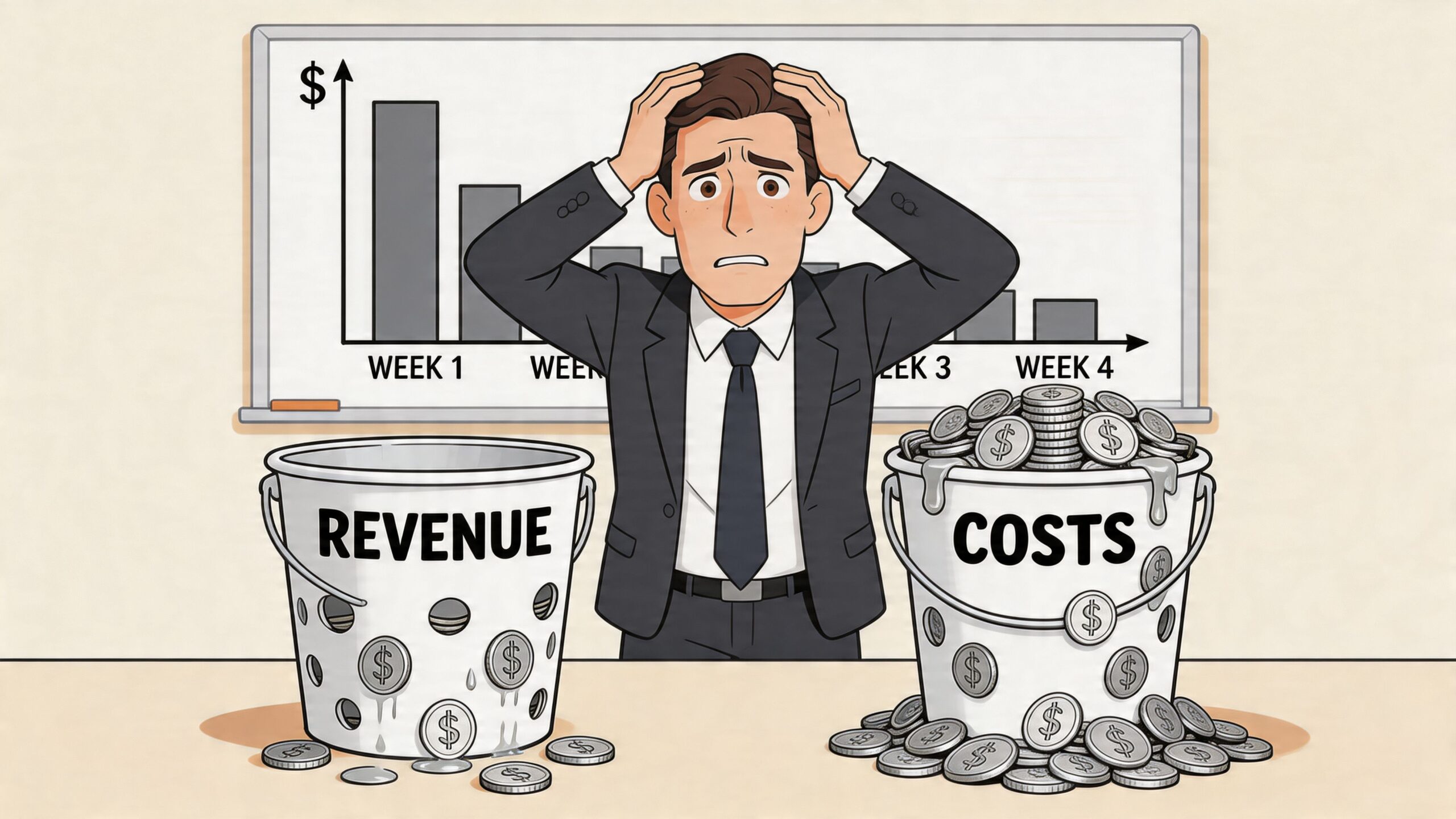
That inconsistency shows up as revenue leakage, wasted lead spend, poor customer experience, and avoidable supervisory overhead. When outbound teams work without structured training, leaders end up paying twice. They pay once for acquisition and again for rework.
Training is an operating system issue
Executives often classify outbound training as a learning-and-development line item. That’s a mistake. In practice, it’s an operating system for front-line execution. It determines whether the organisation can translate strategy into thousands of repeatable, high-quality conversations.
Untrained teams usually produce four visible business failures:
- Low qualification quality: Sales teams inherit leads that looked promising on paper but were poorly assessed in the first interaction.
- Message drift: Agents describe the same product or service in different ways, weakening positioning and creating market confusion.
- Manager dependence: Performance depends too heavily on a few strong supervisors, which makes scale fragile.
- Longer ramp-up cycles: New hires need more intervention because the organisation hasn’t codified what good looks like.
Board lens: If outbound performance varies sharply by team lead or location, the company doesn’t have a people problem. It has a training design problem.
Why the cost compounds
Outbound work sits near the top of the revenue funnel. When it fails there, downstream teams don’t get clean inputs. Marketing sees lower return on campaigns. Sales spends time on unready prospects. Compliance teams handle preventable escalations. Customer support absorbs confusion created earlier in the journey.
That’s why the outbound training meaning should be expanded beyond skill-building. It’s a mechanism for protecting conversion quality at scale. For a CXO, the key question isn’t whether to train. It’s whether the current training model is capable enough to support growth without adding operational drag.
Decoding the Modern Meaning of Outbound Training
In its classic form, outbound training means preparing human teams to start conversations with prospects or customers. That includes opening a call, framing value, handling objections, qualifying needs, documenting outcomes, and deciding the next action. In sales and service environments, it is the discipline that turns outreach from random activity into managed execution.
For leaders who want a sharper commercial baseline, this guide on how to define outbound sales is useful because it clarifies the proactive nature of outbound work. It helps separate outbound from passive lead handling, which matters when you’re designing training, compensation, and governance.
The traditional meaning
Historically, the outbound training meaning centred on human capability. Managers trained agents through scripts, call reviews, shadowing, and live corrections. The objective was to improve judgement under pressure while keeping the brand voice intact.
That model still matters. Human outbound teams are still strongest when conversations require empathy, context reading, or nuanced escalation. The question for modern operators isn’t whether human training remains relevant. It does. The question is where human judgement should be deployed, and where standardised systems should take over.
A useful strategic distinction appears in this discussion of outbound vs inbound sales models. Outbound requires the company to create momentum from a cold or semi-aware audience. That makes training quality disproportionately important because the first interaction shapes both conversion probability and brand perception.
The modern parallel meaning
Today, outbound training also means training AI voice agents and the workflows around them. That doesn’t look like classroom coaching. It looks like prompt design, conversation trees, escalation rules, labelled scenarios, feedback loops, and exception handling.
The easiest analogy is this. Training one high-potential human rep is like mentoring an apprentice. Training an AI outbound system is like designing a fleet. You don’t just teach behaviour once. You define the mission, acceptable responses, fallback actions, and guardrails for every recurring condition.
The strategic shift is simple. Outbound training is no longer only about improving people. It is about engineering consistent conversations across people and machines.
That hybrid definition matters because scale punishes improvisation. Human-led operations can be excellent but uneven. AI-led systems can be highly consistent but only if training inputs are rigorous. The strongest outbound organisations train both layers together: humans for judgement and relationship quality, machines for repetition, coverage, and standard execution.
The Core Components of an Elite Outbound Programme
Companies do not scale outbound by adding energy. They scale it by reducing variance. The strongest programmes are built to produce the same sales logic, compliance standard, and customer experience across every rep, every shift, and increasingly, every AI-assisted interaction.
That is the ultimate design test. If two agents handle the same prospect differently, conversion becomes difficult to forecast, manager coaching turns anecdotal, and revenue quality depends too heavily on individual talent. An elite outbound programme solves that operating risk by defining what good execution looks like, how it is measured, and which parts should be standardised across humans and AI systems.
Operating design comes before script design
Scripts are only one layer of performance. The larger economic driver is whether the programme teaches judgement, message discipline, data capture, and escalation rules in a coordinated way.
That matters more in a hybrid outbound model. Human reps need enough range to handle ambiguity and build trust. AI voice agents need well-defined prompts, decision paths, fallback responses, and escalation thresholds. Both fail when the operating model is vague. Teams that want consistent execution usually start with clear conversation goals, approved messaging logic, and call center script best practices for high-converting outbound teams, then connect those standards to workflows and coaching.
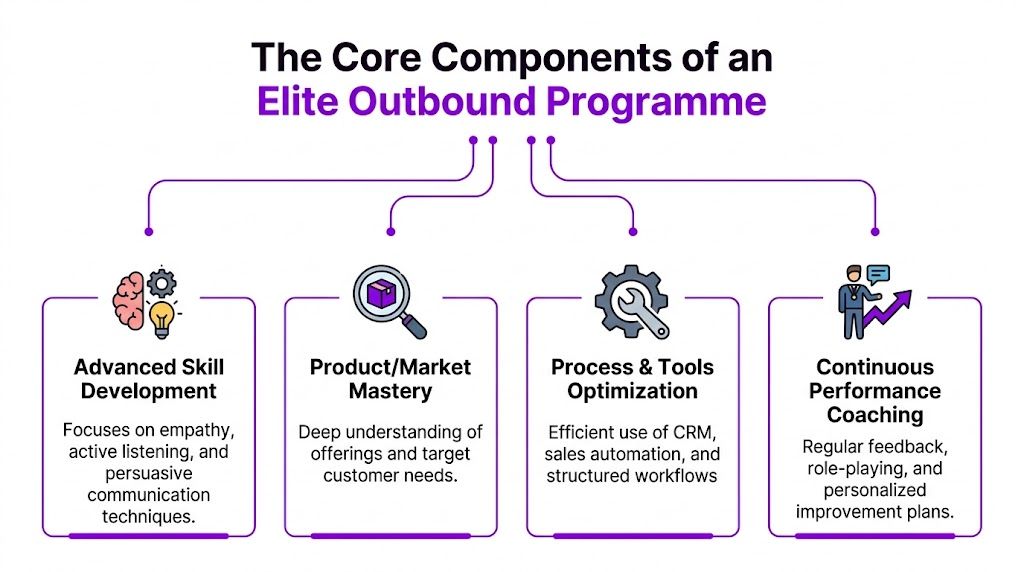
A practical visual summary sits below.
Four pillars that determine operating quality
Advanced skill development
Reps need repeated practice in active listening, objection handling, conversation control, and closing for the next step. These are not soft capabilities. They directly affect connect-to-meeting rates, reduce unproductive call time, and improve the quality of qualified opportunities passed downstream.
Product and market mastery
Outbound teams need a clear view of customer pain points, offer fit, competitor alternatives, and buying triggers. Without that foundation, reps default to generic pitches and qualify poorly. The result is avoidable pipeline inflation, low sales efficiency, and wasted follow-up from account executives.
Process and tools optimisation
CRM discipline, disposition accuracy, workflow triggers, compliance checks, and escalation routing form the control system of outbound. This is also where AI-driven operations separate themselves from manual teams. Human-led programmes often tolerate inconsistent note-taking and uneven follow-through. AI-led systems can enforce structured capture and standard responses at scale, but only if the process rules are defined with precision.
Continuous performance coaching
Coaching works best when it is tied to recurring call patterns, conversion data, and manager calibration. In mature programmes, this loop improves both people and systems. Managers correct rep behaviour. Operations leaders update workflows. AI teams refine prompts, scenario libraries, and exception handling. That creates cumulative efficiency instead of one-off training events.
Practical rule: If coaching findings do not change scripts, workflows, or AI decision rules, the programme is not improving its operating system.
The four pillars work as a single commercial engine. Better product knowledge improves qualification quality. Better process design improves data accuracy. Better coaching improves message consistency. Better system design lets AI handle repeatable interactions while human reps focus on higher-judgement conversations. That is how outbound training shifts from an HR activity to a revenue-scaling discipline.
Proven Training Methods from Roleplay to AI Simulation
Training method choice has direct P and L consequences. The same outbound script can produce very different conversion rates, ramp times, and supervisory costs depending on whether practice is informal, manager-dependent, or systematised through simulation.
A useful signal comes from data cited by Eminent Training showing collaboration metrics improving by 25 to 40 per cent and leadership delegation by 30 per cent after 1 to 2 day outbound training programmes. The strategic takeaway is narrower than the headline. Structured practice changes team behaviour quickly, which matters because outbound performance depends on coordinated execution across messaging, qualification, routing, and follow-up.
Where traditional methods still produce value
Roleplay, peer shadowing, and supervised live calls remain effective in specific operating conditions. They transfer judgment, tone control, and situational handling in ways that slide decks cannot. They are particularly useful early in ramp periods, when new hires need exposure to real conversation flow before they are trusted with independent outreach.
They also work well for high-variance moments such as objection handling or escalation practice. A skilled manager can stop the interaction, diagnose the error, and test a better response in real time. That shortens the path from theory to usable behaviour.
Traditional methods are strongest in three cases:
- Early onboarding: New agents hear how strong calls unfold, including pacing, transitions, and qualification discipline.
- Complex objection handling: Coaches can test multiple responses against the same objection and show the commercial trade-off of each one.
- Culture transmission: Shadowing shows standards of professionalism, note quality, and customer treatment that are rarely captured in formal documentation.
Their limits are operational, not conceptual. Quality depends heavily on who is coaching. Feedback varies between managers. Coverage drops when team leaders are pulled into forecasts, escalations, or hiring. For a board or revenue leader, that means training quality often falls precisely when growth creates the greatest need for consistency.
Why simulation changes the unit economics
Simulation reduces variance. Reps can practise the same scenario repeatedly, receive structured scoring, and improve before they speak to live prospects. AI agents can be tested against edge cases, compliance rules, and escalation triggers before deployment. That lowers customer risk and makes performance easier to compare across teams, markets, and managers.
It also improves script development. Teams refining talk tracks should build against clear conversation design rules, not intuition alone. This guide to call centre script best practices is a useful reference for tightening language, reducing ambiguity, and keeping conversations controlled without sounding rigid.
The economic difference is straightforward. Human-led practice is effective but capacity-constrained. Simulation requires setup effort, yet it produces repeatable practice at scale and creates data that managers can use.
| Method | Scalability | Consistency | Feedback Loop | Cost |
|---|---|---|---|---|
| Manager-led roleplay | Limited by manager capacity | Varies by coach | Manual and subjective | Higher supervisory load |
| Peer shadowing | Moderate | Uneven | Informal | Moderate |
| Supervised live calls | Moderate | Depends on monitoring quality | Delayed but practical | Higher operational risk |
| AI conversational simulation | High | High | Fast and structured | Better suited to repeated practice |
| Synthetic training for AI agents | High | High | Continuous if properly labelled | Front-loaded design effort |
The strategic shift is clear. As outbound volume rises, leaders are no longer solving for whether one rep can perform. They are solving for whether every interaction meets the same commercial and compliance standard.
That is why AI simulation matters beyond training. It helps organisations shorten ramp time, reduce manager dependency, standardise execution, and improve conversion quality at scale. Human coaching still matters, especially for judgment-heavy conversations. But the new operating model combines human expertise with simulated repetition, because that is the combination that improves revenue efficiency fastest.
Measuring What Matters Most Key Outbound KPIs
A training programme without a measurement model is a cost centre. A training programme tied to the right KPIs becomes a profit lever. Senior leaders should insist on the second.
The mistake many organisations make is tracking activity without judging commercial quality. Call counts, attendance, and completion rates don’t tell a board whether outbound execution is improving. Leaders need metrics that connect training inputs to revenue flow, conversion quality, and operating efficiency.
The KPI set that boards should actually review
Four indicators matter most in most outbound environments:
- Connect rate: Measures whether teams are reaching viable contacts. If connect quality is weak, no amount of objection handling will rescue pipeline efficiency.
- Qualification accuracy: Measures whether the team is identifying the right prospects for the next stage. This protects sales capacity and improves forecasting.
- Lead-to-booking conversion: Measures whether outreach is creating commercially meaningful next steps, such as demos, appointments, site visits, or consultations.
- Average handle time: Measures conversation efficiency, but it should never be read in isolation. Shorter calls are only better if quality remains intact.
- Escalation and compliance exceptions: In regulated or process-sensitive sectors, these reveal whether agents understand the boundaries of acceptable communication.
How training changes the dashboard
Each KPI should map to a training component. If connect rate is weak, the issue may sit in targeting, opening lines, or call timing discipline. If qualification accuracy is weak, the issue is often discovery design, listening quality, or poor understanding of the ideal customer profile.
Lead-to-booking conversion usually depends on a combination of message clarity, objection handling, and confidence in asking for the next commitment. Average handle time often improves when scripts are tightened, tools are easier to use, and agents know how to branch conversations rather than wander through them.
A board-ready dashboard should therefore ask three questions:
- Which KPI moved?
- Which training behaviour was meant to influence it?
- Did the improvement hold across teams, managers, and locations?
Metrics only become useful when they identify whether the organisation has a training gap, a process gap, or a targeting gap.
That discipline is what turns outbound training meaning into something operational rather than conceptual. The point isn’t to prove that people attended training. The point is to show that better training created cleaner execution and more efficient growth.
Outbound Training in Action Across Key Industries
Training returns rise when it is built around the economics of a specific workflow. A caller booking a property visit, a BFSI agent completing a verification call, and an EdTech counsellor guiding a prospective student all operate under different conversion logic, risk thresholds, and error costs. One generic programme cannot optimise all three.
Applied practice matters more than classroom theory. Electro Curve reports productivity gains of 20 to 35 per cent from outbound training interventions, and says hands-on challenges improve soft skill retention by 40 per cent versus classroom methods. The management implication is straightforward. Training creates value when it mirrors the actual decision points agents face on live calls.
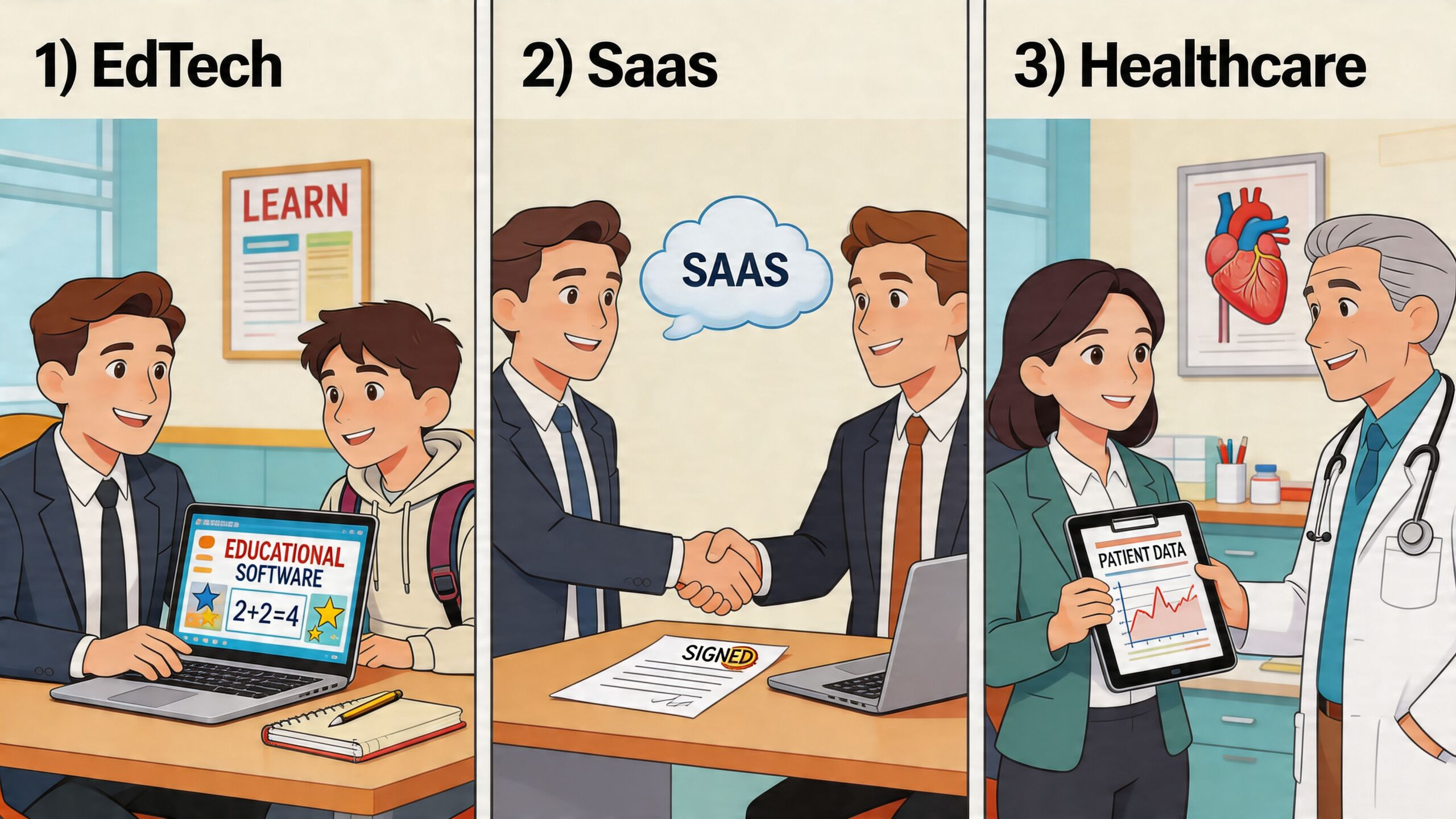
EdTech and SaaS where nuance drives conversion
EdTech outbound teams work in a high-friction buying environment. Prospects are evaluating outcomes, affordability, time commitment, and personal fit, often in the same conversation. Training therefore needs to build diagnostic questioning, objection handling, and the ability to move a prospect to the next counselling step without reducing the call to a script.
SaaS presales calls fail for a different reason. Reps often explain the product before they establish the business problem. Strong training corrects that sequence. It teaches agents to identify use case, qualify urgency, frame value in commercial terms, and secure the demo. That improves meeting quality, not just meeting volume.
The shift now underway is operational as well as pedagogical. Human-led coaching still matters for judgment-heavy conversations, but repetitive qualification flows can increasingly be standardised through AI Voice Agents, especially where consistency, coverage, and clean call data matter more than improvisation.
Real estate BFSI and healthcare where process discipline protects margin
Real estate teams lose efficiency when they treat every inquiry as sales-ready. Better training teaches agents to separate browsing intent from near-term buying intent, confirm budget and location criteria early, and book site visits with consistent language. That reduces wasted follow-up by field teams and raises the value of each booked appointment.
In BFSI, training has to protect revenue and control risk at the same time. Agents need clear rules on disclosures, verification steps, escalation paths, and prohibited language. The cost of failure is not limited to a weak conversion rate. It can include compliance breaches, rework, audit exposure, and avoidable customer churn.
Healthcare outbound work depends on precision. Appointment booking, pre-visit instructions, and follow-up reminders affect attendance, service capacity, and patient experience. A poorly handled call increases no-shows, creates downstream support traffic, and puts additional pressure on clinical and administrative teams.
For operators comparing delivery models, the pattern is clear. Industries with high variability in customer emotion or problem definition still need strong human coaching. Industries with high call volume and repeatable workflows can increasingly codify best practice through systems such as an AI call bot used in production outbound workflows.
The industry lesson is practical. EdTech needs consultative skill. SaaS needs sharp discovery. Real estate needs qualification discipline. BFSI needs controlled execution. Healthcare needs clarity and accuracy. Vertical tailoring is how outbound training stops being a soft-skills initiative and starts improving conversion, utilisation, and operating margin.
The DialNexa Advantage Standardise and Scale with Voice AI
The strongest conclusion for CXOs is that outbound training now has two jobs. It must improve human judgement where nuance matters, and it must standardise repetitive conversation flows where consistency matters more than improvisation.
That’s where Voice AI changes the economics. Instead of trying to coach every interaction manually, leaders can codify best practice into systems that execute the same standard repeatedly. For executives evaluating the broader category, this overview of AI Voice Agents is a useful reference because it highlights the shift from simple automation to structured conversational execution.
A modern outbound stack should do five things well: enforce message discipline, route edge cases intelligently, capture clean call data, surface coaching insights, and scale without quality decay. The decision isn’t human versus AI. It’s which parts of outbound work should remain human-led and which should be systematised.
For leaders exploring practical implementation paths, reviewing how an AI call bot can operate in production workflows helps frame the transition from pilot experiments to repeatable operations. The key is to treat training as an ongoing control loop, not a one-time rollout.
When done properly, outbound training stops being an isolated programme. It becomes the mechanism that aligns people, process, data, and automation around one commercial outcome: better conversations that produce cleaner revenue.
DialNexa Labs Private Limited helps organisations build that kind of outbound engine with DialNexa’s Voice AI platform. If your team needs to standardise qualification, presales, support, recruitment, or follow-up conversations across sectors such as EdTech, BFSI, real estate, hospitality, e-commerce, software, and healthcare, DialNexa offers a practical path to deploy human-like voice agents with consistent messaging, workflow adaptability, and measurable operational control.

Excellent perspective on outbound training as a revenue and operating discipline rather than just an L&D initiative. The focus on consistency, measurable KPIs, and Voice AI integration clearly shows how structured training can improve conversion quality and reduce operational waste.